Bringing Sexy Back (To Valentine’s Day): 17 Steamy Poems by Esteemed Poets

17-steamy-poems-for-valentines-day

Valentine’s Day is upon us, friends, and in its original form (featuring fifteen poems), this has been one of the most popular posts over the last few years. For 2017, I’ve added two poems, for seventeen total. Do you have a favorite I should feature next year?


Toss that teddy bear and give your significant person the gift of verse this Valentine’s Day.

That poet everyone reads at weddings is actually much more appropriate for the bedroom:

e. e. cummings, “i like my body when it is with your” 

An unsexy title for a very sexy poem (check out those ellipses!): 

Li-young Lee, “This Room and Everything In It”

The “Oh, snap” kind of sexy:

Edna St. Vincent Millay, “I, being born a woman and distressed”

Wistful sexy:

C. P. Cavafy, “Body, remember”

Bitter sexy:

Thomas Wyatt. “They Flee from Me”

Literate sexy:

Robert Hass, “Etymology” (start watching at 18:42)

Damn sexy:

Audre Lorde, “Recreation

Desire, frustration, and jewelry. Also: socioeconomic tension. (And the first overtly lesbian poem I read as a teenager. Bit of a lightbulb moment, there.)

Carol Ann Duffy, “Warming her Pearls”

Difficult to choose just one Donne poem, but hey, let’s go with the salute to nakedness:

John Donne, “To His Mistress Going to Bed”

Restraint and abandonment, all at once:

Emily Dickinson, “Wild Nights – Wild Nights! (269)”

For the Dear Readers who are also parents: 

Galway Kinnell, “After Making Love We Hear Footsteps”

Maybe this is where they got the title for Blue is the Warmest Color:

May Swenson, “Blue”

I hate birds, but this poem is still amazing: 

Henri Cole, “Loons”

You’ll never look at roses the same way again, I promise:

D.H. Lawrence, “Gloire de Dijon”

And yes, a Neruda poem. But I can’t find it anywhere on the interwebs, so you’ll have to go find a copy of World’s End or Late and Posthumous Poems for yourself. 

Pablo Neruda, “Física”/”Physics”

Sexy in translation: 

León Salvatierra (trans. Javier O. Huerta), “Act”

Desire in list form: 

Major Jackson, “Superfluities”


Your turn: what’s the sexiest poem you’ve ever read?

Recommended Reading: Pachinko, by Min Jin Lee

pachinko-rosemary-and-reading-glasses-review

Since I finished reading Min Jin Lee’s wonderful novel Pachinko*, I’ve been thinking about family sagas. The appeal is perspective, I think; as readers we’re able to see the lives of multiple generations with a wholeness we are not afforded in the course of our own lives.

We know our own stories intimately, of course, and our parents’ and children’s pretty well, if we’re fortunate enough to enjoy close relationships with them, but then those third generations on the outside—our grandparents and our grandchildren—are beyond our ken in most respects. No matter how much I adored my grandmother (and I adored her very much), I couldn’t really know what it was like for her to grow up during the Depression, or what the atmosphere was like one the night she watched the Moon landing, or why she liked gardenias. And if I’m lucky enough to have grandchildren, I will not live long enough to see the sorrows and triumphs of their middle age; I cannot imagine the political and technological differences between their era and my own.

It’s a pleasure to feel these limitations lifted (if only for a little while, and only in fiction) in a novel as expansive, humane, and well written as Ms. Lee’s Pachinko, which begins, “History has failed us, but no matter.”

img_3691-2We meet first an unnamed couple, the grandparents of Sunja, Pachinko‘s center and beating heart. Hardworking and thrifty, these two have only one son, kind and loyal, who in turn marries a hardworking woman named Yanjing, Sunja’s mother. Mother and daughter work hard at the boardinghouse they run on a small islet near Busan, in Korea, and it seems that Sunja will take her mother’s place one day—until she becomes pregnant. In the early 1930s, in their community, the shame is unbearable, but a young missionary staying with them offers to marry Sunja and bring her with him to Japan, where he is to work as a minister, and where his brother and sister-in-law are waiting for him.

In Japan, Sunja, grateful for the kindness of her gentle new husband and the friendship of her sister-in-law Kyunghee, tries to forget her lover and settle into her new life. But Koreans in Japan are treated very badly, and soon, with war upon them, the family is struggling to survive.

Sunja’s two children, Noa and Mozasu, both born in Japan, grow up feeling as if they don’t have a home, exactly. Japan will not accept them as citizens; Korea, now split, may not take them in. They face this heartbreaking conundrum in different ways: Noa studies hard to become a “model” Korean, wishing he could blend in and pass for Japanese; Mozasu determines to make the best of things and finds lucrative employment at a pachinko parlor, an industry dominated by Koreans.

Pachinko, an arcade game rather like pinball, but with an element of gambling, is an apt metaphor for the role of history in the novel. For Sunja and her family, the sweep of history deals them many, many hardships and the occasional bout of good fortune, but always their ethnicity marks them as different from those they live among. And for Sunja, Yangjin, and Kyunghee, their sex also reduces their options (economically, politically, and within the family) without reducing their labor. Ms. Lee has written not only a searing novel about the immigrant experience and an extraordinarily evocative historical novel, but also one that subtly and yet relentlessly shows readers the value—and the price—of women’s work.

Ms. Lee’s writing is fluid and expressive, keeping the reader firmly planted in the twentieth-century homes and workplaces of her characters. Here’s Sunja, making candy to sell in Osaka, remembering her home:

Yeongdo, their little rocky island, stayed impossibly fresh and sunny in her memory though she hadn’t been back in twenty years. When Isak tried to explain heaven, she had imagined her hometown as paradise–a clear, shimmering beauty. Even the memory of the moon and stars in Korea seemed different than the cold moon here; no matter how much people complained about how bad things were back home, it was difficult for Sunja to imagine anything but the bright, sturdy house that her father had taken care of so well by the green, glassy sea, the bountiful garden that had given them watermelons, lettuces and squash, and the open air market that never ran out of anything delicious. When we was there, she had not loved it enough.

Pachinko is a gorgeous novel that asks nuanced questions about home, faith, and family, questions asked in new ways with each new generation. When the last of Sunja’s family members is introduced, I wished the novel would keep going, so I could learn what would happen to him, too. But the story never ends, does it?

* I received a copy of this book from the publisher for review purposes, which did not affect the content of my review.

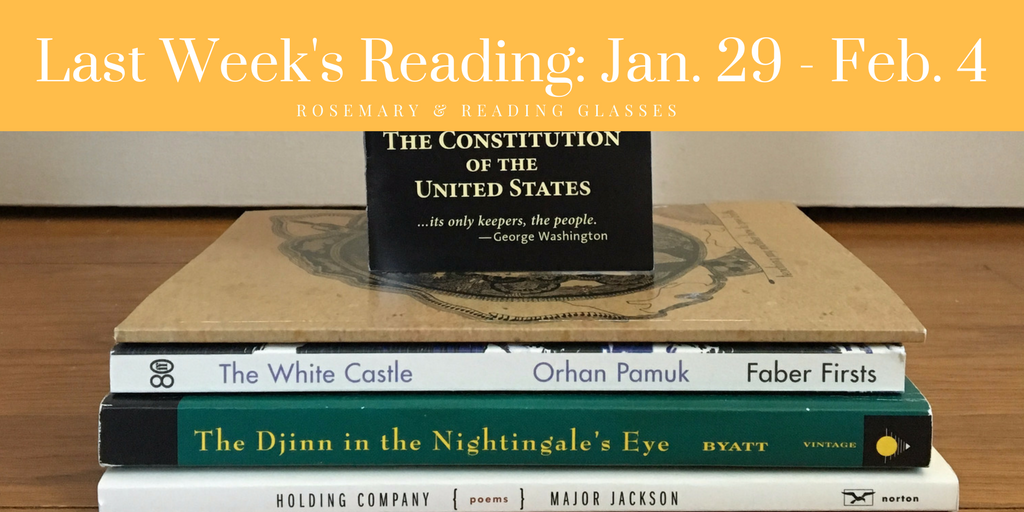
Last Week’s Reading: January 29-February 4

copy-of-last-weeks-reading-january-29-feb-4

The Constitution of the United States: It seemed like a good time to give this a thorough re-read. Highly recommended.

The Djinn in the Nightingale’s Eye: Five Fairy Stories, by A. S. Byatt: After I read Possession, I started scooping up Byatt books whenever I ran across one, which is how this one has been on my shelves for two or three years. The first two fairy stories are pulled from Possession, but I was happy to revisit them. “Dragons’ Breath” is a political allegory that I found very uncomfortable to read in the current climate. “The Story of the Eldest Princess” is now in my pantheon of great fairy tales. And the title story–which, at well over 100 pages, is really more a novella–is exactly what I needed: a consuming, sumptuous tale of a strange creature trapped in a bottle, and the scholar who sets him free. A.S. Byatt’s writing is brilliant, in all senses—had her intellect been applied in a different direction, I’m suspect humanity would have colonized Mars or cured cancer decades ago.

Teaching My Mother How to Give Birth, by Warsan Shire: Ms. Shire rose to prominence last year when her work was featured in Beyoncé’s Lemonade (and, in a nice piece of coincidence for this post, it turns out that Ms. Shire wrote a poem for Beyoncé’s pregnancy announcement) Her poem “Home” has also been widely shared, and I suspect, given the events of the last ten days, that it will be making the rounds again soon. Teaching My Mother How to Give Birth is a chapbook-length collection of bruising poems about trauma, sensuality, exile and home, and women’s lives. Recommended. (You can find an earlier post about Warsan Shire here.)

The White Castle, by Orhan Pamuk (translated by Victoria Holbrook): I wanted to love this early novel by Nobel Prize winner Orhan Pamuk, since his My Name is Red is one of my favorite books, but alas, it was not to be. The premise–in the seventeenth century, a young Italian scholar is taken captive by the Turks and given over to a master who looks exactly like him—is interesting, the writing lovely, the ending masterful. The frame narrative and unreliable narrator are two of my favorite devices and employed remarkably well here, but for me the weight of the psychodrama pulled down the middle, and I found myself wishing the novel were over sooner. Ah well.

Holding Company, by Major Jackson: This 2010 book is the first of Major Jackson’s collections I’ve read, but it won’t be the last. The poems in this collection are ten lines each (with one exception, I think), but there’s such variety among them! Allusive and elusive, lyrical and abstract, personal-political, descriptive: these poems are challenging and a pleasure to read. I’ll be coming back to them.

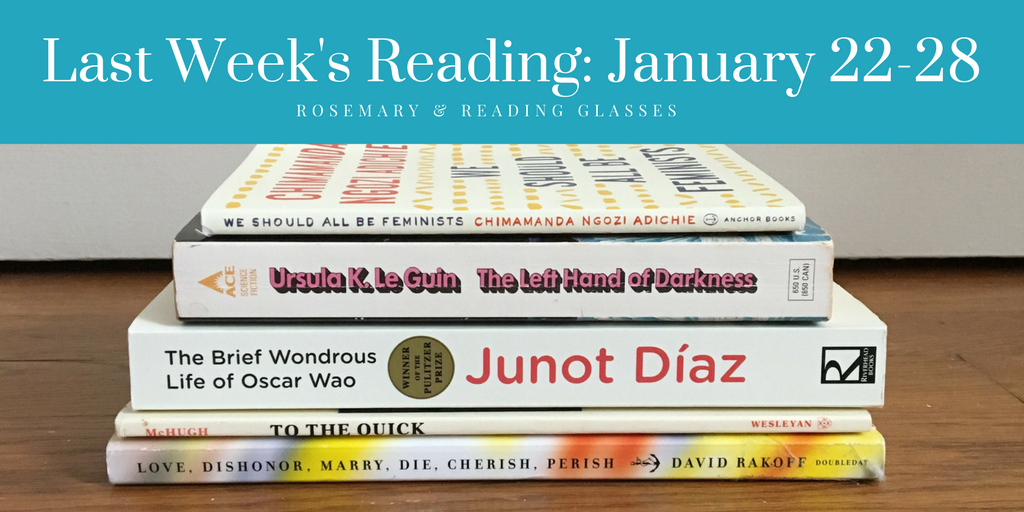
Last Week’s Reading: January 22-28

last-weeks-reading-january-22-28

January 22-28, 2017: A sci-fi classic, a new feminist classic, vignettes in verse,  a much-awarded novel worth the hype, and thirty-year-old poetry that’s still fresh.

We Should All Be Feminists, by Chimamanda Ngozie Adichie: The perfect primer on feminism, eloquent and brief. This would make an excellent gift for high school students in need of a brief introduction to the concept and will rally, I think, those who hesitate to call themselves feminists.

The Left Hand of Darkness, by Ursula K. Le Guin: I’ve had this 1969 sci-fi classic  on my shelves for twenty years, but I’m rather glad I didn’t read it at twelve. Though short—my mass-market paperback is 300 pages—it’s dense, complicated, and incredibly intelligent. Genly Ai is an envoy from a group of planets (think the Federation, but more abstract) assigned to persuade the inhabitants of the planet Gethen (translated, it means Winter–it’s essentially a populated Hoth) to join the Ekumen. Gethenians have a complicated system of etiquette and honor called shifgrethor, but even more confounding for Ai is their lacked of fixed sexuality; they are neither male nor female (all characters are called “he,” a convention Ann Leckie reverses in the excellent Ancillary Justice). The world-building is sublime, the pace of revelation superb–we struggle to understand this culture as Genly does, and in the process Ms. Le Guin asks us to think deeply about exploration, friendship, and patriotism. Highly recommended.

Love, Dishonor, Marry, Die, Cherish, Perish, by David Rakoff: The world lost a funny, sad voice when David Rakoff died in 2012 at the age of 47. If you loved his essay collection Fraud (I did), you’ll find this book quite different–it’s a short novel made of vignettes in verse. It’s grim and witty at the same time, a catalogue of cruelties and kindnesses and most of all, I think, our vulnerabilities. Those looking for an unusual reading experience should pick it up.

The Brief Wondrous Life of Oscar Wao, by Junot Díaz: Deserves every accolade it’s received, and then some. I put off reading this novel because I have limited patience for the male bildungsroman, but my expectations were confounded. Oscar is lovable and tragic, but the story doesn’t belong to him alone; Mr. Díaz takes long excursions into the backgrounds of his mother and sister, giving the book a roundedness and depth I didn’t anticipate. Yunior, the narrator and sometime authorial-alter-ego, is a fantastic narrator, steeped in nerd culture, frenetic, profane and and so full of life that it seems he’s physically propelling words across the page (even in the footnotes). I loved, loved, loved this novel.

To The Quick, by Heather McHugh: Heather McHugh’s wordplay (see “Etymological Dirge”) is fantastic, almost dizzying. This 1987 collection is beautiful and smart and tough. These poems will cut you to the quick. Need proof? Just read “The Amenities.” 

“The weary ones, the sad, the suffering, / All found their comfort in the holy place”: Emma Lazarus’s “In the Jewish Synagogue at Newport”


I wrote this post in December 2015. It’s disheartening, to say the least, to feel the need to share it again, but such are the times we are living through.

I strongly urge you to support, in any way you are able to, the International Rescue Committee.


I was poking about, looking for a Chanukah poem to feature in honor of the holiday (and New_colossusHappy Chanukah, Dear Readers), when I came across a poem that speaks a bit to the holiday itself, but even more to our present moment. Please bear with me as I come around to the poem.

A personage who shall not be named (like the J.K. Rowling villain he seems so desperate to emulate) is voicing repulsive xenophobia, indifferent to the plight of thousands upon thousands of people fleeing violence and seeking no more than what most Americans take for granted: the right to live freely in peace, to pursue happiness. This person, and any who claim to be interested in the Founding Fathers, would do well to recall George Washington’s 1790 letter to the Jewish congregation of Newport, Rhode Island, assuring them—often persecuted in other lands for their religion—of their welcome in America. Herewith, an excerpt:

The citizens of the United States of America have a right to applaud themselves for having given to mankind examples of an enlarged and liberal policy — a policy worthy of imitation. All possess alike liberty of conscience and immunities of citizenship.

It is now no more that toleration is spoken of as if it were the indulgence of one class of people that another enjoyed the exercise of their inherent natural rights, for, happily, the Government of the United States, which gives to bigotry no sanction, to persecution no assistance, requires only that they who live under its protection should demean themselves as good citizens in giving it on all occasions their effectual support.

[…]

May the children of the stock of Abraham who dwell in this land continue to merit and enjoy the good will of the other inhabitants — while every one shall sit in safety under his own vine and fig tree and there shall be none to make him afraid.

May the father of all mercies scatter light, and not darkness, upon our paths, and make us all in our several vocations useful here, and in His own due time and way everlastingly happy.

G. Washington [emphasis mine]

It was the synagogue of this very congregation, the oldest synagogue still standing in America, that inspired Emma Lazarus to write “In the Jewish Synagogue at Newport,” a lovely poem that muses on the plight of exiles and the comforts of shared devotion, and should recall to us all—believers and non-believers alike—the great privilege of living in a country in which freedom of religion is enshrined in law, and the great wisdom, the necessary humanity, of embracing people of goodwill of all faiths, or none at all.

If the name Emma Lazarus sounds familiar, it’s because she’s also the poet whose verses famously adorned a plaque inside the Statue of Liberty:

The New Colossus

Not like the brazen giant of Greek fame,
With conquering limbs astride from land to land;
Here at our sea-washed, sunset gates shall stand
A mighty woman with a torch, whose flame
Is the imprisoned lightning, and her name
Mother of Exiles. From her beacon-hand
Glows world-wide welcome; her mild eyes command
The air-bridged harbor that twin cities frame.
“Keep, ancient lands, your storied pomp!” cries she
With silent lips. “Give me your tired, your poor,
Your huddled masses yearning to breathe free,
The wretched refuse of your teeming shore.
Send these, the homeless, tempest-tost to me,
I lift my lamp beside the golden door!”


Light and not darkness upon our paths, friends.


To donate to the UNCHR, the UN Refugee Agency, click here. 

To donate to UNICEF, click here. 

To donate to Save the Children, click here. 

Last Week’s Reading: January 15-21

last-week-reading-january-15-21

A dystopian classic, two collections by Poets Laureate, sci-fi shorts, a nonfiction juggernaut, and a powerful play.

Well, Dear Readers, here we are. And here’s what I read last week.

The Handmaid’s Tale, by Margaret Atwood: Even more frightening now than when I first read it ten years ago. If you haven’t read this classic yet, now might be a pretty good time.

On the Bus with Rosa Parks, by Rita Dove: I bought this collection in Denver last year, and finally read it on Martin Luther King Day. It’s excellent, particularly in the way the title sequence allows us to see the sweep of historical events through individual experience. The poems grouped in “Cameos” and “Black on a Saturday Night” reminded me of Natasha Trethewey’s Domestic Work; you might try reading the collections together. And bookish folk will love the poems “Maple Valley Branch Library, 1967” and  “The First Book.”

The Immortal Life of Henrietta Lacks, by Rebecca Skloot: I finally got a library card for our new city’s system, and then proceeded (finally) to read this medical and social history that practically everyone else has read in the six or so year since it came out. I was impressed by the volume of research Ms. Skloot conducted and the sensitivity with which she handled the stories of Henrietta Lacks’s family, but I did wish for more background on cell science and advances made with HeLa cells. If you read the book when it came out, you might want to head over to this website to read updates about the project.

Arrival (original published as Stories of Your Life and Others), by Ted Chiang: I bought this collection because I very much want to see Arrival (unfortunately, I missed it in theaters), and I like to read source material first. “Story of Your Life,” which is the basis for the movie, is exceptionally good, one of the very best short stories—though it feels like a super-compressed novel—I’ve ever read. Stunning, and by that I mean I felt stunned after I read it. Also very impressive was “Tower of Babylon,” which leads off the collection. The other six stories (most of the stories in the book are very long for short stories, by the way) were interesting, but not quite my cup of tea, stylistically; they seemed, with exception of “Seventy-two Letters,” like sustained thought experiments. All the stories, however, reveal a deeply thoughtful mind at work, and offer more questions than answers; I’m glad I read them.

The Laramie Project, by Moisés Kaufman and the Members of Tectonic Theater Project: This play must have been (must be) incredibly powerful in performance. It’s an exploration of Laramie, Wyoming’s reaction to the brutal murder of Matthew Shepherd in 1998. The members of the theater group traveled to Wyoming six times in eighteen months to interview friends of Matthew, friends of the perpetrators, police officers, students, religious leaders, and other townspeople; the words gathered in the interviews were shaped into the work. The Laramie Project is an act of radical witness; it’s impossible not to be moved by it.

Notes on the Assemblage, by Juan Felipe Herrera (current United States Poet Laureate): The poems in this collection are political and personal, full of lamentation and exuberance. You’ll find calls to action, pleas for remembrance, elegies, riffs that feel like jazz, Spanish and English talking to each other and not speaking. “Borderbus” was for me the standout poem—heartbreaking and unforgettable.


P. S. Given the busy news cycle this weekend, you might not have focused on the destructive and deadly storms in the South this weekend. If you’d like to support disaster relief efforts, here’s a link to the Red Cross donations page.  You can also check out Pinebelt Relief.

Nolite te bastardes carborundorum, Dear Readers. See you next week.

Last Week’s Reading

last-weeks-reading-jan-8-14

January 8-14: A haunting novel in translation, debut fiction from a poet, a ghost story, a highly acclaimed play, and a poet I wish I’d read years ago.

Human Acts photo by Carolyn OliverSouth Korean writer Han Kang won the Man Booker International Prize for The Vegetarian (which I haven’t read); Human Acts*, which you can find at your local bookstore today, is the next of her novels to be translated into English by Deborah Smith. It is absolutely riveting, though quite hard to read, given the subject matter. The subject is the viciously quelled 1980 Gwanju Uprising, and the lens is the life and death of one boy, Dong-ho. In chapters that shift focus among different people who knew Dong-ho (well or tangentially), the author explores trauma, resilience, memory, witness, and questions of the soul. At what cost do survivors of torture bear witness to their sufferings? How do ordinary people find the strength to resist brutal injustice? How ought we to feel about being human when humans can be despicable creatures—or brave and kind? Human Acts is a devastating, brilliant book.

img_3538After reading Human Acts, I needed something a bit lighter to take the edge off, and Lillian Boxfish Takes a Walk, by Kathleen Rooney, was just the ticket. Eighty-something Lillian Boxfish decides to end 1984 by taking a walk around her beloved New York City, reflecting on a life lived to the very fullest—if not always happily. Lillian has verve, and her recollections of working in the advertising department at Macy’s in the 1930s are wonderful (especially if you’re missing Mad Men); the character is based on Margaret Fishback, the highest paid woman in advertising during her heyday. This novel is light but not fluffy; the emphasis on connection was sensitive rather than mawkish. I generally loved the company of Lillian’s sharp mind (with the exception of several instances of fat-shaming, which, please, dear authors, can we dispense with?).

Less delightful was Gillian Flynn’s The Grown Up. Originally included in a short story anthology, the tale would, I suspect, be better served in that format, rather than as a standalone book (it was included in this month’s Book of the Month mailing). It’s a ghost story with a twist; I found it more grotesque than thrilling, and the ending, alas, didn’t satisfy.

img_3496One of the last books I read in 2016 was John Patrick Shanley’s Doubt; I couldn’t resist the temptation to make the next play I read Proof, David Auburn’s Pulitzer Prize winner (2001). Sometimes I forget how much I love reading drama (I used to teach it), though I’m happy when plays like these remind me. I suspect I don’t read drama often because it doesn’t get the hype in book-world (where, for good or ill, I spend much of my time) that fiction, nonfiction, and even poetry do. I wonder why that is. Anyway, Proof is about math, mental illness, and family. It’s very, very good.

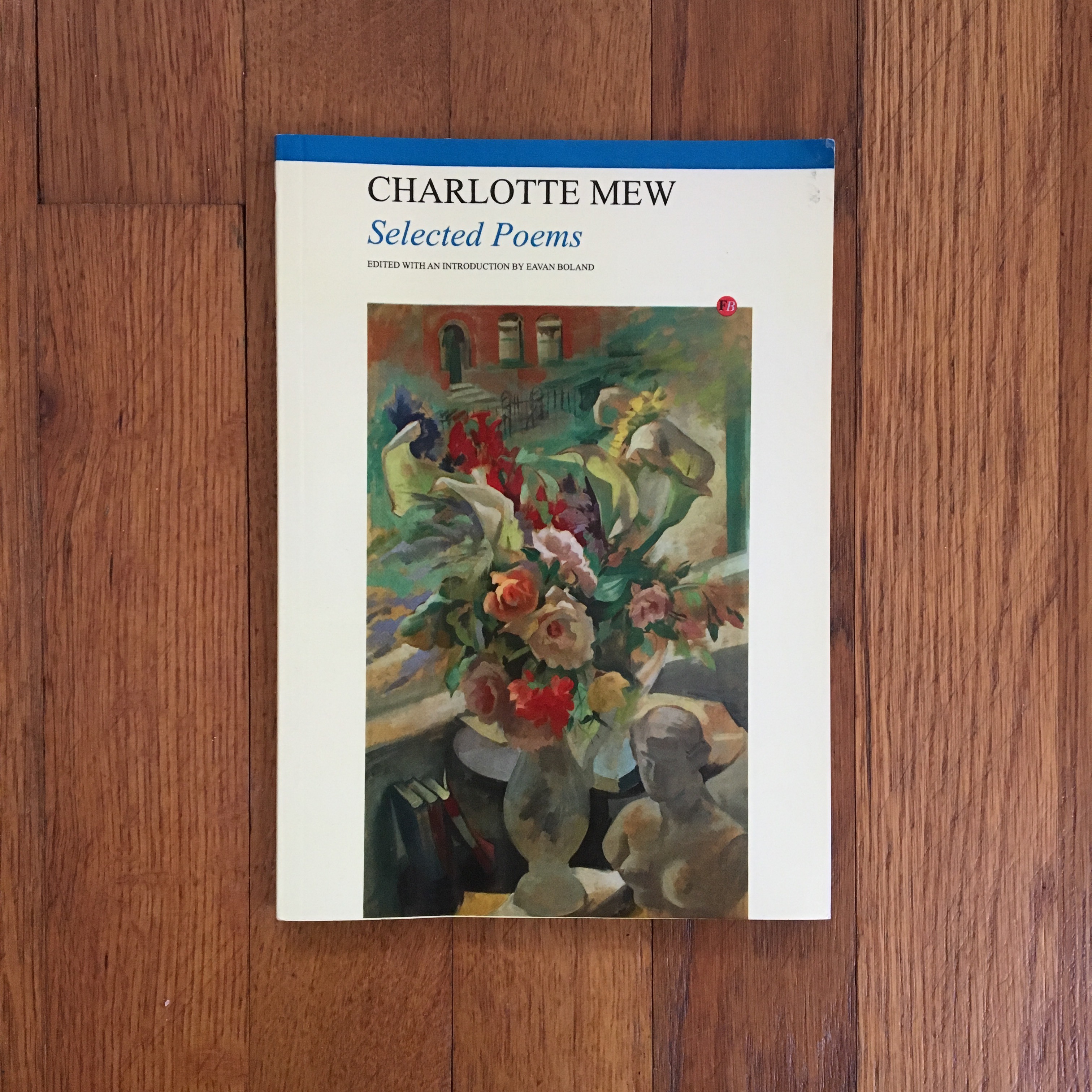
fullsizerender-13Last week, I finally read Charlotte Mew’s Selected Poems (edited and introduced by Irish poet Eavan Boland). Mew came highly recommended by friend and poet Emily Mohn-Slate, and I am kicking myself, Dear Readers that I (a.) didn’t pick up this book ages ago and (b.) didn’t read it as soon as it arrived as a birthday present. Charlotte Mew (1869-1928) is an utterly tragic figure, but her poems are marvels—lines like none I’ve ever read before: part Victorian, part Georgian, part Modernist, and all deeply moving.  I cried twice reading this slim volume, and friends, I do not cry easily when it comes to poetry.


*I received a copy of this book from the publisher for review consideration, which did not affect the content of my review.

I’m not sure this weekly reading wrap-up is going to be a regular feature, but I’m running with it for now!

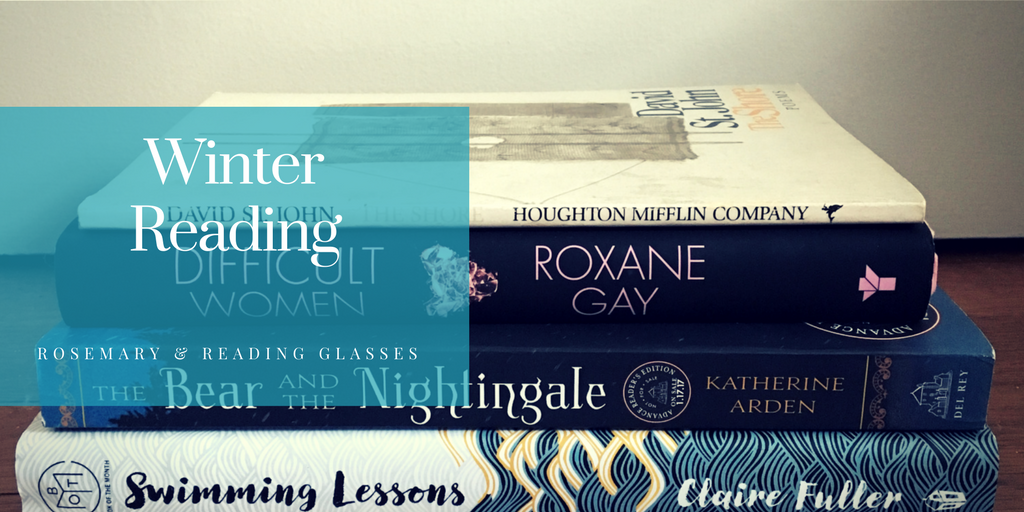
Winter Reading

winter-reading
What I read last week: Roxane Gay’s story collection, debut fiction from Kathleen Arden, poetry by David St. John, and Claire Fuller’s second novel.

The first week of 2017 was a good start to the reading year; I had a bit more time to read than usual, thanks to the holiday, so I managed to zip through four books.

img_2913First up: Roxane Gay’s Difficult Women*, a collection of Ms. Gay’s previously published short stories. The women portrayed in these stories are troubled—by violence, abuse, miscarriage, lost children, lost childhoods—and troubling to those (mostly men) around them, who cannot come to grips with their struggles. Recurring motifs include knives, deer, hunting, mold, and sex, though the stories run the gamut in setting (Michigan’s Upper Peninsula to Florida) and style (realist to fantastical). The exquisite “North Country” is worth the price of admission, and I loved the title story, which takes on the categories women often find themselves assigned to (“Crazy Women”, “Frigid Women,” “Mothers,” and more). Emotionally difficult but worthwhile reading, which is what I expect from the author of An Untamed State and Bad Feminist.

img_3432Katherine Arden’s The Bear and the Nightingale* is perfect reading for a snowy weekend. In her debut, Ms. Arden (who has quite an impressive background in Russian studies) brings medieval Russia to life as she chronicles the extraordinary days of Vasilisa, the fearless, adventuresome youngest daughter of a boyar living in a small village at the edge of a wild forest. If that sounds like the setup for a fairytale, that’s because it is: myth and magic are intertwined with the everyday eking out of survival in Vasya’s world, as she and siblings forget their frozen fingers and empty stomachs as they listen to her old nurse’s tales of the frost demon and the smaller spirits of their home. While there were a few loose ends (meant for a sequel, perhaps?) and one subplot that was a bit trite, overall I found The Bear and the Nightingale to be a delicious, exuberant foray into a lost world.

img_3119Long ago, when this blog was young, it was a way to push myself to memorize poems—less than successful, I’m sorry to say. But the poets I read that year have stuck with me, including David St. John, whose poem “In the  High Country” is just lovely. I was happy to find a copy of The Shore (1980) at one of my favorite used bookstores, but while I liked the collection (and a few poems in particular, including “Guitar” and “Until the Sea is Dead”), it’s not destined for my all-time favorites list. I’m still glad to have read it, though.

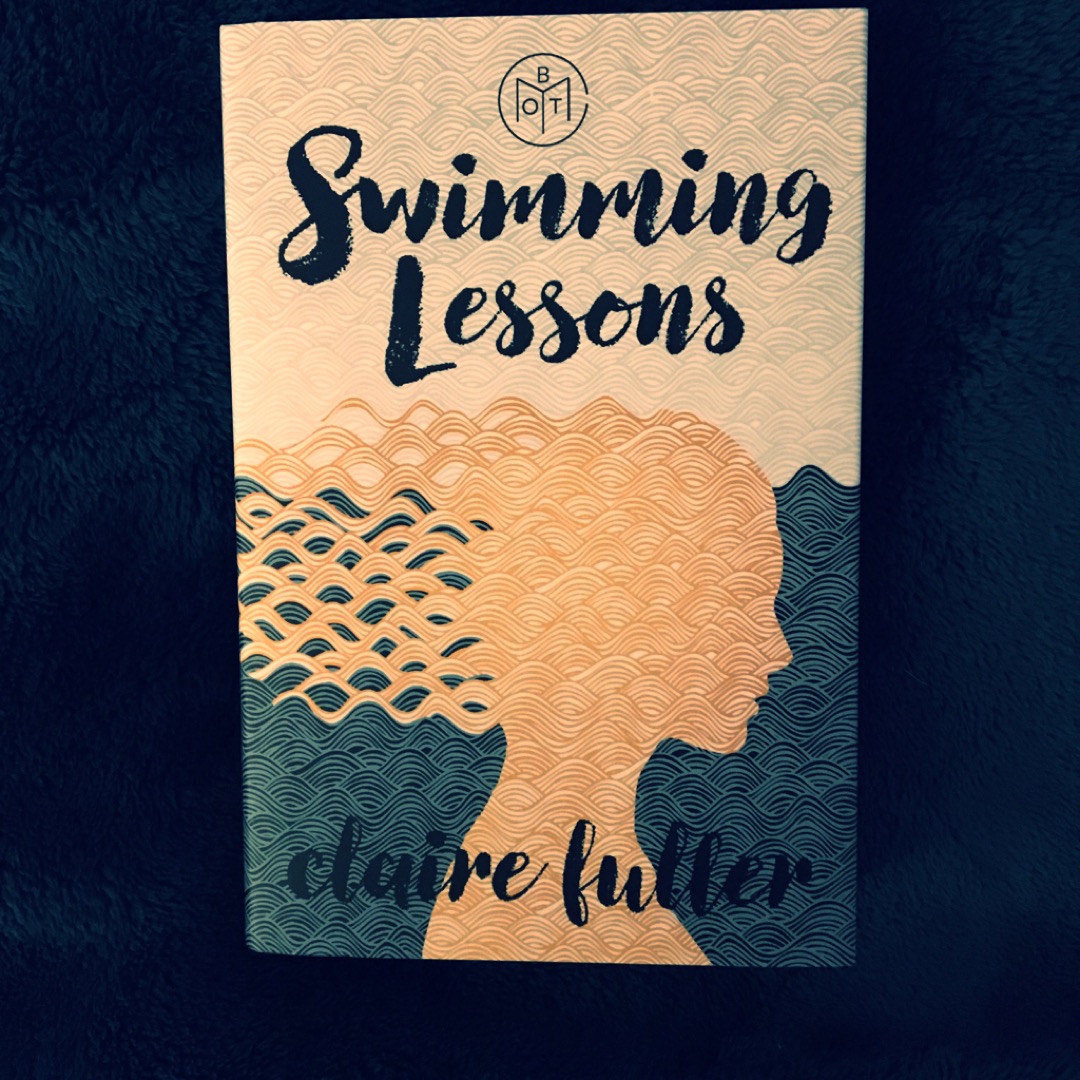
img_3046I recommended Our Endless Numbered Days, Claire Fuller’s debut novel, when it was published in 2015, and her new novel, Swimming Lessons, is another great find (it’s an early pick for the Book of the Month club; look for it in bookstores this February). Like Our Endless Numbered Days, Swimming Lessons offers twin mysteries: in this case, both revolve around the disappearance of Ingrid Coleman, the wife of a semi-famous English novelist and mother to their two daughters. In the present, Flora, the younger daughter, returns to her childhood home to care for her father (with the help of Nan, her sister) and to investigate her mother’s disappearance. In alternating chapters, we read Ingrid’s letters to Gil (never sent; placed in several of his multitudinous books) that chronicle how she was swept away by their romance—and might explain why she disappeared. If you read and like Swimming Lessons, I recommend Meg Wolitzer’s The Wife and Lauren Groff’s Fates and Furies.

I hope your first (and second) week of reading went well! 

*I received a copy of these books from the publishers for review purposes, which did not affect the content of my reviews.

Another Year in Books: Best of 2016


best-of-2016Dear Readers,

Thank you so much for another wonderful year in the world of books. I wish you health and happiness in the new year, and a warm, cheery holiday season, however you celebrate.

Now, for the last Rosemary & Reading Glasses post of the year, the traditional last-minute gift guide. It would tax your patience if I were to talk about every book I’ve read this year (97 as of this writing, probably just over 100 by year’s end), so I’ve listed (with two exceptions) 2016 releases in categories constructed by my arbitrary whims. All these books are recommended.

Poetry

Ocean Vuong, Night Sky with Exit Wounds

Donika Kelly, Bestiary

W. S. Merwin, Garden Time

Catherine Pierce, The Tornado is the World

Monica Youn, Blackacre

Honorable Mention to Ross Gay’s Catalog of Unabashed Gratitude (2015), which I couldn’t bear to leave off this list.

Short Stories

Ellen Prentiss Campbell, Contents Under Pressure

Helen Oyeyemi, What Is Not Yours Is Not Yours

Junot Díaz (editor) and Heidi Pitlor (series editor), The Best American Short Stories 2016

Clare Beams, We Show What We Have Learned

Short Novels

Kent Haruf, Our Souls at Night

Graham Swift, Mothering Sunday

Elizabeth Strout, My Name Is Lucy Barton

Idra Novey, Ways to Disappear

Longer Novels

Dominic Smith, The Last Painting of Sara de Vos

Alexander Chee, The Queen of the Night

Louise Erdrich, LaRose

Peter Ho Davies, The Fortunes

Lived Up to the Hype

Ann Patchett, Commonwealth

Brit Bennett, The Mothers

Colson Whitehead, The Underground Railroad

Jeff Zentner, The Serpent King

Books in Translation

Maylis de Kerangal, The Heart (translated by Sam Taylor)

Dulce María Loynaz, Absolute Solitude (translated by James O’Connor)

Juan Gabriel Vásquez, Reputations (translated by Anne McLean)

Nonfiction

Claire Harman, Charlotte Brontë: A Fiery Heart

Carlo Rovelli, Seven Brief Lessons on Physics

Margot Lee Shetterly, Hidden Figures

Depressing (and Very Good)

Katy Simpson Smith, Free Men

Jung Yun, Shelter

Garth Greenwell, What Belongs to You

Katie Roiphe, The Violet Hour: Great Writers at the End

Delightful (and Very Good)

Shirley Barrett, Rush Oh! 

Lindsay Faye, Jane Steele

Honorable Mention to Zen Cho’s Sorcerer to the Crown, out in paperback this year

Best for Sleuths

Elliott Chaze, Black Wings Has My Angel

Erica Wright, The Granite Moth

Best for New Parents

Jennifer Stewart Miller, A Fox Appears

Best Shakespeare Adaptation

Margaret Atwood, Hag-Seed

Best Graphic Novel/Comic

Brian K. Vaughan and Fiona Staples, Saga: Volume 6 (Start with Volume 1, though!)

Best Sui Generis

Claire-Louise Bennett, Pond


What Were Your Favorite Poems This Year?

Dear Readers,

This week I’ve read two excellent poetry collections: Yona Harvey’s illuminating, musical Hemming the Water (thanks to a recommendation from poet and friend Emily Mohn-Slate) and Simon Armitage‘s Book of Matches (unsettling turns, brilliant wordplay). I highly recommend them both, and wish I had more time to write about them now.

Though I’m not done reading for the year, I am reflecting on the year’s reading, and it’s been just a stellar year for poetry; more on that next week. In the meantime, I hope you’ll take a moment to tell me about your poetry reading this year. What was your favorite poem or collection? What was the most surprising discovery? How are you finding new poems to read?

Until next week!