“My skies rise higher and hang younger stars.”

I can’t tell you how much I love this poem, “Becoming Anne Bradstreet,” by Irish poet Eavan Boland. I love poems that “talk” to other poems, but I especially like the spare couplets in this poem, which traces connections, real and imagined, between the speaker (identifying as the poet) and Anne Bradstreet.

Image courtesy of Supertrooper / Freedigitalphotos.net

Image courtesy of Supertrooper / Freedigitalphotos.net

It’s also lovely to read how deeply affected a writer of poetry can be by being a reader of poetry.

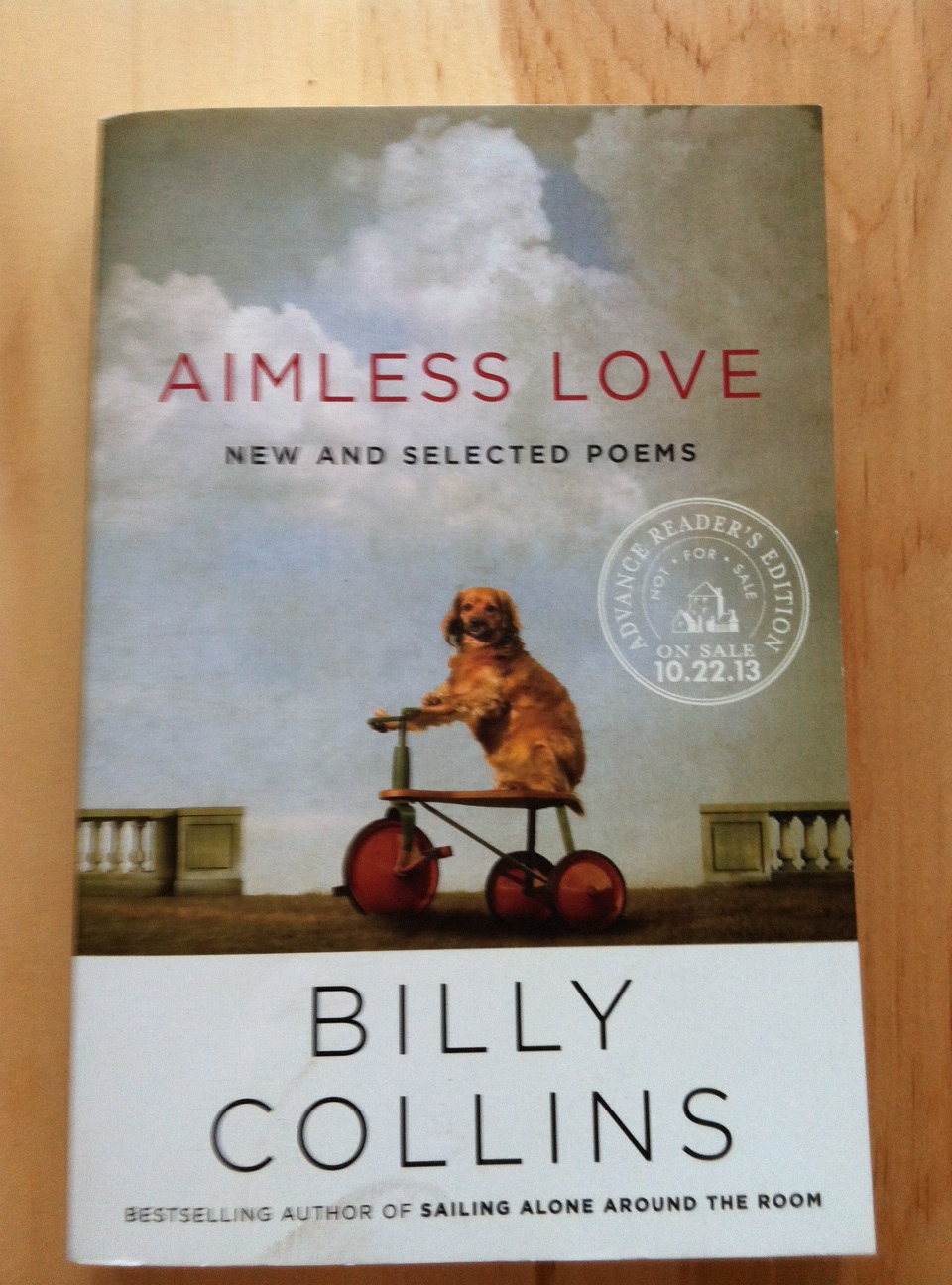
Early Review: Aimless Love*, by Billy Collins

Billy Collins writes one particular kind of poem, and he writes it well. A Collins poem is recognizable by its shape on the page (stanzas of three or four lines, of medium length), by its tendency to flutter from its point of origin for a just a moment, and then alight again a few yards away, like a sparrow on a sidewalk.

Aimless Love, Billy Collins

His poems are cozy but not uncomfortably intimate, clever but not arrogant. Their subjects are work and rest, reading and writing, eating, looking out of windows; in short, the everyday business of being alive in America. As I’ve written elsewhere, his poetry is perfect for picking up on a whim, while you wait for a friend who’s late to dinner, say. You’ll be entertained, you’ll think, and you might even laugh, but you won’t be trying to unknot a metaphor half an hour later while you chew your escarole.

Aimless Love, a collection of new and selected poems due out in October, is no different. Here you’ll find a generous armful of poems from four earlier collections (Nine HorsesThe Trouble With PoetryBallistics, and Horoscopes for the Dead), and about fifty new poems.  In the selection of new poems, I found a misstep or two: “Looking for a Friend in a Crowd of Arriving Passengers: A Sonnet” was fourteen lines long (thirteen lines of four syllables, and one of three), but not interesting or funny enough to pull off the joke about not being a sonnet. “Unholy Sonnet #1” is painful in its riff on “Death Be Not Proud” (one of Donne’s Holy Sonnets, hence the title); Mr. Collins’s lack of technical acumen can’t be avoided; he even reaches into Donne’s oeuvre to find Donne’s once-used words, and these so eclipse Mr. Collins’s own efforts that I was rather embarrassed for the poem, and for him.

Still, these are aberrations. For the most part, these new poems, like their predecessors, are pleasant, undemanding morsels, with a few gems tossed in (“Rome in June”). I’m all for accessibility in poetry, especially if it draws in new readers, and that, certainly, Mr. Collins can claim as an achievement.

If you have the earlier books, you may want to check this one out of the library to see if you think the fifty new additions are worth the price of admission.

You can find Aimless Love on the shelves on October 22nd.

*A disclaimer: I received this book through LibraryThing’s Early Reviewer program. I was not compensated for this review, nor was the content of the review dictated or approved by any party.

“Tonight, nothing is long enough—“

Robert Creeley’s “The Tunnel” is short and difficult, taking aim at three weighty subjects: love, time, and death. I think I’ve read it twenty times now, and I still don’t grasp the whole meaning. I hold on to one stanza and another slips away. I love its concise complexity, and cleverness. Just look at the first line: “Tonight, nothing is long enough–” — the line ends with a long (em-) dash! The line itself is drawn out, lengthened by its punctuation and the pause that follows the end of every line in poetry. What a mind at work.

Read it here, and please tell me what you make of it!

“My last things will be the first things slipping from me”; RIP Seamus Heaney

Maria Popova has put together a beautiful tribute to Seamus Heaney, and I cannot improve upon her work and Seamus Heaney’s own words. However, I can recommend that you seek out one of his books as soon as you can. I like to read the poems in spring, when it’s lightly raining and I can imagine that the earth and the grass I smell are really in Ireland.

This week, in honor of Mr. Heaney, I’m reading his poem “Mint,” from The Spirit Level (1996), included in the collection Opened Ground. It’s not about the fresh smell of the herb, or the glorious color; this mint, in the speaker’s childhood yard, appears “like a clump of small dusty nettles” (l. 1). From this opening, the speaker projects into the future; these early memories will be the last to slip away from him at the end of his life. The turn into the final stanza is so unexpected — I hope you’ll read it for yourself.

I’m so grateful that poets and poetry are part of our world.

“Days are where we live.”

In a recent post on The Poetry Foundation’s website, Caitlin Kimball calls British poet Philip Larkin “that crown prince of misanthropic, socially awkward poet-librarians,” which is probably the best, funniest summation of Larkin’s whole ethos I’ve ever read. For me, reading Larkin’s poems are like sucking on lemons (I know, I know: terrible for one’s teeth. But I do it anyway.). There’s sourness, sure, but it only serves to highlight the brightness of the fruit, the taste like color.

Image courtesy of Pixomar / Freedigitalphotos.net

Image courtesy of Pixomar / Freedigitalphotos.net

In this poem, “Days,” it’s the turn that twists the knife; the first stanza lulls the reader into a little thought experiment, asking her to consider day as a place rather than as a time: “Where can we live but days?” Ay, there’s the rub.

Here’s the second and final stanza.

Ah, solving that question
Brings the priest and the doctor
In their long coats
Running over the fields.

“sun beating on abundance”

This week I’m working on a new(ish) poem by Tami Haaland, who is the poet laureate of Montana (nifty!): “A Colander of Barley.”  As I’m sure you’ve come to expect if you’re a regular reader of my Tuesday posts, it’s a short poem. In a single sentence, Ms. Haaland gives a beautifully concrete, sensory description of barley in a colander, linking it back to the grain in the field, in the truck. It’s a perfect poem for the late summer harvest season. Reading it made me want to bite into a tomato and savor these last sunny, hot days.

You can read “A Colander of Barley” on The Poetry Foundation’s website.

“they don’t pause, don’t buzz, don’t / fly up in fear and light again”

I’ve been itching to feature this poem all summer, but I restrained myself until the timing was right — and now it is!

Image courtesy SweetCrisis / Freedigitalphotos.net

Image courtesy SweetCrisis / Freedigitalphotos.net

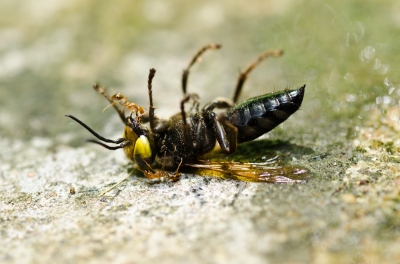
This week, I’m working on Andrew Hudgins’s sublime “Wasps in August.” You can hear Professor Hudgins read the poem here, at Slate (text too). And you should immediately go find Ecstatic in the Poison, from which this poem comes. I own two copies, and I am, sad to say, not sharing.

Professor Hudgins is one of the best living formalist poets, and a kind and funny man to boot (he teaches at The Ohio State University, alma mater of your humble blogger). I’ve never had the pleasure of taking his classes, but my friends who did treasure the experience. He was gracious enough to support the campus literary magazine and its young poets, and he was (and is) a highly-regarded mentor to new poets.

This poem describes the dying days of the wasps outside the speaker’s home, who defend and nurture their larvae in the nest. But it’s about more than that: frailty, death, rebirth, renewal, futility . . . I could go on.

The last line will floor you.

A Literary Wedding, or, “Earth’s the right place for love: / I don’t know where it’s likely to go better.”

our rings

Our wedding rings

We were married three years ago this week, back in the olden days before Pinterest provided endless helpful suggestions regarding how to personalize your wedding with monograms and mason jars.

Now, I love a mason jar as much as the next gal, but our last name’s initial looks a heckuva lot like a circle, so I didn’t (and don’t) see much point in monogramming anything. I think it would have confused people. (“Which table are you sitting at?” “Table 0.” “Oh, I thought we were at table O.” “Oh dear.”) Personalizing one’s wedding ought to mean something more than splashing one’s initials all over it in in perfect wildflower hues, right?

Our wedding would never make the pages of Martha Stewart Weddings. We didn’t meticulously handcraft garlands of paper cranes from the pages of vintage books. We didn’t do favors, rice, confetti, a “real” wedding cake (we went with the Heart of Darkness chocolate torte, with mango coulis), or a “normal” ceremony.

What we did do was try very hard to make the wedding our own, an event that expressed not only who we are as a couple but where we came from — the people and words and music that shaped our lives.

The program included the line from “Birches” I’ve used in this post’s title, and Juliet’s immortal lines, “My bounty is as boundless as the sea / My love as deep. The more I give to thee / The more I have, for both are infinite.” The lettering on the front of the program used a font based on Jane Austen’s handwriting; on the last page we reprinted Shakespeare’s Sonnet 130 in memory of absent friends.

The processional was “Building the Barn” from Witness, because, well, just watch that part of the movie (bonus: Viggo Mortenson cameo!). And the recessional was “Everyone” by Van Morrison because, well, watch the end of The Royal Tenenbaums. But only if you’ve seen the beginning and the middle.

While guests waited they had the option of tinkering with a crossword we made about us, our friends, and families, or looking out over a little river and falls, or browsing in the bookstore.

Yes, we were married at a bookstore. Well, technically, we were married on a deck that’s part of a restaurant that’s located in an old mill that’s been converted into a used bookstore in a town called, of all things, Montague. But I just tell everyone that we were married at a bookstore. It’s easier that way.

[It’s lovely to be able to return to a place that holds such beautiful memories for us; we try to go back at least once a year. I’ll post pictures from our latest visit tomorrow.  I bet you’ll want to go there too.]

Our ceremony was comprised of the usual wedding bits, retooled to suit our beliefs and preferred wording, and literary readings. Each of us asked a parent, a sibling, a friend, and an aunt or uncle to read during the ceremony, in groups of two.

Which readings, you ask?

  • “In Lands I Never Saw,” by Emily Dickinson
  • “The Owl and the Pussycat,” by Edward Lear
  • Most Like an Arch This Marriage,” by John Ciardi
  • Sonnet 116, by William Shakespeare
  • “The Master Speed,” by Robert Frost
  • a selection from the Song of Songs
  • a selection from Emma, by Jane Austen
  • a selection from The Lord of the Rings, by J.R.R. Tolkien

I can still hear each one of these people reading, people we love who shared these words that mean so much to us. Because a marriage ceremony is an act of speaking something into being, and it’s important to get the words right.

***

So, since today is Tuesday, and therefore a poetry day around these parts, I thought today I’d highlight a poem that wasn’t read at our wedding.

You read that right. We both love Robert Frost’s “Birches” — so much so that my husband’s wedding ring is etched to look like birch bark — but it is long, and not really related to marriage, so we chose a different Frost poem for our set of readings. Now, though, after three years and one child together, this poem has taken on even more significance to us. Sometimes I imagine my son as the boy in the poem, confident though solitary. Sometimes I turn to the poem when things get hard, as they are wont to do, when

I’d like to get away from earth awhile
And then come back to it and begin over.

But above all, we love the poem for its abiding love for the beauty and promise of this world and its often-anonymous inhabitants. After all, “one could do worse than be a swinger of birches.”

Three years later, at the bookmill.

Three years later, at the Bookmill.

Did you incorporate readings into your wedding ceremony? How did you choose your readings?

“a skin of ice”


Image courtesy of Tina Phillips / Freedigitalphotos.net

Image courtesy of Tina Phillips / Freedigitalphotos.net

Add another name to the long list of poets I’m embarrassed not to know more about: Kay Ryan. The former poet laureate is one of the most decorated living poets, having won the Guggenheim, the MacArthur, the Ruth Lilly Prize, and the Pulitzer. I feel like quite a Philistine.

Ms. Ryan is apparently known (to others) for her short lines and intellectual precision, both of which I found in her poem “Thin.” You can read the poem, which, refreshingly, has nothing to do with the latest diet craze, here.


“Bright star, would I were as steadfast as thou art”

Well, I think it’s time to acknowledge the Romantics around here, don’t you?

Truth be told, Byron, Shelley (Percy, that is), and Wordsworth have never been my cup of tea (if they’re yours, please direct me to poems that will change my mind!), but I’ve loved Coleridge since I was a child, since Kubla Khan and The Rime of the Ancient Mariner paint such vivid pictures in the mind (and they’re exciting!).

I think I may have run across Keats in high school, but it wasn’t until a Romanticism class in college that I got a big dose. Seriously, the only word that properly describes his poetry is “romantic” — he’s the epitome of the movement. You’ll find Wordsworth and Byron in some of my various anthologies, but one of my prized books is an 1892 copy of The Poetical Works of John Keats; when I win the lottery, I’ll be able to afford a binding repair.

I know it may sound a bit overly, ahem, romantic, but I love having a book of his poems from the same century during which he lived and breathed.

1892 edition of Keats's works

1892 edition of Keats’s works

“Bright Star” is a love sonnet he wrote to Fanny Brawne, his fiancee and center of adoration in the last two years of his life. Jane Campion’s gorgeous, perfect film Bright Star focuses on their relationship; if you haven’t seen it, please locate your handkerchief and then borrow it from your local library (you’ll want to buy it after, I promise.)

Here’s the poem:

Bright Star

Bright star, would I were stedfast as thou art—
         Not in lone splendour hung aloft the night
And watching, with eternal lids apart,
         Like nature’s patient, sleepless Eremite,
The moving waters at their priestlike task
         Of pure ablution round earth’s human shores,
Or gazing on the new soft-fallen mask
         Of snow upon the mountains and the moors—
No—yet still stedfast, still unchangeable,
         Pillow’d upon my fair love’s ripening breast,
To feel for ever its soft fall and swell,
         Awake for ever in a sweet unrest,
Still, still to hear her tender-taken breath,
And so live ever—or else swoon to death.


Lovely, isn’t it?

Which Romantic poems are your favorites?