Paradise Lost, Books IX and X: Crime and Punishment

ParadiseLostReadalongAt long last, we’re here: Books IX and X bring the Fall and its aftermath to Paradise. Let’s get to it, shall we?

Summaries courtesy Milton.

Book IX:

Satan having compast the Earth, with meditated guile returns as a mist by Night into Paradise, enters into the Serpent sleeping. Adam and Eve in the Morning go forth to their labours, which Eve proposes to divide in several places, each labouring apart: Adam consents not, alleging the danger, lest that Enemy, of whom they were forewarn’d, should attempt her found alone: Eve loath to be thought not circumspect or firm enough, urges her going apart, the rather desirous to make trial of her strength; Adam at last yields: The Serpent finds her alone; his subtle approach, first gazing, then speaking, with much flattery extolling Eve above all other Creatures. Eve wondering to hear the Serpent speak, asks how he attain’d to human speech and such understanding not till now; the Serpent answers, that by tasting of a certain Tree in the Garden he attain’d both to Speech and Reason, till then void of both: Eve requires him to bring her to that Tree, and finds it to be the Tree of Knowledge forbidden: The Serpent now grown bolder, with many wiles and arguments induces her at length to eat; she pleas’d with the taste deliberates a while whether to impart thereof to Adam or not, at last brings him of the Fruit, relates what persuaded her to eat thereof: Adam at first amaz’d, but perceiving her lost, resolves through vehemence of love to perish with her; and extenuating the trespass, eats also of the Fruit: The Effects thereof in them both; they seek to cover their nakedness; then fall to variance and accusation of one another.

Book X:

Man’s transgression known, the Guardian Angels forsake Paradise, and return up to Heaven to approve their vigilance, and are approv’d, God declaring that The entrance ofSatan could not be by them prevented. He sends his Son to judge the Transgressors, who descends and gives Sentence accordingly; then in pity clothes them both, and reascends.Sin and Death sitting till then at the Gates of Hell, by wondrous sympathy feeling the success of Satan in this new World, and the sin by Man there committed, resolve to sit no longer confin’d in Hell, but to follow Satan their Sire up to the place of Man: To make the way easier from Hell to this World to and fro, they pave a broad Highway or Bridge over Chaos, according to the Track that Satan first made; then preparing for Earth, they meet him proud of his success returning to Hell; their mutual gratulation. Satan arrives at Pandemonium, in full of assembly relates with boasting his success against Man; instead of applause is entertained with a general hiss by all his audience, transform’d with himself also suddenly into Serpents, according to his doom giv’n in Paradise; then deluded with a show of the forbidden Tree springing up before them, they greedily reaching to take of the Fruit, chew dust and bitter ashes. The proceedings of Sin and Death; God foretells the final Victory of his Son over them, and the renewing of all things; but for the present commands his Angels to make several alterations in the Heavens and Elements. Adam more and more perceiving his fall’n condition heavily bewailes, rejects the condolement of Eve; she persists and at length appeases him: then to evade the Curse likely to fall on their Offspring, proposes to Adam violent ways which he approves not, but conceiving better hope, puts her in mind of the late Promise made them, that her Seed should be reveng’d on the Serpent, and exhorts her with him to seek Peace of the offended Deity, by repentance and supplication.

Out of thousands of things to talk about, I’ve picked three passages from Books IX and X. I’d love to talk about every passage that’s provoked marginalia, but I require food and sleep and interaction with other humans.

It pays to have a compact OED: Sure, it weighs more than my toddler, and you need the included magnifying glass to have any prayer of reading it, but when you read a passage like this —

There was a place,
Now not (though sin, not time, first wrought the change)
Where Tigris at the foot of Paradise
Into a gulf shot underground till part
Rose up a fountain by the Tree of Life.
In with the river sunk and with it rose
Satan involved in rising mist, then sought
Where to lie hid. (9.69-76)

— if you’re like me, you want to know the etymology of “involve.”
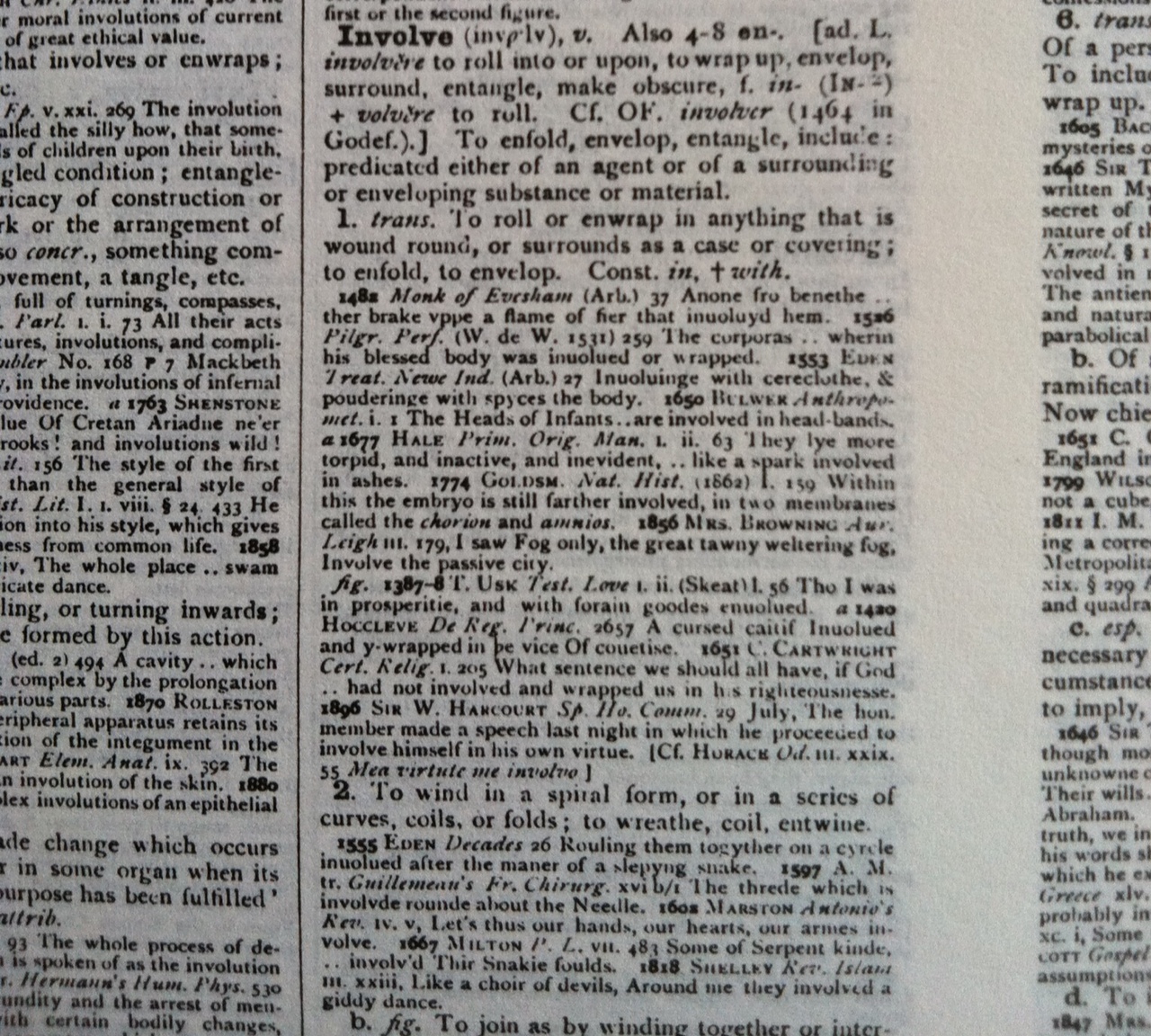
photo (54)And so I turn to my OED and read that it’s from the Latin “to roll into or upon, to wrap up, envelop, surround, entangle, make obscure” (1480). And sure enough, Milton’s cited as an example later in the definition. But see the genius at work here? With Satan’s reappearance in Paradise in Book IX, with one verb, Milton does so much to elucidate Satan and foreshadow the Fall to come. Yes, Satan’s enveloped in mist, and he’ll roll on the serpent’s folds. But he’ll also entangle Eve in sin, and make obscure what is plain. (And, by the way, how awesome are the “mazy folds” of the serpent, and the way Satan rises up on the folds like an orator about to speak?)

One of my favorite similes in the poem:

Much he the place admired, the person more.
As one who long in populous city pent
Where houses thick and sewers annoy the air
Forth issuing on a summer morn to breathe
Among the pleasant villages and farms
Adjoined, from each thing met conceives delight–
The smell of grain or tedded grass, or kine
Or dairy, each rural sight, each rural sound–
If chance with nymph-like step fair virgin pass
What pleasing seemed, for her now pleases more,
She most, and in her look sums all delight.
Such pleasure took the serpent to behold
This flow’ry plat the sweet recess of Eve,
Thus early, thus alone. (9.445-57)

For an epic poem, Paradise Lost is often concerned with the domestic; Eve and Adam are, after all, gardeners. We see them at home and in their ordinary daily pursuits, and with this simile, Milton reaches out to the ever-growing number of city dwellers in his own era, comparing Satan’s pleasure at Eve’s beauty (and the beauty of her handiwork) with the simple pleasures of getting out of town. It’s my favorite incursion of “modernity” in the poem. I’ve said before that we can read Paradise Lost as an example of eco-poetry, and this is just one instance of the way Milton values the rural, the natural, over artificial constructs. Later, after Eve and Adam eat of the forbidden fruit, he writes that “Earth felt the wound,” comparing the pain nature itself experiences at the Fall to the pains of labor and birth.

The return of the poem’s creepiest character: Sin and Death create a path from Hell to Earth, and Death vows to follow in his mother’s steps.

I shall not lag behind nor err
The way, thou leading, such a scent I draw
Of carnage, prey innumerable,, and taste
The savor of death from all things there that live.
Nor shall I to the work thou enterprisest
Be wanting but afford thee equal aid.
So saying with delight he snuffed the smell
Of mortal change on Earth. As when a flock
Of rav’nous fowl though many a league remote
Against the day of battle to a field
Where armies lie encamped come flying, lured
Wish scent of living caracasses designed
For the death the following day in bloody fight,
So scented the grim feature and upturned
His nostril wide into the murky air,
Sagacious of his quarry from so far. (10.266-81)

Gah! I wrote about Yeats’s “The Second Coming” as the scariest poem in English last Halloween, and there’s no way that Milton’s death wasn’t an inspiration for the creature slouching toward Bethlehem. Yeats’s creature is a “shape”; Milton’s Death is a “feature” with one “nostril wide.” And snuffing? Nazgûl-like, if you ask me. And P.S., fellow Tolkien fans: there’s a simile in Book IX that’s a dead ringer for the Dead Marshes.

As if you needed any more incentive to read Paradise Lost.

March 1: The bitter end — wrapping up with Books XI and XII.

“speckled / like a sky” : May Swenson’s “Blue”

A modern entry into the venerable poetic tradition of cataloging the beloved’s physical beauties (see: Petrarch, Shakespeare, Donne), May Swenson’s “Blue” is a poem that just begs to be read aloud. It’s rhythmic, sexy, and filled with bilabial consonants (‘p’ and ‘b’ in particular) that press the reader’s lips together into a kiss.

Swenson

The speaker addresses her lover in lines replete with sensory imagery — taste and touch especially — made even more immediate by the present-tense action of the poem. And you won’t believe what she can do with three colors — white, rose (also the lover’s name), and blue.

Here are my favorite lines:

You’re white in
patches, only mostly Rose,
buckskin and salty, speckled
like a sky. I love your spots,
your white neck, Rose, your hair’s
wild straw splash, silk spools
for your ears.

You can read the entire poem here.

Recommended Reading: Incarnadine, by Mary Szybist

The poems in Mary Szybist’s Incarnadine* consider the collision of the ordinary and the otherworldly (as figured in the Annunciation) from a multitude of angles. With their varied forms and fierce fragility, the poems gracefully explore the relationship between the spirit and the body, motherhood and childlessness, discovery and loss, violence and desire, the sacred and the secular.

Incarnadine

What surprised me most about the collection was the striking range of forms that Ms. Szybist employs. Incarnadine includes a poem in terza rima, a concrete poem (lines densely radiating from a circular negative space, appearing like a sun), prose poems, a poem composed with pieces snipped from Natalie Angier’s Woman: An Intimate Geography and Henry James’s The Portrait of a Lady, a poem as a diagrammed sentence, an abecedarian, near-sonnets, hymn-like structures — all in seventy-two pages.

This formal variety enhances the collection’s fresh approach to the subject of the Annunciation; the scene is replayed in new contexts many times over. For example, in “Annunciation in Nabokov and Starr,” excerpts from Lolita and The Starr Report fill out an annunciation account from the angel’s point of view, while later, in “Annunciation: Eve to Ave,” Eve explains her bewilderment at the discovery that the man who brought her news was not a man at all. After this poem’s especially playful diction, the last lines rise to the surface in all their parenthetical heaviness: “(But I was quiet, quiet as / eagerness–that astonished, dutiful fall.).”

As the book goes on, and the annunciations stack up, they become more and more ensnared in violation, which, it appears, is the underside of this particular adumbration; spirit does not instantiate in flesh without violence.

Ms. Szybist’s verse is elegant, sometimes deceptively simple, and poised, balancing darkness and transcendence, incarnadine and cerulean. Highly recommended reading. 

Incarnadine won the National Book Award for poetry in 2013

*My thanks to Graywolf Press for sending me a review copy of Incarnadine.

An Interview with Lindsay Hill, Author of Sea of Hooks

Yesterday I reviewed Sea of Hooks, Lindsay Hill’s first novel, which was published in 2013 by McPherson & Company. Mr. Hill graciously agreed to be interviewed via email.

Lindsay Hill Photo by Adrian L. Smith

Lindsay Hill
Photo by Adrian L. Smith

How and why did you begin to write Sea of Hooks?

LH: The book was begun on a trip to Bhutan in 1994.  I was traveling with the poet and anthropologist, Nathaniel Tarn, and carrying a notebook.  My intention had been to make a limited written record of the trip and to record any thoughts or lines (for possible poems) that came to mind.  During the course of our travels, we learned of the Terma Tradition within the Nyingma school of Buddhism.  This tradition concerns the scattering of Terma (spiritual treasures) in earth, water, air and mind, for future discovery, in proper sequence, by treasure–finders called Terton.  I was spellbound by the beauty of this tradition and by the idea that such treasures lay hidden among us, waiting to be discovered.  As we traveled through the stunning Himalayan landscape, I started to write the outlines of a story. From the beginning, the themes were going to include the emergence of compassion and the spiritual transformation of a traveler.  Even so, having written only poetry, I had little idea of how to proceed.

Did you approach writing Sea of Hooks, your first novel, differently from the way you approach writing poetry?

LH: The trip to Bhutan, completely inadvertently, began a new phase in my life as a writer.  I began to carry, and fill, small notebooks with thoughts as they occurred to me.  This was very different from sitting down to write, or intending to compose, a finished poem.  I found that I had embarked on the composition of a continuous open text.   Very soon, I began titling the individual entries and letting the threads find their way.  Perhaps because I am severely dyslexic, I subvocalize everything I read.  Also, I am only able to read very slowly.  This combination of conditions led me, very early on, to a passion for reading poetry.  Every concussive syllable, every shifting rhythm, every lyric leap, enthralled me.  At Bard, where I was lucky enough to go to school, I started with Middle English (The Pearl Poet and Chaucer), and finally arrived at the 20th century in my senior year.  In essence, I apprenticed my ear to the arc of great poets in English, and a bit of that rich tradition couldn’t help but rub off!  So, in writing anything, I find myself attentive to sound and rhythm.  Also, I like the difficulty and the challenging associative leaps that often occupy the best poems.  Combine these preferences with my short attention span, and you end up with a novel of titled fragments that carry, at least to some degree, the stylistic characteristics of poems.  The difference lay in the particular demands that the novel, as an artistic form, places on any writer.  The necessities of finding and sustaining “voice” over an extended text; the demands of constructing a compelling plot; the challenges of developing plausible characters; all of these were extremely daunting to me, and any success that I had took hundreds upon hundreds of pages of missteps.  Ultimately, what I hope I was able to accomplish with Sea of Hooks, is a genre–spanning work that employs poetic methods, and architectures, to strengthen narrative structures.  Certainly, this is nothing new or unique, but for me, it was an entirely marvelous adventure of learning how a story could become the wetting stone of lyric language.

I understand that you composed Sea of Hooks over a period of more than twenty years. When you began the work, did you think or know that so much time would pass before it would be finished?

LH: I had no idea.  Originally, I intended to write a simple story.  Eventually, I had to be willing to be completely, even relentlessly, patient as complexity intervened.  Especially in the last eight years of its composition, I was working every day on the novel.  It was a completely joyful enterprise, and I was honestly unconcerned with when it would wrap itself up.  Many times, I truly doubted that it would ever “come together.”  By the time I started editing, I had over 5,000 titled sections from which to select and with which to assemble a coherent book.  The editing took three years and, in the final year, I did no other work.  Basically, four out of every five “sections” were thrown out.  Clearly, I’m not a very efficient novelist!

One thread in the narrative finds Christopher exploring Bhutan and Buddhism. How did you come to this choice?

As mentioned above, this thread originated with my trip to The Himalayas and with my learning about the Terma Tradition.  Christopher, the book’s protagonist, is following an inquiry into how a shattered world can be reassembled.  Everything is at stake for him in this.  Philosophically, Buddhism has much to say about the topics that preoccupy his thinking: the nature of the construction of the self, the puzzle of desire and suffering, the meaning of emptiness and liberation.  One of the book’s central images, that of a mother running armless beside a river where her child is drowning, came from Patrul Rinpoche’s The Words of My Perfect Teacher, and is among the most powerful I’ve ever encountered.  In Rinpoche’s teachings, this image represents a paradigm of compassion: not simply as empathy, but as the practice of staying steadily with suffering that cannot be fixed.  Through the lens of Christopher’s experience, this understanding is key.  So, Buddhism had an extremely generative affect on my thinking and writing and, above all, on my ability to perceive, from the heart, the possibilities that suffering offered for transformation in Christopher’s life.  Of course, Sea of Hooks is a story, and in no way presumes to be a scholarly explication of Buddhism or to reveal the depths of its great traditions.

Which writers do you read while writing? Do your reading choices change depending on the writing project at hand?

LH: I still, primarily, read poetry.  While writing Sea of Hooks,  I spent time with a wide range of work, from Donne’s Satires (...as streams are, power is...) to Gerard Manley Hopkins (…like shining from shook foil…), to the works of contemporaries like Tarn (The Beautiful Contradictions, Ins and Outs of the Forest Rivers), and Palmer (Six Hermetic Songs, Thread), and many younger poets as well.  Also, I read a good deal of philosophy, from the Pre–Socratics to Wittgenstein.  Mostly, I like to read work that poses interesting questions and that approaches them in innovative ways.  I like to read work that takes risks.  This doesn’t really change depending on what I’m writing but I do try to avoid work that may offer “solutions,” to questions I’m wrestling with in my own writing.  I like to stay with difficulties until they reveal their own underpinnings; their own “ways out.

What kinds of writing projects are you planning next?

LH: I strongly believe that a writing project deserves to have authentic urgency behind it: something at risk for the writer in writing it, and for the reader in reading it.  At least for me, that urgency, that necessity, isn’t something that can be “put” into a work.  It’s not an “ingredient.”  It’s the ground from which the work grows, and around which it organizes itself, as it takes shape, and strives to inhabit a living space.  Sometimes you just have to wait for that urgency to arrive.  In the meantime, my intention, and practice, is to maintain a constant relationship with writing.  This means that I continue to keep a small notebook in my back pocket and write as often as something of potential interest occurs to me.  I do this without any expectation that my jottings will be “good,” or used later in any way.  It’s just a practice to keep the dialogue open with my work.  The result has been that I have a joyful and relaxed approach to writing.  All that aside, I have, with some trepidation, started a new novel.  I envision a simple story…

My thanks again to Mr. Hill for sharing his time and generous answers. 

“charged and waiting”: Audre Lorde’s “Recreation”

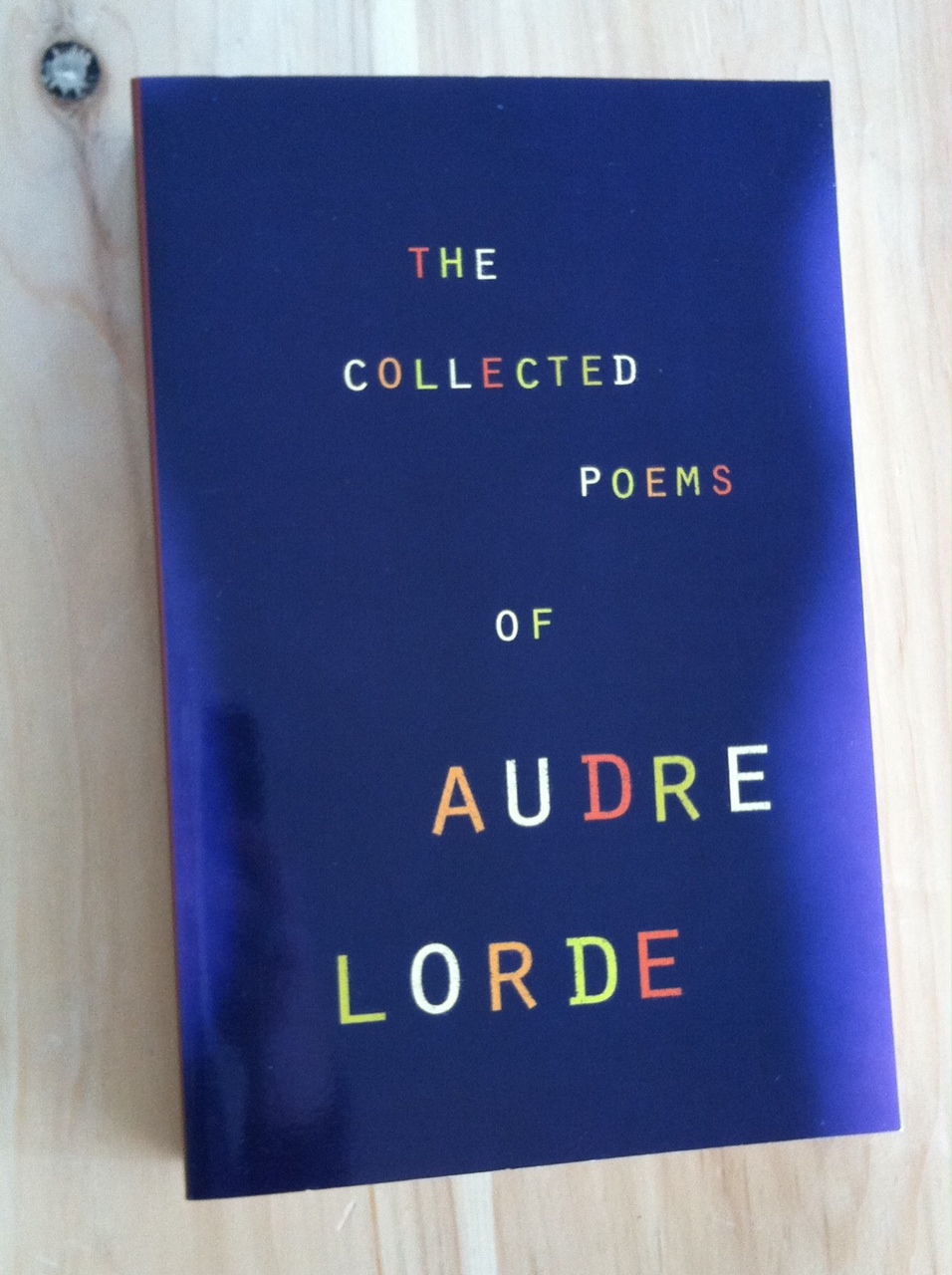
Audre Lorde Collected WorksAudre Lorde’s poem “Recreation” is simultaneously about sex and writing — the act of love and the act of creating. The title itself suggests doubleness: “recreation” in the sense of play (as in, Parks and) and “recreation” as in the repeated act of creating.

Reciprocity is one of the poem’s themes, as the poet/lover both gives to and takes from writing and her lover. At the same time, writing and sex are reciprocal, too:


moving through our word countries
my body
writes into your flesh
the poem
you make of me.


One of the many things I like about this poem is its specificity; it doesn’t claim a universal love, or generalize about pleasure. It’s about a particular speaker in a particular moment, which is deliberate, given Lorde’s views on the relationships among power, creativity, and the erotic.

Paradise Lost, Books VII and VIII: Edenic Education

ParadiseLostReadalongAs per our last outing, I’m going to let Milton himself give the summary of these two books, in which Raphael relates to Adam the story of creation, and Adam tells Raphael what he remembers of his first days in Paradise.

Book VII

Raphael at the request of Adam relates how and wherefore this world was first created; that God, after the expelling of Satan and his Angels out of Heaven, declar’d his pleasure to create another World and other Creatures to dwell therein; sends his Son with Glory and attendance of Angels to perform the work of Creation in six days: the Angels celebrate with Hymns the performance thereof, and his reascention into Heaven.

Book VIII

Adam inquires concerning celestial Motions, is doubtfully answer’d, and exhorted to search rather things more worthy of knowledge: Adam assents, and still desirous to detain Raphael, relates to him what he remember’d since his own Creation, his placing in Paradise, his talk with God concerning solitude and fit society, his first meeting and Nuptials with Eve, his discourse with the Angel thereupon; who after admonitions repeated departs.

Though not as action-packed as Book VI, Books VII and VIII offer perks of their own: Book VII features some of Milton’s loveliest nature poetry (and his sometimes funny tendency to explain absolutely everything), and in Book VIII, we get Milton’s views on aliens and angelic sex. Really — read it and see!

I’m in the midst of a rather horrid cold, dear readers, so I’m going to be correspondingly rather brief.

Milton’s catalog of the beauties of Eden (reminiscent of the evocation of the lush garden in Book IV) is all part of the consistent foreshadowing in these two books: all is beautiful and perfect, and it’s not going to stay that way. Similarly, Adam’s focus on Eve’s beauty and her enthralling charms presages the Fall that’s about to happen.

One of the most interesting discrepancies in the poem is revealed with Adam’s interpretation of Eve’s turning away from him at their first meeting. Adam attributes Eve’s initial relcutance to natural modesty and maiden bashfulness, but Eve tells a different tale in Book IV. Having seen her own reflection, Adam seems “less fair / Less winning soft, less amiably mild” and she wishes to return to the other figure she saw. Interesting, huh?

Here’s a passage I like that seems pretty darn important (Raphael is speaking to Adam):

Consider first that great
Or bright infers not excellence: the earth
Though in comparison of heav’n so small,
Nor glistering, may of solid good contain
More plenty that the sun that barren shines
Whose virtue on itself works to no effect
But in the fruitful earth. (8.90-96)


Something wicked this way comes — on February 20 we’ll be talking about Books IX and X, and the return of everyone’s favorite fallen angel. 

Bringing Sexy Back (To Valentine’s Day): 15 Steamy Poems by Esteemed Poets

Toss that teddy bear and give your significant person the gift of verse this Valentine’s Day.

Red Rose Petals by Victor Habbick, courtesy freedigitalphotos.net

Red Rose Petals by Victor Habbick, courtesy freedigitalphotos.net

That poet everyone reads at weddings is actually much more appropriate for the bedroom:

e. e. cummings, “i like my body when it is with your” 

An unsexy title for a very sexy poem (check out those ellipses!): 

Li-young Lee, “This Room and Everything In It”

The “Oh, snap” kind of sexy:

Edna St. Vincent Millay, “I, being born a woman and distressed”:

Wistful sexy:

C. P. Cavafy, “Body, remember”

Bitter sexy:

Thomas Wyatt. “They Flee from Me”

Literate sexy:

Robert Hass, “Etymology” (start watching at 18:42)

Damn sexy:

Audre Lorde, “Recreation

Desire, frustration, and jewelry. Also: socioeconomic tension. (And the first overtly lesbian poem I read as a teenager. Bit of a lightbulb moment, there.)

Carol Ann Duffy, “Warming her Pearls”

Difficult to choose just one Donne poem, but hey, let’s go with the salute to nakedness:

John Donne, “To His Mistress Going to Bed”

Restraint and abandonment, all at once:

Emily Dickinson, “Wild Nights – Wild Nights! (269)”

For the Dear Readers who are also parents: 

Galway Kinnel, “After Making Love We Hear Footsteps”

Maybe this is where they got the title for Blue is the Warmest Color:

May Swenson, “Blue”

I hate birds, but this poem is still amazing: 

Henri Cole, “Loons”

You’ll never look at roses the same way again, I promise:

D.H. Lawrence, “Gloire de Dijon”

And yes, a Neruda poem. But I can’t find it anywhere on the interwebs, so you’ll have to go find a copy of World’s End or Late and Posthumous Poems for yourself. 

Pablo Neruda, “Física”/”Physics”

Your turn: what’s the sexiest poem you’ve ever read?

“Full nakedness! All joys are due to thee”: John Donne, Sexy Poetry, and Making Valentine’s Day Fun Again

Back in the waning days of 2013, I promised that I’d devote February’s Tuesday poetry posts to sexy poems by dead poets.

I’m here to deliver.

I kinda hate Valentine’s Day, for all the usual reasons, I suppose. Pink looks sickly to me, overpriced roses do not smell as nice as regularly priced roses, and Victoria’s Secret is pretty gross.It’s all so generic and impersonal, and nothing epitomizes the sorry state of Valentine’s Day like the Hallmark card.

So I propose that we bring sexy back with real, honest-to-goodness poetry. Grab some steamy lines from some esteemed wordsmiths and write those in your card to your significant person.

Love poem anthologies there are a-plenty (just search for wedding poems and prepare for the deluge), so I shall take it upon myself this month to point you toward the sexiest poems in English. No hearts, no mushy stuff.

There may even be a list.

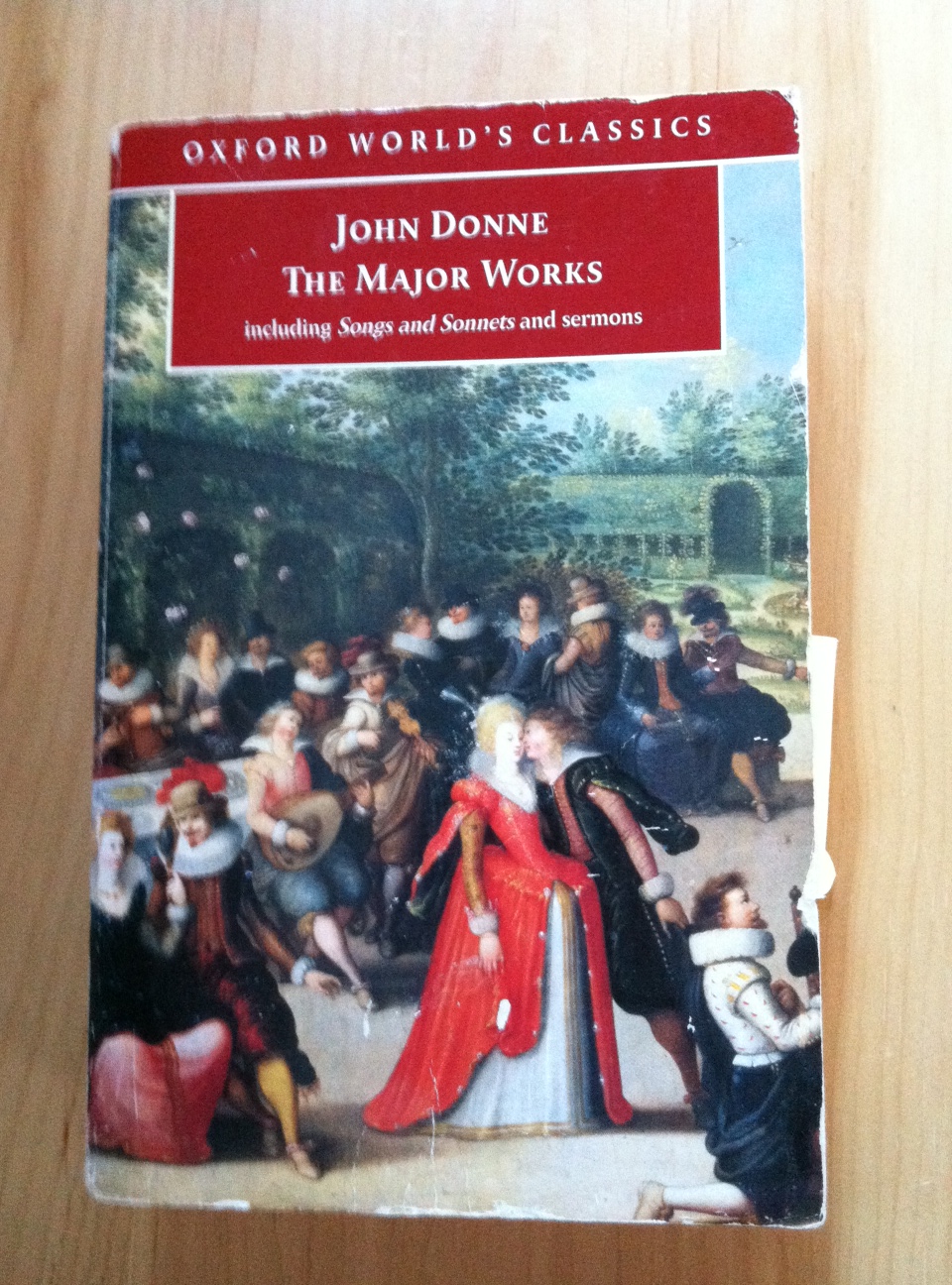
John DonneTo start things off, here’s John Donne’s elegy “To His Mistress Going to Bed” (I know I wrote about John Donne last year, but that was a Holy Sonnet. This is not.).

In the poem, the speaker encourages his inamorata to shed her clothes, piece by piece, because, well, being naked is fun. And only John Donne can manage to convey that the woman being seduced is rich (she has a pocket watch and a tres chic outfit), refer to England’s new colonies, and bring up a midwife in an erotic poem that sparkles with wit, puns, and the most charming sophistry you’ve ever read. Bonus: women are compared to books to explain their sex appeal.

What a guy.

For those who don’t want to write out the whole poem in their Valentine’s Day cards, I’ve excerpted the funniest/raunchiest bit at the end of the post.

Elegy XIX: To His Mistress Going to Bed
John Donne

Come, Madam, come, all rest my powers defy,
Until I labour, I in labour lie.
The foe oft-times having the foe in sight,
Is tir’d with standing though he never fight.
Off with that girdle, like heaven’s Zone glistering,
But a far fairer world encompassing.
Unpin that spangled breastplate which you wear,
That th’eyes of busy fools may be stopped there.
Unlace yourself, for that harmonious chime,
Tells me from you, that now it is bed time.
Off with that happy busk, which I envy,
That still can be, and still can stand so nigh.
Your gown going off, such beauteous state reveals,
As when from flowery meads th’hill’s shadow steals.
Off with that wiry Coronet and shew
The hairy Diadem which on you doth grow:
Now off with those shoes, and then safely tread
In this love’s hallow’d temple, this soft bed.
In such white robes, heaven’s Angels used to be
Received by men; Thou Angel bringst with thee
A heaven like Mahomet’s Paradise; and though
Ill spirits walk in white, we easily know,
By this these Angels from an evil sprite,
Those set our hairs, but these our flesh upright.
Licence my roving hands, and let them go,
Before, behind, between, above, below.
O my America! my new-found-land,
My kingdom, safeliest when with one man mann’d,
My Mine of precious stones, My Empirie,
How blest am I in this discovering thee!
To enter in these bonds, is to be free;
Then where my hand is set, my seal shall be.
Full nakedness! All joys are due to thee,
As souls unbodied, bodies uncloth’d must be,
To taste whole joys. Gems which you women use
Are like Atlanta’s balls, cast in men’s views,
That when a fool’s eye lighteth on a Gem,
His earthly soul may covet theirs, not them.
Like pictures, or like books’ gay coverings made
For lay-men, are all women thus array’d;
Themselves are mystic books, which only we
(Whom their imputed grace will dignify)
Must see reveal’d. Then since that I may know;
As liberally, as to a Midwife, shew
Thy self: cast all, yea, this white linen hence,
There is no penance due to innocence.
To teach thee, I am naked first; why then
What needst thou have more covering than a man?


As promised, the funniest/naughtiest lines (you may need to alter some pronouns to fit your situation. I won’t tell John Donne, but give him a h/t, ok?)

Licence my roving hands, and let them go,
Before, behind, between, above, below.
O my America! my new-found-land,
My kingdom, safeliest when with one man mann’d,
My Mine of precious stones, My Empirie,
How blest am I in this discovering thee!

“Sweetbitter”: The Complete Poems of Sappho, translated by Willis Barnstone

sappho trans, barnstonePlato called her “the tenth muse,” and yet Sappho remains an elusive figure. The outlines of her biography are sketchy, and nearly all her extant poems are fragmentary. Still, the lines we have are some of the most beautiful ever written, hungry and haunted as they are by love and loss.

Acclaimed poet and translator Willis Barnstone’s edition of the poems is grouped thematically, and he makes the interesting choice to title the poems. I’m still on the fence about the effect. In some cases, the titles merely refer to a personage named in the poem; in others, the titles reflect the obvious subject of the poem (“Old Age,” for example). With a few of the poems, however, I would have preferred an untitled version in order to better draw my own conclusions. But this is a small complaint; the volume is beautifully done, and I highly recommend it. (I’d also love to compare it with Anne Carson’s If Not, Winter, which I haven’t read yet — if you have, will you tell me what you think?)

It’s difficult to choose which poem to highlight this week, so I’ll leave you with Mr. Barnstone’s translation of fragment 130, which he titles “Sweetbitter”:

Eros loosener of limbs once again trembles me,
a sweetbitter beast irrepressibly creeping in

“Let now the chimneys blaze / And cups o’erflow with wine”

Here’s a poem to warm up with — Renaissance poet and musician Thomas Campion’s (1567-1620) “Now Winter Nights Enlarge”:

Now Winter Nights Enlarge

Now winter nights enlarge
    The number of their hours;
And clouds their storms discharge
    Upon the airy towers.
Let now the chimneys blaze
    And cups o’erflow with wine,
Let well-turned words amaze
    With harmony divine.
Now yellow waxen lights
    Shall wait on honey love
While youthful revels, masques, and courtly sights
    Sleep’s leaden spells remove.
This time doth well dispense
    With lovers’ long discourse;
Much speech hath some defense,
    Though beauty no remorse.
All do not all things well;
    Some measures comely tread,
Some knotted riddles tell,
    Some poems smoothly read.
The summer hath his joys,
    And winter his delights;
Though love and all his pleasures are but toys,
    They shorten tedious nights.


I like the physicality of this poem, the concession that the chill and storms of winter require light, and wine, and company to be borne, even if “love and all his pleasures are but toys.”