How the Light Gets In

I am sick at heart.  The American electorate has besmirched the dignity of so many people by casting its lot with those who spew hateful invective, with a candidate who cannot and will not acknowledge the full humanity of those he seeks to lead.

Only a few days ago I wrote about reading and empathy. I still believe that reading widely lays the groundwork for empathy and respect. But I do not know how to reach those who will not read the stories of others.

“There is a crack in everything / that’s how the light gets in,” wrote Leonard Cohen. In dark times light is all the more necessary. And so, while we take the measure of what we can do to move forward—how we can best use our time and talents as citizens in service to our fellow human beings—people will still make art and music and poems and novels. We need our artists, and I think we need every space we can get to share hope, build understanding, and renew bonds of love for each other.

It seemed that everywhere I looked on Wednesday I read the first stanza of Yeats’s “The Second Coming”:

Turning and turning in the widening gyre
The falcon cannot hear the falconer;
Things fall apart; the centre cannot hold;
Mere anarchy is loosed upon the world,
The blood-dimmed tide is loosed, and everywhere
The ceremony of innocence is drowned;
The best lack all conviction, while the worst
Are full of passionate intensity.

It is so very bleak, that poem. I believe Yeats wrote it with all the intensity of his passion and belief, and yet, nearly 100 years later, despite a century that laid waste to entire peoples, humanity endures, able to renew its conviction, its commitment to protecting the innocent.

Instead of succumbing to the tide of dread that has washed over so many of us, I suggest (as I have before), that we read the words of Emma Lazaraus:

The New Colossus
Not like the brazen giant of Greek fame,
With conquering limbs astride from land to land;
Here at our sea-washed, sunset gates shall stand
A mighty woman with a torch, whose flame
Is the imprisoned lightning, and her name
Mother of Exiles. From her beacon-hand
Glows world-wide welcome; her mild eyes command
The air-bridged harbor that twin cities frame.
“Keep, ancient lands, your storied pomp!” cries she
With silent lips. “Give me your tired, your poor,
Your huddled masses yearning to breathe free,
The wretched refuse of your teeming shore.
Send these, the homeless, tempest-tost to me,
I lift my lamp beside the golden door!”


Light and not darkness upon our paths, friends. 

Elections and Empathy

vote

Friends, it’s Election Day in the United States.  If you haven’t voted early, perhaps you’re on your way to a local elementary school or a house of worship or a library, temporarily repurposed so that we can choose our future together.

I love voting. I love that, in principle, we all bring our hopes and our convictions and our experiences of America with us to our polling places, these public spaces that shaped us and that we in turn may shape with our best intentions.

Every vote—for president or state representative or a ballot initiative—affects someone; cultivating empathy allows us to examine the ramifications of our votes from the perspective of others with experiences different from our own.

And reading is one of the best ways to cultivate empathy.

So this week, I’m recommending The Fortunes*, by Peter Ho Davies, a book that helped me to think and learn about the Chinese American experience over the last century.

The Fortunes is a novel, but one with an unusual structure. In four sections, Mr. Davies explores the lives of men and women of Chinese heritage as they try to make sense of their identities—the ones they assign themselves and those assigned to them by others.

In “Gold,” which could stand on its own as a novella, Ah Ling is sold by his uncle to work img_2359in a California laundry; from there, Ah Ling becomes the personal servant to a railroad tycoon (the historical figure Charles Crocker) and watches the fortunes of his fellow immigrants, sometimes from within their ranks, sometimes from a less intimate distance. When he first mistakes the maid for Mrs. Crocker, “a hand had loosened from the knot across her chest, floating up to pat her hair coquettishly. She wasn’t flirting with him so much as admiring herself in the mirror of his error, as if he were no more than a puddle or a window she’d caught sight of herself in.” His racial difference, Ah Ling reflects, allows marginalized whites–the Irish, in this case–to see themselves as part of the majority group. “We made them white, Ling thought. Just like Uncle Ng said. Just like bluing. Whiter than any laundry.”

Silver screen star Anna May Wong is the main character in “Silver.” In short vignettes, the story traces her biography as she begins a journey by ship to China to visit her father after suffering a major disappointment—though she’s a famous actress and of Chinese descent, producers refused to cast her in the adaptation of Pearl S. Buck’s The Good Earth. She doesn’t let the hurt show.  “It thrills her fellow passengers, she can see, that they know her and she knows Carole Lombard, and it dismays her too, this reflected starlight that dims her own pallid glow.”  For her—a movie star not allowed to kiss her white co-stars on screen, a daughter whose father is not proud of her work—being Chinese American is incredibly complex, a performance she never gets credit for. Near the end of her life, after the Communist takeover of China, she realizes “They—all of them—are Chinese American now, not just because America has finally, begrudgingly, allowed them to be, but because China has closed to them.”

“Jade” is especially difficult to read. It’s an account of a 1982 hate crime by a childhood friend of the victim. In 1982, Vincent Chin, a Chinese American man, was mistaken for Japanese and beaten by two white autoworkers angry at Japan’s perceived role in the declining American auto industry. He died a few days later. This happened before I was born, and I’m sorry to say that until I read The Fortunes I had never heard of this tragedy, which was one factor in the rise of Asian American rights groups. Vincent’s friend narrates from a place of anger and grief and frustration, wondering if he failed Vincent, wondering how things might have been different. He longs for the “warm anonymity” of the word “American.”

In “Pearl,” Chinese American writer John Smith is in China with his (white) wife, waiting to adopt a baby girl. Small bits and pieces from the other stories filter into this last chapter, suggesting the ways that history repeats itself and bubbles up to the surface of the present. As he considers his daughter’s future (and the inevitable “Where are you from?“), he thinks of the terra-cotta soldiers the famous tomb of the emperor. Each one is different, an individual face, “each figure standing for precisely one man, representing only himself.”

This timely, beautifully written, affecting novel reminds us that we are all part of the kindness and cruelty that is history, shaped by it and shaping it.

May we take the best of our humanity to the polls with us.

*I received a copy of this book from the publisher for review consideration, which did not affect the content of my review.

Recommended Reading: Bestiary, by Donika Kelly

bestiary

A bestiary, as you probably know, is a catalogue of beasts, either real or mythical or both. It’s a rich framework for a book of poems, and Donika Kelly’s Bestiary*, longlisted for the National Book Award, is a wonder. Here you’ll find birds, bears, centaurs, Pegasus, dogs, the Minotaur, a werewolf, and a mermaid—and poems of love, grief, and human monstrosity.

Bestiary photo by Carolyn OliverThese poems bear evidence of trauma, particularly childhood abuse, which makes them both difficult to read and deeply moving. (You can read Donika Kelly’s brief statement on who she wrote the book for here.) The speaker in the long poem “How to be alone” chronicles her loneliness, curling on the couch with her dogs, challenging herself to admit all that she has endured (including her mother’s death, her father’s abuse, self-harm, “the little ways you brick up your heart”). Each four- to seven-line stanza appears on its own page, emphasizing the speaker’s isolation. It’s an incredibly intimate self-portrait.

Bestiary is a book I’ll come back to again, not only for the way it confronts human frailty, but for its love poems. “I have never known a field as wild / as your heart” begins “Love Poem: centaur.” “Love Poem: Satyr” finds the creature calling to its love “with a breath / of spring, a small wind warmed in my breast / and shaped by the lips you loved.” These poems swell with lyric beauty.

I highly recommend this collection. To get a taste of it, you can read “Bower” at VQR here, and “Pegasus” at Graywolf’s website.

You can also read more about Bestiary here and here.

What’s the last poem you read?

*I received a copy of this book from the publisher for review consideration, which did not affect the content of my review.

In Brief: Reputations and The Mothers

the-mothers-and-reputations

Dear Readers, I hope your autumn (or spring, hello Australian readers!) has been going swimmingly. Here at Chez O I’m ramping up my night-time knitting (the holidays, and new nieces/nephews approach), so my evenings are not as devoted to reading as they are the rest of the year. Still, recently I finished two books that I’m happy to recommend.

Reputations, by Juan Gabriel Vásquez, translated by Anne McLean

Reputations_Carolyn Oliver photoThis slim novel (under 200 pages) reminded me of Virginia Woolf’s Mrs. Dalloway in two ways. First, Reputations takes place over a short period (three days to Mrs. Dalloway‘s one), but manages to show the contours of the middle-aged main character’s entire life. Second, Mr. Vásquez’s management of tense is remarkable, like Woolf’s. The past and present flow alongside each other easily, almost liquid.

The prose is beautiful (credit to the translator here too!), with long, cascading sentences, and memorable similes. Two of my favorites:

“The night before had been like making love with a memory, with the memory of a woman and not with the woman who was present, the way we keep feeling, after stepping barefoot on a stone, the shape of the stone in the arch of our foot.”

“Forgetfulness was the only democratic thing in Colombia: it covered them all, the good and the bad, the murderers and the heroes, like the snow in the James Joyce story, falling upon all of them alike.”

The plot: Political cartoonist Javier Mallarino is a force to be reckoned with, dashing careers for decades with a bit of ink and a pithy caption. Honored for his work one evening, he is confronted by a forgotten figure from his past the next day, causing him to question memory, honesty, and his own reputation.

The Mothers, by Brit Bennett

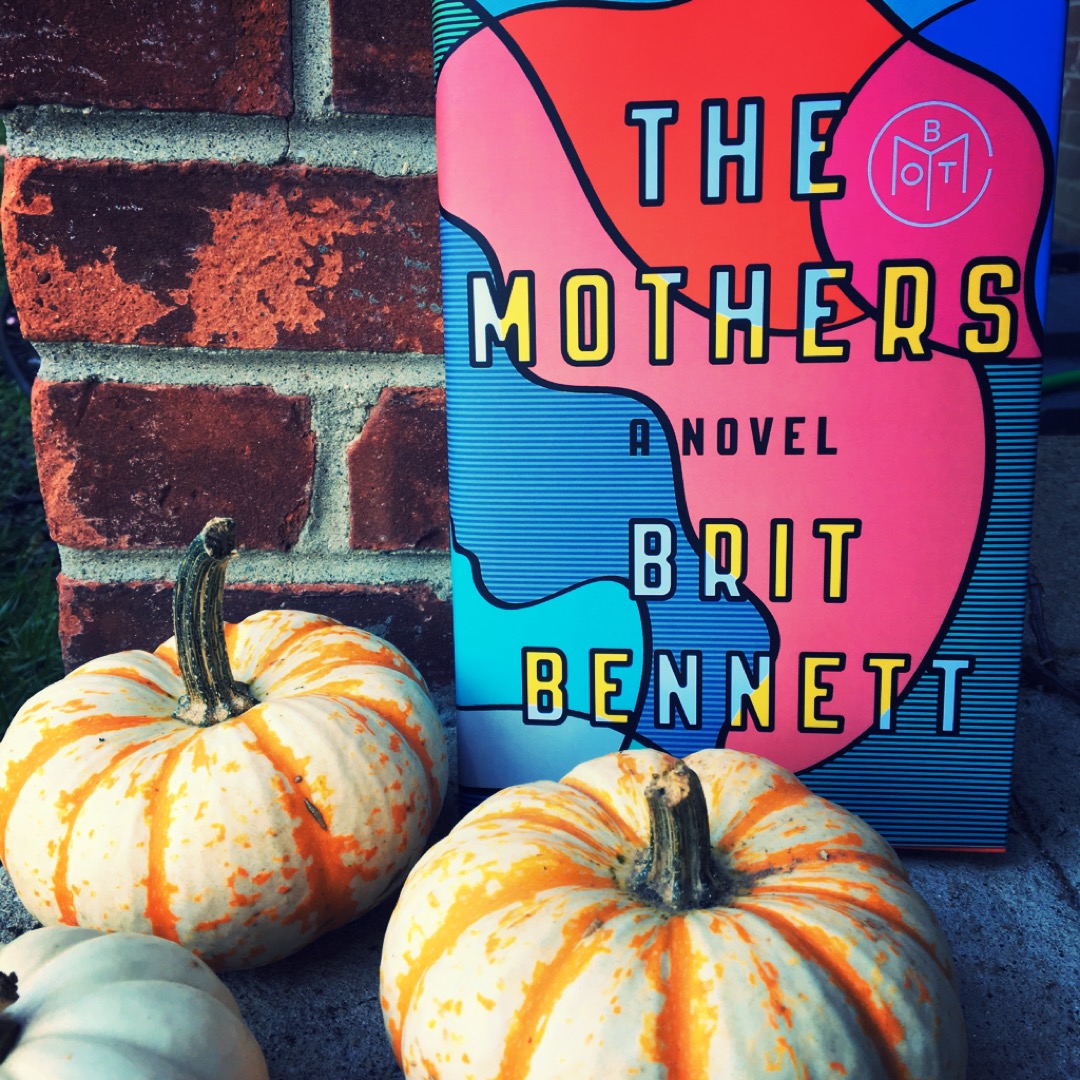
The Mothers photo by Carolyn OliverIf you’re a denizen of the bookternet, there’s no way you haven’t heard of this book, one of the most anticipated of the year. Brit Bennett’s debut novel follows three young people in Southern California—Nadia, Luke, and Aubrey—over the course of a decade.

Reeling after the death of her mother, Nadia becomes involved with Luke, the pastor’s son (and a former football star) during the summer before she leaves for college. But their time together ends in a secret and a coverup, one that if exposed would shake their tight-knit black community badly. After Luke and Nadia part ways, Nadia becomes close with Aubrey, a shy, chaste girl who’s often to be found helping Luke’s mother at their church.

The Mothers is a book about friendship, love, community, mothering, and most importantly, choices. The three main characters’ lives are webbed together not only by the paths they took, but by the paths they didn’t take, and these haunt them.

I loved the writing in this novel (though I wanted more from and about The Mothers, the elderly women who keep Upper Room, the church, running, and who serve as the collective narrator). Here are a few of my favorite lines:

“[ . . .] hard deaths resist words. A soft death can be swallowed with Called home to be with the Lord or We’ll see her again in glory, but hard deaths get caught in the teeth like gristle.”

“The pier was nothing but a long piece of wood that kept crumbling until it was rebuilt, and years later, she wondered if that was the point, if sometimes the glory was in rebuilding the broken thing, not the result but the process of trying.”

“Oh girl, we have known littlebit love. That littlebit of honey left in an empty jar that traps the sweetness in your mouth long enough to mask your hunger. We have run tongues over teeth to savor that last littlebit as long as we could, and in all our living, nothing has starved us more.”

What are your reading plans for this season? 

“When yellow leaves, or none, or few, do hang / Upon those boughs which shake against the cold”: Shakespeare’s Sonnet 73

sonnet-73

Dear Readers,

I know it’s only been five months since I posted a Shakespeare poem, but what’s fall without the most famous fall sonnet of them all? Admittedly it’s a bit gloomy, but I hope your autumn views (still spectacular here) make up for it.

Sonnet 73

William Shakespeare

That time of year thou mayst in me behold
When yellow leaves, or none, or few, do hang
Upon those boughs which shake against the cold,
Bare ruin’d choirs, where late the sweet birds sang.
In me thou see’st the twilight of such day
As after sunset fadeth in the west;
Which by and by black night doth take away,
Death’s second self, that seals up all in rest.
In me thou see’st the glowing of such fire,
That on the ashes of his youth doth lie,
As the death-bed whereon it must expire,
Consum’d with that which it was nourish’d by.
This thou perceiv’st, which makes thy love more strong,
To love that well which thou must leave ere long.

A view from my neighborhood.

A view from my neighborhood.

5 Reasons to Read: The Wangs vs. the World, by Jade Chang

5-reasons-to-read-the-wangs-vs-the-world

Jade Chang’s The Wangs vs. the World* is an exuberant, madcap debut novel about a family in crisis. It’s also one of the most anticipated novels of the fall. Here are five reasons to give it a try:

  1. the wangs vs the worldIt’s a spin on classic immigrant stories: Charles Wang, the patriarch of the family, came to the United States from Taiwan with next to nothing. Decades later, he’s a multimillionaire with a thriving cosmetics business—until the financial crisis hits. Suddenly Charles finds himself with no business, no home, and one very upset family. His new plan: head back to mainland China to reclaim the family land stolen in the Cultural Revolution. But first he needs to get from L.A. to upstate New York in a 38-year-old station wagon.
  2. It’s a road-trip novel: I can’t really remember the last time I read one of these. This is a high-energy book, and part of that is because the scenery changes so often–from L.A. to Arizona, Texas, New Orleans, North Carolina, and a tiny town in New York that hasn’t yet been found by New York City residents who need a country breather. Ms. Wang has a knack for conveying the flavor of a place, and she’s especially good at writing food, from crawfish and doughnuts to flaked whitefish and multi-course banquets.
  3. It’s chock full of compelling characters: Charles is headstrong, brash, lucky and then very unlucky, and full of dad jokes. He loves his luxuries (like his cigarette boat “painted with twenty-seven gallons of Suicide Blonde, his best-selling nail polish color”), but he loves his family more. Barbra, his second wife, is all seething analysis under her quiet exterior. Saina, the eldest daughter (a disgraced New York art-world darling) is torn between two men, and worse, can’t figure out how to move into the next phase of her life. Andrew is a sweet and funny would-be comedian. And Grace is an overprotected, undersupervised, suicide-obsessed, self-indulgent teenager. You’ll end up loving her.
  4. It’s angry: The first lines are, “Charles Wang was mad at America. Actually, he was mad at history.” Despite the futility of these feelings—sure, if none of twentieth-century history had happened, Charles would still be happily ensconced on his family’s land in China, he thinks—Charles still has them. Anger is, I think, an understudied emotion in novels, but this one has it in spades. All the Wangs, and most of the other characters who flit into their orbits, are angry about the way their lives have turned out. It’s compelling to watch them work their way out of that feeling.
  5. The ending: Well, I can’t really say much about that, can I? It’s satisfying without being overly neat—I loved it.

What are you reading this week?

*I received a copy of this book from the publisher for review consideration, which did not affect the content of my review.


Recommended Reading: Monica Youn’s Blackacre

blackacre-1

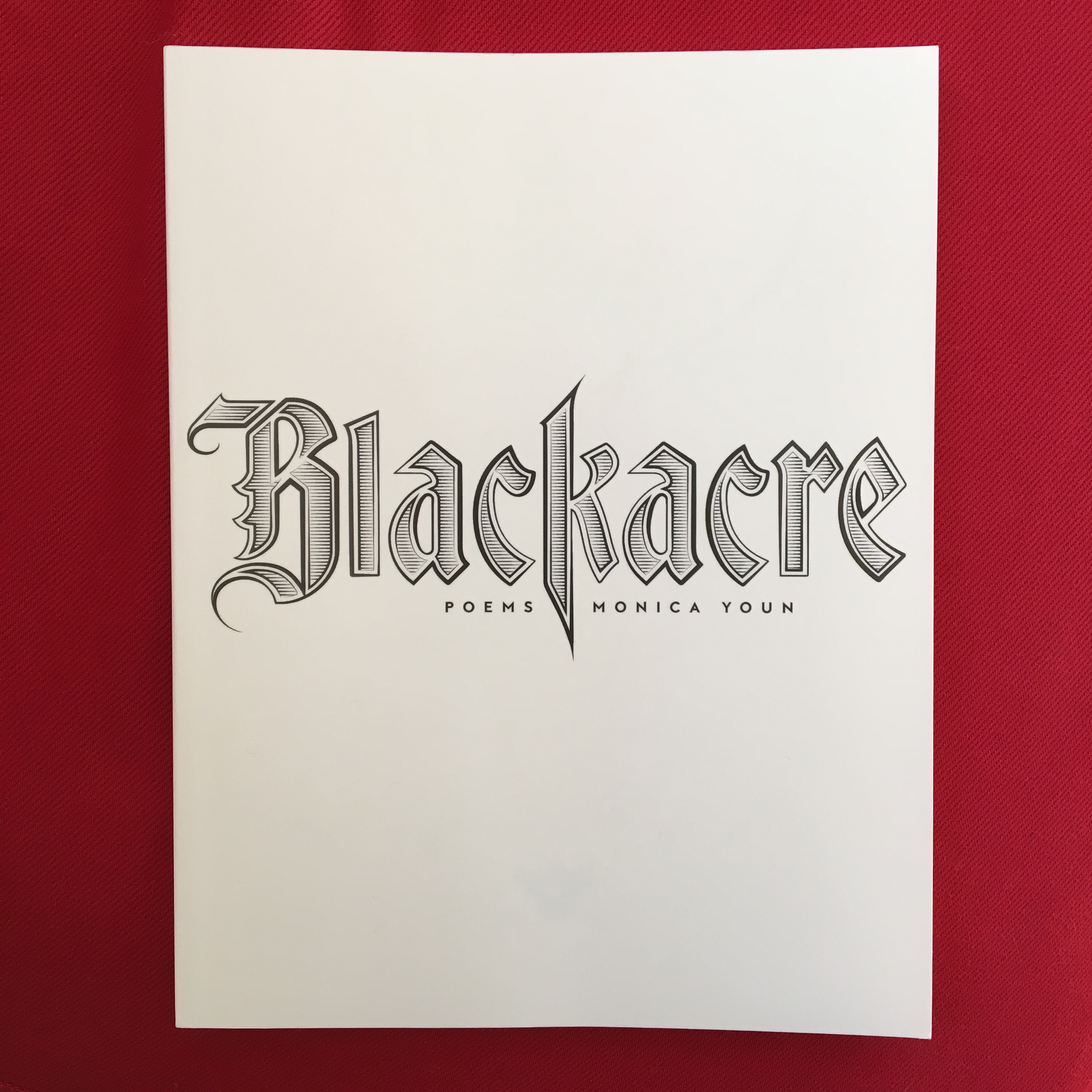
Monica Youn’s Blackacre* practically shimmers with intelligence as it ranges over subjects including desire, territory (physical, emotional, imaginative), race, and fertility. Here intellect meets imagery with an intensity so great it took my breath away.

fullsizerender-5In the first section, eleven poems circle and interrogate Francois Villon’s fifteenth-century Ballade des pendus (Ballad of the Hanged Men); these poems are about transformation, and life as much as death. In “Portrait of a Hanged Woman,” the speaker rejects the Greek notion of catastrophe (the fall from grace):

No it is
the sudden
terrible

elevation of
a single point—
one dot

on the topography
of a life.

Later in the poem, she writes:

A life is not
this supple

it is not meant
to fold, to be
drawn through

a narrow ring.

These very short lines do make me think of falling, always (although that’s maybe my own readerly idiosyncrasy), which plays against the assertion that catastrophe is an elevation. And see how the narrow lines mimic the “narrow ring” of the second quotation?

Blackacre‘s second and third sections offer an eclectic sampling of forms, lengths, and subjects, from the brief, ekphrastic “Quinta del Sordo” to the multi-section “Epiphyte.” These are poems intimate enough to be whispered, learned enough to be declaimed from a lectern.

It is in the third section that the poet introduces the “____acre”; as Monica Youn explains in an essay for The Poetry Foundation, “‘Blackacre‘ is a legal fiction, an imaginary landscape. Just as we use ‘John Doe’ for a hypothetical person, lawyers use ‘Blackacre’ as a placeholder term for a hypothetical plot of land.” The hypothetical nature of the poems’ titles belies their specificity (“minnows wheeling in meticulous formation/ the occasional water snake, angry, lost.”) and (for some) their grounding in the presumably autobiographical “I.”

While I have returned and will again to many of these poems, it’s the fourth section, comprised of two poems (both called “Blackacre”) that I cannot get out of my head.

The second of the two poems, which you can find here, is an extended meditation on Milton’s famous Sonnet 19 (“On His Blindness”); you might remember its final line: “They also serve who only stand and wait.”

“Blackacre” is a long prose poem in fourteen sections. Each section takes as starting point the last word in the corresponding line of Milton’s poem, from which the speaker undertakes a close reading of the sonnet and her own experience with infertility. In the first section, she notes,

I came to consider my body — its tug-of-war of tautnesses and slacknesses — to be entirely my own, an appliance for generating various textures and temperatures of friction. Should I have known, then, that by this act of self-claiming, I was cutting 
myself off from the eternal, the infinite, that I had fashioned myself into a resource that was bounded and, therefore, exhaustible?

I read this poem for the first time in the car, as we drove west at twilight. The sky gradually darkened, and I struggled to catch the last of the sun so I could read the last few pages of this brilliant, cooly radiant book.

Highly recommended.

*I received a copy of this book for review consideration, which did not affect the content of my review.

Recommended Reading: Hag-Seed, by Margaret Atwood

hag-seed

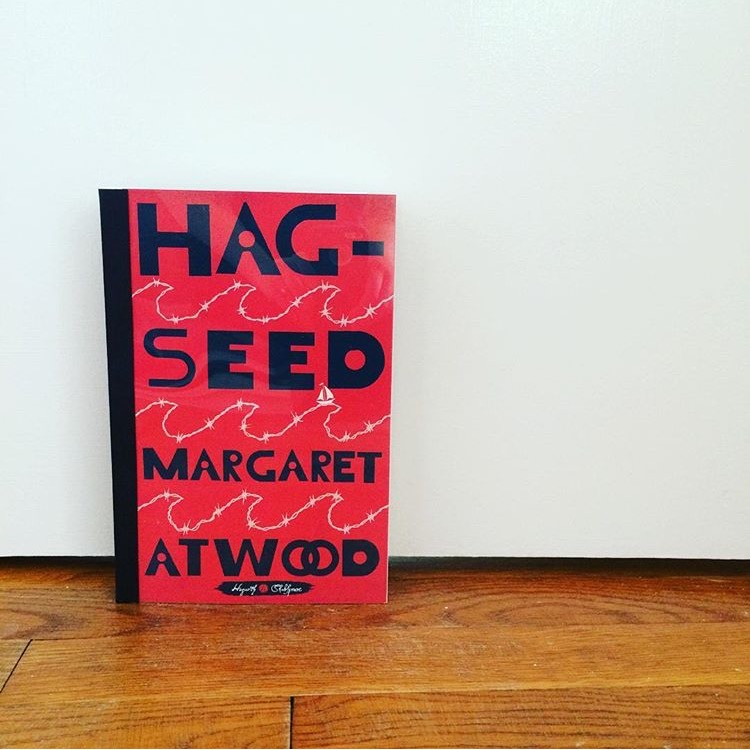
When Margaret Atwood’s Hag-Seed* arrived in the mail, I could barely contain my glee. Margaret Atwood (the Helen Mirren of authors, as I sometimes think of her) taking on Shakespeare? Yes please!

Hag-Seed photo by Carolyn OliverHag-Seed lived up to all my expectations (and it’s the best so far in the Hogarth Shakespeare series, too). I highly recommend the book (and teachers, it would be fabulous to teach alongside its source material), which is often funny, often touching, often a rollicking good time (especially for Shakespeare aficionados), and always thoughtful. It’s a tour-de-force reimagining of The Tempest, and like the original, a provocative examination of theatre, authorship, imprisonment, revenge, and grief.

Felix Phillips is the impresario Artistic Director of the Makeshiweg Theatre Festival. His productions have been beyond avant garde (audience complaints include “Did Lear have to take off all his clothes?”; Felix thinks, “What was so bad about Macbeth done with chainsaws? Topical. Direct.”), and after the sudden loss of his beloved daughter, Miranda, he throws himself into the play he thinks will bring her back to life: The Tempest. However, he’s so caught up in preparations that he doesn’t notice the machinations of Tony Price, his glad-handing lieutenant, who, with the help of Lonnie Gordon, the Chairman of the Board, subsequently ousts Felix from his position.

Despondent, Felix retreats to a hovel in the Canadian backwoods, contemplating revenge and building a new life as “Mr. Duke.” As his alter-ego—which is of course Prospero, as he knows—he takes a job teaching Shakespeare through performance to prison inmates. Years pass, but when Tony and Lonnie seem poised to pass within his orbit, Felix hatches his revenge plot—and begins to teach The Tempest to the Fletcher Correctional Players.

Hag-Seed is delightfully layered; it’s a novel whose plot is taken from a play, and in the novel the characters are enacting the play as they prepare to enact the play (got that?). And by writing Felix teaching his players The Tempest, and respecting their (varied) readings of it, Margaret Atwood is teaching us about the text and its interpretations—while also conveying the importance of literature in prisons. “It’s the words that should concern you [. . . ] That’s the real danger. Words don’t show up on scanners,” Felix thinks, going through the metal detectors and chatting with the guards.  Atwood is, of course, fascinated with imprisonment (The Handmaid’s Tale, The Heart Goes Last, Alias Grace), so it’s a treat to watch her teasing out the power relationships in the novel (and in The Tempest).  It is, as the kids used to say, very meta.

As some reviewers have noted, the minor players are not remarkably distinct from each other; our knowledge of their backgrounds is limited. While that might be a fault in a standalone novel, to me this decision makes sense given the source material. Without picking up your Collected Works, can you recall how Stephano and Trinculo differ?

There are, of course, departures from Shakespeare’s play. Felix is animated not only by revenge and a desire to reclaim his position, but also, most importantly, by grief (in a way that Prospero is not). For Felix, staging The Tempest is a way to make Miranda live again, to take substance, almost. During his years of exile, his imagining of the lost girl is a ghost, a spirit, gradually transforming into Ariel whispering in his ear.

And Prospero, in these years of exile, is Caliban, misshapen by grief and the thirst for vengeance, pinched by loneliness into a new version of his former wild self, but able to call up sweet music and language all the same.  That’s why (I believe) the book is called Hag-Seed, after one of Prospero’s epithets for Caliban; the word brings them together, and means, of course, the child of a witch. And what is Atwood if not a conjuror, and what are her books if not progeny that cannot die?

Related:

My take on Margaret Atwood’s most recent previous novel, The Heart Goes Last (which I read as a take on Milton)

Review of Vinegar Girl, Anne Tyler’s novelization of The Taming of the Shrew

Review of The Gap of Time, Jeanette Winterson’s retelling of The Winter’s Tale

*I received a copy of this book from the publisher for review consideration, which did not affect the content of my review.

Recommended Reading: The Best American Short Stories 2016 Edited by Junot Díaz and Heidi Pitlor (series editor)

best-american-short-stories-2016

I love The Best American Short Stories anthologies; usually, I’ll have one around for quite awhile, dipping in from time to time when I want to read a story but don’t want to commit to a novel or a whole collection.

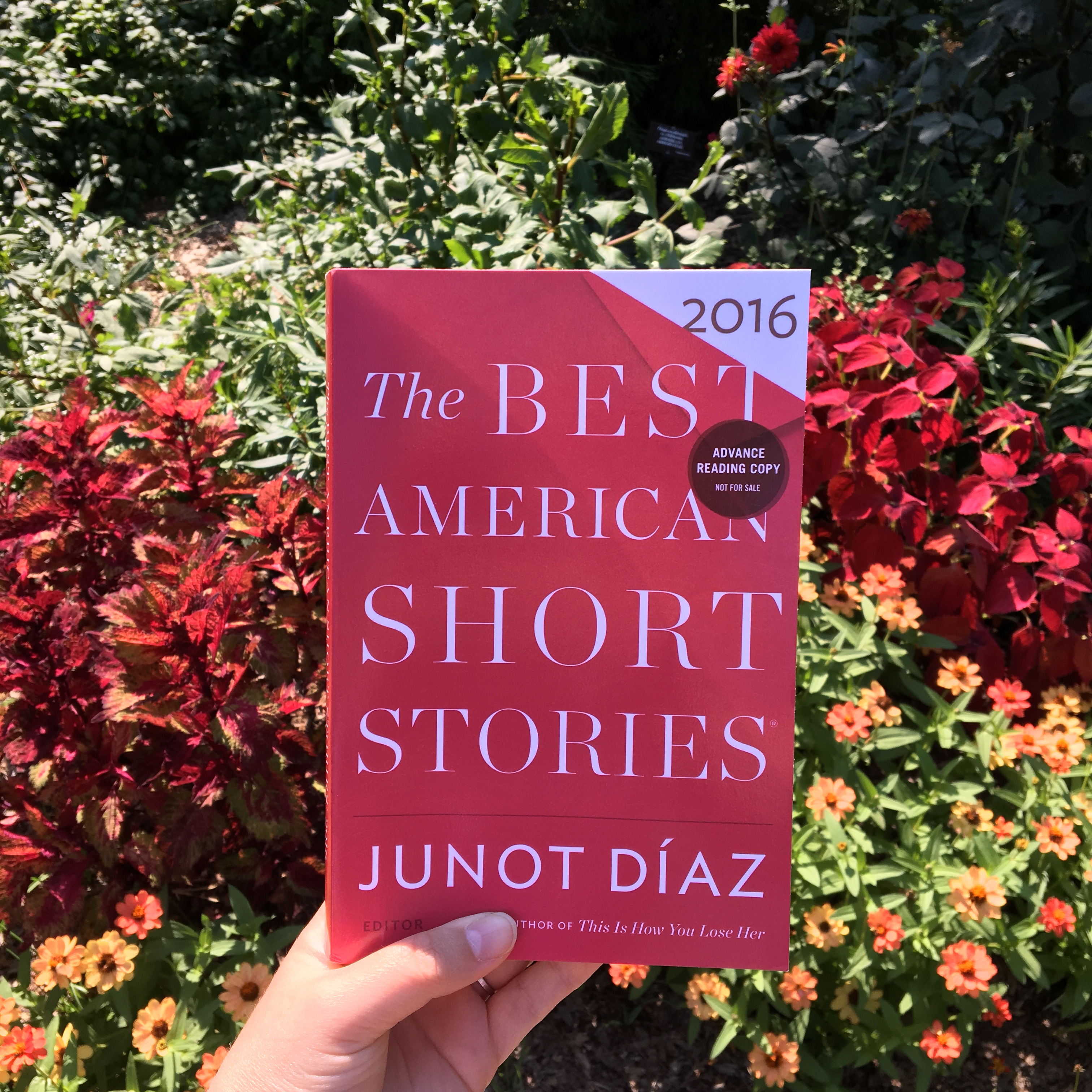
This year, though, I read The Best American Short Stories 2016* cover to cover, and I’m soimg_0839 glad I did. Like many writers, I subscribe to a rotating cast of literary magazines, but it’s impossible to read them all—unless that’s your job. Guest editor Junot Díaz and series editor Heidi Pitlor read many, many stories and chose twenty for this year’s anthology. Their choices are diverse in style, length, subject, and authors’ identities. This is a stellar collection, and I highly recommend it.

While I’d be happy to read any of these stories again, and Junot Díaz’s introduction is not to be missed, standouts (to me) included:

  • “Apollo” by Chimamanda Ngozi Adichie: In Enugu (a city in Nigeria) a man looks back to his childhood, when his friendship with a family servant his own age ended disastrously. “Reading did not do to me what it did to my parents, agitating them or turning them into vague beings lost to time, who did not quite notice when I came and went.”
  • “The Letician Age” by Yalitza Ferreras: A girl and geology, tragedy and family, love and a volcano. “Yet once in a while a person explodes out of her bedrock and becomes someone else.”
  • “For the God of Love, for the Love of God” by Lauren Groff: Tensions simmer as two friends and their husbands share a house in France. “She’d never met a child with beady eyes before. Beadiness arrives after long slow ekes of disappointment, usually in middle age.”
  • “Bridge” by Daniel J. O’Malley: “His mother’s words found a home in his mind the moment they left her mouth.” A boy, supposed to be studying, watches as an elderly couple prepares to jump from a bridge. Absolutely killer last line, which I won’t quote.
  • “On This Side” by Yuko Sakata: A changed figure from a man’s past returns asking for help, or maybe to confront him. “The first thing he felt on the staircase was a knot forming in his stomach, a forgotten seed of guilt he didn’t care to inspect, and now it was threatening to grow.

Two other stories, “Cold Little Bird” by Ben Marcus and “Gifted” by Sharon Solwitz, scared the heck out of me. The first is about a little boy who suddenly and totally withholds all affection from his parents; the second is about a woman whose son becomes critically ill. That’s not really what they’re about, of course–that’s just the framework, but let me tell you: chills. I had to go eat a piece of chocolate after “Cold Little Bird.”

And if you haven’t yet read Louise Erdrich’s excellent LaRose, you can get a taste here; her story “The Flower” is adapted from the novel.

Finally, one of the best parts of these anthologies are the Contributors’ Notes at the end–each includes a short bio of the author and some background on how the story came to be written and published—whether dashed off in a day or labored over for years and dozens of drafts. Fascinating.

Have you read any of the “Best American” anthologies? Do you have a favorite to recommend?

*I received a copy of this book from the publisher for review consideration, which did not affect the content of my review.

“A far sea moves in my ear”: Sylvia Plath’s “Morning Song”

morning-song

Around this time last year, I wrote a quick poetry post to welcome our first niece into the world. I’m delighted to say that this week, we welcomed our second niece (the first on my husband’s side of the family)—she was unexpectedly early, but given her sweet countenance and perfect health, I suspect that, like a wizard, she arrived precisely when she meant to.

This week, then, I’m reading Sylvia Plath’s “Morning Song,” a poem that might remind parents out there of their own first mornings with little ones. This stanza in particular had me strolling down memory lane:

All night your moth-breath
Flickers among the flat pink roses. I wake to listen:
A far sea moves in my ear.

Welcome to the world, Eleanor Hermione!