“the flesh inside them once white and wet as snow”: Jennifer Grotz’s “The Snow Apples,” from Window Left Open

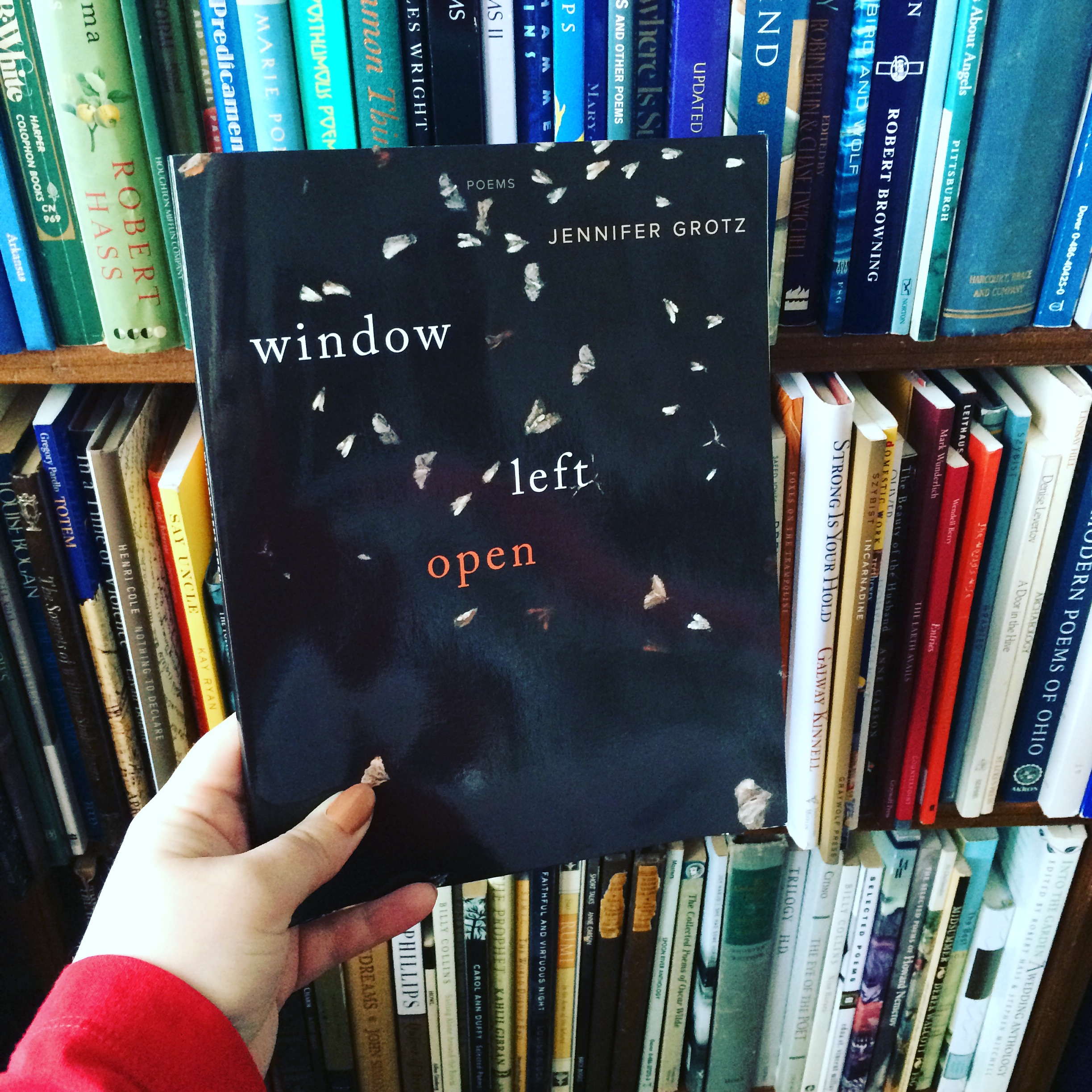
IMG_6313I’ve been slowly reading Jennifer Grotz’s third poetry collection, Window Left Open*, over the last three weeks, a keenly enjoyable experience because her poems invite the very kind of attentiveness that they demonstrate.

In “The Snow Apples,” which you can read here, the speaker considers the “Dulled, shrunken, nicked by wind-flung branches, / squirrel-pawed and beak-pierced, infested / macabre baubles hanging” from the apple tree in February, grasping the branches when most apples  fell together in  “a syncopation” in autumn. These winter apples the speaker compares to “a hard knot / deep in the core, something winter / winnow me down to.” I like the clever use of “core” here, the way the line breaks so that for a a moment the reader can imagine that the “hard knot” is “something winter.” The sadness of these “indegestible” apples “piled beneath the earth’s pelt of snow” is a disquieting, vivid metaphor for the speaker’s sense of disturbance in the long gray months.

Engagement with the natural world runs through Window Left Open, in which you’ll find (in just the first section) a forest with an “unending / staircase of roots worn silver like the soldered iron / that holds stained glass together,” snowflakes “denticulate as dandelion greens,” a display of living, giant cockroaches alongside pinned butterflies, rain “stately at first as punctuation,” a foreign city with “a gray, nearsighted river / one that massages the eyes, focuses / the sweeping birds that skim the water’s surface.”

The second section of the book finds the poet meditating on her time at a French monastery. There’s a poem about a piano in the Alps, one about the impossibility of glimpsing the entirety of a mountain from a window, another about a peacock “as strange as Mount Rushmore.” One of my favorites is called “Apricots,” which will make you see the fruit in a whole new way (“And the ripe ones, which felt like biting into / my own flesh, slightly carnivorous.”).

It’s tempting to go on quoting the memorable images in these poems; it’s harder to get at the sense of the speaker observing not only her world, but herself, and finding unexpected loveliness and unexpected fear, often at the same time. In “Poppies,” Ms. Grotz writes,  “Love is letting the world be half-tamed.” If you look closely enough at anything—an animal, a window, even a word—you’ll find a distancing peculiarity, and Ms. Grotz translates that feeling in these poems. She has a gift for making the familiar strange, and making the strange familiar. I highly recommend Window Left Open.

Further reading:

Ta-Nehisi Coates on “Poppies”

“Self-Portrait on the Street of an Unnamed Foreign City”

*I received a copy of this book from the publisher for review purposes, which did not affect the content of my review.

“the rueful admission”: Billy Collins’s “The Lanyard”

Collins_The LanyardA couple of years ago, in a post about my mother, I obliquely mentioned “The Lanyard,” a poem by Billy Collins. “The Lanyard” was the eulogy my uncle read at my grandmother’s funeral recently, and so I’m featuring it this week. It’s one of my favorite poems about parents and children, and I hope you’ll like it too.

Here’s a link to Mr. Collins reading the poem. 

“People say — This is how the world works”: Emily Mohn-Slate’s “Needlework”

Emily Mohn-Slate -Needlework-This week’s poem is very new; “Needlework” was just published in Tupelo Quarterly. Emily Mohn-Slate is a poet and teacher, and I had the pleasure of meeting and becoming friendly with her in graduate school (you can read more about Emily here).

I loved “Needlework” as soon as I read it. I’m interested in poems about people’s working lives and poems about everyday events (breakfast, phone calls, walks), and this poem is about both. There’s both a playfulness (the references to the gym and the treadmill–working out–in a poem about work) and a seriousness to it. This stanza–

My father told me to do what I loved to do — one third of my life
will be work. Every day, he arrived home ashen,
hiked the basement stairs broken by long pauses.

–is to me the crucial one (Note how all the stanzas are built to resemble stairs. And the description of the speaker’s father reminds me of Robert Hayden’s brilliant “Those Winter Sundays”). How many of us have been told to do what we love, and how many of us find ourselves instead doing a job we merely stand?

I think the poems suggests that the key to avoiding misery in the work that is one third of one’s life is finding something to love in the work, no matter what it is. Take the men who “cut off the trees’ hands.” This doesn’t seem, at first glance, like loveable work, to prune away something that’s alive (reinforced by the use of “hands” for branches), and yet the speaker thinks she hears “them singing,” an echo of the hum of the machines in the first stanza.

It’s a poem that bears re-reading, and I hope you’ll find it as rewarding as I have.

What’s your favorite poem about work?

“I never saw light that way / again”: Dorothea Grossman’s “The Two Times I Loved You Most In a Car”

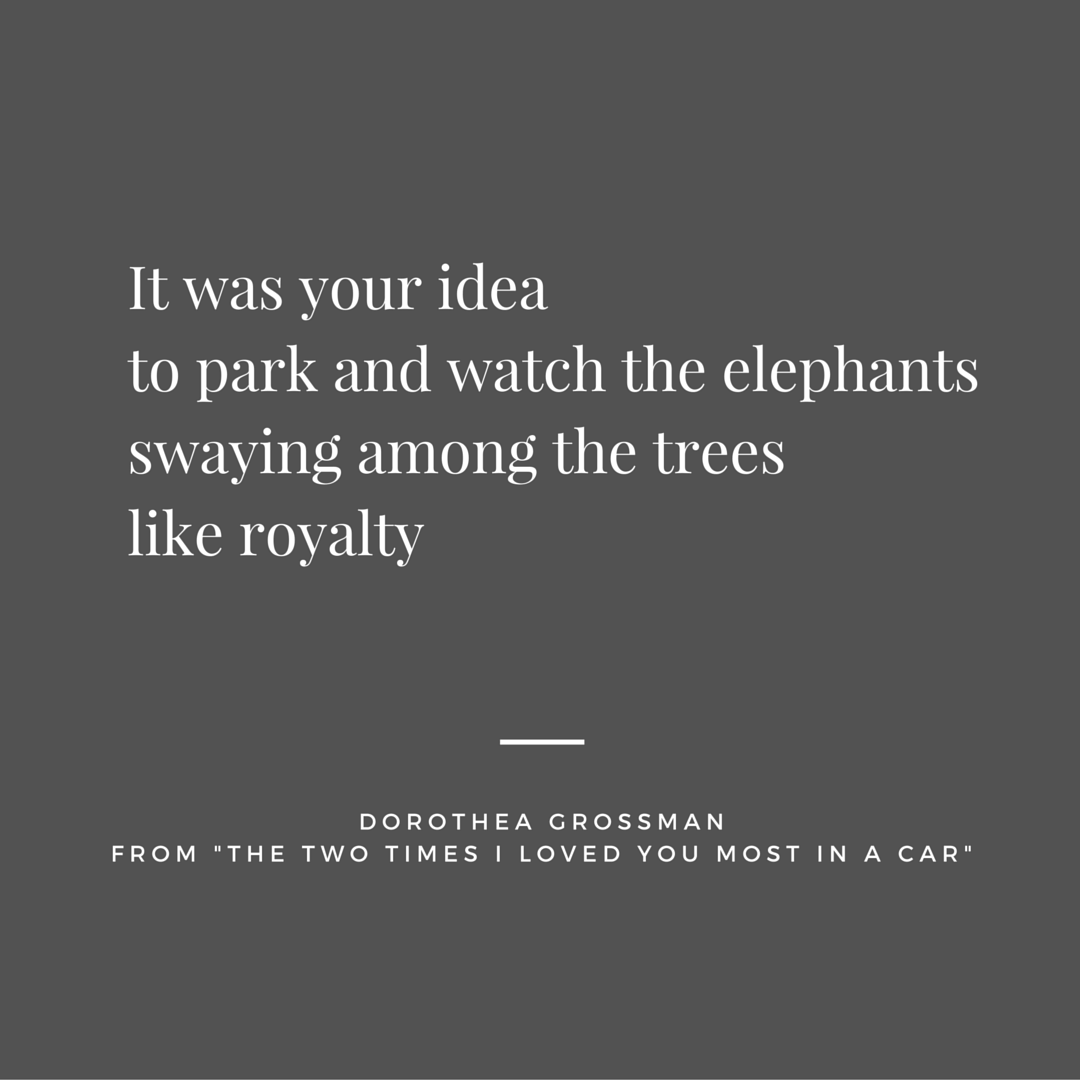
Dorothea GrossmanA tip of the hat to my friend, poet Ashley McHugh, for bringing Dorothea Grossman’s “The Two Times I Loved You Most In a Car” to my attention. In this two-stanza poem, the speaker recalls two instances in which sensory experience startled her: the quietness of elephants swaying among palm trees, and the appearance of stars in the desert night sky.

(You can read more about Dorothea Grossman here and here.

It’s a beautiful little poem; I’ve been thinking about who the addressed person is (A partner? A parent? A friend?).

What do you think? If you were to write a poem on the same subject, which two experiences would you write about?


13 Poems for Galentine’s Day

Friends, there’s a holiday this weekend that we should be celebrating with mimosas, flowers, and massive quantities of waffles with whipped cream.

I’m talking, of course, about Galentine’s Day.

What’s Galentine’s Day, you say?

giphy

It’s only the best day of the year, according to notable Pawnee citizen Leslie Knope.

Galentine’s Day is February 13, and it’s the day when “friends leave their husbands and their boyfriends at home and just kick it breakfast style. Ladies celebrating ladies. It’s like Lilith Fair, minus the angst. Plus, frittatas!” Sorry dudes, but uteruses before duderuses, you know what I mean?

Anyway, Leslie Knope competes only with C.J. Cregg for the title of “Carolyn’s Favorite Fictional Female Government Official,” and let me tell you, those ladies would throw the best planned and wittiest Galentine’s brunch this fine nation has ever seen.

I like to think that brunch would feature readings hand-selected for participants by Leslie Knope; as dedicated Parks and Rec fans know, she once matched poetry with Scotch in a way that moved even the stolid Ron Swanson.

So, in honor of Leslie Knope and in celebration of Galentine’s Day, here are 13 poems on friendship by female poets. Some are elegiac, some are sad, some are funny, some are opaque, some are straightforward—but all are by talented ladies, and I hope you like them.

Happy Galentine's Day!Patricia Spears Jones, “What Beauty Does”

Regan Huff, “Occurrence on Washburn Avenue” 

Elizabeth Woody, “Girlfriends” 

Katherine Philips, “Friendship’s Mystery, To my Dearest Lucasia”

Tess Gallagher, “Love Poem to Be Read to an Illiterate Friend”

Bernadette Mayer,“On Gifts for Grace”

Rebecca Lindenberg, “Letter to a Friend, Unsent”

Jessica Greenbaum, “I Had Just Hung up from Talking to You”

Margaret Kaufman, “Photo, Brownie Troop, St. Louis, 1949” 

Colette Labouff Atkinson, “Perhaps this verse would please you better—Sue—(2)”

Carolyn Kizer, “October 1973”

Lucilla Perillo, “The Garbo Cloth”

Eloise Klein Healy, “The Beach at Sunset”


What will you be reading to celebrate Galentine’s Day?

“Various long midwinter Glooms. / Various Solitary and Terrible Stars”: Alice Oswald’s “Various Portents”

AliceOswald_VariousPortentsI’m partial to poems that are lists; it’s always impressive when a poet can give an impression of action, or set a mood, simply by making a list of items.

Alice Oswald is a poet I know nothing about, but a quick look at her biography at The Poetry Foundation intrigued me; I’m now itching to read Memorial, her treatment of the Iliad, and Dart, a book that’s based on her research into the history of the community around a river in Devon, England.

“Various Portents” is subtly ominous and a bit wintry; it made me think of Game of Thrones (though no, I still haven’t read the book). What do you think of the poem?

“recast in our image”: Lisel Mueller’s “Things”

Mueller_ThingsI like naming things; maybe you do, too. I have a velvet chair named Daisy (it was my friend’s chair first; when she was young it was orange, but now it’s faded to a golden yellow), and once we had fish named Dunder, Mifflin, Don Draper, Giles, and Admiral Ackbar.

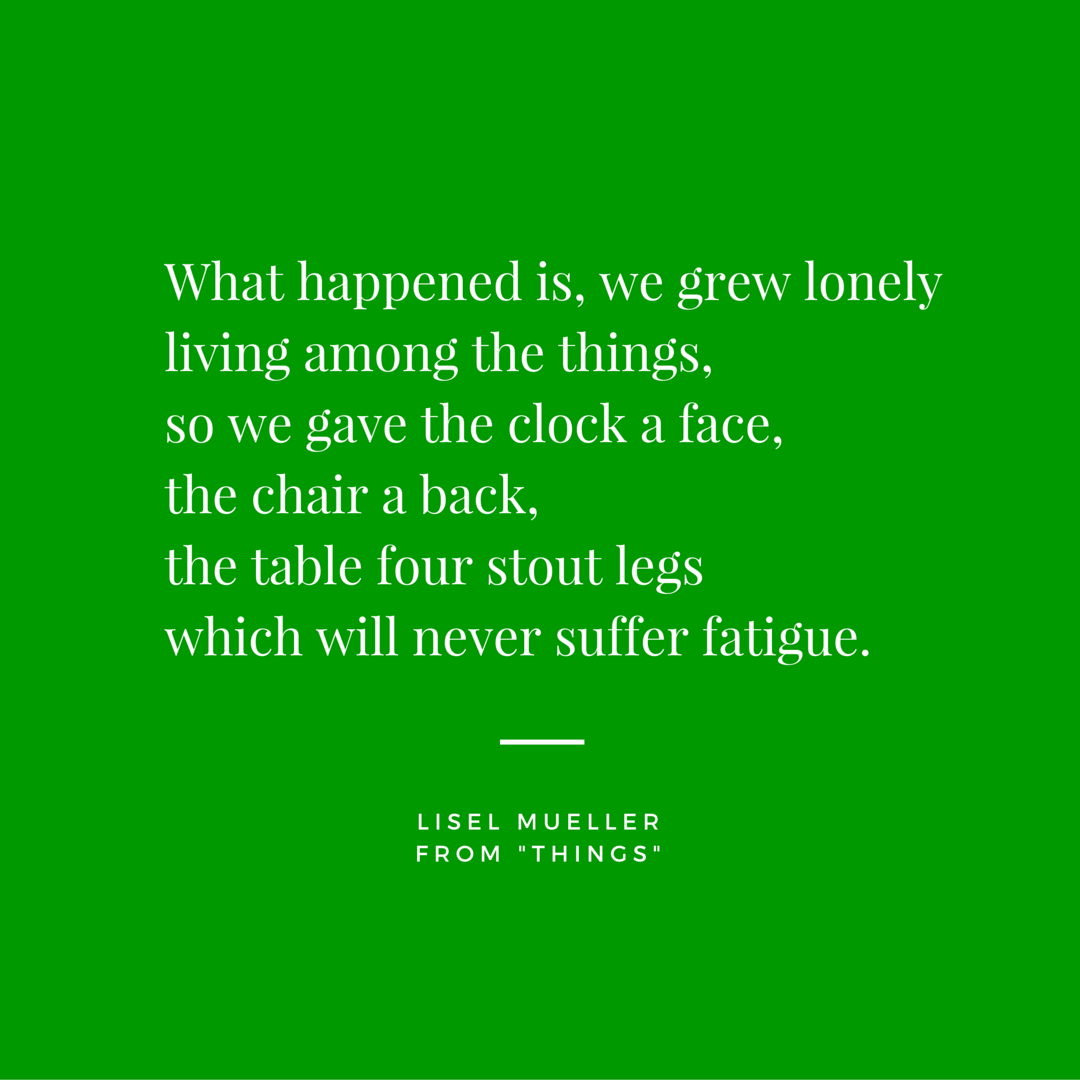
Lisel Mueller’s poem “Things” points out the ways in which, over time, we’ve named parts of objects after ourselves. It reminds me a bit of Heather McHugh’s poem “Etymological Dirge” in the way it offers us a new way to think about words we use every day.

What’s your favorite poem about an everyday object?

In Brief: Poetry and Picard

Dear Readers,

I hope you’ll forgive this departure from our regularly scheduled programming for two brief notes.

First, my first published poem is online to be read or listened to (that’s me reading in a very sleepy voice that I hope comes across as appropriately serious and poetic). It’s about Catherine of Aragon, whom I’ve always found fascinating and rather tragic, in the way that sixteenth-century son-less Spanish princesses can be.

ClementineNext:

Some weeks ago I mentioned that I’m writing an advice column called Dear Clementine; you can read the first column, called “The Other Picard,” here. It involves both babies and Star Trek. And please do send questions to dearclementinepostscript [at] gmail [dot] com.

And that’s the news from here. What are you up to, Dear Readers?

“All glam-glow, all twinkle and gold”: Tracy K. Smith’s “Don’t You Wonder, Sometimes?” (RIP David Bowie)

Tracy K. Smith-Bowie

Since David Bowie has left us for what I’m guessing must be some sort of starsplitting transcendent plane, it’s only appropriate this week to feature Tracy K. Smith’s gorgeous and evocative “Don’t You Wonder, Sometimes?” from her appropriately titled collection Life on Mars

The poem has been making the rounds this week—justifiably so—because it hones in on the multi-persona man as a way to consider the big questions about time, space, death, and belief. In the poem, Bowie is both an otherworldly immortal figure and one of us—just immeasurably cooler (literally, in part two of the poem). I pretty much want to quote the whole poem right now, so please read it. 

Bowie was an avid reader, and if you’re craving more bookish Bowie goodness, head over to BookRiot to check out their list (from summer 2015) of all things books and Bowie.

Turns out I can’t resist quoting the poem:


And how many lives

Before take-off, before we find ourselves

Beyond ourselves, all glam-glow, all twinkle and gold?


Safe travels, Starman.

bowie-reading

“Light larking”: Floyd Skloot’s “Handspun”

About a year ago, I wrote a quick post about poems related to knitting, an activity I find myself frantically trying to finish most holiday seasons (this year I made three scarves, four cowls, four headbands, and I still owe my son a pair of slippers). I much prefer knitting in a more leisurely fashion, and I love seeing the complex projects skilled knitters (I am not among this number) produce—delicate lace, shawls worked with intarsia so that they look like tapestries, that sort of thing. Most of the best projects I see are made with gorgeous wool, to which I am sensitive if not downright allergic, and some are even made with handspun varieties.

Spinning is an art I’ll never practice, but I do love reading about it. And if you’re ever out in Colorado, the Denver Art Museum features a whole floor devoted to textile arts; when I visited a volunteer was demonstrating how she spins wool into yarn at home. It was absolutely fascinating, and I recommend popping by if you’re able.

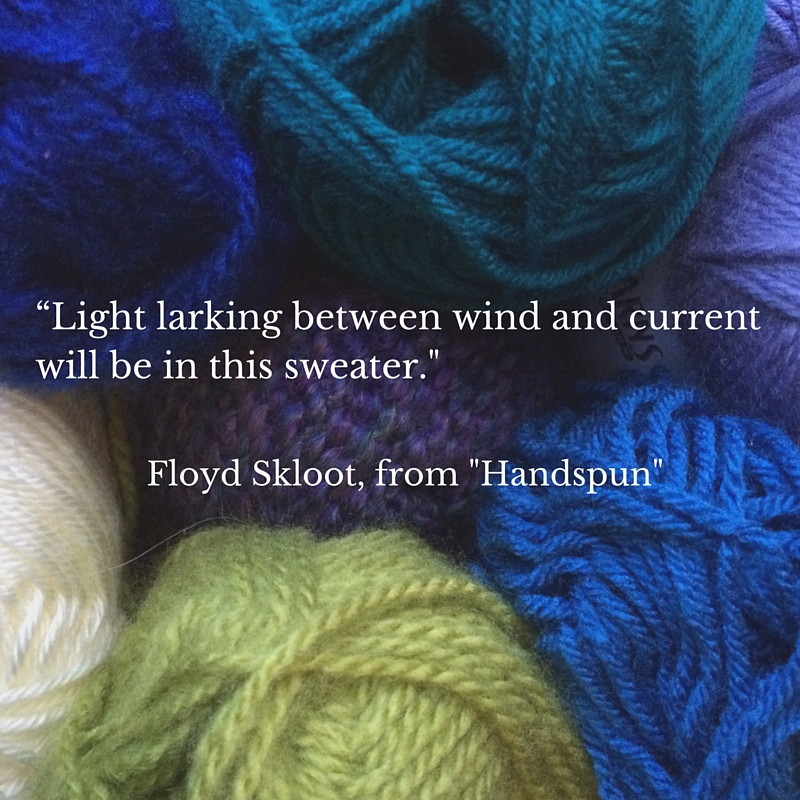
Floyd Skloot Handspun quoteWhich brings me to the poem of the week, Floyd Skloot’s “Handspun,” which was featured in this week’s American Life in Poetry series, curated by Ted Kooser (I highly recommend signing up for the weekly email; Mr. Kooser chooses brief, relatable poems, which are paired with his pithy introductions). In this poem, the speaker watches his wife as she begins yarn for a “summer sweater,” one meant to be worn in summer and one that captures in its colors some of summer’s light.

I like the sensory detail of this poem (it features sound and texture and imagery), and I like the way circularity is subtly emphasized: the swivel chair, the spinning wheel, the sun, the woman “ringed” by yarn—all suggesting the act of spinning itself.  The “swollen river” too might be considered  circular, or at least circulating in nature.

But my favorite line is “Light larking between wind and current / will be in this sweater.” What a verb. What a linebreak.

By the way, if you were wondering why the poet’s last name sounds familiar, it might be because he’s the father of Rebecca Skloot, author of the mega-successful The Immortal Life of Henrietta Lacks (which apparently everyone except me has read).

Do you have a favorite poem about one of your hobbies?