Recommended Reading: Monica Youn’s Blackacre

blackacre-1

Monica Youn’s Blackacre* practically shimmers with intelligence as it ranges over subjects including desire, territory (physical, emotional, imaginative), race, and fertility. Here intellect meets imagery with an intensity so great it took my breath away.
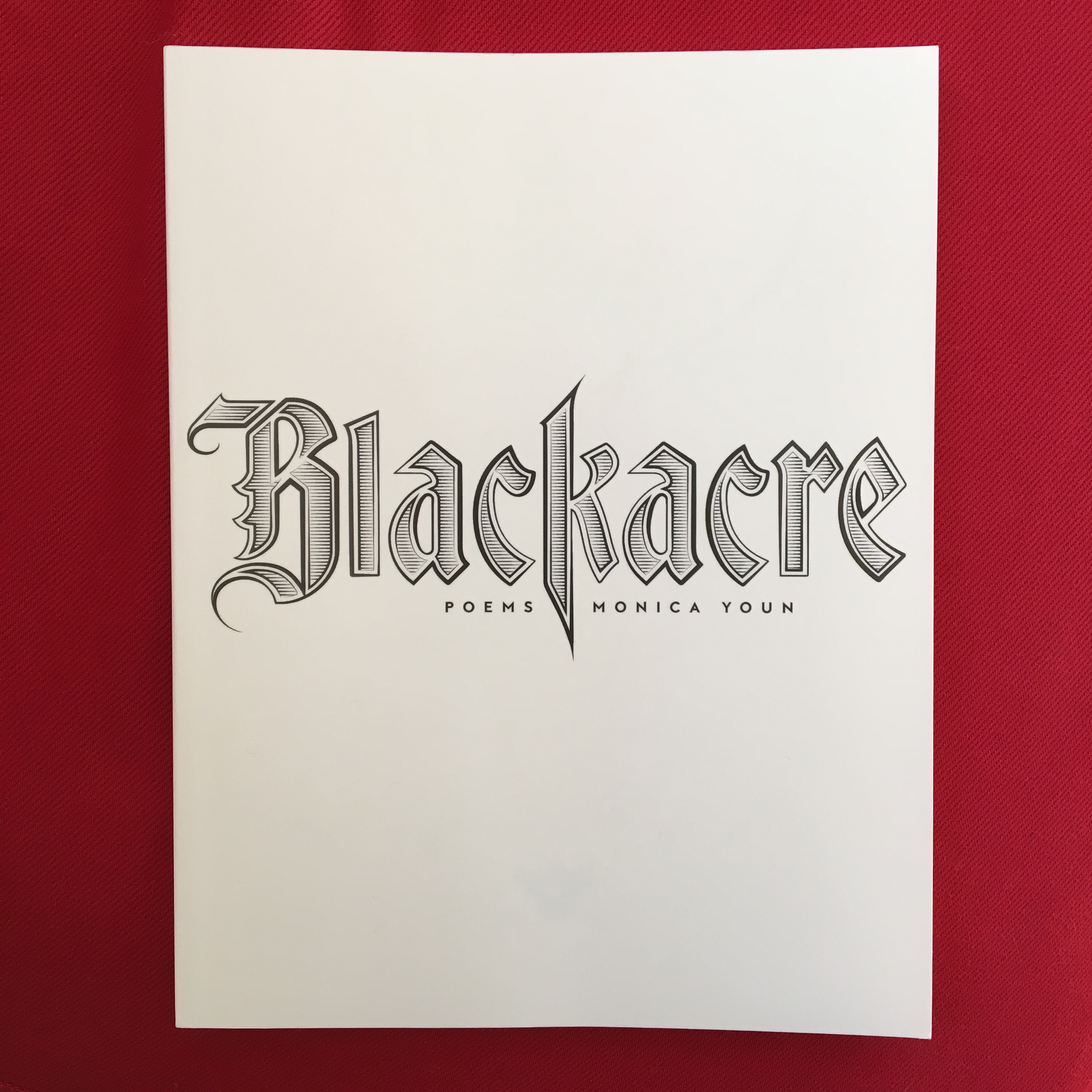
fullsizerender-5In the first section, eleven poems circle and interrogate Francois Villon’s fifteenth-century Ballade des pendus (Ballad of the Hanged Men); these poems are about transformation, and life as much as death. In “Portrait of a Hanged Woman,” the speaker rejects the Greek notion of catastrophe (the fall from grace):

No it is
the sudden
terrible

elevation of
a single point—
one dot

on the topography
of a life.

Later in the poem, she writes:

A life is not
this supple

it is not meant
to fold, to be
drawn through

a narrow ring.

These very short lines do make me think of falling, always (although that’s maybe my own readerly idiosyncrasy), which plays against the assertion that catastrophe is an elevation. And see how the narrow lines mimic the “narrow ring” of the second quotation?

Blackacre‘s second and third sections offer an eclectic sampling of forms, lengths, and subjects, from the brief, ekphrastic “Quinta del Sordo” to the multi-section “Epiphyte.” These are poems intimate enough to be whispered, learned enough to be declaimed from a lectern.

It is in the third section that the poet introduces the “____acre”; as Monica Youn explains in an essay for The Poetry Foundation, “‘Blackacre‘ is a legal fiction, an imaginary landscape. Just as we use ‘John Doe’ for a hypothetical person, lawyers use ‘Blackacre’ as a placeholder term for a hypothetical plot of land.” The hypothetical nature of the poems’ titles belies their specificity (“minnows wheeling in meticulous formation/ the occasional water snake, angry, lost.”) and (for some) their grounding in the presumably autobiographical “I.”

While I have returned and will again to many of these poems, it’s the fourth section, comprised of two poems (both called “Blackacre”) that I cannot get out of my head.

The second of the two poems, which you can find here, is an extended meditation on Milton’s famous Sonnet 19 (“On His Blindness”); you might remember its final line: “They also serve who only stand and wait.”

“Blackacre” is a long prose poem in fourteen sections. Each section takes as starting point the last word in the corresponding line of Milton’s poem, from which the speaker undertakes a close reading of the sonnet and her own experience with infertility. In the first section, she notes,

I came to consider my body — its tug-of-war of tautnesses and slacknesses — to be entirely my own, an appliance for generating various textures and temperatures of friction. Should I have known, then, that by this act of self-claiming, I was cutting 
myself off from the eternal, the infinite, that I had fashioned myself into a resource that was bounded and, therefore, exhaustible?

I read this poem for the first time in the car, as we drove west at twilight. The sky gradually darkened, and I struggled to catch the last of the sun so I could read the last few pages of this brilliant, cooly radiant book.

Highly recommended.

*I received a copy of this book for review consideration, which did not affect the content of my review.

“A far sea moves in my ear”: Sylvia Plath’s “Morning Song”

morning-song

Around this time last year, I wrote a quick poetry post to welcome our first niece into the world. I’m delighted to say that this week, we welcomed our second niece (the first on my husband’s side of the family)—she was unexpectedly early, but given her sweet countenance and perfect health, I suspect that, like a wizard, she arrived precisely when she meant to.

This week, then, I’m reading Sylvia Plath’s “Morning Song,” a poem that might remind parents out there of their own first mornings with little ones. This stanza in particular had me strolling down memory lane:

All night your moth-breath
Flickers among the flat pink roses. I wake to listen:
A far sea moves in my ear.

Welcome to the world, Eleanor Hermione!

“lavishing honey light at her auburn feet”: George Elliott Clarke’s “Discourse on Pure Virtue”

discourse-on-pure-virtue

I live in Massachusetts. Usually, the autumn is  annoyingly brief here, bookended by humid heat and frigid cold on either end, but this year it’s truly ridiculous: the temperature is supposed to hit 84 today.

Which is a roundabout way of explaining why I found this week’s poem, with its heady and yet unoppressive warmth, so appealing.

Naomi at Consumed by Ink has more than once recommended to me the poetry of George Elliott Clarke, who is currently serving as Canadian Parliamentary Poet Laureate, and while I despair at finding one of his collection at a bookstore near me (the poetry section at the bookstore closest to my house is anemic when it comes to Americans, let alone anyone else), I did find a few of his poems online.

This week I’m reading “Discourse on Pure Virtue.” It’s a response, in a way, to Marlowe’s “The Passionate Shepherd to His Love”; in Mr. Clarke’s poem, “All these pleasures will we prove” immediately recalls the famous “Come live with me and be my love / and we will all the pleasures prove” of Marlowe’s. However,  this is not a direct reply, as is Ralegh’s “The Nymph’s Reply to the Shepherd” (you can read both of these poems here); instead, it’s more of a response, or a riff.

Marlowe’s poem is a seduction, wherein the speaker tries to woo the nymph with promises of pastoral pleasures. In “Discourse on Pure Virtue,” it is the speaker who is seduced by the beauty of “The brown girl, golden, sable-eyed.” Just look at all the words used to describe her and her features: exuberant, august, individualized, warm, light-dark. She’s “flowering yellow hibiscus”; her smile shows her “warm, sun-dyed, terracotta lips”; her sari is “lushly brocaded gold silk.”

I love the way the poem luxuriates in these radiant details; it’s a summoning of “virtue” completely antithetical to the way I think of the word visually (Pilgrim portraits, conduct books, grim New England winters). Similarly, “discourse” in the title suggests a certain Enlightenment-era orderly recitation of facts in service to an argument. Instead the poet gives us boundless joy.

What do you think of the poem? And what other poems are you reading this week?

Recommended Reading: The Best American Poetry 2016, Edited by David Lehman (series editor) and Edward Hirsch (guest editor)

Best American Poetry 2016

In Robert Pinsky’s words, the Best American Poetry series is “a vivid snapshot of what a distinguished poet finds exciting, fresh and memorable,” a selection of more than 70 poems drawn from literary magazines large and small.

IMG_0679I love dipping into these collections whenever I have the chance—I especially like the inclusion of poets’ comments on their work in the Contributors section—but this year was the first that I sat down and read the whole book cover to cover in a few sittings, and I wholeheartedly recommend the experience.

Series editor David Lehman’s introduction considers Yeats’s “The Second Coming” as poem and prophecy, making the case, I think, for poetry engaged with the concerns of the day, while guest editor Edward Hirsch writes about the role of lyric poetry in the contemporary landscape (among other things, lyric poetry is, he writes, “a nonutilitarian form of language sometimes put to utilitarian ends, used to build nations and to undermine them, to reinforce power and to protest it.”)

As he read through hundred upon hundreds of poems, Mr. Hirsch (who is the recipient of many honors and awards, the author of many books, and the current president of the Guggenheim Foundation) writes,

What I found myself responding to, what continued to compel me, was precision and surprise. Memorable lines, craft deployed. Poems that demonstrated a certain kind of thinking, imagistic or metaphorical thinking, poetic inquiry. Literary investigations, obsessions, intelligence. Emotional accuracy. Poems written under pressure, poems in which something dramatic is at stake, at risk, for the speaker, who would not be deterred. A kind of ruthless authenticity. Poems that take themselves to task.

“Precision and surprise”—those are qualities I found over and over again as I read The Best American Poetry 2016*, across a broad spectrum of poetic forms and subjects. Poems by Jill Bialosky, Michelle Boisseau, Natalie Diaz, Amy Gerstler, T. R. Hummer, Major Jackson, Keetje Kuipers, Cate Marvin, Hai-Dang Phan, Anya Silver, and Adrienne Su particularly struck me, though I found something to admire in every poem in this collection. I should also note that roughly half the names in this collection were unfamiliar to me, which is both a testament to the editors’ choices and my own

A review of each poem would of course be unreasonable, so I thought I’d leave you, Dear Readers, with a handful of favorite lines, though they do seem lonesome away from their poems.

Off-shore, the whale-roads are so thick
with monsters that were you nimble enough
you could dash across their breaching.
(Michelle Boisseau, from “Ugglig”)

making their great speeded way across the darkest hours,
rippling the sapphired sky-water into a galaxy road.
(Natalie Diaz, from “How the Milky Way Was Made”)

They are all boys, ceaselessly.
(Cate Marvin, from “High School in Schuzou”)

And this, from Edward Hirsch’s introduction:

[Poetry] is an art form that continues to thrive in unexpected ways, engaging and evading its own history, setting out on unknown paths. We live, perhaps we have always lived, in perilous times, and stand on the edge of an abyss, which absorbs us. We are called to task. Poetry enlarges our experience. It brings us greater consciousness, fuller being. It stands on the side of life, our enthrallment.

Add linebreaks, and that’s a poem too.

What poems are you reading this week?

*I received a copy of this book from the publisher for review purposes, which did not affect the content of my review.

“The cathedral in his sea-black eyes”: Ocean Vuong’s “Telemachus” from Night Sky with Exit Wounds

Night Sky with Exit Wounds

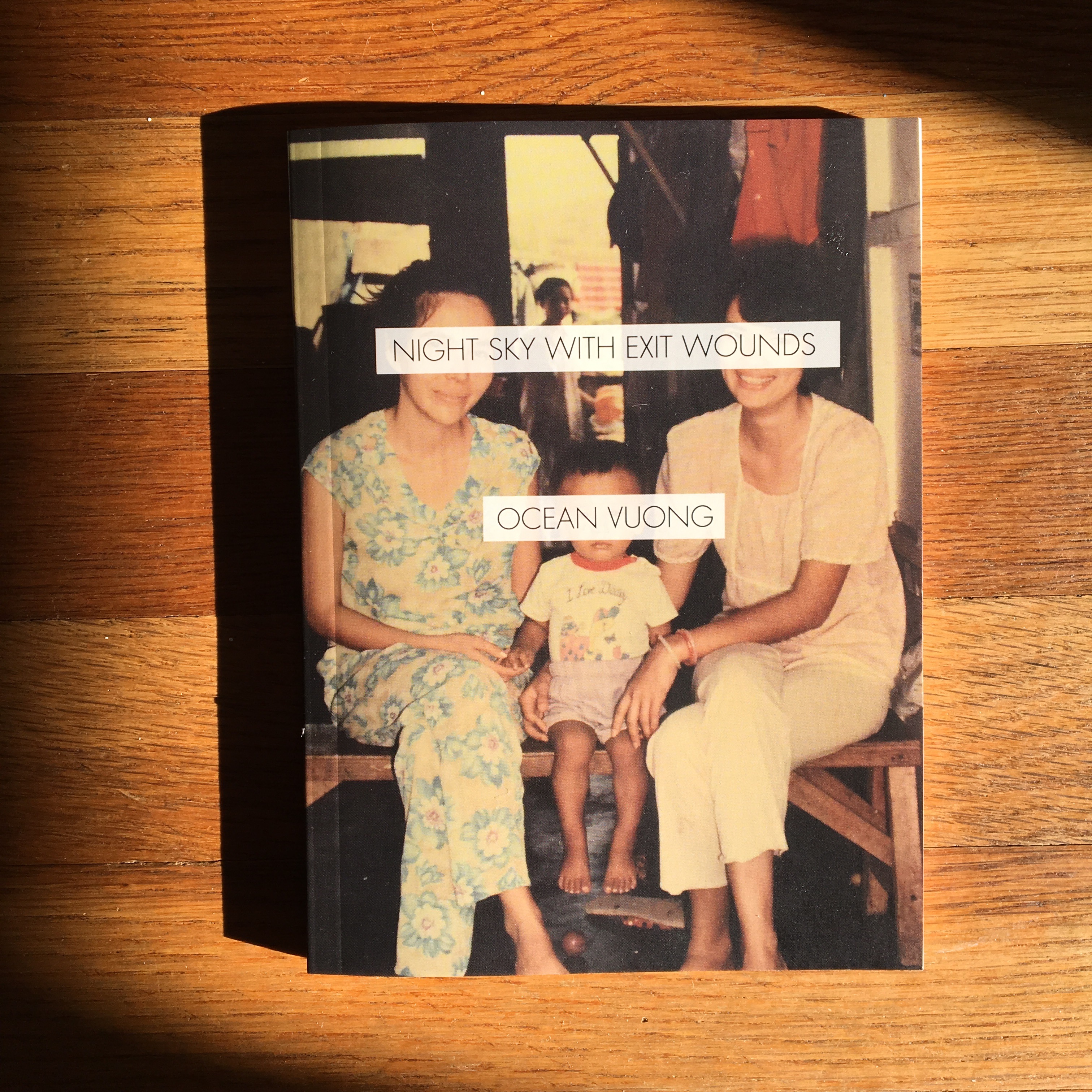
Recently I read Ocean Vuong‘s much-lauded collection Night Sky with Exit Wounds, his first full-length collection.

Night Sky with Exit WoundsIt is indeed a remarkable collection: so open, so intimate, so assured. I was impressed by the range of forms (including haibun, which I don’t come across too often), especially by “Seventh Circle of Earth,” which responds to the murder of two gay men. The poem consists of the numerals 1 through 7 spread out like a constellation over two pages; each number corresponds to a footnote, where the words of the poem reside. The effect is moving—the words are literally too small to do justice to the tragedy; the numbers are bleak.

Night Sky with Exit Wounds is—as you might expect from a book that deals with grief, displacement and the immigrant experience, domestic violence, suicide, sexuality, and love—intense. Take “Telemachus,” in which the speaker does not, as you might expect, assist his Odysseus-father in conquering  his lost kingdom. Instead,

Like any good son, I pull my father out
of the water, drag him by his hair

through sand, his knuckles carving a trail
the waves rush in to erase.

It’s an evocative poem, one that left me surprised at each turn. If you like “Telemachus,” which you can read in full here, then I commend Night Sky with Exit Wounds to your reading.

What poems are you reading this week?

“Scraping toward the first of you”: Patricia Smith’s “Katrina” from Blood Dazzler

Blood Dazzler

Reading Patricia Smith’s Blood Dazzler during the horrible floods in Louisiana (unnamed, but devastating; already more than a dozen people have died and thousands have been forced from their homes) gave the collection an awful resonance.

Blood Dazzler is a polyphonic testament both to the tragedy of Hurricane Katrina and IMG_0587to the power of poetry. Ms. Smith’s poems are beautifully constructed in a wide range of forms; the poems’ subjects include nursing home residents who drowned,  the head of FEMA, a dog left behind by its owners to ride out the storm, and even Katrina herself. It’s an unforgettable collection, and I highly recommend it.

You can read one of the collection’s two poems named “Katrina” here, as well as listen to Ms. Smith read it. You’ll hear the menace of the storm, a menace that begins in one of Blood Dazzler‘s early poems (“5 P.M., Tuesday, August 23, 2005”):

For now
I console myself with small furies,
those dips in my dawning system. I pull in
a bored breath. The brine shivers.


Please see here, herehere, and here for ways to help the victims of flooding in Louisiana.

“first rubythroat / in the fading lilacs”: Maxine Kumin’s “Whereof the Gift Is Small” from And Short the Season

Whereof the Gift Is Small---poetry, Maxine Kumin, poem of the week, poetry discussion, flowers, nature

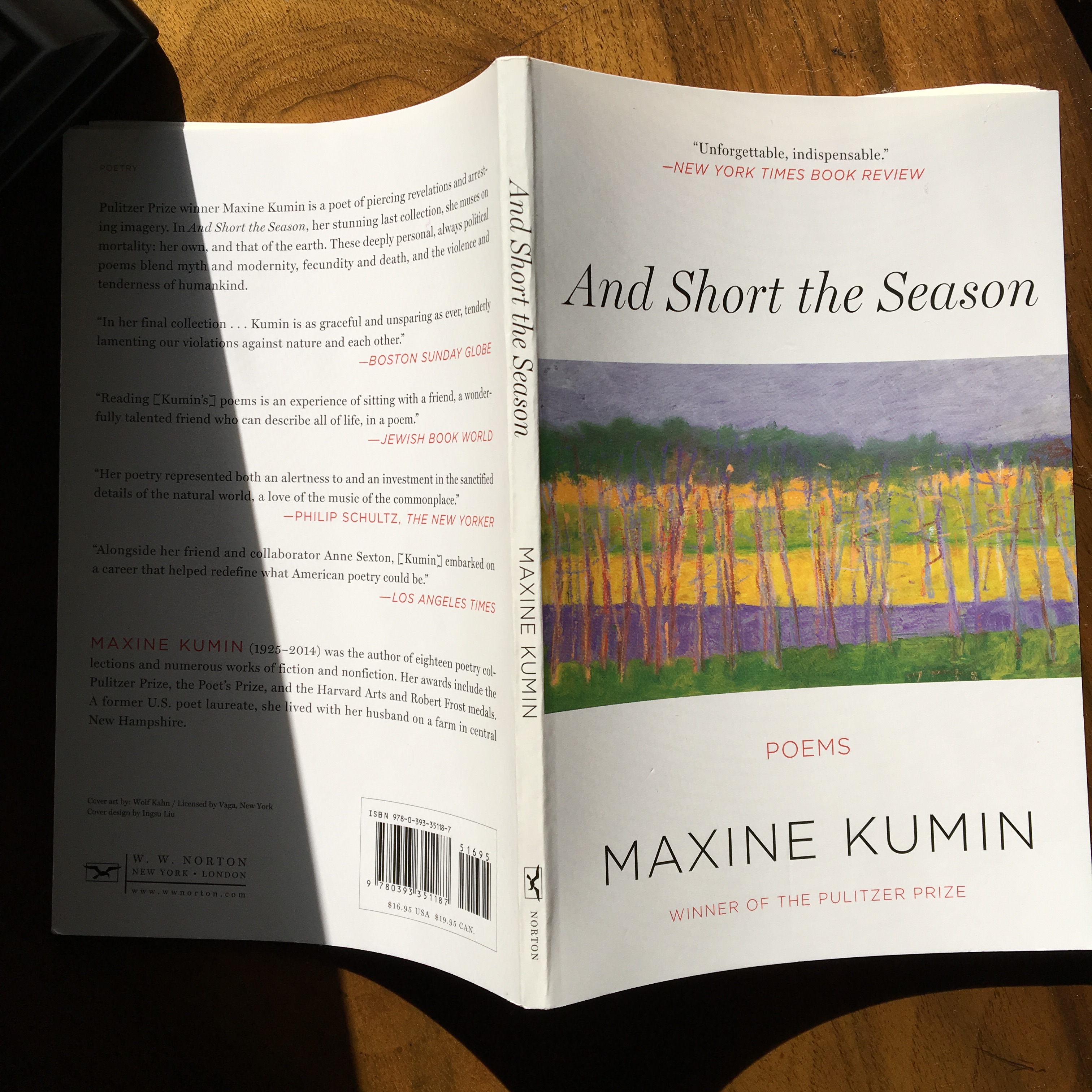
Last week, I had the pleasure of reading And Short the Season, the last collection by Maxine Kumin (1925-2014). Usually I try not to read late collections until I’ve read a few early collections for reference, but I couldn’t pass up this beauty when we stopped in at Island Books in Rhode Island last month.

IMG_0019In the collection, Kumin writes about her New Hampshire farm, politics, the seventeenth-century writer Margaret Cavendish, and the approach of death. These poems, simultaneously elegant and earthy, made me want to pick up Kumin’s selected poems.

Today’s poem, “Whereof the Gift is Small,” refers to and quotes from a sixteenth-century sonnet often called “Brittle Beauty”  by Henry Howard, Earl of Surrey. (As you can see, Kumin also took the collection’s title from this poem.)

Here’s Surrey’s sonnet:

Brittle beauty, that Nature made so frail,
Whereof the gift is small, and short the season;
Flowering to-day, to-morrow apt to fail;
Tickle treasure, abhorred of reason:
Dangerous to deal with, vain, of none avail;
Costly in keeping, past not worth two peason;
Slipper in sliding, as is an eel’s tail;
Hard to obtain, once gotten, not geason:
Jewel of jeopardy, that peril doth assail;
False and untrue, enticed oft to treason;
Enemy to youth, that most may I bewail;
Ah! bitter sweet, infecting as the poison,
Thou farest as fruit that with the frost is taken;
To-day ready ripe, tomorrow all to-shaken.

(Carol Rumens has an excellent write-up of the poem in The Guardian.)

In “Whereof the Gift Is Small,” which opens And Short the Season, Kumin takes Surrey’s theme—that beauty is not only frail and transitory, but maybe even dangerous—and softens it considerably. Surrey, the last person executed on the orders of Henry VII, died at 30; “Whereof the Gift Is Small” appeared in print in 2011, when Kumin was past 80. True that beauty is swift to fade, she writes with the benefit of those extra fifty years; true that there’s “a honeybee bumbling in the bleeding heart / on my gelding’s grave while beetles swarm / him underground.”

But look, she seems to say, at the texture and richness of nature’s brief beauty; consider the beginnings made out of ends: the rubythroated hummingbird in the “fading lilacs,” the alyssum (an annual, usually cream-colored, that smells like honey), the bee in the bleeding heart (a flower that looks like its name), the green of the new grass eaten by the living horses. Consider the “bluets, violets,” the “little flecks of buttercup on my sneaker toes.” These delicate flowers (all of them small, or composed of very small petals bunched together) are a rainbow of color, and like a rainbow, short-lived.

While the speaker’s “wet feet, wet cuffs” and her sneakers suggest (to me, anyway) a child outdoors at first light, soaked with dew, the poem’s last line—“brittle beauty—might this be the last?”—reminds us that the speaker is no child, that this season, this gift, could be the last whose shock of color she witnesses, and versifies.

What poems are you reading this week?

“still the geese keep coming”: Meg Kearney’s “Loneliness”

Loneliness

Friends, I’m pretty sure I recommend Ted Kooser’s American Life in Poetry column at least half a dozen times a year, but here I am, at it again.


Last week’s column featured a short poem by Meg Kearney called “Loneliness,” a vignette that illuminates the title emotion.

It’s a little slice out of time; the poem could be describing something that happened last autumn or something out of a fairytale.

And the details are so effective at placing us in the moment: the goose’s foot that feels like the little girl’s hand, the V of the geese that is “two fingers / spread against a caution-yellow sky.” Two fingers in a V is the sign for peace, which the poet plays against the poem’s violence (the father is “about to bring down his third goose” of the day), echoed in the girl’s gesture of kindness that is a severed foot.

What do you think of the poem?

“An interval like summer passed”: Jana Prikryl’s “New Life,” from The After Party

New Life

When I read Jana Prikryl’s The After Party* last week, I struggled to connect with most of the poems in the collection. I felt this was a failing on my own part; Ms. Prikryl is a senior editor at the New York Review of Books, my favorite non-book publication, and she has contributed poems to some of the best magazines in the world.

IMG_7418Still, while I respected the craft at work in these poems, and the ingenuity of “Thirty Thousand Islands,” a long poem in forty-two parts that makes up the second half of The After Party, it wasn’t until I read Dan Chiasson’s thoughtful review in The New Yorker that the collection really opened up for me. He examines The After Party through the lens of loss (Ms. Prikyl’s older brother died suddenly in 1995), while I’d been trying to understand the poems in the context of migration and exile.

I went back and re-read most of the book, and was rewarded.

This week I recommend Jana Prikryl’s “New Life,” which you can read at The Baffler**.

Its imagery is arresting (the opening lines are: “From the fields of a calendar, its snow / packed firmly into squares, I farmed you.”) as is the speaker’s address to the brother who lives in her memory. The form is unobtrusive, but underscores, I think, the control it takes to examine a deep loss.

What poems are you reading this week?

*I received a copy of this book from the publisher for review purposes, which did not affect the content of my review.

** Full disclosure: I occasionally work for The Baffler on a freelance basis.

“the upswept fog bank of her hair”: J. D. McClatchy’s “Three Dreams about Elizabeth Bishop”

Three Dreams about Elizabeth Bishop

Do you suppress the urge to roll your eyes whenever someone mentions “the crazy dream I had last night?” I know I do, or at least I sure hope so, since I don’t like offending people unnecessarily. Rarely are dreams of interest to anyone but the dreamers themselves (and psychoanalysts, I suppose).

The same holds true in fiction—I’ve been known to scan quickly through dream descriptions, looking for the “real” action to start—but recently I read a poem about dreams that I loved: J.D. McClatchy’s “Three Dreams about Elizabeth Bishop.” 

The poem’s three sections (for the three dreams) are packed with memorable images and lines, from the description of Bishop lying in state (like Lenin) and her eyes fluttering as Robert Lowell speaks to her (while the speaker looks on as a memorial wreath) to the “upswept fog bank of her hair” to the homely sight of two mugs with last night’s gin left on a deck come morning.

This is a poem I’ll come back to.

What do you think of the poem? Are there any poems about dreams that you like?