Musings on Moby-Dick, Part 3: Meeting Ahab

(Chapter 28, if you’re counting.)

Moby-Dick

I’d wager that a person who hasn’t read Moby-Dick, but who’s heard of it, can tell you one thing about Ahab: he has a peg leg, made of whalebone. However, for Ishmael, Ahab’s “grim aspect” is so engrossing that “for the first few moments I hardly noted that not a little of this overbearing grimness was owing to the barbaric white leg upon which he partly stood.” In other words, Ahab’s missing leg is not his defining physical feature, at least to the men he works with.

The ship’s mates are uncomfortable too, for “moody stricken Ahab stood before them with a crucifixion in his face; in all the nameless regal overbearing dignity of some mighty woe” (135). Indeed, Ishmael’s first impression is similar to the impression of torment given in this passage; at first glance, Ahab “looked like a man cut away from the stake, when the fire has overrunningly wasted all the limbs without consuming them, or taking away one particle from their compacted aged robustness” (134).

I find this juxtaposition of images — the Christ-figure crucified and the heretic at the stake — intriguing, especially since my first reading of the stake comparison relied on my image of Joan of Arc — until I realized that she wasn’t canonized until 1920.  With these two images, Melville and Ishmael provide us with a foreshadowing of Ahab’s later character development; we’ll find him to be brave, stoic, even, but also possessed with the pursuit of unrighteous revenge.

I’ll leave off my musing with another contrasting set of images: Ahab as a tree.

In the first, his scarring (which happened before his encounter with the white whale) is compared to the mark of a lightning strike on a great tree, in such a way that I thought of Ahab as nature’s inertia embodied, markable but not really changeable in essence (was his monomania brought on by Moby Dick’s attack, or was the capacity for madness always lurking within him?).

In the second, the possibility for softness in Ahab’s character emerges without diminishing his otherness from his fellow men.

(1)

[Ahab’s scar] resembled that perpendicular seam sometimes made in the straight, lofty trunk of a great tree, when the upper lightning tearingly darts down it, and without wrenching a single twig, peels and grooves out the bark from top to bottom, ere running off into the soil, leaving the tree still greenly alive, but branded. (134)

(2)

For, as when the red-cheeked, dancing girls, April and May, trip home to the wintry, misanthropic woods, even the barest, ruggedest, most thunder-cloven old oak will at least send forth some few green sprouts, to welcome such glad-hearted visitants; so Ahab did, in the end, a little respond to the playful allurings of that girlish air. More than once did he put forth the faint blossom of a look, which, in any other man, would have soon flowered out in a smile. (136)

What do you remember most about Ahab?
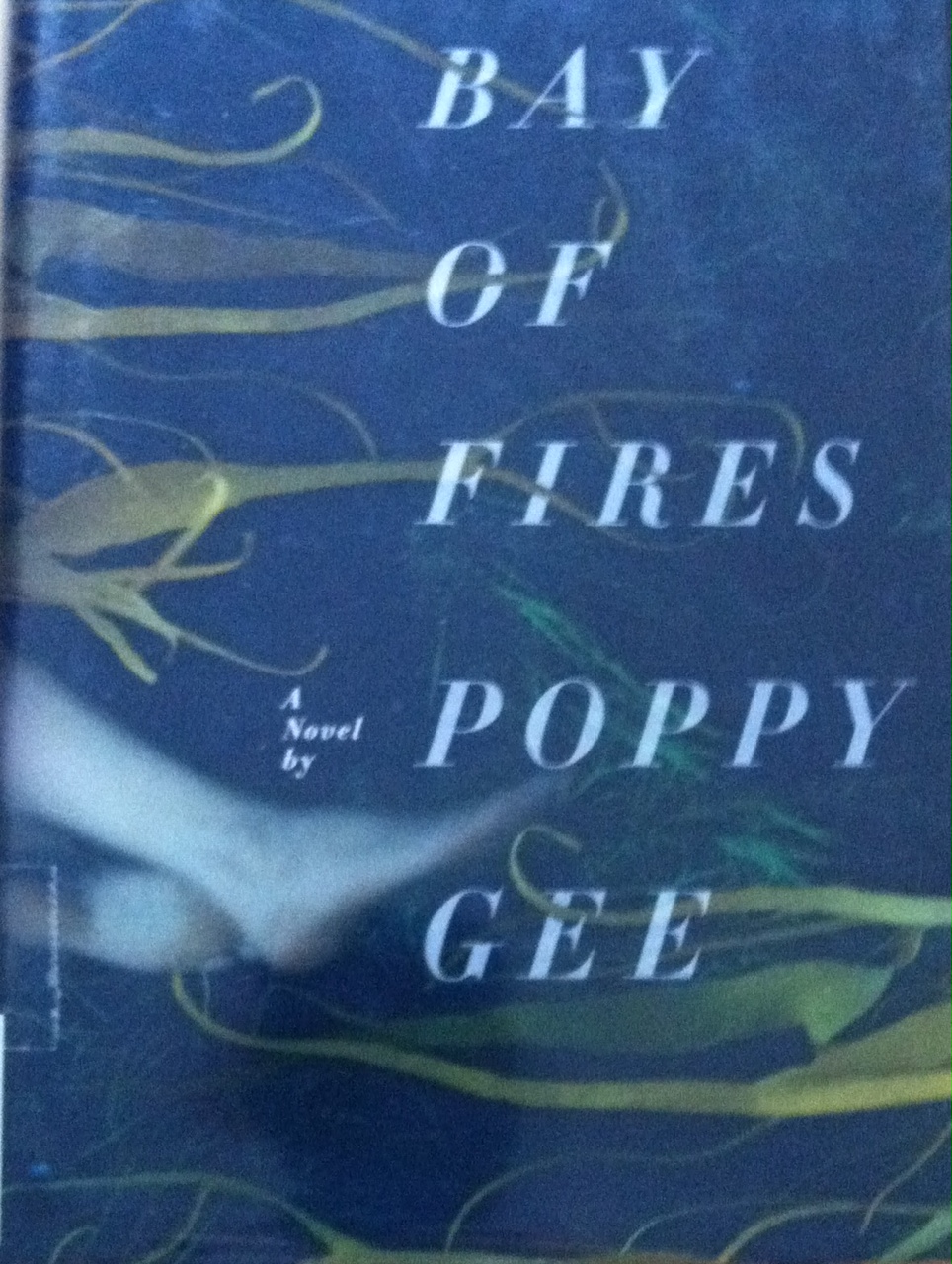
Recommended Reading: Bay of Fires, by Poppy Gee

It was this book’s title that led me to pull it off the shelf, as well as the understated cover design. I didn’t realize, at the time, that the Bay of Fires is a real place in Tasmania, a large island off Australia’s southern coast.

Bay of Fires cover

Here’s the setup: Sarah, after some bad decisions, ends up at home for the holidays, unsure what to do next. While she’s thinking it over, she’s one of two people to discover a young woman’s body on the beach, and for the next week, she and a down-on-his-luck reporter try to solve the mystery of the young woman’s disappearance.

Now, before I read Ms. Gee’s novel, I knew nothing about Tasmania, other than that it is an island and the namesake of a small, fierce marsupial creature. But one of this novel’s best features is its strong sense of place; Ms. Gee describes the scrub, the ocean, the rock pools, and the small community on the bay in fresh detail. Often, scenery escapes me, because I’m so focused on characters (with exceptions: Jane Eyre, The Lord of the Rings, and A Midsummer Night’s Dream come to mind). However, I think I was jolted out of my reading habits by the reversed seasons — the novel takes place around Christmas and New Year’s Day, and yet it’s summer.

Equally refreshing is Bay of Fires‘s main character, Sarah Avery. Deeply flawed, she is nonetheless tenacious, strong, and good. You know, a person, not a caricature of womanhood. For awhile, Ms. Gee’s focus on Sarah’s physical strength and fitness annoyed me, until I realized that her fitness is an integral part of her character, and informs many of her decisions over the novel’s course. She’s an original, interesting character, who sometimes reminded me of Starbuck from Battlestar Galactica. If you loved Starbuck, you’ll love Sarah.

Here’s my final recommendation: I thought I had the mystery solved on page 107 (of 371), and I kept reading. I was only half right, and the novel kept me guessing til the very end. I’ll be looking for Poppy Gee’s next book.

Feeling Restless After The Ten-Year Nap

The Ten-Year Nap finds four friends, women who live in New York, contemplating the choices they made about parenting and professions. The four all gave up their careers about ten years ago (hence the title), and some regret the decision; others are comfortable with the lives they’ve chosen.

The Ten-Year Nap 

It’s a testament to the talents of Meg Wolitzer that even thought I didn’t care for this book, I still borrowed two more of her novels from my local library. She’s very, very funny — keep an eye out for Amy Lamb’s reaction to her son’s favored reading material.

The novel follows all four women, plus one more character who drives the plot, and then veers off to show vignettes in the lives of women related the main characters. I felt that the novel never settled, as if Ms. Wolitzer couldn’t decide which person she was most interested in exploring; there’s fodder here for two or three novels.

Another aggravation for me was the jacket copy (no surprise there), which described the characters as middle class. Um, no. Maybe two of them are middle class by New York standards, as my friend Katie pointed out, but by any other standard these women are wealthy, wealthy, wealthy, with the luxury of choosing whether or not to parent their children at home.

Occasionally they glance at the lives of the less fortunate. Roberta, for instance, flutters in and out of left-wing activism; at the private boys’ school attended by three of the friends’ sons, poor children of color are invited for a yearly visit that is halted after an incident (there’s not too much plot to give away here, but nonetheless, I refrain.). Even Jill, whose adopted daughter comes from an understaffed Russian orphanage, spends her mental energy focused on herself, without much thought for the other children left without adoptive parents.  I found these women unlikable, but I suspect Ms. Wolitzer is trying to point out foibles that we might find in ourselves: a tendency, no matter our political leanings, toward self-centeredness. We draw back from the world we see out the window.

The Ten Year-Nap also made me uncomfortable because it hits close to home. I’m the at-home parent to our son, and though he’s too small for school now, I do wonder what I will do, how I will feel, when he’s ten, or twelve, or fifteen. Even if I wanted to enter the workforce right now (I’m ambivalent, given H’s age), or go back to grad school to finish my PhD, we couldn’t afford it. Yes, you read that right. Daycare is so expensive here that it’s cheaper for me to stay home than to work as a teacher. And for other women the situation is reversed: they can’t afford not to work. As I often explain, it’s a complicated calculus, one that will probably hold for the next few years, though I hope not forever. I love my child and will do my best to see that he arrives safely at adulthood as a kind and loving person, and I think that’s a worthy goal, a worthy and difficult occupation. But I want to contribute something more to the world —not necessarily something better, just something more.

To me, The Ten-Year Nap implies that the women it follows had done something wrong, some disservice to themselves, by parenting their children at home. Even the title is diminutive, implying that the women are childish (not a rest or a sleep, but a nap). Maybe it’s the suggestion that these women are asleep to themselves that I find annoying; why can’t one be oneself and an at-home parent too?

Have you read the novel? What did you think?

Musings on Moby-Dick, Part 2

William Giraldi’s essay on Herman Melville-as-reader has been making the rounds on the web this week, appearing first in the LA Times and then elsewhere (Maria Popova tweeted about it; A Piece of Monologue ran it), including Salon, which is where I ran across it.

Moby-Dick

It’s a good piece, though I could do without the put-downs of genre fiction and some of the vitriol (Mr. Giraldi is known in literary circles for his excoriating review of two Alix Ohlin books. His point in this essay boils down to: The drivel that’s published these days flows from the keys of those who do not read (Mr. Giraldi’s closing line is “So put down your pen awhile. Pick up Moby Dick [sic].) Melville, like other great writers, stood on the shoulders of giants. In order to write well, one must read well, and often, and deeply. (I’d make the same argument about living well, but that’s for another time). He points to Milton, one of those authors Melville grapples with most intensely, and rightly so. Earlier this week, though, I was thinking about another kind of literacy, or literary awareness, as I read Chapter 9 of Moby-Dick (“The Sermon”).

Though I’m not a believer, I’m grateful for an elementary education that gave me familiarity with Bible stories and concepts. It’s incredibly helpful, in all kinds of contexts, to understand references to Judith and Holofernes, for example, or the wedding feast at Cana.

Or Jonah and the Whale. Without the background music of Biblical phrasing in mind, it would have been difficult for me to appreciate just how brilliant this chapter is. Father Mapple tailors his sermon for the sea-going folk and sea-watchers in his congregation, conjuring up the details of Jonah’s cabin (“a swinging lamp slightly oscillates in Jonah’s room” [50]) to make the text come alive. In embroidering an old tale to reach a new audience, he becomes a figure of the novelist. And when he ends his sermon, he’s shaken by his awesome responsibility.

Here’s a little gem from the sermon: “But oh! shipmates! on the starboard hand of every woe, there is a sure delight; and higher the top of that delight, than the bottom of the woe is deep” (54).

Recommended Reading: The Wife by Meg Wolitzer

A tip of the hat once more to my friend Katie, who pointed me toward Meg Wolitzer (Katie was, at the time, reading The Ten-Year Nap, and that’s on my list now, too!). The Wife is about a very unfunny subject —the unravelling of a marriage — but in Ms. Wolitzer’s capable hands, Joan (the wife in question) tells her story in darkly comic fashion.

Photo courtesy Tanatat / Freedigitalphotos.net

Photo courtesy Tanatat / Freedigitalphotos.net

Joan’s husband is the much-awarded novelist Joe Castleman, and when the novel opens, she’s made up her mind to leave him as they fly to Helsinki, where he’s to receive his latest accolade. From there, Joan takes the narrative back to Smith College in the 1950s, and we learn how the pair met, and just how it all went wrong.

As a narrator, Joan is simultaneously unreliable and honest, and always a keen observer, not only of her own marriage, but also of the changing world around her. Though The Wife was published ten years ago, Joan’s observations about the role of wives echo loudly, especially with the recent debates about Sheryl Sandberg’s Lean In and Anne-Marie Slaughter’s article on work-life balance in last summer’s Atlantic. Here’s Joan near the end of the novel:

Everyone knows how women soldier on, how women dream of blueprints, recipes, ideas for a better world, and then sometimes lose them on the way to the crib in the middle of the night, on the way to the Stop & Shop, or the bath. They lose them on the way to greasing the path on which their husband and children will ride serenely through life. (183)

Apparently, I’m not the first reader to love this passage; the page was dog-eared when I picked up the book.

A Book I’m Not Sure What to Make of: The Testament of Mary, by Colm Tóibín

Published last year to critical acclaim (and just longlisted for the 2013 Man Booker Prize), Colm Tóibín‘s The Testament of Mary is a short novel (only eighty-one pages) that upends our (or at least, my) cultural conception of Mary.

Image courtesy of Seksuwat / Freedigitalphotos.net

Image courtesy of Seksuwat / Freedigitalphotos.net

In  Mr. Tóibín’s vision, the mother of Jesus does not believe that her son is divine, tries to save him from a path that will lead to execution, thinks his followers are a mob of lost men, and flees for her life before her son’s death on the Cross. She thinks of John and Paul (not named; I’m inferring—please correct me if I’m in error) as supercilious keepers, rather than trusted supporters. In her old age, Mary judges herself harshly, and her opinion of the nascent Christian movement is hardly charitable.

This novel isn’t plot driven, and I didn’t expect to like it. I’m still not sure how I feel about it, to tell the truth. But what I did appreciate was the intimacy and immediacy of Mary’s voice. Mr. Tóibín makes her come alive (with unexpected thoughts and feelings, to be sure) dissolving the distance that I feel when reading about her or seeing a painting of her.

Oddly, this portrayal of Mary reminded me of Olivia Hussey’s performance in Zefferelli’s Jesus of Nazareth (a family tradition at Christmas and Easter when I was growing up). Unlike this older, wearier Mary, Ms. Hussey’s Mary is convinced of her son’s divinity and supportive of his ministry. Like Mr. Tóibín’s Mary, however, she is infused with quiet strength and dignity.

Have you read The Testament of Mary? What did you think? If you haven’t read it, do you plan to?

What are your favorite first lines?

Yesterday, my friend Kori pointed me to a piece in the Atlantic in which authors choose their favorite opening lines, and write little paragraphs about their reasoning, or, in Margaret Atwood’s case, a tweet:

“Call me Ishmael.” 3 words. Power-packed. Why Ishmael? It’s not his real name. Who’s he speaking to? Eh?

That’s my favorite of the lot. My own favorite first line, however, is a tossup between Hamlet and Jane Eyre.

Hamlet begins with Bernardo’s challenge, “Who’s there?” — and the interpretive possibilities are endless. Is he afraid? Full of bravado? Why is a soldier, on duty in his own kingdom, challenging someone else in uniform? Is it nighttime? Is he speaking to us, the audience? Who’s the “who”? How do we define ourselves? How do we answer?

Shakespeare offers at least as many questions in two words as Melville does in three.

Now, on to Jane Eyre: “There was no possibility of taking a walk that day.” Why not? Who was planning on walking? What’s the significance of “that” day?

There was no possibility of taking a walk that day.

There was no possibility of taking a walk that day.

This line has more meaning as you progress through the novel (and if you haven’t, now’s the time to stop reading this post so I don’t ruin the experience for you. And seriously, go read Jane Eyre!).

Of course, “that” day is the day that John Reed throws a book at Jane’s head and Mrs. Reed sends Jane to the Red Room, which precipitates her move to Lowood, and, eventually, Thornfield Hall. And while Jane and her cousins remain inside on account of the rain, in a few short weeks, she and the other unfortunate girls at Lowood will be exposed to all manner of the elements. Jane often walks when others think she ought not to, or when she has no other choice. For instance, it’s on a long walk alone (despite the protestations of Mrs. Fairfax) that she meets Mr. Rochester, and it’s alone again that she makes her way through the fields to the Riverses’ cottage.

But where would Jane have ended up if she had been able to walk that day?

What are your favorite first lines?

Recommended Reading: Gone Girl, by Gillian Flynn

I know, I know: this was the it book of 2012, and I am late to the party.

It’s a pretty rad party.

Gone Girl is part mystery, part comedy, part domestic drama, and entirely, viciously delightful. Amy disappears on the morning of her fifth wedding anniversary, and police attention begins to swirl (inevitably?) on her attractive husband with the flimsy alibi. But nothing turns out how you think it will.

Highly recommended, especially as a highbrow beach read.

Recommended Reading: Shift, by Hugh Howey

When Dust comes out this August, I’ll be first in line to buy the complete Silo trilogy, without even reading the last one first. These books are just so fun—suspenseful, inventive page-turners.

My practice is never to reveal spoilers, and I won’t start here. So really, I can’t say too much about the plot because you must read Wool first. Shift answers some of Wool‘s questions and will leave the reader with many more to ponder before the final installment comes out.

If anyone out there has read Hugh Howey’s other novels, I’d love to hear what you thought of them!

Recommended Reading: The Round House, by Louise Erdrich

The plot of Louise Erdrich’s amazing novel concerns a boy’s search for the man who attacked his mother, while his father searches for justice despite the twisted web of federal, state, and tribal laws that stands in his way.

It sounds simple, but The Round House is the work of a master-storyteller, each detail bringing daily life on the reservation into focus. Joe, the narrator, is a funny, honest companion through the often-horrifying story, and through his eyes we see all the best of late-boyhood friendships in his adventures with Cappy, Zack, and Angus, as well as the worst in men.

The raw anger and frustration that this book made me feel was balanced by admiration for Ms. Erdrich’s stunning language and deft way of shaping her characters. One of my favorite passages is Joe’s relation of the boys’ love for Star Trek: The Next Generation. The boys all want to be Worf, but admire Data immensely. (Also, the chapter names are often taken from the names of Star Trek: The Next Generation episodes.)

I finished reading The Round House last Wednesday, and I’m thrilled that I’ve finally had the chance to recommend it.