Paradise Lost, Books V and VI: The Books in Danger of a Michael Bay Adaptation

ParadiseLostReadalongWe’ve made it halfway in the Paradise Lost ReadAlong, so here are some links if you’d like to catch up:

Introduction
Books I and II
Books III and IV

Books V and VI find Raphael relating recent celestial history to Adam as part of a mission from the Father. He tells Adam of the war in Heaven between the rebellious and loyal angels, effectively bringing us, by the end of Book VI, up to the starting point of the poem in Book I: Satan’s fall, with his cohort, from Heaven into Hell.

In a departure from my usual practice, I’m going to let Milton himself give you the synopsis of these two books (Yes, he’s considerate enough to provide a synopsis for each book before the verse starts. Isn’t he great?). Also, I’m writing this late at night, so things may get, shall we say, irreverent?

Book V:

Morning approacht, Eve relates to Adam her troublesome dream; he likes it not, yet comforts her: They come forth to their day labours: Their Morning Hymn at the Door of their Bower. God to render Man inexcusable sends Raphael to admonish him of his obedience, of his free estate, of his enemy near at hand; who he is, and why his enemy, and whatever else may avail Adam to know. Raphael comes down to Paradise, his appearance describ’d, his coming discern’d by Adam afar off sitting at the door of his Bower; he goes out to meet him, brings him to his lodge, entertains him with the choycest fruits of Paradise got together by Eve; their discourse at Table: Raphael performs his message, minds Adam of his state and of his enemy; relates at Adams request who that enemy is, and how he came to be so, beginning from his first revolt in Heaven, and the occasion thereof; how he drew his Legions after him to the parts of the North, and there incited them to rebel with him, perswading all but only Abdiel a Seraph, who in Argument diswades and opposes him, then forsakes him.

Book VI:

Raphael continues to relate how Michael and Gabriel were sent forth to battle against Satan and his Angels. The first Fight describ’d: Satan and his Powers retire under Night: He calls a Councel, invents devilish Engines, which in the second day’s Fight put Michael and his Angels to some disorder; But, they at length pulling up Mountains overwhelm’d both the force and Machines of Satan: Yet the Tumult not so ending, God on the third day sends Messiah his Son, for whom he had reserv’d the glory of that Victory: He in the Power of his Father coming to the place, and causing all his Legions to stand still on either side, with his Chariot and Thunder driving into the midst of his Enemies, pursues them unable to resist towards the wall of Heaven; which opening, they leap down with horrur and confusion into the place of punishment prepar’d for them in the Deep: Messiah returns with triumph to his Father.

Neat, huh? I’ve cleaned up a bit of the spelling. (These “Arguments,” as Milton called them, aren’t pulled from Gordon Teskey’s edition of the poem, since I thought it might be nice to give you delightful readers a better taste of seventeenth-century phrasing.)

As you can tell, Books V and VI are heavy on action (hence today’s post title. Which was a joke. I hope.) Book V features a particularly Miltonic moment, however: a lone voice raised against wrong action, in the form of Abdiel’s resistance to Satan’s call for rebellion and war.

On the surface, Satan’s initial raillery against the Father’s elevation of the Son might seem appealing to a republican (small-r) revolutionary like Milton: Satan objects to being asked to prostrate himself to a new master (especially one whose power seems to derive from nepotism) who promises to hand down new laws that must be obeyed.

However, Milton (via Abdiel) neatly refutes Satan by revealing his error — the assumption that the Son and the angels are equals:

Canst thou with impious obloquy condemn
The just decree of God pronounced and sworn
That to his only Son by right endued
With regal scepter every soul in Heav’n
Shall bend the knee and in that honor due
Confess him rightful King? Unjust thou say’st,
Flatly unjust, to bind with laws the free
And equal over equals to let reign,
One over all with unsucceeded pow’r.
Shalt thou give law to God, shalt thou dispute
With Him the points of liberty who made
Thee what thou art and formed the pow’rs of Heav’n
Such as He pleased and circumscribed their being? (5.813-25)

Scorned by Satan and Satan’s fellows, Abdiel remains steadfast, and in one of the poem’s best images, he walks fearlessly away from the rebellious to join the righteous:

So spake the seraph Abdiel faithful found
Among the faithless, faithful only he
Among innumerable false. Unmoved,
Unshaken, unseduced, unterrified
His loyalty he kept, his love, his zeal.
Nor number nor example with him wrought
To swerve from truth or change his constant mind
Though single. From amidst them forth he passed
Long way through hostile scorn which he sustained
Superior, nor of violence feared aught
And with retorted scorn his back he turned
On those proud tow’rs to swift destruction doomed. (8.597-907)

A powerful passage, isn’t it? And particularly poignant, given Milton’s own part in the failed (though initially righteous, in his eyes) English revolution. Like Abdiel, “his loyalty he kept, his love, his zeal.”

*

I won’t quote lengthy passages from Book VI, but it’s one of the most entertaining books of the poem, in which Raphael describes to Adam (Eve being noticeably absent, having fulfilled her womanly serving duties *grumble grumble feminist grumble*) the progress of the war. On the first day, Michael leads the loyal angels against Satan and his followers. Angels on both sides are injured, but only the rebel angels feel pain (and we also learn that they’ve lost the ability to feel pleasure). Angelic bodies heal themselves, it turns out. Michael faces Satan in single combat, and Satan, to his dismay, is bested and forced to retreat.

During the night, the rebel angels invent cannon (often regarded as devilish in the Renaissance) and surprise the heavenly hosts, who respond by hurling mountains at their foes. The imagery here is so fantastic — it just cries out for Guillermo del Toro. (Michael Bay, in the unlikely event you’re reading this blog: STAY AWAY FROM MILTON.) Plus Satan engages in some tricky non-diplomacy and witty banter with his pals, so now I’m envisioning a del Toro/ Aaron Sorkin collaboration . . . But I digress.

On the third day, the Father decides that enough is enough. Michael’s done excellent work at QB, but it’s time to bring out the Son, who says, basically, “Hold up. I got this.” The loyal angels line up and watch as the Son, with thunder blaring and chariot blazing, charges the rebel angels alone and so terrifies them that they throw themselves out of Heaven (h/t to obliging self-opening, self-healing heavenly wall) and into a nine-day fall to Hell.  That’s what George Lucas would call aggressive negotiation. (Now that I’ve quoted possibly the worst screenplay of all time, I’m done with movies now, I promise.)

But it’s not all fun and demon defeat in Book VI. The point of Raphael’s tale is to warn Adam, lest he think about disobeying God:

Let it profit thee t’have heard
By terrible example the reward
Of disobedience! Firm they might have stood,
Yet fell. Remember, and fear to transgress! (6.909-12)

Fear will keep the local systems in line. Fear of this battle Son. Wait. Where have I heard that before?

Really done now.

Coming up on February 10: Books VII and VII — Adam’s Edenic education continues.
A programming note: Today features a rare double post here on Rosemary and Reading Glasses, so you might like to scroll down or click over to today’s earlier post, a review of Melissa Pritchard’s fascinating novel Palmerino.

Recommended Reading: Palmerino, by Melissa Pritchard

PalmerinoThe life of British writer Violet Paget — better known by her nom de plume and male persona, Vernon Lee — seems ripe for novelization. Born into an intellectual family, Violet/Vernon was considered quite ugly (though I confess that every picture I’ve seen belies this assessment), but also brilliant, gifted especially with language. She spent most of her life in Europe, where she held court in a kind of salon at Palmerino, a villa near Florence. The constellation of writers and thinkers in her orbit reads like a who’s who of a late-Victorian anthology: Henry and William James, Edith Wharton, Oscar Wilde, Walter Pater. One of her best childhood friends was John Singer Sargent.

Violet/Vernon wrote supernatural fiction and researched aesthetics, and was one of the first people to study empathy and art. (This link between science and art explains why Palmerino is published by Bellevue Literary Press, a small, nonprofit press dedicated to publishing works that connect art and science.)

Melissa Pritchard’s Palmerino defied my expectations in its structure and plot. I though I’d be reading a straightforward exploration of Violet/Vernon’s life and loves, perhaps featuring one of her several lesbian relationships. And indeed, the novel is about Violet/Vernon’s life, and about her relationships with Mary Robinson and Kit Anstruther-Thomson in particular.

However, Ms. Pritchard approaches her subject through a framing device, following the fictional American novelist Sylvia as she takes up residence at Palmerino to begin work on a novel about Vernon Lee. The perspective alternates among Sylvia, V. (apparently the ghostly voice of Violet/Vernon in the present), and Sylvia’s narrative of Vernon’s world. Ms. Pritchard is selective about the parts of Vernon’s biography included, so the effect is rather like piecing together a puzzle. For example, we see particularly vivid scenes from V.’s childhood and adolescence which bear on her future as a thinker and writer. The elided sections speak through silence, like the turns between stanzas in poetry.

Palmerino incorporates elements of biography, supernatural fiction, and historical fiction as it explores the nature of research,, genius loci, loneliness, and eroticism — and it’s a fascinating, unexpected way to enter into Vernon Lee’s life. Highly recommended.

Tomorrow on the blog: An interview with Melissa Pritchard, author of Palmerino.

Note: I received this copy through LibraryThing’s Early Reviewers program, in exchange for an honest review.

“Sweetbitter”: The Complete Poems of Sappho, translated by Willis Barnstone

sappho trans, barnstonePlato called her “the tenth muse,” and yet Sappho remains an elusive figure. The outlines of her biography are sketchy, and nearly all her extant poems are fragmentary. Still, the lines we have are some of the most beautiful ever written, hungry and haunted as they are by love and loss.

Acclaimed poet and translator Willis Barnstone’s edition of the poems is grouped thematically, and he makes the interesting choice to title the poems. I’m still on the fence about the effect. In some cases, the titles merely refer to a personage named in the poem; in others, the titles reflect the obvious subject of the poem (“Old Age,” for example). With a few of the poems, however, I would have preferred an untitled version in order to better draw my own conclusions. But this is a small complaint; the volume is beautifully done, and I highly recommend it. (I’d also love to compare it with Anne Carson’s If Not, Winter, which I haven’t read yet — if you have, will you tell me what you think?)

It’s difficult to choose which poem to highlight this week, so I’ll leave you with Mr. Barnstone’s translation of fragment 130, which he titles “Sweetbitter”:

Eros loosener of limbs once again trembles me,
a sweetbitter beast irrepressibly creeping in

An Interview with Rachel Pastan, Author of Alena

Yesterday I reviewed Alena, Rachel Pastan’s latest novel. Ms. Pastan graciously agreed to be interviewed via email about the novel and her writing. 

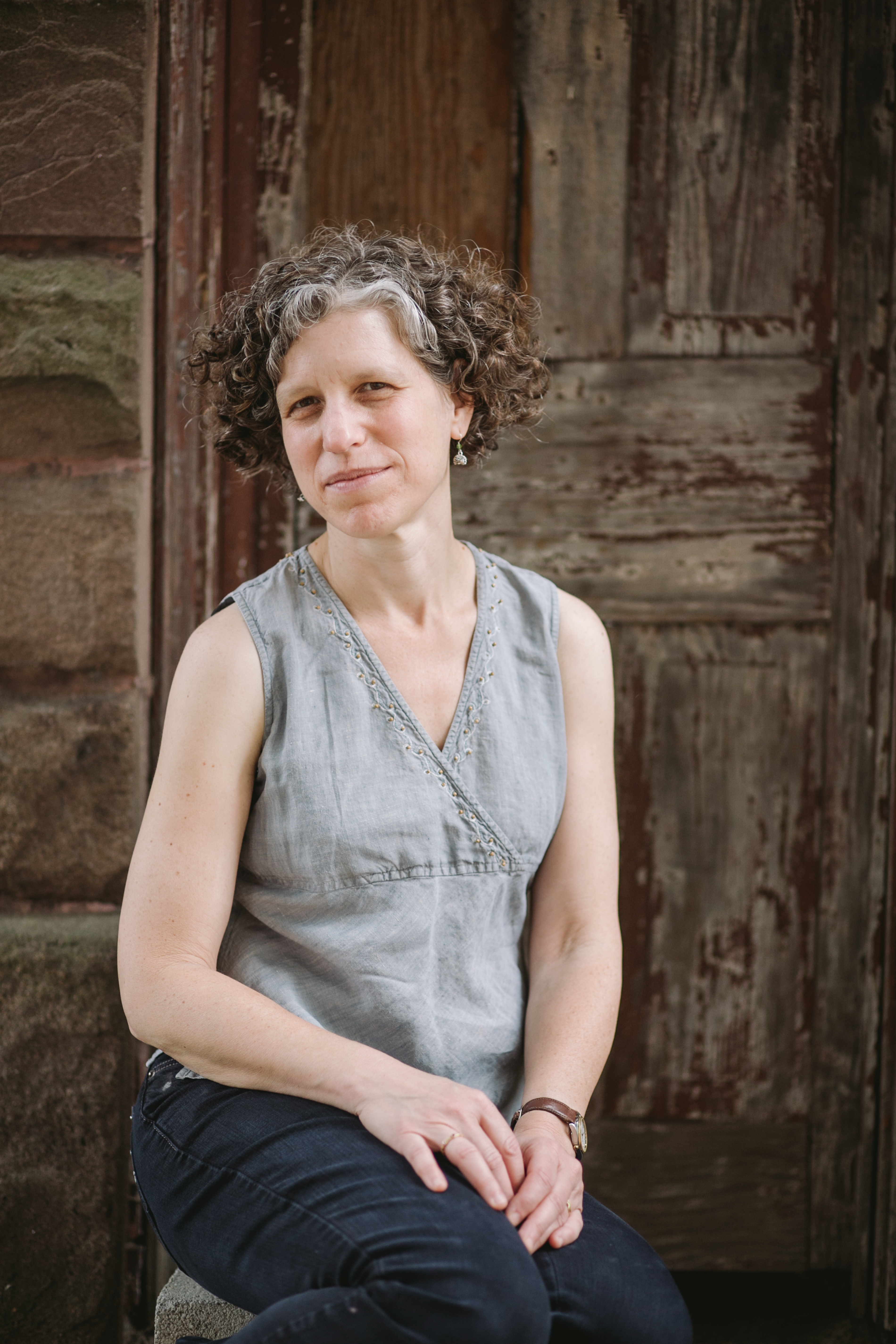
Rachel Pastan  (c) Carina Romano

Rachel Pastan
(c) Carina Romano

When and how did you conceive of writing a book that responds to Rebecca? Was the writing process long?

RP: I had taken a nine-to-five office job—a different kind of job than I’d ever had before. The woman who’d worked there before me, Elysa, had left months before, so I didn’t have anyone to train to me, and I kept making mistakes. People would say, “Elysa used to do it this way.” I felt inadequate, and a little in awe of this unknown Elysa. And then I thought: It’s just like Rebecca, only in the workplace! And then I thought: That’s a good idea for a novel. I wasn’t able to start writing it for a while, but once I did, it went quickly. It took me only about eighteen months to finish a draft.

Much of Alena‘s action takes place on Cape Cod. Was there a particular reason (or reasons) for this choice? 

RP: My family used to spend a month in Cape Cod every summer when I was little, and the landscape has always stayed with me. For years I used to have dreams about the ocean there. Rebecca takes place on a coast—probably of Cornwall. The atmosphere of Cape Cod seemed like a good parallel to me, and I was happy to revisit its beaches in my imagination.

Was it challenging to avoid giving the narrator a name?

RP: Actually I gave her a name while I was writing—I figured I just wouldn’t be faithful to that part of Rebecca. But afterwards I saw I could take the name out. Du Maurier had a few advantages; people could call her narrator “Mrs. de Winter.” After I took out the name, I did go back and make one of the characters call my narrator Cara—Italian for “darling.” That helped.

AlenaHow did you go about learning about contemporary art, which is so critical to Alena? Did you discover a favorite contemporary artist along the way?

RP: For last few years I have worked at the ICA—the Institute of Contemporary Art—in Philadelphia, writing and editing. This has been a fabulous immersion course in contemporary art. I don’t have a favorite contemporary artist—any more than I have a favorite contemporary writer—but the discovery of Anne Truitt was a wonderful and memorable moment. She made very simple, tall sculptures that are somehow incredibly moving and evocative. She wrote a terrific memoir, too, called Daybook, The Journal of an Artist, which talks about her struggles in her work, and with trying to combine work and family life.

Which writers do you read while you’re writing, if any? Do they change from book to book?

RP: I often read a little every morning before I start working, a few pages by someone whose sentences I love. Alice Munro is a favorite, as is Margaret Drabble. Other than that, I might read books that address a subject I’m writing about to see how other people handle it. When I was writing Alena I read a bunch of novels that deal with contemporary art in one way or another: By Nightfall by Michael Cunningham and “A Thing of Beauty” by Steve Martin were a couple.

What kinds of projects are you planning next?

RP: I have a very different project in mind: a novel based on the life of a real person, which is something I’ve never done before. It’s exciting—and daunting—to think about how to shape a real life into a compelling narrative.

Many thanks to Ms. Pastan for her time and thoughtful answers!

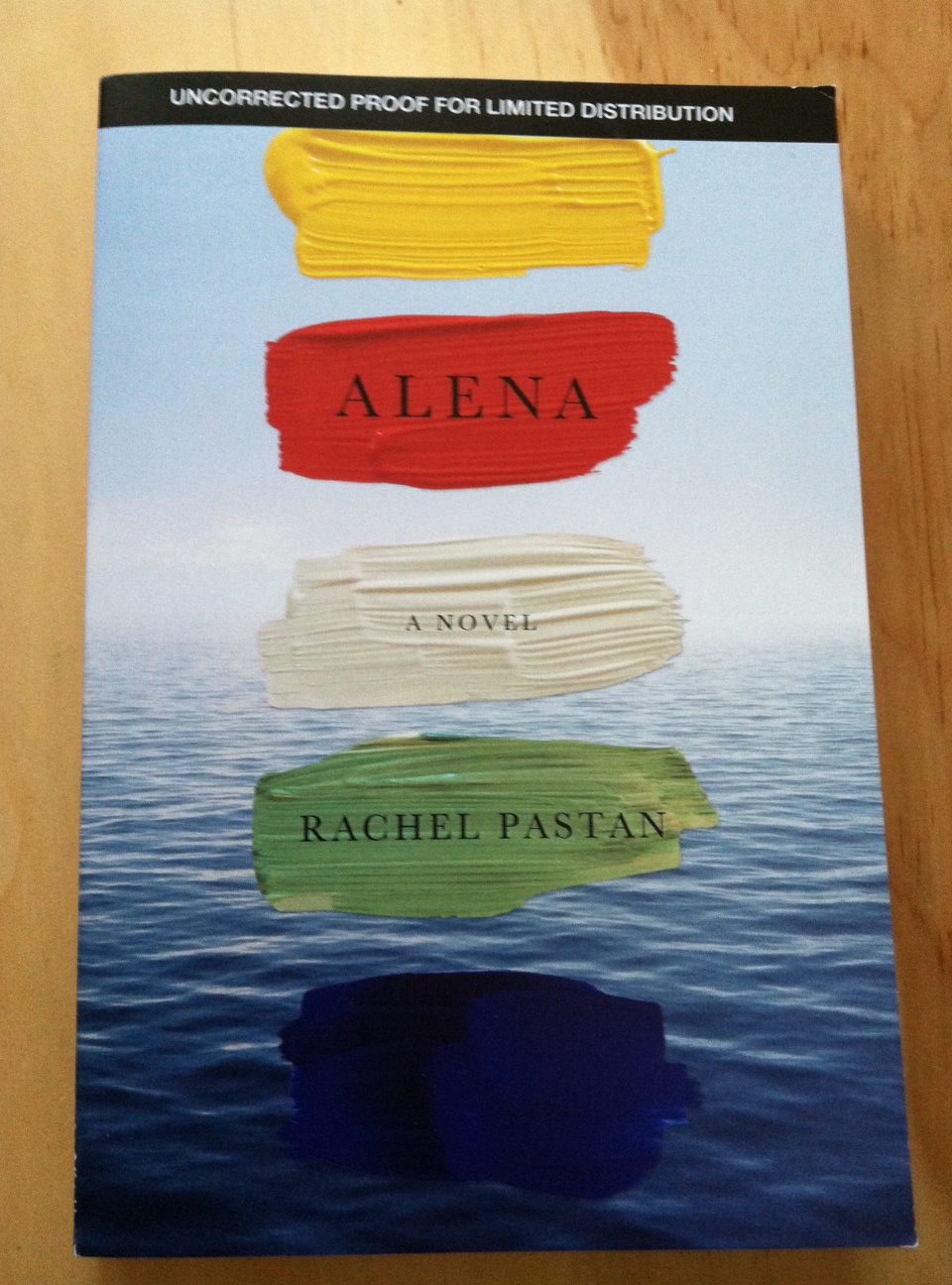
Out Today: Rachel Pastan’s Alena

AlenaFrom its first line — “Last night I dreamed of Nauquasset again” — Alena, Rachel Pastan’s new novel, echoes its inspiration, Daphne du Maurier’s Rebecca. However, Ms. Pastan’s interpretation of Rebecca‘s plot rejects recapitulation in favor of a refreshing focus on the workplace and contemporary art.

Alena‘s narrator, like du Maurier’s original, is an unnamed young woman from a modest background. Here, she is from the outset identified as a curator of contemporary art. On a trip to the Venice Biennale, she meets Bernard Augustin, the elegant, wealthy, and mysterious founder of a small museum on Cape Cod devoted to contemporary art — the Nauquasset, or Nauk. Bernard sees in her a fine sensibility and eye, and offers her the job of curator.

Arriving at the Nauk, the new curator finds that the staff, particularly the black-clad Agnes, still devoted to the previous (and presumed dead) curator, Alena. Alena’s touch and vision suffuses the small museum’s rooms and atmosphere, and soon the new curator must decide between reopening the museum with an exhibit of her own choice — or Alena’s choice, the grotesque art of a man named Morgan McManus. Meanwhile, clues to Alena’s disappearance linger in the shadows, waiting for their moment to appear.

One of the major differences between Alena and Rebecca is Alena’s shift of focus from the domestic environment to the workplace, a change wrought for the better (meaning no disrespect to Rebecca, of course). By raising the stakes (for example, from a country house party to the opening of a contemporary art museum), Alena pushes its focus outward from the personal into the world of art and the non-domestic workplace, without losing sight of the personal. The relationship between Bernard and his new curator, we learn quickly, cannot possibly be sexual, and doesn’t carry the erotic charge between Maxim and the second Mrs. de Winter, but that does not diminish its intensity.

The novel is wonderfully evocative of Cape Cod in the summer (I speak from experience, here — my husband grew up on the Cape and we spend time with his family who live there), and lucid in matters of contemporary art. I’m not a contemporary art aficionado by any stretch of the imagination (on a college trip to Paris, I skipped the Centre Pompidou to spend the day at the Louvre, a trade I’d still make any day); I have a passing familiarity with Damien Hirst and Marina Abramovic, and I like Chihuly’s work very much, but that’s about it. Ms. Pastan refers to a great many more artists, but her descriptions of art are so finely crafted that it’s easy to imagine the art she describes.

Death, lying side by side with art, is the novel’s other fascination. Like Rebecca, Alena is suffused with creepiness, a sense of something malevolent lurking just around the next corner, biding its time. Add that sensation to the narrator’s overwhelming anxiety, and the result is a suspenseful read, daring in both its departure from and adherence to its source material.

Note: I received this book through LibraryThing’s Early Reviewers program.

Tomorrow on the blog: An interview with Rachel Pastan, author of Alena

“Let now the chimneys blaze / And cups o’erflow with wine”

Here’s a poem to warm up with — Renaissance poet and musician Thomas Campion’s (1567-1620) “Now Winter Nights Enlarge”:

Now Winter Nights Enlarge

Now winter nights enlarge
    The number of their hours;
And clouds their storms discharge
    Upon the airy towers.
Let now the chimneys blaze
    And cups o’erflow with wine,
Let well-turned words amaze
    With harmony divine.
Now yellow waxen lights
    Shall wait on honey love
While youthful revels, masques, and courtly sights
    Sleep’s leaden spells remove.
This time doth well dispense
    With lovers’ long discourse;
Much speech hath some defense,
    Though beauty no remorse.
All do not all things well;
    Some measures comely tread,
Some knotted riddles tell,
    Some poems smoothly read.
The summer hath his joys,
    And winter his delights;
Though love and all his pleasures are but toys,
    They shorten tedious nights.


I like the physicality of this poem, the concession that the chill and storms of winter require light, and wine, and company to be borne, even if “love and all his pleasures are but toys.”

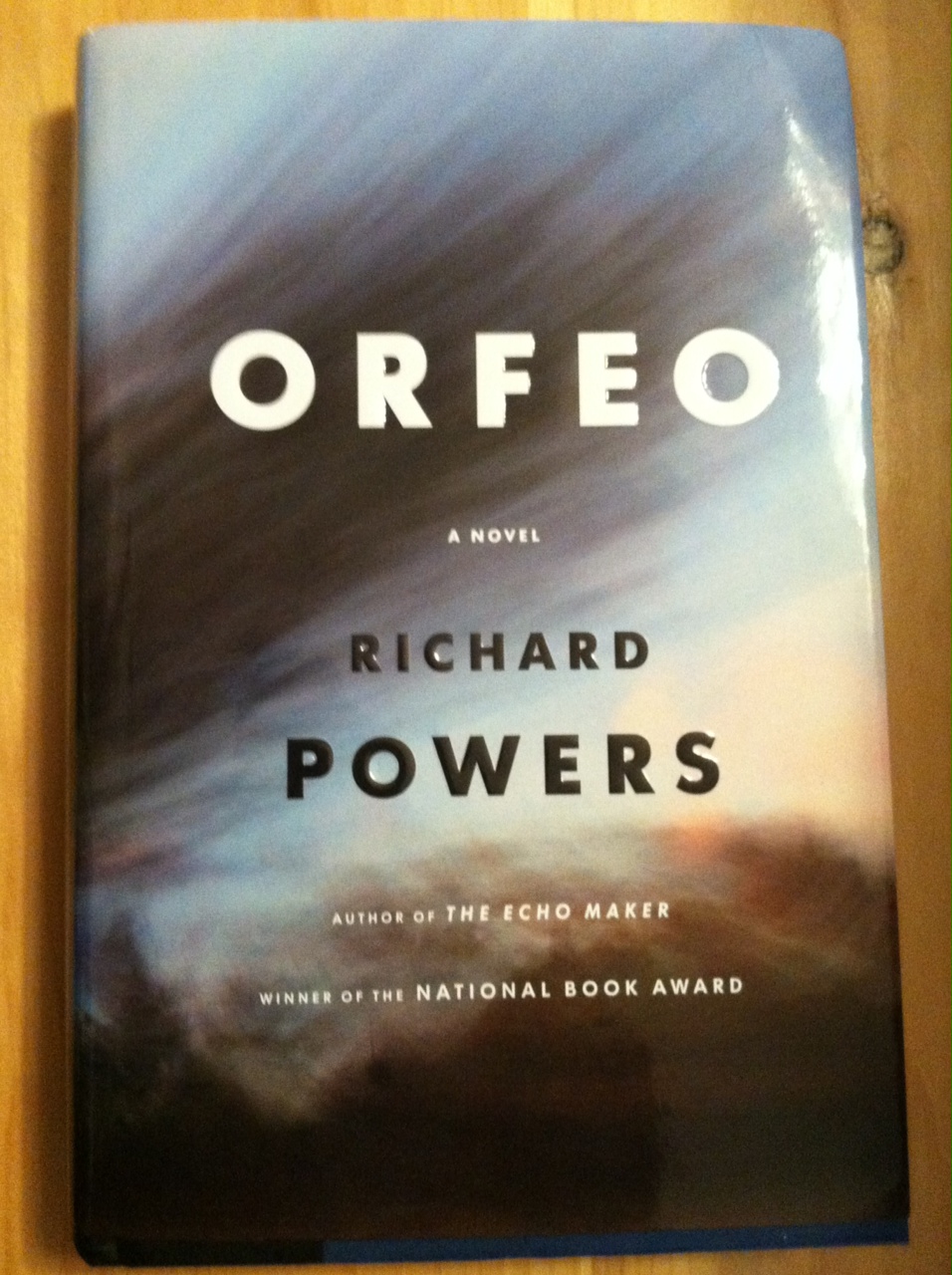
Coming Soon: Orfeo*, by Richard Powers

OrfeoIt’s January 17th, and I’m confident that I just read the book that will top my (mental) list of books published in 2014: Orfeo, by Richard Powers.

Yes, it’s that good.

When the feds come knocking on Peter Els’s door, concerned about his hobby — experimenting with the genetics of a less-than-safe bacterium — the seventy-year-old avant-garde composer assumes that their misapprehension about his motives will evaporate with the slightest scrutiny. Then he finds his home cordoned off by police tape and his belongings stuffed into cartons, and he decides to run.  As he sets out to make amends with the people he loves most before what he believes will be his inevitable capture, Els reconstructs the movements and suites of his own past.

Mr. Powers’s novels deal with the intersections of technology with art and life (this novel, his eleventh, is not the first to take genetics and music as its subject); they’re intensely intelligent, showcasing Mr. Powers’s nearly unbelievable erudition (he’s the recipient of not only the National Book Award, but also a MacArthur Fellowship — the “genius” grant). Orfeo is no exception. In the past, some reviewers have suggested that the cerebral splendor of Mr. Powers’s novels comes at the cost of emotional heft, but not so with Orfeo. As Peter Els tries to make meaning out of the complicated patterns of his life and his art, the reader witnesses love and friendship in fragile permutations both familiar and fresh.

Orfeo‘s lyrical beauty draws the reader in swiftly. Els experiences the world through sound, and we hear what he hears, from staccato birdsong to Messiaen’s Quartet for the End of Time, in passages so lovely and richly visual that they could describe paintings. I’ve never read music described so well.  I trained as a singer when I was younger, thinking, maybe, that I’d study opera at a conservatory — but I could not (and can’t) read music. Orfeo made me both wistful and grateful for that missed path.

In Gain (1997), Powers draws connections between the corporation and cancer, and here, in Orfeo, he draws our attention to the ever-expanding powers of the surveillance state and the ways it creeps into everyday life — even into the production of music (Powers’s description of Shostakovich’s Fifth Symphony is haunting, wonderful). Because what Peter Els is trying to do is to extract music from his life, and then engineer that music back into life itself:

He couldn’t begin to tell her. Life. Four billion years of chance had written a score of inconceivable intricacy into every living cell. And every cell was a variation on that same first theme, splitting and copying itself without end through the world. All those sequences, gigabits long, were just waiting to be auditioned, transcribed, arranged, tinkered with, added to by the same brains that those scores assembled. A person could work in such a medium–wild forms and fresh sonorities. Tunes for forever, for no one.

Dangerous work. But then, art is dangerous. Richard Powers would know.

Orfeo will be released on January 20th.

* My thanks to W. W. Norton for sending an advance copy of Orfeo in exchange for an honest review.

Recommended Reading (and a Classics Club Checkmark): Outlander and Dragonfly in Amber, by Diana Gabaldon

photo 1 (14)About two hundred pages into Diana Gabaldon’s Outlander, it occurred to me that somewhere out there is an HBO executive repeatedly berating himself or herself for not acquiring the TV rights to the seven (soon to be eight)-book-long series. Sex, violence, accents, great costuming possibilities, episodic structure, and a huge built-in audience of (largely female) fans? Good grief. It’s a series just waiting to happen. And it will happen, on Starz, this summer. Someone please offer to get me cable, because Ronald D. Moore is producing, and I think we all know how much I loved his Battlestar Galactica.

Before I get into the Claire & Jamie festivities, a funny story: A couple months ago, my friends (who also happen to be neighbors) were talking books at our consciousness-raising rap group (aka Wine Night), and Elena mentioned Outlander, and gave a rough outline of the plot. This rang a bell. Well, two bells, actually. Outlander had appeared on a best-of-classic sci-fi list, so I’d added it to my in-progress Classics Club list over the summer. But that’s not what came to mind first.

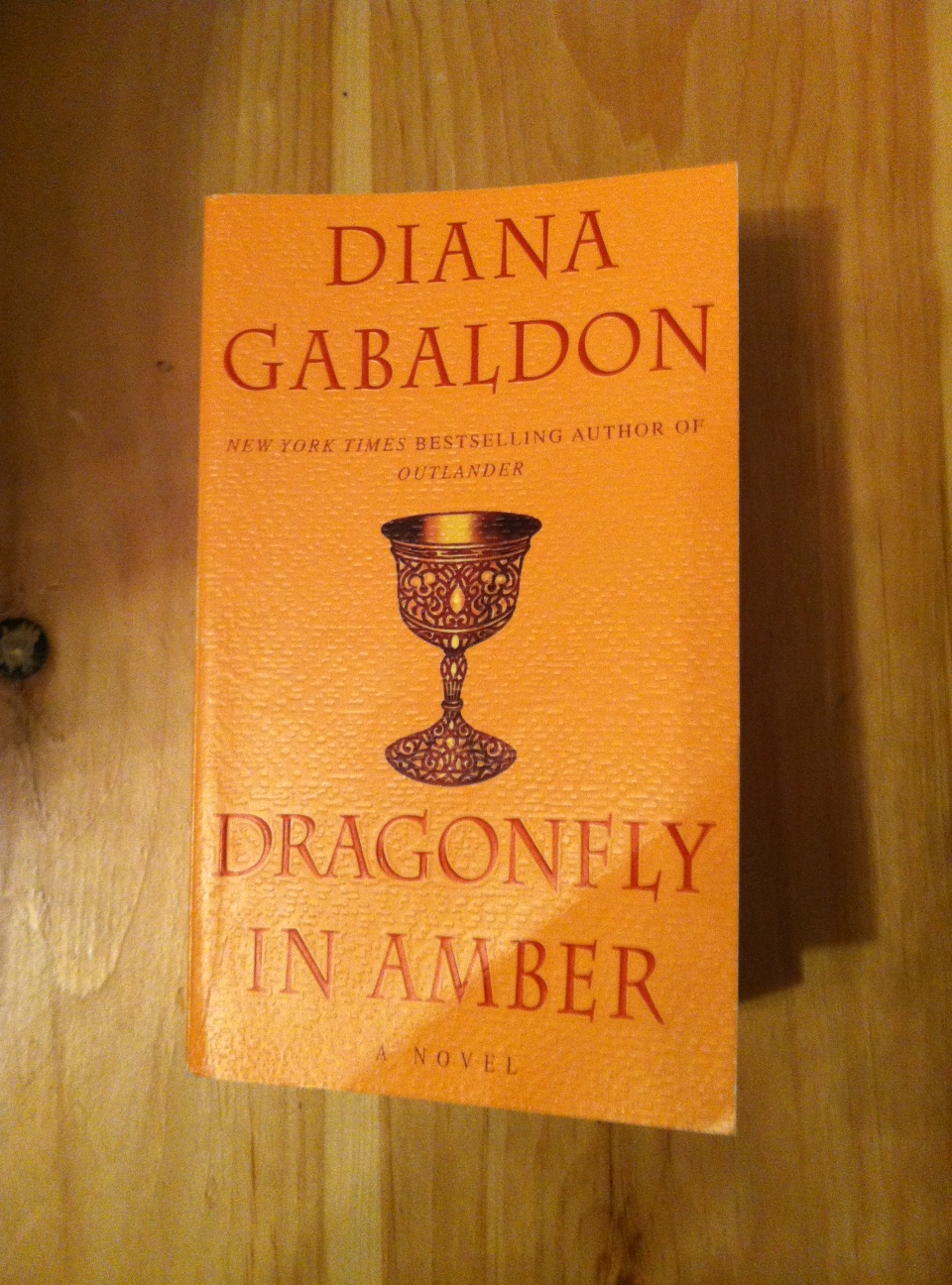
As a teenager, I came across Dragonfly in Amber, the first of Outlander‘s sequels, in the local library. I liked the title, and had no idea it was part of a series, so I just started flipping through. Oddly enough, the book kept falling open at some pretty steamy scenes (I’m looking at you, patrons of the Bertram Woods branch). Despite the fact that my parents never once in my life stopped me from reading a book, nor hovered over me while I read or browsed books, I was too chicken to check it out. So, rebel that I was, I’d pop by the shelf from time to time while I was in the library to read a chapter or two. I was a couple hundred pages in when someone took the book out, and I never found out what happened to Claire and Jamie. In fact, I forgot all about the book until Elena and a glass of pinot noir shook it loose from my uncooperative memory.Dragonfly in Amber

Onto the books. As per usual, I will give you advance warning of spoilers, which in this case appear at the end of the post.

Both Outlander and Dragonfly in Amber are door-stops: 850 and 947 pages, respectively (my editions are the mass-market paperbacks). And they’re tricky to classify by genre; let’s go with 55% historical fiction, 35% romance, and 10% SF-F.

The premise: Claire Beauchamp Randall, a former army nurse, is on holiday with her husband, Frank, in the Scottish Highlands. Frank’s a historian with a particular interest (which Claire doesn’t share) in the Jacobite risings of the eighteenth century, so naturally he finds plenty to occupy his time on their trip. On an outing, Claire, an amateur herbalist/botanist, gets too close to a circle of standing stones, only to find herself transported to 1743 — two years before the disastrous Jacobite Rising of 1745 (Bonnie Prince Charlie and all that). Disoriented and confused, it takes her some time to discover when and where she is. As an Englishwoman, she’s an “outlander,” a sassenach, and her position is most precarious.

Which is not to say that 1743 Scotland doesn’t have its perks: adventure, intrigue, professional pride (Claire quickly gains a reputation as a skilled healer), and an extremely good-looking young man named Jamie, who has his own set of problems (price on his head, a sadistic English army captain interested in him, etc.). Needless to say, events conspire to put Jamie and Claire very much in each other’s way as they attempt to navigate through the Highlands’ natural and political terrain. Much danger (and sex) ensues as Claire is forced to choose between her past and her present.

Outlander follows the pair to the end of 1743; Dragonfly in Amber picks up where Outlander leaves off, and includes a long foray into France (happily, Claire and Jamie both speak perfect French.) as they try to stop the Rising before it begins, with the help of Claire’s foreknowledge. But time is tricky stuff, as any good sci-fi fan knows.

Ms. Gabaldon doesn’t write literary fiction, and that’s just fine — because she does write rollicking adventure with excellent pacing. Near the end of Outlander, the tension was so extreme that I had to put the book down and catch my breath. The historical detail is intriguing, especially since the reader makes discoveries alongside Claire. If there’s a woman perfectly suited for dangerous time travel, it’s Claire: she’s quick-thinking, brave, very intelligent, and possessed of numerous practical skills thanks to her training as a nurse. She’s pleasant company as a narrator. Jamie’s a puzzle at first; he has all of the attributes you’d expect (strong, tall, brave, loyal, suitably appreciative of heroine,etc.), but he’s also very young and, for the most part, respectful toward women. Actually, sometimes I thought he seemed too much like a thirty-five year-old man, rather than a twenty-three-year-old; the author’s point that people grew up faster in centuries past is well taken, but sometimes Jamie’s emotional maturity is no verra believable, ye ken?

Sorry, couldn’t resist. Won’t happen again.

Bottom line: these are deliciously entertaining and diverting books, but if you prefer your fiction free of gore and bodice-ripping, look somewhere else.

Spoilers Ensue. Also, TW: sexual violence and child abuse.

Both novels include scenes of rape and attempted rape, and Dragonfly in Amber has a particularly horrifying account of a child being raped. In all cases the rapists (eventually) meet the eighteenth century version of justice, and in all instances rape is not glorified or glamorized, but shown as brutal and causeless. The victims are not blamed.

The villain in  Outlander is the aforementioned sadistic English captain, Jack Randall (just to complicate matters, he’s Frank’s ancestor.). Randall’s particular interest is the sexual debasement and torture of men (though he’s perfectly happy to beat Claire, and attempt to rape her too) — and he’s got his eye on Jaimie. I’ll get back to that in a second, but first, here’s my major philosophical issue with the books: Jack Randall is described, by Claire in 1968, as a pervert, and it’s not clear to me that what she’s describing is his sadism, rather than his homosexuality (which is referred to more than once). For that matter, why does the only gay character in the two books have to be a pedophile, rapist, and sadist? I realize that homosexuality wasn’t even a term in use in the eighteenth century, and that Outlander was published in 1991, but c’mon. Of course, I haven’t read the next 5,000 pages of the series, so maybe I’m speaking too soon.

UPDATE: Kay from WhatMeRead tells me that there’s a non-vilified gay character in another of Ms. Gabaldon’s books.

UPDATE 2: I’m happy to be wrong — please scroll down in the comments to read Ms. Gabaldon’s (!) clarification on this point.

Anyway. True to conventional romance tropes, Jamie rescues Claire from attempted rape at least twice in Outlander alone, but at the end of the book, something I’ve never seen in fiction happens. Jamie, condemned to hang, is in prison, and Claire’s first rescue attempt fails. Jack Randall is about to have her raped by one of his minions and then killed, but Jaime trades her life for his acquiescence to Jack Randall’s predilections. Basically, he consents to be raped and tortured to save Claire’s life.

And that’s exactly what happens. There’s no last-minute saving of his “honor.” Claire does manage to organize a rescue, but Jaime suffers for hours first. The last act of the novel is Claire’s struggle to help Jamie heal, physically and psychologically, from his experience (he does). These scenes are excruciating to read, but I was impressed by Ms. Gabaldon’s turning a romance trope on its head.

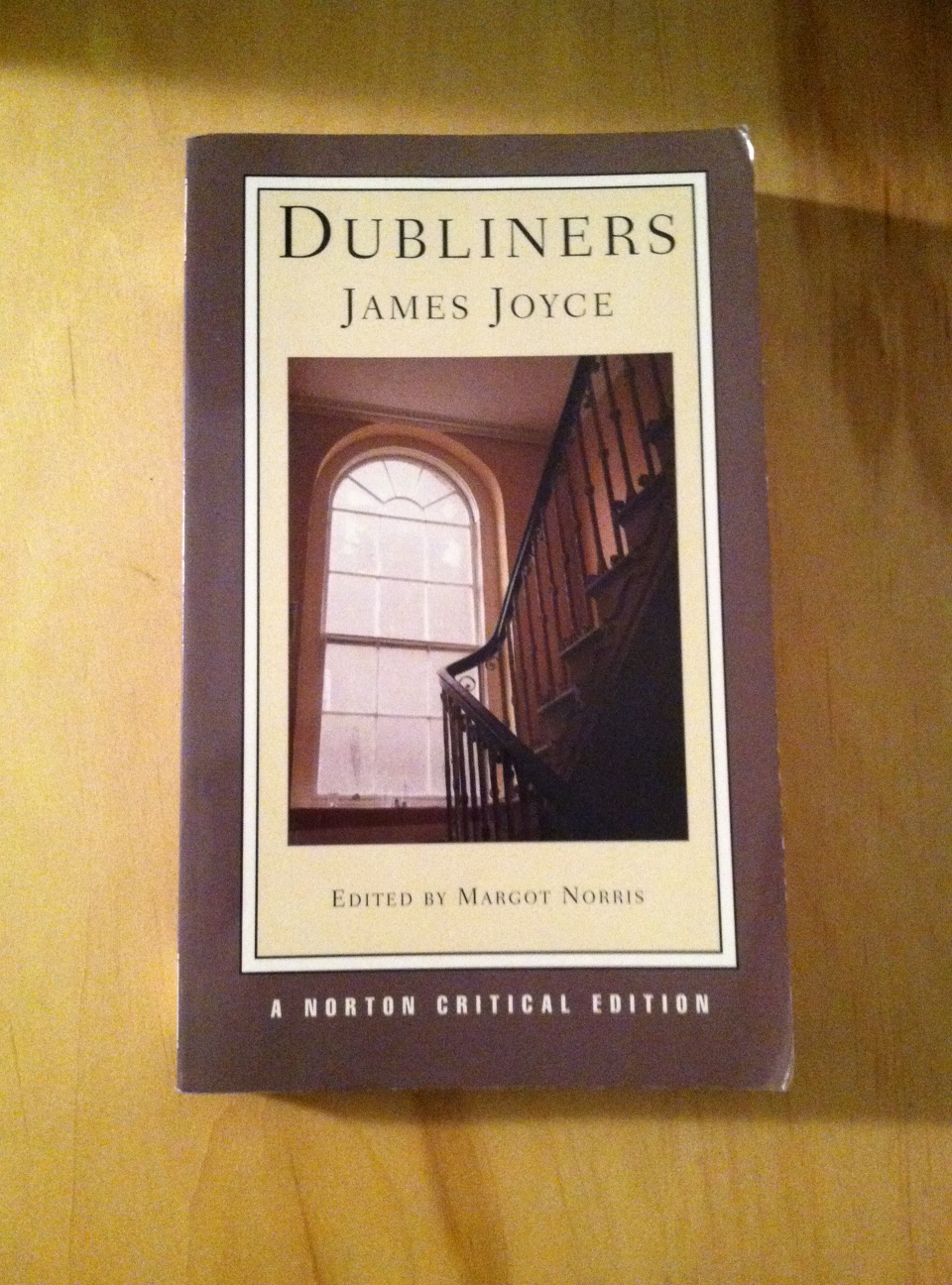
Guest Post: CJ from ebookclassics on Dubliners, by James Joyce

Backstory: In December, Rick at Another Book Blog organized a bookish Secret Santa event. A group of bloggers agreed to read a book suggested by someone else, and then post a review to that someone else’s blog. I was lucky enough to draw CJ from ebookclassics, and suggested that she read Dubliners, by James Joyce. Here’s her post. — Carolyn O


DublinersDubliners, by the Irish writer and poet James Joyce, is a collection of short stories depicting the lives of middle class men and women from Dublin during the early 20th century. Joyce writes each story starkly with little detail or background, and in a style he described as “scrupulous meanness”. This has often given readers the false impression that nothing happens in the stories. I laugh when I remember reading the first story, Three Sisters, because I was like, “That’s it?” It ended so suddenly.

However, Joyce is attempting to capture a moment in time when a character realizes something deeply important about themselves, whether good or bad, which is why the word epiphany is so heavily associated with this collection. My own epiphany was that it is not about what is happening in the story, but the emotions that are churning beneath the surface. Through the characters, the reader encounters sadness, regret, loneliness, confusion, anger, frustration and love of all dimensions. Some characters release their emotions loudly, publicly and towards other people. Others keep everything bottled up inside like acid eating away at their souls. But no matter where they go or what they do, the characters bring their emotions along with them like heavy baggage. Joyce said, “Dubliners is about how we are everywhere – it’s the experience of modern urban life.”

Truthfully, I found the stories sad and hopeless. That’s if I understood the story in the first place! I didn’t understand what some stories were about until researching the collection. So yes, someone did have to spell out to me that a story about a man falling down the stairs was about religion. I did relate to the twin themes of “being stuck”, and to me that meant either having some kind of obligation whether to family or a job, and “paralysis” or the inability of characters to make changes or move forward as a result. It made me think of how life just happens and sometimes people have toed the line so long, the habit is deep in every fibre of their muscles. Choosing the path of least resistance is automatic.

I have to give a special mention to The Dead which is supposed to be Joyce’s short story masterpiece. Tied in with the themes of “being stuck” and “paralysis”, the main character, Gabriel, gives a moving speech in the story about moving forward from the past to focus on the present. He said, “Our path through life is strewn with many such sad memories: and were we to brood upon them always we could not find the heart to go on bravely with our work among the living. We have all of us living duties and living affections which claim, and rightly claim, our strenuous endeavours.” However, by the end of the night he is an emotional wreck, dwelling on whether it is better to die young and have no past, or grow old and be plagued by mistakes and bitterness. The contradiction being on the outside he openly encouraged letting go of the past, but on the inside was torturing himself with it.

Dubliners was my first experience with James Joyce and I have Carolyn from Rosemary and Reading Glasses to thank for making the introduction. Although I found the stories sad and even downright depressing, I cannot deny Joyce is a masterful storyteller and writes so poignantly about human experience and the tedium of everyday life. I didn’t connect with any particular character or story, but I could appreciate the emotions and themes Joyce wanted to write about. Sad stories won’t deter me from enjoying more of his work in the future. In fact, I had an epiphany that sad stories can sometimes be the best stories.

 — CJ at ebookclassics

“Sundays too my father got up early”

Collected Poems of Robert HaydenRobert Hayden’s “Those Winter Sundays” is often anthologized, and deservedly so. A moving meditation on parents and children from the not-so-safe remove of adulthood, the poem reaches its plaintive, universal question in just three stanzas.

In the first stanza, the rhymes and alliteration (“weekday weather,” for instance) underscore the repetitiveness of the speaker’s father’s labor (“Sundays too my father got up early” [emphasis mine]); this father doesn’t rest even on the traditional day of rest.

In the second stanza, the “I” appears; the speaker includes himself in those who never thanked his father for his efforts. The same stanza, though, undercuts the father’s act of kindness, since the child fears “the chronic angers of that house.” The sense of icy brittleness expands — hard “c” sounds repeat throughout the poem — to encompass not only the winter cold, but also the chill of strained familial relationships.

The third stanza turns again, as we learn that the speaker’s father not only warmed the house, but polished the boy’s good shoes, presumably for church, an image meant to echo, I think, the biblical story of Christ washing the disciples’ feet. Our knowledge, built on the adult speaker’s point of view, that the father performed these acts of love alone and unthanked — whatever his faults may have been — brings us to the final couplet, in which the speaker asks what we all ask of ourselves at some point, thinking of those who care for us:

What did I know, what did I know
of love’s austere and lonely offices?