Literary Wives: The World’s Wife, by Carol Ann Duffy

literarywives2If you’re new to Literary Wives, here’s the summary: we’re an online bookclub of five to six book bloggers, and we post every other month about a different book with the word “wife” in the title. When we read these books, we have two questions in mind:

1. What does this book say about wives or the experience of being a wife?

2. In what way does this woman define “wife”—or in what way is she defined by “wife”?

This month, we’re talking about Carol Ann Duffy’s The World’s Wife, a 1999 collection of poetry.  We invite you to join the discussion by commenting on our blogs (links below) or posting your own review on our Facebook page.

We also hope you’ll join us next time, on Monday, October 6, when we’ll be discussing Melanie Gideon’s Wife 22.
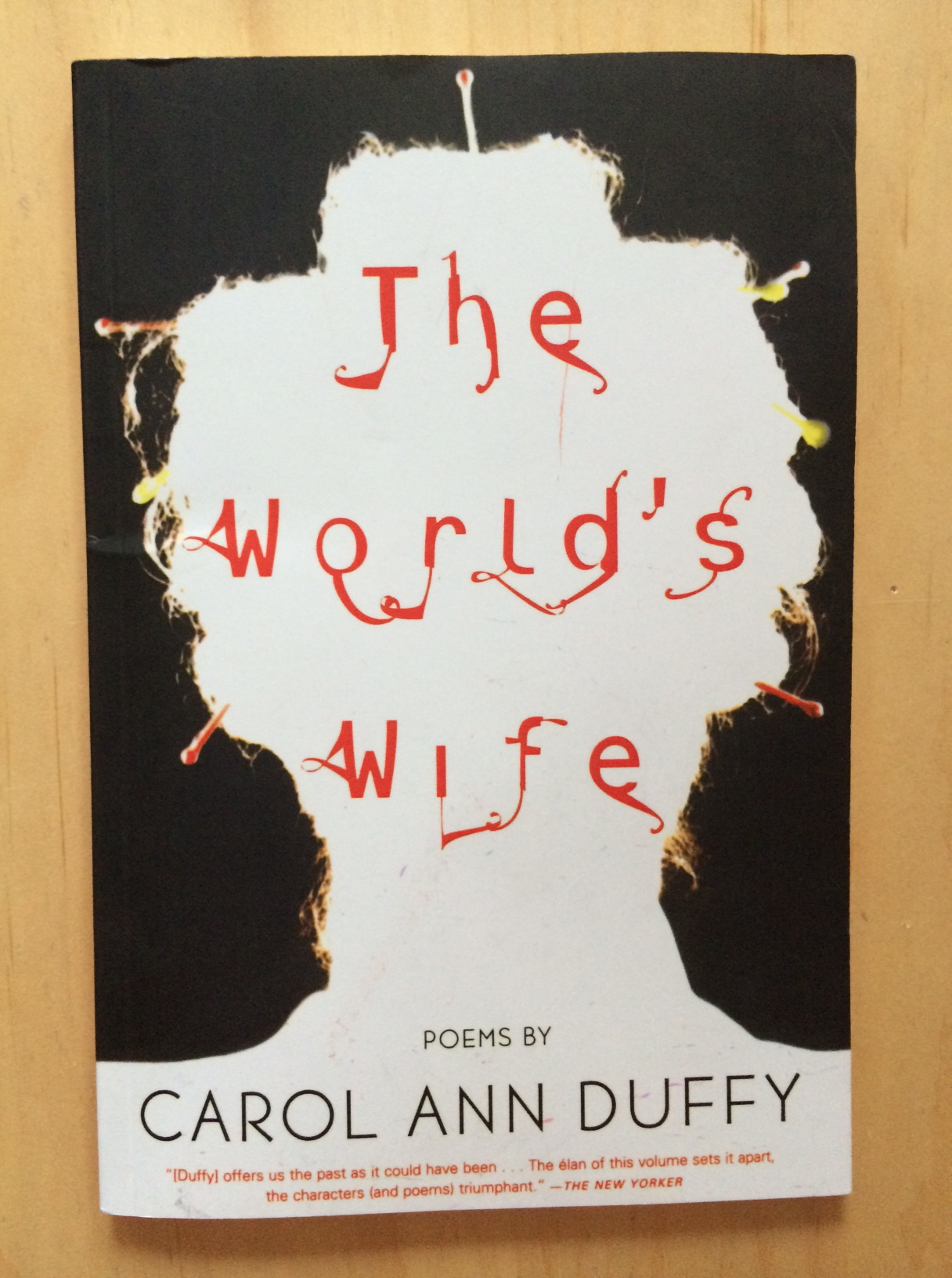

photo (112)Dear Readers, it will come as no surprise to you that I love Carol Ann Duffy. I’ve talked about her poetry in a couple of different contexts (here and here), and she’s one of the few writers whose work I’ll buy without reading reviews or flipping through pages. Several of the poems in The World’s Wife are included in Ms. Duffy’s Selected Poems, which is how I first learned of the book.

In The World’s Wife, Ms. Duffy imagines the voices of the women close to famous historical or cultural male figures (“Mrs. Lazarus”, “Frau Freud”) or the voices of the people those male figures might have been had they been female (so, “The Kray Sisters” instead of the Kray Brothers, “Queen Kong” instead of King Kong), or the voices of women whose stories have been rendered in men’s voices (“Delilah,” “Little Red Cap”).

The poems range from a few lines to a few pages long, but all of them feature Ms. Duffy’s trademark sharp wit, incisive language, and zinging, unexpected rhymes. These poems are often funny and always thought provoking, a glorious medley of feminist social commentary in an entertaining package.

Usually, this is the part of the post in which I’d address our Literary Wives questions, but since this book presents so many women, it would be folly to write about them all. In general, though, Ms. Duffy presents a picture of wifehood that is at once one of frustration and one of power; the invisible wives of history are, in The World’s Wife, fully imbued with agency, requiring our attention. Ms. Duffy asks us to consider what it would be like to mourn and grieve for a dead partner, only to have him reappear (“Mrs. Lazarus”) or what it would be like to be terrified that your husband might accidentally turn you into gold (“Mrs. Midas”).

Sometimes Ms. Duffy’s characters supply an answer to a vexing historical quandary. In “Anne Hathaway,” Shakespeare’s wife tells us exactly why her husband in his will left her “my second best bed.” Sometimes her speakers are drawn forward into the modern era. We see wily “Mrs. Faust” making use of her husband’s bargain, and witness “Mrs. Tiresias”‘s  exasperation when her gender-changing husband experiences menstruation for the first time (hint: a strongly-worded letter to “the powers that be” demanding paid menstrual leave ensues”).  These are “Bad girls. Serious women.” They’re not always women you’d like to meet, but they’re fascinating creations.
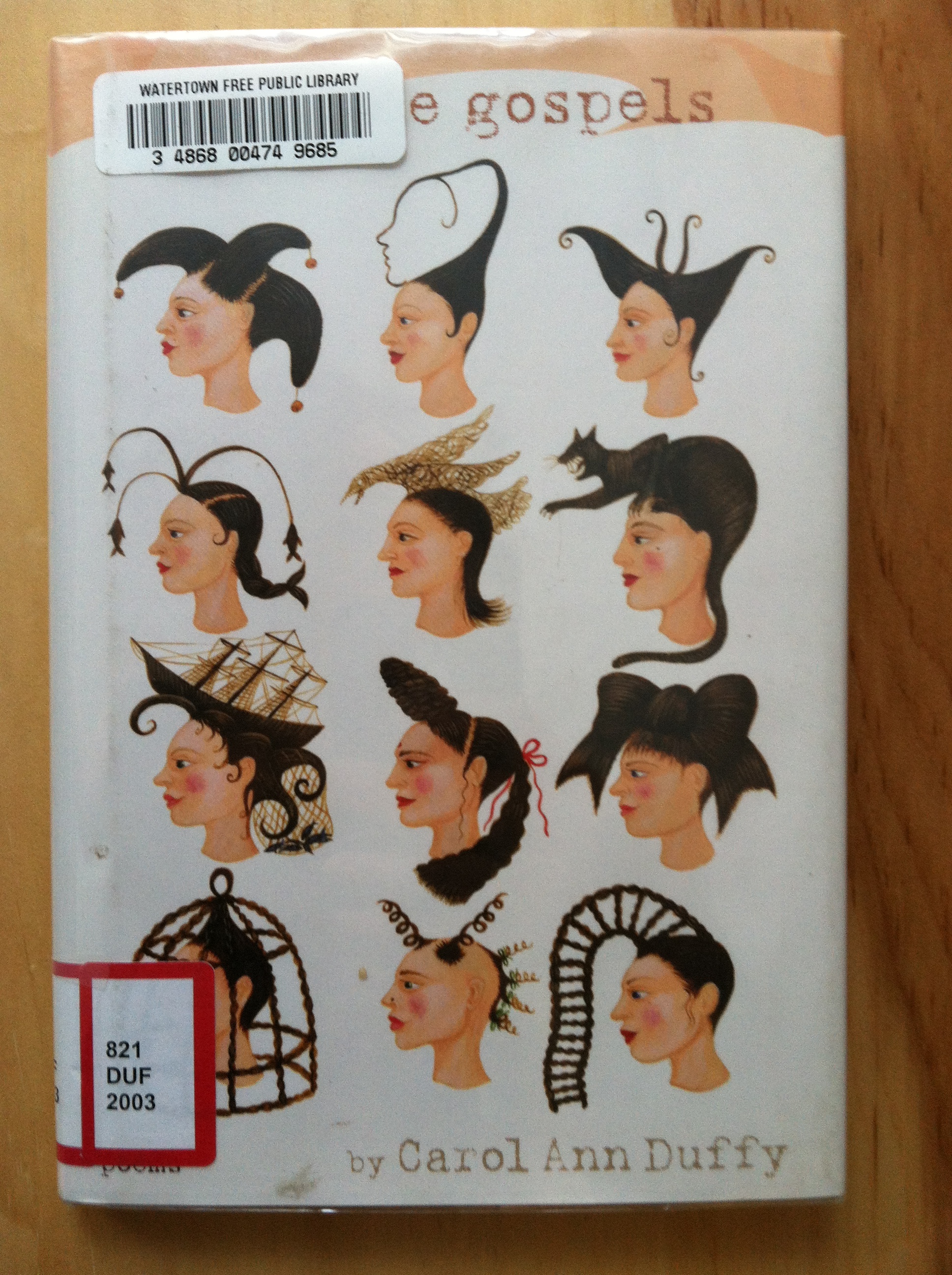
Feminine GospelsIf you loved The World’s Wife and are wondering which book to read next, I’m happy to recommend Ms. Duffy’s collection Feminine Gospels (2002), which you might consider a kind of follow-up to The World’s Wife. I read it recently and it was fantastic. Like The World’s Wife, the characters in the poems allow us entry into the world from a female perspective, though one much more everyday, not necessarily associated with names everyone knows. Feminine Gospels includes a long poem, “The Laughter of Stafford Girls’ High” which sparkles with wit and depth and character; I don’t usually go in for non-epic long poems, but this one is just fabulous.


Please visit the other Literary Wives bloggers to get their takes on the book! 

Emily at The Bookshelf of Emily J. 

Cecilia at Only You

Kay at WhatMeRead

Lynn at Smoke and Mirrors

(Ariel at One Little Library will be posting sometime in the next couple weeks)

(Audra at Unabridged Chick is on hiatus)
An American in Burgundy, Part Deux: Maximillian Potter’s Shadows in the Vineyard

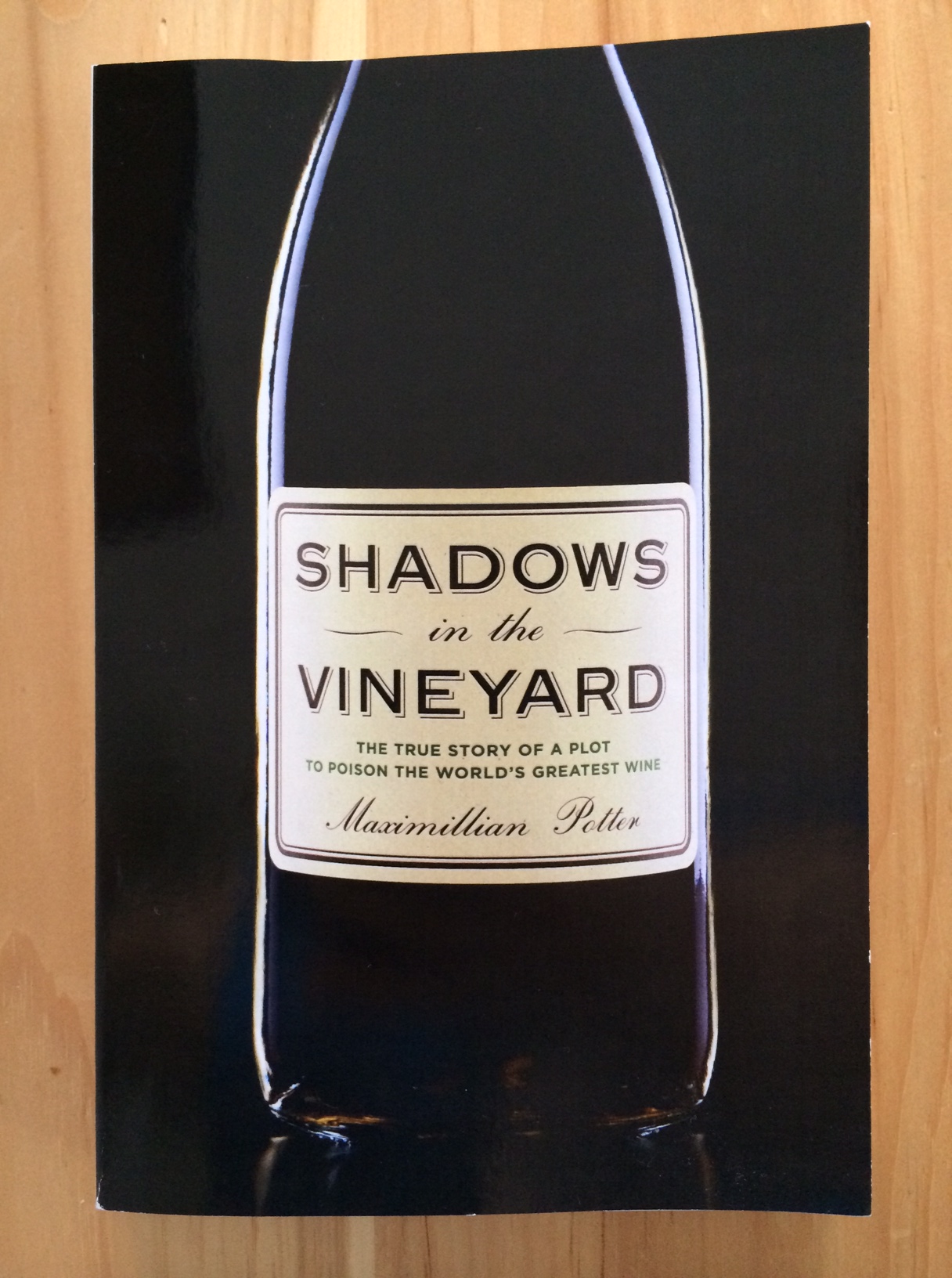
photo (110)The subtitle of Maximillian Potter’s Shadows in the Vineyard* is “The True Story of the Plot to Poison the World’s Greatest Wine,” which conjures up images of ski-masked men in dark cellars lacing bottles of wine with cyanide or arsenic.

The truth is somewhat different; a more accurate subtitle would have focused on the vineyard and the vines that produce one of the world’s most expensive and highly-regarded wines. While no cyanide appears in Shadows in the Vineyard, two vines in the Domaine de la Romanée Conti vineyard were indeed poisoned, and the man who did it threatened to poison more. These events were the subject of a Vanity Fair article penned by Mr. Potter, which was then expanded into this book.

The book as it stands is less about the crime than about the history of the vineyard and its tangled web of owners and winemakers; Mr. Potter in particular focuses on Aubert de Villane, the Domaine’s current proprietor, a serious, kindly, humble man who clearly cherishes his vineyard and its wines. (I started to think of him as “the grape-whisperer” as I read Shadows in the Vineyard.)

Earlier this summer I reviewed Ray Walker’s The Road to Burgundy, which is one man’s tale of leaving it all for the love of terroir. Shadows in the Vineyard is more invested in territory, in how this famous vineyard came to be, in the forces that shaped both winemakers and winemaking.

The organization of the book leaves much to be desired; Mr. Potter attempts to build tension and flesh out a short true-crime story by coming back to the poisoning plot time and again even as he digresses into other subjects (history, the wine market, tensions among the DRC’s owners, etc.). A better strategy, I think, would have been to frame the poisoning plot as just one of the many challenges the vineyard has surmounted over hundreds of years, and using it to bookend his study of Aubert de Villane and his vineyard.

Still, there’s much to learn, and if you’re a wine connoisseur, you won’t want to miss this book given its focus on vineyards and the history of burgundy wine (especially the Domaine’s). For the rest of us mere mortals, who will probably never taste a wine valued at thousands of dollars a bottle (really: check out this Sotheby’s auction listing), Shadows in the Vineyard offers carefully drawn portraits of Monsieur de Villane (though I rather wish the author would not purport to know exactly what the man was thinking at such-and-such a moment), his family, and even the vine-poisoner.

Mr. Potter, and many others, consider the best kind of wine to be a consumable work of art, a da Vinci painting, say, in a glass; what would drive a person to deface that kind of beauty? If you’re interested in the question, you might like Shadows in the Vineyard.

*I received a copy of this book from the publisher for review purposes, which did not affect the content of my review.

Recommended Reading: Cristina Henríquez’s The Book of Unknown Americans

photo (95)As The Book of Unknown Americans* opens,  Alma and Arturo Rivera arrive in Delaware with their daughter, Maribel. The journey was long and uncomfortable, and already they miss their life in Mexico, but what they hope for eclipses all the uncertainty and fear they face: they just want their daughter, injured in an accident, to get well.

They’ve waited for months for Arturo to find work — though in Mexico he worked as a skilled builder, here he works long days in darkness at a mushroom-growing facility — so that Maribel can attend a school that might help her manage the memory loss and personality fluctuations that resulted from her accident.

Some of the first neighbors to welcome them to their new apartment complex are the Toros, a family who fled political upheaval in Panama years before. Mayor is about Maribel’s age; he’s shy, bullied at school, and woefully unskilled at soccer compared to his older brother. He feels caught between two worlds: “I felt more American than anything, but even that was up for debate according to the kids at school [. . . ] The truth was that I didn’t know which I was. I wasn’t allowed to claim the thing I felt and I didn’t feel the thing I was supposed to claim” (78). Mayor falls immediately for Maribel’s beauty, but as the weeks go on they develop a deep friendship.

While Maribel is at school and Arturo is at work, Alma navigates life in a strange country, helped along by Mayor’s mother Celia. After a run-in with a menacing teenager soon after their arrival, Alma is extremely protective of Maribel.  Her protectiveness and Mayor’s growing affection for Maribel soon lead to friction between the two families, and, eventually, tragic consequences.

The Book of Unknown Americans is about love: not just romantic love, but the love of parents for their children. It’s not a Romeo and Juliet story, and I appreciated the depth of the narrative that’s due to Alma and Mayor’s alternating narration.

The novel is also an evocative rendering of the multiplicity of immigrant experiences. In deftly composed vignettes, Ms. Henríquez introduces us to many of the residents of the Toros’ and Riveras’ apartment complex, men and women from all over Latin America, men and women with sad and funny and terrible stories. These small sections, told in characters’ own voices, feature some of the best writing in the novel; I wanted to know more about these characters. The brevity of these sections is deliberate, of course; even these sketches are more than we usually read about the “unknown Americans” of the novel’s title. As Micho Alvarez puts it,

When I walk down the street, I don’t want people to look at me and see a criminal or someone that they can spit on or beat up. I want them to see a guy who has just as much right to be here as they do, or a guy who works hard, or a guy who loves his family, or a guy who’s just trying to do the right things. [. . . ] We’re the unknown Americans, the ones no one even wants to know, because they’ve been told they’re supposed to be scared of us and because maybe if they did take the time to get to know us, they might realizes that we’re not that bad, maybe even that we’re a lot like them. And who would they hate then? (237)

The Book of Unknown Americans is a nuanced, deeply affecting examination of what it means to live in America, and what it means to be American. Highly recommended reading.

Tomorrow: An interview with Cristina Henríquez, author of The Book of Unknown Americans

* I received a review copy of this book from the publisher in exchange for an honest review


Writer to Watch: Anne Leonard

Recently, I had the unusual experience of reading a book that didn’t really work for me as a whole, but that also ensured I’ll read the author’s next book.

photo (86)The author is Anne Leonard, and the book is Moth and Spark*.  Here’s the summary from Ms. Leonard’s website:

For three years, Prince Corin of Caithen has been waiting nervously for the Sarian army in the east to invade his kingdom. Now it is finally happening. But there are gaps in his memory and blank spots in his mind, his father is keeping secrets, and the Emperor’s dragons appear to be spying. The Empire which should protect Caithen may even be allied with the Sarians. If all that weren’t enough, the pressure is on for him to get married.

While Corin faces a world gone awry, Tam, the commoner daughter of a respected doctor, arrives at court as the guest of her sister-in-law. It is the season for making matches, but Tam has not come husband-hunting; she is insatiably curious about the court instead. Trying to control her impertinent attitude seems like enough of a challenge – until she begins having visions.

Chance leads Tam and Corin into meeting, and Tam is swiftly pulled into Corin’s life of war and politics. While they are falling into forbidden love, they learn there is another player in the war: the dragons themselves. Seeking to break free of their slavery, the dragons intend to use Corin and Tam as their tools. And the dragons demand whatever it takes, without regard for love or life or loyalty.

When I picked up the book, I had just finished Roxane Gay’s An Untamed State (review coming next week), and I needed a bit of a breather. I was expecting a literary-but-light read with plenty of escapism (see: dragons).  Moth and Spark confounded those expectations, since it is, at heart, a novel about court intrigue, through the lens of an accelerated Elizabeth Bennet/Mr. Darcy relationship. Yes, there were a few dragons, but not as many as you’d think, given the description of the book. The long middle section, which takes place at court, is quite tense.

Essentially, there’s so much going that the action sometimes felt truncated, and opportunities to elaborate on the culture, customs, and history of the world Ms. Leonard created simply passed by. Much as I love a standalone book, particularly in SF/F, I think Moth and Spark could have been and perhaps should have been three books: one that followed Tam and Corin in parallel, ending with their meeting; one about the intrigues at court and in the capital city; and one in the world at war.

It’s this sense of missed richness that makes me think Anne Leonard is a writer to watch. The Tam/Corin relationship is drawn from Jane Austen, as Ms. Leonard takes care to point out (though, for my taste, Tam is so perfect that she’s often annoying; “impertinence” is not something a character needs to overcome). The court politics and factions had some Dune-like overtones. The setting was a nice mix of the medieval and Victorian periods, with a few Gothic touches. The fantasy elements of the novel owe debts to Anne McCaffrey’s Dragonriders of Pern series, Greek mythology, and Tolkien (just a bit). It’s an unusual writer who can draw so many disparate threads together, and that’s why I’m looking forward to Anne Leonard’s next book.

*I received a review copy of this book from the publisher in exchange for an honest review.

Recommended Reading: All That Is Solid Melts into Air, by Darragh McKeon

photo (85)Darragh McKeon’s debut novel, as both an account of the Chernobyl disaster’s human toll and a portrait of Soviet Russia’s collapse, concerns itself with decay. As the familiar falls away, what’s concealed beneath is difficult to confront.

All That Is Solid Melts into Air* follows four characters. First, we meet Yevgeni, a nine-year-old piano prodigy mercilessly bullied by his peers. Yevgeni’s fingers are forced to hover over the keyboard — the family can’t afford a piano — in the tiny Moscow apartment he shares with his mother and aunt, because the neighbors can’t stand the “noise.”

His aunt, Maria, was once a writer who clandestinely circulated news of Poland’s Solidarity movement; revealed as a dissident, she now works at a factory, making car parts and wondering if all hope for reform is lost. She is wholly devoted to Yevgeni and loves her sister dearly, though the two struggle with tension stemming from their deceased father’s awful past.

Maria’s estranged husband, Grigory, is one of Moscow’s most promising surgeons when he’s called away on an urgent — and secret — matter: to advise the Soviet officials presiding over the Chernobyl disaster.  Outraged by the combination of blindness and cowardice he finds, Grigory attempts to protect refugees and residents of areas near the accident site, only to find himself swiftly deprived of authority. Instead of returning to Moscow, he stays in the displacement camps, operating on children who’ve suddenly developed thyroid cancer and witnessing firsthand the devastation radiation inflicts on the human body.

One of Grigory’s patients is Artyom, a teenage peasant who’s the first in his village to notice that something is terribly wrong: the cows are bleeding from their ears. It’s only the beginning of a hellish journey for Artyom, his parents, and his sister. Betrayed by the Soviet system, counted as expendables, the family is one of thousands who lose everything. Artyom is the only major character in the story who seems to fade from view — just like the people whose stories his is drawn from.

Mr. McKeon’s prose is careful, eschewing the sensational in favor of measured, occasionally lyrical depictions of everyday life in Moscow and Artyom’s village near the Chernobyl plant. The plight of people affected by the disaster, crushed under weight of Soviet indifference and forced invisibility runs parallel to the plight of ordinary citizens of Moscow, miles away, just as crushed by a system that breathes fear and breeds violence.

Only three years from the fall of the Berlin Wall, even would-be dissidents are more than cautious. Maria tells a friend, “Sometimes I hear these words, ‘glasnost,’ ‘perestroika,’ and they sound to me like the final breaths of an empire” — only to hear her friend remind her of dashed hopes thirty years before: “So we went back to doing what we do so well: watching, deluding ourselves with fragile hopes, with an occasional moment of grace or luck; holding on to these things as omens. Hoping ourselves into inaction. Perhaps in a year we’ll be shot for daring to tell a stupid chicken-farmer joke” (255).

Ultimately, All That Is Solid Melts into Air is Grigory’s story. He’s the hub of the novel’s spoking plotlines, intimately involved in the tragic aftermath of Chernobyl. Like Maria in Moscow, who lives in drudgery to help her nephew escape the same fate, Grigory finds in Artyom a child who helps him keep his hold on hope. He drifts, doing all the good in his power even though he knows it will never, ever be enough:

During these nights, he gazes at them in their cots. Nothing so unimaginable that it cannot be true, this is what he things, beauty and ugliness resting within the single body of a diseased infant, the two faces of nature brought into stark relief.

No officials have made their way here, despite his daily entreaties. He wants them to walk into this room, a place where ideology, political systems, hierarchy, dogma, are relegated to mere words, belonging to files, banished to some dusty office. There is no system of belief that can account for this. The medical staff know that, in comparison, nothing that has gone before in their lives has any significance. There are only these months, these rooms, these people. (198)

Decay is inevitable, surely. All That is Solid Melts into Air offers the consolations of memory and witness.

Coming Soon: An Interview with Darragh McKeon, author of All That Is Solid Melts into Air

* I received a review copy of this book from the publisher in exchange for an honest review.

Literary Wives: The Crane Wife, by Patrick Ness

literarywives2If you’re new to Literary Wives, here’s the summary: we’re an online bookclub of five to six book bloggers, and we post every other month about a different book with the word “wife” in the title. When we read these books, we have two questions in mind:

1. What does this book say about wives or the experience of being a wife?

2. In what way does this woman define “wife”—or in what way is she defined by “wife”?

This month, we’re talking about Patrick Ness’s latest novel, The Crane Wife*.  We invite you to join the discussion by commenting on our blogs (links below) or posting your own review on our shiny new Facebook page.

We also hope you’ll join us next time, on Monday, August 4, when we’ll be discussing Carol Ann Duffy’s The World’s Wife (poetry! hooray!).


photo (83)I’ve had my eye on The Crane Wife for a few months. I like novels that bend myths and folklore in new ways, and Patrick Ness has been the recipient of all kinds of praise. And isn’t the cover just gorgeous?

Here’s the summary from the publisher:

George Duncan is an American living and working in London. At forty-eight, he owns a small print shop, is divorced, and is lonelier than he realizes. All of the women with whom he has relationships eventually leave him for being too nice. But one night he is waked by an astonishing sound—a terrific keening, which is coming from somewhere in his garden. When he investigates he finds a great white crane, a bird taller than himself. It has been shot through the wing with an arrow. Moved more than he can say, George struggles to take out the arrow from the bird’s wing, saving its life before it flies away into the night sky.

The next morning, a shaken George tries to go about his daily life, retreating to the back of his store and making cuttings from discarded books—a harmless personal hobby—when a woman walks through the front door of the shop. Her name is Kumiko, and she asks George to help her with her own artwork. George is dumbstruck by her beauty and her enigmatic nature and begins to fall desperately in love with her. She seems to hold the potential to change his entire life, if he could only get her to reveal the secret of who she is and why she has brought her artwork to him.

You see where that’s going, right? I think we’re meant to; as we (the readers) read to understand how and why Kumiko and the crane are connected, George busies himself just trying to learn who Kumiko is — she’s evasive, to say the least; the most personal information she’ll share is a mythic story about a crane and a volcano that she’s depicting in a private series of works.

The novel is at its best when it focuses on the everyday lives of its characters. George is a thoughtful, kind man (a real treat to read about, in this day and age), and his daughter, Amanda, was my favorite character. Angry and overworked on both the professional and the domestic fronts, Amanda has trouble fitting in with other women at work, who discount her passionate opinions and remain oblivious to her particular brand of humor. She’s still in love with her ex-husband and delights in their rambunctious son. Like George, like everyone, she’s entranced by Kumiko. I was entranced by Amanda, by her intensity and her awareness and by how much she cares for her family. Throughout the novel, I preferred realism to the hazy sort of philosophy that Kumiko seems to represent.

I have three quibbles with the novel’s style. First, Mr. Ness italicizes words for emphasis, which drove me crazy. (See?) Once I could overlook, but it happens repeatedly. Second, the tone occasionally veers into the maudlin and sentimental, which was distracting. Third, several long sections consist entirely of dialogue (which is fine), with pauses indicated by ellipses in quotation marks. Would it have been so difficult to write, “He paused.”? And how is an ellipsis spoken?

The Crane Wife is a gentle, sometimes sentimental novel with memorable characters. If that’s your kind of book, I think you’ll like it.


And now, on to the Literary Wives questions:

1. What does this book say about wives or the experience of being a wife?

Despite the title, neither of the main female characters — Kumiko and Amanda — are properly wives. George’s ex-wife is refreshingly non-harpy-like, and happily remarried. Amanda’s experience of marriage — what little we see of it — was difficult because of the two personalities involved. There’s no cohesive picture of what it means to be a wife, and that’s just fine.

2. In what way does this woman define “wife”—or in what way is she defined by “wife”?

Again, a difficult question to answer, since, properly, the Crane Wife is a folktale/mythological/fairytale figure, and in this instance she seems to be the crane in Kumiko’s story, who must see the world for what it is, be willing to suffer for love, and ultimately forgive those who hurt her (this is all a bit fuzzy, to tell the truth). I don’t think I like this vision of what it means to be a wife — see feminist credentials, mine — but this is all wrapped up in the “hazy philosophy” I mentioned above, so I will forgo the rant for now.

*I, along with the other Literary Wives bloggers, received a review copy of this novel from the publisher in exchange for an honest review.

Please visit the other Literary Wives bloggers to get their takes on the book! 

Emily at The Bookshelf of Emily J. 

Ariel at One Little Library

Cecilia at Only You

Kay at WhatMeRead

Lynn at Smoke and Mirrors

(Audra at Unabridged Chick is on hiatus)

Out Today and Recommended: The Map Thief, by Michael Blanding

photo (82)For years, E. Forbes Smiley III seemed to be the kind of man who matched his name’s connotations: moneyed, educated, successful. An antiquarian map dealer, Smiley shuttled between both sides of the Atlantic, becoming an expert in valuable and rare maps, particularly early maps of New England.

He was also stealing them.

In The Map Thief*, Michael Blanding investigates the paradox that Smiley represents. How could a man who treasured maps, who taught himself about them by poring over them in some of the world’s finest libraries, desecrate the very documents he valued and betray the people who shared his interests?

Mr. Blanding delves into Smiley’s life and work, bringing to life Smiley’s quixotic attempt to shape the world to fit his vision. (For instance, Smiley tried to reinvigorate a Maine town on his own, without much consideration of residents’ input, which turned into a spectacular failure.) His friends came up with the term “Forbes dollars”: “a personal accounting system in which Smiley always spent less than he had and was always owed more than he was” (83). As his career progressed, Smiley sank deeper into debt, impulsively buying maps even if he didn’t have the funds ready to pay for them.

In one instance, Smiley bought a rare atlas from another dealer for $50,000. When his check bounced, the other dealer demanded the atlas back, but it was too late: “he had taken the atlas apart right on the train up to Boston, selling several charts of Boston Harbor to Leventhal and keeping the rest, hoping to sell them to other clients to recoup the cost. [. . . ] he [the other dealer] couldn’t help but be appalled that Smiley had so cavalierly taken apart a book with less than ten known copies in the world” (73).

If the thought of Smiley tearing apart an atlas he (ostensibly) bought makes you shudder, the actual thefts will repel you. The gravity of the thefts — the number, the institutions affected, the rarity of the works taken, the fact that many are still unrecovered — is simply outrageous; Smiley’s prison sentence seems ridiculously light. I’ve had the privilege of handling two or three rare books, and the thought of someone opening one too swiftly sets my heart racing — the thought of someone ripping out a page is painful.

Though Smiley is the subject of The Map Thief, and Mr. Blanding places him in the context of the lively and sometimes strange world of rare map aficionados (dealers, collectors, and librarians), the book shines brightest when Mr. Blanding recounts the history of the rare maps themselves and the people who created them. The research is meticulous, and the historical characters fascinating. The book includes several full-color plates of some of the maps discussed in the text, and they’re just glorious (this comes, by the way, from a person whose only displayed map is one of Middle Earth). If you aren’t a map person before you read this book, you very well may be one afterward.

Tomorrow: An Interview with Michael Blanding, author of The Map Thief

*I received a review copy of this book from the publisher in exchange for an honest review.


Recommended Reading: Swoop, by Hailey Leithauser

photo (62)National Poetry Month is on the horizon, Dear Readers, and I can’t imagine a better way to celebrate than by picking up Hailey Leithauser’s exuberant, brilliant debut collection, Swoop*.

Reading Swoop, I couldn’t help but notice myself smiling at first. Then there was the impulse to read aloud, to drum the table in front of me. These poems are musical, rhythmic, dance-provoking. They’re fearless and funny and macabre and eloquent. I loved them.

I came to this conclusion exactly two poems into the collection. The first poem, “Scythe,” imagines the desires of that object, with one of the best images of opposition I’ve ever read . The scythe wants

two bottomless,
unchanging pockets,

the one
that is larder, the other

one locust.

For those keeping track of such things — killer linebreaks, right?

I’ve made no secret of my love for Bogie & Bacall’s first joint film, To Have and Have Not, and so I was prepared to fall hard for Swoop‘s second poem, “Was You Ever Bit by a Dead Bee?” — which, of course, I did. It’s a poem that answers the movie’s famous question, with the kind of rhythm that would make Hoagy Carmichael proud. Here are the first two lines:

I was, I was—by its posthumous chomp,
by its bad dab of venom, its joy-buzzer buzz.

Doesn’t that make you want to read the rest?

As you can probably tell, Ms. Leithauser is the kind of poet who’s enchanted by the sounds that words make, and by the wonderful oddities of the English language.  (More than once I turned to my trusty OED: after all, how often does one encounter “lamaseried”?) Indeed, several poems are composed of entries “From the Grandiloquent Dictionary” (look for a particularly hilarious entry, Metrophobia. Then look up metrophobia.) Reading Swoop is in some ways like like listening to a Dorothy Parker who’s fascinated not only by people, but by the personalities of words themselves. Take these lines, from “Schadenfreude”:

So often ironic,
at times caustic, despotic,

and always so
honestly,

profoundly
Teutonic,

I’d love to take you through each and every one of Swoop‘s poems to tell you what I love about them, from the dazzling description of one of Moby-Dick‘s tragic characters (“Pip, Mid-Sea”), to the bluesy “Bad  Sheep” with its twenty-six synonyms for dark (except black), from the darkly comic “Sex Circumspect” to the downright funny “Sex Fiasco.”

I feel rather cruel, Dear Readers, for passing along these tantalizing morsels and not full plates. Luckily, Swoop is a feast, and you’re invited.

*My thanks to Graywolf Press for sending me a review copy of Swoop.

Tomorrow: One of Hailey Leithauser’s poems will be the featured poem of the week.

Wednesday: An interview with Hailey Leithauser, author of Swoop, winner of the Emily Dickinson First Book Award from The Poetry Foundation.