Recommended Reading: American Wife, by Curtis Sittenfeld

At 555 pages, this novel, inspired by the life of Laura Bush, is quite an undertaking, in more ways than one. The original four Literary Wives bloggers — Angela, Ariel, Audra, and Emily — have reviewed the book with more insight than I’ll be able to muster, but I thought I’d share just a few thoughts.

American Wife

First, some highlights, passage-wise, for me:

  • Alice’s love for the Midwest: “It is quietly lovely, not preening with the need to have its attributes remarked on” (53).
  • “When you are a high school girl, there is nothing more miraculous than a high school boy” (58).
  • The passage about Alice and Charlie during the tornado warning (193-96); Alice and Charlie are from Wisconsin, and Ms. Sittenfield, like yours truly, is a native of Ohio. I live outside Boston now, and the Boston-born didn’t have tornado drills growing up, and are always amused at the description I provide. But I’ve never been really close to  a tornado, and I have no desire to be, ever. Sidebar here: Immediately read Catherine Pierce’s amazing poem “The Mother Warns the Tornado.”
  • “I have always had a soft spot for people who talk a lot beause I feel as if they’re doing the work for me” (223).
  • I can’t find the page, but I liked the way Alice recognized a single woman based on what she was buying at the grocery store — yogurt and apples (though I have to say, I bought my fair share of hamburger as a single woman. Spaghetti is always the right answer to “What should I make for dinner?”). The novel is full of nice little details like this.
  • Almost any passage involving Alice’s grandmother.
  • “But I should note, for all my resistance to organized religion, that I don’t believe Charlie could have quit drinking without it. It provided him with a way to structure his behavior, and a way to explain that behavior, both past and present, to himself. Perhaps fiction has, for me, served a similar purpose—what is a narrative arc if not the imposition of order on disparate events?—and perhaps it is my avid reading that has been my faith all along” (429-30).

I found Alice, the main character, both intriguing and infuriating, both a product of her time and well ahead of it.

I think Alice’s nods to her privileged existence (when she’s at the pool with Jadey, when she’s thinking about the war at the novel’s end) were cursory, but I couldn’t tell if this is a fault in Alice’s thinking or the author’s failing. Sure, Alice is charitable and cares about others less fortunate than she, but she allows her values to be completely overshadowed by her husband’s. It’s as if Alice disappears, and I didn’t feel Ms. Sittenfield provided a satisfactory explanation for Alice’s weak attempt to explain herself (sorry, “they elected him, not me” doesn’t cut it). At the very least, as a citizen, she should feel free to express her views to her husband.

(Please note: I’m not judging Laura Bush here, because I don’t have the access to the interior self that Sittenfeld provides us for Alice. And literacy rules.)

Despite my frustration, I thought the book was excellent, and as I went along, I began to think that maybe the unresolved ambiguities in Alice’s thoughts and behavior are meant to be inscrutable; after all, how much do we really know about our neighbors’ marriages, or about our own? How much do we want to admit to ourselves?
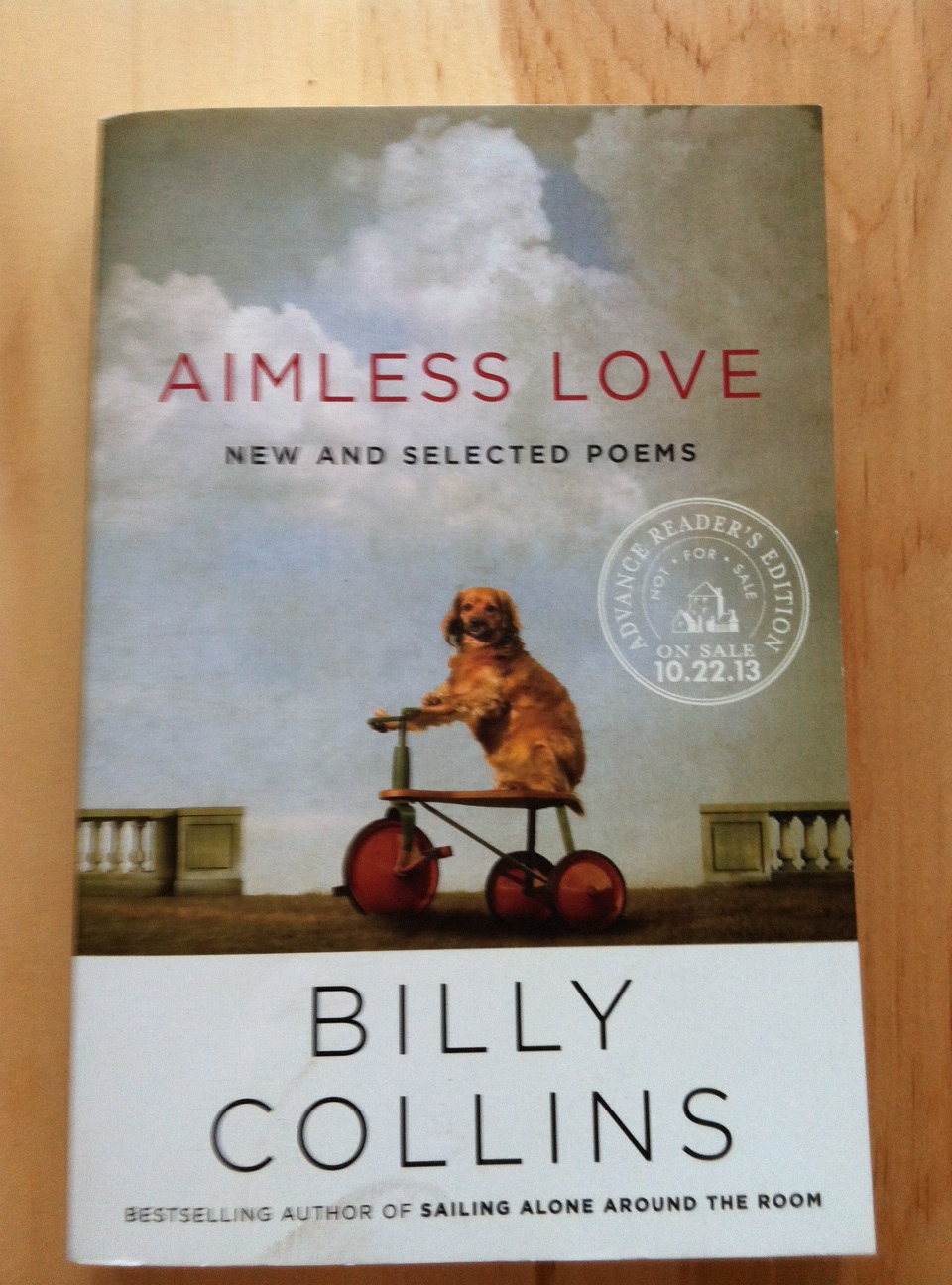
Early Review: Aimless Love*, by Billy Collins

Billy Collins writes one particular kind of poem, and he writes it well. A Collins poem is recognizable by its shape on the page (stanzas of three or four lines, of medium length), by its tendency to flutter from its point of origin for a just a moment, and then alight again a few yards away, like a sparrow on a sidewalk.

Aimless Love, Billy Collins

His poems are cozy but not uncomfortably intimate, clever but not arrogant. Their subjects are work and rest, reading and writing, eating, looking out of windows; in short, the everyday business of being alive in America. As I’ve written elsewhere, his poetry is perfect for picking up on a whim, while you wait for a friend who’s late to dinner, say. You’ll be entertained, you’ll think, and you might even laugh, but you won’t be trying to unknot a metaphor half an hour later while you chew your escarole.

Aimless Love, a collection of new and selected poems due out in October, is no different. Here you’ll find a generous armful of poems from four earlier collections (Nine HorsesThe Trouble With PoetryBallistics, and Horoscopes for the Dead), and about fifty new poems.  In the selection of new poems, I found a misstep or two: “Looking for a Friend in a Crowd of Arriving Passengers: A Sonnet” was fourteen lines long (thirteen lines of four syllables, and one of three), but not interesting or funny enough to pull off the joke about not being a sonnet. “Unholy Sonnet #1” is painful in its riff on “Death Be Not Proud” (one of Donne’s Holy Sonnets, hence the title); Mr. Collins’s lack of technical acumen can’t be avoided; he even reaches into Donne’s oeuvre to find Donne’s once-used words, and these so eclipse Mr. Collins’s own efforts that I was rather embarrassed for the poem, and for him.

Still, these are aberrations. For the most part, these new poems, like their predecessors, are pleasant, undemanding morsels, with a few gems tossed in (“Rome in June”). I’m all for accessibility in poetry, especially if it draws in new readers, and that, certainly, Mr. Collins can claim as an achievement.

If you have the earlier books, you may want to check this one out of the library to see if you think the fifty new additions are worth the price of admission.

You can find Aimless Love on the shelves on October 22nd.

*A disclaimer: I received this book through LibraryThing’s Early Reviewer program. I was not compensated for this review, nor was the content of the review dictated or approved by any party.

Musings on Moby-Dick, Part 3: Meeting Ahab

(Chapter 28, if you’re counting.)

Moby-Dick

I’d wager that a person who hasn’t read Moby-Dick, but who’s heard of it, can tell you one thing about Ahab: he has a peg leg, made of whalebone. However, for Ishmael, Ahab’s “grim aspect” is so engrossing that “for the first few moments I hardly noted that not a little of this overbearing grimness was owing to the barbaric white leg upon which he partly stood.” In other words, Ahab’s missing leg is not his defining physical feature, at least to the men he works with.

The ship’s mates are uncomfortable too, for “moody stricken Ahab stood before them with a crucifixion in his face; in all the nameless regal overbearing dignity of some mighty woe” (135). Indeed, Ishmael’s first impression is similar to the impression of torment given in this passage; at first glance, Ahab “looked like a man cut away from the stake, when the fire has overrunningly wasted all the limbs without consuming them, or taking away one particle from their compacted aged robustness” (134).

I find this juxtaposition of images — the Christ-figure crucified and the heretic at the stake — intriguing, especially since my first reading of the stake comparison relied on my image of Joan of Arc — until I realized that she wasn’t canonized until 1920.  With these two images, Melville and Ishmael provide us with a foreshadowing of Ahab’s later character development; we’ll find him to be brave, stoic, even, but also possessed with the pursuit of unrighteous revenge.

I’ll leave off my musing with another contrasting set of images: Ahab as a tree.

In the first, his scarring (which happened before his encounter with the white whale) is compared to the mark of a lightning strike on a great tree, in such a way that I thought of Ahab as nature’s inertia embodied, markable but not really changeable in essence (was his monomania brought on by Moby Dick’s attack, or was the capacity for madness always lurking within him?).

In the second, the possibility for softness in Ahab’s character emerges without diminishing his otherness from his fellow men.

(1)

[Ahab’s scar] resembled that perpendicular seam sometimes made in the straight, lofty trunk of a great tree, when the upper lightning tearingly darts down it, and without wrenching a single twig, peels and grooves out the bark from top to bottom, ere running off into the soil, leaving the tree still greenly alive, but branded. (134)

(2)

For, as when the red-cheeked, dancing girls, April and May, trip home to the wintry, misanthropic woods, even the barest, ruggedest, most thunder-cloven old oak will at least send forth some few green sprouts, to welcome such glad-hearted visitants; so Ahab did, in the end, a little respond to the playful allurings of that girlish air. More than once did he put forth the faint blossom of a look, which, in any other man, would have soon flowered out in a smile. (136)

What do you remember most about Ahab?

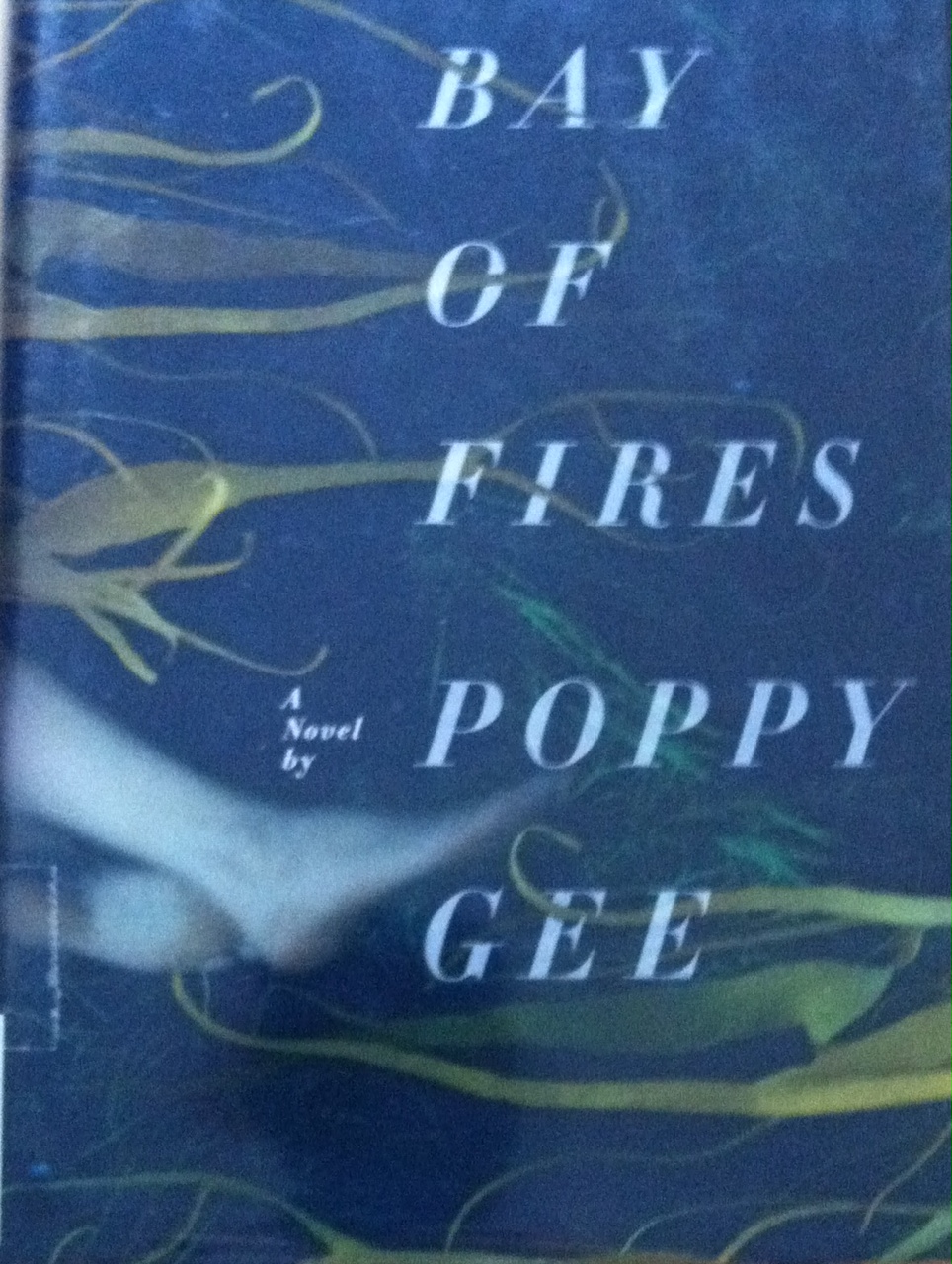
Recommended Reading: Bay of Fires, by Poppy Gee

It was this book’s title that led me to pull it off the shelf, as well as the understated cover design. I didn’t realize, at the time, that the Bay of Fires is a real place in Tasmania, a large island off Australia’s southern coast.

Bay of Fires cover

Here’s the setup: Sarah, after some bad decisions, ends up at home for the holidays, unsure what to do next. While she’s thinking it over, she’s one of two people to discover a young woman’s body on the beach, and for the next week, she and a down-on-his-luck reporter try to solve the mystery of the young woman’s disappearance.

Now, before I read Ms. Gee’s novel, I knew nothing about Tasmania, other than that it is an island and the namesake of a small, fierce marsupial creature. But one of this novel’s best features is its strong sense of place; Ms. Gee describes the scrub, the ocean, the rock pools, and the small community on the bay in fresh detail. Often, scenery escapes me, because I’m so focused on characters (with exceptions: Jane Eyre, The Lord of the Rings, and A Midsummer Night’s Dream come to mind). However, I think I was jolted out of my reading habits by the reversed seasons — the novel takes place around Christmas and New Year’s Day, and yet it’s summer.

Equally refreshing is Bay of Fires‘s main character, Sarah Avery. Deeply flawed, she is nonetheless tenacious, strong, and good. You know, a person, not a caricature of womanhood. For awhile, Ms. Gee’s focus on Sarah’s physical strength and fitness annoyed me, until I realized that her fitness is an integral part of her character, and informs many of her decisions over the novel’s course. She’s an original, interesting character, who sometimes reminded me of Starbuck from Battlestar Galactica. If you loved Starbuck, you’ll love Sarah.

Here’s my final recommendation: I thought I had the mystery solved on page 107 (of 371), and I kept reading. I was only half right, and the novel kept me guessing til the very end. I’ll be looking for Poppy Gee’s next book.

Musings on Moby-Dick, Part 2

William Giraldi’s essay on Herman Melville-as-reader has been making the rounds on the web this week, appearing first in the LA Times and then elsewhere (Maria Popova tweeted about it; A Piece of Monologue ran it), including Salon, which is where I ran across it.

Moby-Dick

It’s a good piece, though I could do without the put-downs of genre fiction and some of the vitriol (Mr. Giraldi is known in literary circles for his excoriating review of two Alix Ohlin books. His point in this essay boils down to: The drivel that’s published these days flows from the keys of those who do not read (Mr. Giraldi’s closing line is “So put down your pen awhile. Pick up Moby Dick [sic].) Melville, like other great writers, stood on the shoulders of giants. In order to write well, one must read well, and often, and deeply. (I’d make the same argument about living well, but that’s for another time). He points to Milton, one of those authors Melville grapples with most intensely, and rightly so. Earlier this week, though, I was thinking about another kind of literacy, or literary awareness, as I read Chapter 9 of Moby-Dick (“The Sermon”).

Though I’m not a believer, I’m grateful for an elementary education that gave me familiarity with Bible stories and concepts. It’s incredibly helpful, in all kinds of contexts, to understand references to Judith and Holofernes, for example, or the wedding feast at Cana.

Or Jonah and the Whale. Without the background music of Biblical phrasing in mind, it would have been difficult for me to appreciate just how brilliant this chapter is. Father Mapple tailors his sermon for the sea-going folk and sea-watchers in his congregation, conjuring up the details of Jonah’s cabin (“a swinging lamp slightly oscillates in Jonah’s room” [50]) to make the text come alive. In embroidering an old tale to reach a new audience, he becomes a figure of the novelist. And when he ends his sermon, he’s shaken by his awesome responsibility.

Here’s a little gem from the sermon: “But oh! shipmates! on the starboard hand of every woe, there is a sure delight; and higher the top of that delight, than the bottom of the woe is deep” (54).

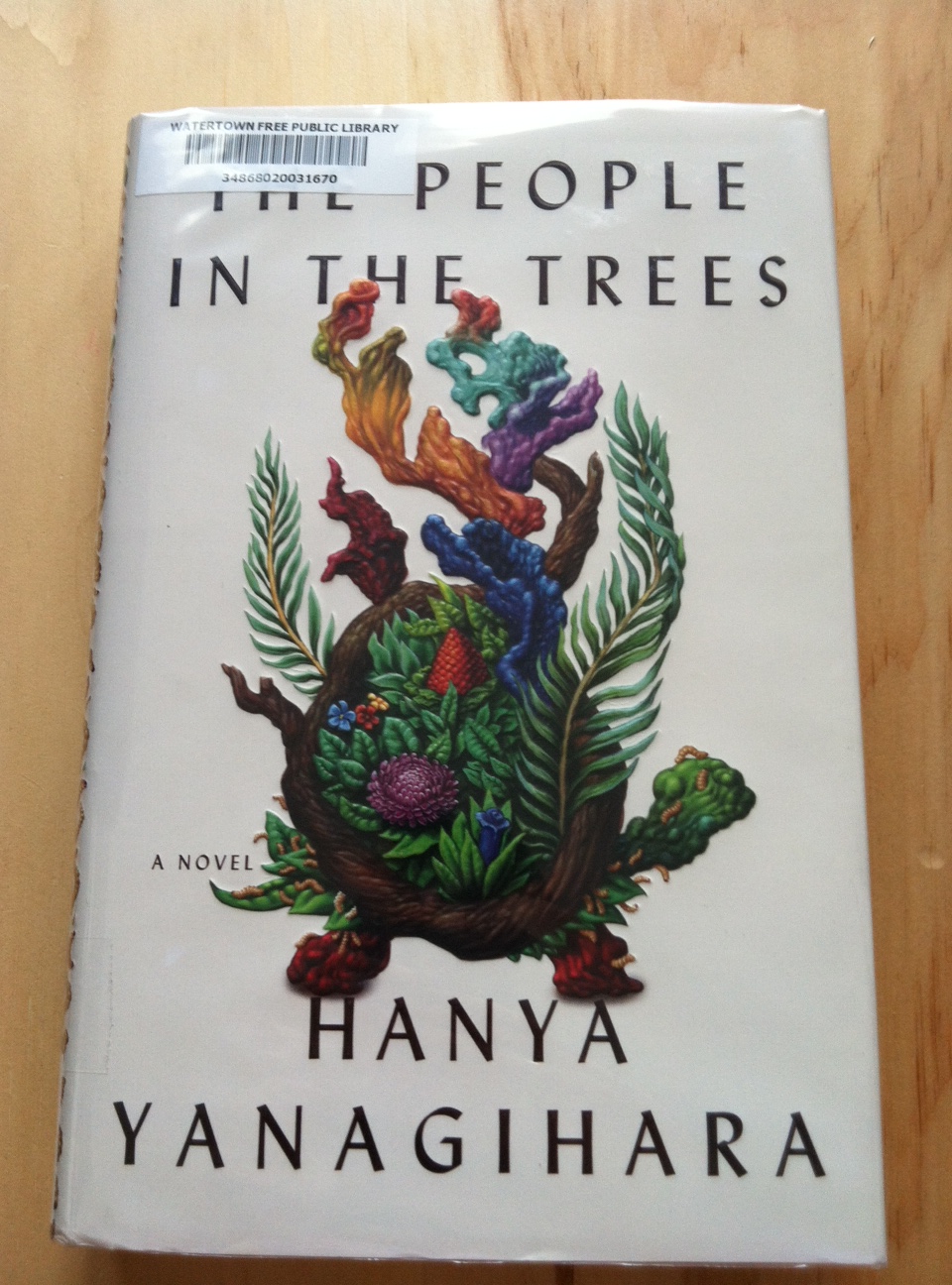
Recommended Reading: The People in the Trees, by Hanya Yanagihara

Hanya Yanigahara’s The People in the Trees is the most disturbing novel I’ve read in years, and simultaneously one of the most beautiful.

The People in the Trees

Seeing the look on my face when I was most of the way through the novel, my husband asked, “Are you reading horror?”

“No,” I said, “but it’s pretty frightening.”

“Well, the title is creepy.”

And so it went.

The epigraph to The People in the Trees comes from The Tempest (4.1), when Prospero inveighs against what he sees as Caliban’s fundamental intractability, his resistance to civilization (that is, both civilization itself and being civilized, none too humanely, by Prospero). It’s an apt choice for Ms. Yanagihara’s narrative of science, immortality, destruction, ethics, and exploration itself.

The novel is composed of the memoirs of Norton Perina, framed by a preface and epilogue penned by his colleague and friend, Ronald Kubodera, who provides insight and explication with academic footnotes throughout the text. Perina, a doctor, is part of a small group that discovers a “lost” tribe on the fictional island of Ivu’ivu, with disastrous consequences for the islanders and, ultimately, for Perina himself. (By the way, I suggest that you do not read the jacket copy before you begin reading the novel itself — spoilers abound.)

Perina’s voice is compelling — both suave and vicious, aware of his personal shortcomings and willfully blind to his greatest moral failings. Kubodera, though trying to protect his mentor and justify his life’s work (and his own), consistently undercuts Perina’s attempt to appear as if he is withholding nothing, giving the reader the unvarnished truth. And maybe, in some sick way, Perina thinks he is delivering his own truth.

The horrors the novel presents are juxtaposed with the lush (there’s no other word) descriptions of the fantastical plants and creatures of Ms. Yanagihara’s invention. Even the few words of the U’ivuan language that Perina shares are musical and perfectly suited to the environment of the story.

As a child, I remember learning in school that the rainforest ought to be protected so that it would remain available for future study. When I read this novel, it occurred to me, after all these years, that perhaps we should be protecting it, and all the other wild places of the world,  from study. After all, wouldn’t Caliban have been better off without Prospero?


Musings on Moby-Dick

Here’s a little story about me and Moby-Dick. (Since Ahab’s Wife is up next in the Literary Wives series, I thought I should probably have a look at Moby-Dick; it’s been a few years. I’ll be posting about it every once in awhile as I go along.)

Yes, I know this is a Maine lighthouse, but I don't have any recent pictures of harpooned whales or peg-legged ship captains.

Yes, I know this is a Maine lighthouse, but I don’t have any recent pictures of harpooned whales or peg-legged ship captains.

Now, there was a time when I hated Moby-Dick with the fiery passion of a thousand suns. That was when I was about eleven.

You see, my parents were and are big believers in reading aloud. My Mom read aloud to us when we were little, and when she went back to work and Dad started staying home,  he read aloud individually to us until we left for college (though less in high school when extracurriculars took up more of our time). He chose books in consultation with us, so my brother might be listening to Ivanhoe an hour after Dad read “The Twin Brothers” to our younger sister.

It was a delightful tradition. We’d settle into the comfy chairs in the living room, and Dad would read in his perfectly cadenced voice while I listened, sometimes working on whatever craft project I was trying out that week (never with success, I might add). When I was about eleven, we decided to settle in for a challenge: Moby-Dick.

We hated it. We hated the chapter on Cetology and the long philosophical disquisitions and the drawn-out plot. For years we said it would have been a great story if it had been fifty pages, not the 500 of our hardcover version. We hated it so much that eventually we decided to finish it just so we could say we had done it — we had killed Moby-Dick.

To this day, of all the books Dad read to me, it’s the one I remember best, the one we joke about the most often. Dad gave me the Cliffs Notes to the novel as a Christmas present one year, even though I hated the book so much that I avoided any American Lit course that mentioned it in the course description — and I was an English major!

And yet, something in the back of my brain needled me, like a tooth-pick-sized harpoon. What if I hadn’t given it a fair shot? What if I was too young when I read it? Why did other people (including one of my uncles, a brilliant English teacher) like it so much?

So, more than ten years after I’d read the book with my dad, I tried again. And I loved it. Because it’s musical. Because it’s exciting. Because it’s funny.

No, really. It is.

Consider the very first chapter. We all know the famous first three words, but what follows is a riot. Ishmael decides to put to sea not because the ocean calls to his soul (that bit comes later), but because he’s hilariously, hyperbolically depressed:

whenever I find myself involuntarily pausing before coffin warehouses, and bringing up the rear of every funeral I meet; and especially whenever my hypos get such an upper hand of me, that it requires a strong moral principle to prevent me from deliberately stepping into the street, and methodically knocking people’s hats off—then, I account it high time to get to sea as soon as I can (3).

See? Told you it was funny. Now if only I could convince my dad.

Recommended Reading: The Wife by Meg Wolitzer

A tip of the hat once more to my friend Katie, who pointed me toward Meg Wolitzer (Katie was, at the time, reading The Ten-Year Nap, and that’s on my list now, too!). The Wife is about a very unfunny subject —the unravelling of a marriage — but in Ms. Wolitzer’s capable hands, Joan (the wife in question) tells her story in darkly comic fashion.

Photo courtesy Tanatat / Freedigitalphotos.net

Photo courtesy Tanatat / Freedigitalphotos.net

Joan’s husband is the much-awarded novelist Joe Castleman, and when the novel opens, she’s made up her mind to leave him as they fly to Helsinki, where he’s to receive his latest accolade. From there, Joan takes the narrative back to Smith College in the 1950s, and we learn how the pair met, and just how it all went wrong.

As a narrator, Joan is simultaneously unreliable and honest, and always a keen observer, not only of her own marriage, but also of the changing world around her. Though The Wife was published ten years ago, Joan’s observations about the role of wives echo loudly, especially with the recent debates about Sheryl Sandberg’s Lean In and Anne-Marie Slaughter’s article on work-life balance in last summer’s Atlantic. Here’s Joan near the end of the novel:

Everyone knows how women soldier on, how women dream of blueprints, recipes, ideas for a better world, and then sometimes lose them on the way to the crib in the middle of the night, on the way to the Stop & Shop, or the bath. They lose them on the way to greasing the path on which their husband and children will ride serenely through life. (183)

Apparently, I’m not the first reader to love this passage; the page was dog-eared when I picked up the book.

Blackout Books

A friend reminded me that the Northeast blackout of 2003 happened ten years ago. My parents lost power in northeast Ohio, and I was a long way away scheduled to fly home and completely panicked that I wouldn’t make it home (I did). Several tubs of ice cream were eaten, several games of Scrabble played, several novels read, and luckily, that was the worst of it for us.

So, I wonder: when the lights go out, what’s the book you reach for in candlelight?

(Mine is The Amazing Adventures of Kavalier and Clay)

Recommended Reading: Fraud, by David Rakoff

Longtime readers may recall a post about this book (and Steven Seagal, and All About Eve) way back in the mists of time. I returned the book to my friend, who had left it here accidentally, and put it on my someday list. Of course, when I came around to that part of the list, our local library didn’t have a copy, so I had to wait for the book to arrive from the moneyed halls of Weston.

Fraud

Happily, the other thirteen essays live up to the wry promise of “In New England Everyone Calls You Dave” and “Including One Called Hell.” The essays are from Rakoff’s point of view, but oriented outward, whereas, for example, David Sedaris’s essays (at least to me) are engaged with the world but oriented inward. I’m not knocking them; they’ve made me guffaw on the porch so hard that the neighbors probably thought my personal clock was set to five p.m. I think Rakoff’s brand of humor is quieter, his voice more melancholy, though his opinions are fierce (he truly hates Life is Beautiful, and thanks to him, I can’t imagine ever watching it.)

Whether he’s giving outdoor tracking school a try, hunting for the Loch Ness Monster, searching for elves in Iceland, or remembering  what it was like to live in Tokyo, Rakoff gives master classes in understated elegance and economy of language. He’s clear. Take, for instance, these lines, some of my favorites, from “The Best Medicine”: “Not being funny doesn’t make you a bad person. Not having a sense of humor does.”

I think my favorite essay in the collection, aside from the one about Seagal-fest and the opening salvo (climbing Mount Monadnock on Christmas Day), is “Christmas Freud,” in which Rakoff describes what it was like to play Freud in a department store Christmas window display. Now, I find the whole idea of the Christmas tableau vivant very odd indeed (I’ve never seen one in person — have you?), but Rakoff elevates it to the sublime. Read this book, and I think you, like me, will wish for Christmas Freuden too.