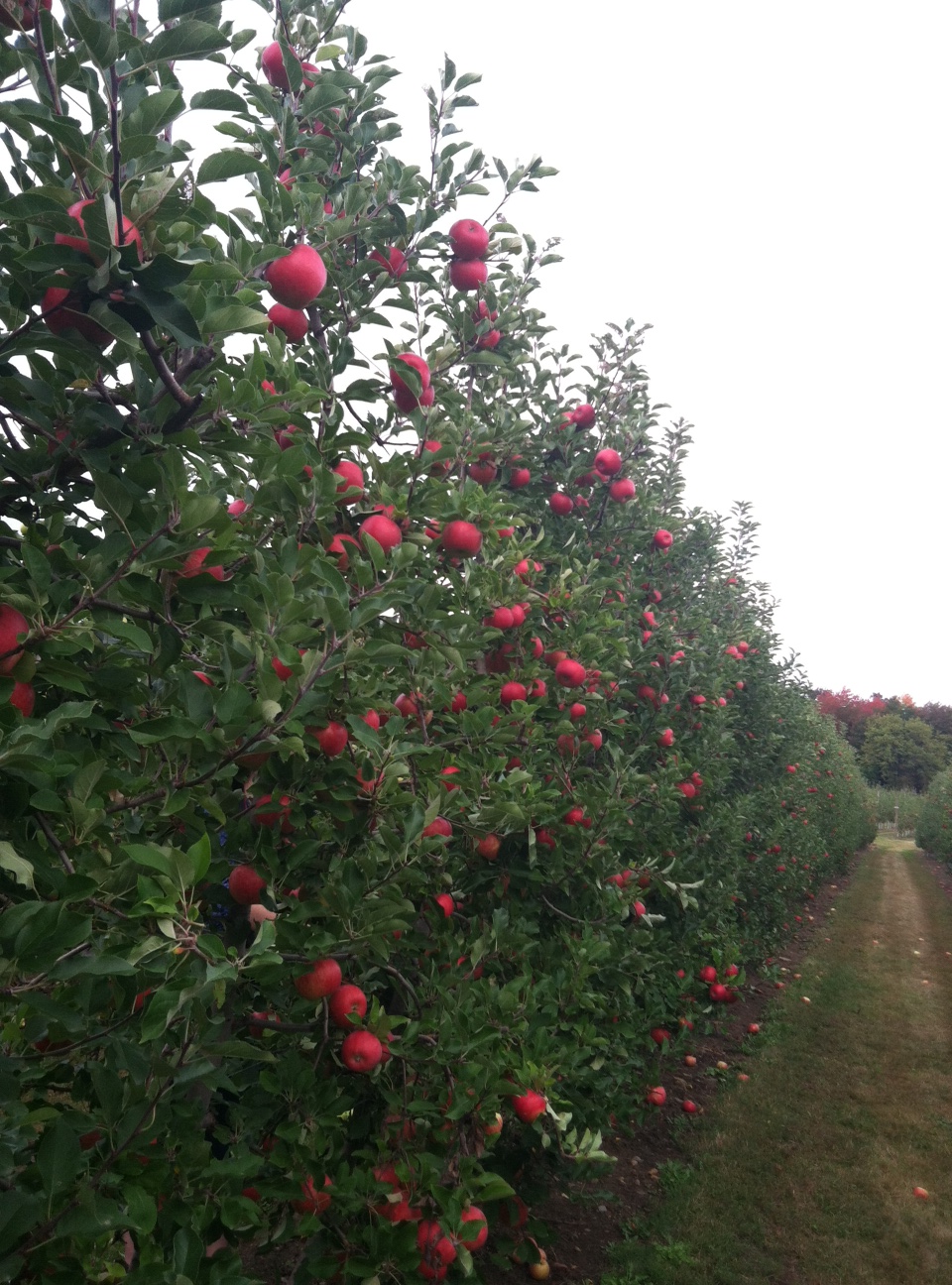
“There were ten thousand thousand fruit to touch, / Cherish in hand, lift down, and not let fall.”

Tougas farm, apple season Photo by CR OliverI remember assigning Robert Frost’s “After Apple Picking,” along with “Birches” and “Mending Wall” to my first-ever college class. I was twenty-two, and at least one of the seniors in the class was older than I was. A clerical error had given me a class of thirty instead of twenty, and we were assigned a narrow, windowless room on the second floor of the library. The heaters clanged on in August and the noise of campus construction somehow reverberated in that room.

It was glorious.

I loved being a newly-minted teacher, choosing readings and building a course that I wanted to teach (and take). I loved practicing my students’ names so that they would feel comfortable in class (one Thai last name was a real tongue twister!), and I loved watching their ideas spill onto the chalkboard. There’s no better job than being a tour guide through literature.

I chose to teach Frost because we’re in New England, after all, and he’s THE New England poet, and I encouraged my students to get out of the city and see the beautiful blend of colors in the trees. I’ve gone apple picking each fall with Mr. O since we started dating, and there’s nothing like the blue sky and the fiery trees and the red, red rows of apples.

“After Apple-Picking” is a dreamy meditation on life and death, sleep and wakefulness. Maybe we too will look back on moments both missed and remembered, and think,

“There were ten thousand thousand fruit to touch,
Cherish in hand, lift down, and not let fall.”

Updated: Dragon Bound, Part the Third: Pregnant Unicorns and Other Things I Wish I Never Had to Read About

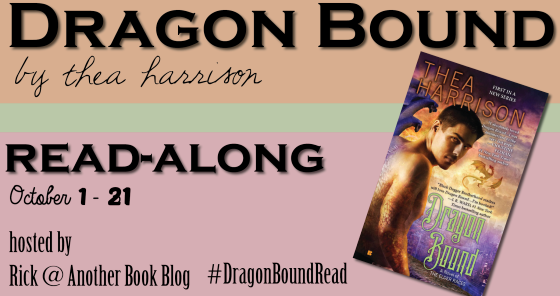
dragonboundreadalongbutton-01I feel as if I’ve gone through all the stages of grief reading this book:

Denial:  I’m not really doing this, right? 

Anger: See Part 1 reaction, please.

Bargaining: “If I read one more chapter, I can have a glass of wine, and this will all go away and I can go back to reading real books . . . ”

Depression: “Oh my god. This was published and people read it. Like, for fun. For enjoyment. What’s the point any more? I can’t believe I brought a child into the kind of world where people like reading about emotionally abusive, repulsive relationships. Where’s the wine again?”

Acceptance: “It’s over, it’s really over! I still have to write about it, but I never have to read it again! I don’t care that other people read this, right? And that maybe feminism is dying?”

So here we are at last. I’ve accepted that Pia is a unicorn, that she’s carrying Dragos’s über-weird dragon-baby, and that Dragos is just going to inform her that they’re getting married after yet another bout of ultra-aggressive and strangely boring sex, and that the book will end with her slipping a giant diamond on her finger. For realsies.

I hate this book with the fiery passion of a thousand exploding suns, if you needed it spelled out.  I hate it so much that I don’t really have anything productive to say about this last third. It was predictable and infuriating at the same time.

I can tell you with assurance, dear readers, that it will be many a year before I read another romance novel. I loathed Dragon Bound and even the tiny bits that were amusing couldn’t save the gag-inducing whole.

I’m glad I read it, though, because I like to uphold my claim to be an omnivorous reader (even though omnivorous is taking on all kinds of new meanings thanks to the spectacularly awful ‘devouring’ scenes in Dragon Bound), and because now I’ll never wonder if I’m missing out by skipping the Romance Buffet.

To entertain you, I will now cast the movie version of Dragon Bound. You’ll have to click the links for pictures because I am way paranoid about posting copyrighted images. My apologies to all of you, dear actors, for associating you, even fictitiously, with this book.

PiaKate Mara

DragosJason Momoa (Khal Drogo on Game of Thrones. I don’t watch Game of Thrones, but good lord is hard to not know about it.)

Rune, Dragos’s second-in-command and best bro, despite the episode in which Dragos almost kills him for conducting self-defense training with Pia: Brad Pitt circa Legends of the Fall

Tricks, the perky, tiny, Fae PR person: Kristin Chenoweth. Honorable Mention: Kristen Bell.

Graydon, another one of Dragos’s bros, the one who actually likes Pia, despite annoying habit of calling her “Cupcake” : Tyrese Gibson (yeah, I’m ignoring the physical description. I’m bored with all the tan/tawny-haired guys.) Honorable Mention: Tahmoh Penikett.

Urien, the Dark Fae King or Lord of the Sith or whatever: Tom Hiddleston (extra apologies to you, Mr. Hiddleston, because of all your fine Shakespeare work.)

Aryal the Harpy, by far the most interesting unexplored character: Eva Green.

Pia’s dead unicorn motherConnie Neilsen

Quentin, Pia’s only friend, dreamy, mysterious, and possibly half-Elf: Lee Pace

That was pretty fun! Like I said, I’m glad I read this, even if I hated it. I liked the whole reading-with-others-separately experience, so much so that I’m going to host my own (VERY DIFFERENT) read-along in 2014. All of 2014. Guess what has twelve parts and a few characters who fly?

Stay tuned, dear readers.

In the meantime, perhaps the other readers-along have something more intelligent to say about this last third of the book:

A Novel Idea: Saving Independent Publishers, One Pre-order at a Time

vernon downsJaime Clarke’s new novel, Vernon Downs, will be published in 2014 by Roundabout Press. But you don’t have to wait ’til then — Roundabout will ship the book directly to you in December.

The catch?

Don’t preorder the book on Amazon — order directly from the publisher. You can read Jaime’s personal message at his aptly named website, http://pleasedontbuymybookonamazon.com/.

A disclaimer here: Jaime and his wife Mary are friends, and also co-owners of Newtonville Books,  an independent bookstore here in Boston which I like to link to (you may have noticed). But even if Jaime weren’t a friend (and a great writer, and a great curator of the written word — see Baum’s Bazaar), I’d still be writing about his excellent plan. It’s a gutsy move that’s gotten some press, and I hope it reaches a wider audience.

If you order Vernon Downs directly from Roundabout before its official April release, perks abound:

1. You’ll receive your copy in the mail in December — five months early.

2. You can enter the name of your favorite independent bookstore in the Special Instructions section at checkout, and Roundabout will send 50% of the monies (excluding shipping) to that store.

3. Jaime is forgoing all royalties until April, so your entire purchase supports independent publishing and bookselling.

And, as a special treat, if you order before midnight (EST) on October 28th, Roundabout will send you an audio clip of Chris Cooper (!) reading a selection from Vernon Downs. I’ve been pretty much entirely in love with since Chris Cooper October Sky, so . . . yeah.

I’m excited. I hope you are too.

If you have any other great ideas or news items about saving independent presses, please share! 

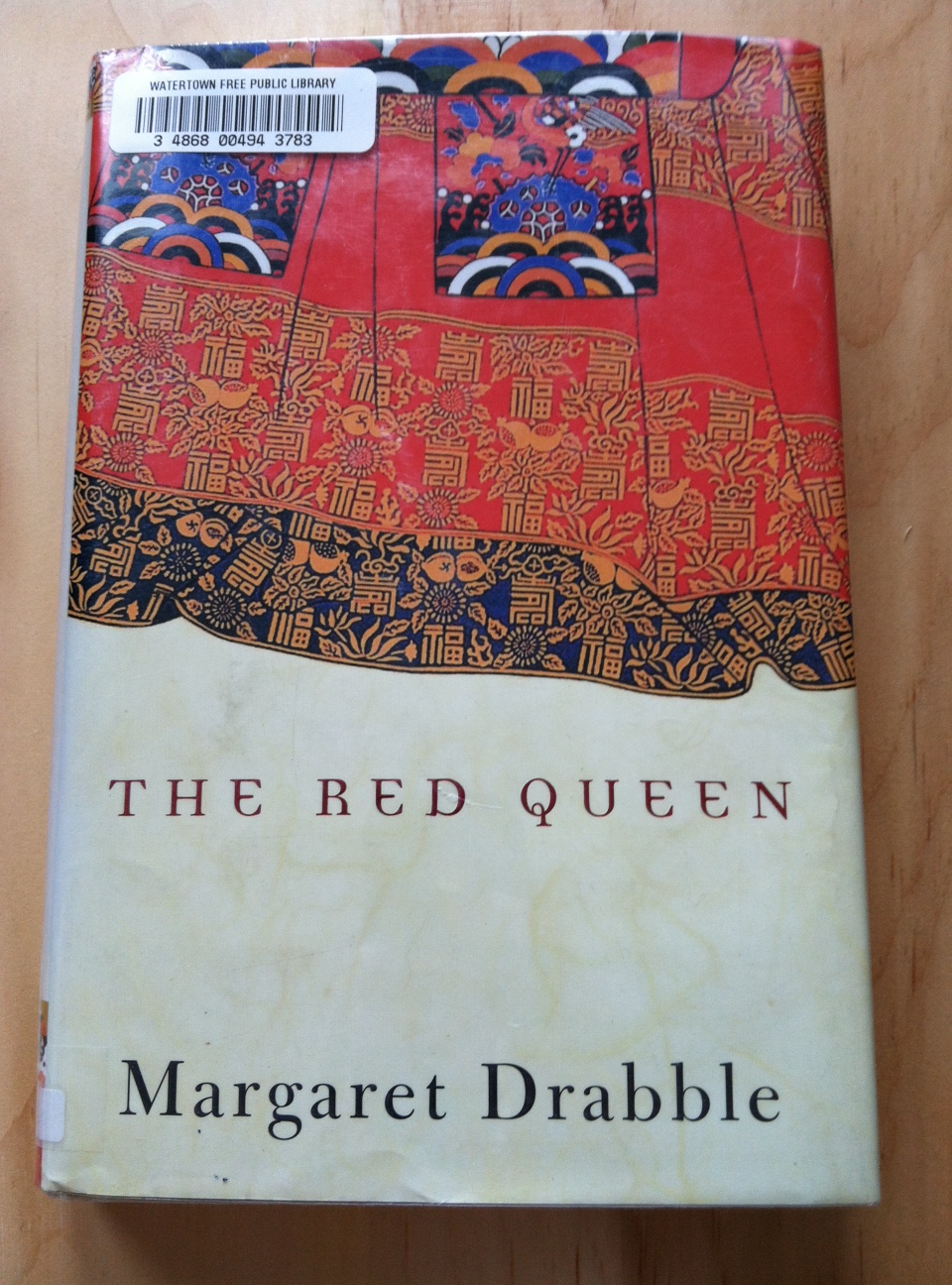
Recommended Reading: The Red Queen, by Margaret Drabble

Since I’ve read two books by A.S. Byatt so far this year, I thought it would be only fair to give one of her sister’s novels a try. Sister, you say? You haven’t heard of another novelist with the last name of Byatt?

The Red Queen

Well, that’s because A.S. Byatt’s non-pen name is Dame Antonia Duffy (she was born Antonia Susan Drabble), and her sister’s name is Margaret Drabble.

Both writers have been laureled and lauded many times over, but they do not see each other often and do not read each other’s novels, the result, apparently, of their rivalry as writers and their disagreement over the portrayal of their mother and the use of the family tea-set in a novel.  It’s a real shame, not only because their novels are so good, but because in all the interviews I’ve read, both women seem like lovely people.

Enough about that. Let’s talk about the book.

The back jacket of The Red Queen claims that it’s “a rich and playful novel about love, about personal and public history, and what it means to be remembered.” Readers may recall my feelings about unattributed jacket copy, and I do think that this is better than most, with one slight problem. “Playful” implies that the novel is funny, or piquant. It is not.

It is, however, excellent. What’s playful about the novel is its structure. In the first part, our narrator is the woman known, inaccurately, she tells us, as Lady Hong, a Korean princess of the eighteenth century. The Korean Crown Princess is known in Korea (less so in the rest of the world) for her memoirs, written for different audiences over a period of some time. The version of the princess that Ms. Drabble presents is an unreliable narrator, to be sure, sometimes blinded by her own interests or those of her family. She drifts into long digressions, circles around issues, leaves out salient details. She’s also dead, knows she’s dead, and has the advantage, with some limitations, of looking over history to fill out her own story. What she wants is to be remembered, to reach a wider audience (she won me over — I have to find those memoirs!).

In the second part of the novel, she succeeds. We switch gears entirely to follow Dr Barbara Halliwell in the present day as she attends an academic conference, makes a friend, and embarks on an affair in Seoul. Throughout her time in Korea, she’s drawn to the tale of the Crown Princess, unsure who gave her the memoirs and what she should be taking away from her visit, her affair, her very life. I’ll stop here, because you know I never offer spoilers. Let’s just say that the story keeps spiraling outward and inward, and the last few pages are a treat, so very clever. It’s a novel I’d be pleased to have on my shelf, and I hope you and A.S. Byatt will read it too.

Early Review*: We Do! American Leaders Who Believe in Marriage Equality, Edited by Jennifer Baumgardner and Governor Madeleine M. Kunin

First off, let me put my cards on the table: I’m a member of the LBGTQ community, and I support equal rights for LGBTQ persons. Period.We Do!

We Do! doesn’t offer the jazziest format or a comprehensive tour through queer history, but it’s an excellent resource for speeches and essays relating to the LGBTQ-rights movement. As you might expect, Harvey Milk’s “Hope” speech is the first to appear, and you’ll also find testimony from well-known political figures, up to and including President Obama.

Glaring omissions on this front: Senator Lisa Murkowski (R-Alaska) and Senator Mark Kirk (R-Illinois).  Senator Murkowki’s press release on her change of heart (June 2013) especially merits inclusion. (Senator Rob Portman [R-Ohio] made the cut.) Marriage equality is coming, and the longer Republicans hold out, the worse they’ll look, and I’m sure Democrats will gleefully bash them for it. However, ending discrimination against LGBTQ persons should trump party hostility, and the more moderate (or even conservative; see Cheney, Dick) GOP politicians come forward to support LGBTQ rights, the better, especially since they face animus from the right flank of their own party.

But enough of politics (hasn’t it been a great two weeks here . . . UGH) Some high points of the book:

  • Transcriptions of speeches by Virgina Apuzzo and David Mixner: rousing, tragic, fundamental.
  • Andrew Sullivan’s prescience on the conservative case for gay marriage. He was way out front in 1989.
  • Personal testimony from LGBTQ legislators like Representative Bill Lippert.

I see this book as part of a growing awareness (in America) of LGBTQ history, which is *such* a positive development. Not everyone will run out to their bookstore to buy Stonewall: The Riots That Sparked a Revolution (though I wish it were so!), but a book like We Do! could be a gateway to more reading about the struggles the LGBTQ community has faced in this and past centuries.

Speaking of LGBT history, if you’re looking for another way to learn more, I suggest trying the Quist (Queer History smushed together) app for your phone. Daily tidbits of LGBTQ history, and it’s free. Full disclosure: My sister-in-law, Sarah Prager, created the app and owns it, and I (your humble blogger) edited it before its release.

We Do! American Leaders Who Believe in Marriage Equality will hit the shelves on Tuesday (October 15).

*I received this ARC through LibraryThing’s Early Reviewer program in exchange for an honest review.

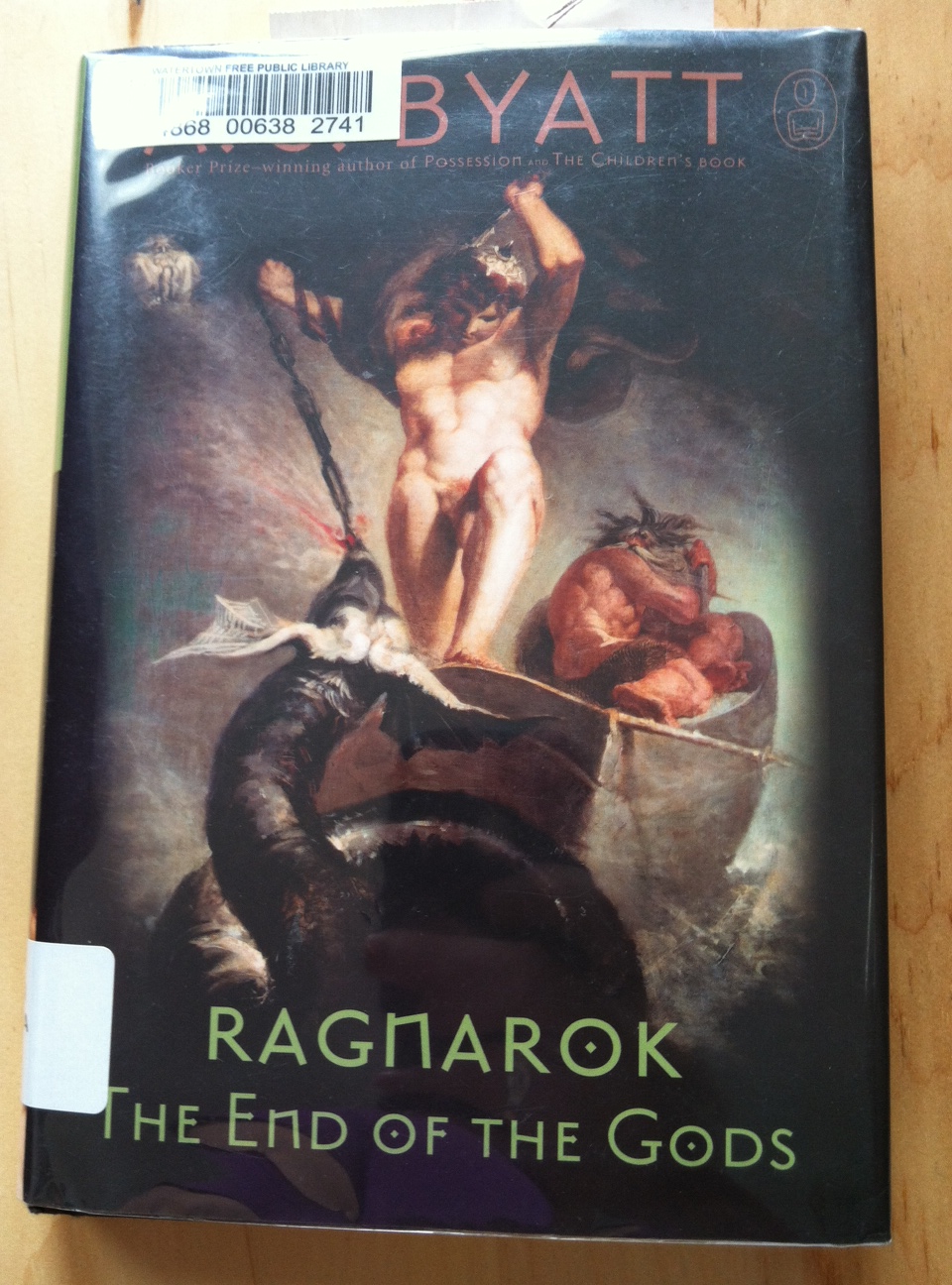
Recommended Reading: Ragnarok, by A.S. Byatt

I was raised on opera as a child; I couldn’t identify a New Kids on the Block Song (still can’t), but I could pick Wagner out of a lineup every time. So with his Ring Cycle in mind, I was excited to read A.S. Byatt’s take on Ragnarok, or The End of the Gods, especially because I found Possession to be such a wonderful book (and if you read it, you might remember that Ash wrote a poem called “Ragnarok”).

Sorry, library copy.

Sorry, library copy.

Fans of A.S. Byatt will encounter her erudition and her command of language here, with cascading descriptions and lists reminiscent of Milton’s Paradise Lost. The language is so satisfying, so meaty, that this short book (171 pages) takes quite a while to savor.

What impressed me most, in this telling, is the structure of the work. It’s not exactly a novel, but not exactly D’Aulaires’ Book of Greek Myths, either (my favorite book of mythology when I was a child). But there is a narrative flow, and the book opens with “a thin child in wartime” encountering the stories of these irascible, imperfect, impulsive gods and their creations. But these myths, as A.S. Byatt points out in an essay that closes the book, differ greatly from fairy tales; the good do not always prosper, and the bad are not always punished; indeed, Ragnarok is the end of the gods. The world with its gods dies and is not reborn.

The book is not an allegory for the woes of our world, but present in the author’s mind was, she writes, the steady bursts of destruction we inflict on the earth ourselves, without any help from the gods.

Recommended Reading: Asunder, by Chloe Aridjis

I think we l know how I feel about jacket copy and blurbs. To wit: not good. But for once, the blurbs are on to something, and it’s the gem that is Chloe Aridjis’s Asunder.

AsunderThe novel follows Marie, a guard at London’s National Gallery, through her perambulations at work, at home, and abroad. This is isn’t a novel with extravagant plot points; instead, it’s superb gathering of images and moments, a testament to a quiet life. To observation.

It’s about the entropy of decay and the possibility for violent change. It’s a weirdly beautiful excavation of life. And the images! New, lively, strange.  Here’s one example. Marie is examining a painting:

It was a mysterious painting, of a seaside landscape with a few human figures, and my eyes first came to rest on the wall of ancient wrinkled cliffs resembling a procession of tired elephants. (111)

Arresting, isn’t it?  I felt swallowed up the images as I read. I loved this novel, and if you’ll excuse me, I‘ll be off to find my own copy.

Literary Wives: Una Spenser and DIY Wifehood

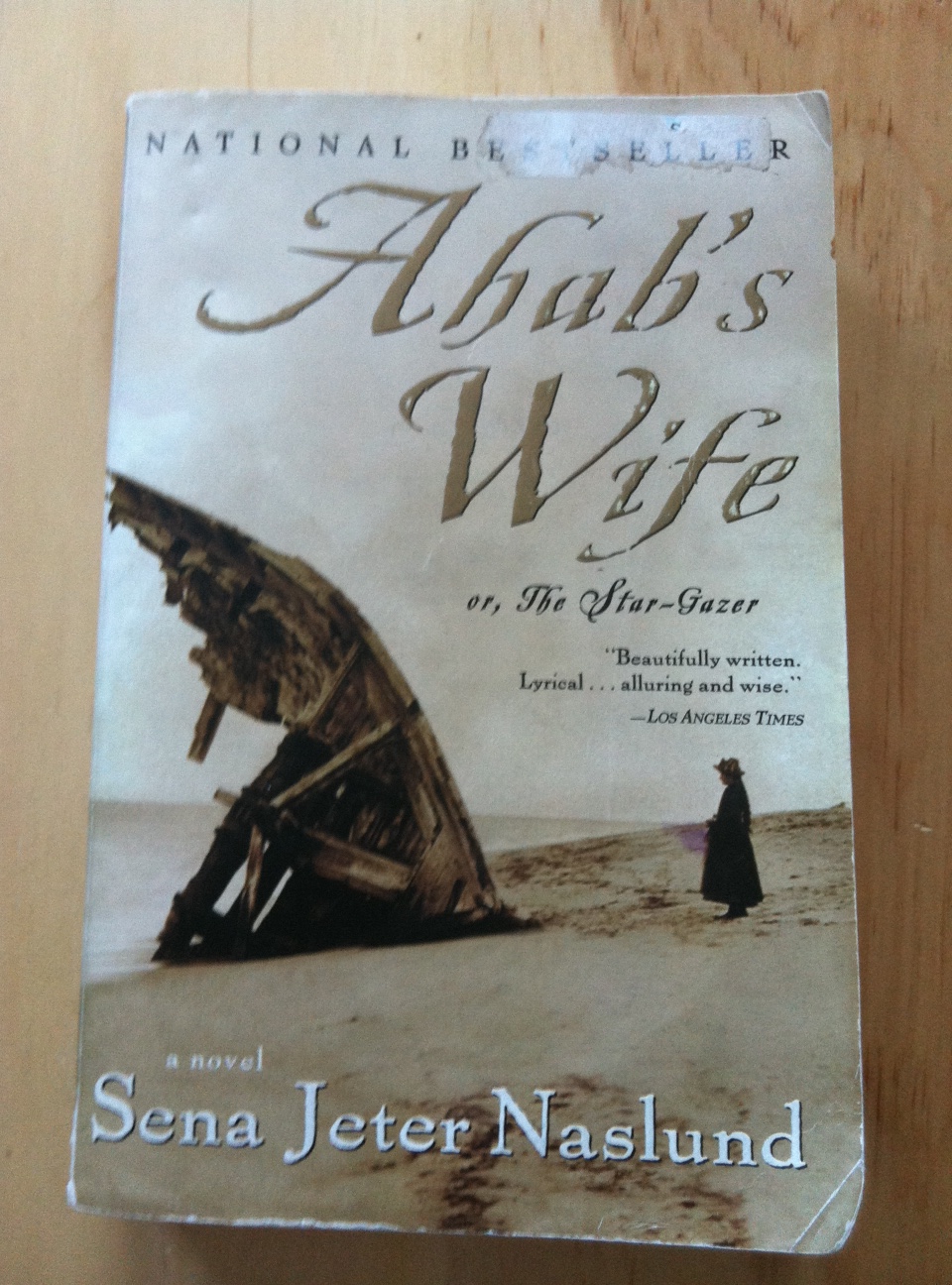
literarywives2If you missed the Literary Wives introductory post, here’s the summary:  I’ll be joining founding bloggers Ariel, Audra, and Emily, as well as fellow newcomers Cecilia and Lynn, as we post every other month about a different book with the word “wife” in the title. This month, we’re writing about Sena Jeter Naslund’s Ahab’s Wife, the sweeping, imaginative, feminist answer to Moby-Dick.

Readers take note: Although I usually refrain from spoilers, what follows is a consideration of one aspect of the novel, and so I shall be spoiling away. Beware!

I read Ahab’s Wife years ago and remembered liking it very much, and I looked forward to reading it again. I like the gusto with which Ms. Naslund throws all she has at Una’s story, giving her connections not only to the characters and world of Moby-Dick, but also to the time and culture of Melville’s novel.

Ahab's Wife

Una experiences much and meets a cast of strange and interesting characters — including Hawthorne, Maria Mitchell, Margaret Fuller (sidebar to myself: a cenotaph to her memory is somewhere in Mount Auburn Cemetery, a must-find), and a young Henry James (this last strains credulity, really). I fear that I’m making the novel sound like a literary Forrest Gump. Ah well. It’s certainly interesting, with passages of real, sensual beauty.

As I read it through this time, I felt as if Ms. Naslund were trying to construct Una as a secular saint, progressive and feminist ahead of her time, flawed but thoughtful. Una understands that “choice lies in the purse” (142); freedom of movement, of action, is often dependent on financial independence, something we twenty-first century feminists think about often. Some of Una’s free-thinking, as it would be called at the time, seems more like wishful thinking on the part of the author.

In the narrative, Nantucket becomes a little free-thinking paradise, and almost everyone gets a happy ending. The lost and the dead are mourned, but never for too long; after all, when reading Goethe, Una prefers Wilhelm: “While Werther disintegrated, Wilhelm learned from the wonder of life, and grew” (387).

1. What does this book say about wives or about the experience of being a wife?

This novel’s first line is misleading in the opposite way that Moby-Dick‘s is deceptive. “Call me Ishmael,” begins the American epic, leading us to believe that we will learn much about the narrator, this Ishmael. Instead, we are offered lessons in cetology and monomania.

Here, Una begins her narrative: “Captain Ahab was neither my first husband nor my last,” which suggests that the novel’s focus will be on her husbands and their marriages. However, Ahab’s Wife is always Una’s story, told from her perspective and focusing on her thoughts and feelings, a bildungsroman that extends into middle life.

Along the way, her adventures offer Una many models of wifehood:

  • Una’s own mother, loyal to an abusive husband whose religious zealotry endangers Una; nonetheless, she is an educated, caring woman who protects her daughter the best way she knows how.
  • Aunt Agatha, in perhaps the novel’s ideal union. She and Torchy are equals, co-parents and co-workers, who face their isolated life with good cheer, open minds, and hands together. However, she, like her sister, is confined, an important epiphany for Una:

For my aunt and my mother, journeying lay in their fingers for the most part. They knew the landscape of colored patches, the rivulets and tributaries of stitchery. They knew the voyage of reading. It seemed an inward journey. But the sea! the sea! How could it not seem freer, wider, more uncharted than anything else one could know? I wanted it for Giles. For any man I loved. Perhaps in sending Kit to play the part of companion, Giles wished me to learn that many men could love me, that choice and not inevitability were the lot of both woman and man.

For my mother and my aunt, the thought of babies revitalized their beings. And yet, I did not just want babies, or men who went to sea. I wanted something for myself. (124)

  • Captain Swift’s absent wife, who died in childbed: “Her bed’s the grave . . . She gave her life for Chester of the darling curls” (161). A reminder of the very real danger Una and any other nineteenth-century woman faced in childbirth; an example of what I like to call the good-dead-wife trope.
  • Sallie Swain, feminine, generous, adherent to the standards of feminine behavior common to her time and place, even on board a merchant vessel.
  • Charlotte Hussey, vivacious and cheerful, practical to a limit. Warm toward her much-older husband, but overcome with her love for Kit.
  • Mrs. Macey, a widow who tells Una the joys of being a sailor’s wife: “You can come to love your own life. Alone” (348).
  • Mary Starbuck, steadfast and loyal, calm and religious and kind, the ideal Quaker wife.

(At over 650 pages, you’d expect it to be a long list, right?)

Una learns over time that the experience of being a wife is not an universal one; neither fidelity nor infidelity, neither solitude nor company, neither cruelty nor kindness may be expected of all spouses. Knowing her own mind, Una chooses her husbands with care; she compares herself to Maria Mitchell, reflecting, “my investments were so much in people” (464). By observing the women and marriages around her, Una chooses pieces of wifehood for herself, crafting an approach to wifehood all her own.

2. In what way does this woman define “wife”—or in what way is she defined by “wife”?

What magic there was in the word when it names all that I would be! Mother, daughter, neighbor, friend—I let go of all those names, except my own, for that of wife. I drank the word as if it were wine. (457)

Una comes to marriage on her own terms, and she defines herself as married even when, in the case of her last marriage, there’s no semblance of ceremony or state sponsorship to confirm the union. How she views her own position as “wife” varies from marriage to marriage, but in every marriage, as she says of the second, “I did not question the legitimacy of our marriage, our power to define our lives” (361).

In her first marriage to the mad (and frequently abusive) Kit, Una sees her role as that of caretaker and provider. She plans to sew to make money, to grow food in a garden, to cook and bake with Kit, and do her best to keep him sane. Her loyalty is shaken by his madness, but when Charlotte offers a possible avenue out of the marriage, by gently suggesting that a marriage at sea is not binding, Una refuses the gesture: “We have shared a bed . . . That binds” (320). However, when Una comes to realize that some harms cannot be undone, she lets Kit go with grace and good will, recognizing that his self-preservation will also be her own.

Una’s marriage to Ahab embodies Charlotte’s earlier admonishment: “The world is not closed off, Una, because a man and his wife make a small, inviolate circle at the center of it” (324). Ahab divorces Una from Kit (he had declared them married) and marries her himself on the Pequod‘s deck (“Ahab no more needed the validation of priest or paper than I” [360].). After their first night together, Ahab goes off on a whaling voyage, leaving Una to her own devices. They both relish this independence, especially Una, who realizes that this kind of relationship is not always typical: “Now I was married, but because my husband was independent, so was I” (386, emphasis mine).

Una regards Ahab as more capable of love and devotion than Kit, and delights in Ahab’s passion for her. They meet as partners, bearers of histories: “Nothing was concealed, and though nothing was overtly revealed, all was known. In guilt and in forgiveness we counted ourselves equals, and always had” (475).  Ahab regards their marriage as one of true minds (and I do love a good Shakespeare sonnet), a union of souls for which “marriage” is too common a word. He tells Una in a letter that he would go mad and destroy any thing that kept them apart. Unfortunately for Una, Ahab’s first encounter with Moby Dick leaves Ahab mangled, in body and mind. Though Una does not regard their relationship differently, she sorrows at Ahab’s monomania, and does not try, materially, to stop him from seeking revenge. She knows that he will not return, and grieves for it, but soon settles into new routines.

Una’s third marriage is with Ishmael (I’m afraid I think this last turn is too cute by half), whom she glimpses at times in the story — on board the merchant ship that rescues her with Giles and Kit, and at the dock before the Pequod’s last sailing, for instance. Together, the creative two “write” their tales, united by choice though not custom: “We are not legally married [. . .] but united by our natures. Each day and forever we choose to be husband and wife” (664). Once again, Una chooses a non-traditional (for the nineteenth century, of course) mode of wifehood, focusing on her own continuing choices and those of her partner. Each is independent, though they craft their companionship together.

Now that you’ve read my meanderings on the subject, please visit the other Literary Wives bloggers! 

Emily at The Bookshelf of Emily J. 

Audra at Unabridged Chick

Ariel at One Little Library

Cecilia at Only You

Kay at WhatMeRead

Lynn at Smoke and Mirrors

We’d love to hear what you think of Ahab’s Wife, and we hope you’ll join us on December 1, when we’ll be talking about The Wife, The Maid, and the Mistress, by Ariel Lawhorn (visit the site at http://www.ariellawhon.com/). 
Recommended Reading: Burial Rites, by Hannah Kent

Ah, Iceland. We meet at last. Almost.

Books are modes of conveyance, right?

Books are modes of conveyance, right?

My husband has had a thing for Iceland since long before we met; he listened to Sigur Rós before it was everyone’s favorite inspiring music (Glósóli was the first song on the first mix-CD he made for me—yes, you read that right— and would have been our son’s birth song, had it not been for that pesky emergency C-section). He’s wanted to visit for ages, and when I win the lottery, I’m booking us a flight.

I can’t claim that Iceland holds the same appeal for me as it does for Mr. O, but Hannah Kent’s Burial Rites brings the stark, relentless landscape into such focus that now I’m itching to see the land, the grey sea, and the ice-blue sky. I’m not much for landscapes, as I mentioned when I wrote about Bay of Fires, but this is the second book this year to make me care deeply about its characters’ surroundings.

The jacket copy (and Goodreads summary) will tell you right off the bat that this novel is an exploration of the last months of Agnes Magnúsdóttir, the last woman publicly beheaded in Iceland, so I don’t feel too bad about telling you too. Before her execution, she’s placed as a worker-prisoner with an unwilling family for a few months while a priest tries to save her soul; instead, they hear her story. That’s what I like to call a dramatic situation.

The action of the novel moves toward the inexorable end with grace and sure footing, even if the same can’t always be said for Agnes. At first I was a little thrown by the unconventional structure (letters and documents interspersed with third-person narration and first-person narration from Agnes’s viewpoint), but by the end of the novel, I loved it. The structure regulated the pacing, and eventually the narratives meld together in perfect synchronization.

One word kept coming to me over and over as I read:

Endurance.

Not the Shackletonian type of endurance, but the kind of constant scraping by that leaves blisters that never heal. Agnes endures abandonment after abandonment until the warmest home she finds is with her keepers, her best company a nervous priest and a sharp-seeing middle-aged woman who also waits for certain death (that reliable killer of nineteenth-century female characters — tuberculosis) but no execution date.

In the world Ms. Kent recreates, even the comparatively well-off in nineteenth-century Iceland are engaged in survival tasks every day. We see Icelandic families collecting dung for fires, slaughtering sheep, knitting clothes, making blood sausage, scavenging a beached whale, gathering in the harvest, trying not to freeze. Agnes remembers feeding tallow candles to children at one farm while she ate boiled leather — because they were starving.

Furthermore, people in this story are forced to endure each other. In each household, people sleep all together — masters and servants, parents and children — in one room. Conversations are overheard, stories and gossip spread like an oil slick on the wave. There’s no way to escape, especially in the winter, when the snow closes in.

Reading this book made me think how shocking it is that we’ve managed to endure as a species, when for a long time, for many people, even the simplest pleasures were the faintest sparks in an existence spent fighting for physical survival.

Notes and Asides