Bringing Sexy Back (To Valentine’s Day): 15 Steamy Poems by Esteemed Poets

Toss that teddy bear and give your significant person the gift of verse this Valentine’s Day.

Red Rose Petals by Victor Habbick, courtesy freedigitalphotos.net

Red Rose Petals by Victor Habbick, courtesy freedigitalphotos.net

That poet everyone reads at weddings is actually much more appropriate for the bedroom:

e. e. cummings, “i like my body when it is with your” 

An unsexy title for a very sexy poem (check out those ellipses!): 

Li-young Lee, “This Room and Everything In It”

The “Oh, snap” kind of sexy:

Edna St. Vincent Millay, “I, being born a woman and distressed”:

Wistful sexy:

C. P. Cavafy, “Body, remember”

Bitter sexy:

Thomas Wyatt. “They Flee from Me”

Literate sexy:

Robert Hass, “Etymology” (start watching at 18:42)

Damn sexy:

Audre Lorde, “Recreation

Desire, frustration, and jewelry. Also: socioeconomic tension. (And the first overtly lesbian poem I read as a teenager. Bit of a lightbulb moment, there.)

Carol Ann Duffy, “Warming her Pearls”

Difficult to choose just one Donne poem, but hey, let’s go with the salute to nakedness:

John Donne, “To His Mistress Going to Bed”

Restraint and abandonment, all at once:

Emily Dickinson, “Wild Nights – Wild Nights! (269)”

For the Dear Readers who are also parents: 

Galway Kinnel, “After Making Love We Hear Footsteps”

Maybe this is where they got the title for Blue is the Warmest Color:

May Swenson, “Blue”

I hate birds, but this poem is still amazing: 

Henri Cole, “Loons”

You’ll never look at roses the same way again, I promise:

D.H. Lawrence, “Gloire de Dijon”

And yes, a Neruda poem. But I can’t find it anywhere on the interwebs, so you’ll have to go find a copy of World’s End or Late and Posthumous Poems for yourself. 

Pablo Neruda, “Física”/”Physics”

Your turn: what’s the sexiest poem you’ve ever read?

Recommended Reading: To the Lighthouse, by Virginia Woolf

To the LighthouseAttempting to write a review of To The Lighthouse makes me feel rather like Lily Briscoe about to take up her brushes:

Where to begin?–that was the question, at what point to make the first mark? One line placed on the canvas committed her to innumerable risks, to frequent and irrevocable decisions. All that in idea seemed simple became in practice immediately complex; as the waves shape themselves symmetrically from the cliff top, but to the swimmer among them are divided by steep gulfs, and foaming crests. Still, the risk must be run; the mark made. (157)

It’s been about ten years since I read To The Lighthouse, and I’m glad it’s found me again just now. I’m a devotee of Mrs. Dalloway to such an extent that I know the page numbers of certain passages in my copy (I’ve taught it three times at least), and there’s a family joke that the correct answer to any question is probably Mrs. Dalloway.  I want that kind of familiarity with To the Lighthouse.

I read Persuasion while I was reading To the Lighthouse, and what struck me as I read was the startling interiority of Persuasion, and the way it almost leads up to Woolf’s style “Stream of consciousness” doesn’t do Woolf’s writing justice because she creates and chooses such fascinating characters whose consciousnesses to follow. Woolf in this novel is primarily concerned with women’s perceptions, making visible the unseen and silent struggles of women’s everyday interactions.

The first section of the novel often floats in the currents of Mrs. Ramsay’s thoughts. If Mrs. Dalloway is the perfect hostess, Mrs. Ramsay is, outwardly, the model of the Victorian “angel in the house” (an ideal Woolf satirized in an essay) — she’s a wife, mother, mistress of servants, and anticipator of others’ needs. But Woolf shows us the turmoil under her deferential demeanor. Here’s Mrs. Ramsay after her husband dismisses the notion of a trip to the lighthouse the following day, ruining their six-year-old son’s hopes:

To pursue truth with such astonishing lack of consideration for other people’s feelings, to rend the thin veils of civilisation so wantonly, so brutally, was to her so horrible an outrage of human decency that, without replying, dazed and blinded, she bent her head as if to let the pelt of jagged hail, the drench of dirty water, bespatter her unrebuked. There was nothing to be said. (32)

So she doesn’t say anything, and seethes.

Though she is a doting mother, kind and sensitive to the needs of her eight (!) children of varying ages, Mrs. Ramsay recognizes the need for her own time. My friend Katie wrote a funny (and spot-on) post recently about how difficult it is to find portrayals of life with small children in fiction. I think this passage, though, captures what it’s like for parents, especially at-home parents, to sit down at the end of a long day:

No, she thought, putting together some of the pictures he had cut out–a refrigerator, a mowing machine, a gentleman in evening dress–children never forget. For this reason, it was so important what one said, and what one did, and it was a relief when they went to bed. For now she need not think about anybody. She could be herself, by herself. And that was what now she often felt the need of–to think; well, not ever to think. To be silent; to be alone. All the being and the doing, expansive, glittering, vocal, evaporated; and one shrunk, with a sense of solemnity, to being oneself, a wedge-shaped core of darkness, something invisible to others. Although she continued to knit, and sat upright, it was thus that she felt herself; and this self having shed its attachments was free for the strangest adventures. When life sank down for a moment, the range of experience seemed limitless. (62)

“The range of experience seemed limitless” — that’s a good way to describe this book. The novel is broken in three sections: “The Window,” “Time Passes,” and “The Lighthouse” — but it’s difficult to convey the plot. A family and visitors gather at the family summer home before the First World War. After that last summer, some people drift away, some die (including a major character, in one sentence at the end of a paragraph), and the war happens. Ten years later, a few of the guests and a few of the family gather again at the house. I haven’t made it sound like much, but somehow, the novel is about art and life, men and women, children and parents, love and death, and above all, change. It’s brilliant and beautiful and never, ever sentimental.

Lily, as the artist, solitary and devoted to her work, seems to stand in for the author at times. In this passage, which I’ll leave you with, her description of life itself could describe To the Lighthouse:

And, what was even more exciting, she felt, too, as she saw Mr. Ramsay bearing down and retreating, and Mrs. Ramsay sitting with James in the window and the cloud moving and the tree bending, how life, from being made up of little separate incidents which one lived one by one, became curled and whole like a wave which bore one up with it and threw one down with it, there, with a dash on the beach. (47)

“Full nakedness! All joys are due to thee”: John Donne, Sexy Poetry, and Making Valentine’s Day Fun Again

Back in the waning days of 2013, I promised that I’d devote February’s Tuesday poetry posts to sexy poems by dead poets.

I’m here to deliver.

I kinda hate Valentine’s Day, for all the usual reasons, I suppose. Pink looks sickly to me, overpriced roses do not smell as nice as regularly priced roses, and Victoria’s Secret is pretty gross.It’s all so generic and impersonal, and nothing epitomizes the sorry state of Valentine’s Day like the Hallmark card.

So I propose that we bring sexy back with real, honest-to-goodness poetry. Grab some steamy lines from some esteemed wordsmiths and write those in your card to your significant person.

Love poem anthologies there are a-plenty (just search for wedding poems and prepare for the deluge), so I shall take it upon myself this month to point you toward the sexiest poems in English. No hearts, no mushy stuff.

There may even be a list.

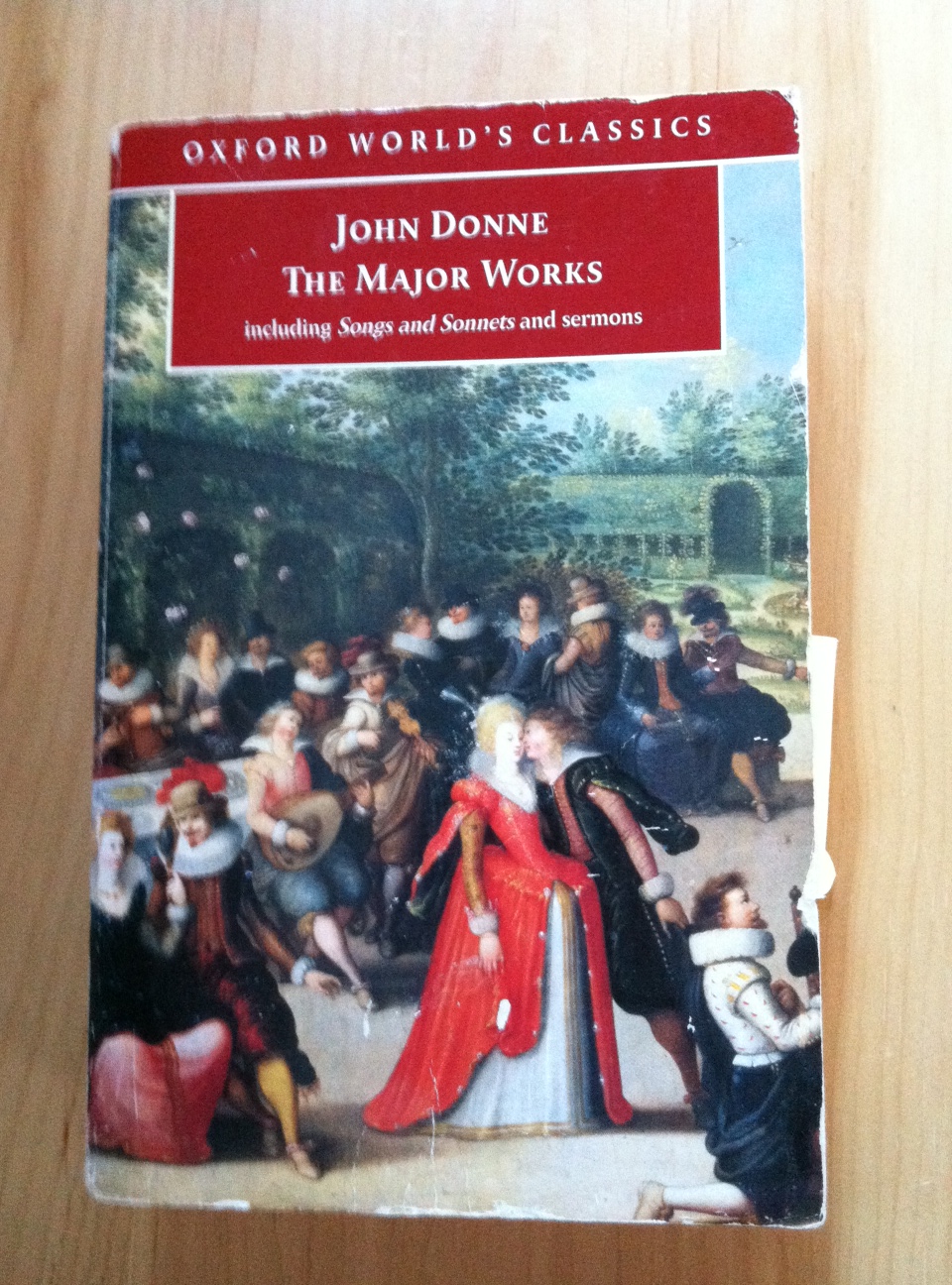
John DonneTo start things off, here’s John Donne’s elegy “To His Mistress Going to Bed” (I know I wrote about John Donne last year, but that was a Holy Sonnet. This is not.).

In the poem, the speaker encourages his inamorata to shed her clothes, piece by piece, because, well, being naked is fun. And only John Donne can manage to convey that the woman being seduced is rich (she has a pocket watch and a tres chic outfit), refer to England’s new colonies, and bring up a midwife in an erotic poem that sparkles with wit, puns, and the most charming sophistry you’ve ever read. Bonus: women are compared to books to explain their sex appeal.

What a guy.

For those who don’t want to write out the whole poem in their Valentine’s Day cards, I’ve excerpted the funniest/raunchiest bit at the end of the post.

Elegy XIX: To His Mistress Going to Bed
John Donne

Come, Madam, come, all rest my powers defy,
Until I labour, I in labour lie.
The foe oft-times having the foe in sight,
Is tir’d with standing though he never fight.
Off with that girdle, like heaven’s Zone glistering,
But a far fairer world encompassing.
Unpin that spangled breastplate which you wear,
That th’eyes of busy fools may be stopped there.
Unlace yourself, for that harmonious chime,
Tells me from you, that now it is bed time.
Off with that happy busk, which I envy,
That still can be, and still can stand so nigh.
Your gown going off, such beauteous state reveals,
As when from flowery meads th’hill’s shadow steals.
Off with that wiry Coronet and shew
The hairy Diadem which on you doth grow:
Now off with those shoes, and then safely tread
In this love’s hallow’d temple, this soft bed.
In such white robes, heaven’s Angels used to be
Received by men; Thou Angel bringst with thee
A heaven like Mahomet’s Paradise; and though
Ill spirits walk in white, we easily know,
By this these Angels from an evil sprite,
Those set our hairs, but these our flesh upright.
Licence my roving hands, and let them go,
Before, behind, between, above, below.
O my America! my new-found-land,
My kingdom, safeliest when with one man mann’d,
My Mine of precious stones, My Empirie,
How blest am I in this discovering thee!
To enter in these bonds, is to be free;
Then where my hand is set, my seal shall be.
Full nakedness! All joys are due to thee,
As souls unbodied, bodies uncloth’d must be,
To taste whole joys. Gems which you women use
Are like Atlanta’s balls, cast in men’s views,
That when a fool’s eye lighteth on a Gem,
His earthly soul may covet theirs, not them.
Like pictures, or like books’ gay coverings made
For lay-men, are all women thus array’d;
Themselves are mystic books, which only we
(Whom their imputed grace will dignify)
Must see reveal’d. Then since that I may know;
As liberally, as to a Midwife, shew
Thy self: cast all, yea, this white linen hence,
There is no penance due to innocence.
To teach thee, I am naked first; why then
What needst thou have more covering than a man?


As promised, the funniest/naughtiest lines (you may need to alter some pronouns to fit your situation. I won’t tell John Donne, but give him a h/t, ok?)

Licence my roving hands, and let them go,
Before, behind, between, above, below.
O my America! my new-found-land,
My kingdom, safeliest when with one man mann’d,
My Mine of precious stones, My Empirie,
How blest am I in this discovering thee!

An Interview with Melissa Pritchard, author of Palmerino

Yesterday, I reviewed Palmerino, Ms. Pritchard’s latest novel, out now from Bellevue Press. Ms. Pritchard graciously consented to be interviewed via email. 

How did you first learn about Violet Paget/Vernon Lee, and what led you to write a novel about V.’s life?

Melissa Pritchard photo (c) John Beckett

Melissa Pritchard
photo (c) John Beckett

MP: In July 2008, while visiting Florence, I was introduced by an Italian friend, Giuditta Viceconte, to Federica Paretti, a member of the Angeli family, current owners of Villa il Palmerino, Vernon Lee’s former home.  At the time, I had been thinking of starting a writer’s residency, and Giuditta immediately decided I should meet Federica to discuss possibilities. On the afternoon I met Federica, I felt an immediate kinship with her and strangely, with the Villa itself. I had a deeply comforting sense of having “come home.” As I learned of Vernon Lee from Federica, I began to sense and to “see” things around the villa and the property that caused Federica to regard me strangely, until she finally said, “You may be meant to write a book about Vernon Lee. Perhaps that is the real reason you have come here.” For example, as I was looking out of a upstairs window onto the terrace, I  “saw,” as in a film, a puppet show for children being performed there. I turned to Federica, saying “this would make a wonderful space for a children’s puppet show!”  She then told me that was the exact place where Vernon Lee performed puppet shows for the children of the peasants or contadini. But it was after I learned about Vernon Lee’s supernatural tales, about her fascination with genius loci or spirit of place, and about her being one of the first writers to explore the notion of empathy in art, that I began to connect with her on a deeper level, and feel “called” to write about her. It’s also true that I fell in love with Villa il Palmerino itself before I fully committed to researching and writing about Vernon Lee. After our first meeting, Federica invited me to return, and one year later I did, renting out one of the spacious rooms. I would return three more times, each time for a longer period, to do research on Vernon Lee and to write the first and subsequent drafts of the novel. I completed Palmerino in Switzerland, at Chateau Lavigny, a writer’s residence, in the autumn of 2012.

What was the writing process for Palmerino like? Do you share writing traits with Sylvia?

MP: I embarked upon over a year of research, visiting the Vernon Lee archives at Colby College, Maine, and returning to Florence several more times. Once I felt prepared, I then had to begin to shape the novel’s perimeters, determine its structure. Once I decided to largely focus on Vernon Lee’s emotional life, specifically her two great love affairs, I began the actual writing. I designed the novel in three alternating threads, Vernon Lee’s ghostly voice, Sylvia’s voice, and the story that Sylvia was telling. Writing is a risk, a gamble, a running through the darkness, so I could only hope this unconventional design would work. One of my literary inspirations was Henry James’s The Turn of the Screw, the other Vernon Lee’s own highly regarded supernatural tales, particularly “Amor Dure.”

If I share any writing traits with Sylvia, it may be that I always write in longhand first, and that I love to have food around me when I write. I also tend to isolate myself when I’m writing, particularly when working on a first draft – it’s the only way I can “hear” the book. It is a lonely phase, but also a thrilling kind of pilgrimage into the life of the imagination, into other lives and worlds.

V. dismisses modern scholarship about her life and, particularly, her sexuality (pages 127-28). Do you share her assessment of current scholarly efforts to understand, or analyze, Vernon Lee’s/Violet Paget’s life?

MP: In the last ten or so years, there has been a tremendous resurgence of scholarly interest in Vernon Lee. There is a wonderful online journal, The Sibyl, that is richly and entirely devoted to current studies on Vernon Lee. In September, 2012, I was fortunate to be a part of the first international seminar on Vernon Lee, held in Florence. I went to many talks by scholars dedicating their academic lives to aspects of Vernon Lee’s extraordinary and prolific life. I was honored to close the seminar with a reading from Palmerino, a reading held at twilight, in one of the many hidden gardens on the grounds of Villa il Palmerino. It was a magical way to close a scholarly seminar, and while reading,I seemed to feel Vernon Lee’s presence nearby. My sense is that she would both be critical of all the research being done on her, the published books, papers and articles, the seminars, but that she would also be deeply pleased.

How did you go about conducting research for Palmerino?
PalmerinoI started with Vernon Lee biographies, relying mainly on two, then read many of the books Vernon herself had read and admired. I visited Colby College, Maine and in the archives room, sat for hours poring through correspondence between Henry James, John Singer Sargent, Edith Wharton, Clementina “Kit” Anstruther Thompson and Vernon Lee. I cannot describe the feeling of holding a letter written by Henry James, addressed to Vernon, in my hands. And while reading Kit’s immensely charming letters, illustrated with whimsical figures, I understood exactly how and why Vernon fell in love with her, needed her, and was devastated when she left Vernon. In Florence, I found the two places Vernon and her family had lived before moving to Villa il Palmerino. I visited the British Institute where there is a room filled entirely with a large portion of Vernon Lee’s extensive library, and was able to look through her books, see her pencilled annotations and marginalia, written with a bold, energetic hand. And at the famous Gabinetto Vieusseux, I was able to read more of her letters, many in Italian or German, and see the progression of her emotional state through her handwriting from the firm, bold hand of her middle years to the weak scrawl of later years, the intelligence still evident but the infirmity of a failing body sadly taking hold. And of course, I found much to read online, scholarly papers, other references.

Which writers do you read while you’re writing, if any? Do they change from book to book?

As part of my research for Palmerino, I read a great many of the books Vernon had been strongly influenced by. I also read books and articles relating to that time period in Florence, to the Anglo-American cultural community of 19th century Florence. On my author website, on the Palmerino page, I have put a partial list of these books. I also listened to classical music, particularly music Vernon Lee had liked. She was, among other things, a respected authority on eighteenth century Italian music.

When I write a book, it becomes an immersion experience. If it is an historically based novel or short story, I intentionally surround myself with the books, art and music of that time period, as a way of spelling myself back into that time and place. In writing contemporary fiction, I mainly read poetry and contemporary fiction I find compelling and hugely exciting. Steeping myself in the best literature is, I have found, a pleasant way to keep standards for my own writing as high as possible.

What kinds of projects are you planning next?

I’d like to finish editing a book-length collection of essays I’ve written, all of which have been individually published. After writing historically inspired fiction and a few humanitarian journalism pieces for the last three or so years, I’m starved to return to writing contemporary fiction – as a way of balancing, I think. But my next big project will be another historically based novel about a nineteenth century British Shakespearean actress who was also an abolitionist. The big, ambitious plan is to write a series of historically inspired novels, beginning with Vernon Lee, on three nineteenth century British women, a writer, an actress, a medical reformer. All three of these women defied the constraints and conventions of their time and forged, not without sacrifice, accomplished and brave lives.

My thanks again to Ms. Pritchard for her time and generous, thoughtful answers. You can read more about Palmerino, and Melissa Pritchard’s other published works, on her website, and you can follow Ms. Pritchard on Twitter: @PritchardMeliss. 

Paradise Lost, Books V and VI: The Books in Danger of a Michael Bay Adaptation

ParadiseLostReadalongWe’ve made it halfway in the Paradise Lost ReadAlong, so here are some links if you’d like to catch up:

Introduction
Books I and II
Books III and IV

Books V and VI find Raphael relating recent celestial history to Adam as part of a mission from the Father. He tells Adam of the war in Heaven between the rebellious and loyal angels, effectively bringing us, by the end of Book VI, up to the starting point of the poem in Book I: Satan’s fall, with his cohort, from Heaven into Hell.

In a departure from my usual practice, I’m going to let Milton himself give you the synopsis of these two books (Yes, he’s considerate enough to provide a synopsis for each book before the verse starts. Isn’t he great?). Also, I’m writing this late at night, so things may get, shall we say, irreverent?

Book V:

Morning approacht, Eve relates to Adam her troublesome dream; he likes it not, yet comforts her: They come forth to their day labours: Their Morning Hymn at the Door of their Bower. God to render Man inexcusable sends Raphael to admonish him of his obedience, of his free estate, of his enemy near at hand; who he is, and why his enemy, and whatever else may avail Adam to know. Raphael comes down to Paradise, his appearance describ’d, his coming discern’d by Adam afar off sitting at the door of his Bower; he goes out to meet him, brings him to his lodge, entertains him with the choycest fruits of Paradise got together by Eve; their discourse at Table: Raphael performs his message, minds Adam of his state and of his enemy; relates at Adams request who that enemy is, and how he came to be so, beginning from his first revolt in Heaven, and the occasion thereof; how he drew his Legions after him to the parts of the North, and there incited them to rebel with him, perswading all but only Abdiel a Seraph, who in Argument diswades and opposes him, then forsakes him.

Book VI:

Raphael continues to relate how Michael and Gabriel were sent forth to battle against Satan and his Angels. The first Fight describ’d: Satan and his Powers retire under Night: He calls a Councel, invents devilish Engines, which in the second day’s Fight put Michael and his Angels to some disorder; But, they at length pulling up Mountains overwhelm’d both the force and Machines of Satan: Yet the Tumult not so ending, God on the third day sends Messiah his Son, for whom he had reserv’d the glory of that Victory: He in the Power of his Father coming to the place, and causing all his Legions to stand still on either side, with his Chariot and Thunder driving into the midst of his Enemies, pursues them unable to resist towards the wall of Heaven; which opening, they leap down with horrur and confusion into the place of punishment prepar’d for them in the Deep: Messiah returns with triumph to his Father.

Neat, huh? I’ve cleaned up a bit of the spelling. (These “Arguments,” as Milton called them, aren’t pulled from Gordon Teskey’s edition of the poem, since I thought it might be nice to give you delightful readers a better taste of seventeenth-century phrasing.)

As you can tell, Books V and VI are heavy on action (hence today’s post title. Which was a joke. I hope.) Book V features a particularly Miltonic moment, however: a lone voice raised against wrong action, in the form of Abdiel’s resistance to Satan’s call for rebellion and war.

On the surface, Satan’s initial raillery against the Father’s elevation of the Son might seem appealing to a republican (small-r) revolutionary like Milton: Satan objects to being asked to prostrate himself to a new master (especially one whose power seems to derive from nepotism) who promises to hand down new laws that must be obeyed.

However, Milton (via Abdiel) neatly refutes Satan by revealing his error — the assumption that the Son and the angels are equals:

Canst thou with impious obloquy condemn
The just decree of God pronounced and sworn
That to his only Son by right endued
With regal scepter every soul in Heav’n
Shall bend the knee and in that honor due
Confess him rightful King? Unjust thou say’st,
Flatly unjust, to bind with laws the free
And equal over equals to let reign,
One over all with unsucceeded pow’r.
Shalt thou give law to God, shalt thou dispute
With Him the points of liberty who made
Thee what thou art and formed the pow’rs of Heav’n
Such as He pleased and circumscribed their being? (5.813-25)

Scorned by Satan and Satan’s fellows, Abdiel remains steadfast, and in one of the poem’s best images, he walks fearlessly away from the rebellious to join the righteous:

So spake the seraph Abdiel faithful found
Among the faithless, faithful only he
Among innumerable false. Unmoved,
Unshaken, unseduced, unterrified
His loyalty he kept, his love, his zeal.
Nor number nor example with him wrought
To swerve from truth or change his constant mind
Though single. From amidst them forth he passed
Long way through hostile scorn which he sustained
Superior, nor of violence feared aught
And with retorted scorn his back he turned
On those proud tow’rs to swift destruction doomed. (8.597-907)

A powerful passage, isn’t it? And particularly poignant, given Milton’s own part in the failed (though initially righteous, in his eyes) English revolution. Like Abdiel, “his loyalty he kept, his love, his zeal.”

*

I won’t quote lengthy passages from Book VI, but it’s one of the most entertaining books of the poem, in which Raphael describes to Adam (Eve being noticeably absent, having fulfilled her womanly serving duties *grumble grumble feminist grumble*) the progress of the war. On the first day, Michael leads the loyal angels against Satan and his followers. Angels on both sides are injured, but only the rebel angels feel pain (and we also learn that they’ve lost the ability to feel pleasure). Angelic bodies heal themselves, it turns out. Michael faces Satan in single combat, and Satan, to his dismay, is bested and forced to retreat.

During the night, the rebel angels invent cannon (often regarded as devilish in the Renaissance) and surprise the heavenly hosts, who respond by hurling mountains at their foes. The imagery here is so fantastic — it just cries out for Guillermo del Toro. (Michael Bay, in the unlikely event you’re reading this blog: STAY AWAY FROM MILTON.) Plus Satan engages in some tricky non-diplomacy and witty banter with his pals, so now I’m envisioning a del Toro/ Aaron Sorkin collaboration . . . But I digress.

On the third day, the Father decides that enough is enough. Michael’s done excellent work at QB, but it’s time to bring out the Son, who says, basically, “Hold up. I got this.” The loyal angels line up and watch as the Son, with thunder blaring and chariot blazing, charges the rebel angels alone and so terrifies them that they throw themselves out of Heaven (h/t to obliging self-opening, self-healing heavenly wall) and into a nine-day fall to Hell.  That’s what George Lucas would call aggressive negotiation. (Now that I’ve quoted possibly the worst screenplay of all time, I’m done with movies now, I promise.)

But it’s not all fun and demon defeat in Book VI. The point of Raphael’s tale is to warn Adam, lest he think about disobeying God:

Let it profit thee t’have heard
By terrible example the reward
Of disobedience! Firm they might have stood,
Yet fell. Remember, and fear to transgress! (6.909-12)

Fear will keep the local systems in line. Fear of this battle Son. Wait. Where have I heard that before?

Really done now.

Coming up on February 10: Books VII and VII — Adam’s Edenic education continues.
A programming note: Today features a rare double post here on Rosemary and Reading Glasses, so you might like to scroll down or click over to today’s earlier post, a review of Melissa Pritchard’s fascinating novel Palmerino.

Recommended Reading: Palmerino, by Melissa Pritchard

PalmerinoThe life of British writer Violet Paget — better known by her nom de plume and male persona, Vernon Lee — seems ripe for novelization. Born into an intellectual family, Violet/Vernon was considered quite ugly (though I confess that every picture I’ve seen belies this assessment), but also brilliant, gifted especially with language. She spent most of her life in Europe, where she held court in a kind of salon at Palmerino, a villa near Florence. The constellation of writers and thinkers in her orbit reads like a who’s who of a late-Victorian anthology: Henry and William James, Edith Wharton, Oscar Wilde, Walter Pater. One of her best childhood friends was John Singer Sargent.

Violet/Vernon wrote supernatural fiction and researched aesthetics, and was one of the first people to study empathy and art. (This link between science and art explains why Palmerino is published by Bellevue Literary Press, a small, nonprofit press dedicated to publishing works that connect art and science.)

Melissa Pritchard’s Palmerino defied my expectations in its structure and plot. I though I’d be reading a straightforward exploration of Violet/Vernon’s life and loves, perhaps featuring one of her several lesbian relationships. And indeed, the novel is about Violet/Vernon’s life, and about her relationships with Mary Robinson and Kit Anstruther-Thomson in particular.

However, Ms. Pritchard approaches her subject through a framing device, following the fictional American novelist Sylvia as she takes up residence at Palmerino to begin work on a novel about Vernon Lee. The perspective alternates among Sylvia, V. (apparently the ghostly voice of Violet/Vernon in the present), and Sylvia’s narrative of Vernon’s world. Ms. Pritchard is selective about the parts of Vernon’s biography included, so the effect is rather like piecing together a puzzle. For example, we see particularly vivid scenes from V.’s childhood and adolescence which bear on her future as a thinker and writer. The elided sections speak through silence, like the turns between stanzas in poetry.

Palmerino incorporates elements of biography, supernatural fiction, and historical fiction as it explores the nature of research,, genius loci, loneliness, and eroticism — and it’s a fascinating, unexpected way to enter into Vernon Lee’s life. Highly recommended.

Tomorrow on the blog: An interview with Melissa Pritchard, author of Palmerino.

Note: I received this copy through LibraryThing’s Early Reviewers program, in exchange for an honest review.

“Sweetbitter”: The Complete Poems of Sappho, translated by Willis Barnstone

sappho trans, barnstonePlato called her “the tenth muse,” and yet Sappho remains an elusive figure. The outlines of her biography are sketchy, and nearly all her extant poems are fragmentary. Still, the lines we have are some of the most beautiful ever written, hungry and haunted as they are by love and loss.

Acclaimed poet and translator Willis Barnstone’s edition of the poems is grouped thematically, and he makes the interesting choice to title the poems. I’m still on the fence about the effect. In some cases, the titles merely refer to a personage named in the poem; in others, the titles reflect the obvious subject of the poem (“Old Age,” for example). With a few of the poems, however, I would have preferred an untitled version in order to better draw my own conclusions. But this is a small complaint; the volume is beautifully done, and I highly recommend it. (I’d also love to compare it with Anne Carson’s If Not, Winter, which I haven’t read yet — if you have, will you tell me what you think?)

It’s difficult to choose which poem to highlight this week, so I’ll leave you with Mr. Barnstone’s translation of fragment 130, which he titles “Sweetbitter”:

Eros loosener of limbs once again trembles me,
a sweetbitter beast irrepressibly creeping in

An Interview with Rachel Pastan, Author of Alena

Yesterday I reviewed Alena, Rachel Pastan’s latest novel. Ms. Pastan graciously agreed to be interviewed via email about the novel and her writing. 

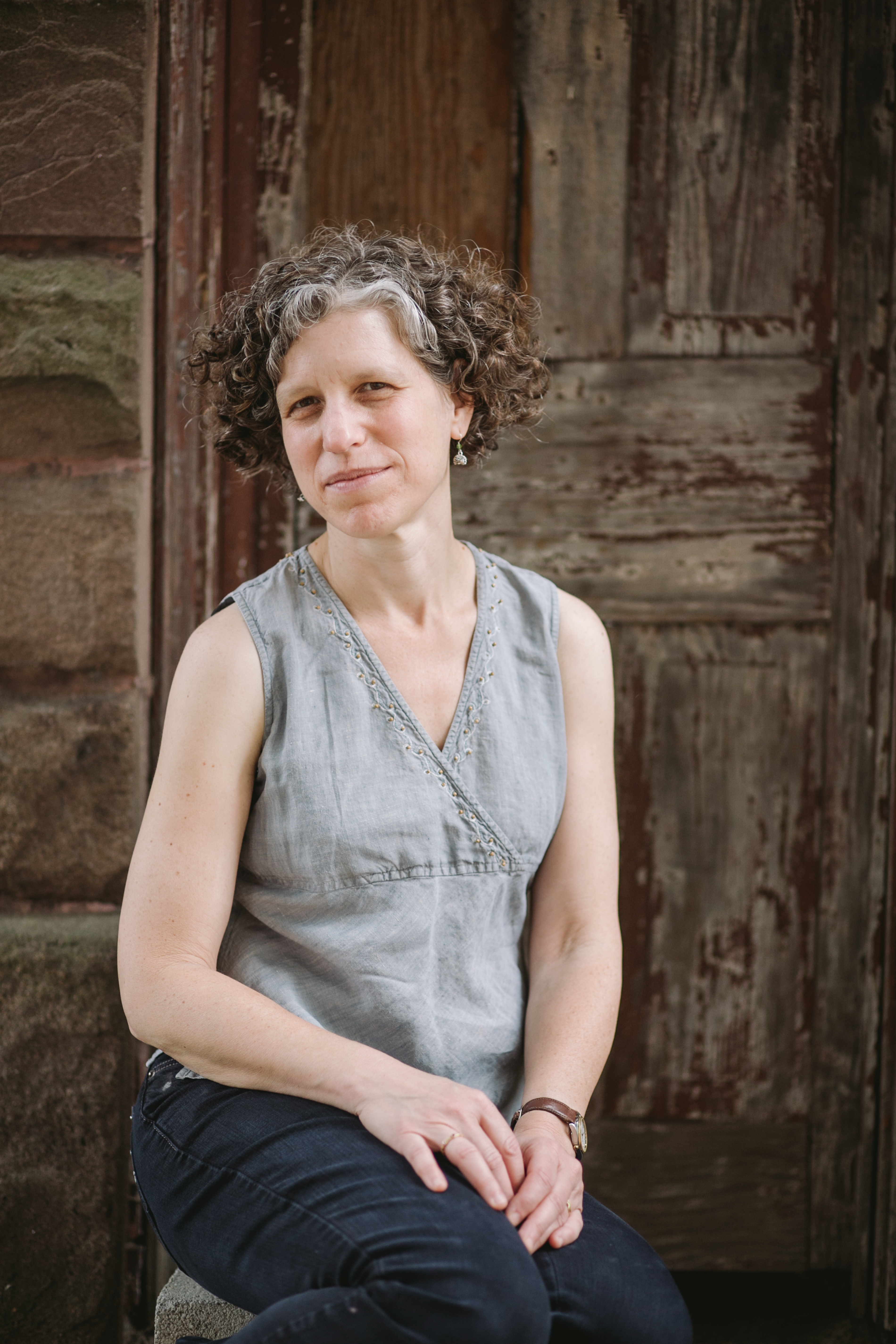
Rachel Pastan  (c) Carina Romano

Rachel Pastan
(c) Carina Romano

When and how did you conceive of writing a book that responds to Rebecca? Was the writing process long?

RP: I had taken a nine-to-five office job—a different kind of job than I’d ever had before. The woman who’d worked there before me, Elysa, had left months before, so I didn’t have anyone to train to me, and I kept making mistakes. People would say, “Elysa used to do it this way.” I felt inadequate, and a little in awe of this unknown Elysa. And then I thought: It’s just like Rebecca, only in the workplace! And then I thought: That’s a good idea for a novel. I wasn’t able to start writing it for a while, but once I did, it went quickly. It took me only about eighteen months to finish a draft.

Much of Alena‘s action takes place on Cape Cod. Was there a particular reason (or reasons) for this choice? 

RP: My family used to spend a month in Cape Cod every summer when I was little, and the landscape has always stayed with me. For years I used to have dreams about the ocean there. Rebecca takes place on a coast—probably of Cornwall. The atmosphere of Cape Cod seemed like a good parallel to me, and I was happy to revisit its beaches in my imagination.

Was it challenging to avoid giving the narrator a name?

RP: Actually I gave her a name while I was writing—I figured I just wouldn’t be faithful to that part of Rebecca. But afterwards I saw I could take the name out. Du Maurier had a few advantages; people could call her narrator “Mrs. de Winter.” After I took out the name, I did go back and make one of the characters call my narrator Cara—Italian for “darling.” That helped.

AlenaHow did you go about learning about contemporary art, which is so critical to Alena? Did you discover a favorite contemporary artist along the way?

RP: For last few years I have worked at the ICA—the Institute of Contemporary Art—in Philadelphia, writing and editing. This has been a fabulous immersion course in contemporary art. I don’t have a favorite contemporary artist—any more than I have a favorite contemporary writer—but the discovery of Anne Truitt was a wonderful and memorable moment. She made very simple, tall sculptures that are somehow incredibly moving and evocative. She wrote a terrific memoir, too, called Daybook, The Journal of an Artist, which talks about her struggles in her work, and with trying to combine work and family life.

Which writers do you read while you’re writing, if any? Do they change from book to book?

RP: I often read a little every morning before I start working, a few pages by someone whose sentences I love. Alice Munro is a favorite, as is Margaret Drabble. Other than that, I might read books that address a subject I’m writing about to see how other people handle it. When I was writing Alena I read a bunch of novels that deal with contemporary art in one way or another: By Nightfall by Michael Cunningham and “A Thing of Beauty” by Steve Martin were a couple.

What kinds of projects are you planning next?

RP: I have a very different project in mind: a novel based on the life of a real person, which is something I’ve never done before. It’s exciting—and daunting—to think about how to shape a real life into a compelling narrative.

Many thanks to Ms. Pastan for her time and thoughtful answers!

Out Today: Rachel Pastan’s Alena

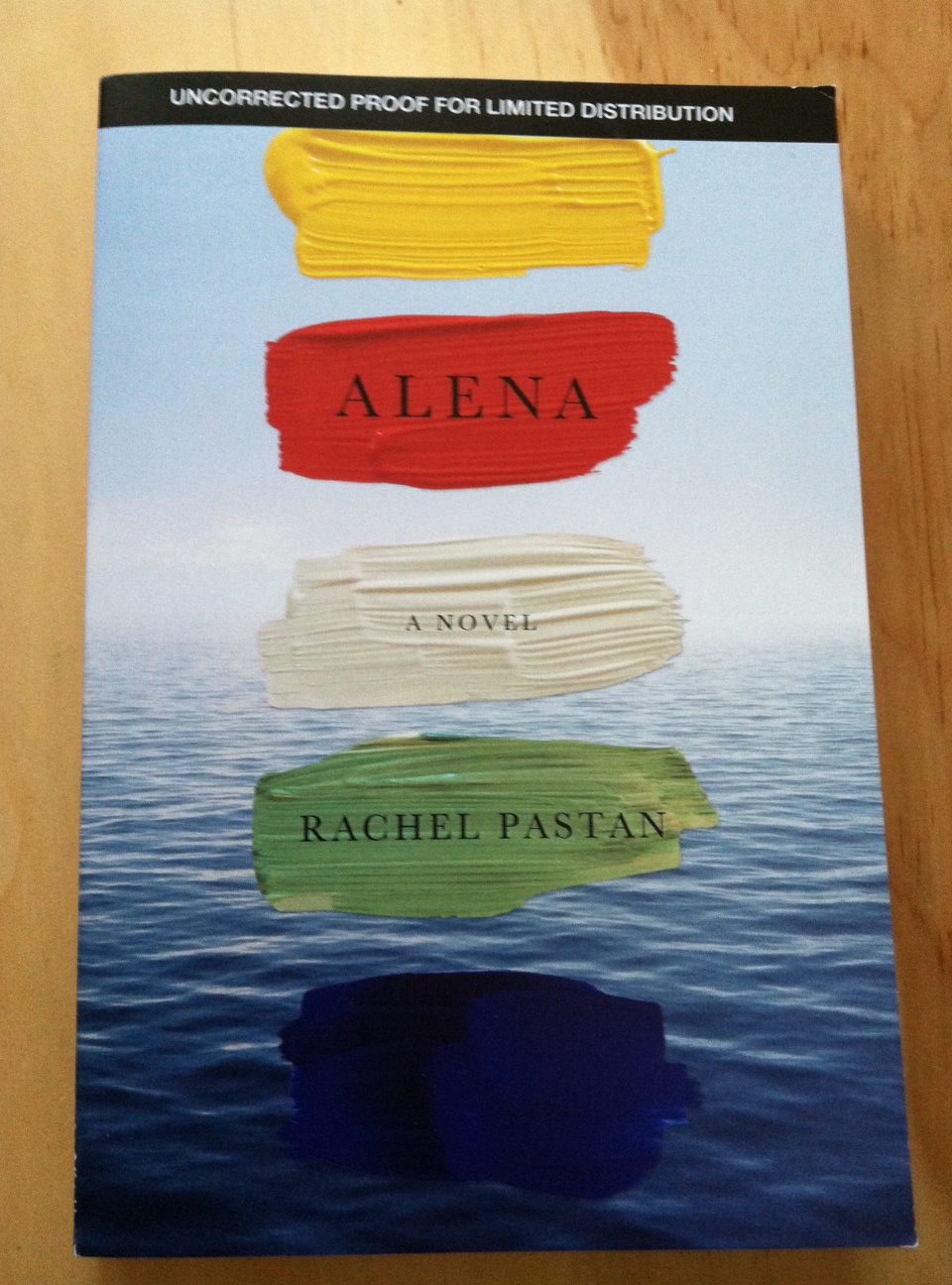
AlenaFrom its first line — “Last night I dreamed of Nauquasset again” — Alena, Rachel Pastan’s new novel, echoes its inspiration, Daphne du Maurier’s Rebecca. However, Ms. Pastan’s interpretation of Rebecca‘s plot rejects recapitulation in favor of a refreshing focus on the workplace and contemporary art.

Alena‘s narrator, like du Maurier’s original, is an unnamed young woman from a modest background. Here, she is from the outset identified as a curator of contemporary art. On a trip to the Venice Biennale, she meets Bernard Augustin, the elegant, wealthy, and mysterious founder of a small museum on Cape Cod devoted to contemporary art — the Nauquasset, or Nauk. Bernard sees in her a fine sensibility and eye, and offers her the job of curator.

Arriving at the Nauk, the new curator finds that the staff, particularly the black-clad Agnes, still devoted to the previous (and presumed dead) curator, Alena. Alena’s touch and vision suffuses the small museum’s rooms and atmosphere, and soon the new curator must decide between reopening the museum with an exhibit of her own choice — or Alena’s choice, the grotesque art of a man named Morgan McManus. Meanwhile, clues to Alena’s disappearance linger in the shadows, waiting for their moment to appear.

One of the major differences between Alena and Rebecca is Alena’s shift of focus from the domestic environment to the workplace, a change wrought for the better (meaning no disrespect to Rebecca, of course). By raising the stakes (for example, from a country house party to the opening of a contemporary art museum), Alena pushes its focus outward from the personal into the world of art and the non-domestic workplace, without losing sight of the personal. The relationship between Bernard and his new curator, we learn quickly, cannot possibly be sexual, and doesn’t carry the erotic charge between Maxim and the second Mrs. de Winter, but that does not diminish its intensity.

The novel is wonderfully evocative of Cape Cod in the summer (I speak from experience, here — my husband grew up on the Cape and we spend time with his family who live there), and lucid in matters of contemporary art. I’m not a contemporary art aficionado by any stretch of the imagination (on a college trip to Paris, I skipped the Centre Pompidou to spend the day at the Louvre, a trade I’d still make any day); I have a passing familiarity with Damien Hirst and Marina Abramovic, and I like Chihuly’s work very much, but that’s about it. Ms. Pastan refers to a great many more artists, but her descriptions of art are so finely crafted that it’s easy to imagine the art she describes.

Death, lying side by side with art, is the novel’s other fascination. Like Rebecca, Alena is suffused with creepiness, a sense of something malevolent lurking just around the next corner, biding its time. Add that sensation to the narrator’s overwhelming anxiety, and the result is a suspenseful read, daring in both its departure from and adherence to its source material.

Note: I received this book through LibraryThing’s Early Reviewers program.

Tomorrow on the blog: An interview with Rachel Pastan, author of Alena

Paradise Lost, Books III and IV: Oh, Milton.

Feel free to read the Paradise Lost Readalong introductory post here, and catch up on Books I and II here.

ParadiseLostReadalong

Books III and IV of Paradise Lost are, for me, the most difficult to grapple with. Book III is, for the most part, an exercise in Milton’s brand of theology (which I find unconvincing) and Book IV contains some of the very worst of Milton’s views on gender hierarchy. So in today’s post, I’m going to wrestle (in a limited way) with these issues. But first: the summary.

Book III begins with the invocation to light, one of the poem’s most famous passages. Within the invocation, the poem transitions from the darkness of Hell to the light of Heaven, where God the Father tells the Son and the heavenly hosts what is to come: Satan’s successful temptation of Eve and Adam and the Fall. However, the Father also plans to offer humanity grace, but only if a suitable sacrifice can be offered to satisfy the demands of justice. The Son offers to become that sacrifice; the Father accepts, and orders the angels to praise the Son. Meanwhile, Satan reaches the Limbo of Vanity, and from there goes  to the gate of Heaven. Disguising himself as a lesser angel, he finds Uriel, regent of the sun, and asks directions to the home of humankind. He “alights first on Mount Niphates.”

In Book IV, we finally reach Eden, and meet Adam and Eve. Satan, after much internal debate, reaffirms his evil purpose, and descends into the Garden (enacting yet another fall). The garden, as well as Adam and Eve, are at last described. Satan stalks the human pair, and learns that God has forbidden them to eat of the Tree of Knowledge. Meanwhile, Uriel, having recognized Satan as a bad angel by  his wild gesticulations on Mount Niphates, warns Gabriel (who’s in charge of security in Paradise) that an evil spirit is skulking about. Gabriel sends two angels to check on Adam and Eve as they sleep, and they find Satan crouched at Eve’s ear, tempting her in a dream. Brought to Gabriel, he plans to resist, but a sign from Heaven sends him flying out of Paradise.

Here’s what I’m mulling over this week:

The Problem of Evil

Book III finds Milton confronting the problem of evil (why does an all-loving, all-powerful God allow Evil to exist? Why does he allow the Fall to occur?). He presents his solution in the most Miltonic way imaginable: by putting his theories in the mouth of God (the Father) himself. He prefaces this excursion with the invocation to “holy light” (3.1), recalling his invocation to the Muse (Holy Spirit) in Book I, in which he asked,

What in me is dark
Illumine, what is low raise and support
That to the heighth of this great argument
I may assert Eternal Providence
And justify the ways of God to men. (1.22-26)

God’s omniscience means that he mixes his tenses rather indiscriminately, so that even though, in linear time, the Fall hasn’t yet happened, God can accuse Adam and Eve of ingratitude, explaining that he created them “sufficient to have stood though free to fall” (3.99). He goes on to ask his audience (rhetorically) if he hadn’t given men and angels free will, “what proof could they have giv’n sincere / Of true allegiance, constant faith, or love” (3.103-04). He dismisses his own foreknowledge as an influence on those who choose to sin, and makes a distinction between those who sinned without deception (the bad angels) and those tempted and deceived (men). The latter will receive mercy, tempered with justice; the former will languish in Hell.

Kingship

When the Son offers to be the sacrifice demanded by justice (though Milton never explains why an omnipotent God feels bound by justice), the Father praises him and anoints him “universal king” (3.317).  In Milton’s view, true kingship is born of sacrifice and sanctity, not a will to power. Earthly kinship, in Milton’s theology, is an echo of Satan’s desire to usurp the heavenly throne, to reign as a tyrant.

Hypocrisy

(This passage speaks for itself.)

So spake the false dissembler unperceived,
For neither man nor angel can discern
Hypocrisy, the only evil that walks
Invisible except to God alone
By His permissive will through Heav’n and Earth.
And oft, though Wisdom wake, Suspicion sleeps
At Wisdom’s gate and to Simplicity
Resigns her charge while Goodness thinks no ill
Where no ill seems (3.681-89)

The Garden and the Nature of Work

Milton’s triumphant, lovely description of Paradise is too long to quote here. The garden is wild, dripping with fecundity and lush growth; Milton compares it with modern planned gardens, praising Paradise’s luxurious profusion. Here all manner of beasts and birds and plants live harmoniously (Adam and Eve are vegetarians; fruit practically offers itself to them, and they use the husks to scoop water from accommodating streams.). This natural world (and the pair’s bower of bliss) contrasts with the demons’ artificial edifice in Hell, just as humans’ prelapsarian work (tending the garden) contrasts with Fallen labor (Mulciber will teach men to, “with impious hands / [Rifle] the bowels of their mother Earth / for treasures better hid” [1.686-88].).

Gender Hierarchy

It’s always difficult for me to suppress a groan when I read the first description of Adam and Eve in Book IV. Both are beautiful, more beautiful than any other humans will ever be, but Milton is careful to describe their relationship in terms of hierarchy:

Though both
Not equal as their sex not equal seemed:
For contemplation he and valor formed,
For softness she and sweet attractive grace:
He for God only, she for God in him. (3.296-99)

Coming from a man whose views on marriage and sexuality were, for his day, very progressive (In the 1640s, Milton was widely excoriated for the tract Doctrine and Discipline of Divorce, in which he advocated companionate marriage — a meeting of the minds — and the right to divorce if the spouses were not compatible emotionally. And he’s no prude — Adam and Eve clearly have sex before the Fall.), this declaration always disappoints me, even if it doesn’t surprise me.

However, scholars have pointed to several ways in which Milton ameliorates Eve’s subservient position. Foremost among these is the simple fact that Eve is the poem’s best poet. Adam’s declarative sentences are leaden read next to Eve’s lovely, flowing lines. Even Satan doesn’t compose as well as she does; his syntax is too sinuous, too studded with outbursts. Eve speaks in melodious paragraphs. Here’s an example of the way Eve undercuts her own stated submission with glorious poetry:

To whom thus Eve, with perfect beauty adorned:
My author and disposer, what thou bidd’st
Unargu’d I obey; so God ordains.
God is thy law, thou mine: to know no more
Is woman’s happiest knowledge and her praise.
With thee conversing I forget all time,
All seasons and their change: all please alike.
Sweet is the breath of morn, her rising sweet,
With charm of earliest birds; pleasant the sun,
When first on this delightful land he spreads
His orient beams, on herb, tree, fruit, and flow’r,
Glist’ring with dew; fragrant the fertile earth
After soft showers; and sweet the coming-on
Of grateful evening mild; then silent night,
With this her solemn bird, and this her moon,
And these the gems of heav’n, her starry train:
But neither breath of morn when she ascends
With charm of earliest birds, nor rising sun
On this delightful land, nor herb, fruit, flower,
Glist’ring with dew, nor fragrance after showers,
Nor grateful evening mild, nor silent night,
With this her solemn bird, nor walk by moon
Or glittering starlight, without thee is sweet.
But wherefore all night long shine these? for whom
This glorious sight, when sleep hath shut all eyes? (4.634-58)

Or consider Eve’s account of her creation, the first to appear in the poem, at lines 440-91 . I’ll talk about it next time, when we venture into books V and VI on January 30th.