“Once I walked out and the world / rushed to my side”: Mark Wunderlich’s The Earth Avails

photo (70)Brimming with life and color, Mark Wunderlich’s collection The Earth Avails* is the perfect book to read on Earth Day. In these poems, the natural world is both celebrated and mourned in a speaker’s voice that is sometimes measured, sometimes impassioned, and always thoughtful.

In his Notes on the poems, Mr. Wunderlich explains that upon reading a nineteenth-century small book of German prayers found in his family’s home, as well as Heaven-letters, “folk-religious documents” from the eighteenth and nineteenth centuries, he adapted these documents into poems (69). Roughly half the poems in The Earth Avails take the form of prayers or Heaven Letters; in their posture of supplication, in their evocations of simple desires (“spare the orchards from hail”), they nonetheless suggest that the power addressed is the power of language itself, building in rumbling, crescendoing couplets.

In adapting these older forms, Mr. Wunderlich has written poems with an utterly fluid sense of time. A poem might include charms against flooding or pests or disease — common enough nineteenth-century agrarian concerns — but then mention at its end a detail that places the poem in a contemporary world. The juxtaposition is pleasantly jolting, showing us just how rooted we are in the past — and how far we are from it — while offering the promise that the sense of connection to the land we think we’ve lost could be recovered.

Many of the poems reflect the landscape, both interior and exterior, of Mr. Wunderlich’s home in the Hudson Valley. The word that kept coming to mind as a I read was “renovation,” not only in the sense of rebuilding a structure, like the house here with its “crumbling cow-hair plaster mending the wall,” but also in its etymological sense of “to make new again.” The poems in The Earth Avails make the natural world new again, giving us fresh eyes to see the coyote with mange, or “the green worms / ciphering the cabbages’ leaves” or the wild boar’s “rusty wool along the belly.”  These poems reflect engagement with other nature poets (Robert Frost came to mind more than once, and “Sand Shark” would be a perfect companion piece for anyone teaching Elizabeth Bishop’s “The Fish”), and since I’ve just read The Poetic Species, I couldn’t help thinking about the ways in which this volume works at the intersection of the humanities and the sciences.

I think you can probably tell that I loved these poems. I highly recommend The Earth Avails.

The featured poem of the week is “Prayer for a Birthday,” by Mark Wunderlich, which appears in The Earth Avails. You can read the poem, and a short comment from the poet, on Poets.org.

*My thanks to the publisher for sending me a copy of this book in exchange for an honest review.

The Poetry Concierge Recommends: Robert Frost

[The Poetry Concierge is an occasional feature here on Rosemary and Reading Glasses wherein I select a poem, poet, or book of poems for individual readers based on a short questionnaire. Come play along! Read the introductory post here, my first recommendation here, and then email me at: rosemaryandreadingglasses [at] gmail [dot] com.]

This week, our pilgrim in search of poetry is Tania, who runs (along with Kirt) Write Readsa blog and Canadian reading book club podcast.

1. When you read fiction, who’s your go-to author?

I can only pick one? Okay, Margaret Laurence …but there are so many others!! 

2. If you read nonfiction, which subjects are most likely to interest you? (cultural history, science, biography, memoir, survival stories?)

Travel, Political/Social Commentary and anything by Bill Bryson.

3. If you were stuck on a desert island for a week, which five books would you bring to keep you entertained?

The Diviners by Margaret Laurence
I Shall Wear Midnight by Terry Pratchett
The Name of the Wind by Patrick Rothfuss
The Decameron by Boccacccio
The Rebel Angels by Robertson Davies

4. If you were on a five-year mission to Mars, which five books would you bring to keep you sane?

An Abundance of Katherines by John Green
Sunshine Sketches of a Little Town by Leacock
The Diviners by Margaret Laurence
The Name of the Wind by Patrick Rothfuss
Asterios Polyp by Mazzuchelli

5. What kinds of questions are most likely to keep you up at night? (death, the nature of love, politics, environmental issues, meaning of life, end of the world, justice and injustice, etc?)
 

Meaning of life
Justice/Injustice

6. If you’ve read poetry before, what have you liked? What have you disliked?

I’ve liked a lot of T.S. Eliot. I’ve liked more story-telling poems and less of the random images and symbols that I don’t understand poetry 🙂


Ok, so this is a tricky one, because I haven’t read any of the books that Tania lists! (Well, excerpts from The Decameron, and I’ve read one Bill Bryson book, but still.) However, with a little poking around, I got the sense that Tania likes well-developed characters, vignette-like structures, and a strong sense of place. It’s these last two qualities, in particular, that lead me to recommend that American poet everyone thinks he knows, Robert Frost.

Modern in sensibility, if not in form, Frost’s poetry is rooted in nature, and the woods of New England, in particular. Many of his poems read like vignettes, records of small moments in country life, whether everyday (“Stopping by Woods on a Snowy Evening”) or horrific (“‘Out, out–‘”). Darkness lurks around the edges of the very poems that are so often celebrated for their beauty and felicitous phrasing; isolation, death, and despair walk in the woods, too.

Take Robert Frost’s “The Wood-Pile”, which I think might be just right for Tania. The speaker is far from home, walking through a frozen swamp, and before we can wonder why, we’re distracted by the flighty bird that’s leading the speaker on, and then by the wood-pile, orderly but abandoned, out in the woods. There’s so much going on with that wood-pile that I’ll let you discover it for yourself.  I hope you’ll like this poem, Tania, and Robert Frost’s work, too!


Would you like the Poetry Concierge to make a recommendation for you? Check out the introductory post, and send your answers to the questionnaire, along with the name and/or blog you’d like posted with the reply, to rosemaryandreadingglasses [at] gmail [dot] com.

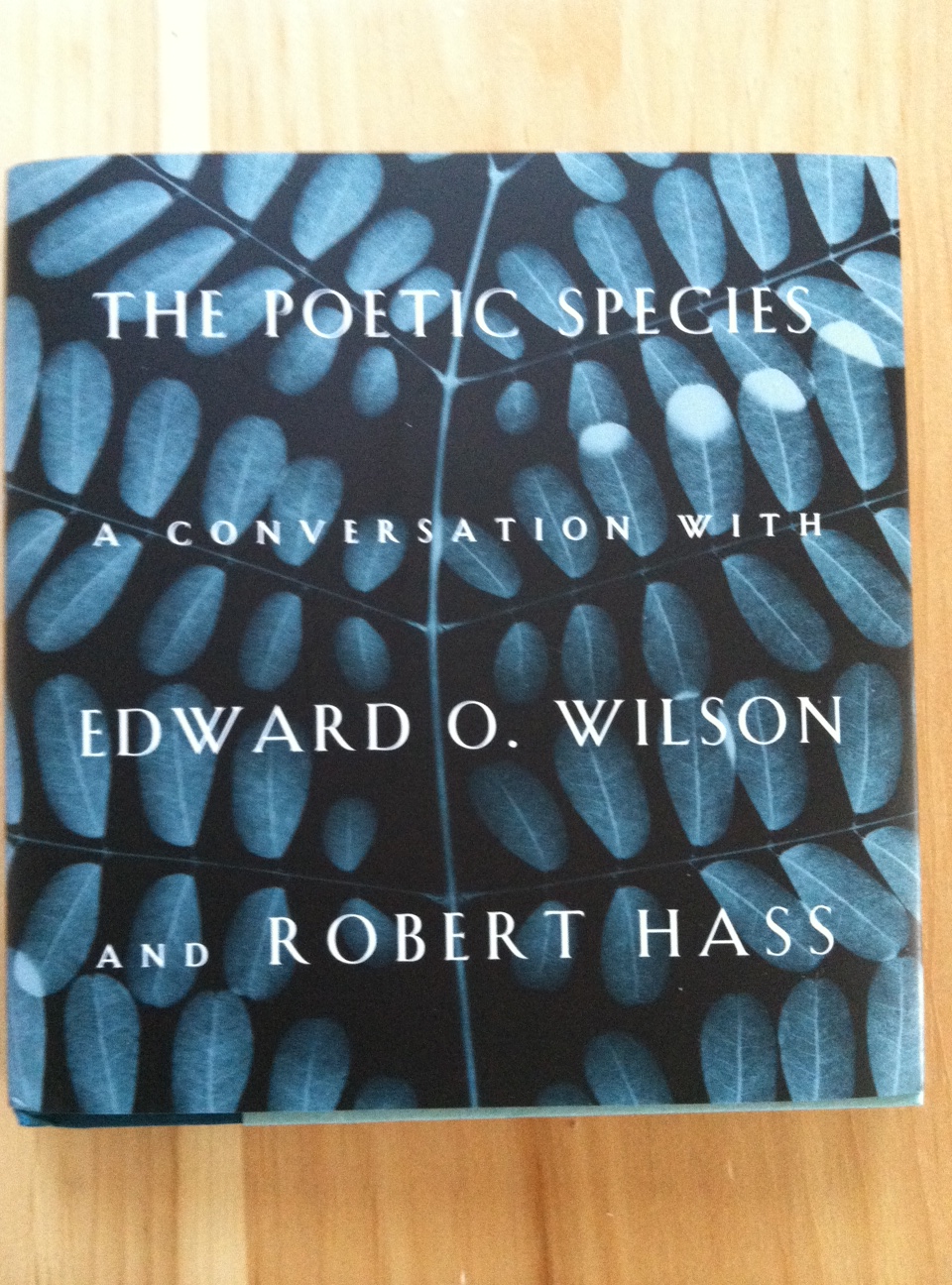
Recommended Reading: The Poetic Species: A Conversation with Edward O. Wilson and Robert Hass

photo (69)This slim volume — beautifully designed, by the way — is the record of a conversation between two careful thinkers: Edward O. Wilson (better known as E. O. Wilson, perhaps), a biologist famous for his work on ants and his sometimes controversial theories about evolution, and Robert Hass, a highly acclaimed poet, essayist and environmentalist who is a former Poet Laureate.The event — think a long-form TED dialogue — took place in late 2012, was co-sponsored by Poets House and the American Museum of Natural History.

As Lee Briccetti writes in the Foreword to The Poetic Species*, “Poetry is not purely associative. Science is not purely analytic. All skilled human production depends on subtle networks of cognitive capacities and the ability to transition between them” (23). Professor Wilson and Professor Hass came together to talk about the ways that science and the humanities inform each other, and how thinkers in both disciplines might come together to protect the natural world.

The first part of the discussion traces Professor Wilson’s theory of the perpetual conflict embedded in human nature (and yes, the question of “human nature” is, as it’s often maddeningly put in the academy, “vexed”): a tendency toward altruism with regard to members of one’s social group (and concomitant hostility toward outside groups), and the impulse to act selfishly at the individual level. Professor Hass notes, “the dance of the tension between these two things must constitute something of what we mean by consciousness, by the experience of having choice and free will and moral life. A productive oscillation between a social self and a private, individual self, in each person and in the species” (40-41). He goes on to suggest that this kind of oscillation appears in art, between form and departure from form, between what makes us comfortable and what challenges us and makes us uncomfortable.

Professor Wilson, too, emphasizes the connection between biology and art: “I’ve suggested many times that the humanities, and especially the creative arts, are the natural history of Homo sapiens” (48). In his view, “The creative arts are the sharing of our inner desires and humanity’s struggle. The humanities are our way of understanding and managing the conflict between the two levels that created Homo sapiens” (53). Put another way, in Robert Hass’s words: “At a very simple level, poetry can give us someone to talk to. To read is, in that way, to have your inner life acknowledged by somebody else’s” (78).

(As you can probably tell, I’d love to quote great swaths of the dialogue in this review, but then I’d run the risk of quoting the whole book; every page offers something worth contemplating. I’d love to see more collaborations of this kind in print, and I’d happily read another conversation between E.O. Wilson and Robert Hass. While The Poetic Species takes the initial format of Professor Hass interviewing Professor Wilson about his work, and works from that point, I’d like to read another conversation in which Professor Wilson questions Professor Hass about the natural elements in his poetry (which is deeply rooted in the environment of northern California). Given Professor Wilson’s admission, in his own list of suggested reading, that he does not read literature for its own sake, perhaps this is wishful thinking.)

The last third of The Poetic Speciesis an impassioned plea for conservation of wildernesses, a plea to take the initiative to save places and species that are in danger of disappearing. Wilson says, “I’m spending more and more of the time I have left on national parks” (67). Both men encourage education of young people in both biology and the humanities to promote environmental stewardship; Wilson suggests that education should go beyond facts and terms — “it’s somehow got to be made into a story” (76). Common Core creators, take note.

Reflecting on elegant solutions in math and sciences, Hass says, “Beauty sends out ripples, like a pebble tossed in a pond, and the ripples as they spread seem to evoke among other things a stirring of curiousity. The aesthetic effect of a Vermeer painting is a bit like that. Some paradox of stillness and motion. Desire appeased and awakened” (79). That’s how science and poetry work — we solve one problem, come to one possible solution, and another question presents itself — like endless webs that spin outward and outward to gather us all in.

The Poetic Species is a fascinating foray into the ways we’re connected to each other and the natural world — highly recommended reading.

*My thanks to the publisher for sending me an advance review copy of this book in exchange for an honest review.

Recommended Reading: Michelle Huneven’s Off Course

photo (68)Cressida Hartley, a graduate student in economics and a casual artist, has retreated to her parents’ A-frame in California’s Sierras to finish her dissertation, a venture that she hopes will take a few months. Instead, it’s years before she comes down off the mountain, years in which she veers both slightly and wildly off course from the life she had planned.

Michelle Huneven’s fourth novel, Off Course* is a delicate character study, one that is deeply rooted in setting. Like her Shakespearean namesake, Cress is at times difficult to like, but always believable, always human — flawed and interesting. Her dissertation languishes while Cress is willingly seduced by the jolly (and non-monogamous) owner of the local lodge, a gathering place for the mountain’s residents and visitors. This affair, quick to to start and quick to finish, would have necessitated only a minor course correction on Cress’s part — but then she meets an intriguing — and married — carpenter.

This is the sort of affair that serves as the backstory or the amusing antics of the best friend/sidekick in romantic comedies, but Ms. Huneven spins the relationship into a masterpiece of characterization. What seems incomprehensible — why an intelligent, feminist, career-oriented woman would spend years of her life on a man who’s often emotionally unavailable and always married — is made comprehensible by the way the novel tracks Cress’s decisions and delays, the disturbances in her understanding of herself. Though she’s an economist, Cress neglects the cost-benefit analysis that could save her grief; and yet, how does one put a price on love?

What I loved most about this novel was Ms. Huneven’s attentiveness to the setting. The land, the sky, the weather, the animals of the Sierras — all seem to seduce Cressida just as much as the men who live on the mountain. If she were a professional artist, she thinks, she would have wanted to work in landscapes. The double edge of the landscape’s isolation and consolation slices through Off Course, exposing not only the tradeoffs Cress makes, but our own concessions to love.

Tomorrow: An Interview with Michelle Huneven, Author of Off Course

*My thanks to the publisher for sending me an advance copy of this novel in exchange for an honest review.

Introducing: The Poetry Concierge

Dear Readers,

Was the last time you read poetry sometime during a high school English class? Do you want to love poetry, but don’t know where to start? Are you slightly embarrassed that you can’t remember the last time you bought a book of poems?

Friends, I’m here to help. I’m your new poetry concierge! (Should I trademark that?)

Yes, this April — and for the rest of the life of this blog, I hope — I’ll be available to lead you to the sweet springs of verse, where you may sip or swill to your heart’s content.

Here’s how to help your new Poetry Concierge help you:

Send me an email [rosemaryandreadingglasses (at) gmail (dot) com] with your name as you’d like it to appear, a link to your blog if you’d like, and answers (as specific as possible) to the following questions:

1. When you read fiction, who’s your go-to author?

2. If you read nonfiction, which subjects are most likely to interest you? (cultural history, science, biography, memoir, survival stories?)

3. If you were stuck on a desert island for a week, which five books would you bring to keep you entertained?

4. If you were on a five-year mission to Mars, which five books would you bring to keep you sane?

5. What kinds of questions are most likely to keep you up at night? (death, the nature of love, politics, environmental issues, meaning of life, end of the world, justice and injustice, etc?)

6. If you’ve read poetry before, what have you liked? What have you disliked?

7. Would you like your name and/or blog to be published on Rosemary and Reading Glasses along with your recommendation?

I’ll read your answers and come up with a poet, a poem, or even a book for you to try out (maybe even more than one!).

Within a week or two (if you haven’t heard from me by then, comment on ye olde blog) I’ll publish your answers to the questionnaire, and my recommendation, on Rosemary and Reading Glasses (with your name removed, if you so choose). If you want to report back on what you think of my choice, all the better!

[UPDATE: The volume of responses is more than I expected — hooray! — so it’s possible your recommendation may be delayed beyond two weeks. If you have a poetry emergency, though (proposal, wedding, retirement, etc), please be sure to tell me!]

Poetry Concierge posts won’t appear on any set schedule, but I’d love to make a few recommendations soon, in honor of National Poetry Month, so bring on those questionnaires!

Yours in verse,
Carolyn the Poetry Concierge

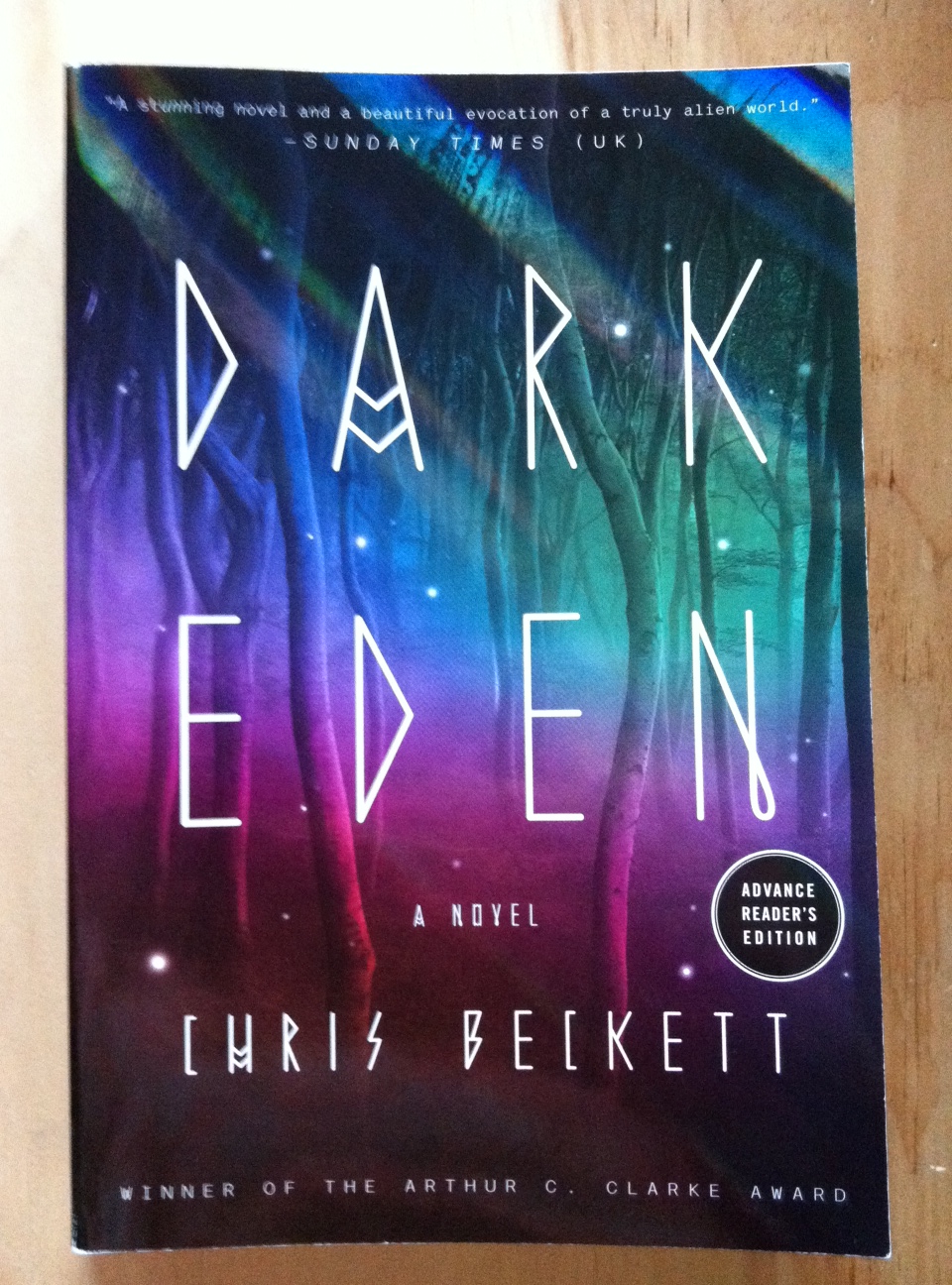
New and Recommended Reading: Chris Beckett’s Dark Eden

Anthropology meets sci-fi meets adventure meets myth-making meets bildungsroman meets philosophy in Chris Beckett’s remarkable new novel, Dark Eden*.

photo (65)On a planet without a visible sun, the Family lives in the glow of phosphorescent trees, waiting to be rescued by the people of their ancestors. Time is measured in terms of “wakings” and “womb-times”; Siren-like singing panthers kill in the forest, and giant worms lurk in the glowing trees. Eden is a frightening place even before the Family’s internal problems are taken into account. Years of inbreeding have produced genetic abnormalities in the small population; their vocabulary is dwindling; their oral tradition and laws and methods of keeping the peace are all strained to the point of breaking. Even food is becoming scarce.

The 532 inhabitants of Eden hear legends of a world where “lecky-tricity” made things move, where there was a sun in the sky, where people could make ships that left the world itself. And soon, the stories tell them, a “Landing Veekle” will take them back to that world.

But young John Redlantern isn’t content to wait. A cross between Prometheus and Cain, John wants to explore beyond the Family’s living area and hunting grounds, to remake Eden as a permanent home for the Family. He wants to do the unthinkable: traverse Snowy Dark, where the cold can kill and the darkness is absolute. It’s dangerous, and worse, it’s heretical. What will happen to the Family if their most closely-held beliefs are challenged?

Dark Eden‘s world-building is excellent, and refreshing, since it’s neither Star-Trekkian (gadgets and gizmos and talking computers) nor Hunger Games-style dystopian (our own world in a terrible mess). Don’t get me wrong — I love Star Trek and The Hunger Games. But it’s wonderful to read something fresh, that answers a question I wish I’d thought to ask: what would a primitive culture look like if it evolved on an alien planet from a tiny population with prior experience of technology and advanced culture?

It turns out that the intentions of the initial population matter a great deal; the Family’s founders attempted to give their children a good chance at long-term survival, insisting, for instance, that children go to school, that histories be preserved, that women and men are equal. As I mentioned above, the gender politics in the novel are fascinating; the Family doesn’t quite have a matriarchal power structure, but paternity isn’t tracked and sexual violence is unheard of in Eden.

One of Dark Eden’s best aspects is the author’s attention to linguistic detail. Over generations, vocabulary changes and some kinds of speech atrophy (oh, my poor subjunctive!). So, for example, in the Family’s oral/aural culture, some pronunciations are off (“lecky-trickety”), and intensifiers like “very” have been lost. To convey that something is “very cold,” John Redlantern or Tina Spiketree would say, “cold cold.” On the other hand, English slang (“bloke”) and personal euphemisms (“slipping” for “sex”) remain, perfectly out of place in an alien world.

Dark Eden‘s story is John Redlantern’s, in many respects, but he is not the sole narrator. Mr. Beckett chooses his other narrators carefully to give a rounded perspective on the world and John’s actions. Given the limited vocabulary all the narrators work with, the resulting polyphony is all the more impressive. This is literary sci-fi at its best, and highly recommended reading.

Tomorrow: An interview with Chris Beckett, author of Dark Eden

*My thanks to the publisher for sending me advance copy of this novel in exchange for an honest review.

What Larks!: Dickens Re-evaluated

My fourteen-year-old self is going to think I’m Madame DeFarge. And not just because I learned how to knit a few years ago. No, it’s more the face-of-evil-betrayal thing.

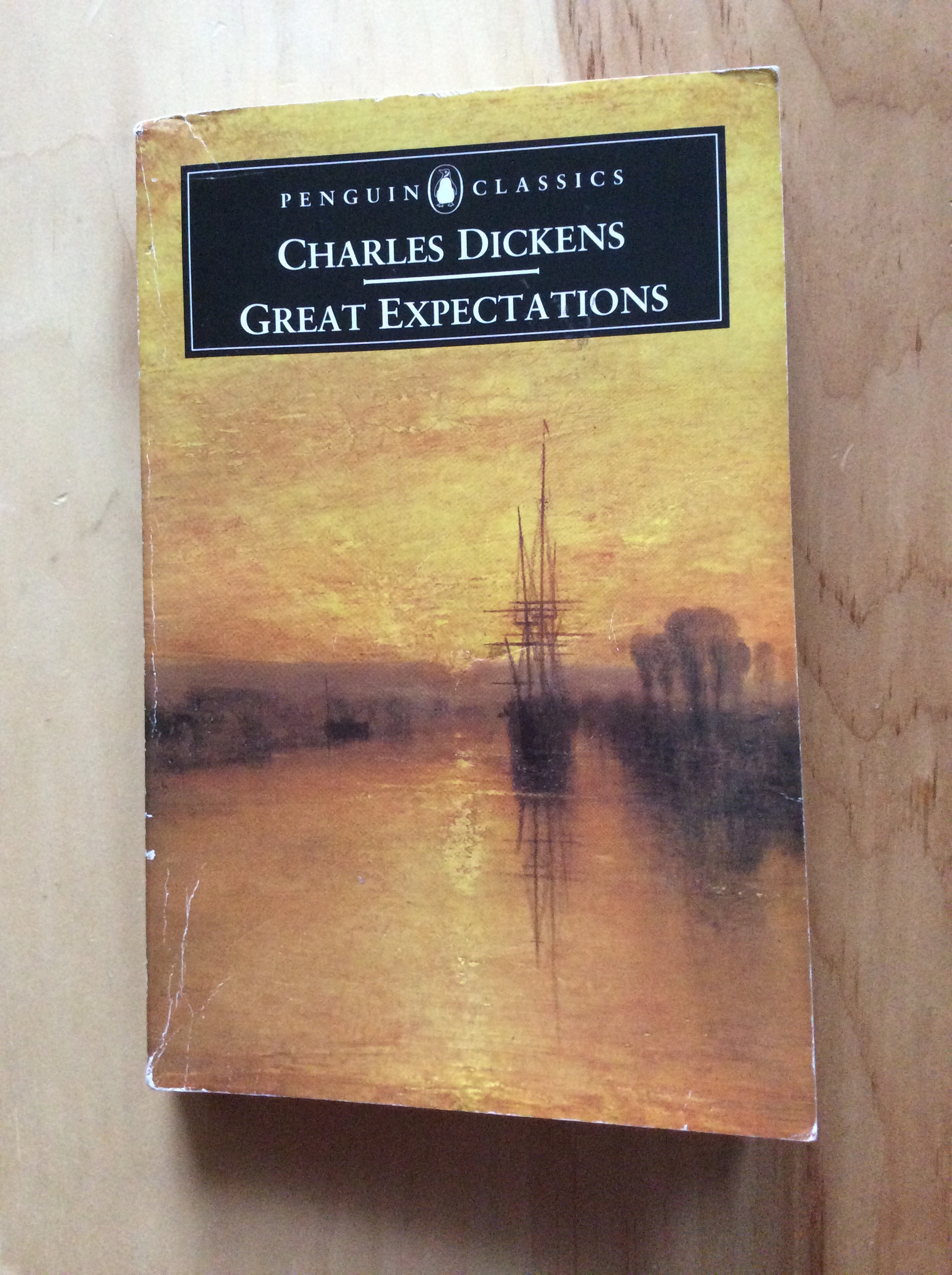
I liked Great Expectations.

Horror of horrors: it appears that Mr. Dickens and I have come to an understanding.

I last read Great Expectations in the ninth grade — fifteen years ago, give or take. The following photo (64)year brought A Tale of Two Cities, which I will never read again thanks to truly irritating Lucie Mannette and her golden thread, and then I had a long break from Dickens until Hard Times popped up in a graduate seminar six or seven years ago, a break punctuated only by sporadic forays into David Copperfield.
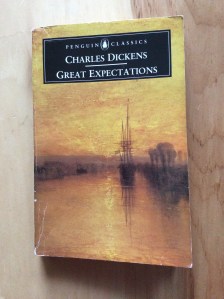
Before this reading of Great Expectations, my major Dickensian complaints consisted of: Dickens’s long-windedness, his lack of subtlety, the tidy way that characters prove related to one another. Seriously. It felt like reading a nineteenth-century version of Crash sometimes.

Honestly, I put Great Expectations on my Classics Club list not from any noble intention to re-evaluate my own notoriously long-lived literary grudges (see: Steinbeck, Faulkner), but because at the time I thought I might like to read Havisham (still haven’t gotten around to it), and I like to read literary reimaginings with the original text firmly in mind. (Why I wanted to read Havisham is a story for another post.) When I decided was peer pressured into participating into the Classics Club Spin selection, I popped Great Expectations onto the spin list in position number 20, dead last, never thinking for a moment that it would really be picked.

I suppose I’ll be taking 5% chances more seriously from now on.


Great Expectations is Dickens’s penultimate completed novel, and though my edition clocks in at 484 pages (excluding notes and introduction), it’s one of the shortest of Dickens’s novels (which may halfway explain my change of heart). Unrequited love, the pursuit of wealth and status, the plight of the poor, and the nature of guilt are themes traced through the novel.

On the bleak marshes of Kent, Pip, a young orphan, has no expectations at all when the novel begins, except perhaps a slap upside the head from his sister, or a kind word from her blacksmith husband, Joe Gargery (the pair are raising him). A chance encounter with a runaway convict causes Pip no end of fright and guilt, until those emotions are eventually crowded out by his love for and anxiety over Estella, the cold and contemptuous ward of the ghastly Ms. Havisham. Notified one day that a mysterious benefactor wishes Pip to become a gentleman, Pip leaves his home, Joe, and Estella behind, setting out for London and the issuance of his “great expectations.” Once there, however, the new wealth that confers upon Pip the status of gentleman also separates him from the people he loves, and, often, the best parts of himself. Great Expectations is largely concerned with the forces, both internal and external, that shape Pip’s character.

The novel’s narration is an older (and perhaps wiser) Pip, who looks on his childhood self’s foibles and his adolescent self’s willful errors with an uncompromisingly honest eye. His narration is wry, emotional, often funny. Pip meets a typical cast of Dickensian characters on his road: Jagger, the unscrupulous, clever, perpetually hand-washing lawyer; Joe, the gentle blacksmith, unfailingly tender-hearted, too convinced of his own unworthiness to correct Pip’s faults; Mr. Wopsle, the ridiculous cleric-turned-actor; Miss Havisham, withering and decaying in her own bitter memories.

And Wemmick, my favorite character in the novel. Wemmick is, I think, Dickens’s embodiment of modernity and practicality. While tender-hearted and thoughtful at home, caring for his deaf father (“The Aged Parent”) and sneaking his arm around proper Miss Skiffins’s waist, Wemmick transforms into an entirely different creature at Jaggers’s office, where he works as a clerk. He remonstrates with clients, ignores their tears, and carries out his duties without any regard to the suffering around him. It’s as if he shuts down his emotions as a form of self-preservation; otherwise, how could he bear what he sees every day? I suspect that this is Dickens’s commentary on the kind of person one must become to survive in — though not change — the modern world.

I know I didn’t appreciate Wemmick fifteen years ago because he came as a total surprise to me. What I also failed to see as a fourteen-year-old was Dickens’s marvelous sense of humor — abundantly evident in caricature studies, if you will, but here particularly in bleak, black humor. The novel’s second paragraph, after Pip explains the origin of his name in the first, is an extended joke. Pip explains how he derived a sense of his parents’ characters and his siblings’ physical attitudes from their tombstones:

As I never saw my father or my mother, and never saw any likeness of either of them (for their days were long before the days of photographs), my first fancies regarding what they were like were unreasonably derived from their tombstones. The shape of the letters on my father’s, gave me an odd idea that he was a square, stout, dark man, with curly black hair. From the character and turn of the inscription, “Also Georgiana Wife of the Above,” I drew a childish conclusion that my mother was freckled and sickly. To five little stone lozenges, each about a foot and a half long, which were arranged in a neat row beside their grave, and were sacred to the memory of five little brothers of mine,—who gave up trying to get a living, exceedingly early in that universal struggle,—I am indebted for a belief I religiously entertained that they had all been born on their backs with their hands in their trousers-pockets, and had never taken them out in this state of existence.

The tragic death of five infant boys transmuted into the image of children born with trousers on, relaxed and jaunty — how strange, how macabre, how childishly innocent!

Take, then, the next paragraph:

Ours was the marsh country, down by the river, within, as the river wound, twenty miles of the sea. My first most vivid and broad impression of the identity of things seems to me to have been gained on a memorable raw afternoon towards evening. At such a time I found out for certain that this bleak place overgrown with nettles was the churchyard; and that Philip Pirrip, late of this parish, and also Georgiana wife of the above, were dead and buried; and that Alexander, Bartholomew, Abraham, Tobias, and Roger, infant children of the aforesaid, were also dead and buried; and that the dark flat wilderness beyond the churchyard, intersected with dikes and mounds and gates, with scattered cattle feeding on it, was the marshes; and that the low leaden line beyond was the river; and that the distant savage lair from which the wind was rushing was the sea; and that the small bundle of shivers growing afraid of it all and beginning to cry, was Pip.

Pip introduces us to his child-self at the moment of self-realization, at the moment when he places himself within the context of his surroundings. And we learn what remains, for most of the novel, Pip’s defining characteristic: fearfulness. As a child, Pip fears his sister and her abuse, fears for his own safety once he’s met the convict, fears Estella’s coldness, fears becoming trapped in his provincial town with a respectable profession. Later he fears what people will think of him if acts a certain way; he even fears the boy he hires to be his valet. And of course he fears losing Estella, and fears that his convict will not forget him.

Though Pip-the-narrator never excuses his own (sometimes deplorable) behavior, in the background Dickens always seems to be saying, “consider the circumstances!”; take, for example, the paragraph I have just cited. Dickens emphasizes that Pip’s parents and brothers are dead; the churchyard overgrown with nettles suggests that the church (or religion) will be of little help to Pip (and indeed religion plays little role in the story); and the bleakness of the physical environment suggests that even nature will not be a comfort to Pip. Great Expectations provoked more marginalia for me than any other book this year — just look at the layering of adjectives that describe Pip’s surroundings: raw, bleak, overgrown, dark, flat, low, leaden, distant, savage. A fearsome environment for a “small bundle of shivers.”

Here’s part of Dickens’s description of the convict: “A man who had been soaked in water, and smothered in mud, and lamed by stones, and cut by flints, and stung by nettles, and torn by briars.” Textbook “good” writing — all action verbs — but the convict is the object of the actions; all these things have happened to him. What wonder then that he wants to become a man of action, to make things happen himself? What wonder then that he acts savagely to instill fear in a mere child?

(The characters for whom Dickens reserves real contempt are those who lack circumstances dire enough to mitigate their behavior: the second convict, Pip’s sister, the pompous bully Pumblechook, Herbert’s non-maternal mother.)

I’ve rambled on and only covered the first two pages of the novel — as you might imagine, the rest provoked plenty of commentary in the margins. I couldn’t help but think, as I read, that I must be missing things that would be obvious to people who specialize in Victorian literature (hi, Joanna!), people I’ve regarded with incredulity for years because they make a regular habit of reading Dickens. I’m sorry that it’s taken me so long to remake Wemmick’s acquaintance, and Joe Gargery’s, and I plan on reading Great Expectations again.

But don’t count on me reading Tale of Two Cities anytime soon.


A final aside, Dear Readers, for those who’ve read Milton and those who are considering the plunge: here are the last lines of Volume I, as Pip is about to embark upon his “great expectations”:

We changed again, and yet again, and it was now too late and too far to go back, and I went on. And the mists had all solemnly risen now, and the world lay spread before me.

Compare these passages, from Paradise Lost, Book XII:

from the other hill
To their fixed station all in bright array
The cherubim descended, on the ground
Gliding meteorous as evening mist
Ris’n from a river o’er the marish glides
And gathers ground fast at the laborer’s heel
Homeward returning.

and

The world was all before them, where to choose
Their place of rest, and Providence their guide.
They hand in hand with wand’ring steps and slow
Through Eden took their solitary way

See what Dickens did there? Pip may be off to find his great expectations, but Paradise is behind him. And then, we must ask, what kind of paradise was it?

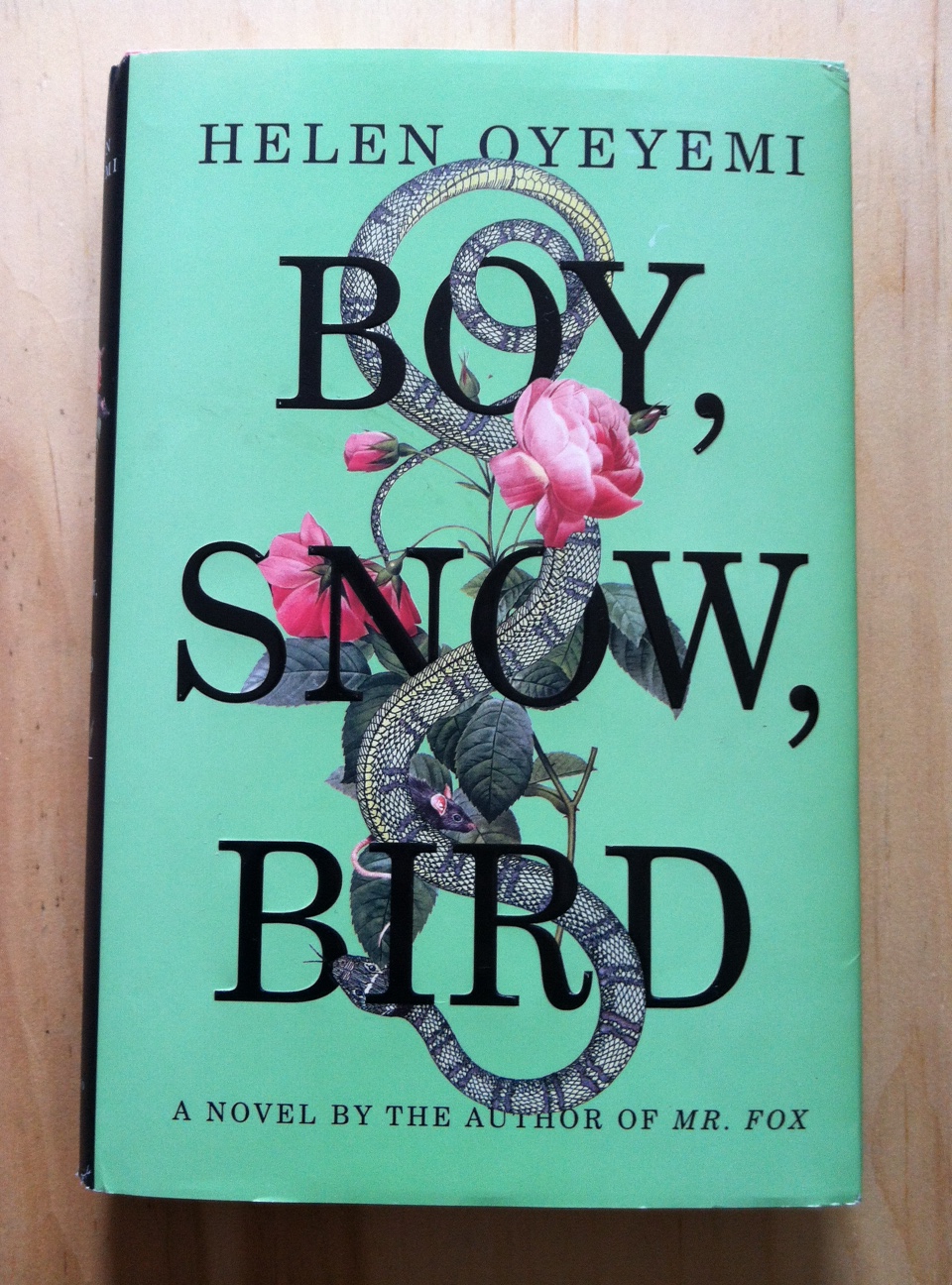
An Interview with Helen Oyeyemi, Author of Boy, Snow, Bird

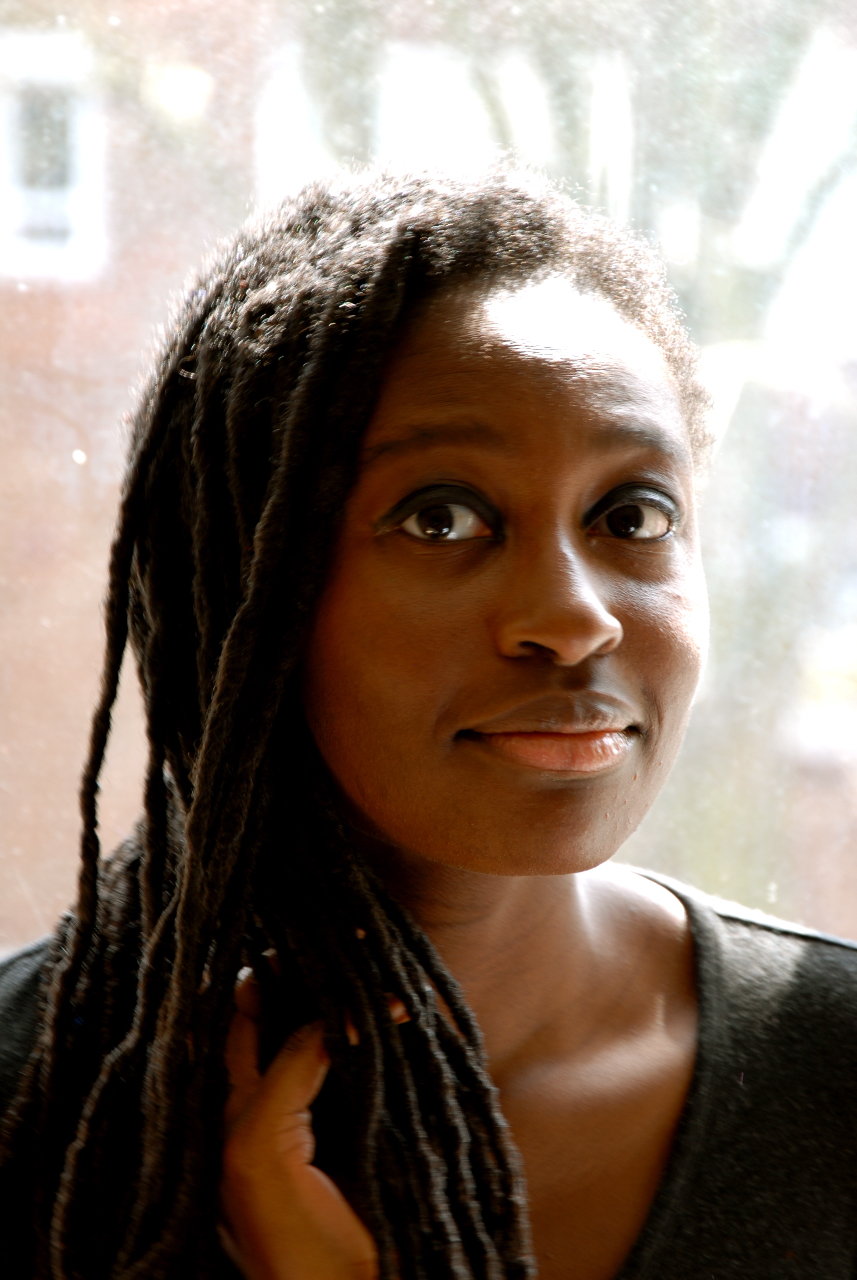
Yesterday I reviewed Helen Oyeyemi’s marvelous (in every sense of the word) new novel, Boy, Snow, Bird. Ms. Oyeyemi graciously agreed to be interviewed via email. 

How would you describe the inception of Boy, Snow, Bird? What was the writing process like? 

Helen Oyeyemi  (c) Piotr Cieplak

Helen Oyeyemi
(c) Piotr Cieplak

HO: the idea of writing a wicked stepmother story had been in my mind ever since i’d read Barbara Comyns’ novel, The Juniper Tree, which is a retelling of the fairy tale of the same title from the perspective of the wicked stepmother (poor, poor woman – i mean the wicked stepmother, not Comyns…Comyns’ narrative voice is so wonderfully eldritch, a mix of light and grit in proportions that only she can master.) it took me some time to get into Boy’s voice – perhaps i was worried about the difficulties she was going to have in terms of trying not to do harm when she’d been harmed herself.

Much of the novel takes place in a small town in Massachusetts. Was there a particular reason for this choice? Did you visit the area to get a sense of the landscape, or conduct other kinds of research for the novel?

HO: i have a dear friend who lives in boston; we drove up to worcester after i’d finished writing the book so i could see how completely imaginary the small town near worcester in my book is. massachusetts is linked to emily dickinson and louisa may alcott in my mind, so i think of it as a place where my kind of woman can flourish: a good place to send Boy to, i think.

photo (63)Boy, Snow, Bird is in part an adaptation of the Snow White fairy tale. Did other contemporary retellings of folktales and fairy stories inform your writing? 

HO: Anne Sexton’s take on Snow White, in her collection, Transformations, affected the way that i read snow white – that image at the end of the poem, the wicked queen dancing herself to death in red hot shoes. for me Anne Sexton’s retelling exposes a notion that’s woven into the story: where there are two beautiful women, one must pay a price – a price for both women’s beauty, perhaps. most of the characters in my own retelling are wise to this notion, and don’t accept it.

Boy, Snow, Bird confronts — always with grace — difficult issues of race, gender, family, and aesthetics. What’s one question you hope readers ask as they come away from the novel?

HO: i hope a reader leaves the story wondering how to get better at seeing other people, or at least seeing through our own halls of mirrors.

 As readers may know, you’re a prolific writer, with five novels and two plays to your credit already. What’s next on your writing horizon?

HO: o dear…your guess is as good as mine. but i’m looking forward to it, whatever it is.

My thanks again to Ms. Oyeyemi for her time and her thoughtful answers.

Recommended Reading: Helen Oyeyemi’s Marvelous Boy, Snow, Bird

photo (63)Helen Oyeyemi’s Boy, Snow, Bird* deserves all the attention it’s attracting; it’s a beautiful, lyrical novel, thrumming with life and grappling with difficult issues of love, aesthetics, race, trauma, and identity.

Boy Novak flees both home (New York City) and her abusive father for life in small-town Massachusetts. Drifting from job to job, and occasionally frightened by her own strangeness (“It wasn’t that I didn’t want to speak; it just seemed smarter not to. All of a sudden it felt as if I had far too many teeth, more teeth than it was decent to show” [45.]), Boy eventually settles down with a former professor (now jeweler) Arturo Whitman and his beautiful, enchanting daughter, Snow. However, when Boy’s daughter, Bird, is born, a secret is revealed that leads Boy to send Snow away when “Snow’s daintiness grew day by day, to menacing proportions” (142). Boy becomes a wicked stepmother in absentia.

Time passes, however, and Snow and Bird prove themselves determined to reunite, to find out the whole truth (Bird is a budding journalist) — because there’s another woman missing from their story.

I loved Boy, Snow, Bird. The characters’ voices are distinct, witty, and smart, and the reworking of the Snow White fairytale surprised me at nearly every turn. While it deploys the same tactic that makes C.S. Lewis’s Til We Have Faces so brutally brilliant — that is, telling an established myth from the point of view of the “evil” character — Boy, Snow, Bird is even more expertly layered. The veneer of magic both conceals and reveals our own preoccupations with perception and the practice of looking.

Reviewers and readers have, justifiably, focused on the novel’s engagement with race (Ron Charles in the Washington Post has a particularly good paragraph about it, which you can read here). I’d also like to point out that the novel consistently reminds us of what it’s like to be a woman, and therefore constantly looked at (by others and by yourself). One of Boy’s teenage friends from the bookstore where Boy works, a girl named Sidonie, is catcalled every day on her way home from school (disturbingly, street harassment hasn’t changed much from the book’s 1953 setting); one of the ways that Snow is initially marked as “young for her age” is that “she hadn’t yet learned to smile even when she didn’t feel like it” (71). She hasn’t learned, in other words, the right face to show the world that’s looking at her.

And then there’s the lead up to a terrifying episode of abuse that Boy’s father, a rat catcher, perpetrates. Two weeks before her escape, Boy walks home with her boyfriend of sorts. Boy’s father greets them at the door: “‘I’ve seen the way you look at my daughter. You think she’s pretty, don’t you?'” Then:

They both turned to me and went on a looking spree. I left them to it and wished I could sail over their heads and into the acid blue sky. They didn’t look for long, it was more a practiced series of glances; they knew what they were looking for and seemed to find it. It was a wonder there was anything left by the time they were through looking. (120)

After the rat catcher (as Boy thinks of him) threatens to mar Boy’s beauty, to scar her badly enough that only a “true love” could accept her, Boy comes to the conclusion that “no matter what anybody else said or did my father saw something revolting in me, and sooner or later he meant to make everyone else agree with him” (123). Is it any wonder that Boy fears the face that looks back at her from the mirror, the face that sometimes isn’t hers?

It’s in articulating the tension between the fear of beauty and the craving for it that Ms. Oyeyemi truly shines.

Tomorrow: An interview with Helen Oyeyemi, author of Boy, Snow, Bird

*My thanks to the Riverhead Books for sending me a copy of this novel in exchange for an honest review.


“with one hand under our head / and with the other in a mound of planets”: Zbigniew Herbert’s “I Would Like to Describe”

This weekend I finished reading Diane Ackerman’s book The Zookeeper’s Wife,  which I’ll be reviewing for the Literary Wives group on April 7 (it’s a quick read, so there’s still plenty of time to hop aboard if you’d like to join the discussion). The book is full of interesting facts; for example, during World War II, the Polish underground movement managed to keep students in high school and college (which had been outlawed for Poles by Nazi decree) — and even grant degrees — through a system of “floating” classrooms.

One of those students was Zbigniew Herbert, who went on to become one of Poland’s most famous post-war poets. For many years he refused to submit his work to state-sanctioned venues, and was throughout his adult life an opponent of communism and censorship.  His work has been translated by, among others, Czeslaw Milosz.

His poem “I would like to describe” expands on the poet’s frustration at his own inability to summon just the right word or words to describe emotion. While bemoaning the inadequacies of metaphor, the speaker nonetheless conjures up some beautiful examples. “I would like to describe courage / without dragging behind me a dusty lion” (l. 12-13) is one of my favorites.

I confess that I didn’t know much about Herbert before I researched this week’s post, but now I’m going to go off and get my hands on a copy of his selected poems.

Who’s a poet you’d like to learn more about?