. . . which you can read here, Dear Readers. It’s an informal spring break this week on the blog, and I hope you are all enjoying, in the words of one Margaret Dashwood, “very fine weather.”
Poetry
“‘What do you hate, / and who do you love?'”: Taha Muhammad Ali’s “Meeting at an Airport”
Since it’s National Poetry Month, I’ll once again recommend The Poetry Foundation’s app (conveniently called Poetry) if you’re looking for a little more poetry in your life (and who isn’t?). It’s perfect for a little pick-me-up when you’re feeling stressed, or when you’re waiting for the bus and realize you’ve forgotten your book (horror!), or when you’re a book blogger looking for a poem to recommend.
Speaking of which . . .
I just read “Meeting at an Aiport,” by the late Palestinian poet Taha Muhammad Ali. It’s just lovely, joyous and sad all at once, and a perfect example of what a gifted poet can do with simple repetition.
So, which new poets and poems have you discovered lately?
“And early though the laurel grows / It withers quicker than the rose.”
To an Athlete Dying Young
A. E. Housman
The time you won your town the race
We chaired you through the market-place;
Man and boy stood cheering by,
And home we brought you shoulder-high.
Today, the road all runners come,
Shoulder-high we bring you home,
And set you at your threshold down,
Townsman of a stiller town.
Smart lad, to slip betimes away
From fields where glory does not stay,
And early though the laurel grows
It withers quicker than the rose.
Eyes the shady night has shut
Cannot see the record cut,
And silence sounds no worse than cheers
After earth has stopped the ears.
Now you will not swell the rout
Of lads that wore their honours out,
Runners whom renown outran
And the name died before the man.
So set, before its echoes fade,
The fleet foot on the sill of shade,
And hold to the low lintel up
The still-defended challenge-cup.
And round that early-laurelled head
Will flock to gaze the strengthless dead,
And find unwithered on its curls
The garland briefer than a girl’s.
(Rest in peace, EVC.)
Happy National Poetry Month! Have Some Hopkins.
 It’s National Poetry Month! Are you celebrating with sonnets or pantoums? Sestinas or epigrams? Odes or rondels? Do tell.
It came to my attention, because I was thinking about dinosaurs and dragons (tip of the hat to parenthood there), that I’ve never featured Gerard Manley Hopkins, who wrote one of my favorite alliterations of all time: “dragonish damask.”
Weep no more, Dear Readers. This shocking oversight is remedied below with “Spelt from Sibyl’s Leaves.”
Earnest, earthless, equal, attuneable, ‘ vaulty, voluminous, … stupendous
Evening strains to be tíme’s vást, ‘ womb-of-all, home-of-all, hearse-of-all night.
Her fond yellow hornlight wound to the west, ‘ her wild hollow hoarlight hung to the height
Waste; her earliest stars, earl-stars, ‘ stárs principal, overbend us,
Fíre-féaturing heaven. For earth ‘ her being has unbound, her dapple is at an end, as-
tray or aswarm, all throughther, in throngs; ‘ self ín self steedèd and páshed—qúite
Disremembering, dísmémbering ‘ áll now. Heart, you round me right
With: Óur évening is over us; óur night ‘ whélms, whélms, ánd will end us.
Only the beak-leaved boughs dragonish ‘ damask the tool-smooth bleak light; black,
Ever so black on it. Óur tale, O óur oracle! ‘ Lét life, wáned, ah lét life wind
Off hér once skéined stained véined variety ‘ upon, áll on twó spools; párt, pen, páck
Now her áll in twó flocks, twó folds—black, white; ‘ right, wrong; reckon but, reck but, mind
But thése two; wáre of a wórld where bút these ‘ twó tell, each off the óther; of a rack
Where, selfwrung, selfstrung, sheathe- and shelterless, ‘ thóughts agaínst thoughts ín groans grínd.
You can hear poet Mary Jo Bang talk about this poem and read it here. I also recommend reading it aloud yourself. It has an oddly salubrious effect.
On Julia Wendell’s Take This Spoon
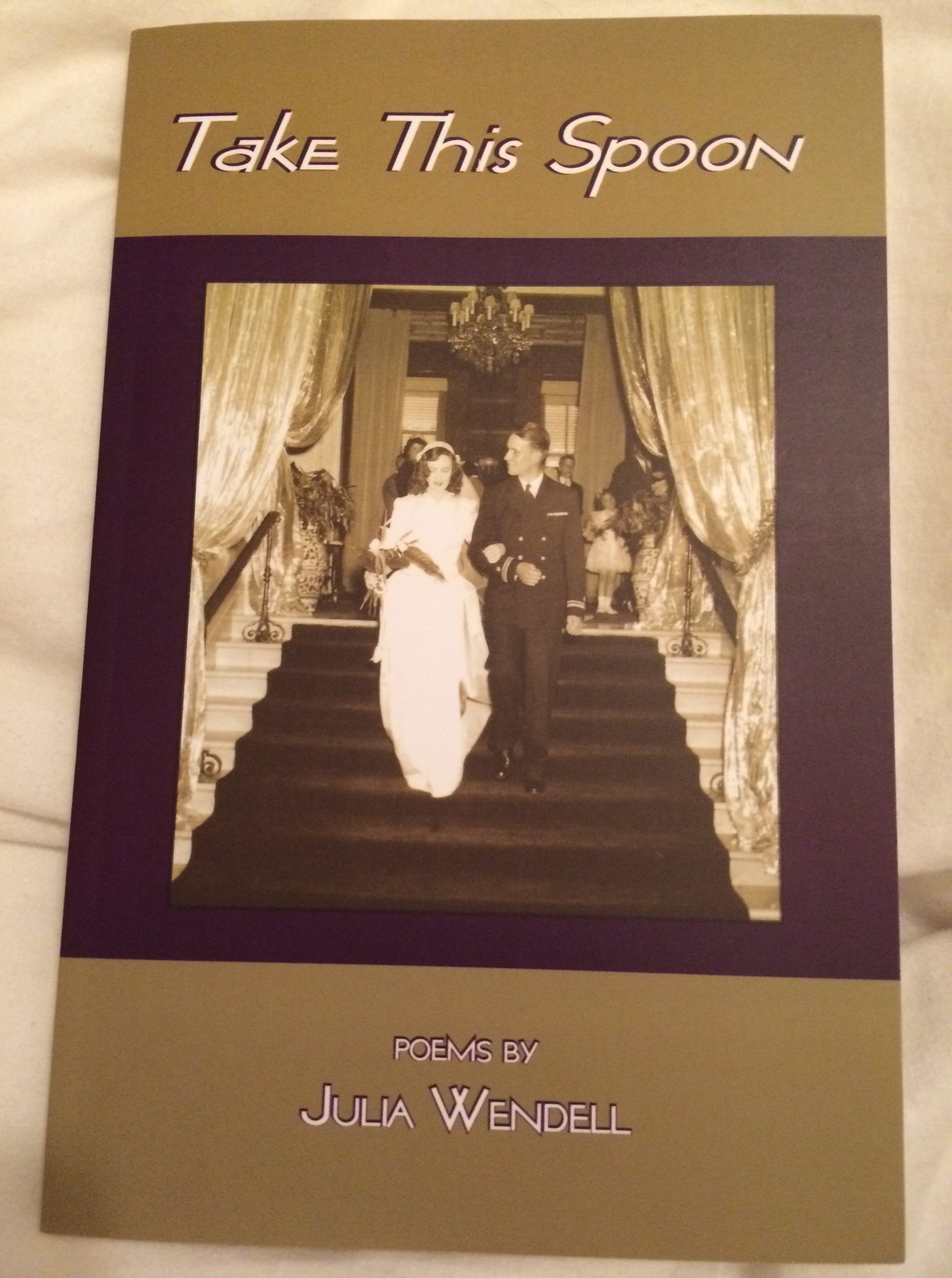 Julia Wendell’s Take This Spoon* is a deeply personal and strikingly accessible collection of poems that brings together the poet’s memories of food and family, heartbreak and health.
Ms. Wendell opens each section of the book with a family recipe (which, I have to say, made me long for my pre-paleo days) for something delectable and luxuriously rich (cheese soufflé, peanut butter pie, an intensely garlicky salad that I want right now). The poems pick up on these recipes, investigating the place of food in domestic life and in the poet’s personal history, which includes struggles with both anorexia and addiction. These challenges are at the heart of the collection, as the poet confronts her relationship with her mother and how it affects her responses to her own children.
Ms. Wendell’s informal and comfortable style is disarming; these are poems you can imagine as conversations in the poet’s kitchen. Her descriptive language is evocative, not only of culinary exploits, but of the experiences of childhood and parenthood, and the gap between the two.
For a taste of Take This Spoon, you can visit Ms. Wendell’s website to read “Cream of Tartar.”
*I received a copy of this book from the author for review consideration, which did not affect the content of my review.
“a narrow plot of sand”: Natasha Trethewey’s “History Lesson” from Domestic Work
 Domestic Work is the first collection of poems by Natasha Trethewey, Poet Laureate of the United Sates from 2012 to 2014 and winner of the Pulitzer Prize. The collection won the inaugural Cave Canem Prize (an annual prize for the best first collection of poems by an African American poet), selected by Rita Dove. In both free verse and gorgeous formal poetry, these poems tell the stories of working-class African American people, focusing on men and women in the South in the twentieth century.
In her introduction to the book, Rita Dove writes, “With a steely grace reminiscent of those eight washerwomen [in the poem “Three Photographs”], she tells the hard facts of lives pursued on the margins, lived out under oppression and in scripted oblivion, with fear and a tremulous hope” (xi-xii).
It’s the tremulous hope that shines brightest in Domestic Work, but it’s a hope that flutters on the edges of a terrible past and an uncertain present. Take, for instance, “History Lesson.” At first, Trethewey describes a picture of herself as a small girl in a flowered bikini, toes curling in the sand “on a wide strip of Mississippi beach,” painting in vivid words the sense of the photo, and the bright sun of the day.
Then, at precisely the poem’s midpoint, the turn: “I am alone / except for my grandmother, other side.”
Now the focus shifts to the “history lesson” of the poem’s title, as Trethewey takes us back in time in two jumps. We learn that the poet’s grandmother is taking the picture in 1970—just “two years after they opened / the rest of this beach to us,” a chilling reminder of the cruelties of Jim Crow South; who could deny the pleasures of this beach, with its sun and its minnows, to a child?
And then the end of the poem completes the structure Trethewey has set up: it’s forty years since her grandmother (to whom the second half of the poem belongs)
stood on a narrow plot
of sand marked colored, smiling,
her hands on the flowered hips
of a cotton meal-sack dress.
The “meal-sack dress” on is the visual counterpoint to the bikini Trethewey’s child-self wears, which seems like symbol of progress (out of poverty, and with only the beach behind it, not the dreadful sign). But then we remember that the picture of the poet is only two years past the end of the beach’s segregation, and progress—from “narrow plot” to “wide strip”—seems a fragile, fragile thing.
Recommended Reading: “The Kingfisher” and The Kingfisher, by Amy Clampitt
I picked up Amy Clampitt’s The Kingfisher at a used bookstore in Central Square sometime in January. It’s a gorgeous book in more ways than one; originally published in 1983, my copy is from the eighth printing in 1989, and it’s pristine. Heavy, unyellowed paper, gorgeous design. Well done, Knopf.
I came to the book knowing nothing about Amy Clampitt, but it was an utterly delectable reading experience; Clampitt’s facility with aural language reminded me of the fun I had reading Hailey Leithauser’s Swoop last year. (More on the language in a moment.)
As I read, I couldn’t believe I hadn’t heard more about this wonderful poet, and once I did a bit of research, I started to see why: born in 1920, Amy Clampitt died in 1994. The Kingfisher was her first major book, and remains her most famous.
My favorite poems in the book are those that appear first, largely set along the rocky Maine coastline (of which I am quite fond), but all six of the book’s wide-ranging sections are spectacular. The poems are erudite without being condescending (the poet provides notes after the text), controlled but bursting with language’s multitudinous possibilities. In these pages whales are “basking reservoirs of fuel” (116) and a poem about the Dakota hotel finds the speaker telling us “Grief / is original, but it / repeats itself: there’s nothing / more original it can do.”
Here are some lines from “The Cove”:
Where at low tide the rocks, like the
back of an old sheepdog or spaniel, are
rugg’d with wet seaweed, the cove
embays a pavement of ocean, at times
wrinkling like tinfoil, at others
all isinglass flakes, or sun-pounded
gritty glitter of mica; or hanging
intact, a curtain wall just frescoed
indigo, so immense a hue, a blue
of such majesty it can’t be looked at,
at whose apex there pulses, even
in daylight, a lighthouse, lightpierced
like a needle’s eye.
Stunning, yes?
The only other writer I’ve come across in the last half decade with Amy Clampitt’s command of English vocabulary is A.S. Byatt (who, by the way, Clampitt mentions in this fascinating interview with the Paris Review, which I highly recommend; unsurprisingly, she had great taste in poetry and fiction—she names Alice Munro as her favorite contemporary fiction writer 20 years before Ms. Munro won the Nobel). If (and I hope when) you pick up The Kingfisher, you’ll want a dictionary close at hand for words like these:
- repoussé
- pannicled
- plissé
- chrysoprase
- grisaille
- bizarrerie
- catalpa
- peplos
- aconite
- sozzled
- gasconades
- traghetto
- curveting
- loess
- clepsydra
- maguey
I could go on. At length.
I was enchanted by The Kingfisher—you can read the title poem here—and I hope you’ll let me know if you read it so we can compare notes, and maybe word lists.
“the beautiful, needful thing”: Robert Hayden’s “Frederick Douglass”
This past weekend marked the fiftieth anniversary of what has come to be known as Bloody Sunday, when peaceful protestors in Selma, Alabama marching for civil rights were brutally attacked by state troopers.
In honor of this anniversary, I suggest reading Robert Hayden’s “Frederick Douglass,” a powerful poem by one the twentieth century’s best American poets. Robert Hayden’s most anthologized poem is probably “Those Winter Sundays” (which I wrote about here). He was Consultant in Poetry to the Library of Congress—or, what is now known as Poet Laureate—the first African American poet to hold the post.
“He makes a world here out of frog songs / and packed earth”: Linda Gregg’s “Hephaestus Alone”
 Like so many others, I was sad to hear of the death of Leonard Nimoy on Friday. From afar, he seemed like a gentle man, thoughtful and interested in giving what he could to the world. He lived long and prospered, and wished the same for the rest of us.
Much as I love Spock, I’ve never been an aficionado of Mr. Nimoy’s poetry, though I did go hunting today for a poem to feature in his honor. I looked for poems about stars and Vulcan and Spock, but nothing stood out in particular until I came across a poem about Hephaestus (Vulcan is the Roman analogue of the Greek god). It occurred to me that while the behavior of most Vulcans on Star Trek is consistently cool and logical, more Apollonian than anything, underlying that rational exterior is a passionate interior, burning like the fire god’s furnaces, as Mr. Nimoy’s Spock demonstrated more than once.
In Linda Gregg’s poem “Hephaestus Alone,” we see the ardent creativity of the hammer-wielding, forge-tanned, lonely god Hephaestus. Crippled in one of his father’s rages, deserted by his wife, the god labors apart from his fellows, producing works of beauty and mechanical intricacy. Or so it goes in the myths. In this poem, undergirded by that history, we see Hephaestus producing images of the very gods he sets himself apart from, including Aphrodite:
He made his wife
so she contains the green-fleshed
melons of Lindos, thalo blue of the sea,
and one ripe peach at five in the morning.
He fashioned her by the rules, with love,
made her with rage and disillusion.
It’s an intriguing poem, and one that will remind me now of the creative person who gave us a new kind of Vulcan.
LLAP.
Eat, Drink, and Be Merry: Ben Jonson’s “Inviting a Friend to Supper”
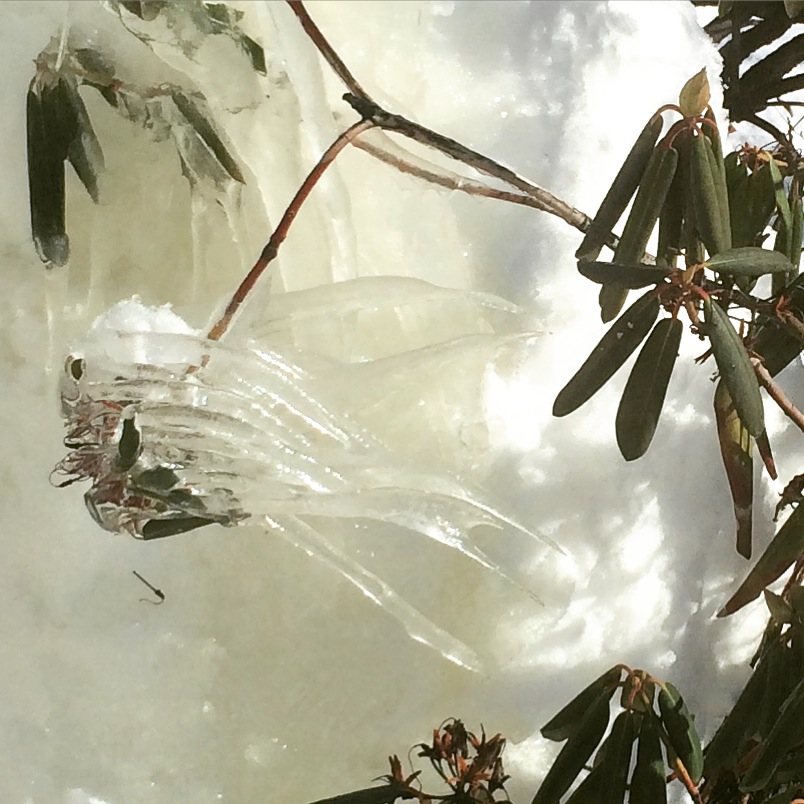
Sideways jellyfish icicle from the front window.
Unpleasant weather continues here in Boston (this weekend delivered the trifecta of snow, rain, and ice), and even hardened and hardy New Englanders agree that the last few weeks have been miserable. We’ve been staying put most weekends, venturing out for groceries and then settling in between bouts of shoveling.
Luckily, friends, like sunshine, have made brief but welcome appearances, and so in honor of friends who come to dinner, this week’s poem is Ben Jonson’s “Inviting a Friend to Supper.”
Jonson addresses his patron, William Herbert, with what I’d call a tone of amused deference. The feast he describes is quite something, even for a man of Jonson’s epicurean appetites: capers, olives, mutton, chicken, larks, other kinds of available fowl, a bit of salad, lemons, and, most importantly,
a pure cup of rich Canary wine,
Which is the Mermaid’s now, but shall be mine;
Of which had Horace, or Anacreon tasted,
Their lives, as so their lines, till now had lasted.
Tobacco, nectar, or the Thespian spring,
Are all but Luther’s beer to this I sing.
Hilarious (the Mermaid was a tavern, by the way). I’d like to try wine that good.
Now, our friendly dinners are never so grand or so well-appointed, and the wine has never been compared the Thespian spring, but the company, I’ll venture to say, is even better than William Herbert’s, and we are more grateful for our friends than Jonson was for Canary wine.
Ben Jonson
Inviting a Friend to Supper
Tonight, grave Sir, both my poor house, and I
Do equally desire your company;
Not that we think us worthy such a guest,
But that your worth will dignify our feast
With those that come, whose grace may make that seem
Something, which else could hope for no esteem.
It is the fair acceptance, Sir, creates
The entertainment perfect, not the cates.
Yet shall you have, to rectify your palate,
An olive, capers, or some better salad
Ushering the mutton; with a short-legged hen,
If we can get her, full of eggs, and then
Lemons, and wine for sauce; to these a cony
Is not to be despaired of, for our money;
And, though fowl, now, be scarce, yet there are clerks,
The sky not falling, think we may have larks.
I’ll tell you of more, and lie, so you will come:
Of partridge, pheasant, woodcock, of which some
May yet be there, and godwit, if we can;
Knat, rail, and ruff too. Howsoe’er, my man
Shall read a piece of Virgil, Tacitus,
Livy, or of some better book to us,
Of which we’ll speak our minds, amidst our meat;
And I’ll profess no verses to repeat.
To this, if ought appear which I not know of,
That will the pastry, not my paper, show of.
Digestive cheese and fruit there sure will be;
But that which most doth take my Muse and me,
Is a pure cup of rich Canary wine,
Which is the Mermaid’s now, but shall be mine;
Of which had Horace, or Anacreon tasted,
Their lives, as so their lines, till now had lasted.
Tobacco, nectar, or the Thespian spring,
Are all but Luther’s beer to this I sing.
Of this we will sup free, but moderately,
And we will have no Pooley, or Parrot by,
Nor shall our cups make any guilty men;
But, at our parting we will be as when
We innocently met. No simple word
That shall be uttered at our mirthful board,
Shall make us sad next morning or affright
The liberty that we’ll enjoy tonight.
 Rosemary and Reading Glasses