“Three people come where no people belong any more”: Hayden Carruth’s “Abandoned Ranch, Big Bend”

Abandoned Ranch, Big Bend

As I’ve mentioned before, I’m a big fan of the Poetry Foundation’s “Poem of the Day” emails. I don’t always love the featured poem, but I do appreciate the chance to sample the work of poets who are (let’s be honest, more often than not) unfamiliar to me. As a certified poetry pusher, I think you should sign up too!

Last week, one of the featured poems was “Abandoned Ranch, Big Bend” by Hayden Carruth, whom—and this is going to sound familiar—I don’t know much about. But now I’m on the hunt for more of his work, because anyone who titles a book of poems Scrambled Eggs and Whiskey is someone I want to know better (also, I’m going to go ahead and recommend to Leslie Knope that she pick that collection up for Ron’s birthday, for reasons I hope are obvious.)

Anyway, the poem drew me in with its intense descriptions (“Sun / on the corrugated roof is a horse treading”) of the scene: a man, woman, and child converge on an abandoned ranch. We don’t know why; “here are only / Dry cistern, adobe flaking, a lizard.” The scene feels timeless, like something out of the nineteenth century, until the introduction of the useless binoculars, which would only reveal the desert “spiral[ing] away.” And then we learn that the three people have been drawn to this place:

Summoned
From half across the world, from snow and rock,
From chaos, they arrived a moment ago, they thought,
In perfect fortuity.

And then it gets really creepy:

There is a presence emerging here in
Sun dance and clicking metal, where the lizard blinks
With eyes whetted for extinction; then swirling
Outward again, outward and upward through the sky’s
White-hot funnel. Again and again among the dry
Wailing voices of displaced Yankee ghosts
This ranch is abandoned to terror and the sublime.

I’m getting shades of Yeats there (am I the only one?), and the tone reminds me of the grim Westerns I’ve loved (like Kim Zupan’s The Ploughmen).

In a poem marked by repeated words like “summoned,” “pulsing,” “sun,” “horse,” “lizard,” the last lines arrive like a trickle of clear water:

They give him
The steady cool mercy of their unreproachful eyes.

For me, “Abandoned Ranch, Big Bend” is tantalizing, like a story with key plot points missing; the fun is filling them in.

What do you think of the poem?

P.S. Here’s the link to Big Bend National Park in Texas. Rory at Fourth Street Review visited the park not too long ago; here’s her post.

Recommended Reading: Jennifer Stewart Miller’s A Fox Appears

A Fox Appears

My friend Emily sent me  A Fox Appears by Jennifer Stewart Miller, and I’m so grateful she did (thanks, Emily!). This is a small gem of a book, “a biography of a boy in haiku,” as the subtitle has it.

In six sections, the poet gives us glimpses of her son’s early life through haiku. Maybe you, like me, spent a fifth-grade unit on haiku, struggling to conjure up nature imagery and conform to the 5/7/5-syllable format (those pesky articles and conjunctions, am I right?). As it turns out, rules are meant to be broken; the charming folks at the Academy of American Poets tell us that in modern haiku-writing, while some formal elements may lapse, “the philosophy of haiku has been preserved: the focus on a brief moment in time; a use of provocative, colorful images; an ability to be read in one breath; and a sense of sudden enlightenment and illumination.”

IMG_6829That is exactly what I found in A Fox Appears. As Ms. Miller shows, the haiku is an ideal form (perhaps the ideal form) for evoking a parent’s perspective of the fleeting phases of early childhood. These poems are perfectly, unexpectedly descriptive; their simplicity enhances their perceptiveness.

Here are a few of my favorites (with apologies since the line indents won’t come through):

I stroke the sole
of your foot — small toes
flick open like a fan.

Tiny hands —
fiddlehead ferns
waiting to unfurl.

Patient as stone
you drop stones
in the sea.

The washing machine
empties your pockets —
acorns acorns.

Across a green field
a bluebird flew —
you were at school.

Lovely, aren’t they?

Cats, the moon, stones, and feathers appear throughout this slim volume, tying together the observations and giving us a sense of the passing of seasons and years. And I should note too that Franklin Einspruch’s beautiful black and white gouache artwork complements the poems very well. A Fox Appears is a beautiful volume, and recommended. Thank you Emily!

Have you ever written haiku? Do you have a favorite?

“in the pleatpetal purring of mouthweathered May”: Karen Volkman’s “May”

IMG_6833A couple years ago, I reviewed Hailey Leithauser’s Swoop, a collection that plays with language so exuberantly that I found myself grinning over many of the poems.

I felt that same sense of exuberance–though tilted toward the macabre, I think–when I read Karen Volkman’s “May.”

In the poem’s couplets, “the old saw wind” dressed in May’s finery (“gaud gown and ruby reckoning”) “[s]ays, dance that skeletal startle the way I might.” In couplets the wind directs a kind of dance (“you one, you two, you three your cruder schemes, / you blanch black lurk and blood the pallid bone”) that’s more about evoking a sense of atmosphere through words that punch than about describing actual movement.

For me the poem captures those brief days in May when all the trees are blooming pink and white, but already on the cusp of discarding those petals—just waiting for the right breeze.

It’s a tricky poem, though; what do you think of it?


“Her heartbeat is a metaphor”: Anthony Lawrence’s “My Darling Turns to Poetry at Night”

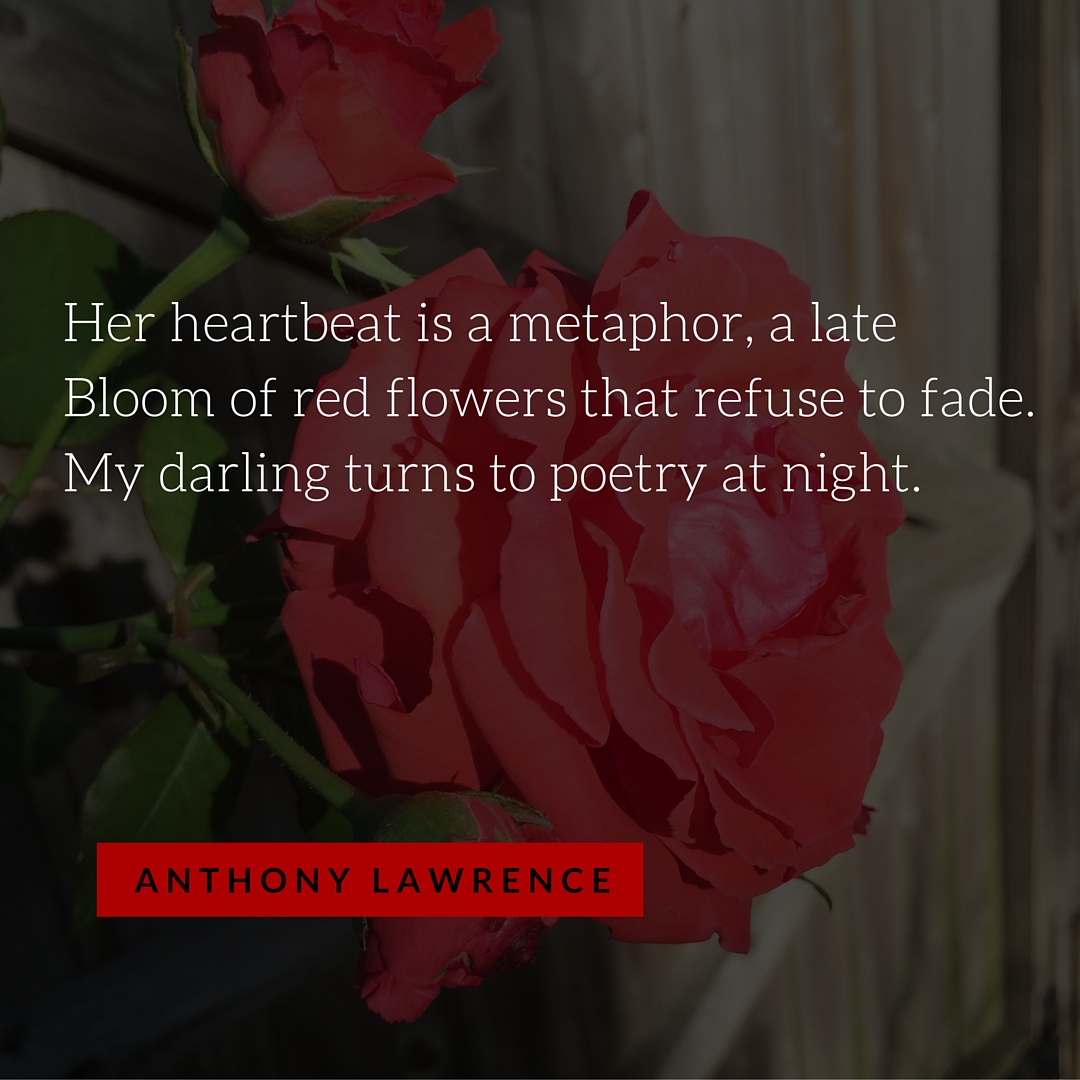
Anthony Lawrence_My Darling Turns to Poetry at NightI happen to love formal poetry—and by that I mean poetry that adheres to a particular structure or set of rules, not poetry in top hat in tails. I happily read free verse, but there’s just something about a poet mastering a form (or sometimes breaking from it in a meaningful way) that tends to make my verse-loving heart go all aflutter.

As regular readers know, I do write poetry myself, but I have never written a satisfactory villanelle. When I read a masterful one like Anthony Lawrence’s “My Darling Turns to Poetry at Night” (out in this month’s issue of Poetry, dedicated to Australian poets), I almost want to stop trying.

Almost.

At first I thought the poem would be about the speaker’s beloved reading poetry (as in the way we might say “She turned back to her book”), but instead the speaker imagines her as poetry. It’s simply gorgeous.

Probably most famous example of the villanelle—at least in English, at least; French speakers, do weigh in—is Dylan Thomas’s “Do not go gentle into that good night” (used to great effect in Interstellar, now that I think about it), but I’ve always been partial to Elizabeth Bishop’s “One Art.” 

What’s your favorite villanelle?

“They were but sweet, but figures of delight”: Shakespeare in the Spring

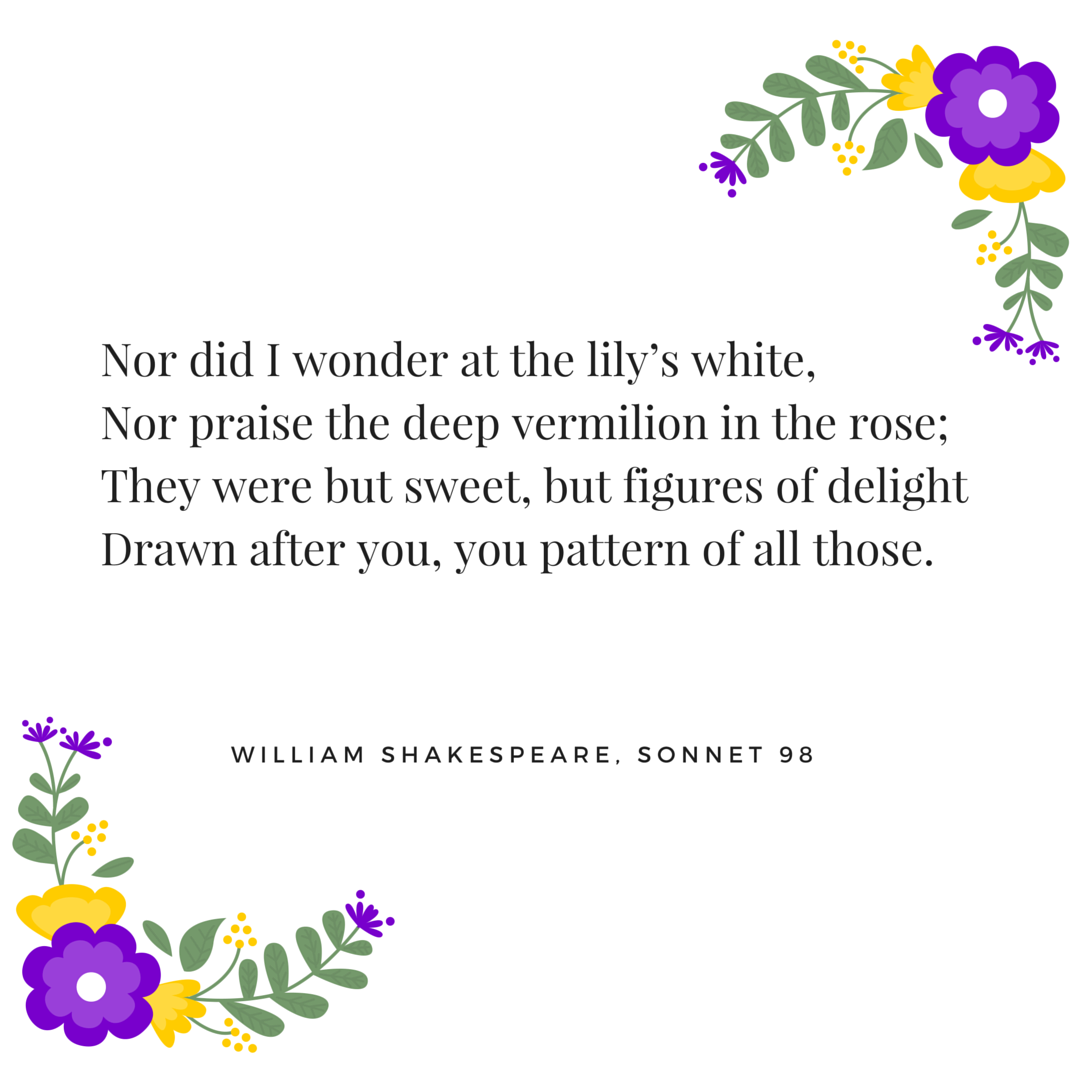
Sonnet 98


“Nothing is so beautiful as spring,” wrote the poet Gerard Manley Hopkins. He didn’t live in Boston, where spring brings with it almost any weather; this week it’s wall-to-wall rain and gray. So here’s a little dose of Shakespeare in the hope of sunshine and optimal flower-viewing.


Sonnet 98

From you have I been absent in the spring,
When proud-pied April, dressed in all his trim,
Hath put a spirit of youth in everything,
That heavy Saturn laughed and leaped with him.
Yet nor the lays of birds, nor the sweet smell
Of different flowers in odour and in hue,
Could make me any summer’s story tell,
Or from their proud lap pluck them where they grew:
Nor did I wonder at the lily’s white,
Nor praise the deep vermilion in the rose;
They were but sweet, but figures of delight
Drawn after you, you pattern of all those.
    Yet seem’d it winter still, and, you away,

    As with your shadow I with these did play.

And as a bonus, here are a few of my favorite lines from A Midsummer Night’s Dream:

I know a bank where the wild thyme blows,
Where oxlips and the nodding violet grows,
Quite over-canopied with luscious woodbine,
With sweet musk-roses and with eglantine:
There sleeps Titania sometime of the night,
Lull’d in these flowers with dances and delight;
And there the snake throws her enamell’d skin,
Weed wide enough to wrap a fairy in

[It gets fairly nasty at this point, alas.]

Have you read any spring poems lately?

Recommended (Poetry) Reading: Ross Gay’s Catalog of Unabashed Gratitude

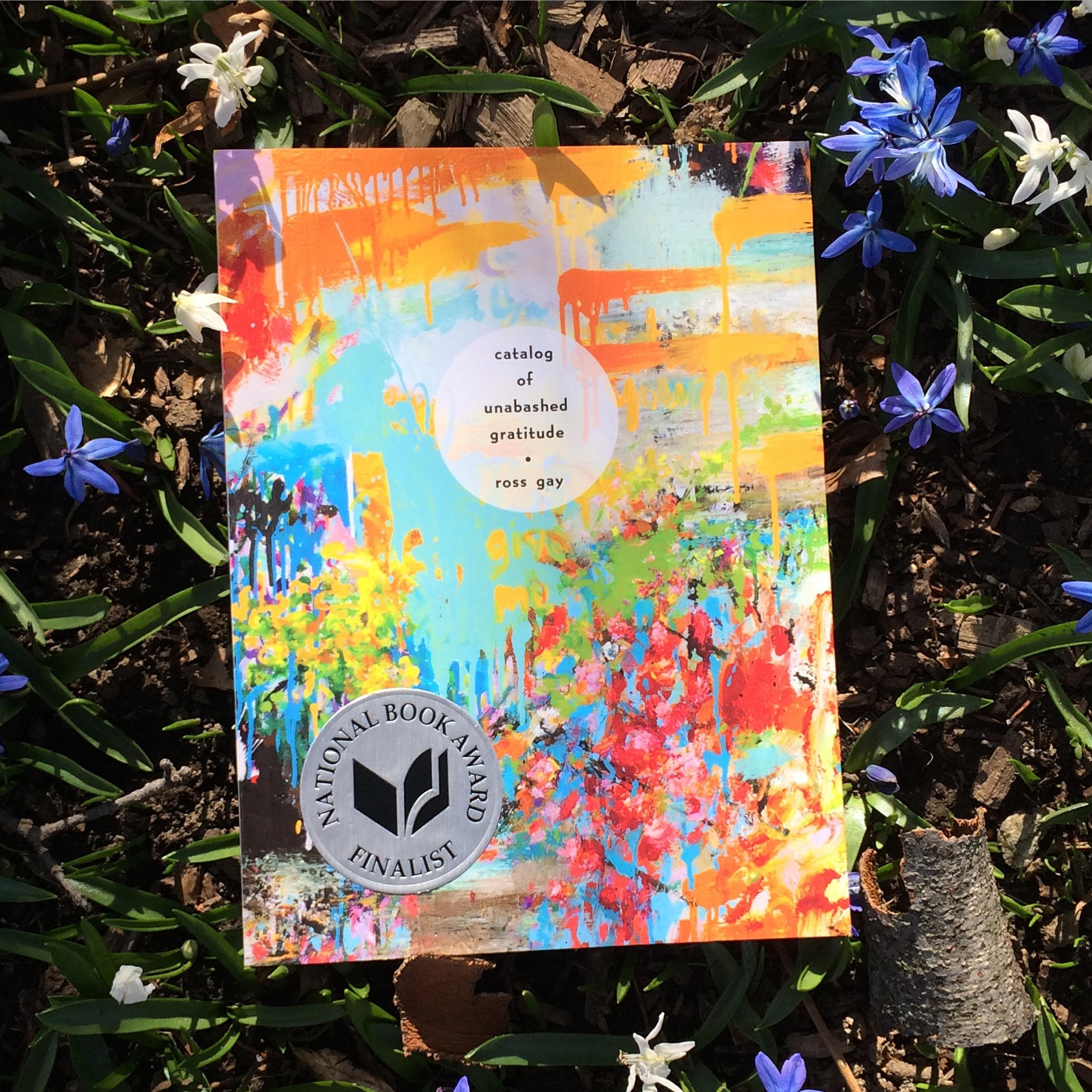
IMG_6414As I thought about how to describe Ross Gay’s Catalog of Unabashed Gratitude, I found myself turning into some sort of very specific thesaurus: his work is ebullient, irrepressible, joyous, boisterous. I loved it without reservation.

In this collection you’ll find a wonderful poem about strangers in a city gathering to pick figs from an overladen tree; an epithalamion (one that I would have liked at my own wedding); a searing, funny, furious elegy for the poet’s friend Don Belton; reflective poems about the poet’s parents; many poems celebrating gardens, orchards, and green growing things.

It took me a bit to adjust to Mr. Gay’s lines, which are often quite short, with limited punctuation, but I came to find that these kinds of lines offered me the chance to be deeply attentive, unstrung from my usual way of seeing a line and automatically looking for the outlines of a sentence. Here are the first few lines of “Ode to the Puritan in Me”:

There is a puritan in me
the brim of whose
hat is so sharp
it could cut
your tongue out

I think my favorite poem in the collection might be the wholly unexpected “Last Will and Testament,” but since I couldn’t find it online, here’s a link to the collection’s title (and penultimate) poem, “Catalog of Unabashed Gratitude.”

I love the way the poem invites the reader in by opening with a direct address (“Friends”—a strategy you’ll see more than once in the collection), and then sweeps into an account of a dream. Now, like most people, I find other people’s dreams rather a trial to hear or read about, but not this one. In the dream is a command to speak, and so begins the catalog of gratitude, with an orchard sunk into colorfully acquired compost:

twirling dung with my pitchfork
again and again
with hundreds and hundreds of other people
we dreamt an orchard this way,
furrowing our brows,
and hauling our wheelbarrows,
and sweating through our shirts,
and two years later there was a party
at which trees were sunk into the well-fed earth,
one of which, a liberty apple, after being watered in
was tamped by a baby barefoot
with a bow hanging in her hair
biting her lip in her joyous work
and friends this is the realest place I know,


This poem is absolute magnificent; I was crying by the end of it. I highly recommend this remarkable book. 

If this quick review piques your interest, you might like:

Ross Gay’s tour of his garden in essay form

This correspondence in poems between Mr. Gay and poet Aimee Nezhukumatathil about their gardens. 

“we can say at least the lettuce loved the rain”: Lisa Olstein’s “Dear One Absent This Long While”

Lisa Olstein_Dear One Absent This Long WhileLisa Olstein’s “Dear One Absent This Long While” is a lovely poem, and especially appropriate for the rainy early spring we’re having here, when “everything blooms coldly.”

In what I thought of as an unsent letter, the speaker addresses the absent person—though the poem leaves open the identity of the missing loved one—revealing how she’s been so anxious to see him or her that she’s mistaken “leaves in the wind,” “the retreating shadow of a fox, daybreak” for the return of the absent loved one.

In the meantime, the speaker (solitary, we understand, since the other who wait are the cat and the stove—stoves in poems always remind me of Bishop’s “Sestina,” by the way) takes to planting to pass the time:

June efforts quietly.
I’ve planted vegetables along each garden wall


so even if spring continues to disappoint
we can say at least the lettuce loved the rain.
Initially stopped short by the unusual verb choice in that first line (“June efforts quietly”), I’ve since come to like it; it suggests the whole month is gathering its forces with the speaker, to try to wait out this rainy, lonely period.
What do you make of the last three stanzas? There’s the contrast of the new gardening tools with the practice of eulogies (eulogies that either describe animals or describe people using animals as metaphors) and the suggestion of death and decay (the “unrabbited” woods instead of the fecundity associated with rabbits). The beloved’s name is spoken by leaves that somehow chatter (like books?)–but are the leaves on the trees, or lying dead on the forest floor? Lots to think about.


“the flesh inside them once white and wet as snow”: Jennifer Grotz’s “The Snow Apples,” from Window Left Open

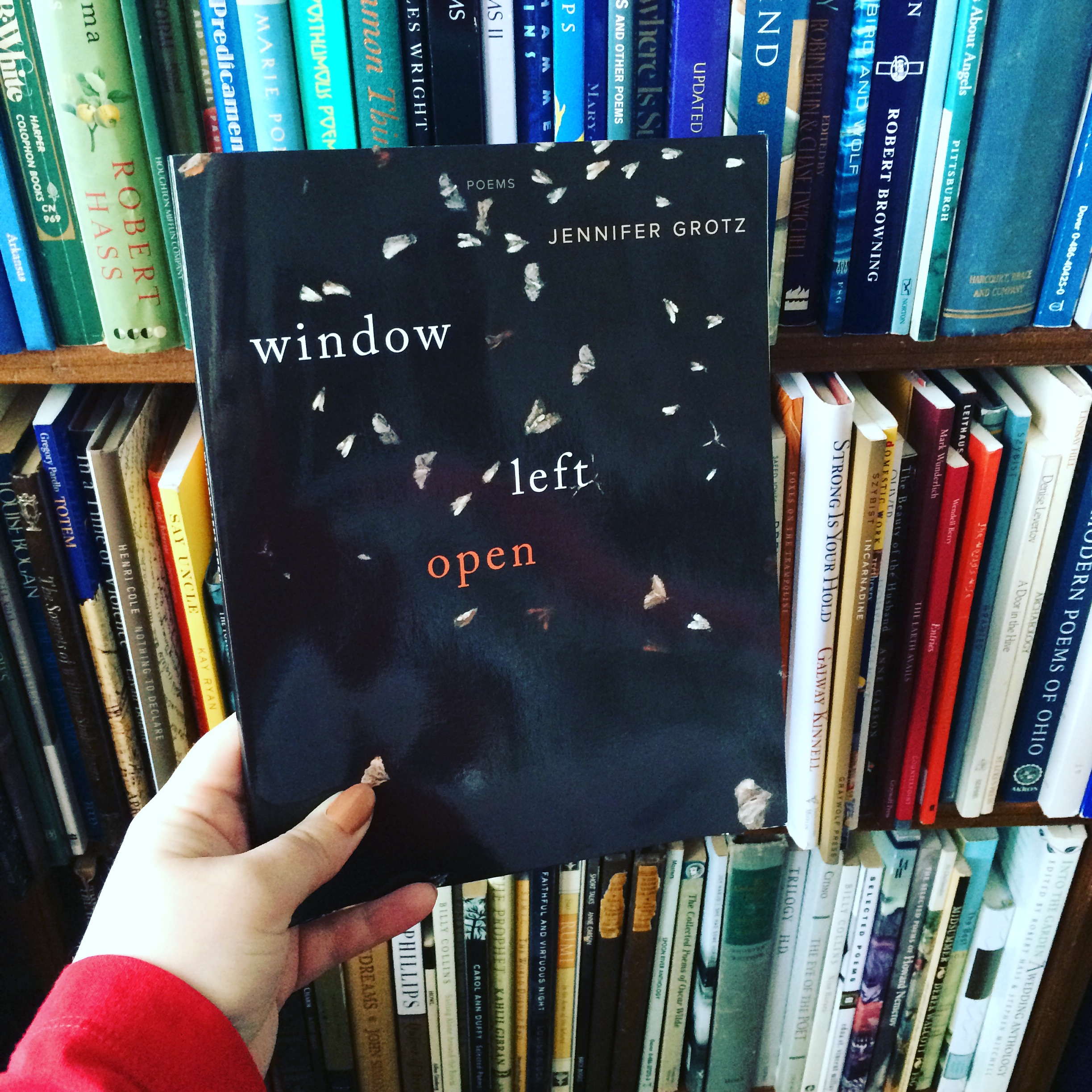
IMG_6313I’ve been slowly reading Jennifer Grotz’s third poetry collection, Window Left Open*, over the last three weeks, a keenly enjoyable experience because her poems invite the very kind of attentiveness that they demonstrate.

In “The Snow Apples,” which you can read here, the speaker considers the “Dulled, shrunken, nicked by wind-flung branches, / squirrel-pawed and beak-pierced, infested / macabre baubles hanging” from the apple tree in February, grasping the branches when most apples  fell together in  “a syncopation” in autumn. These winter apples the speaker compares to “a hard knot / deep in the core, something winter / winnow me down to.” I like the clever use of “core” here, the way the line breaks so that for a a moment the reader can imagine that the “hard knot” is “something winter.” The sadness of these “indegestible” apples “piled beneath the earth’s pelt of snow” is a disquieting, vivid metaphor for the speaker’s sense of disturbance in the long gray months.

Engagement with the natural world runs through Window Left Open, in which you’ll find (in just the first section) a forest with an “unending / staircase of roots worn silver like the soldered iron / that holds stained glass together,” snowflakes “denticulate as dandelion greens,” a display of living, giant cockroaches alongside pinned butterflies, rain “stately at first as punctuation,” a foreign city with “a gray, nearsighted river / one that massages the eyes, focuses / the sweeping birds that skim the water’s surface.”

The second section of the book finds the poet meditating on her time at a French monastery. There’s a poem about a piano in the Alps, one about the impossibility of glimpsing the entirety of a mountain from a window, another about a peacock “as strange as Mount Rushmore.” One of my favorites is called “Apricots,” which will make you see the fruit in a whole new way (“And the ripe ones, which felt like biting into / my own flesh, slightly carnivorous.”).

It’s tempting to go on quoting the memorable images in these poems; it’s harder to get at the sense of the speaker observing not only her world, but herself, and finding unexpected loveliness and unexpected fear, often at the same time. In “Poppies,” Ms. Grotz writes,  “Love is letting the world be half-tamed.” If you look closely enough at anything—an animal, a window, even a word—you’ll find a distancing peculiarity, and Ms. Grotz translates that feeling in these poems. She has a gift for making the familiar strange, and making the strange familiar. I highly recommend Window Left Open.

Further reading:

Ta-Nehisi Coates on “Poppies”

“Self-Portrait on the Street of an Unnamed Foreign City”

*I received a copy of this book from the publisher for review purposes, which did not affect the content of my review.

“the rueful admission”: Billy Collins’s “The Lanyard”

Collins_The LanyardA couple of years ago, in a post about my mother, I obliquely mentioned “The Lanyard,” a poem by Billy Collins. “The Lanyard” was the eulogy my uncle read at my grandmother’s funeral recently, and so I’m featuring it this week. It’s one of my favorite poems about parents and children, and I hope you’ll like it too.

Here’s a link to Mr. Collins reading the poem. 

A Brief Note on Claudia Emerson’s The Opposite House

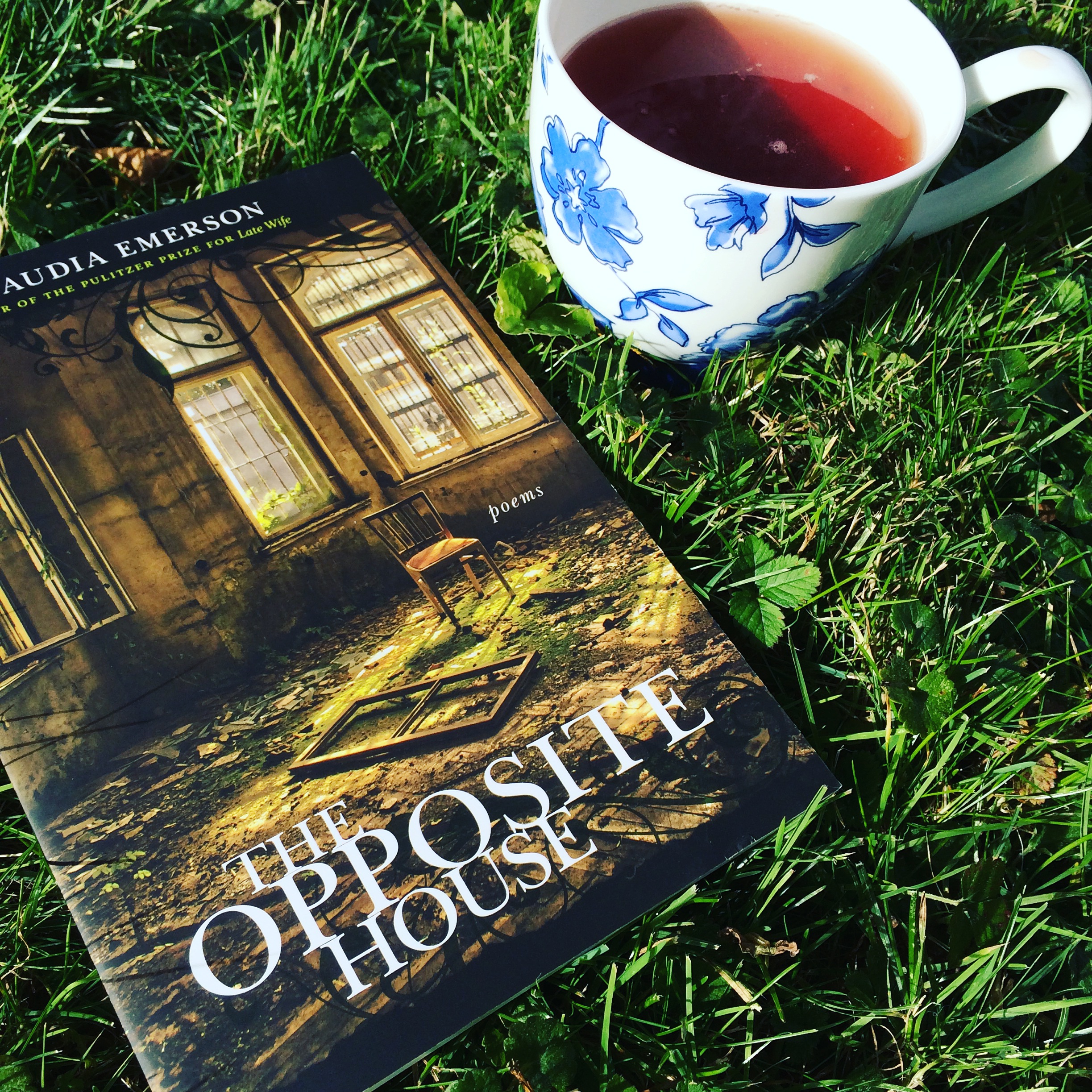
IMG_5562This week, I’ve been thinking quite a bit about Claudia Emerson’s book The Opposite House (which I read last year over the Thanksgiving holiday). I’ve written about her before; she died in 2014, and The Opposite House was posthumously published. As Jonathan Farmer writes in Slate,

Emerson presumably wrote the poems in The Opposite House years before she died, but it’s impossible to keep the news from them. Her gaze narrows and intensifies to an extent that I can’t help assuming—as she tells story after story of old age, demise, time folding so that what is most distant in a life comes nearest to it—that she was working on the far side of a diagnosis of cancer, if not a prognosis of death.

I completely agree. I found the poems in this collection haunting, in the best sense; take the last few lines of “Ephemeris,” a poem which Mr. Farmer considers in more depth than I will here. Here’s a link to “On Leaving the Body to Science,” in which the title accomplishes the future act of the first lines. What a poem.

The Opposite House is an intricate, fierce, intelligent collection. Highly recommended.