“The field as iridescent as a Renaissance heaven”

I just downloaded The Poetry Foundation’s app for iPhone, and friends, it is swanky.  I lack the requisite hand-eye coordination for Angry Birds and other games you can play on a phone, so most of my apps are (a) free and (b) related to news or making lists. But this morning, sitting through yet another rendition of “Elmo’s World” on Sesame Street (my presence is requested at all viewings), it occurred to me that maybe I should search for a poetry app.

For me, this app is like a delightful game: pick a few thematic elements, and voila! Poems! Scrolling through today, I found the poem I’ll be memorizing this week, David St. John’s “In the High Country,” a lovely May meditation, particularly appropriate given the beautiful weather in Boston this afternoon (not to last, I’m sure).

“Three days of spring winter and suddenly / birds everywhere.”

I had a lovely Mother’s Day — thank you for asking! My husband gave me the gift of extra sleep in the morning, which was glorious, and I woke up to homemade biscuits smothered in hollandaise. Couldn’t have been better.

I was looking, this week, for a poem about mothers, but I find that they tend to be, necessarily, incredibly specific, tied to the poet’s or speaker’s own mother or conception of motherhood. And, as I thought about it further, I realized how difficult it would be for me, personally, to write a poem even about one small aspect of my relationship with my own (amazing, kind, generous, hard-working, accomplished, intelligent, warm, self-sacrificing) mother.

So I gave up, and nosed around for a poem that would express a little of the happiness I’ve felt over the last few weeks when enjoying time with my son (it’s only my second Mother’s Day), and I came across Kathy Fagan’s “Letter from the Garden,” from her 2002 book The Charm.

Now, a disclaimer here: Professor Fagan teaches at my alma mater, and while I never had the privilege of taking one of her courses, several of my friends did, and I’ve met Professor Fagan once or twice, though there’s no way she’d remember me. Personal feelings and alumni pride aside, she’s a wonderful poet, and you should head over to your local bookseller and ask for one of her books.

“Letter from the Garden” has nothing to do with mothers and sons — it’s addressed to a lover — but what made me choose it this week is the poem’s attention to birds, filling the space of early spring, appearing “everywhere.” We’ve had that experience this year. I rather dislike birds (excepting only penguins, owls, and ducks) and their beady, gold-rimmed or black-pooling eyes and reptilian feet. Flying dinosaurs.

My son, however, loves them. He stares at them from the dining room windows. He chases every single one he sees, despite the fact that they always flee from him, and seeing ducks in a pond or robins at the cemetery is the highlight of many a weekend.
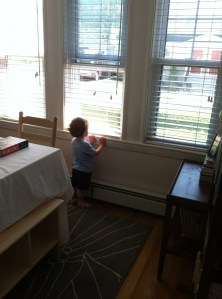
looking at the birds


Two weeks ago, we saw a wholly golden-yellow small bird (a finch?) alight on a tree next to us, and he turned to me and whispered, “Quiiiiii–et”; when it disappeared, he determined that it was sleeping, and that’s why it wouldn’t come back. I try now to see the birds through his eyes: the graceful hops and undignified racing for the trees when they see his little body bopping toward them, the sudden, knowing turn of the head.


“Like an ermine mantle tossed over someone’s shoulder”

This week, I’m departing from Shakespeare only to find him again in a short poem, “While Reading Hamlet” (1909), by Anna Akhmatova, the foremost Russian poet of the twentieth century. She’s perhaps best known for her long cycle Requiem, an outcry against Stalinist oppression, which claimed the lives of two of her three husbands.

This little poem is much lighter in tone, though the menace of the cemetery lingers. I wrestle with reading poems in translation, because to me it tends to feel almost like voyeurism, peeking in at something I don’t really have the right to know about or understand. No-one can speak all languages, though, polyglots notwithstanding, and so I must resign myself to translation if I want to read Milosz or Szymborska or Rimbaud or the great Anna Akhmatova.

I’m reading from my copy of the Norton edition of Akhmatova’s poems translated by Lyn Coffin; you can find it here.

“Sweet love, renew thy force”

After the awful and exhausting events of last week, I felt drained just contemplating the search for this week’s poem. Then I realized that today is the Bard’s birthday, and my dear Aunt Rita’s, and the choice was clear.

A sonnet!

Who doesn’t love fourteen lines of love poetry? I’ve taught the sonnets whenever I could, and students are always amazed at just how much meaning Will packs into those lines (and that the first cycle is addressed to a man — that’s mind-blowing to them, and perhaps unsurprising, since some editions “regularize” the pronouns in the earlier poem. Don’t get me started.).

My favorite is 116, which we asked a friend to read at our wedding, and which is probably one of the five most famous. I remember hearing it (or rather, part of it) first in Sense and Sensibility (adapted by Emma Thompson, bless her, and directed by Ang Lee), and that’s one of my favorite literary combinations.

But that’s not the first time I heard a sonnet. I can precisely date my first memory of one of the poems: my tenth birthday. At the time, my father was working out of state, but he and my uncle (my mother’s brother) took the time to sit in my uncle’s kitchen and record a tape (yes, I’m that old) of songs and poems for me. I treasure it; it’s on my desk as we speak. My uncle played the guitar and my dad attempted the drums, and they both sang and read. Simon and Garfunkel, Gordon Lightfoot, Robert Frost, Shakespeare, and even a few originals made it on to the tape. I listen to it every year on my birthday, but it’s been so long that I can hear clips of the tape in my mind if I choose to.  The banter and the squeaky chair are hilarious.

My father is an excellent reader (more on that some other time), and so I’m choosing to memorize the sonnet he read for me, “Sonnet 6–Number 56,” as he corrected himself.

William Shakespeare

Sonnet 56

Sweet love, renew thy force, be it not said
Thy edge should blunter be than appetite,
Which but to-day by feeding is allay’d,
To-morrow sharp’ned in his former might:
So, love, be thou: although to-day thou fill
Thy hungry eyes even till they wink with fullness,
To-morrow see again, and do not kill
The spirit of love with a perpetual dullness:
Let this sad int’rim like the ocean be
Which parts the shore, where two contracted new
Come daily to the banks, that, when they see
Return of love, more blest may be the view;
As call it winter, which being full of care
Makes summer’s welcome thrice more wish’d, more rare.


Happy birthday Shakespeare!

“Look’d up in perfect silence at the stars.”

After we turned the television off last night, and let the quiet seep in, we were no less sad, but we had the space to feel the sadness of the day, and great thankfulness and joy in our ordinary lives.

Walt Whitman

When I Heard the Learn’d Astronomer

When I heard the learn’d astronomer,
When the proofs, the figures, were ranged in columns before me,
When I was shown the charts and diagrams, to add, divide, and measure them,
When I sitting heard the astronomer where he lectured with much applause in the lecture-room,
How soon unaccountable I became tired and sick,
Till rising and gliding out I wander’d off by myself,
In the mystical moist night-air, and from time to time,
Look’d up in perfect silence at the stars.

“Silver dust, / lifted from the earth”

It is, perhaps, premature to offer a spring poem from my chair in New England. But the crocuses are blooming — yesterday we counted twenty-one next to the garage — and I wish I had an orchard (romantic, I know, and all the orchard-growers out there will tell me how much work I’d be in for), so this week I’m reading “Pear Tree,” by the Imagist poet H.D. (less mysteriously, Hilda Doolittle).

And, with a pithiness that I hope befits the poet, that’s that.

“Your hands hold roses always in a way that says / They are not only yours”

The end of a long story of mine is that I own the poetry collection of someone I loved very deeply and who died much too young.  In the beginning I kept our collections separate, and thought that someday I’d try to read through them as a way to work through my grief. But over time the project receded, and our collections have melded together so thoroughly that often I don’t know the provenance of a particular book.

This morning, my little son, H, and I were looking over the shelves to find a poem to work on this week, and I was drawn to Richard Wilbur’s New and Collected Poems (1989), which won the Pulitzer (Wilbur’s second). It’s a thick volume, and I found several promising poems, full of sly wit and concrete images, but nothing that shook me by the shoulders and said “This one!”

Until, that is, as my son fell asleep in my arms, I read the title of the last section: The Beautiful Changes, the title of Wilbur’s first book of poetry, published in 1947, when he was twenty-six (oh, to have the touch of genius!). My hands shook a little; I know these poems, “Cicadas” and “O.” I’ve read poems that talk to them.

And the last poem in the book, in the collection, is “The Beautiful Changes,” and it expresses, for me, what has happened since I lost this person I loved, whose fingers turned these very pages. Through the madness and the crushing weight of sorrow, the images that I cannot un-see, life and consolation reached out and found me.

I knew, without looking, that if I opened the inside back cover, I’d find three angular initials, and that they wouldn’t be mine.

But now the poem is ours.

“We get our danger from the lord”

One of the best side effects of this little project is learning a little about those poets whose names I’ve come across time and again but whose work I’ve never read. Case in point: Heather McHugh.  I want to run out to the bookstore and buy all of her books right now, but I won’t, because, you know, responsible-saving-for-house-and-H’s-summer-wardrobe/adult-life stuff.

[If, however, you wanted to run out to a bookstore and buy her books, and you happen to live in Metro Boston, I highly recommend Newtonville Books. It’s owned by my friends Mary and Jaime (full disclosure) and they are wonderful people who love writers and readers — a love that shows in their well-appointed store.]

Anyway, back to Heather McHugh. I’m reading “Etymological Dirge” this week, a short, smart poem that melds etymology (as you might expect) and emotion. I’m a sucker for word origins, despite my barely-there Latin and Greek, and this poem is just deliciously brilliant. Go ahead and give it a read here.

“so sweet / and so cold”

I know it will seem like cheating, since this poem is so short, but I’ve always wanted to really know William Carlos Williams’s “This is Just To Say” — and I’ve never made it past the first two lines. I’m hoping to learn it well enough that all my notes, in future, will have the same apologetic, wistful clarity.