Writer to Watch: Diana Souhami

photo (19)Diana Souhami is a debut novelist, but her twelve previously published works of nonfiction arrived to critical acclaim (she has won both the Whitbread Biography Award and the Lambda Literary Award). Given the talent and ambition she shows in her first novel, Gwendolen*, I suspect we’ll be seeing more of Ms. Souhami’s fiction.

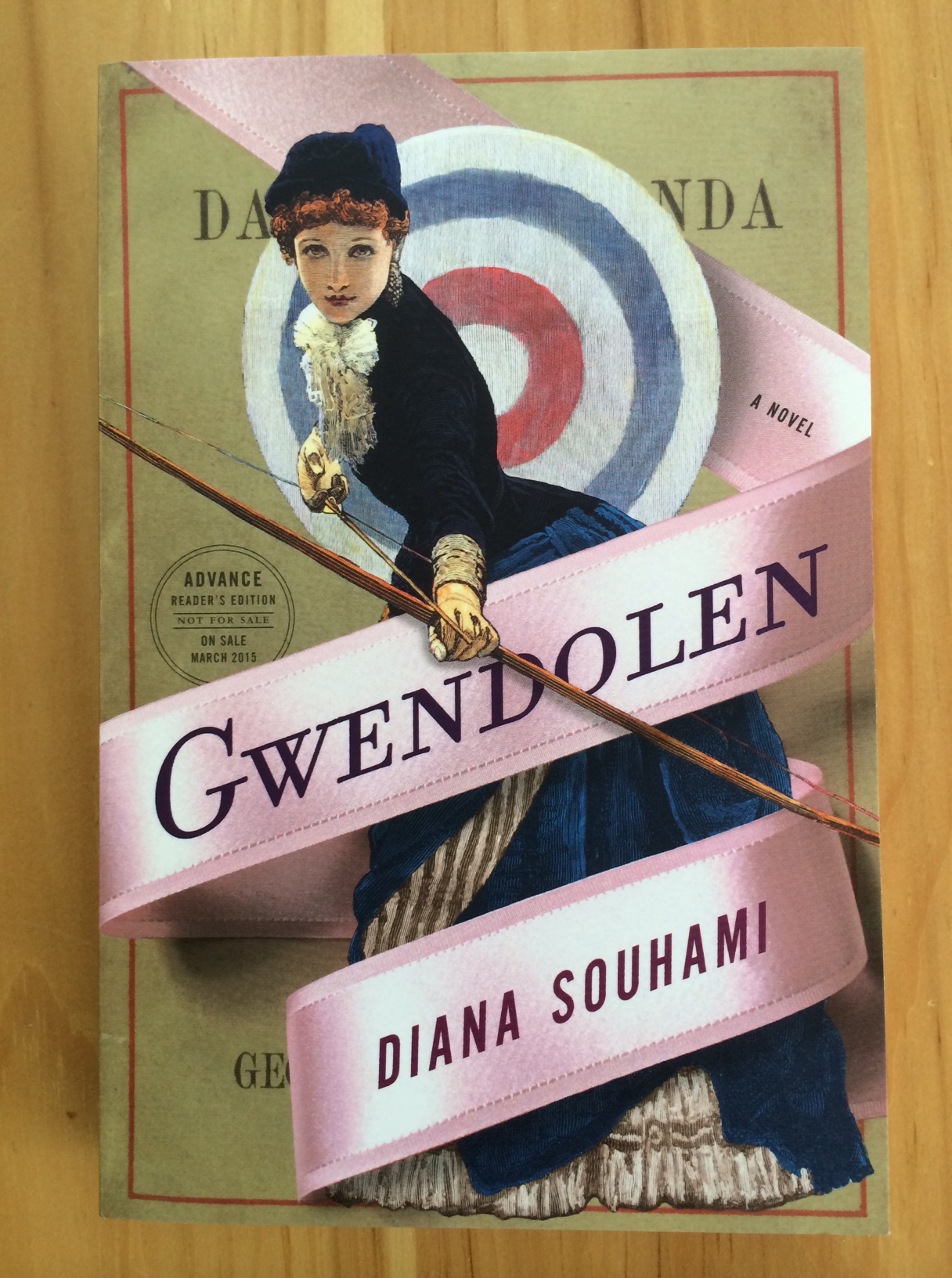
First, the ambition: Gwendolen is a re-telling and expansion of George Eliot’s final novel, Daniel Deronda (as you can see in the very clever cover design, the original nineteenth-century cover has been altered). It’s quite a task to take on the formidable Eliot, but Daniel Deronda is perhaps ripe for such interpretations; some critics of the novel thought it could do without Gwendolen Harleth, and some thought that Gwendolen was worthy of her own novel.

That’s what Ms. Souhami gives us. The first two-thirds of Gwendolen recount the events of Daniel Deronda from Gwendolen’s intimate perspective, in the form of a very long letter written to Deronda, but never sent. Gwendolen is beautiful, but self-centered and insensible to the ways of the world:

And so it began: life-changing decisions made by sudden inclinations, vanity, and rash daring. [ … ] I did not stop to consider what it meant truly to know another person or myself. I knew nothing of the world beyond the drawing rooms of Pennicote and the bewildering nowhere places of my childhood travels: nothing of the war in America, the struggles of the suffragists, the suffering of the workhouse, the customs and mores of other societies. And nothing whatsoever of the motivations of men or of the qualities that might matter, beyond chandeliers, paddocks, and diamonds, when choosing a husband. (50)

Gwendolen explains the dire financial straits and over-reliance on her considerable beauty  that led her to marry Grandcourt, a rich but cruel man whom she did not love and whom she knew to be involved with another woman (a longtime mistress with four children). The moral depredations of Grandcourt that Daniel Deronda hints at are fully revealed in Gwendolen.

The remaining chapters of the novel explore what Gwendolen’s life is like after the events of Daniel Deronda, and it is here that Ms. Souhami’s talents are put to best use. While the first two parts of the book are close in spirit to Eliot’s work, they are not satisfyingly different enough from the original. However, when exploring the changes in Gwendolen’s material circumstances and emotional states in her new life, I found myself eager to learn more about Ms. Souhami’s new characters, like the circus performer Julian/Juliette, the painter Paul LeRoy (based on a real person), and the group of suffragists Gwendolen befriends.

I was thrown off by the inclusion of Mrs. Lewes (George Eliot) as a character known to Gwendolen; it didn’t quite work, especially since Eliot’s uncanny knowledge about Gwendolen’s private affairs is never explained. And the notes about real people slipped into the tone of biography, instead of remaining in Gwendolen’s distinctive voice. I wanted the novel to explore Gwendolen’s relationship with her four stepsisters in greater depth instead.

Alas, this last section is far too brief, and doesn’t bloom as it could have, had the proportions of the plot been reversed. However, Ms. Souhami’s talent for sketching lively characters and period settings and her way of framing classic literature to allow readers to think about the social systems of the present ensures my willingness to read her next novel when it appears.

*I received a copy of this book from the publisher for review purposes, which did not affect the content of my review.
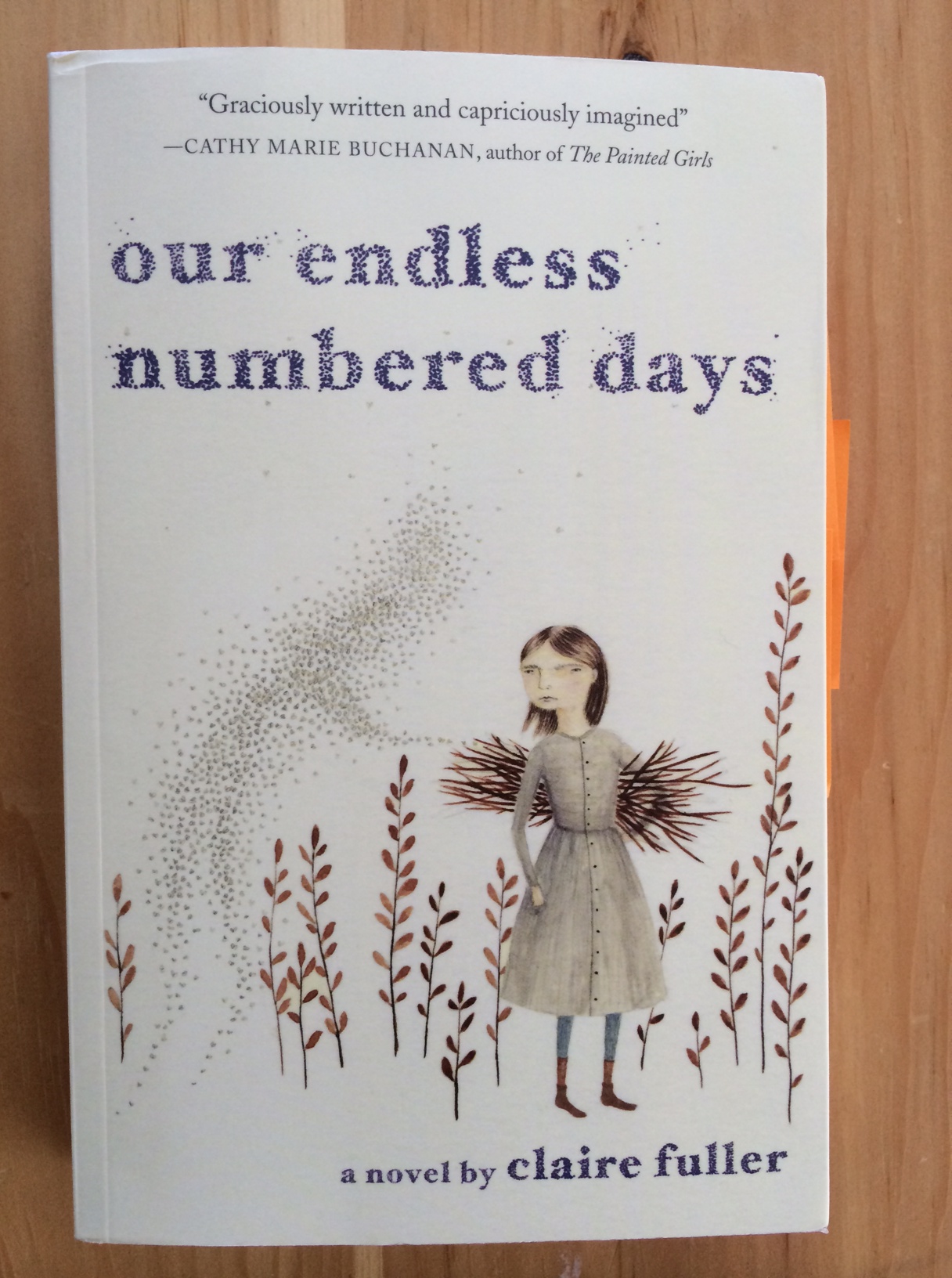
Recommended Reading: Our Endless Numbered Days, by Claire Fuller

photo (20)I first learned of Claire Fuller’s debut novel Our Endless Numbered Days* from Naomi’s review on Consumed by Ink. Once I picked up the book, I couldn’t put it down.

In reading Our Endless Numbered Days, I stepped  outside of my comfort zone; my reading (and viewing, for that matter) bête noir is child endangerment, and Peggy Hillcoat is in danger for quite a lot of the novel.

In 1976, when Peggy is eight, her father, a survivalist, packs up supplies and Peggy and leads her deep into a German forest, to “die Hutte,” where the two will live for the next nine years. Peggy’s experiences in wild living are juxtaposed with chapters about her life after she rejoins her mother, Ute, a noted concert pianist, in London nine years later (and this was what allowed me to read the book: knowing that she would come home alive, if not unscathed).

Peggy’s father tells her that they are the only two people left in the world, and decides to stop keeping track of time:

“We’re not going to live by somebody else’s rules of hours and minutes any more,” he said. When to get up, when to go to church, when to go to work.”
I couldn’t remember my father ever going to church, or even to work.
“Dates only make us aware of how numbered our days are, how much closer to death we are for each one we cross off. From now on, Punzel, we’re going to live by the sun and the seasons.” He picked me up and spun me around, laughing. “Our days will be endless.”

So Peggy—or Punzel, as she takes to calling herself and being called—settles into a routine of hunting and gathering and playing one piece on a piano that doesn’t make a sound—until one day she sees a pair of boots in the woods and begins to understand that all is not as her father told her.

Given the lies that James and Ute tell themselves, their daughter, and each other, Peggy isn’t the most reliable narrator—except where matters of practical living are concerned. The details of Peggy and James’s survival strategies are fascinating, particularly considering just how much effort it takes to learn how to live primitively (I just read a NYT story on a woman who walked 10,000 miles in three years, so I guess I’m on a bit of a kick). Their struggles do not recommend the outdoor lifestyle (though maybe I’m biased, since my favorite magnet says “I love not camping.”)

Ms. Fuller’s writing is strong and assured, her words gliding gracefully; I finished the book in two sittings. She skillfully builds tension as the novel’s twin mysteries unravel: How (and why) did Peggy escape the wilderness? And why did her father leave with her in the first place?

Once you pick up Our Endless Numbered Days, these questions will draw you into Peggy’s world, and it’s difficult to leave.

*I received a review copy of this book from the publisher, which did not affect the content of my review.

Recommended Reading: “The Kingfisher” and The Kingfisher, by Amy Clampitt

IThe Kingfisher on the couch picked up Amy Clampitt’s The Kingfisher at a used bookstore in Central Square sometime in January. It’s a gorgeous book in more ways than one; originally published in 1983, my copy is from the eighth printing in 1989, and it’s pristine. Heavy, unyellowed paper, gorgeous design. Well done, Knopf.

I came to the book knowing nothing about Amy Clampitt, but it was an utterly delectable reading experience; Clampitt’s facility with aural language reminded me of the fun I had reading Hailey Leithauser’s Swoop last year. (More on the language in a moment.)

As I read, I couldn’t believe I hadn’t heard more about this wonderful poet, and once I did a bit of research, I started to see why: born in 1920, Amy Clampitt died in 1994. The Kingfisher was her first major book, and remains her most famous.

My favorite poems in the book are those that appear first, largely set along the rocky Maine coastline (of which I am quite fond), but all six of the book’s wide-ranging sections are spectacular. The poems are erudite without being condescending (the poet provides notes after the text), controlled but bursting with language’s multitudinous possibilities. In these pages whales are “basking reservoirs of fuel” (116) and a poem about the Dakota hotel finds the speaker telling us “Grief / is original, but it / repeats itself: there’s nothing / more original it can do.”

Here are some lines from “The Cove”:

Where at low tide the rocks, like the
back of an old sheepdog or spaniel, are
rugg’d with wet seaweed, the cove
embays a pavement of ocean, at times
wrinkling like tinfoil, at others
all isinglass flakes, or sun-pounded
gritty glitter of mica; or hanging
intact, a curtain wall just frescoed
indigo, so immense a hue, a blue
of such majesty it can’t be looked at,
at whose apex there pulses, even
in daylight, a lighthouse, lightpierced
like a needle’s eye.

Stunning, yes?

The only other writer I’ve come across in the last half decade with Amy Clampitt’s command of English vocabulary is A.S. Byatt (who, by the way, Clampitt mentions in this fascinating interview with the Paris Review, which I highly recommend; unsurprisingly, she had great taste in poetry and fiction—she names Alice Munro as her favorite contemporary fiction writer 20 years before Ms. Munro won the Nobel). If (and I hope when) you pick up The Kingfisher, you’ll want a dictionary close at hand for words like these:

  • repoussé
  • pannicled
  • plissé
  • chrysoprase
  • grisaille
  • bizarrerie
  • catalpa
  • peplos
  • aconite
  • sozzled
  • gasconades
  • traghetto
  • curveting
  • loess
  • clepsydra
  • maguey

I could go on. At length.

I was enchanted by The Kingfisheryou can read the title poem here—and I hope you’ll let me know if you read it so we can compare notes, and maybe word lists.

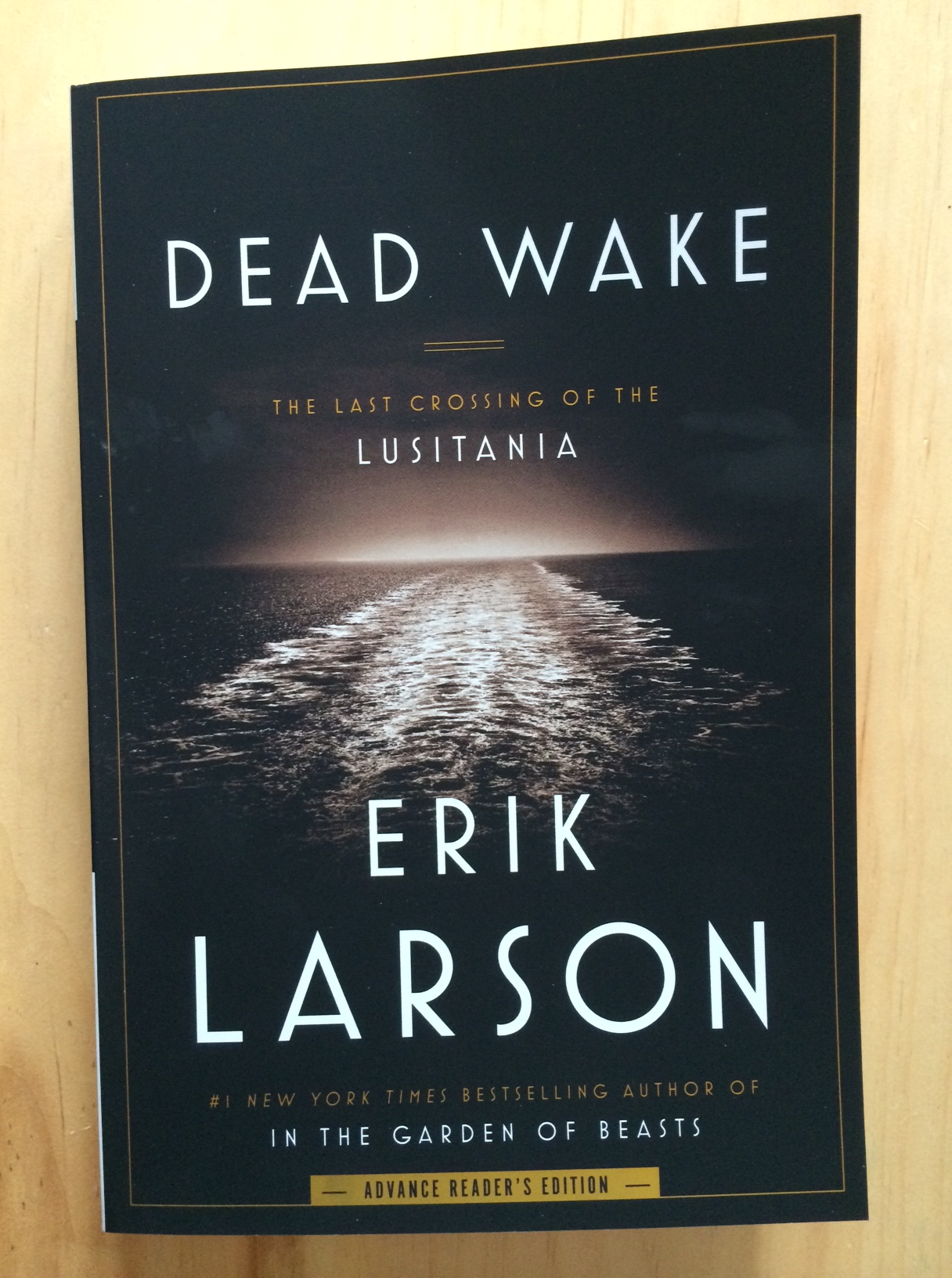
Recommended Reading: Dead Wake, by Erik Larson

"Enlist" poster by Fred Spear Library of Congress, Prints & Photographs Division, WWI Posters, LC-USZC4-1129

“Enlist” poster by Fred Spear
Library of Congress, Prints & Photographs Division, WWI Posters, LC-USZC4-1129

This May will mark 100 years since the Lusitania, a Liverpool-bound British passenger liner, was torpedoed by a German U-boat and sank off the coast of Ireland, killing nearly 1200 people on board. While the United States did not enter World War I until 1917, when unrestricted submarine warfare and the Zimmerman telegram had finally swayed public opinion against neutrality, the 1915 tragedy was still fresh in American minds, and a century later questions still remain about the sinking.

Erik Larson’s Dead Wake* is the meticulously researched tale of the Lusitania‘s final voyage, focusing on the ship, its passengers, the U-boat that sank it, Woodrow Wilson, and a top-secret British intelligence unit that could have saved the ship.

It’s also a fascinating portrait of 1915 America—its attitudes, tastes, movements, styles of dress, and even writing peculiarities (I was struck by the description of the Arts and Crafts movement, which sounds very similar to the DIY/maker culture that’s floating about today [for parodies, see Portlandia]).

photo (18)Mr. Larson follows several passengers throughout the voyage, including Charles Lauriat, a famous Boston bookseller who was transporting priceless works by Thackeray and Dickens to England; a pair of brothers who joined the Lusitania’s crew at the last minute; Theodate Pope, spiritualist and architect; and families with young children. The Lusitania sailed with an unusual number of children aboard, which makes the account of the torpedoing, sinking, and rescue effort particularly difficult to read, since so many children were killed (of thirty-one infants aboard, only six survived). Some parents were separated from their children, and entire families fell together to the bottom of the sea.

The direct responsibility for this horrible event rests squarely on the shoulders of the U-20’s commander, Walther Schweiger (who had once fired on a marked hospital ship), but Mr. Larson makes the case for other indirect causes of the disaster. A delayed departure, fog, conflicting messages sent to the Lusitania‘s captain, orders that the ship shouldn’t run at top speed—all of these played some role in setting the ship in Schweiger’s path.

And that path was being tracked by British intelligence, though they did not share information with Cunard that could have prevented the sinking—but why? Mr. Larson’s suggestions are intriguing.

The book only falters, in my opinion, in its over-focus on Woodrow Wilson. While Mr. Larson shows how hard Wilson was working to keep the country out of the war (Wilson’s strongly-worded notes to the Kaiser after the sinking were the target of Onion-like satire, and the political parallels with the present day are hard to miss, especially given Wilson’s fondness for golf), I was often taken out of the story’s grip when the book detoured into Wilson’s relationship with Edith Bolling; I felt that story belonged in another book. Wilson’s political maneuverings and diplomatic philosophy could have been more strongly juxtaposed against those of Winston Churchill, First Lord of the Admiralty when Lusitania sank. I would have liked to see more focus on Churchill, as well.

Dead Wake is well-written and suspenseful, even though the outcome of the sailing is a foregone conclusion. I found it hard to put down, and I’m happy to have had the opportunity to read one of Mr. Larson’s books.

*I received a copy of this book from the publisher for review purposes, which did not affect the content of my review.

“the beautiful, needful thing”: Robert Hayden’s “Frederick Douglass”

This past weekend marked the fiftieth anniversary of what has come to be known as Bloody Sunday, when peaceful protestors in Selma, Alabama marching for civil rights were brutally attacked by state troopers.

In honor of this anniversary, I suggest reading Robert Hayden’s “Frederick Douglass,” a powerful poem by one the twentieth century’s best American poets. Robert Hayden’s most anthologized poem is probably “Those Winter Sundays” (which I wrote about here). He was Consultant in Poetry to the Library of Congress—or, what is now known as Poet Laureate—the first African American poet to hold the post.

Recommended Reading: The Evening Chorus by Helen Humphreys

photo (17)The Evening Chorus*, by Helen Humphreys, is a quiet gem of a book. Ms. Humphreys is an accomplished Canadian poet and novelist, and I honestly can’t believe that this is the first book of hers I’m reading. It won’t be the last.

The Evening Chorus follows three people: James Hunter, a British pilot confined to a German prisoner-of-war camp when the book opens; his new and young wife Rose, living in their cottage at the edge of Ashdown Forest; and Enid, James’s sister, who comes to stay with Rose after her London flat is destroyed in the bombing of the city. James’s story is the frame and the touchstone (which honestly makes the book’s US cover annoying, too generic and too specific all at once; the Canadian cover is a better representation of the book).

The novel follows James, Rose, and Enid in turn, though of course they’re all connected, not only by their family ties, but by their appreciation of the natural world. James passes his days in the camp by taking up the study of a family of birds, while Rose learns to love her walks as an air raid warden with only the company of her dog. And Enid, brought low by loss, finds solace in undertaking a study of the heath and forest near Rose’s cottage.

Ms. Humphreys’s writing makes me want to use words like “limpid” and “spare” and “lyrical.” Her language is clear, building images and characters deftly and with a supreme sense of balance. When revelations appear, as they must in a story, they’re not shocking twists, but rather forks in a path that you haven’t noticed being built beneath your feet.

Here’s one passage that I particularly liked:

The minutiae of Ashdown Forest are more interesting than she first assumed. Every little flower has a history and cultural references , is a superstition or a cure for something. Everything in its own world, and if Enid stays there, in these worlds, she won’t have to break the surface of the large, terrifying world she actually lives in (150).

It’s the same impulse that leads her brother to study his family of redstarts, though the realities of imprisonment are naturally less avoidable than Enid’s realities are for her. I appreciated the details of  the POW camp that Ms. Humphreys provides, the portraits of the men passing time and fighting boredom, cold, and filth by finding their own projects: gardening, bird-watching, escaping. While life in a place governed by the Geneva Conventions—even marginally—is nothing at all like the horrors of the death camps, it is frightening, and the men deal with it in their own ways. James’s redstarts are a way for him to make sense of his new world, because he is there, as another prisoner puts it, “for the duration.”

And making sense of the world, in all its cruelty and its flashes of beauty, is the subject of The Evening Chorus. James, Rose, and Enid, with their different paths and personalities, live and grieve through the lens of the natural world, even when they feel removed from it, and from each other.

This is a beautiful, affecting novel, and I highly recommend it.

*I received a copy of this book from the publisher for review purposes, which did not affect the content of my review.
“He makes a world here out of frog songs / and packed earth”: Linda Gregg’s “Hephaestus Alone”

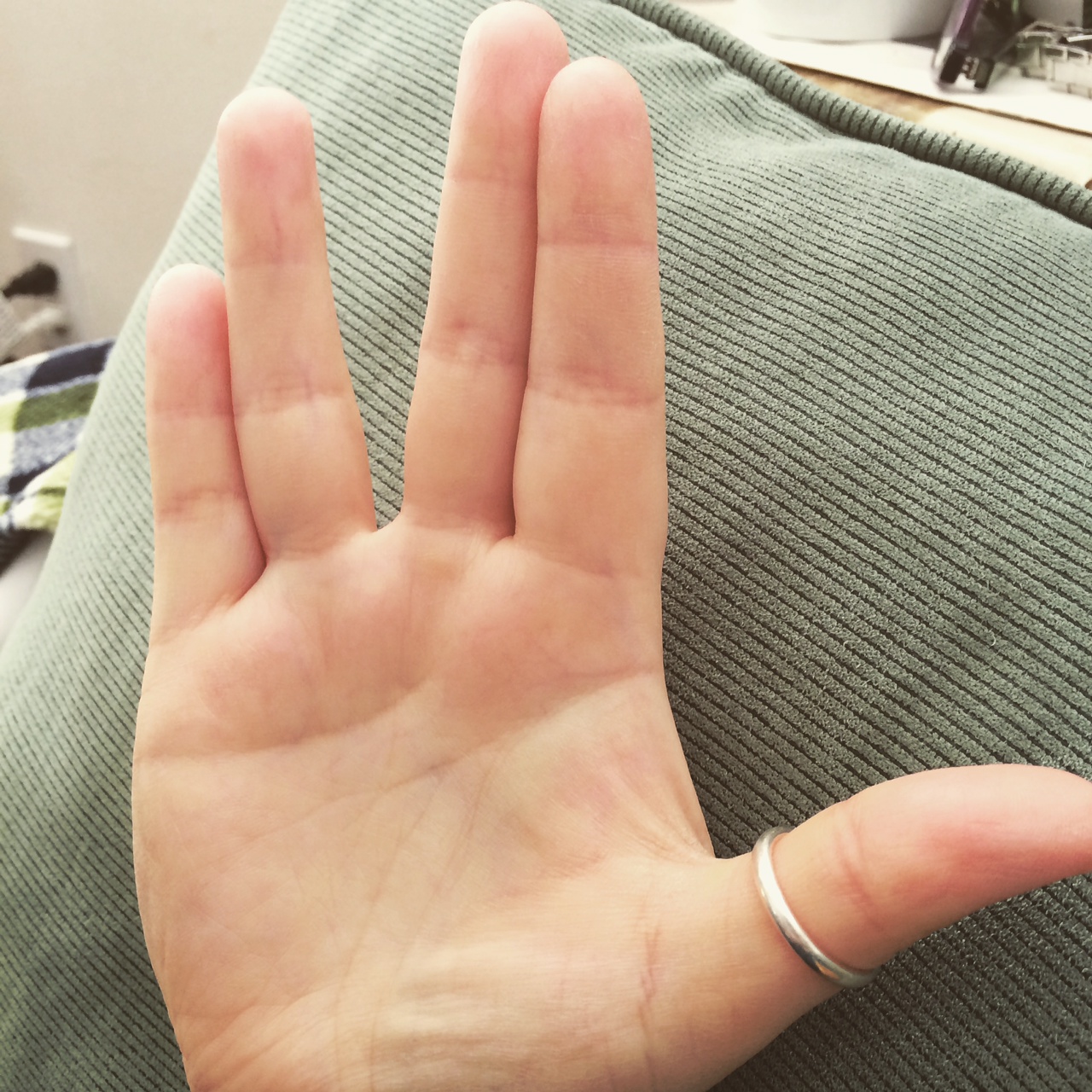
photo (15)Like so many others, I was sad to hear of the death of Leonard Nimoy on Friday. From afar, he seemed like a gentle man, thoughtful and interested in giving what he could to the world. He lived long and prospered, and wished the same for the rest of us.

Much as I love Spock, I’ve never been an aficionado of Mr. Nimoy’s poetry, though I did go hunting today for a poem to feature in his honor. I looked for poems about stars and Vulcan and Spock, but nothing stood out in particular until I came across a poem about Hephaestus (Vulcan is the Roman analogue of the Greek god). It occurred to me that while the behavior of most Vulcans on Star Trek is consistently cool and logical, more Apollonian than anything, underlying that rational exterior is a passionate interior, burning like the fire god’s furnaces, as Mr. Nimoy’s Spock demonstrated more than once.

In Linda Gregg’s poem “Hephaestus Alone,” we see the ardent creativity of the hammer-wielding, forge-tanned, lonely god Hephaestus. Crippled in one of his father’s rages, deserted by his wife, the god labors apart from his fellows, producing works of beauty and mechanical intricacy. Or so it goes in the myths. In this poem, undergirded by that history, we see Hephaestus producing images of the very gods he sets himself apart from, including Aphrodite:

He made his wife
so she contains the green-fleshed
melons of Lindos, thalo blue of the sea,
and one ripe peach at five in the morning.
He fashioned her by the rules, with love,
made her with rage and disillusion.

It’s an intriguing poem, and one that will remind me now of the creative person who gave us a new kind of Vulcan.

LLAP.

Recommended Reading: Making Nice, by Matt Sumell

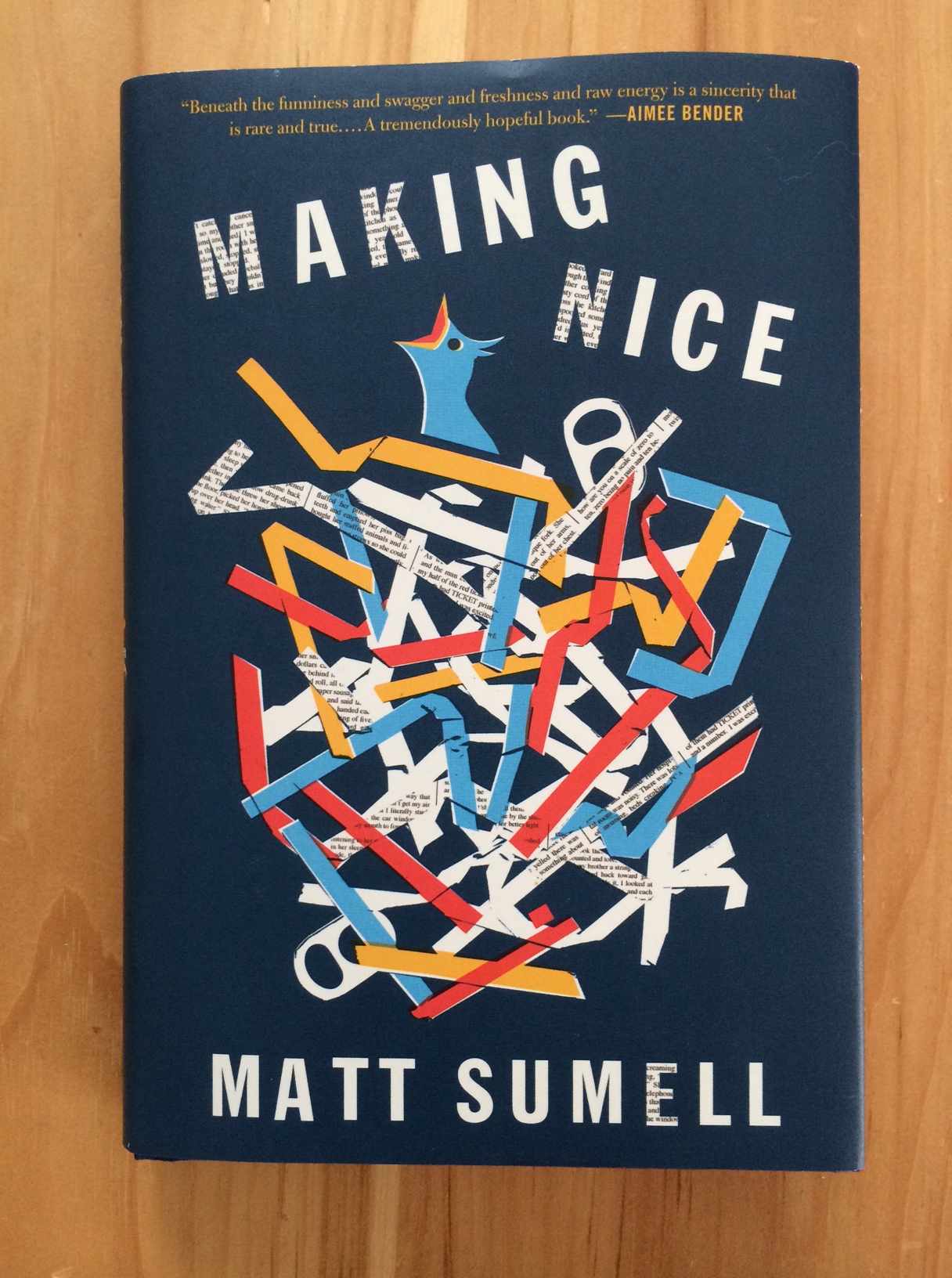
photo (14)When I finished Making Nice*, Matt Sumell’s debut novel-in-stories, I couldn’t stop thinking of it as a bildungsroman, even though the narrator, Alby, is about thirty.

I think that’s because we can come of age not once, but at least three times: when we physically and, to some extent, emotionally “grow up” (the fodder for the archetypal bildungsroman, like Great Expectations or Jane Eyre), when we meet our own children, and when our parents die.

This last sense is speculation on my part, for which I am very grateful, but I can imagine the jarring sense of being alone in the adult world that would accompany the grief over a parent’s death.

Making Nice is about how Alby deals with his mother’s death from cancer—not very well, it turns out—but at the same time, it’s about his whole life, his family, his environment, and his choices. It’s a bruising account of that final and terrible kind of growing up.

On paper, Alby is not a sympathetic character: he drinks to violent excess, he steals pain medication not meant for him, he fights, he’s often contemptuous and belligerent toward women. He’s prone to egregious lapses in impulse control.

However, in Mr. Sumell’s capable hands, he is very much a whole person: studded with flaws more visible than most people’s, but a man of blistering emotions who demonstrates a profound capacity for empathy. The book’s structure—linked stories—is ideally suited to conveying the complexities of Alby’s character. Rage and humor sit uncomfortably close to one another, and the result is great writing, even if it’s sometimes difficult to read. This is a compassionate, humane book, and I recommend it.

(The Paris Review, which published one of the stories now included in Making Nice, has a fascinating interview with Matt Sumell that explores some of the novel’s autobiographical aspects.)

*I received a copy of this book from the publisher for review consideration, which did not affect the content of my review.

Eat, Drink, and Be Merry: Ben Jonson’s “Inviting a Friend to Supper”

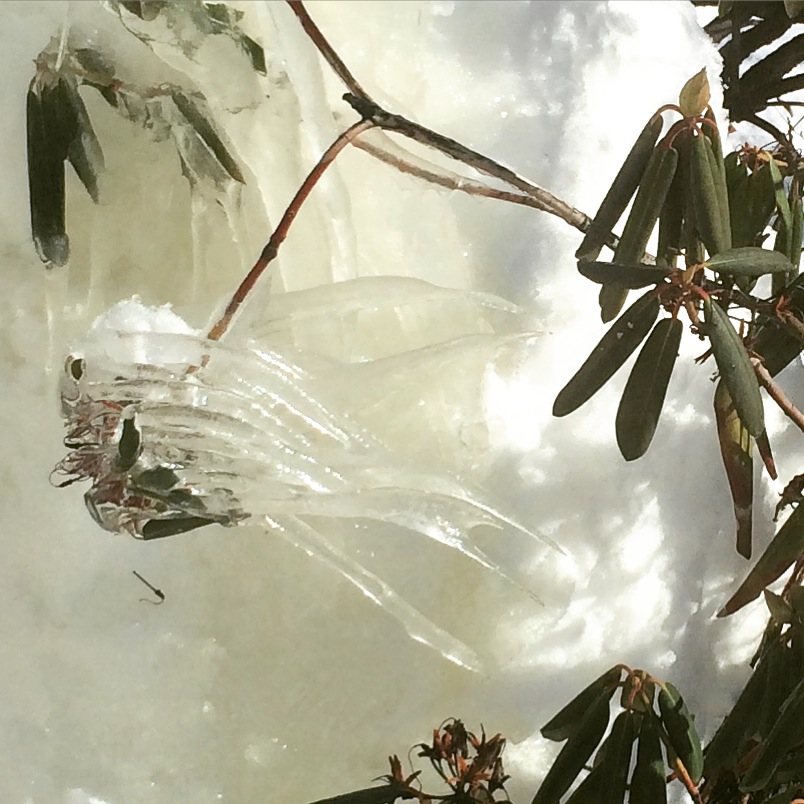
Sideways jellyfish icicle from the front window.

Sideways jellyfish icicle from the front window.

Unpleasant weather continues here in Boston (this weekend delivered the trifecta of snow, rain, and ice), and even hardened and hardy New Englanders agree that the last few weeks have been miserable. We’ve been staying put most weekends, venturing out for groceries and then settling in between bouts of shoveling.

Luckily, friends, like sunshine, have made brief but welcome appearances, and so in honor of friends who come to dinner, this week’s poem is Ben Jonson’s “Inviting a Friend to Supper.”

Jonson addresses his patron, William Herbert, with what I’d call a tone of amused deference. The feast he describes is quite something, even for a man of Jonson’s epicurean appetites: capers, olives, mutton, chicken, larks, other kinds of available fowl, a bit of salad, lemons, and, most importantly,

a pure cup of rich Canary wine,
Which is the Mermaid’s now, but shall be mine;
Of which had Horace, or Anacreon tasted,
Their lives, as so their lines, till now had lasted.
Tobacco, nectar, or the Thespian spring,
Are all but Luther’s beer to this I sing.

Hilarious (the Mermaid was a tavern, by the way). I’d like to try wine that good.

Now, our friendly dinners are never so grand or so well-appointed, and the wine has never been compared the Thespian spring, but the company, I’ll venture to say, is even better than William Herbert’s, and we are more grateful for our friends than Jonson was for Canary wine.

Ben Jonson
Inviting a Friend to Supper

Tonight, grave Sir, both my poor house, and I
Do equally desire your company;
Not that we think us worthy such a guest,
But that your worth will dignify our feast
With those that come, whose grace may make that seem
Something, which else could hope for no esteem.
It is the fair acceptance, Sir, creates
The entertainment perfect, not the cates.
Yet shall you have, to rectify your palate,
An olive, capers, or some better salad
Ushering the mutton; with a short-legged hen,
If we can get her, full of eggs, and then
Lemons, and wine for sauce; to these a cony
Is not to be despaired of, for our money;
And, though fowl, now, be scarce, yet there are clerks,
The sky not falling, think we may have larks.
I’ll tell you of more, and lie, so you will come:
Of partridge, pheasant, woodcock, of which some
May yet be there, and godwit, if we can;
Knat, rail, and ruff too. Howsoe’er, my man
Shall read a piece of Virgil, Tacitus,
Livy, or of some better book to us,
Of which we’ll speak our minds, amidst our meat;
And I’ll profess no verses to repeat.
To this, if ought appear which I not know of,
That will the pastry, not my paper, show of.
Digestive cheese and fruit there sure will be;
But that which most doth take my Muse and me,
Is a pure cup of rich Canary wine,
Which is the Mermaid’s now, but shall be mine;
Of which had Horace, or Anacreon tasted,
Their lives, as so their lines, till now had lasted.
Tobacco, nectar, or the Thespian spring,
Are all but Luther’s beer to this I sing.
Of this we will sup free, but moderately,
And we will have no Pooley, or Parrot by,
Nor shall our cups make any guilty men;
But, at our parting we will be as when
We innocently met. No simple word
That shall be uttered at our mirthful board,
Shall make us sad next morning or affright
The liberty that we’ll enjoy tonight.

Recommended Reading: The Rabbit Back Literature Society by Pasi Ilmari Jääskeläinen

photo (12)Last year, when I was reading Emmi Itäranta’s Memory of Water, I came across the phrase “Finnish weird,” which is an umbrella term that encompasses the speculative fiction that’s been coming out of Finland for the last couple of decades.

The Rabbit Back Literature Society* is definitely Finnish, and definitely weird, so I’m going to go ahead and say it’s Finnish weird. Pasi Ilmari Jääskeläinen’s novel is set in contemporary Finland, in the small town of Rabbit Back. The town is known primarily as the home of the famous children’s writer Laura White and her Rabbit Back Literature society, a club of nine children whom she trained as writers and who went on to become some of Finland’s most important and popular authors.

Ella Milana is a young substitute literature teacher in Rabbit Back, living with her mother and dementia-ridden father. After a short story of hers is published in the town paper, she receives an invitation to join the Rabbit Back Literature Society as its tenth member—an honor, as far as anyone knows, that hasn’t been conferred in the society’s long history.

On the day she is to meet Laura White, however, something very strange indeed happens, and Ella falls down the rabbit hole, so to speak.

One of the jacket blurbs compares this book to Twin Peaks and The Secret History, and those are pretty good comparisons, up to a point. Rabbit Back is populated by strange small-town souls and subject to peculiar quirks, like gnome infestations and an epidemic of stray dogs. The members of Ella’s new society play a very strange game that one player describes as “psychic strip poker around a glass table” (181). And there’s a plague infecting books, leading Sonja to murder Raskolnikov, for example, in the copy of Crime and Punishment that Ella confiscates from a student.

I loved the weirdness of this book, the little and large strangenesses, but the novel as a whole does have some limitations (some might be due to the fact that it’s a work in translation). Some phrases repeat without a strong reason to be repetitive, and I caught one editing error (“phased” instead of “fazed”). The ending isn’t neat, which didn’t bother me, but might annoy some readers who like all the answers, or at least a good sense that the answers they come up with are quite possibly correct. And the sexuality in the book tends toward the creepy (with a notable exception at the very end of the book, which I thought was really interesting and good) and uncomfortable, which didn’t quite mesh with the book’s atmospheric weirdness.

Still, if library book theft gets your heart pounding or if you often wonder where your favorite authors get their ideas, you might just love The Rabbit Back Literature Society.

*I received a copy of this book from the publisher for review purposes, which did not affect the content of my review.