Recommended Reading: Jennifer Stewart Miller’s A Fox Appears

A Fox Appears

My friend Emily sent me  A Fox Appears by Jennifer Stewart Miller, and I’m so grateful she did (thanks, Emily!). This is a small gem of a book, “a biography of a boy in haiku,” as the subtitle has it.

In six sections, the poet gives us glimpses of her son’s early life through haiku. Maybe you, like me, spent a fifth-grade unit on haiku, struggling to conjure up nature imagery and conform to the 5/7/5-syllable format (those pesky articles and conjunctions, am I right?). As it turns out, rules are meant to be broken; the charming folks at the Academy of American Poets tell us that in modern haiku-writing, while some formal elements may lapse, “the philosophy of haiku has been preserved: the focus on a brief moment in time; a use of provocative, colorful images; an ability to be read in one breath; and a sense of sudden enlightenment and illumination.”

IMG_6829That is exactly what I found in A Fox Appears. As Ms. Miller shows, the haiku is an ideal form (perhaps the ideal form) for evoking a parent’s perspective of the fleeting phases of early childhood. These poems are perfectly, unexpectedly descriptive; their simplicity enhances their perceptiveness.

Here are a few of my favorites (with apologies since the line indents won’t come through):

I stroke the sole
of your foot — small toes
flick open like a fan.

Tiny hands —
fiddlehead ferns
waiting to unfurl.

Patient as stone
you drop stones
in the sea.

The washing machine
empties your pockets —
acorns acorns.

Across a green field
a bluebird flew —
you were at school.

Lovely, aren’t they?

Cats, the moon, stones, and feathers appear throughout this slim volume, tying together the observations and giving us a sense of the passing of seasons and years. And I should note too that Franklin Einspruch’s beautiful black and white gouache artwork complements the poems very well. A Fox Appears is a beautiful volume, and recommended. Thank you Emily!

Have you ever written haiku? Do you have a favorite?

“in the pleatpetal purring of mouthweathered May”: Karen Volkman’s “May”

IMG_6833A couple years ago, I reviewed Hailey Leithauser’s Swoop, a collection that plays with language so exuberantly that I found myself grinning over many of the poems.

I felt that same sense of exuberance–though tilted toward the macabre, I think–when I read Karen Volkman’s “May.”

In the poem’s couplets, “the old saw wind” dressed in May’s finery (“gaud gown and ruby reckoning”) “[s]ays, dance that skeletal startle the way I might.” In couplets the wind directs a kind of dance (“you one, you two, you three your cruder schemes, / you blanch black lurk and blood the pallid bone”) that’s more about evoking a sense of atmosphere through words that punch than about describing actual movement.

For me the poem captures those brief days in May when all the trees are blooming pink and white, but already on the cusp of discarding those petals—just waiting for the right breeze.

It’s a tricky poem, though; what do you think of it?


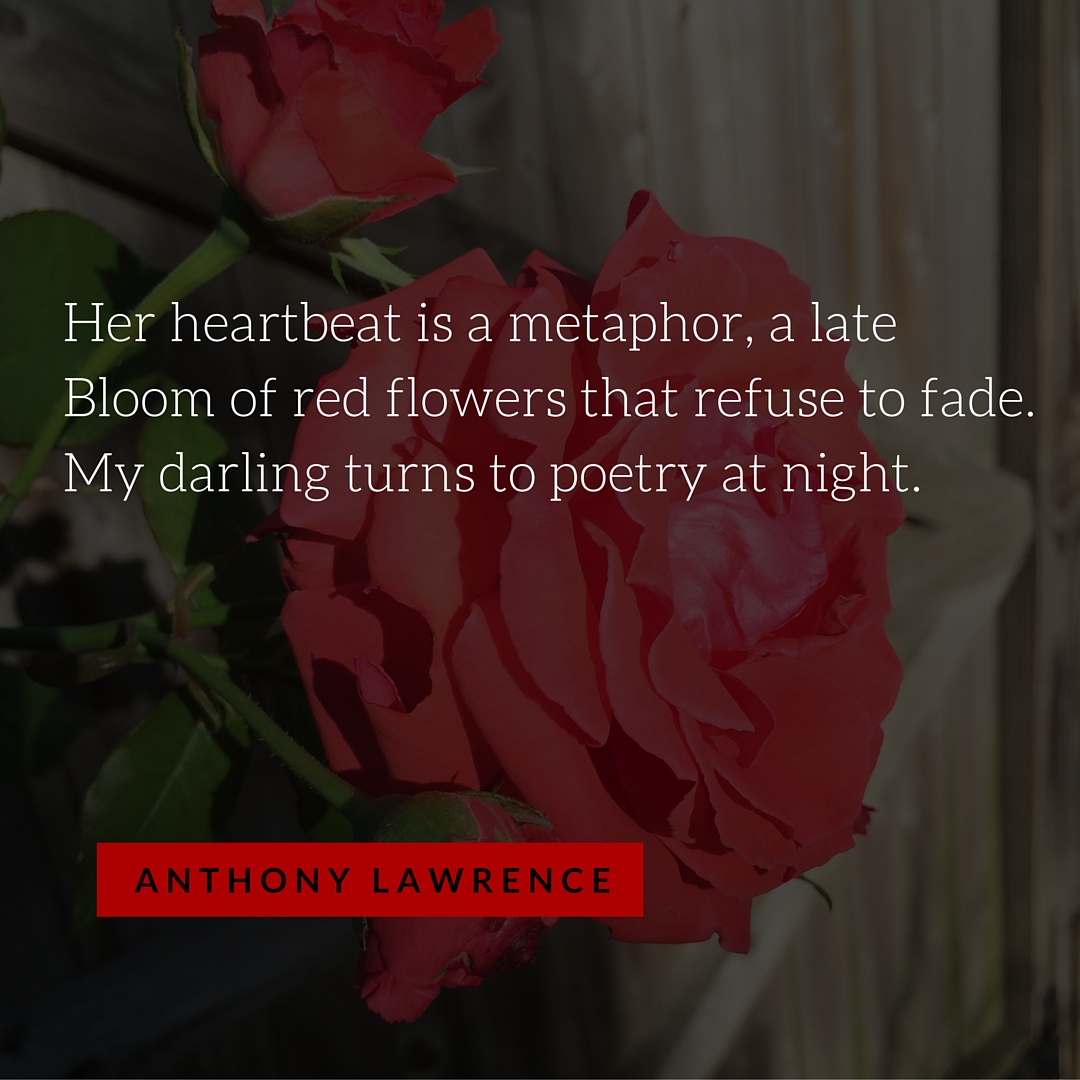
“Her heartbeat is a metaphor”: Anthony Lawrence’s “My Darling Turns to Poetry at Night”

Anthony Lawrence_My Darling Turns to Poetry at NightI happen to love formal poetry—and by that I mean poetry that adheres to a particular structure or set of rules, not poetry in top hat in tails. I happily read free verse, but there’s just something about a poet mastering a form (or sometimes breaking from it in a meaningful way) that tends to make my verse-loving heart go all aflutter.

As regular readers know, I do write poetry myself, but I have never written a satisfactory villanelle. When I read a masterful one like Anthony Lawrence’s “My Darling Turns to Poetry at Night” (out in this month’s issue of Poetry, dedicated to Australian poets), I almost want to stop trying.

Almost.

At first I thought the poem would be about the speaker’s beloved reading poetry (as in the way we might say “She turned back to her book”), but instead the speaker imagines her as poetry. It’s simply gorgeous.

Probably most famous example of the villanelle—at least in English, at least; French speakers, do weigh in—is Dylan Thomas’s “Do not go gentle into that good night” (used to great effect in Interstellar, now that I think about it), but I’ve always been partial to Elizabeth Bishop’s “One Art.” 

What’s your favorite villanelle?

The Poetry Concierge Recommends: Warsan Shire

PoetryConcierge[The Poetry Concierge is an occasional feature here on Rosemary and Reading Glasses wherein I select a poem, poet, or book of poems for individual readers based on a short questionnaire. Come play along! Read the introductory post here, my first recommendation here, the reboot here, and then email me at: rosemaryandreadingglasses [at] gmail [dot] com.]

This week, our pilgrim in search of poetry is Emily, who writes at The Bookshelf of Emily J.

1. When you read fiction, who’s your go-to author?

Joyce Carol Oates or John Steinbeck

2. If you read nonfiction, which subjects are most likely to interest you? (cultural history, science, biography, memoir, survival stories?)

I love cultural history. I just finished The Warmth of Other Suns about the great migration of African Americans from the south to other parts of the country. I learned so much and realized how much more we have left to do in terms of racial equality and acceptance.

3. If you were stuck on a desert island for a week, which five books would you bring to keep you entertained?

I would bring Blonde by Joyce Carol Oates, East of Eden by John Steinbeck, Angle of Repose by Wallace Stegner, The Age of Innocence by Edith Wharton, and A Tree Grows in Brooklyn by Betty Smith.

4. If you were on a five-year mission to Mars, which five books would you bring to keep you sane?

Oh wow. Maybe five books from Sophie Kinsella’s Shopaholic series because they always make me laugh.

5. What kinds of questions are most likely to keep you up at night? (death, the nature of love, politics, environmental issues, meaning of life, end of the world, justice and injustice, etc?)

My future and where academia will take me. I also get worried about issues with my kids. Sometimes nerves keep me up the day before a big presentation or a first day of teaching.

6. If you’ve read poetry before, what have you liked? What have you disliked?

I love William Wordsworth and William Blake. I had the opportunity to take a class on British lit as an undergrad, which included poetry, from Leslie Norris, a famed Welsh poet himself.


Well, for a while there I was stumped. Who to recommend? Elizabeth Barrett Browning (whose lifetime overlapped with Wordsworth’s, and whose poetry took on social issues of the day)? Emily’s favored Joyce Carol Oates, who is not only a prolific novelist, but also a poet? Langston Hughes (a contemporary of Steinbeck’s, and of course one of the great American poets)?

Possibilities abounded.

And then I watched Lemonade, the Beyonce visual album that came out this past weekend. The whole piece is utterly absorbing, but I found the poetry between songs most arresting of all. The poet is Warsan Shire, a British poet (she was born in Kenya and her parents are Somali) who earned fame with her 2011 short collection Teaching My Mother How to Give Birth. In late 2015 she was profiled in the New Yorker; Alexis Okeowo wrote of her first collection, “It’s a first-generation woman always looking backward and forward at the same time, acknowledging that to move through life without being haunted by the past lives of your forebears is impossible.” You can read a bit more about Warsan Shire here. 

Her poem “Home” was quoted in the New York Times, and by Benedict Cumberbatch in his impassioned plea for aid to refugees after the curtain call for Hamlet (I saw the NT live production in the movie theater). You can read the poem here. 

I think, given Emily’s interest in social issues and the movement of people and cultural history (Steinbeck, The Warmth of Other Suns) that Ms. Shire’s work, which deals with immigration, diaspora, family history, belonging, violence, and womanhood, will be appealing, and still a change of pace. While you can find a few of her poems online—they tend to be widely shared—you should be able to find Teaching My Mother How to Give Birth in your library or in bookstores, and look out for her first full-length collection to appear late this year.

P.S. For those nerves, I recommend Hazel Hall’s “Before Quiet.” And if you’re looking for even more poetry of social engagement, you might want to check out the Split This Rock festival.


Would you like the Poetry Concierge to make a recommendation for you? Check out the introductory post, and send your answers to the questionnaire, along with the name and/or blog you’d like posted with the reply, to rosemaryandreadingglasses [at] gmail [dot] com.


The Poetry Concierge Recommends: Mary Oliver

PoetryConcierge[The Poetry Concierge is an occasional feature here on Rosemary and Reading Glasses wherein I select a poem, poet, or book of poems for individual readers based on a short questionnaire. Come play along! Read the introductory post here, my first recommendation here, the reboot here, and then email me at: rosemaryandreadingglasses [at] gmail [dot] com.]

This week, our pilgrim in search of poetry is Audra at Unabridged Chick. 

1. When you read fiction, who’s your go-to author?

Penelope Lively

2. If you read nonfiction, which subjects are most likely to interest you? (cultural history, science, biography, memoir, survival stories?)

Biographies of authors

3. If you were stuck on a desert island for a week, which five books would you bring to keep you entertained?

Rebecca, The True Confessions of Charlotte Doyle, Kristin Lavransdatter, The Doomsday Book, and Good Omens

4. If you were on a five-year mission to Mars, which five books would you bring to keep you sane?

Kristin Lavransdatter, The Sparrow, Far From the Madding Crowd, The Moon Is A Harsh Mistress, and some Norton edition that is ten thousand of those onion-paper thin pages of all Western lit or something.

5. What kinds of questions are most likely to keep you up at night? (death, the nature of love, politics, environmental issues, meaning of life, end of the world, justice and injustice, etc?)

The loss of my child, politics, women’s rights, community violence

6. If you’ve read poetry before, what have you liked? What have you disliked?

Like Dylan Thomas and Sharon Olds, H.D. and Diane Wakoski. Diane Ackerman and Anna Akhmatova. Dislike old school guys or stuff with too many allusions that I can’t figure out.


(optional) Are you looking for a poem or poet to help you through a tough time, or to help you answer a question? If so, please explain.

Yes — I’m feeling so conflicted about work and creative endeavors — stressed and unhappy. I need advice, or a pep talk, or something. Centering, maybe.


Just like last week, there’s so much to work with here! Audra is into classics, sci-fi, some truly photo (60)great poetry (shout out to Anna Akhmatova!), a novelist I can’t believe I haven’t encountered before (putting Penelope Lively on my TBR immediately)–so many directions to choose from. I had Wislawa Szymborska, Margaret Atwood, and June Jordan in mind.

But it’s Audra’s answer to that last question that struck me as the most important, and one poet immediately leapt to mind: Mary Oliver*.

Chances are you’ve heard of Mary Oliver, since she’s one of the best-selling poets in the United States (though I confess I only started reading her work a few years ago). She’s the author of many collections and the recipient of many awards.

I recommend in particular House of Light (1990). Here’s a bit I wrote about the collection a few years ago:

A native of Northeast Ohio, Ms. Oliver now resides on Cape Cod (her poems celebrate its interior marshes more than its seashore), and since I grew up in Cleveland and now live in Boston (and married a man from Cape Cod), her poems often feel homey and familiar to me. I love the intimacy of her observations, the feeling, almost, of conversation. This feeling of casual grace is remarkable, because elsewhere Ms. Oliver has written that she revises most poems forty or fifty times!

I think this collection is right for Audra because of the contemplative feel and focus and nature often feel centering, while a few poems are galvanizing, like the famous “The Summer Day”: “Tell me, what is it you plan to do / with your one wild and precious life?”

A huge question, but with this book in hand, one feels better prepared to face it.

Audra, I hope this recommendation is helpful! Thank you for writing in.

P.S. Audra, if you want some poetry with a sci-fi twist, you might also want to check out the panel “Stars in My Pocket Like Grains of Sand: Poetry and Science Fiction,” moderated by Heather Hughes, at the 2016 Massachusetts Poetry Festival later this month.


Would you like the Poetry Concierge to make a recommendation for you? Check out the introductory post, and send your answers to the questionnaire, along with the name and/or blog you’d like posted with the reply, to rosemaryandreadingglasses [at] gmail [dot] com.

*No relation to yours truly.

The Poetry Concierge Recommends: Claudia Rankine

PoetryConcierge[The Poetry Concierge is an occasional feature here on Rosemary and Reading Glasses wherein I select a poem, poet, or book of poems for individual readers based on a short questionnaire. Come play along! Read the introductory post here, my first recommendation here, the reboot here, and then email me at: rosemaryandreadingglasses [at] gmail [dot] com.]

This week, our pilgrim in search of poetry is Jenny of Reading the End. 

1. When you read fiction, who’s your go-to author?

It’s so hard to choose just one! I’m going to say Maggie Stiefvater, because she’s the blend of creepiness and feelings and Societal Issues that I’m feeling very fond of right now.

2. If you read nonfiction, which subjects are most likely to interest you? (cultural history, science, biography, memoir, survival stories?)

Cultural studies is always good for me — anything that describes society with a keen eye, whether it’s our present society now or a time long past.

3. If you were stuck on a desert island for a week, which five books would you bring to keep you entertained?

I’d probably pick five from my TBR list relatively at random, depending on what my mood was like. Probably at least two hefty nonfiction books, to last me; a romance novel for funsies; a YA novel I’ve been anticipating for a while; and a big fat chunky novel that I’ve been putting off reading for a while, like East of Eden.

4. If you were on a five-year mission to Mars, which five books would you bring to keep you sane?

Angels in America, the Bible, Robert and Elizabeth Barrett Browning’s letters, Shakespeare, and Diana Wynne Jones’s Fire and Hemlock.

5. What kinds of questions are most likely to keep you up at night? (death, the nature of love, politics, environmental issues, meaning of life, end of the world, justice and injustice, etc?)

What will happen to the people I love (death sometimes, illness sometimes, lost jobs sometimes), and how frustrating it is that I don’t have the power to change it.

6. If you’ve read poetry before, what have you liked? What have you disliked?

I love June Jordan and CP Cavafy and Paradise Lost; I’ve never had any luck with poets who gaze at flowers like Wordsworth and Shelley (sorry, dudes).


So much to work with here! Jenny is an omnivorous reader after my own heart (and, confession, Wordsworth and Shelley have never been my favorites either).

First I focused on the creepy angle from Jenny’s answer to the first question, because that’s not something I see too often. It put me in mind of Louise Glück’s “All Hallows” or a handful of Emily Dickinson poems (nothing like a dead speaker for creepiness).

But then I circled back around to Jenny’s interest in social issues, which she not only mentions explicitly, but also shows in her literary picks (June Jordan, Shakespeare, Milton, Angels in America, the Bible, East of Eden). Audre Lorde leapt to mind (“Never to Dream of Spiders,” “Coal,” A Woman Speaks”), and I think Jenny might like those poems, and also Tracy K. Smith’s book Life on Mars (especially given what keeps Jenny up at night), but I thought choosing Life on Mars would be cheating since I’ve already recommended it. 

Then I wandered around my house full of books, and found the answer in the hallway: Claudia Rankine’s Citizen: An American Lyric, which I just read last week (two weeks ago, by the time you read this) and was about to return to the library.

IMG_6469Citizen won many, many awards (and got some unexpected media attention), and rightly so. It’s a hybrid of poetry, images and essay, a wide-ranging witnessing of how race and racism and race work in America (and it’s also fantastic sports writing, which I haven’t seen often mentioned). It combines the poet’s personal experiences (as in this excerpt, which you can hear Claudia Rankine read here), considerations of the media’s treatment of African American citizens, meditations on the injustices we’ve all seen in the news. It’s an important, formally exciting book (and so popular that my library still has a waitlist for it, even though it was published in 2014!).

I hope you have a chance to read Citizen, Jenny, and that it’s a pick that’s right for you!


Would you like the Poetry Concierge to make a recommendation for you? Check out the introductory post, and send your answers to the questionnaire, along with the name and/or blog you’d like posted with the reply, to rosemaryandreadingglasses [at] gmail [dot] com.

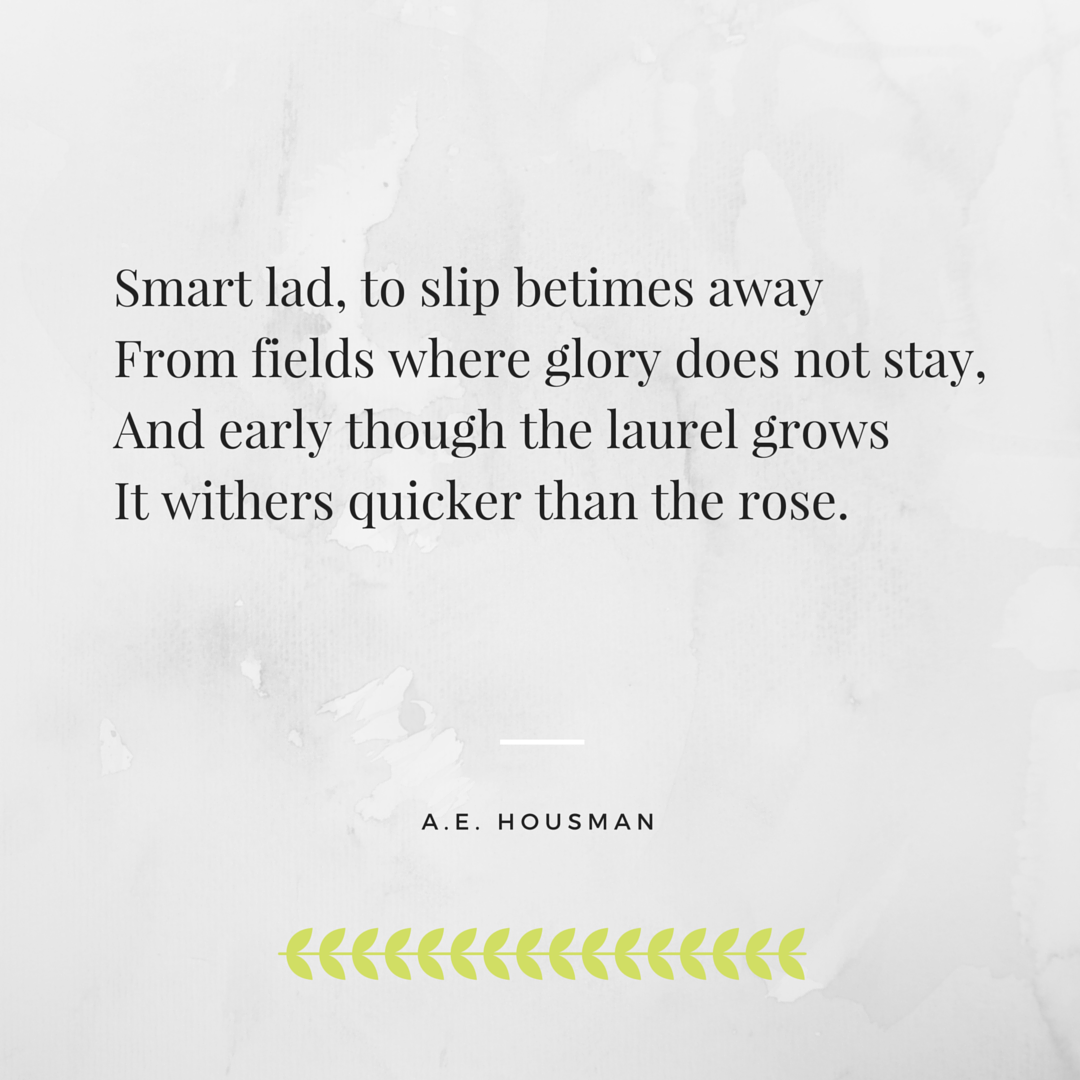
“And early though the laurel grows / It withers quicker than the rose.”

Readers might notice that on or around April 11 every year I post a poem like this one, in honor of someone I loved very much.


To an Athlete Dying YoungHousman

A. E. Housman

The time you won your town the race
We chaired you through the market-place;
Man and boy stood cheering by,
And home we brought you shoulder-high.

Today, the road all runners come,
Shoulder-high we bring you home,
And set you at your threshold down,
Townsman of a stiller town.

Smart lad, to slip betimes away
From fields where glory does not stay,
And early though the laurel grows
It withers quicker than the rose.

Eyes the shady night has shut
Cannot see the record cut,
And silence sounds no worse than cheers
After earth has stopped the ears.

Now you will not swell the rout
Of lads that wore their honours out,
Runners whom renown outran
And the name died before the man.

So set, before its echoes fade,
The fleet foot on the sill of shade,
And hold to the low lintel up
The still-defended challenge-cup.

And round that early-laurelled head
Will flock to gaze the strengthless dead,
And find unwithered on its curls
The garland briefer than a girl’s.


(Rest in peace, EVC.)

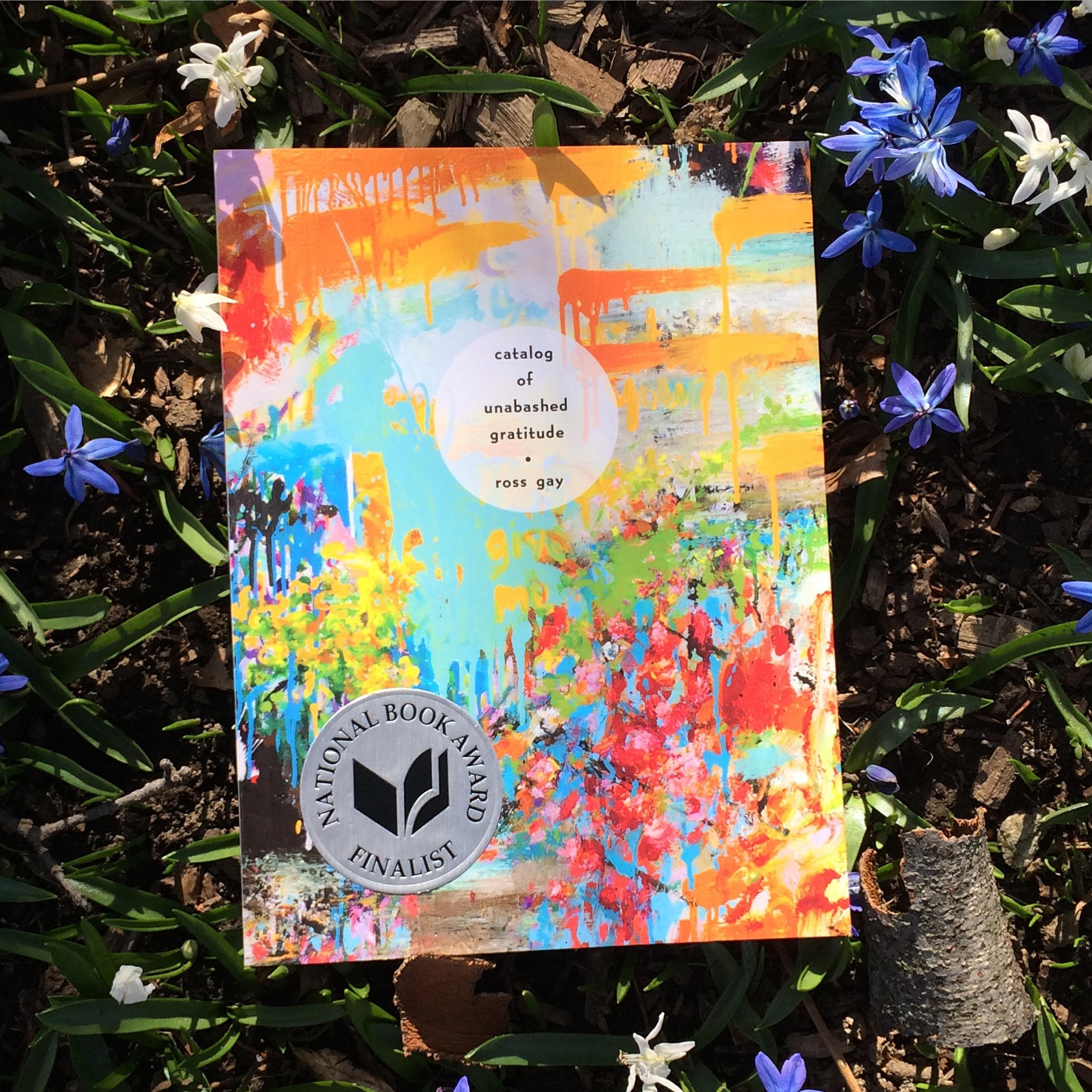
Recommended (Poetry) Reading: Ross Gay’s Catalog of Unabashed Gratitude

IMG_6414As I thought about how to describe Ross Gay’s Catalog of Unabashed Gratitude, I found myself turning into some sort of very specific thesaurus: his work is ebullient, irrepressible, joyous, boisterous. I loved it without reservation.

In this collection you’ll find a wonderful poem about strangers in a city gathering to pick figs from an overladen tree; an epithalamion (one that I would have liked at my own wedding); a searing, funny, furious elegy for the poet’s friend Don Belton; reflective poems about the poet’s parents; many poems celebrating gardens, orchards, and green growing things.

It took me a bit to adjust to Mr. Gay’s lines, which are often quite short, with limited punctuation, but I came to find that these kinds of lines offered me the chance to be deeply attentive, unstrung from my usual way of seeing a line and automatically looking for the outlines of a sentence. Here are the first few lines of “Ode to the Puritan in Me”:

There is a puritan in me
the brim of whose
hat is so sharp
it could cut
your tongue out

I think my favorite poem in the collection might be the wholly unexpected “Last Will and Testament,” but since I couldn’t find it online, here’s a link to the collection’s title (and penultimate) poem, “Catalog of Unabashed Gratitude.”

I love the way the poem invites the reader in by opening with a direct address (“Friends”—a strategy you’ll see more than once in the collection), and then sweeps into an account of a dream. Now, like most people, I find other people’s dreams rather a trial to hear or read about, but not this one. In the dream is a command to speak, and so begins the catalog of gratitude, with an orchard sunk into colorfully acquired compost:

twirling dung with my pitchfork
again and again
with hundreds and hundreds of other people
we dreamt an orchard this way,
furrowing our brows,
and hauling our wheelbarrows,
and sweating through our shirts,
and two years later there was a party
at which trees were sunk into the well-fed earth,
one of which, a liberty apple, after being watered in
was tamped by a baby barefoot
with a bow hanging in her hair
biting her lip in her joyous work
and friends this is the realest place I know,


This poem is absolute magnificent; I was crying by the end of it. I highly recommend this remarkable book. 

If this quick review piques your interest, you might like:

Ross Gay’s tour of his garden in essay form

This correspondence in poems between Mr. Gay and poet Aimee Nezhukumatathil about their gardens. 

No Joke: The Poetry Concierge Returns

PoetryConciergeDear Readers,

Remember way back in the mists of time when I spent a few months as the self-dubbed Poetry Concierge? I’m bringing the feature back for this year’s National Poetry Month. Read on, and put me to work handpicking poems!


Was the last time you read poetry sometime during a high school English class? Do you want to love poetry, but don’t know where to start? Are you slightly embarrassed that you can’t remember the last time you bought a book of poems?

Friends, I’m here to help. I’m your poetry concierge.

Yes, this April — and for the rest of the life of this blog, I hope — I’ll be available to lead you to the sweet springs of verse, where you may sip or swill to your heart’s content.

Here’s how to help your Poetry Concierge help you:

Send me an email [rosemaryandreadingglasses (at) gmail (dot) com] with your name as you’d like it to appear, a link to your blog or website if you’d like, and answers (as specific as possible) to the following questions:

1. When you read fiction, who’s your go-to author?

2. If you read nonfiction, which subjects are most likely to interest you? (cultural history, science, biography, memoir, survival stories?)

3. If you were stuck on a desert island for a week, which five books would you bring to keep you entertained?

4. If you were on a five-year mission to Mars, which five books would you bring to keep you sane?

5. What kinds of questions are most likely to keep you up at night? (death, the nature of love, politics, environmental issues, meaning of life, end of the world, justice and injustice, etc?)

6. If you’ve read poetry before, what have you liked? What have you disliked?

7. Would you like your name and/or blog to be published on Rosemary and Reading Glasses along with your recommendation?

8. (optional) Are you looking for a poem or poet to help you through a tough time, or to help you answer a question? If so, please explain.

I’ll read your answers and come up with a poet, a poem, or even a book for you to try out (maybe even more than one!).

As soon as I can, I’ll publish your answers to the questionnaire, and my recommendation, on Rosemary and Reading Glasses (with your name removed, if you so choose). If you want to report back on what you think of my choice, all the better! If you have a poetry emergency, (proposal, wedding, retirement, etc.), please be sure to tell me that, preferably in bold print. 

Poetry Concierge posts won’t appear on any set schedule, but I’d love to make a few recommendations soon, in honor of National Poetry Month, so bring on those questionnaires!

Yours in verse,

Carolyn the Poetry Concierge


Previous Poetry Concierge picks:

Natasha Trethewey

Dorothy Parker

Margaret Atwood

Tracy K. Smith and Anne Carson

Ashley Anna McHugh and Rebel Angels: 25 Poets of the New Formalism

Rumi

Sharon Olds

Li-Young Lee

Samuel Taylor Coleridge

Robert Frost

“we can say at least the lettuce loved the rain”: Lisa Olstein’s “Dear One Absent This Long While”

Lisa Olstein_Dear One Absent This Long WhileLisa Olstein’s “Dear One Absent This Long While” is a lovely poem, and especially appropriate for the rainy early spring we’re having here, when “everything blooms coldly.”

In what I thought of as an unsent letter, the speaker addresses the absent person—though the poem leaves open the identity of the missing loved one—revealing how she’s been so anxious to see him or her that she’s mistaken “leaves in the wind,” “the retreating shadow of a fox, daybreak” for the return of the absent loved one.

In the meantime, the speaker (solitary, we understand, since the other who wait are the cat and the stove—stoves in poems always remind me of Bishop’s “Sestina,” by the way) takes to planting to pass the time:

June efforts quietly.
I’ve planted vegetables along each garden wall


so even if spring continues to disappoint
we can say at least the lettuce loved the rain.
Initially stopped short by the unusual verb choice in that first line (“June efforts quietly”), I’ve since come to like it; it suggests the whole month is gathering its forces with the speaker, to try to wait out this rainy, lonely period.
What do you make of the last three stanzas? There’s the contrast of the new gardening tools with the practice of eulogies (eulogies that either describe animals or describe people using animals as metaphors) and the suggestion of death and decay (the “unrabbited” woods instead of the fecundity associated with rabbits). The beloved’s name is spoken by leaves that somehow chatter (like books?)–but are the leaves on the trees, or lying dead on the forest floor? Lots to think about.