“I want you and you are not here. I pause”

Tomorrow, someone I love would have turned 31.Carol Ann Duffy, Selected Poems

I bought my first Carol Ann Duffy book when he was twenty-three and I was twenty-one and we were friends. He was out in California, studying poetry, and I was visiting Paris, and bought a beautiful paperback version of Ms. Duffy’s Selected Poems at Shakespeare and Co., perhaps the most storied independent bookstore ever, a feast for the imagination of literary types (I also bought Roald Dahl’s Fantastic Mr. Fox, if you were wondering). I bought her Selected Poems because I already loved (and sill do) the sexy, glowing “Warming Her Pearls,” but I didn’t know then that the book will always fall open on another page.

“I want you and you are not here.” That’s the first, plaintive sentence of Carol Ann Duffy’s wonderful poem “Miles Away,” which is about conjuring up the presence of the absent beloved in thought and language. It’s such a perfect rendering of what I felt so keenly for so many months, and still sometimes, that I can only point toward the poem itself:

                        I have got your mouth wrong,
but still it smiles. I hold you closer, miles away,
inventing love, until the calls of nightjars
interrupt and turn what was to come, was certain,
into memory.

This one’s for you, EVC.

“This is the barrenness / of harvest or pestilence.”

Better late than never, right? It’s been three days since All Souls Day, but I’m still mulling over Louise Glück’s creepy and just-right poem, “All Hallows.

Image Hay Bales On Freshly Harvested Fields" Courtesy of Franky242/ freedigitalphotos.net

Image Hay Bales On Freshly Harvested Fields” Courtesy of Franky242/ freedigitalphotos.net

I like that the particular line I’ve quoted in the post’s title captures the dichotomy of the end of fall (well, at least here it feels like the end of fall, even if there are technically six more weeks until winter) — it’s difficult to discern, sometimes, whether it feels like the ground underfoot is dying or bursting with life.

Just now the first stanza of the poem, which begins, “Even now this landscape is assembling.” suggests to me a painting, I think a Monet, of the gathered hay covered in lavender snow. Come to think of it, I can bring to mind several summer and spring paintings, and not a few decked with snow, but I’m having a difficult time coming up with a fall painting (if you have one you like, let me know!). Maybe that’s because, as the first line suggests, autumn “is assembling” itself for winter; it’s a flux-state, not even, really, itself.

Recommended Reading: The Niagara River, by Kay Ryan

Back in late July, I featured a poem called “Thin,” by Kay Ryan.  I liked it so much that I went to the library that week to find a full-length book of hers, and the library obligingly provided The Niagara River. As a child, I spent many happy summer afternoons jumping into the Niagara River from my Uncle Bill and Aunt Mary Kay’s dock, so the whole thing seemed beshert.

Image courtesy of  George Stojkovic / Freedigitalphotos.net

Image courtesy of George Stojkovic / Freedigitalphotos.net

I love these poems. They’re unlike any others in my pretty extensive poetry library. They’re short, rarely flowing from one page onto another, and the lines are short as well, often just three or four syllables in length. I found the rhythm, and the occasional rhymes, jarring, but not unpleasantly so. Many of the poems end with a subtle twist, a line that forces the whole poem into sharper focus. These poems call for slow reading and then re-reading; I wanted to savor and remember them.

Some of my favorites in this volume are “Carrying a Ladder,” “Sharks’ Teeth,” “Green Hills,” “Ideal Audience,” “Hide and Seek,” and “The Well or the Cup.” I hope you’ll have a look at them for yourself.

“And what rough beast, its hour come round at last, / Slouches towards Bethlehem to be born?”

Halloween approaches, friends, and what better way to ring it in than with the scariest freakin’ poem in the English language? That’s right: we’re bringing out W.B. Yeats’s “The Second Coming.”

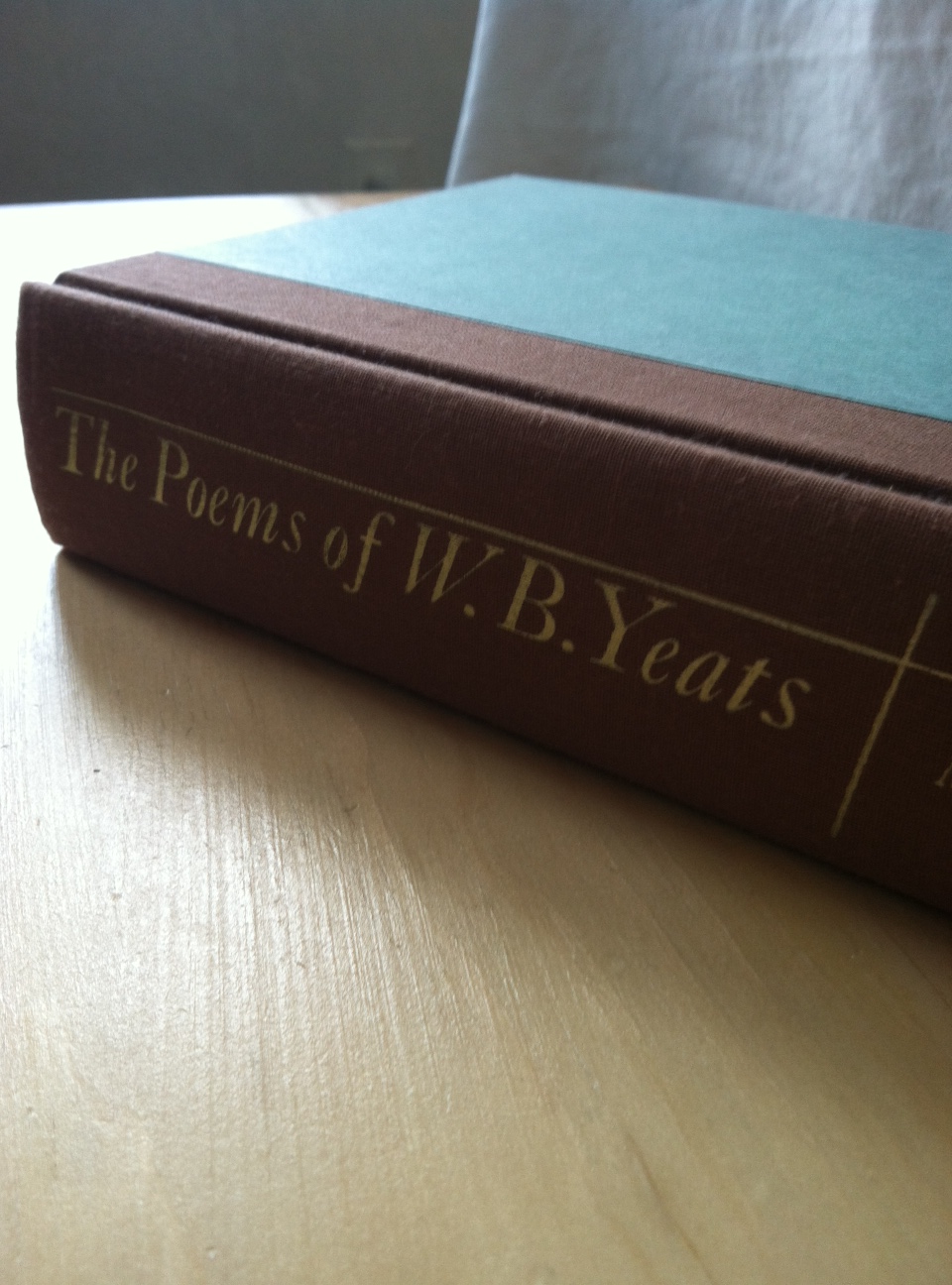
Collected Yeats

You know it’s bad when “Mere anarchy is loosed upon the world” (l.4). I mean, anarchy is bad, not just “mere,” right? Really bad, à la The Dark Knight Rises? Turns out that’s just the start:

The blood-dimmed tide is loosed, and everywhere
The ceremony of innocence is drowned;
The best lack all conviction, while the worst
Are full of passionate intensity. (ll.5-8)


And then there’s the Big Bad, as fellow Joss Whedon fans* might say: a thing, its gaze “blank and pitiless as the sun,” “A shape with lion body and the head of a man.” It’s the formlessness that’s frightening; there’s no sign of intelligence in the blank eyes. It’s inexorable, this shape. It’s not a lion with a man’s head, but a shape. And get this: it’s “moving its slow thighs.” It’s in no great rush to destroy the world, because the destruction is inevitable.  If that doesn’t give you the creeps, I don’t know what will.

Wait a second. Yes I do. This will:

The darkness drops again; but now I know
That twenty centuries of stony sleep
Were vexed to nightmare by a rocking cradle,
And what rough beast, its hour come round at last,
Slouches towards Bethlehem to be born?

*First Evil, anyone?

[Honorable Mention, Children’s Category: “Seein’ Things,” Eugene Fields]

What’s your pick for scariest poem?

“There were ten thousand thousand fruit to touch, / Cherish in hand, lift down, and not let fall.”

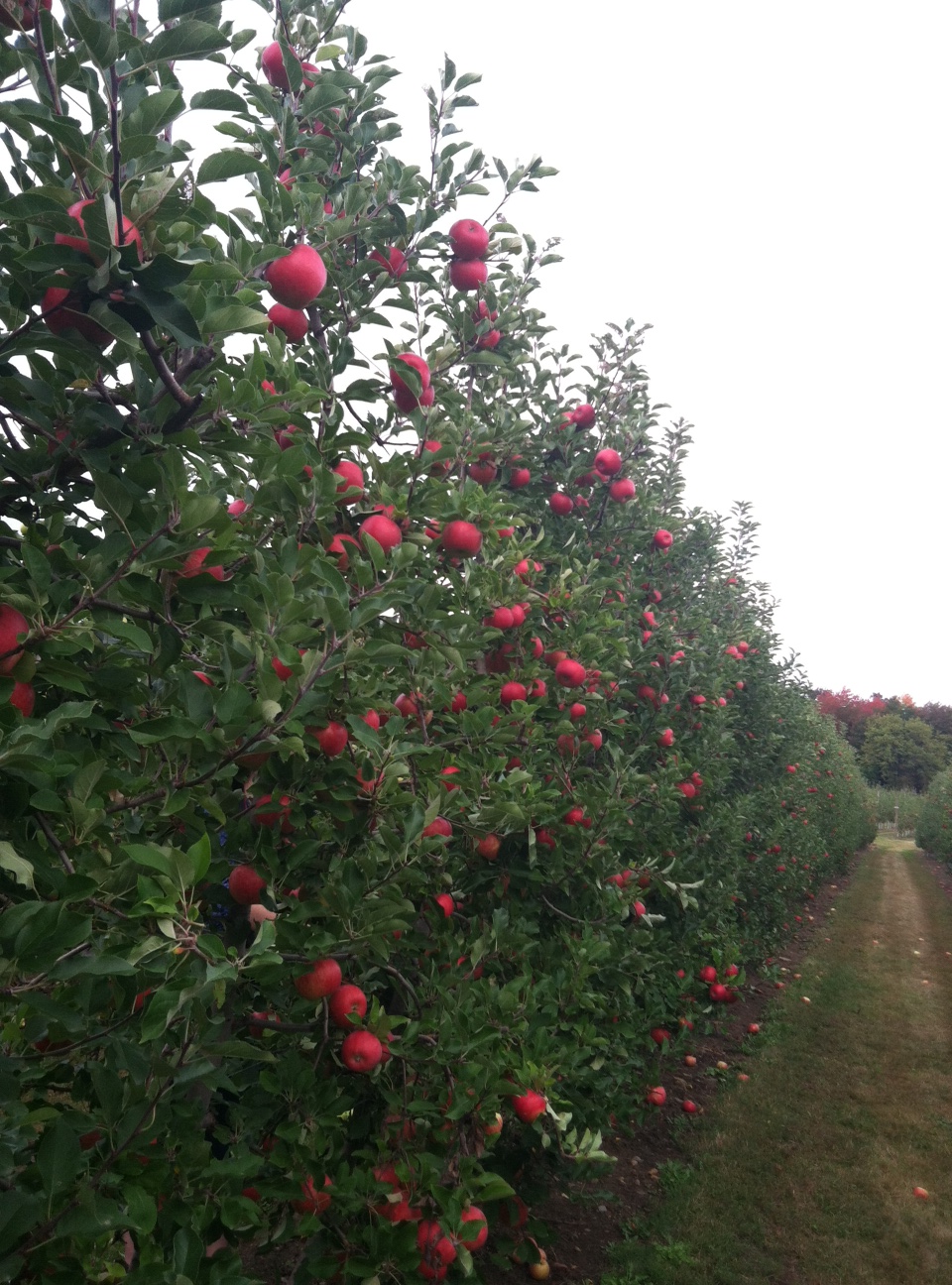
Tougas farm, apple season Photo by CR OliverI remember assigning Robert Frost’s “After Apple Picking,” along with “Birches” and “Mending Wall” to my first-ever college class. I was twenty-two, and at least one of the seniors in the class was older than I was. A clerical error had given me a class of thirty instead of twenty, and we were assigned a narrow, windowless room on the second floor of the library. The heaters clanged on in August and the noise of campus construction somehow reverberated in that room.

It was glorious.

I loved being a newly-minted teacher, choosing readings and building a course that I wanted to teach (and take). I loved practicing my students’ names so that they would feel comfortable in class (one Thai last name was a real tongue twister!), and I loved watching their ideas spill onto the chalkboard. There’s no better job than being a tour guide through literature.

I chose to teach Frost because we’re in New England, after all, and he’s THE New England poet, and I encouraged my students to get out of the city and see the beautiful blend of colors in the trees. I’ve gone apple picking each fall with Mr. O since we started dating, and there’s nothing like the blue sky and the fiery trees and the red, red rows of apples.

“After Apple-Picking” is a dreamy meditation on life and death, sleep and wakefulness. Maybe we too will look back on moments both missed and remembered, and think,

“There were ten thousand thousand fruit to touch,
Cherish in hand, lift down, and not let fall.”

“though chimneys smoke and blue concedes / to bluer home-time dark”

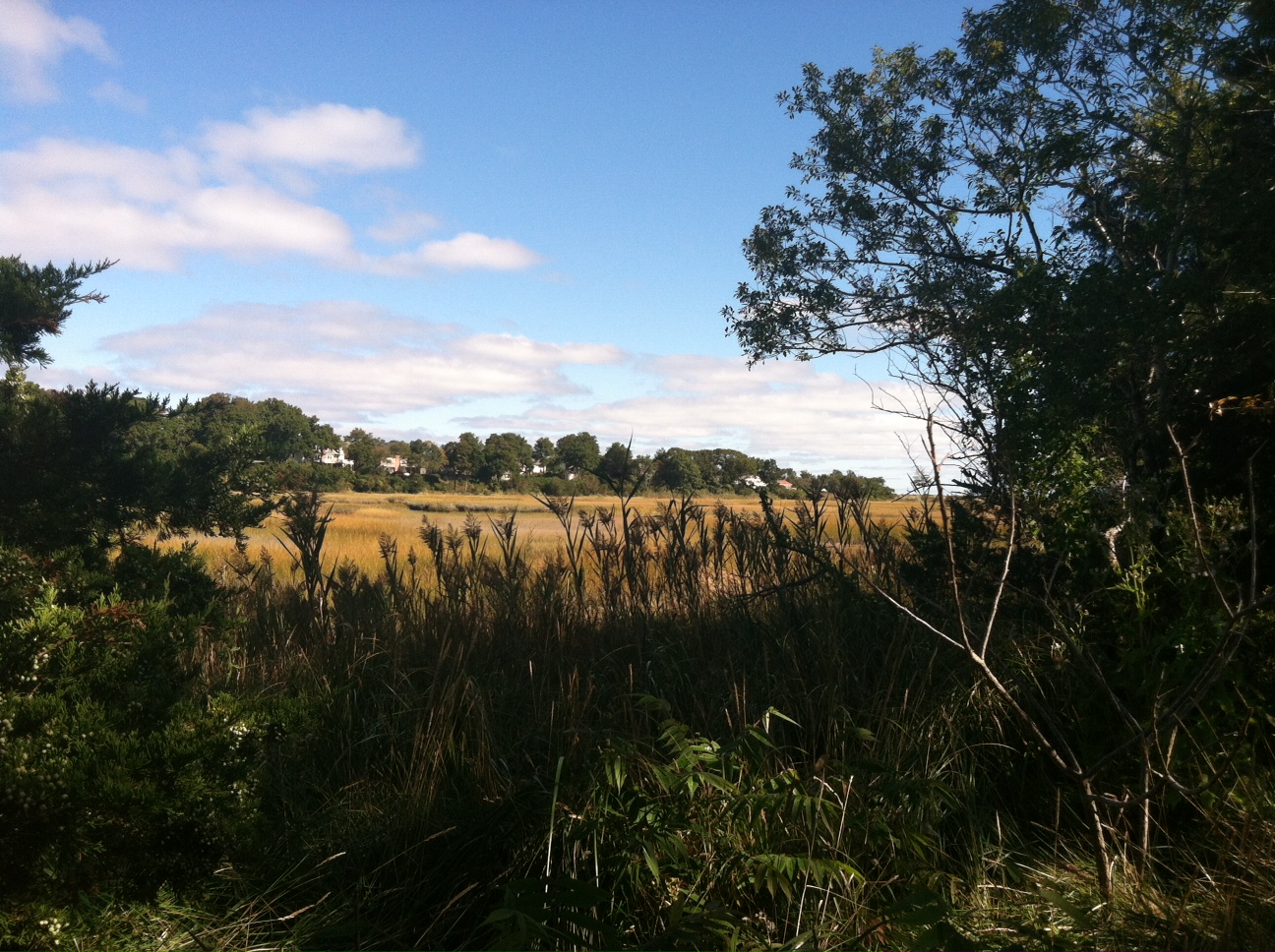
Sandwich Marsh in Fall, by CR OliverA very apropos poem this week: Jacob Polley’s “October,” which you can read here. I love formalist poetry (you might have noticed), and I think this poem is just lovely. In the first stanza, the speaker describes the change of the seasons, the way the sky-blue of summer six o’clock becomes the midnight blue of autumn six o’clock, graciously giving way (my favorite image in the poem, which I’ve quoted in this post’s title).

It’s a poem about change and continuity, perfect for a fall day. I hope you’ll read it and tell me what you think!

“And beyond them a stretch of open country / That strives into the sea.”

Ashley McHugh*, a poet and friend, directed my attention to this poem, “A Figure of Plain Force,” by Michael Heffernan (to be more precise, she pointed out the next poem on the page, but I was drawn to the first poem).

Grass by C.R. Oliver

In “A Figure of Plain Force,” the speaker considers “you,” a person turned into an open door in the early morning. We aren’t given anything about their relationship, or even the person’s gender, but I couldn’t help imagining the speaker as a child remembering his mother readying herself to meet the day. She might work on “nothing of consequence,” or perhaps she’ll fall into a whirl of activity to finish a task she’d left undone.

As you’ll note from the line I pulled for the title, the location is somewhere near the ocean, but when I read these lines:

In this condition you pretend to lean
Solidly into the open while you gather
The winds about you by deliberate grace
Turning you into a figure of plain force,
Careful and candid, never in a dither,
Given to nothing noisome or unclean.

I can’t help but think of a pioneer woman looking out onto a sea of prairie grass, formidable in her determination.

What’s your reaction to the poem?

*By the way, you should check out Ashley’s glorious first book, Into These Knots.

Why I Love Parks & Rec, or “O were my Love yon Lilack fair”

I love Parks and Recreation. Amy Poehler can do no wrong, of course, but it’s the show’s pitch-perfect blend of snark and heart that gets me every time. And also Ron Swanson. Oh Ron, you magnificent bastard, with your mustache and your Lagavulin and your love of breakfast food and pretty dark-haired women  . . .

Image courtesy zirconicusso / Freedigitalphotos.net

Image courtesy zirconicusso / Freedigitalphotos.net

(This is not the time to ask, friends, if I bought a waffle maker to ring in the show’s sixth season.)

As I was saying.

Mr. O and I delayed our viewing of the premiere by a day because he was out of town (an act of true love, as those three of you who follow me on Twitter know).  Well worth the wait, the show pushed its characters around with wit and gusto. Stop reading now if you care about spoilers. Look for the bold when I start a-chatting about poetry.

By far my favorite set piece: Ron on a Leslie-designed train trip through northern England and into Scotland, culminating in a visit to the Lagavulin distillery. But here’s the best part: Ron sitting on a green, craggy piece of land, reading the poetry of Scotland’s favorite son out loud — “O were my Love yon Lilack fair.” And tearing up. I sure did.

So, let’s talk about poetry and Scotch, and you’re safe to come back now, people who didn’t want to read spoilers. 

I came across Bobby Burns some time in college, but his genius didn’t truly hit home until I hosted an ersatz Burns supper when I was a young lass in grad school. In reality, it was more like a boozy birthday party with poetry (January 25th, if you were wondering, is Burns’s birthday). My friend Emily, having brought a fine single malt, performed another wondrous service, reciting “The Mouse” with an amazing Scots burr. It was a fine evening. I recommend hosting one such gathering yourself to keep off the winter chill. Here are the steps:

1. Make some food and buy a bottle of Scotch.
2. Invite your friends to bring a bottle of Scotch over.
3. Eat, drink, read Burns, and assign designated drivers. (Be safe and make good choices, as my college roommate’s mother liked to say.)

Now that I’ve assured you that I, like Ron Swanson, enjoy scotch, let me tell you that I also love the subjunctive, fast becoming a forgotten mood in English. If there’s a poet who loves the subjunctive, that poet is Robert Burns.

Here’s Burn’s “O were my Love yon Lilack fair”:

O were my Love yon Lilack fair,
Wi’ purple blossoms to the Spring;
And I, a bird to shelter there,
When wearied on my little wing.

How I wad mourn, when it was torn
By Autumn wild, and Winter rude!
But I was sing on wanton wing,
When youthfu’ May its bloom renew’d.

[O gin my love were yon red rose,
That grows upon the castle wa’!
And I mysel’ a drap o’ dew,
Into her bonnie breast to fa’!

Oh, there beyond expression blesst
I’d feast on beauty a’ the night;
Seal’d on her silk-saft faulds to rest,
Till fley’d awa by Phebus’ light!]

In other words, sic transit gloria mundi, but isn’t it something in the meantime?

“I prove a theorem and the house expands:”

Rita Dove’s poem “Geometry” is one I’ve been saving for fall, because the title reminds me of school (sorry, Mrs. A, but your ninth-grade classroom is still the only place I’ve ever tried to prove a theorem).  As you might guess from its first line (reproduced in this post’s title), it’s about the feeling of expansion that comes when you stretch your mind over unfamiliar pathways.

Image Courtesy Grant Cochrane / Freedigitalphotos.net

Image Courtesy Grant Cochrane / Freedigitalphotos.net

You can find “Geometry” in Ms. Dove’s Selected Poems, and you can read more about the poet and her work at the Poetry Foundation.

By the by: A couple weeks ago I highlighted Tami Haaland’s poem “A Colander of Barley,” and Ted Kooser (Poet Laureate, 2004-2006) selected it this week for his “American Life in Poetry” series. I love getting a poem in my inbox every week; you can sign up here.

Recommended Reading: American Wife, by Curtis Sittenfeld

At 555 pages, this novel, inspired by the life of Laura Bush, is quite an undertaking, in more ways than one. The original four Literary Wives bloggers — Angela, Ariel, Audra, and Emily — have reviewed the book with more insight than I’ll be able to muster, but I thought I’d share just a few thoughts.

American Wife

First, some highlights, passage-wise, for me:

  • Alice’s love for the Midwest: “It is quietly lovely, not preening with the need to have its attributes remarked on” (53).
  • “When you are a high school girl, there is nothing more miraculous than a high school boy” (58).
  • The passage about Alice and Charlie during the tornado warning (193-96); Alice and Charlie are from Wisconsin, and Ms. Sittenfield, like yours truly, is a native of Ohio. I live outside Boston now, and the Boston-born didn’t have tornado drills growing up, and are always amused at the description I provide. But I’ve never been really close to  a tornado, and I have no desire to be, ever. Sidebar here: Immediately read Catherine Pierce’s amazing poem “The Mother Warns the Tornado.”
  • “I have always had a soft spot for people who talk a lot beause I feel as if they’re doing the work for me” (223).
  • I can’t find the page, but I liked the way Alice recognized a single woman based on what she was buying at the grocery store — yogurt and apples (though I have to say, I bought my fair share of hamburger as a single woman. Spaghetti is always the right answer to “What should I make for dinner?”). The novel is full of nice little details like this.
  • Almost any passage involving Alice’s grandmother.
  • “But I should note, for all my resistance to organized religion, that I don’t believe Charlie could have quit drinking without it. It provided him with a way to structure his behavior, and a way to explain that behavior, both past and present, to himself. Perhaps fiction has, for me, served a similar purpose—what is a narrative arc if not the imposition of order on disparate events?—and perhaps it is my avid reading that has been my faith all along” (429-30).

I found Alice, the main character, both intriguing and infuriating, both a product of her time and well ahead of it.

I think Alice’s nods to her privileged existence (when she’s at the pool with Jadey, when she’s thinking about the war at the novel’s end) were cursory, but I couldn’t tell if this is a fault in Alice’s thinking or the author’s failing. Sure, Alice is charitable and cares about others less fortunate than she, but she allows her values to be completely overshadowed by her husband’s. It’s as if Alice disappears, and I didn’t feel Ms. Sittenfield provided a satisfactory explanation for Alice’s weak attempt to explain herself (sorry, “they elected him, not me” doesn’t cut it). At the very least, as a citizen, she should feel free to express her views to her husband.

(Please note: I’m not judging Laura Bush here, because I don’t have the access to the interior self that Sittenfeld provides us for Alice. And literacy rules.)

Despite my frustration, I thought the book was excellent, and as I went along, I began to think that maybe the unresolved ambiguities in Alice’s thoughts and behavior are meant to be inscrutable; after all, how much do we really know about our neighbors’ marriages, or about our own? How much do we want to admit to ourselves?