The Poetry Concierge Recommends: Rose, by Li-Young Lee

[The Poetry Concierge is an occasional feature here on Rosemary and Reading Glasses wherein I select a poem, poet, or book of poems for individual readers based on a short questionnaire. Come play along! Read the introductory post here, my first recommendation here, and then email me at: rosemaryandreadingglasses [at] gmail [dot] com. ]

This week, our pilgrim in search of poetry is Cecilia, who writes about life, reading, and parenthood at Only You.


1. When you read fiction, who’s your go-to author?

I have more than one! Junot Diaz, Kazuo Ishiguro, Jhumpa Lahiri, Charlotte Bronte

2. If you read nonfiction, which subjects are most likely to interest you? (cultural history, science, biography, memoir, survival stories?)

memoir, personal essays, history, psychology

3. If you were stuck on a desert island for a week, which five books would you bring to keep you entertained?

This is How You Lose Her (Junot Diaz) and Me Talk Pretty One Day (David Sedaris), for the comfort factor (re-reads by two of my go-to authors); Never Let Me Go (Kazuo Ishiguro) because everyone’s been telling me how amazing this book is; In the Blood by Lisa Unger (I have never read her but this sounded good, as something fast and entertaining); and Teaching My Mother How to Give Birth (Warsan Shire), a book of poetry I haven’t yet read but want to.

4. If you were on a five-year mission to Mars, which five books would you bring to keep you sane?

One comfort book: Me Talk Pretty One Day (David Sedaris) and four books that have been on my to-read list: Middlemarch, either Anna Karenina or The Golden Notebook, Life After Life (Kate Atkinson), and The Mayflower & The Pilgrims’ New World (Nathaniel Philbrick)

5. What kinds of questions are most likely to keep you up at night? (death, the nature of love, politics, environmental issues, meaning of life, end of the world, justice and injustice, etc?)

Closer to home – the meaning/purpose in life, how I’m doing as a parent

The bigger picture – human rights, civil rights

6. If you’ve read poetry before, what have you liked? What have you disliked?

I’d only read an excerpt but I was completely blown away by the writing in Teaching My Mother How to Give Birth by Warsan Shire.

We studied quite a bit of poetry during high school but it was never one of my favorite subjects. I think that my early education in poetry reinforced my fears that poetry is impossible to decipher and difficult to access. A couple of exceptions were Robert Frost and Edgar Allen Poe, whom I did enjoy.


[Sidebar: Never Let Me Go is amazing, and everyone should read it.]

From Cecilia’s list of go-to authors, I got the sense that writing that deals with the immigrant experience is important to her, as well as writing that focuses on the interiority of its characters. One name leapt to mind, and stayed with me as I read the rest of Cecilia’s answers: Li-Young Lee.
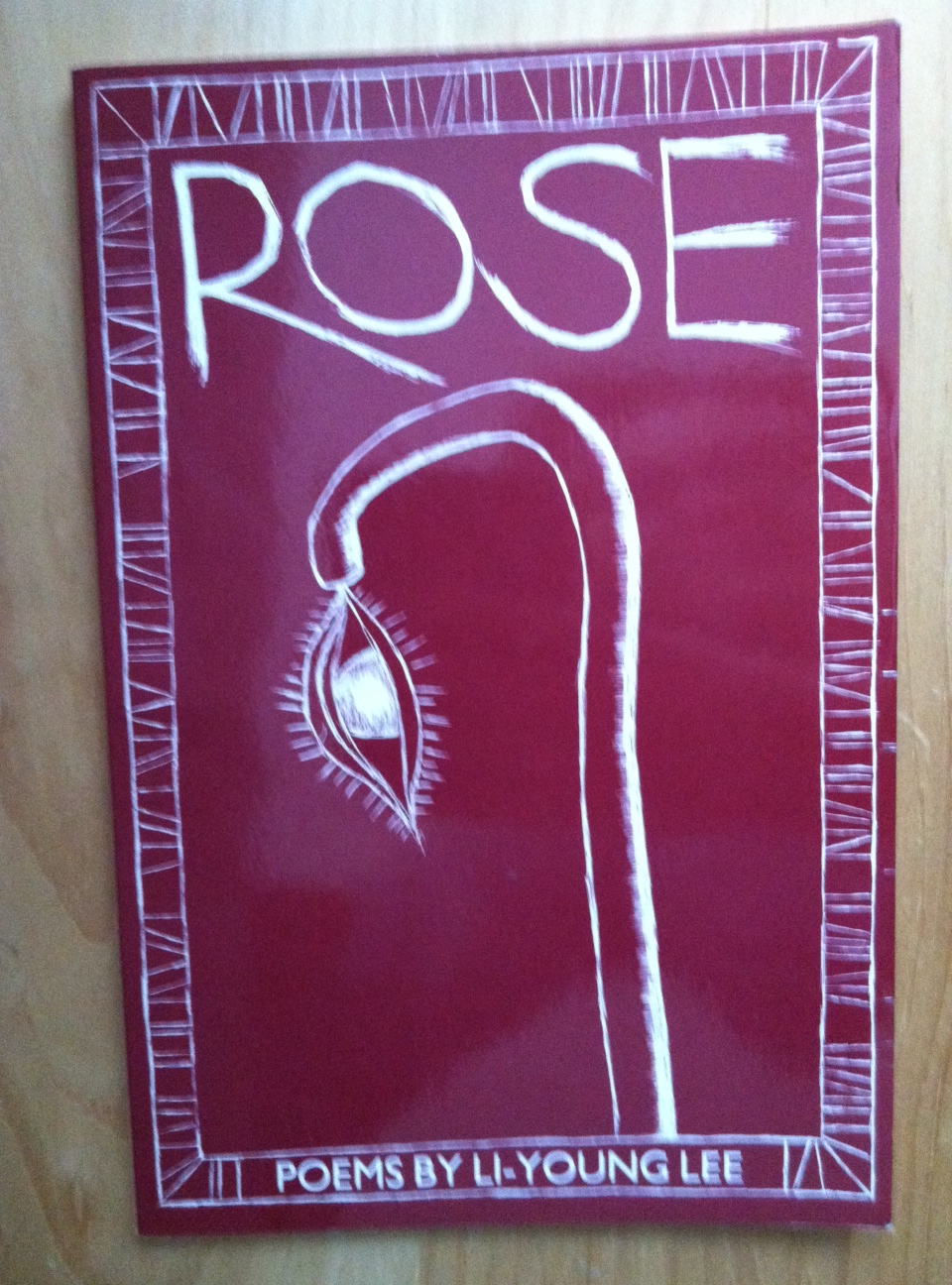
photo (77)Li-Young Lee’s poetry is intensely lyrical and personal. Born in Indonesia to Chinese parents who fled China for political reasons, Mr. Lee came with his family to the United States in 1964. His family (especially his father and his wife) plays a major role in the poetry of Rose, his first collection, which I’m recommending for Cecilia. “The Gift” and “Persimmons” (frequently anthologized) are the second and third poems in the book. In “Persimmons,” the speaker remembers:

In sixth grade Mrs. Walker
slapped the back of my head
and made me stand in the corner
for not knowing the difference
between persimmon and precision

This startling, painful memory forms the foundation of the poet’s exploration of life in two cultures, and how the senses tie us to memory. In fact, because of this poem, I remember the very first time I saw a persimmon in a market, and what it felt like to cut into it at home.

In “The Gift,” the speaker remembers his father pulling a splinter from his hand. It’s one of the most beautiful poems about parents and children that I’ve ever read.
Cecilia, I hope you’ll find poems you love in Rose. Thanks for writing in!


Would you like the Poetry Concierge to make a recommendation for you? Check out the introductory post, and send your answers to the questionnaire, along with the name and/or blog you’d like posted with the reply, to rosemaryandreadingglasses [at] gmail [dot] com.

The Poetry Concierge Recommends: Two Books, This Time Per Request

[The Poetry Concierge is an occasional feature here on Rosemary and Reading Glasses wherein I select a poem, poet, or book of poems for individual readers based on a short questionnaire. Come play along! Read the introductory post here, the first recommendation here, and then email me at: rosemaryandreadingglasses [at] gmail [dot] com.]

This week, our pilgrim in search of poetry is Rick, who blogs about books over at Another Book Blog. Rick went very public with his poetry concierge request (a minor, forgiven insurrection); he further stipulated that he’d like me to recommend two books of poetry, which will become part of his self-re-education program. No pressure or anything.

1. When you read fiction, who’s your go-to author?

I don’t know if I’ve ever had a go-to author, to be honest. I don’t have anyone specific that I turn to when I’m in a reading funk. If anything, my literary achilles heel has always been how easily I get bored with any one thing after a while. However, if there’s anyone who even comes close, it’s Tad Williams. He’s probably my single biggest inspiration, and the author from whom I’ve read the most.

2. If you read nonfiction, which subjects are most likely to interest you? (cultural history, science, biography, memoir, survival stories?)

I really love nonfiction books about people who challenge the status quo. I’m not a big backer of rebellion per se, at least not in any physical way, but intellectual rebellion really appeals to me. I’m fascinated by religion, and science, and historical shifts.

3. If you were stuck on a desert island for a week, which five books would you bring to keep you entertained?

A.J. Jacobs’ The Know-It-All, because it’s basically an encyclopedia in less than 400 pages. Bill Bryson’s A Short History of Nearly Everything, because it’s the best science text for the uninitiated I’ve ever read, and I swear to god it’s funny. Apathy and Other Small Victories, probably the funniest book I’ve ever read. Essex County, my favourite graphic novel of all time, a truly brilliant piece of literature short enough to savour in just a week of exile. And a book of Mad Libs, because ever since I discovered how funny they can be when you think of the most disgusting answers possible, they’ve been one of my favourite things on Earth.

4. If you were on a five-year mission to Mars, which five books would you bring to keep you sane?

I Know This Much is True by Wally Lamb, River of Stars by Guy Gavriel Kay, The Brothers Karamazov by Fyodor Dostoevsky, The Book of Joby by Mark J. Ferrari, and Skippy Dies by Paul Murray. Four of them because they’re four of my favourite single volume stories (and they’re all really long), The Brothers Karamazov because I’ve always wanted to read it, and five years on Mars sounds like I’d finally find the time.

5. What kinds of questions are most likely to keep you up at night? (death, the nature of love, politics, environmental issues, meaning of life, end of the world, justice and injustice, etc?)

I’ve always been a fan of righteous indignation. I’m fascinated by spirituality even though I don’t subscribe to anything in particular. I’m in awe of the universe and all it’s (likely) unanswerable questions. I couldn’t give two s**ts about conversations regarding politics and the environment because there hasn’t been a single one I’ve come across that hasn’t degenerated into smart people sounding like partisan a**holes. [Sorry for the censorship, but my Mom reads this blog, so, you know. –CO]

6. If you’ve read poetry before, what have you liked? What have you disliked?

The one work of poetry that’s actually resonated with me (that’s lasted more than a month is In Memoriam by Lord Alfred Tennyson. I’ve always been awestruck at how thousands of people have been arguing both for and against its Christian/anti-Christian message for hundreds of years. It takes a special kind of rhetorical talent to receive adamant support from both of those groups at the same time. For the record, I think it’s clearly a Christian poem by the end, but Tennyson’s willingness to question his faith has always been the measuring stick to which I hold up all religious persons. Furthermore, it’s just beautifully written and undeniably tragic and heartfelt.

As for what I don’t like: If you prescribe me something like The Red Wheelbarrow, then “Friends Off.”


Like I said, no pressure.

Rick’s into big ideas — science, religion, meaning of life, that kind of thing, so right off I dismissed light verse as a possibility, even though Rick has a wily sense of humor (no Edward Lear for you, Rick.). And while I’m tempted to round out Rick’s poetic education with other DWMs (Dead White Men, for those in the peanut gallery) — think Yeats, Eliot, Browning, Donne — I think living poets deserve to be read by a reader like Rick.

So here are my bold picks:

photo 2 (13)Anne Carson’s work defies categorization, blending poetry, Classics (capital-C), translation, drama, essays, prose, and scholarship. She’s a phenomenal intellect. I was tempted to start off with the unbelievably good Glass, Irony, and God, but given Rick’s fondness for Satan — the Miltonic Satan, that is — I think a poem about a winged red monster might be in order. Anne Carson’s Autobiography of Red is incredibly weird and wonderful, a novel in verse form (framed with some classical scholarship and jokes — just go with it, and it works) in which she transforms the myth of Geryon — said monster, killed by Herakles as one of his labors — into a most unusual bildungsroman. Geryon is a lonely, artistic soul, just a little boy when we first meet him, and Ms. Carson captures his pain and his pleasures with a lens that’s never sentimental, only scintillating. It’s heartbreaking and gorgeous. I’m surprised every time I re-read it.

Bonus: Anne Carson is Canadian, so Rick gets a little CanLit infusion for his syllabus.

Double Bonus: There’s a sequel!

photo 1 (16)Next, I’ve selected Tracy K. Smith’s Life on Mars (which won the Pulitzer in 2012). You want science and the universe, Rick? Here it is. As the New Yorker‘s review puts it, “Smith’s central conceit allows her to see us, our moment, as specks in the future’s rearview mirror. Futures and pasts are, in astronomy as in poetry, all mixed up.” Life on Mars is, in part, an elegy for Ms. Smith’s father, who worked on the Hubble space telescope. The tone varies from wonderment to fury and back again, as the poems consider matters both existential and quotidian, personal and political. Take a look at “Sci Fi,” which is the poem of the week, for an example of Ms. Smith’s original take on the future.

Rick, I (fervently) hope you’ll find poems you love in these books. Thanks for writing in!


Would you like the Poetry Concierge to make a recommendation for you? Check out the introductory post, and send your answers to the questionnaire, along with the name and/or blog you’d like posted with the reply, to rosemaryandreadingglasses [at] gmail [dot] com.
The Poetry Concierge Recommends: Sharon Olds

[The Poetry Concierge is an occasional feature here on Rosemary and Reading Glasses wherein I select a poem, poet, or book of poems for individual readers based on a short questionnaire. Come play along! Read the introductory post here, my first recommendation here, and then email me at: rosemaryandreadingglasses [at] gmail [dot] com. ]

This week, our pilgrim in search of poetry is Laura, who writes about things bookish at Reading In Bed.

1. When you read fiction, who’s your go-to author?

This is hard, there’s no one author who is perfect in my eyes. I might say Michael Ondaatje because I’m in love with him right now. Or I might say David Adams Richards, who if you haven’t read him, lists Faulkner, Dostoyevsky and Emily Bronte among his influences, which sounds about right.

2. If you read nonfiction, which subjects are most likely to interest you? (cultural history, science, biography, memoir, survival stories?)

Personal essays, feminism

3. If you were stuck on a desert island for a week, which five books would you bring to keep you entertained?

Astray by Emma Donoghue
The Many Lives and Secret Sorrows of Josephine B, Sandra Gulland
The Crimson Petal and the White, Michel Faber
High Fidelity, Nick Hornby
The Tenant of Wildfell Hall by Anne Bronte (haven’t read it yet FYI but it’s calling to me)

4. If you were on a five-year mission to Mars, which five books would you bring to keep you sane?
Love in the Time of Cholera
A Confederacy of Dunces
The Stone Angel
Mercy Among the Children
Having trouble with #5!

5. What kinds of questions are most likely to keep you up at night? (death, the nature of love, politics, environmental issues, meaning of life, end of the world, justice and injustice, etc?)
 

Nature of love 80+% of the time

6. If you’ve read poetry before, what have you liked? What have you disliked?

I like prose that reads like poetry. See comment about The English Patient above. In high school I liked John Donne. I liked The Inferno.


Like Kay last week, Laura’s given me lots to work with here: a wide range of authors (not surprising, I guess, since her one of her reading lists is 1001 books long), varied in tone, themes, and style; defined interests; and an openness to poetry in general.

Now, I was tempted to cheat a little and recommend Michael Ondaatje right off (maybe The Cinnamon Peeler?), but I suspect Laura’s thought of that one already. Given her interests in feminism and personal essays, though, I started thinking about feminist poets: Audre Lorde, Adrienne Rich, Carol Ann Duffy, Katha Pollitt, Carmen Giménez Smith (by no means is this an exhaustive list). I think Laura would like the work of any of these poets (and I was inches from choosing Audre Lorde’s “Now That I Am Forever with Child” but I can’t find an online source with copyright permission, so try your local library for her Collected Poems.).

That said, I think the work of Sharon Olds would appeal to Laura, and so I’m recommending Strike Sparks: Selected Poems 1980-2002, which I think gives a rounded view of her work up until that point (she’s published two collections since then; Stag’s Leap won the 2013 Pulitzer for poetry.

Ms. Olds draws on her personal experiences and familial relationships (and not infrequently, her sex life) to construct poems that are simultaneously deeply personal and startlingly universal. While her work is sometimes controversial because of its sexual content, I’m guessing Laura won’t bat an eye after that time we read a paranormal romance.

For now though, Dear Readers, here’s a G-rated but jarring poem to get you started with Sharon Olds:

“I Could Not Tell”

Laura, I hope you’ll find poems you love in this book (Michael Ondaatje did!).  Thanks for writing in!


Would you like the Poetry Concierge to make a recommendation for you? Check out the introductory post, and send your answers to the questionnaire, along with the name and/or blog you’d like posted with the reply, to rosemaryandreadingglasses [at] gmail [dot] com.

The Poetry Concierge Recommends: Two Books (oh my!)

[The Poetry Concierge is an occasional feature here on Rosemary and Reading Glasses wherein I select a poem, poet, or book of poems for individual readers based on a short questionnaire. Come play along! Read the introductory post here, my first recommendation here, and then email me at: rosemaryandreadingglasses [at] gmail [dot] com. ]

This week, our pilgrim in search of poetry is Abby, who blogs about invertebrate marine biology over at The Spineless Life. Weren’t expecting that, were you? Abby and I attended the same high school, walked the boards of the same stage, and now she’s an awesome scientist-ninja.

1. When you read fiction, who’s your go-to author?

My go-to authors change as I read through all of their material. Among people still writing, I am partial to John Irving and Ian McEwan, but also have a very strong liking for Steinbeck, Zola, and Edith Wharton (among recent favorites). Oh, and C.P. Snow.

2. If you read nonfiction, which subjects are most likely to interest you? (cultural history, science, biography, memoir, survival stories?)

I spend all day reading technical science writing, but I still love popular science, as well as travel memoirs. I frequently pick up histories and biographies but rarely make it through.

3. If you were stuck on a desert island for a week, which five books would you bring to keep you entertained?

5 books for a week? Oof. Let’s go with a book of nature essays by David Quammen, The Glass Bead Game (Hesse), Atonement, Slaughterhouse Five, and Wuthering Heights. (actually, that’s a nice cross-section of my strange reading habits right there.)

4. If you were on a five-year mission to Mars, which five books would you bring to keep you sane?
5 books for 5 years is actually easier, because my to-read list is full of long ones that would require that sort of time. War & Peace (no really, Anna Karenina is a favorite of mine), In Search of Lost Time (does that count as a single book?), Stephen Jay Gould’s The Structure of Evolutionary Theory, and to balance all of this heft, Paris to the Moon (Adam Gopnik, already read and loved), and A Tree Grows in Brooklyn (also a favorite).

5. What kinds of questions are most likely to keep you up at night? (death, the nature of love, politics, environmental issues, meaning of life, end of the world, justice and injustice, etc?)
 

Hm. Climate change. My love life. The meaning of family. The state of the academic job market.

6. If you’ve read poetry before, what have you liked? What have you disliked?

I love things that rhyme and have meter, and really don’t like things that don’t. I adore Poe and Longfellow, and “O Captain My Captain” and “The Charge of the Light Brigade” and “In Flanders Field” and pretty much everything else that you would find in an anthology of familiar, comforting verse. When I find something new that I really like, it has some element of familiarity — the rhyming scheme or the rhythm. French surrealism and I did not mix well.


There may have been a fist pump in my vicinity when I read the first phrase of Abby’s last answer: “I love things that rhyme and have meter.” Me too, ladyfriend, and while I’ll read pretty much any kind of poetry out there, there’s something sweet and satisfying about ye olde formalism.

Or, for that matter, the New Formalism. Yes, my Dear Readers, just like 90s fashion, formalism is back. Well, it never really went away (neither did 90s fashion, judging by the amount of flannel that’s lived in my closet for the intervening years), but let’s set that aside for the moment while I recommend post-World War II poetry for Abby.

Given Abby’s fearlessness toward long reading assignments (War and Peace, In Search of Lost Time), I’m going to be daring and recommend two books:

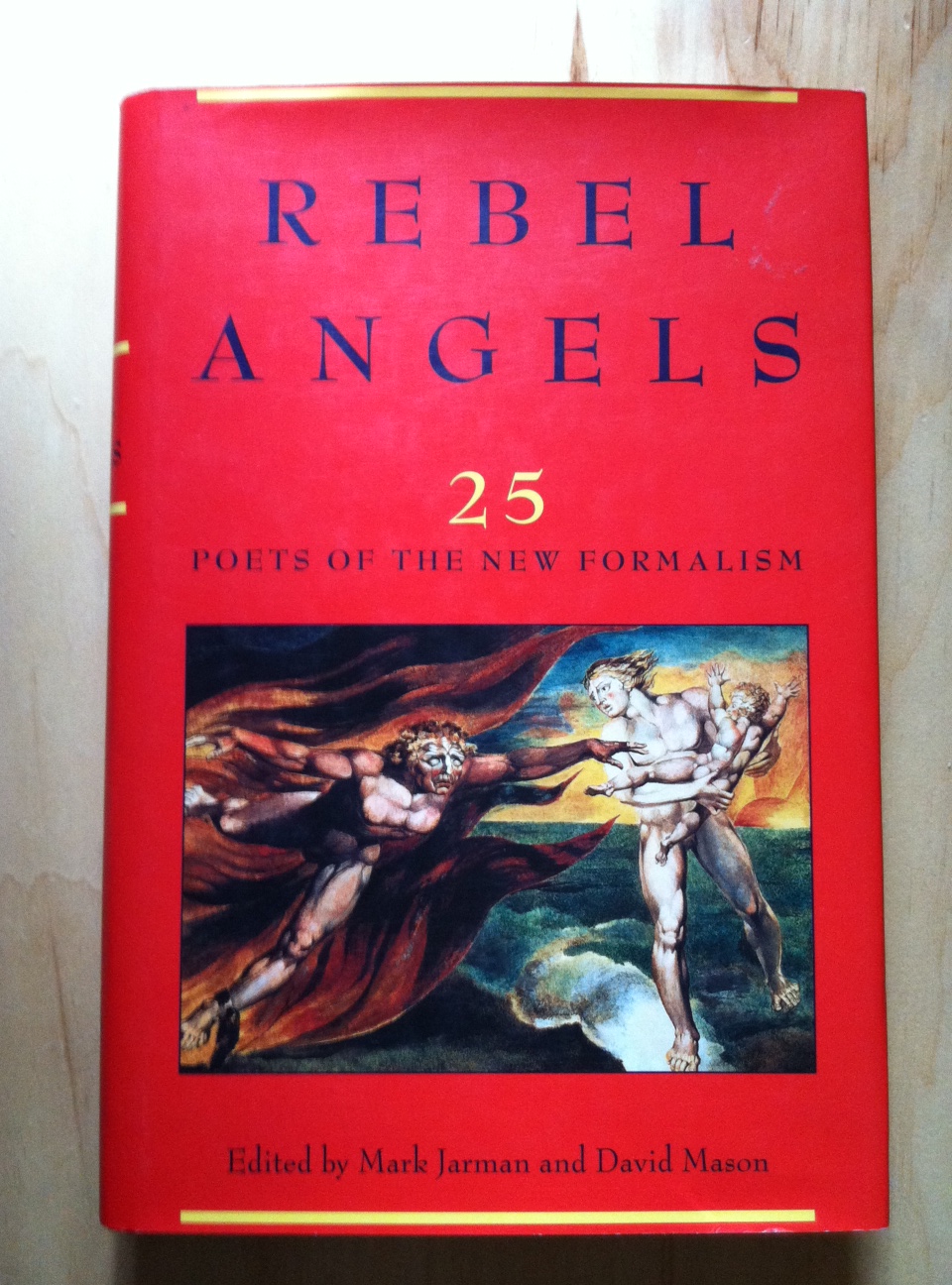
photo (73)Rebel Angels: 25 Poets of the New Formalism came out in 1996, and it’s a great sample of newer formalist work. As with all anthologies, not every poem will appeal to every reader, but I think Abby will find lots to like here. I’d especially recommend the poems by Andrew Hudgins, professor of poetry at The Ohio State University, fabulous reader, and friend of several friends.


photo (72)One of Professor Hudgins’s former students is Ashley McHugh, and it’s her luminous debut, Into These Knots, that I’m also recommending. (Full disclosure: Ashley is a friend, and I’ve met Andrew Hudgins a few times, and been regaled with tales of his workshops more times than I can count.)  Ms. McHugh is an especially accomplished sonneteer, as you’ll see when you read this poem, “The Unquarried Blue of Those Depths is All But Blinding,” which she wrote for her now-husband.

Abby, I hope you’ll find poems you love in these books. Thanks for writing in!


Would you like the Poetry Concierge to make a recommendation for you? Check out the introductory post, and send your answers to the questionnaire, along with the name and/or blog you’d like posted with the reply, to rosemaryandreadingglasses [at] gmail [dot] com.

The Poetry Concierge Recommends: Dorothy Parker

[The Poetry Concierge is an occasional feature here on Rosemary and Reading Glasses wherein I select a poem, poet, or book of poems for individual readers based on a short questionnaire. Come play along! Read the introductory post here, my first recommendation here, and then email me at: rosemaryandreadingglasses [at] gmail [dot] com. ]

This week, our pilgrim in search of poetry is Kay, who blogs about books over at WhatMeRead.

1. When you read fiction, who’s your go-to author?

I don’t know that I have just one go-to author, but maybe Jane Austen. I reread all her books every few years.

2. If you read nonfiction, which subjects are most likely to interest you? (cultural history, science, biography, memoir, survival stories?)

History and biography/memoir (but not usually celebrity biography/memoir) are my favorite nonfiction subjects. I read mostly biographies about figures from history, and literary people or artists.

3. If you were stuck on a desert island for a week, which five books would you bring to keep you entertained?

I would need a big book for the island, so that might be Bleak House. I would need something funny, so that might be something by Georgette Heyer, maybe Cotillion. I would need something I hadn’t read before, maybe another book by Halldor Laxness. I have The Fish Can Sing on my Wish List, so let’s pick that one. I would need something that makes me cry about someone else, so maybe Sense and Sensibility. I would need something about resourceful people to keep me encouraged, so maybe Life After Life by Kate Atkinson. I just read Robinson Crusoe, so I would NOT take that!

4. If you were on a five-year mission to Mars, which five books would you bring to keep you sane?
Hmmm, you’re really trying to make me think, aren’t you? If I was on a five-year mission to Mars, at least I would know I was coming back, so maybe that would be a different choice than the island all right. I’m thinking big books that feel like friends and I can read over and over again: David Copperfield, Jane Eyre, Cloud Atlas or The Thousand Autumns of Jacob De Zoet, maybe read The Luminaries again, and something with beautiful language I can puzzle over, maybe something I haven’t read by Nabokov.

5. What kinds of questions are most likely to keep you up at night? (death, the nature of love, politics, environmental issues, meaning of life, end of the world, justice and injustice, etc?)
 

I actually write reviews in my head at night after I finish a book. Sigh. Also, sometimes work.

6. If you’ve read poetry before, what have you liked? What have you disliked?

I have liked Frost, ee cummings, Shakespeare’s sonnets, some Yeats that isn’t too obscure, some Edna St. Vincent Millay. I have not liked Ezra Pound, because I don’t understand him at all. I have not liked some of the romantic poets, because they have too many allusions to things I don’t know enough about to understand them. Also, I think Keats and Wordsworth are boring. I generally don’t like really long poems, because I find I can’t concentrate on them long enough.


Well, I admit that I’m nervous with this pick, because not only is Kay a very sophisticated

reader, but she’s also read everything (it seems), and she doesn’t pull her punches. On the

Dorothy Parker | Image courtesy Wikimedia commons

Dorothy Parker | Image courtesy Wikimedia commons

other hand, someone who’s liked Shakespeare, ee cummings, and Edna St. Vincent Millay (oh Edna, you’re my favorite) gives me lots of leeway in choosing a poet to recommend. I thought about Howard Nemerov, Seamus Heaney, and Louise Glück, and I think their poetry (judiciously selected) would have been just fine for our purposes.

But Kay makes me laugh with her often acerbic reviews, and for someone whose go-to author is Jane Austen, I think urbane, mordant wit is called for. Enter: Dorothy Parker.

A screenwriter, poet, and satirist, Dorothy Parker is celebrated for her impeccable way with the bon mot, her short and snappy poems with the bite at the end, and her perennial quotability (seriously, she’s on this Kate Spade tote.).

Here are two of her poems, with characteristically deceptive titles: “Interview” and “Love Song.”  Let’s also call “Interview” our poem of the week, shall we?

Kay, I hope these poems make you laugh. Thanks for writing in!


Would you like the Poetry Concierge to make a recommendation for you? Check out the introductory post, and send your answers to the questionnaire, along with the name and/or blog you’d like posted with the reply, to rosemaryandreadingglasses [at] gmail [dot] com.

An Interview with Mark Wunderlich, Author of The Earth Avails

Yesterday I reviewed Mark Wunderlich’s new book, The Earth Avails. Mr. Wunderlich graciously agreed to be interviewed via email. 

How did The Earth Avails come together as a collection? How did you go about putting the poems in order?

Mark Wunderlich Photo (c) Nicholas Kahn

Mark Wunderlich
Photo (c) Nicholas Kahn

MW: I knew early on which poems I wanted as the first and last poems in the collection.  I opened with a poem which I think of as perhaps one of the only unadulteratedly happy poems I’ve written as it describes walking out into the natural world and feeling fully alive.  The book ends with a sort of extended argument with God, in which the speaker gives over control to a God whose attention is elsewhere, and who is ambivalent to the suffering happening on earth.  This is not a new or original argument to have, but I felt to compelled to have it anyway.  In between these two bookends, I chose and ordered the poems to create variation, modulation of tone and subject.

About half the poems in The Earth Avails take the form of prayers or “heaven letters”; who is the “you” addressed in these poems?

MW: The second person to whom many of the poems are addressed is God.  Mind you, I’m not a believer.  There is no deity. So the God I’m addressing is an emotional and intellectual construct–the center around which I wound a long skein of rhetoric and heightened speech which are poems.  Though I don’t believe in a deity, I do believe in the mystery and glory of the natural world, and I am regularly in awe of it.  The natural world is full of such intelligence, so many patterns and complex interactions, and in my mind these are sacred.  The God in The Earth Avails is a conflation of a Christian God (whom I beg, praise, admonish, flatter and to whom I complain and sometimes eroticize), and my own notions of that which is sacred.

Readers may know that you teach writing and literature at Bennington College. How has teaching affected your writing?

photo (70)MW: I am lucky in that teaching is my vocation–my calling.  I love being in the classroom, and I love teaching my students at Bennington.  Just this week, I was introducing Leaves of Grass to a class of undergraduates at Bennington, and I could see on their faces that the work was opening up to them, and that it was becoming their own–their inheritance.  I teach a variety of writing and literature courses–literature to undergraduates, and writing courses to graduate students–and both sustain me in various ways, particularly because I have a great deal of freedom as to what I teach and how I teach it.  Teaching has allowed me to continue my education and to read more deeply, and teaching also requires that you articulate you thoughts.  As a teacher of writing, I think a great deal about the mechanics of writing, particularly syntax, and the ways in which that influences forms of poetic expression.  I have learned to break down the different components of poems in order to explain them to other people.  These activities have made me a better writer.  That said, teaching takes a great deal of energy–energy not spent on one’s own poems.  Sometimes I do feel as though I am burning my own work so someone else might write theirs, but that’s a false notion.  One can always find twenty minutes.

“Sand Shark” brought to mind Elizabeth Bishop’s “The Fish,” and The Earth Avails is a collection keenly attentive to the natural world. Were you influenced by any nature writers in particular as you were working on these poems? How do you envision poetry’s role in preserving the natural world?

MW: I spent a lot of time reading Virgil’s Georgics as I worked on this book.  I love the sweetness and melancholia of those poems, and I love the ways in which he explains various agricultural tasks and husbandry in poetic form.  He was one of my primary literary influences with this book.  I am also completely entranced by Jorie Graham’s most recent book called Place, in which she contemplates, among other things, the degradation of the environment.  As for the role poetry might play in preserving the natural world, I’m not sure it’s a significant one.  If only it were! Poems can expand our sense of the importance of a subject by creating in readers a greater sense of mystery.  Poems, by applying language to the world, can heighten our sense and also name those things we admire or are moved by, but that heretofore were unsaid or unspoken. I’m afraid, however, that the larger forces that hold sway in the material world–global capitalism and the petroleum economy–are much too powerful.  I’m afraid we are past the point of no return, as far as the level of greenhouse gasses we have put into the atmosphere. The problem is so large and there are so many contrary demands and desires in play that I’m afraid we’ve passed the point of no return.  The future–as far as climate change goes–does not look good for us.  The title of my book, however, is a tiny reminder that the earth itself is indifferent.  The earth will last, but the current patterns of the climate, the current forms of life may not.  The earth will win out.  We will be the ones to lose.

What kinds of projects are you working on now?

MW: It’s spring now, so I’m gardening.  I’m looking after my beehives.  I’m teaching and traveling to give readings.  I’m grading countless student essays.  As far as writing goes, I have a nonfiction project in the works which stems from my travels to places north of the Arctic Circle.  I’m also trying to write new poems.

My thanks again to Mr. Wunderlich for his time and his thoughtful answers.

“Once I walked out and the world / rushed to my side”: Mark Wunderlich’s The Earth Avails

photo (70)Brimming with life and color, Mark Wunderlich’s collection The Earth Avails* is the perfect book to read on Earth Day. In these poems, the natural world is both celebrated and mourned in a speaker’s voice that is sometimes measured, sometimes impassioned, and always thoughtful.

In his Notes on the poems, Mr. Wunderlich explains that upon reading a nineteenth-century small book of German prayers found in his family’s home, as well as Heaven-letters, “folk-religious documents” from the eighteenth and nineteenth centuries, he adapted these documents into poems (69). Roughly half the poems in The Earth Avails take the form of prayers or Heaven Letters; in their posture of supplication, in their evocations of simple desires (“spare the orchards from hail”), they nonetheless suggest that the power addressed is the power of language itself, building in rumbling, crescendoing couplets.

In adapting these older forms, Mr. Wunderlich has written poems with an utterly fluid sense of time. A poem might include charms against flooding or pests or disease — common enough nineteenth-century agrarian concerns — but then mention at its end a detail that places the poem in a contemporary world. The juxtaposition is pleasantly jolting, showing us just how rooted we are in the past — and how far we are from it — while offering the promise that the sense of connection to the land we think we’ve lost could be recovered.

Many of the poems reflect the landscape, both interior and exterior, of Mr. Wunderlich’s home in the Hudson Valley. The word that kept coming to mind as a I read was “renovation,” not only in the sense of rebuilding a structure, like the house here with its “crumbling cow-hair plaster mending the wall,” but also in its etymological sense of “to make new again.” The poems in The Earth Avails make the natural world new again, giving us fresh eyes to see the coyote with mange, or “the green worms / ciphering the cabbages’ leaves” or the wild boar’s “rusty wool along the belly.”  These poems reflect engagement with other nature poets (Robert Frost came to mind more than once, and “Sand Shark” would be a perfect companion piece for anyone teaching Elizabeth Bishop’s “The Fish”), and since I’ve just read The Poetic Species, I couldn’t help thinking about the ways in which this volume works at the intersection of the humanities and the sciences.

I think you can probably tell that I loved these poems. I highly recommend The Earth Avails.

The featured poem of the week is “Prayer for a Birthday,” by Mark Wunderlich, which appears in The Earth Avails. You can read the poem, and a short comment from the poet, on Poets.org.

*My thanks to the publisher for sending me a copy of this book in exchange for an honest review.

The Poetry Concierge Recommends: Robert Frost

[The Poetry Concierge is an occasional feature here on Rosemary and Reading Glasses wherein I select a poem, poet, or book of poems for individual readers based on a short questionnaire. Come play along! Read the introductory post here, my first recommendation here, and then email me at: rosemaryandreadingglasses [at] gmail [dot] com.]

This week, our pilgrim in search of poetry is Tania, who runs (along with Kirt) Write Readsa blog and Canadian reading book club podcast.

1. When you read fiction, who’s your go-to author?

I can only pick one? Okay, Margaret Laurence …but there are so many others!! 

2. If you read nonfiction, which subjects are most likely to interest you? (cultural history, science, biography, memoir, survival stories?)

Travel, Political/Social Commentary and anything by Bill Bryson.

3. If you were stuck on a desert island for a week, which five books would you bring to keep you entertained?

The Diviners by Margaret Laurence
I Shall Wear Midnight by Terry Pratchett
The Name of the Wind by Patrick Rothfuss
The Decameron by Boccacccio
The Rebel Angels by Robertson Davies

4. If you were on a five-year mission to Mars, which five books would you bring to keep you sane?

An Abundance of Katherines by John Green
Sunshine Sketches of a Little Town by Leacock
The Diviners by Margaret Laurence
The Name of the Wind by Patrick Rothfuss
Asterios Polyp by Mazzuchelli

5. What kinds of questions are most likely to keep you up at night? (death, the nature of love, politics, environmental issues, meaning of life, end of the world, justice and injustice, etc?)
 

Meaning of life
Justice/Injustice

6. If you’ve read poetry before, what have you liked? What have you disliked?

I’ve liked a lot of T.S. Eliot. I’ve liked more story-telling poems and less of the random images and symbols that I don’t understand poetry 🙂


Ok, so this is a tricky one, because I haven’t read any of the books that Tania lists! (Well, excerpts from The Decameron, and I’ve read one Bill Bryson book, but still.) However, with a little poking around, I got the sense that Tania likes well-developed characters, vignette-like structures, and a strong sense of place. It’s these last two qualities, in particular, that lead me to recommend that American poet everyone thinks he knows, Robert Frost.

Modern in sensibility, if not in form, Frost’s poetry is rooted in nature, and the woods of New England, in particular. Many of his poems read like vignettes, records of small moments in country life, whether everyday (“Stopping by Woods on a Snowy Evening”) or horrific (“‘Out, out–‘”). Darkness lurks around the edges of the very poems that are so often celebrated for their beauty and felicitous phrasing; isolation, death, and despair walk in the woods, too.

Take Robert Frost’s “The Wood-Pile”, which I think might be just right for Tania. The speaker is far from home, walking through a frozen swamp, and before we can wonder why, we’re distracted by the flighty bird that’s leading the speaker on, and then by the wood-pile, orderly but abandoned, out in the woods. There’s so much going on with that wood-pile that I’ll let you discover it for yourself.  I hope you’ll like this poem, Tania, and Robert Frost’s work, too!


Would you like the Poetry Concierge to make a recommendation for you? Check out the introductory post, and send your answers to the questionnaire, along with the name and/or blog you’d like posted with the reply, to rosemaryandreadingglasses [at] gmail [dot] com.

Recommended Reading: The Poetic Species: A Conversation with Edward O. Wilson and Robert Hass

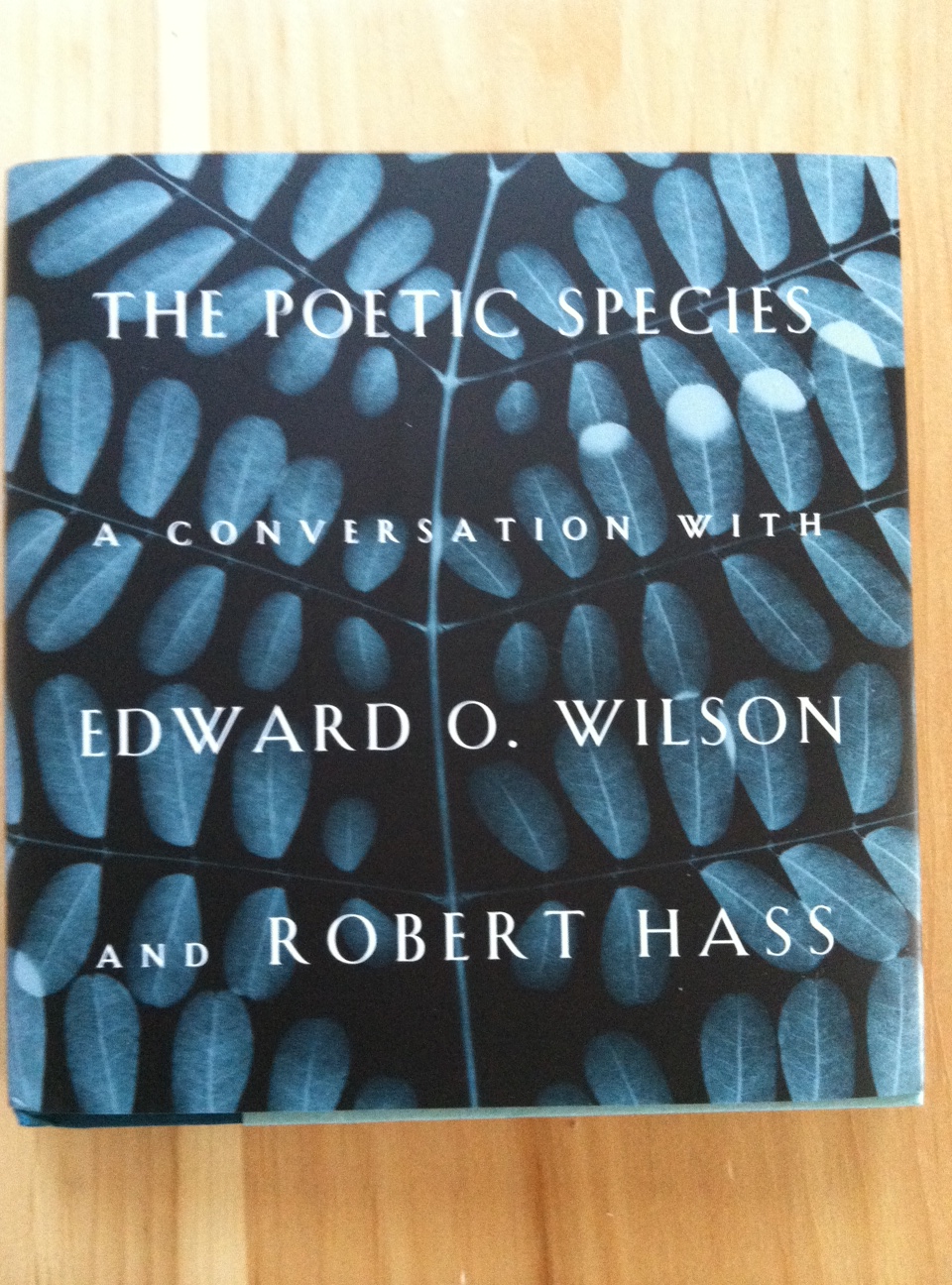
photo (69)This slim volume — beautifully designed, by the way — is the record of a conversation between two careful thinkers: Edward O. Wilson (better known as E. O. Wilson, perhaps), a biologist famous for his work on ants and his sometimes controversial theories about evolution, and Robert Hass, a highly acclaimed poet, essayist and environmentalist who is a former Poet Laureate.The event — think a long-form TED dialogue — took place in late 2012, was co-sponsored by Poets House and the American Museum of Natural History.

As Lee Briccetti writes in the Foreword to The Poetic Species*, “Poetry is not purely associative. Science is not purely analytic. All skilled human production depends on subtle networks of cognitive capacities and the ability to transition between them” (23). Professor Wilson and Professor Hass came together to talk about the ways that science and the humanities inform each other, and how thinkers in both disciplines might come together to protect the natural world.

The first part of the discussion traces Professor Wilson’s theory of the perpetual conflict embedded in human nature (and yes, the question of “human nature” is, as it’s often maddeningly put in the academy, “vexed”): a tendency toward altruism with regard to members of one’s social group (and concomitant hostility toward outside groups), and the impulse to act selfishly at the individual level. Professor Hass notes, “the dance of the tension between these two things must constitute something of what we mean by consciousness, by the experience of having choice and free will and moral life. A productive oscillation between a social self and a private, individual self, in each person and in the species” (40-41). He goes on to suggest that this kind of oscillation appears in art, between form and departure from form, between what makes us comfortable and what challenges us and makes us uncomfortable.

Professor Wilson, too, emphasizes the connection between biology and art: “I’ve suggested many times that the humanities, and especially the creative arts, are the natural history of Homo sapiens” (48). In his view, “The creative arts are the sharing of our inner desires and humanity’s struggle. The humanities are our way of understanding and managing the conflict between the two levels that created Homo sapiens” (53). Put another way, in Robert Hass’s words: “At a very simple level, poetry can give us someone to talk to. To read is, in that way, to have your inner life acknowledged by somebody else’s” (78).

(As you can probably tell, I’d love to quote great swaths of the dialogue in this review, but then I’d run the risk of quoting the whole book; every page offers something worth contemplating. I’d love to see more collaborations of this kind in print, and I’d happily read another conversation between E.O. Wilson and Robert Hass. While The Poetic Species takes the initial format of Professor Hass interviewing Professor Wilson about his work, and works from that point, I’d like to read another conversation in which Professor Wilson questions Professor Hass about the natural elements in his poetry (which is deeply rooted in the environment of northern California). Given Professor Wilson’s admission, in his own list of suggested reading, that he does not read literature for its own sake, perhaps this is wishful thinking.)

The last third of The Poetic Speciesis an impassioned plea for conservation of wildernesses, a plea to take the initiative to save places and species that are in danger of disappearing. Wilson says, “I’m spending more and more of the time I have left on national parks” (67). Both men encourage education of young people in both biology and the humanities to promote environmental stewardship; Wilson suggests that education should go beyond facts and terms — “it’s somehow got to be made into a story” (76). Common Core creators, take note.

Reflecting on elegant solutions in math and sciences, Hass says, “Beauty sends out ripples, like a pebble tossed in a pond, and the ripples as they spread seem to evoke among other things a stirring of curiousity. The aesthetic effect of a Vermeer painting is a bit like that. Some paradox of stillness and motion. Desire appeased and awakened” (79). That’s how science and poetry work — we solve one problem, come to one possible solution, and another question presents itself — like endless webs that spin outward and outward to gather us all in.

The Poetic Species is a fascinating foray into the ways we’re connected to each other and the natural world — highly recommended reading.

*My thanks to the publisher for sending me an advance review copy of this book in exchange for an honest review.

The Poetry Concierge Recommends Margaret Atwood

[The Poetry Concierge is an occasional feature here on Rosemary and Reading Glasses wherein I select a poem, poet, or book of poems for individual readers based on a short questionnaire. Come play along! Read the introductory post here, my first recommendation here, and then email me at: rosemaryandreadingglasses [at] gmail [dot] com. ]
This week, our pilgrim in search of poetry is Naomi, who blogs about books over at Consumed by Ink.

1. When you read fiction, who’s your go-to author?

Already, this is a hard question.  I don’t do a lot of re-reading, but there are some authors who I’ve read many of their books:  Margaret Atwood, Ann Patchett, Geraldine Brooks, L. M. Montgomery, Lois Lowry, Michael Crummey.

2. If you read nonfiction, which subjects are most likely to interest you? (cultural history, science, biography, memoir, survival stories?)

Probably memoirs, survival stories, and historical figures.

3. If you were stuck on a desert island for a week, which five books would you bring to keep you entertained?

Ok, a week isn’t too long.  I would probably want to bring 5 books I haven’t read yet, which means I don’t know what they’d be.  A couple on my TBR pile that would be good to bring to a desert island would be Rockbound by Frank Day and The Republic of Nothing by Lesley Choyce. Nothing scary or spooky please.  Maybe something funny, like Christopher Moore and another Will Ferguson book.  One more-maybe a good love story.

4. If you were on a five-year mission to Mars, which five books would you bring to keep you sane?
5 years is much longer than a week, so I would have to either bring books that I know I would like to re-read, or bring some big chunksters.  I have never read Middlemarch, so maybe that one.  A big, fat Dickens to take my time with.  Jane Eyre would be nice to have – I would definitely re-read that one.  The Time Traveler’s wife, so I would have lots of time to get it all straight.  Lastly, either Roots or Lonesome Dove.  I have never read Lonesome Dove, and my mother says I should, but if I took Roots I would know that I already love it.  If I was allowed to count a series as 1 book (which I probably am not), I would bring the Anne books.

5. What kinds of questions are most likely to keep you up at night? (death, the nature of love, politics, environmental issues, meaning of life, end of the world, justice and injustice, etc?)
 

I’m most likely to be kept up at night thinking about the nature of love, or environmental issues and how they will someday affect the way we live.  Also, I sometimes try to make sense of societal rules, and how I might like to change some of them.

6. If you’ve read poetry before, what have you liked? What have you disliked?

I don’t like poetry that takes a long time to figure out what the person is getting at.  So, I like to be able to know what the poet is saying, whether she’s describing something or telling a story.  When I think of poetry I like, I always think of A.A. Milne’s poems for children (no laughing).  I still love them, and have several memorized. Also, I just thought I would add a little challenge for you.  Along with whatever you choose for me, do you think you might also be able to come up with a Canadian suggestion as well?  If possible.  I actually had been looking at the library for one to read for this month, but didn’t have any luck. 


For Naomi, I’m recommending a Canadian poet who’s more famous for her novels: Margaret Atwood. Yes, THE Margaret Atwood, author of The Handmaid’s Tale, The Blind Assassin, and Oryx and Crake, among many other highly-regarded novels. Ms. Atwood is also a distinguished poet whose collections include The Circle Game, The Animals in That Country, Morning in the Burned House, and, most recently, The Door.

(I almost feel like I’m cheating since Naomi wrote in first answer that Margaret Atwood is one of her go-to novelists, but then again, the questionnaire is meant to be revelatory, right?)

I also think Ms. Atwood’s work is right for Naomi because of their mutual interest in environmental issues and social justice. And Naomi’s pick of Christopher Moore as an author whose novel she’d take to a desert island tells me that she has a great sense of humor, and Margaret Atwood’s work is full of humorous touches. Furthermore, some of the authors and books Naomi singled out for attention deal with women who are isolated in some way, like Jane Eyre, or Anne Shirley (as in Anne of Green Gables); the speaker of the particular poem I’ve picked out for Naomi (though I’m recommending Margaret Atwood’s work as a whole) feels isolated by her profession.

Here’s “The Loneliness of the Military Historian,” by Margaret Atwood.

Naomi, I hope you’ll like this poem’s careful deployment of startling imagery, the strong narrative voice, and its message. Thanks for writing in!


Would you like the Poetry Concierge to make a recommendation for you? Check out the introductory post, and send your answers to the questionnaire, along with the name and/or blog you’d like posted with the reply, to rosemaryandreadingglasses [at] gmail [dot] com.