“Joy-buzzer buzz”: Hailey Leithauser’s “‘Was You Ever Bit by a Dead Bee?'”

photo (62)Hey, remember yesterday when I wrote about how much I loved Swoop, Hailey Leithauser’s debut collection? Remember how I bet that you wanted to read the rest of “‘Was You Ever Bit by a Dead Bee?'”

Well, want no more! Here’s a link to the full text of the poem, with a special bonus: an audio recording of the poet herself reading it!

Joy-buzzer buzz!

Recommended Reading: Swoop, by Hailey Leithauser

photo (62)National Poetry Month is on the horizon, Dear Readers, and I can’t imagine a better way to celebrate than by picking up Hailey Leithauser’s exuberant, brilliant debut collection, Swoop*.

Reading Swoop, I couldn’t help but notice myself smiling at first. Then there was the impulse to read aloud, to drum the table in front of me. These poems are musical, rhythmic, dance-provoking. They’re fearless and funny and macabre and eloquent. I loved them.

I came to this conclusion exactly two poems into the collection. The first poem, “Scythe,” imagines the desires of that object, with one of the best images of opposition I’ve ever read . The scythe wants

two bottomless,
unchanging pockets,

the one
that is larder, the other

one locust.

For those keeping track of such things — killer linebreaks, right?

I’ve made no secret of my love for Bogie & Bacall’s first joint film, To Have and Have Not, and so I was prepared to fall hard for Swoop‘s second poem, “Was You Ever Bit by a Dead Bee?” — which, of course, I did. It’s a poem that answers the movie’s famous question, with the kind of rhythm that would make Hoagy Carmichael proud. Here are the first two lines:

I was, I was—by its posthumous chomp,
by its bad dab of venom, its joy-buzzer buzz.

Doesn’t that make you want to read the rest?

As you can probably tell, Ms. Leithauser is the kind of poet who’s enchanted by the sounds that words make, and by the wonderful oddities of the English language.  (More than once I turned to my trusty OED: after all, how often does one encounter “lamaseried”?) Indeed, several poems are composed of entries “From the Grandiloquent Dictionary” (look for a particularly hilarious entry, Metrophobia. Then look up metrophobia.) Reading Swoop is in some ways like like listening to a Dorothy Parker who’s fascinated not only by people, but by the personalities of words themselves. Take these lines, from “Schadenfreude”:

So often ironic,
at times caustic, despotic,

and always so
honestly,

profoundly
Teutonic,

I’d love to take you through each and every one of Swoop‘s poems to tell you what I love about them, from the dazzling description of one of Moby-Dick‘s tragic characters (“Pip, Mid-Sea”), to the bluesy “Bad  Sheep” with its twenty-six synonyms for dark (except black), from the darkly comic “Sex Circumspect” to the downright funny “Sex Fiasco.”

I feel rather cruel, Dear Readers, for passing along these tantalizing morsels and not full plates. Luckily, Swoop is a feast, and you’re invited.

*My thanks to Graywolf Press for sending me a review copy of Swoop.

Tomorrow: One of Hailey Leithauser’s poems will be the featured poem of the week.

Wednesday: An interview with Hailey Leithauser, author of Swoop, winner of the Emily Dickinson First Book Award from The Poetry Foundation.

Recommended Reading: A Burnable Book, by Bruce Holsinger

photo (59)A Burnable Book*, the first novel from noted medieval scholar Bruce Holsinger, is enjoyable on so many levels that it’s difficult to decide where to begin. It’s historical fiction, a mystery, a book about books, and a character study, all rolled into one.

London in 1385 is dangerous and dirty, still reeling after a revolt by the commons several years earlier. Nobles jostle each other for favor at court, bishops visit the stews without charity in mind, and everyone from the butcher’s boy to a duke’s mistress tries to navigate through precarious games and ploys.

John Gower, the English poet now better known primarily for his appearance in Shakespeare’s Pericles than for his writing (Mirroir de l’OmmeVox Clamantis, and Confessio Amantis are his major works)  is in Professor Holsinger’s novel a man of secrets, a dealer in information with his own shadows that he’d prefer stay hidden. When his friend Chaucer comes to him for help finding a missing book whose cryptic verses are already spreading through London, Gower, the “subterranean man,” is drawn into a web of conspiracy, murder, and lies that reaches from England’s highest nobles to the maudlyns (prostitutes) in London’s stews. The book is a “burnable book” — treasonous — and those who possess it are hunted by forces that even Gower can’t identify. As the novel approaches its climax, unraveling metaphor and mystery begin to amount to the same thing.

The cast of characters in A Burnable Book is so long that Professor Holsinger includes a listing before the action begins. Gower and Chaucer are delightful to watch from this distance, especially in terms of their combative friendship. Katherine Swynford, John of Gaunt’s mistress, and Isabel Syward, prioress of St. Leonard’s Bromely are drawn with a fine brush, calculating and calm, working for their own ends. And then there are the maudlyns — so very many of them! By far the most interesting of these is Eleanor/Edgar Rykener, who switches gender presentation depending on clients’ preferences and the relative safety of different parts of London and its environs. Eleanor/Edgar is deeply caring and mightily resourceful, easily my favorite of all the author’s inventions.

A Burnable Book’s meticulous attention to period detail reminded me of Hilary Mantel’s Wolf Hall and Bring Up the Bodies, while King Richard’s cameo appearances are notable for the combination of political non-acumen and lyrical speech that characterize Shakespeare’s own Richard II. The narrative is just as earthy as Chaucer’s Wife of Bath’s speech, though considerably (and understandably) less funny. And for its literary/action combination, The Name of the Rose comes to mind. In other words, there’s a little something for all kinds of readers to be found in A Burnable Book, and I hope Professor Holsinger will sally forth into the fictional fourteenth century again soon.

*My thanks to the publisher for sending a copy of this book in exchange for an honest review.

Recommended Reading: Strange Bodies, by Marcel Theroux

photo (57)Strange Bodies* is a Frankenstein for the twenty-first century, an engrossing, frightening, funny meditation on technology, memory, language, and the nature of identity. It’s speculative fiction meets literary fiction, and it’s a great read. Marcel Theroux is better known on the other side of the Atlantic, but I do hope Strange Bodies grants him a devoted American readership.

(After all, the novel made me, of all people, want to read Samuel Johnson, so you know it’s good.)

Dr. Nicholas Slopen is dead, but it’s very easy to forget that fact as you read his “testimony,” taken from a flash drive given to an old friend (like Mary Shelley’s classic, Strange Bodies is a frame narrative.).  In life, Nicky had a troubled marriage, a sputtering career as a professor of eighteenth-century literature (specializing in Johnson), and some very strange run-ins with wealthy people claiming to have discovered a cache of never-before-seen papers in Johnson’s hand.  The only trouble is, if Nicky Slope is dead, who’s the “I” narrating his story?

I won’t give too much of the plot away — have a look at the the books several epigraphs, some of the best chosen I’ve ever seen, and you’ll get an idea or two — but the book is more than its twists and bumps in the night. Mr. Theroux clearly enjoys playing with the conventions of mystery and monster novels, and even the lowbrow literary thriller,  but it’s when he lets his own style loose that the novel really shines. His imaginings of Johnson’s reactions to twenty-first-century London are blindingly funny and sad at the same time. And his knack for description is wonderful. Take this sentence:

“Every time I came back, Vera seemed more lovely; her eyes behind their thickly made-up lashes tender with sympathy, her broad mouth with its liverish lipstick, the touch of her gloved hand on my knee fierce and protective like the raised wing of a mother swan” (113).

I love the contrast of the vaguely ghoulish “liverish” lips and the maternal tenderness of the “raised wing of a mother swan.” Elsewhere in the novel, the descriptions are mordant;  he suggests that overindulgence in Bikram yoga has turned a woman to gristle (for the life of me I can’t find the page number on that). Hilarious. Actually, considering the novel’s grim premise, I found myself laughing more than expected.

Strange Bodies is smart and literary and scary, all at once. If you read it, you’ll be wondering why you haven’t read Marcel Theroux before.

* My thanks to Farrar, Straus and Giroux for sending me a copy of this novel in exchange for an honest review.

Recommended Reading, Classics Club Edition: Narrative of the Life of Frederick Douglass, by Frederick Douglass

This slim volume, published in 1845, was one that I should have read years ago. Sure, I’ve Narrative of the Life of Frederick Douglassread excerpts from time to time, but really, at 106 pages, this should be required reading in high school American lit classes. It’s powerful, not only for its depictions of the myriad cruelties of slavery, but also for Douglass’s tour de force rhetorical performance.

I think it’s also important to find the right edition of this text (I read an Oxford University Press edition), since context is so important to the narrative. I found the introduction, chronology, and background notes especially helpful when I’m reading autobiography — which is, no matter how truthful, always a literary production, with an intended audience and an agenda.

In this case, for example, it was helpful to learn from the notes that while Frederick Douglass was noted later in life for his support of women’s suffrage, black women are nearly voiceless in his narrative. For example, his fiancee (and later wife), Anna Murray, helped him to escape, but he doesn’t credit her at all in the Narrative. And that, I think, is because the rhetorical strategy Douglass deploys is one that insists on his independence, which is signaled from the book’s original title and authorial designation: Narrative of the Life of Frederick Douglass, American Slave, Written by Himself.

It’s shocking just how much Douglass overcame to reach a free state, and the Narrative is often difficult to read due to the many scenes of brutality. It’s impassioned, frank, and blistering in its indictment of slaveholders. It’s a must-read.

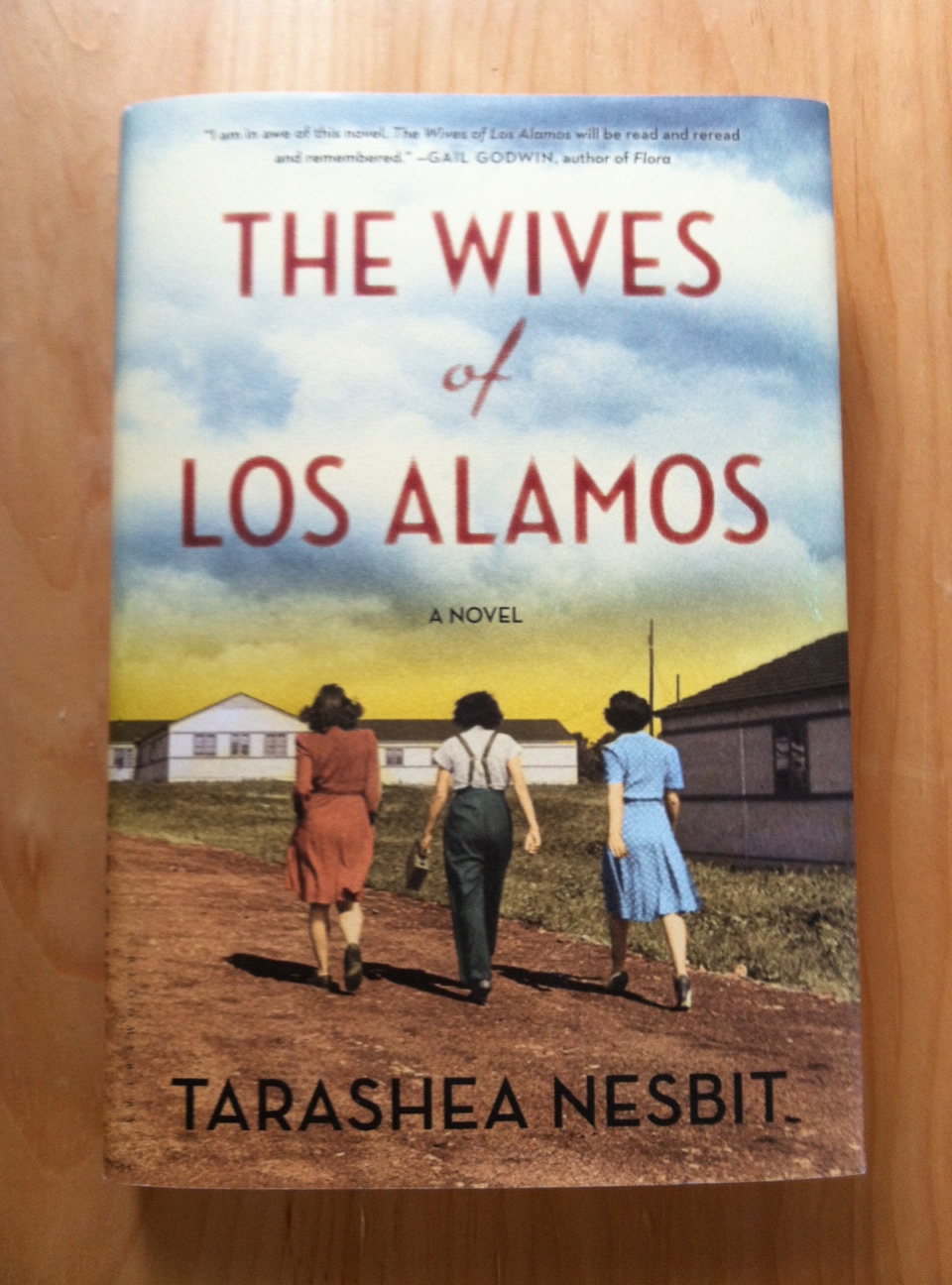
Recommended Reading: TaraShea Nesbit’s The Wives of Los Alamos

The Wives of Los Alamos

The Wives of Los Alamos

If you’re looking for refreshing, stylistically bold historical fiction, look no further. The Wives of Los Alamos*, TaraShea Nesbit’s debut novel, is the book for you.

[Full disclosure: Ms. Nesbit and I share friends in common, but we have never met.]

Written from the unconventional first-person plural perspective, The Wives of Los Alamos explores the difficult transition from the ordinary world to the extremely secretive world of the Los Alamos site of the Manhattan Project. Leaving behind their families, friends, and often careers of their own, the women married to the scientists who created the atomic bomb gradually form a community in the desert.

At first the choice of the first-person plural threw me; I was expecting a standard interconnected-threads type of novel, following maybe three or four women through their time at Los Alamos. Instead, I found Ms. Nesbit’s approach simultaneously universal and intimate, emphasizing both the common struggle to adapt to new living conditions and the idiosyncrasies of particular women.

At first, the women focus on the physical isolation and practical problems of life in New Mexico: no automatic washing machines or bathtubs, often inadequate supplies at the commissary — and the inability to visit with parents or even children old enough to attend college. And of course their husbands are sequestered in the labs, unable to discuss anything about their work. As time goes on, strain mounts as the wives negotiate the complex web of relationships they’ve developed — with each other, with their husbands, with the men guarding them, with the women hired to help them around the house, with their own children — and, finally, as they come to understand the awesome destructive force their husbands have constructed.

In addition to the well-articulated historical detail, I loved the roundness of the portraiture in The Wives of Los Alamos. While attesting to the scenic grandeur of the surroundings and the occasional pleasures of solitude, Ms. Nesbit doesn’t sugarcoat the realities of the women’s isolated lives, or their own blindness when it comes to the lives of their maids, often women of color. The women’s reactions to the revelation of the atomic bomb are mixed in tone, and treated thoughtfully. There are no easy answers, no neat endings — but that’s part of what makes this such a fascinating novel.

*My thanks to Bloomsbury for providing me with a review copy of this book in exchange for an honest review.

“El amor como la resina”: Pablo Neruda’s “Física”

Well, it’s the end of February, which means this is the last entry in my series of sexy poems by photo (56)dead poets. It’s been fun — let me know in the comments if you think I should try this again next February, or something different?

Neruda is over-anthologized when it comes to love poems, but here’s one that’s less well known. I cannot find the full text of this poem anywhere online, so here it is in the original Spanish, with my (very humble) translation following.

Física

El amor como la resina
de un árbol colmado de sangre
cuelga su extraño olor a germen
del embeleso natural:
entra el mar en el extremismo
o la noche devoradora
se desploma el alma en ti mismo,
suenan dos campanas de hueso
y no sucede sino el peso
de tu cuerpo otra vez vacío.

Physics

Love, like the resin
of a tree, overflowing with blood
suspends its strange scent over the bud
of spontaneous ecstasy:
the sea enters us in the last extremity,
or the devouring night
collapses your soul into itself,
two bells of bone ring out,
and nothing follows except the weight
of your body, hollow again.

An Interview with Daniel Price, author of The Flight of the Silvers

Yesterday I reviewed The Flight of the Silvers, Daniel Price’s new novel, which is out now from Blue Rider Press. Mr. Price graciously agreed to be interviewed via email.

When and how did the idea for The Flight of Silvers come to you? Did you know then that it would become a multi-part saga?

Daniel Price Photo courtesy of the author.

Daniel Price
Photo courtesy of the author.

DP: I’ve been developing the story for fifteen years now. I can’t even remember what originally inspired the idea. All I know is that the ending came to me first. Everything else—the world, the characters—sprang backward from that.

It wasn’t long before I realized that the plot was too big to contain in one book, which scared the crap out of me. I’d never written a series before, much less one about superpowered people on an alternate Earth. If I got it wrong. I’d be spending years of my life on a saga that either no one saw or everyone hated. Who wants that?

So I pushed the idea to the back burners and moved on to other projects. But the Silvers story kept poking at me. It took a brief bout with cancer to remind me that there were worse fates than trying and failing at something. I finally started writing Silvers in 2009, and it turned out to be the best decision of my life. Now on hindsight I wonder why the hell I was so nervous.


How was writing a sci-fi-action-suspense novel different from writing non-sci-fi fiction, like your first novel, Slick?

The Flight of the SilversDP: Like night and day. My first novel is a comedy set in the world of public relations, which I’d never personally been a part of. I was determined to research the hell out of it and get the details right. It was constraining, but I loved every minute of it.

With Silvers, I had more freedom than I knew what to do with. I could change the rules of reality, invent new history. It was unbelievably fun to dream up this stuff. The hard part was introducing the world in a way that didn’t make people go cross-eyed.

Fortunately, my alpha readers kept me honest. The earliest drafts of Silvers were littered with plot-stopping info dumps. My friends helped me smooth them over.


How did you go about conducting research for The Flight of the Silvers?

DP: As far as the science went, I didn’t go nuts. I read some extremely dumbed-down books on temporal physics until I had a good enough grasp on the new rules of my world. And with each manner of timebending I introduced, I did some speculation into the side effects and limitations, which led to some interesting new details.

But when it came to the worldbuilding, I did a ton of research. My alternate Earth exists in a timeline that drastically changed after a cataclysmic event in 1912. So I studied the culture of that era and then rebuilt world history, decade by decade. That also led to some fun new details.

The third aspect of my research was etymology. Every new word I introduce has a traceable origin. I didn’t want to make up stuff just because it sounds good.


Which other time-travel books/movies/shows would you recommend to fans of The Flight of the Silvers?

DP: For alternate history, nothing inspired me more than Watchmen. Alan Moore and Dave Gibbons paint a world that’s completely recognizable and yet terrifyingly different. It blew me away when I first read it in 1986. I’ve lost count of the number of times I’ve devoured it since then.

In terms of temporal hijinks, I can’t say enough good things about Slaughterhouse Five. Kurt Vonnegut was the first writer to truly mess with my perception of time. And like all of his books, he wraps his craziness around a strong and beautiful character story.


Which writers do you read while writing? Do your reading choices change depending on the writing project at hand?

DP: Sadly, I can’t read other people’s fiction when I’m writing. It screws me up. I do take the occasional sanity break and tear through my read pile. The top two novels of my list right now are The Waking Engine, by David Edison and The Martian by Andy Weir. Looking forward to both of them.


I understand you’re working on the sequel to The Flight of the Silvers. How many books can we expect in the saga? And what other kinds of projects are on your horizon?

DP: I wish I could answer that second question, but I can’t see an inch beyond Silvers at the moment. I have a few ideas percolating, in both the sci-fi and “real world” genres, but it’ll be a long while before I get to touch any of them.

As for your first question, the Silvers series will fall somewhere between three to five books. The final number hasn’t been determined yet. Whatever happens, I promise the story will be resolved in a most definitive way. The whole thing began in my mind with an ending. I have every intention of getting there.

What’s a question that you wish interviewers would ask you,  and how would you answer it?

DP: Well, if I can’t get people to ask me how I got to be so awesome, then I suppose the next best question is “What puts you in a good mood these days?”

The answer is feedback. I love getting thoughtful comments from readers, whether it’s praise or constructive criticism. It’s just great to know that my stories are out there spinning gears in people’s heads. I encourage everyone who reads The Flight of the Silvers to let me know what they thought about it. Shoot me an e-mail. Post a review on Goodreads or Amazon. I write for the love of writing, but smart feedback is a major perk of the job. It’s the five-dollar bill in my tip jar.

My thanks to Mr. Price for his time and thoughtful answers! You can learn more about The Flight of the Silvers, and Daniel Price, on Mr. Price’s website, and you can follow him on Twitter: @SilversGuy.

Recommended Reading: The Flight of the Silvers, by Daniel Price

photo (55)“Time rolled to a stop on the Massachusetts Turnpike.”

That’s the first line of Daniel Price’s refreshing novel The Flight of the Silvers*, one of the most entertaining time-travel stories I’ve read in years. This first line signals not only that we’re in for some weird time-bending stuff but also that the author is interested in realism, not just the fireworks of mind-bending world-building. (Don’t worry, there’s that, too.)

As children, two sisters, Amanda and Hannah, witness time stand still when three mysterious and quite possibly malevolent strangers inexplicably rescue them from a — relatively speaking of course — mundane accident (near Chicopee, for my fellow Mass Pike-goers).

Seventeen years later, Amanda and Hannah are as different as two sisters can be, and yet, they, along with four strangers, are rescued from the end of the world by the silver bracelets snapped over their wrists by the same shadowy figures from the Massachusetts Turnpike.

Then the really weird stuff begins.

In their new world, which, refreshingly, is neither utopia nor dystopia, just a topia (ok, alt-topia), the six strangers navigate an America they don’t understand (that’s where the very cool world-building comes in) and personal powers that surprise and shock them. (I don’t want to give too much away, but think X-Men meets time travel meets Terminator 2. Kinda.) The forces tracking them are powerful in different ways, and are largely unfriendly, to say the least: the menacing, powerful strangers who saved them from apocalypse; an FBI-type agent hoping not to get an NSA-like agency involved; a group of strangers with their own superpowers and everything to lose; and a psychopath from their own America with a nasty grudge.

Two squabbling, sisters, one recovering alcoholic, one boy genius with possible sociopathic tendencies, one teenage girl, and one cynical comic-book artist attempt to evade them all without losing themselves in the process. While The Flight of the Silvers is a rollicking and often funny piece of speculative fiction, Mr. Price also asks questions about community, isolation, family, and immigration that figure prominently in our own place and time.

And a final word to the wise, dear readers: The Flight of the Silvers is the first in a multi-part series, and from where I sit, there’s no way it won’t become a film franchise.

*My thanks to Blue Rider Press for sending a review copy of The Flight of the Silvers.

Tomorrow: An interview with Daniel Price, author of The Flight of the Silvers

Paradise Lost, Books IX and X: Crime and Punishment

ParadiseLostReadalongAt long last, we’re here: Books IX and X bring the Fall and its aftermath to Paradise. Let’s get to it, shall we?

Summaries courtesy Milton.

Book IX:

Satan having compast the Earth, with meditated guile returns as a mist by Night into Paradise, enters into the Serpent sleeping. Adam and Eve in the Morning go forth to their labours, which Eve proposes to divide in several places, each labouring apart: Adam consents not, alleging the danger, lest that Enemy, of whom they were forewarn’d, should attempt her found alone: Eve loath to be thought not circumspect or firm enough, urges her going apart, the rather desirous to make trial of her strength; Adam at last yields: The Serpent finds her alone; his subtle approach, first gazing, then speaking, with much flattery extolling Eve above all other Creatures. Eve wondering to hear the Serpent speak, asks how he attain’d to human speech and such understanding not till now; the Serpent answers, that by tasting of a certain Tree in the Garden he attain’d both to Speech and Reason, till then void of both: Eve requires him to bring her to that Tree, and finds it to be the Tree of Knowledge forbidden: The Serpent now grown bolder, with many wiles and arguments induces her at length to eat; she pleas’d with the taste deliberates a while whether to impart thereof to Adam or not, at last brings him of the Fruit, relates what persuaded her to eat thereof: Adam at first amaz’d, but perceiving her lost, resolves through vehemence of love to perish with her; and extenuating the trespass, eats also of the Fruit: The Effects thereof in them both; they seek to cover their nakedness; then fall to variance and accusation of one another.

Book X:

Man’s transgression known, the Guardian Angels forsake Paradise, and return up to Heaven to approve their vigilance, and are approv’d, God declaring that The entrance ofSatan could not be by them prevented. He sends his Son to judge the Transgressors, who descends and gives Sentence accordingly; then in pity clothes them both, and reascends.Sin and Death sitting till then at the Gates of Hell, by wondrous sympathy feeling the success of Satan in this new World, and the sin by Man there committed, resolve to sit no longer confin’d in Hell, but to follow Satan their Sire up to the place of Man: To make the way easier from Hell to this World to and fro, they pave a broad Highway or Bridge over Chaos, according to the Track that Satan first made; then preparing for Earth, they meet him proud of his success returning to Hell; their mutual gratulation. Satan arrives at Pandemonium, in full of assembly relates with boasting his success against Man; instead of applause is entertained with a general hiss by all his audience, transform’d with himself also suddenly into Serpents, according to his doom giv’n in Paradise; then deluded with a show of the forbidden Tree springing up before them, they greedily reaching to take of the Fruit, chew dust and bitter ashes. The proceedings of Sin and Death; God foretells the final Victory of his Son over them, and the renewing of all things; but for the present commands his Angels to make several alterations in the Heavens and Elements. Adam more and more perceiving his fall’n condition heavily bewailes, rejects the condolement of Eve; she persists and at length appeases him: then to evade the Curse likely to fall on their Offspring, proposes to Adam violent ways which he approves not, but conceiving better hope, puts her in mind of the late Promise made them, that her Seed should be reveng’d on the Serpent, and exhorts her with him to seek Peace of the offended Deity, by repentance and supplication.

Out of thousands of things to talk about, I’ve picked three passages from Books IX and X. I’d love to talk about every passage that’s provoked marginalia, but I require food and sleep and interaction with other humans.

It pays to have a compact OED: Sure, it weighs more than my toddler, and you need the included magnifying glass to have any prayer of reading it, but when you read a passage like this —

There was a place,
Now not (though sin, not time, first wrought the change)
Where Tigris at the foot of Paradise
Into a gulf shot underground till part
Rose up a fountain by the Tree of Life.
In with the river sunk and with it rose
Satan involved in rising mist, then sought
Where to lie hid. (9.69-76)

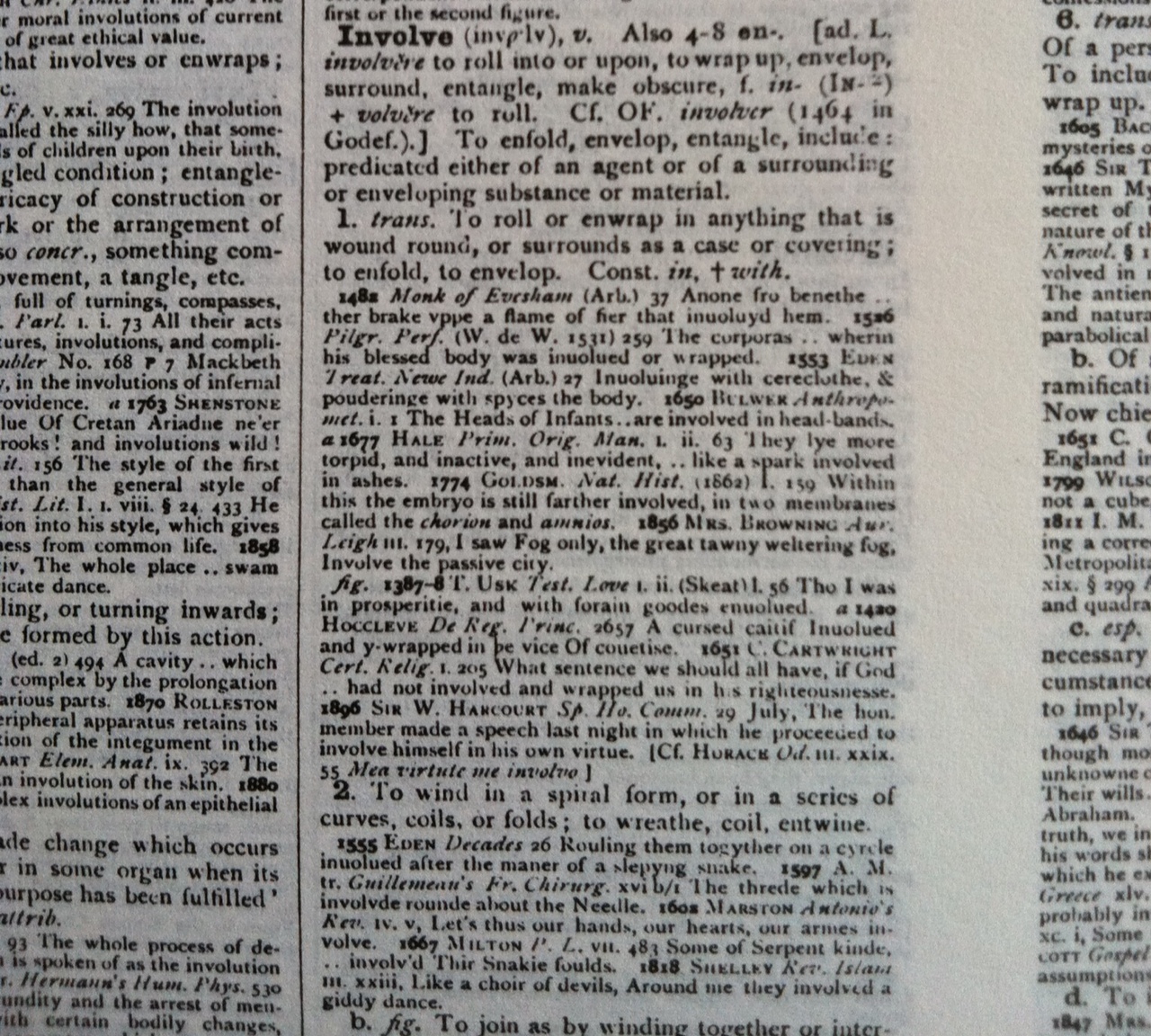
— if you’re like me, you want to know the etymology of “involve.”

photo (54)And so I turn to my OED and read that it’s from the Latin “to roll into or upon, to wrap up, envelop, surround, entangle, make obscure” (1480). And sure enough, Milton’s cited as an example later in the definition. But see the genius at work here? With Satan’s reappearance in Paradise in Book IX, with one verb, Milton does so much to elucidate Satan and foreshadow the Fall to come. Yes, Satan’s enveloped in mist, and he’ll roll on the serpent’s folds. But he’ll also entangle Eve in sin, and make obscure what is plain. (And, by the way, how awesome are the “mazy folds” of the serpent, and the way Satan rises up on the folds like an orator about to speak?)

One of my favorite similes in the poem:

Much he the place admired, the person more.
As one who long in populous city pent
Where houses thick and sewers annoy the air
Forth issuing on a summer morn to breathe
Among the pleasant villages and farms
Adjoined, from each thing met conceives delight–
The smell of grain or tedded grass, or kine
Or dairy, each rural sight, each rural sound–
If chance with nymph-like step fair virgin pass
What pleasing seemed, for her now pleases more,
She most, and in her look sums all delight.
Such pleasure took the serpent to behold
This flow’ry plat the sweet recess of Eve,
Thus early, thus alone. (9.445-57)

For an epic poem, Paradise Lost is often concerned with the domestic; Eve and Adam are, after all, gardeners. We see them at home and in their ordinary daily pursuits, and with this simile, Milton reaches out to the ever-growing number of city dwellers in his own era, comparing Satan’s pleasure at Eve’s beauty (and the beauty of her handiwork) with the simple pleasures of getting out of town. It’s my favorite incursion of “modernity” in the poem. I’ve said before that we can read Paradise Lost as an example of eco-poetry, and this is just one instance of the way Milton values the rural, the natural, over artificial constructs. Later, after Eve and Adam eat of the forbidden fruit, he writes that “Earth felt the wound,” comparing the pain nature itself experiences at the Fall to the pains of labor and birth.

The return of the poem’s creepiest character: Sin and Death create a path from Hell to Earth, and Death vows to follow in his mother’s steps.

I shall not lag behind nor err
The way, thou leading, such a scent I draw
Of carnage, prey innumerable,, and taste
The savor of death from all things there that live.
Nor shall I to the work thou enterprisest
Be wanting but afford thee equal aid.
So saying with delight he snuffed the smell
Of mortal change on Earth. As when a flock
Of rav’nous fowl though many a league remote
Against the day of battle to a field
Where armies lie encamped come flying, lured
Wish scent of living caracasses designed
For the death the following day in bloody fight,
So scented the grim feature and upturned
His nostril wide into the murky air,
Sagacious of his quarry from so far. (10.266-81)

Gah! I wrote about Yeats’s “The Second Coming” as the scariest poem in English last Halloween, and there’s no way that Milton’s death wasn’t an inspiration for the creature slouching toward Bethlehem. Yeats’s creature is a “shape”; Milton’s Death is a “feature” with one “nostril wide.” And snuffing? Nazgûl-like, if you ask me. And P.S., fellow Tolkien fans: there’s a simile in Book IX that’s a dead ringer for the Dead Marshes.

As if you needed any more incentive to read Paradise Lost.

March 1: The bitter end — wrapping up with Books XI and XII.