Why I Love Parks & Rec, or “O were my Love yon Lilack fair”

I love Parks and Recreation. Amy Poehler can do no wrong, of course, but it’s the show’s pitch-perfect blend of snark and heart that gets me every time. And also Ron Swanson. Oh Ron, you magnificent bastard, with your mustache and your Lagavulin and your love of breakfast food and pretty dark-haired women  . . .

Image courtesy zirconicusso / Freedigitalphotos.net

Image courtesy zirconicusso / Freedigitalphotos.net

(This is not the time to ask, friends, if I bought a waffle maker to ring in the show’s sixth season.)

As I was saying.

Mr. O and I delayed our viewing of the premiere by a day because he was out of town (an act of true love, as those three of you who follow me on Twitter know).  Well worth the wait, the show pushed its characters around with wit and gusto. Stop reading now if you care about spoilers. Look for the bold when I start a-chatting about poetry.

By far my favorite set piece: Ron on a Leslie-designed train trip through northern England and into Scotland, culminating in a visit to the Lagavulin distillery. But here’s the best part: Ron sitting on a green, craggy piece of land, reading the poetry of Scotland’s favorite son out loud — “O were my Love yon Lilack fair.” And tearing up. I sure did.

So, let’s talk about poetry and Scotch, and you’re safe to come back now, people who didn’t want to read spoilers. 

I came across Bobby Burns some time in college, but his genius didn’t truly hit home until I hosted an ersatz Burns supper when I was a young lass in grad school. In reality, it was more like a boozy birthday party with poetry (January 25th, if you were wondering, is Burns’s birthday). My friend Emily, having brought a fine single malt, performed another wondrous service, reciting “The Mouse” with an amazing Scots burr. It was a fine evening. I recommend hosting one such gathering yourself to keep off the winter chill. Here are the steps:

1. Make some food and buy a bottle of Scotch.
2. Invite your friends to bring a bottle of Scotch over.
3. Eat, drink, read Burns, and assign designated drivers. (Be safe and make good choices, as my college roommate’s mother liked to say.)

Now that I’ve assured you that I, like Ron Swanson, enjoy scotch, let me tell you that I also love the subjunctive, fast becoming a forgotten mood in English. If there’s a poet who loves the subjunctive, that poet is Robert Burns.

Here’s Burn’s “O were my Love yon Lilack fair”:

O were my Love yon Lilack fair,
Wi’ purple blossoms to the Spring;
And I, a bird to shelter there,
When wearied on my little wing.

How I wad mourn, when it was torn
By Autumn wild, and Winter rude!
But I was sing on wanton wing,
When youthfu’ May its bloom renew’d.

[O gin my love were yon red rose,
That grows upon the castle wa’!
And I mysel’ a drap o’ dew,
Into her bonnie breast to fa’!

Oh, there beyond expression blesst
I’d feast on beauty a’ the night;
Seal’d on her silk-saft faulds to rest,
Till fley’d awa by Phebus’ light!]

In other words, sic transit gloria mundi, but isn’t it something in the meantime?
Recommended Reading: Burial Rites, by Hannah Kent

Ah, Iceland. We meet at last. Almost.

Books are modes of conveyance, right?

Books are modes of conveyance, right?

My husband has had a thing for Iceland since long before we met; he listened to Sigur Rós before it was everyone’s favorite inspiring music (Glósóli was the first song on the first mix-CD he made for me—yes, you read that right— and would have been our son’s birth song, had it not been for that pesky emergency C-section). He’s wanted to visit for ages, and when I win the lottery, I’m booking us a flight.

I can’t claim that Iceland holds the same appeal for me as it does for Mr. O, but Hannah Kent’s Burial Rites brings the stark, relentless landscape into such focus that now I’m itching to see the land, the grey sea, and the ice-blue sky. I’m not much for landscapes, as I mentioned when I wrote about Bay of Fires, but this is the second book this year to make me care deeply about its characters’ surroundings.

The jacket copy (and Goodreads summary) will tell you right off the bat that this novel is an exploration of the last months of Agnes Magnúsdóttir, the last woman publicly beheaded in Iceland, so I don’t feel too bad about telling you too. Before her execution, she’s placed as a worker-prisoner with an unwilling family for a few months while a priest tries to save her soul; instead, they hear her story. That’s what I like to call a dramatic situation.

The action of the novel moves toward the inexorable end with grace and sure footing, even if the same can’t always be said for Agnes. At first I was a little thrown by the unconventional structure (letters and documents interspersed with third-person narration and first-person narration from Agnes’s viewpoint), but by the end of the novel, I loved it. The structure regulated the pacing, and eventually the narratives meld together in perfect synchronization.

One word kept coming to me over and over as I read:

Endurance.

Not the Shackletonian type of endurance, but the kind of constant scraping by that leaves blisters that never heal. Agnes endures abandonment after abandonment until the warmest home she finds is with her keepers, her best company a nervous priest and a sharp-seeing middle-aged woman who also waits for certain death (that reliable killer of nineteenth-century female characters — tuberculosis) but no execution date.

In the world Ms. Kent recreates, even the comparatively well-off in nineteenth-century Iceland are engaged in survival tasks every day. We see Icelandic families collecting dung for fires, slaughtering sheep, knitting clothes, making blood sausage, scavenging a beached whale, gathering in the harvest, trying not to freeze. Agnes remembers feeding tallow candles to children at one farm while she ate boiled leather — because they were starving.

Furthermore, people in this story are forced to endure each other. In each household, people sleep all together — masters and servants, parents and children — in one room. Conversations are overheard, stories and gossip spread like an oil slick on the wave. There’s no way to escape, especially in the winter, when the snow closes in.

Reading this book made me think how shocking it is that we’ve managed to endure as a species, when for a long time, for many people, even the simplest pleasures were the faintest sparks in an existence spent fighting for physical survival.

“I prove a theorem and the house expands:”

Rita Dove’s poem “Geometry” is one I’ve been saving for fall, because the title reminds me of school (sorry, Mrs. A, but your ninth-grade classroom is still the only place I’ve ever tried to prove a theorem).  As you might guess from its first line (reproduced in this post’s title), it’s about the feeling of expansion that comes when you stretch your mind over unfamiliar pathways.

Image Courtesy Grant Cochrane / Freedigitalphotos.net

Image Courtesy Grant Cochrane / Freedigitalphotos.net

You can find “Geometry” in Ms. Dove’s Selected Poems, and you can read more about the poet and her work at the Poetry Foundation.

By the by: A couple weeks ago I highlighted Tami Haaland’s poem “A Colander of Barley,” and Ted Kooser (Poet Laureate, 2004-2006) selected it this week for his “American Life in Poetry” series. I love getting a poem in my inbox every week; you can sign up here.

Notes and Asides

Well, this happened.

This week, I was going to write a post about “Cetology,” that not-much-loved chapter of Moby-Dick, but then I got a little email from my library telling me that a book I’d requested had arrived. (Don’t worry, my pretties, we’ll get to “Cetology” yet.)

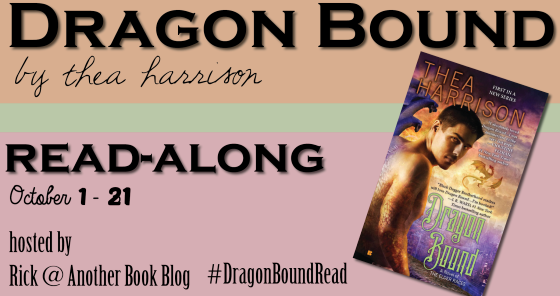
So, here’s the book I requested:

What have I done?

What have I done?

Now, there’s a way to look at this where this is all Rick’s fault.  He made a joke about how he ought to host a paranormal romance read-along, and then the joke became a reality, kind of like a turducken. I’m reading the post, laughing so hard that my neighbors were probably concerned, and apparently I lost the flow of oxygen to my brain, because I threw my hat in the ring too.

Oh lord. I’m about to read my first-ever romance book.

I would also like to add that I was too much of a coward to go pick it up at the library (the librarians know me now, you know?), and since I’m not good with disguises, I sent my husband in my stead. He’s a noble fellow.

So, here’s Rick’s timetable. Run out and get your copies now, folks. Seriously. Please don’t make me do this alone.

  • September 30: Introductory Post
  • October 7: First-third reaction
  • October 14: Second-third reaction
  • October 21: Third-third (?) reaction

I’d also recommend following Rick (@BlogAnotherBook) on Twitter. He claims he’s going to live-tweet the experience.

Excuse me. I have to go gird my loins.

Recommended Reading: American Wife, by Curtis Sittenfeld

At 555 pages, this novel, inspired by the life of Laura Bush, is quite an undertaking, in more ways than one. The original four Literary Wives bloggers — Angela, Ariel, Audra, and Emily — have reviewed the book with more insight than I’ll be able to muster, but I thought I’d share just a few thoughts.

American Wife

First, some highlights, passage-wise, for me:

  • Alice’s love for the Midwest: “It is quietly lovely, not preening with the need to have its attributes remarked on” (53).
  • “When you are a high school girl, there is nothing more miraculous than a high school boy” (58).
  • The passage about Alice and Charlie during the tornado warning (193-96); Alice and Charlie are from Wisconsin, and Ms. Sittenfield, like yours truly, is a native of Ohio. I live outside Boston now, and the Boston-born didn’t have tornado drills growing up, and are always amused at the description I provide. But I’ve never been really close to  a tornado, and I have no desire to be, ever. Sidebar here: Immediately read Catherine Pierce’s amazing poem “The Mother Warns the Tornado.”
  • “I have always had a soft spot for people who talk a lot beause I feel as if they’re doing the work for me” (223).
  • I can’t find the page, but I liked the way Alice recognized a single woman based on what she was buying at the grocery store — yogurt and apples (though I have to say, I bought my fair share of hamburger as a single woman. Spaghetti is always the right answer to “What should I make for dinner?”). The novel is full of nice little details like this.
  • Almost any passage involving Alice’s grandmother.
  • “But I should note, for all my resistance to organized religion, that I don’t believe Charlie could have quit drinking without it. It provided him with a way to structure his behavior, and a way to explain that behavior, both past and present, to himself. Perhaps fiction has, for me, served a similar purpose—what is a narrative arc if not the imposition of order on disparate events?—and perhaps it is my avid reading that has been my faith all along” (429-30).

I found Alice, the main character, both intriguing and infuriating, both a product of her time and well ahead of it.

I think Alice’s nods to her privileged existence (when she’s at the pool with Jadey, when she’s thinking about the war at the novel’s end) were cursory, but I couldn’t tell if this is a fault in Alice’s thinking or the author’s failing. Sure, Alice is charitable and cares about others less fortunate than she, but she allows her values to be completely overshadowed by her husband’s. It’s as if Alice disappears, and I didn’t feel Ms. Sittenfield provided a satisfactory explanation for Alice’s weak attempt to explain herself (sorry, “they elected him, not me” doesn’t cut it). At the very least, as a citizen, she should feel free to express her views to her husband.

(Please note: I’m not judging Laura Bush here, because I don’t have the access to the interior self that Sittenfeld provides us for Alice. And literacy rules.)

Despite my frustration, I thought the book was excellent, and as I went along, I began to think that maybe the unresolved ambiguities in Alice’s thoughts and behavior are meant to be inscrutable; after all, how much do we really know about our neighbors’ marriages, or about our own? How much do we want to admit to ourselves?

“My skies rise higher and hang younger stars.”

I can’t tell you how much I love this poem, “Becoming Anne Bradstreet,” by Irish poet Eavan Boland. I love poems that “talk” to other poems, but I especially like the spare couplets in this poem, which traces connections, real and imagined, between the speaker (identifying as the poet) and Anne Bradstreet.

Image courtesy of Supertrooper / Freedigitalphotos.net

Image courtesy of Supertrooper / Freedigitalphotos.net

It’s also lovely to read how deeply affected a writer of poetry can be by being a reader of poetry.

Because I Love a Bandwagon: The Classics Club

One of my goals for this fall (and winter, because, really, let’s not kid ourselves) is to make a list of my (ridiculous number of) books and try to put a schedule together to read the unread ones.

So naturally, I’m sidetracking myself by joining the Classics Club. And I love a full bandwagon, so maybe you could join too?

Here’s the idea: Make a list of at least fifty classic books you’d like to read, and then commit to reading them in five years, at most. More than fifty books? Great! Your classics are all sci-fi/nineteenth-century/YA/poetry? Go right ahead and list them (but seriously. YA? Really?).

My list, as you’ll see, is rather a smorgasbord. I’m trying to fill gaps in my education (and, you know, try to stomach a few things from the eighteenth century) and refresh my memory and remedy my shocking lack of under-the-belt sci-fi classics.  You’ll also notice that there’s nary a sixteenth- or seventeenth-century work to be found on my list, because I spent five years in grad school chilling with my pals Shakespeare, Spenser, Donne, Middleton, Cavendish, Milton, Marvell, Jonson, and Lanyer. I feel like we can stay in touch via Facebook for at least a few more years.

Start Date: September 13, 2013

End Date: September 12, 2018

Here’s my list o’ 51. I did not alphabetize it. Please still hang out with me.

Well Before the Eighteenth Century

Homer, The Iliad

Homer, The Odyssey 

Murasaki Shikibu, The Tale of Genji


18th Century 

Laurence Sterne, The Life and Opinions of Tristram Shandy, Gentleman

Ann Radcliffe, The Mysteries of Udolpho

Daniel Defoe, Robinson Crusoe


19th Century 

Thomas Hardy, Tess of the D’Urbervilles

Anne Brontë, Agnes Grey

Elizabeth Barret Browning, Aurora Leigh

Wilkie Collins, The Woman in White

Frederick Douglass, Narrative of the Life of Frederick Douglass

George Sand, Indiana

Charlotte Brontë, Villette

Walt Whitman, Leaves of Grass

To Revisit:

Herman Melville, Moby-Dick (last read 2008)

Charles Dickens, Great Expectations (last read 1998)

Charlotte Bronte, Jane Eyre (last read 2010ish)

Nathaniel Hawthorne, The Scarlet Letter (last read 2000 or 2001)


20th Century 

Chinua Achebe, Things Fall Apart

Sherwood Anderson, Winesburg, Ohio

Robertson Davies, The Rebel Angels

Edgar Lee Masters, Spoon River Anthology

Willa Cather, O Pioneers!

Ford Madox Ford, Parade’s End

Graham Greene, The Quiet American

Barbara Pym, Excellent Women

Ernest Hemingway, To Have and Have Not

Kazuo Ishiguro, The Remains of the Day

Vladimir Nabokov, Pale Fire

Flann O’Brien, At Swim-Two-Birds

Sherman Alexie, The Lone Ranger and Tonto Fistfight in Heaven

Flannery O’Connor, Wise Blood

Ursula Leguin, The Left Hand of Darkness

Virginia Woolf, The Waves

Octavia Butler, Lilith’s Brood

Diana Gabaldon, Outlander

Sigrid Undset, Kristin Lavransdatter

Doris Lessing, The Golden Notebook

Iris Murdoch, The Sea, The Sea

James Baldwin, Another Country

Wallace Stegner, Angle of Repose

Ralph Ellison, Invisible Man

Raymond Chandler, The Big Sleep

Thomas Pynchon, The Crying of Lot 49

Muriel Spark, The Prime of Miss Jean Brodie

Nadine Gordimer, The Conservationist

Henry Miller, Tropic of Cancer

Ray Bradbury, The Martian Chronicles

Margaret Atwood, The Blind Assassin

To revisit:

Sir Arthur Conan Doyle, The Hound of the Baskervilles (last read sometime in the late ’90s)

Virginia Woolf, To the Lighthouse (last read sometime in the early aughts)

So, what did I miss? What would you have added? Are you already a member? How’s it going?

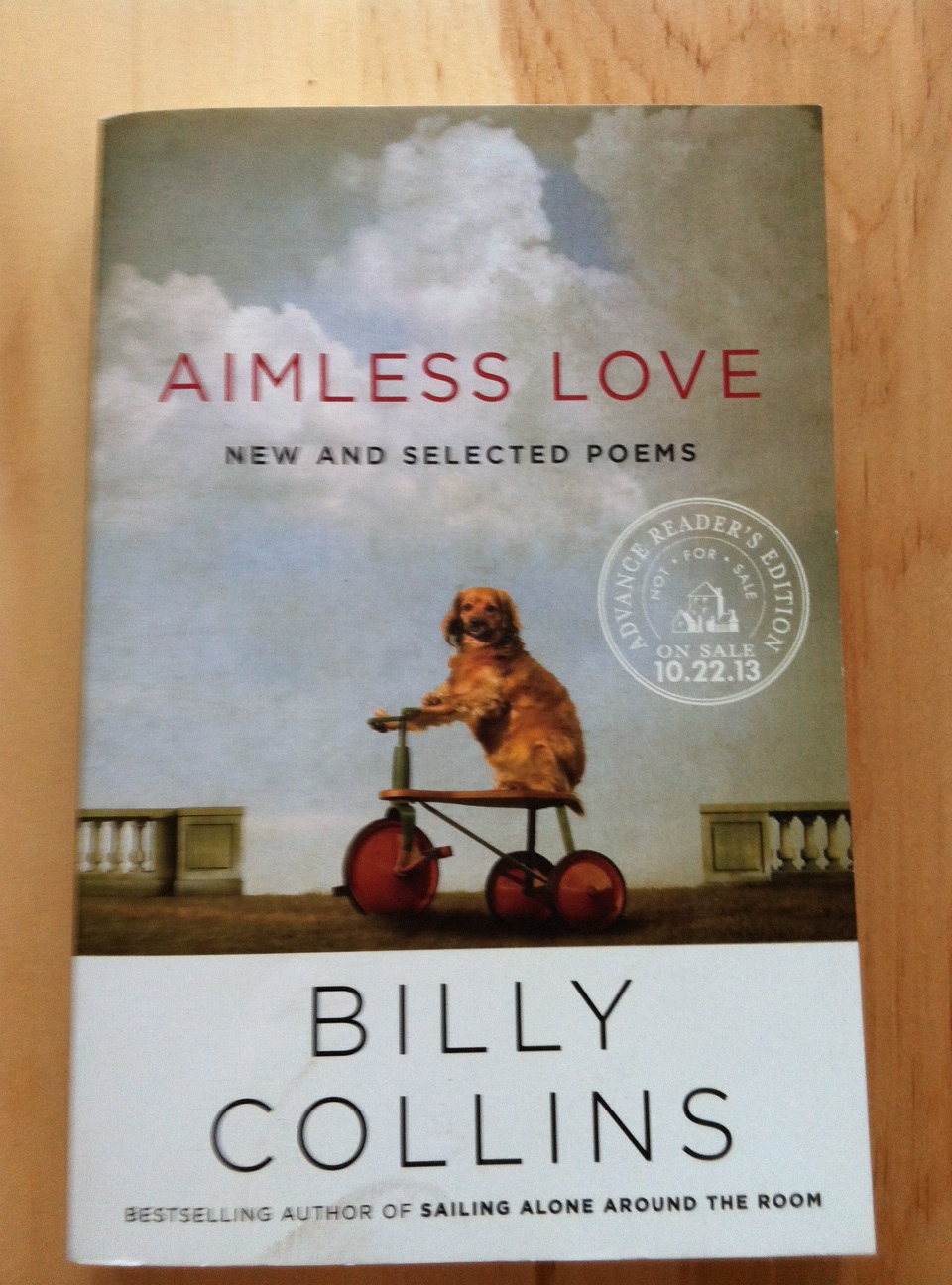
Early Review: Aimless Love*, by Billy Collins

Billy Collins writes one particular kind of poem, and he writes it well. A Collins poem is recognizable by its shape on the page (stanzas of three or four lines, of medium length), by its tendency to flutter from its point of origin for a just a moment, and then alight again a few yards away, like a sparrow on a sidewalk.

Aimless Love, Billy Collins

His poems are cozy but not uncomfortably intimate, clever but not arrogant. Their subjects are work and rest, reading and writing, eating, looking out of windows; in short, the everyday business of being alive in America. As I’ve written elsewhere, his poetry is perfect for picking up on a whim, while you wait for a friend who’s late to dinner, say. You’ll be entertained, you’ll think, and you might even laugh, but you won’t be trying to unknot a metaphor half an hour later while you chew your escarole.

Aimless Love, a collection of new and selected poems due out in October, is no different. Here you’ll find a generous armful of poems from four earlier collections (Nine HorsesThe Trouble With PoetryBallistics, and Horoscopes for the Dead), and about fifty new poems.  In the selection of new poems, I found a misstep or two: “Looking for a Friend in a Crowd of Arriving Passengers: A Sonnet” was fourteen lines long (thirteen lines of four syllables, and one of three), but not interesting or funny enough to pull off the joke about not being a sonnet. “Unholy Sonnet #1” is painful in its riff on “Death Be Not Proud” (one of Donne’s Holy Sonnets, hence the title); Mr. Collins’s lack of technical acumen can’t be avoided; he even reaches into Donne’s oeuvre to find Donne’s once-used words, and these so eclipse Mr. Collins’s own efforts that I was rather embarrassed for the poem, and for him.

Still, these are aberrations. For the most part, these new poems, like their predecessors, are pleasant, undemanding morsels, with a few gems tossed in (“Rome in June”). I’m all for accessibility in poetry, especially if it draws in new readers, and that, certainly, Mr. Collins can claim as an achievement.

If you have the earlier books, you may want to check this one out of the library to see if you think the fifty new additions are worth the price of admission.

You can find Aimless Love on the shelves on October 22nd.

*A disclaimer: I received this book through LibraryThing’s Early Reviewer program. I was not compensated for this review, nor was the content of the review dictated or approved by any party.