‘Tis the Season: Donating Books

IMG_5636Perhaps, Dear Readers, you, like me, have a few books in need of new homes this holiday season. Maybe you’re clearing shelf space in anticipation of Santa leaving a few tomes under the tree, or maybe Hanukkah’s end finds you with more books than you expected.

There are many fine places to donate books; here are four where books from our house are headed this year.

Prison Book Program

This listing is for Massachusetts, but there are many similar programs that might be geographically closer to you. Book bloggers take note: ARCs are generally accepted by prison book programs.

Van Buren Family Shelter

This is a new shelter in Columbus, Ohio (home of my beloved alma mater) which I learned about from writer and professor Michelle Herman. She writes that about 250 children come through the shelter every month, and so volunteers are organizing a children’s book drive:

“The goal is to provide access to a library of books to every child, but also to send each child out of the shelter with two books of her or his own, and thus to collect at least 10,000 books now (or now-ish)–to cover the first two years or so. The organizers are contacting publishers, bookstores, libraries, and schools, as well as everyone they know, and I offered to expand the network to everyone I know. You could too, if you had a mind to. They are accepting new or gently used children’s books, which can be sent directly to the shelter.”

If you have new or gently used children’s books to send, the address is:

Van Buren Shelter
595 Van Buren Dr
Columbus OH
43223

Our Local Library

Prison book programs typically don’t accept hardcovers, so we donate ours to our local public library, where they might circulate, but more likely will be sold in the ongoing library book sale to raise funds for library improvements and outreach.

Epilepsy Foundation New England

The New England chapter of the Epilepsy Foundation collects all sorts of household goods donated by the community, including books.

I’m sure there are many other worthy places to donate books, and I’d be happy to hear about your favorites!
Comics Round Up

I know, Dear Readers: that’s a post title you probably didn’t expect from these quarters.

I’m unpredictable.

Given my nearly unassailable geek credentials, comics should be situated squarely in my wheelhouse, but two factors have stood in the way:

  1. I hate cartoons. With limited exceptions, I find them aesthetically displeasing and grating to the ear (my son’s current favorite, Paw Patrol, is the worst offender right now). Pixar movies are fine because they’re made for adults to enjoy, but I have been done with Disney movies for many years (and that’s not even taking into consideration the deplorable antifeminist and heteronormative sentiments of most of them). South Park, The Simpsons, Futurama, anything on Adult Swim: sorry, no. For years, I though of comics as cartoons in paper form.
  2. I like to have all the information. I realize that’s broad, so let me re-frame: I like to start a story from the very beginning with confidence that there will be an ending of some sort; if a story is particularly gripping, I like to know that I can read (or watch) the next installment pretty much immediately. This is why it’s been hard for me to get into Dr. Who; even if we started at the reboot, I’ll feel as though I’m missing quite a bit—and of course there’s no way I’m catching up on decades’ worth of TV any time soon. This is also why I’ve been waiting to start the Kingkiller Chronicles and to move on to Ann Leckie‘s Ancillary Sword (although the third book in that trilogy is out now, so I suppose I could). And that’s why I’ve never been interested in jumping into Marvel or D.C. comics—it would be virtually impossible to catch up after all these years. And since I associated comics with superheroes for a long time, it didn’t really occur to me that other kinds of comics might be out there.

So, for most of my reading life, I happily disregarded the existence of comics.

But then someone somewhere on the vast interwebs posted about a new comic called Saga; the first volume (collecting issues one through six) of this fantasy space opera features an interspecies couple on the cover, with the armed mother breastfeeding.

I am so totally here for that.

I bought it immediately, and now I’m hooked. It’s so much fun to read—think the best parts of Dune and Star Wars with pulp elements and a love story—and Fiona Staples’s art is just gorgeous, awash in color—it perfectly complements Brian Vaughan’s text. Saga was the gateway drug to a bunch of other comics (all out from Image, now that I think about it) that I read this year. Here’s my rundown of what to read and what to skip.

IMG_5638

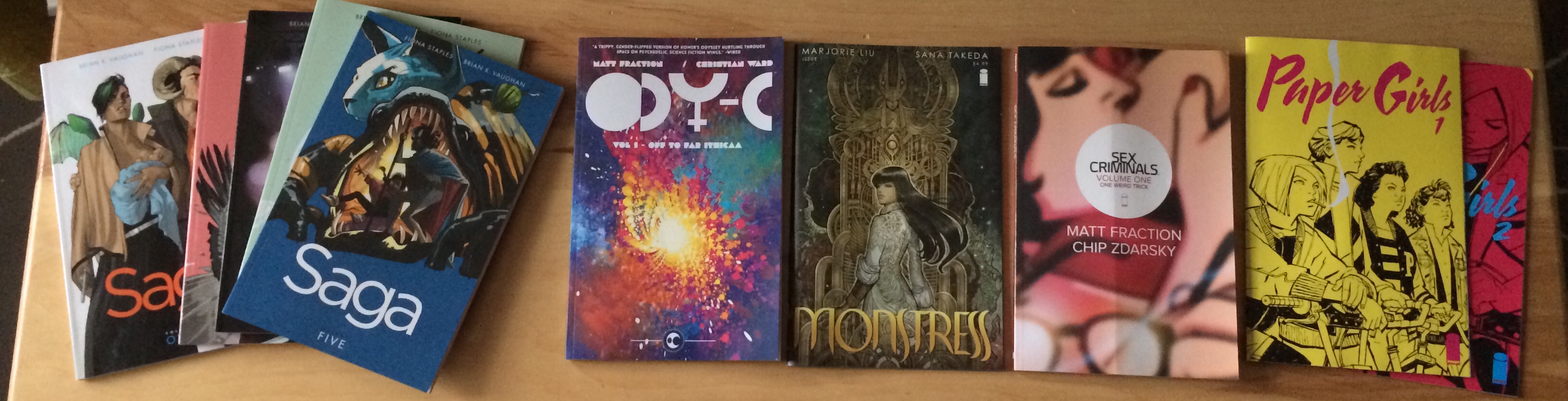
Saga (Brian K. Vaughan & Fiona Staples): Definitely read this if you like sci-fi. There are now five volumes out and I’ve loved all of them, but I’d say the first two are perhaps the strongest. Note that Saga is intended for an adult audience: there’s some sex, a great deal of violence, and mature themes throughout.

ODY-C (Matt Fraction & Christian Ward): I wanted to love this, since it’s a gender-twisted version of the Odyssey set in space. While the artwork is really something—it seems like it wants to splatter off the page, and the colors combinations are inventive—I found two major sources of disappointment. One was the style of the writing, which was going for the archaic feel of some Odyssey translations but too often ended up as mangled syntax. The other was the gender-bending—I’m all for it in theory, but the artwork and writing combined portrayed female sexuality as monstrous (part of a long tradition)—and I don’t think the inventiveness of the project was enough to redeem it. Skip this one.

Monstress (Marjorie Liu & Sana Takeda): The art in this comic, described as “a dark fantastic adventure set in an alternate 1900s Asia,” is absolutely gorgeous, all the more remarkable for its limited palette. The story is complex; the main character, Maika, is on a mission of vengeance, infiltrating an enemy stronghold for reasons that weren’t fully clear in the first issue. It seemed that all or nearly all the characters are female, which was refreshing (you’ll notice that Ms. Liu, Ms. Takeda, and Ms. Staples are the only women among the writers and artists I’ve listed here). I’d love to see where this story goes, but given how dense it is—novelistic, almost—I think I’m going to wait for the first collection to come out before I continue reading. Recommended, though.

Sex Criminals Vol. 1: One Weird Trick (Matt Fraction & Chip Zdarsky): This came highly recommended from a few sources. I liked the hilarious title and the ridiculous premise (the main character, a librarian, discovers that time stops whenever she has an orgasm, and when she meets another person who shares her talent, hijinks ensue), but I just wasn’t into the storyline. Maybe it became more interesting in later issues, but I can’t stop time with any weird trick, alas, and life is short, so I’m afraid I won’t be finding out. Lots of other readers were really into this comic, so I’d recommend checking it out at the library.

Paper Girls (Brian K. Vaughan & Cliff Chiang, plus Matt Wilson and Jared Fletcher): I’m only a couple issues into this comic, but I like it quite a bit. Four paper delivery girls in Ohio (hey Buckeyes!) in the 80s are trying to finish their route in the wee hours of Halloween, but run across more trouble than they anticipated. This review in the Onion’s A.V. Club is spot-on. I’m not going to run out to buy every issue, but I’d definitely pick up the volume of collected issues when it comes out. I’d recommend it to any Goonies fans out there.

That’s it for this year, Dear Readers. Have you read any comics this year? What did you like? What should I be looking for next year?

P.S. If you’re a comics fan who’s stumbled across this post, let me take this opportunity to recommend a novel: Michael Chabon’s The Amazing Adventures of Kavalier & Clay. The title doesn’t lie; it’s one of my favorite books.

“The weary ones, the sad, the suffering, / All found their comfort in the holy place”: Emma Lazarus’s “In the Jewish Synagogue at Newport”

New_colossusI was poking about, looking for a Chanukah poem to feature in honor of the holiday (and Happy Chanukah, Dear Readers), when I came across a poem that speaks a bit to the holiday itself, but even more to our present moment. Please bear with me as I come around to the poem.

A personage who shall not be named (like the J.K. Rowling villain he seems so desperate to emulate) is voicing repulsive xenophobia, indifferent to the plight of thousands upon thousands of people fleeing violence and seeking no more than what most Americans take for granted: the right to live freely in peace, to pursue happiness. This person, and any who claim to be interested in the Founding Fathers, would do well to recall George Washington’s 1790 letter to the Jewish congregation of Newport, Rhode Island, assuring them—often persecuted in other lands for their religion—of their welcome in America. Herewith, an excerpt:

The citizens of the United States of America have a right to applaud themselves for having given to mankind examples of an enlarged and liberal policy — a policy worthy of imitation. All possess alike liberty of conscience and immunities of citizenship.

It is now no more that toleration is spoken of as if it were the indulgence of one class of people that another enjoyed the exercise of their inherent natural rights, for, happily, the Government of the United States, which gives to bigotry no sanction, to persecution no assistance, requires only that they who live under its protection should demean themselves as good citizens in giving it on all occasions their effectual support.

[…]

May the children of the stock of Abraham who dwell in this land continue to merit and enjoy the good will of the other inhabitants — while every one shall sit in safety under his own vine and fig tree and there shall be none to make him afraid.

May the father of all mercies scatter light, and not darkness, upon our paths, and make us all in our several vocations useful here, and in His own due time and way everlastingly happy.

G. Washington [emphasis mine]

It was the synagogue of this very congregation, the oldest synagogue still standing in America, that inspired Emma Lazarus to write “In the Jewish Synagogue at Newport,” a lovely poem that muses on the plight of exiles and the comforts of shared devotion, and should recall to us all—believers and non-believers alike—the great privilege of living in a country in which freedom of religion is enshrined in law, and the great wisdom, the necessary humanity, of embracing people of goodwill of all faiths, or none at all.

If the name Emma Lazarus sounds familiar, it’s because she’s also the poet whose verses famously adorned a plaque inside the Statue of Liberty:

The New Colossus

Not like the brazen giant of Greek fame,
With conquering limbs astride from land to land;
Here at our sea-washed, sunset gates shall stand
A mighty woman with a torch, whose flame
Is the imprisoned lightning, and her name
Mother of Exiles. From her beacon-hand
Glows world-wide welcome; her mild eyes command
The air-bridged harbor that twin cities frame.
“Keep, ancient lands, your storied pomp!” cries she
With silent lips. “Give me your tired, your poor,
Your huddled masses yearning to breathe free,
The wretched refuse of your teeming shore.
Send these, the homeless, tempest-tost to me,
I lift my lamp beside the golden door!”


Light and not darkness upon our paths, friends.


To donate to the UNCHR, the UN Refugee Agency, click here. 

To donate to UNICEF, click here. 

To donate to Save the Children, click here. 

Recommended Reading: The Nearest Thing to Life, by James Wood

IMG_5613As I wrote about a few weeks ago, I very much enjoyed hearing James Wood’s lecture during the Boston Book Festival, after which he signed copies of his newest book, The Nearest Thing to Life (the title is drawn from George Eliot’s description of art). Three of its four chapters (which read like extended essays) were originally delivered as lectures, and indeed I found the book’s style similar to Mr. Wood’s speaking style; erudite and fluid, geared toward the intelligent and interested layperson reader. Though Mr. Wood is a professor at Harvard, his writing is very different from the jargon-laden, theory-heavy academic writing on literature that yours truly grew accustomed to reading in graduate school; this is an almost old-fashioned style of personally-inflected criticism.

In the first chapter, “Why?,” Mr. Wood considers the question of death (and the subsequent need for theodicy) as it relates to fiction and its worlds of infinite possibility, writing, for example, that “I was struck by the thought that death gives us the awful privilege of seeing a life whole; that a funeral or even an obituary is a liturgical home for that uneasy privilege; and that fiction is the literary genre that most powerfully offers a secular version of that liturgical hospitality” (19).

Next, Mr. Wood reflects on the role of detail in fiction in the chapter “Serious Noticing,” which was also the subject of his talk at the Boston Book Festival. Fiction asks us to look more closely at people and objects, and for Mr. Wood detail is the “lifeness” that fiction alone can present: “[details] represent that magical fusion, wherein the maximum amount of literary artifice (the writer’s genius for selection and imaginative creation) produces a simulacrum of the maximum amount of nonliterary or actual life, a process whereby artifice is then indeed converted into (fictional, which is to say, new) life” (39).

In “Using Everything,” Mr. Wood makes a case for evaluative literary criticism. Since literary criticism is the only kind of arts criticism that falls into the same medium as its subject, Mr. Wood sees an opportunity for “critical retelling” or “revoicing” in literary criticism, which uses the same tools (like metaphor) as literature itself.

Finally, “Secular Homelessness,” the most personal, I think, of the work here, finds the author reflecting on exile, emigration, and home. Thought-provoking; it made me wonder if Mr. Wood has read George Prochnik’s excellent book on Stefan Zweig, The Impossible Exile.

To illustrate his points, Mr. Wood examines scenes from Chekov, Woolf, Penelope Fitzgerald, and many other writers (though I do wish more were women); his writing is wonderfully descriptive, enhancing the texts he considers, as the best criticism does.

I highly recommend The Nearest Thing to Life to readers of fiction who are interested in thinking deeply about how fiction works, and why; to writers of fiction, for the same reason; and to my fellow bloggers—here you’ll find a model of criticism to strive for.

“the little Mars rover”: Matthew Rohrer’s “There Is Absolutely Nothing Lonelier”

photo (74)A couple weeks ago, Mr. O and I were able to go see The Martian in the theatre (a rare treat); I absolutely loved the book and heartily endorse the movie. There was a catch, however: now I want to re-read the book, and since this is the season when my desire to read all the books smashes up my need to knit all the things—Houston, we have a problem.

To satisfy my sci-fi craving, first I tried to convince our four-year-old to watch WALL-E, but no dice; he’s preemptively scared of most movies. You’re thinking that maybe I should just look forward to the next Star Wars, but I say unto you: thrice bitten, still shy (and still going, but that’s beside the point).

So then I started thinking about poetry, and while I continue to commend Tracy K. Smith’s Life on Mars to you, I have a new poem for your perusal. I owe a tip of the hat to poet Simeon Berry on this one, who posted a link to Matthew Rohr’s poem “There Is Absolutely Nothing Lonelier” a few days ago.

You will never read a JPL press release quite the same way again.

Recommended Reading: The Gap of Time by Jeanette Winterson**

IMG_5576Over the Thanksgiving holiday, I finished reading Jeanette Winterson’s The Gap of Time,* a reimagining of Shakespeare’s late play The Winter’s Tale. (If you don’t know The Winter’s Tale, think Othello plus pregnancy, a lost and then found child, funny time business, more clowns, and a happy ending.)

Adaptations of Shakespeare, as of anything sui generis, are tricky. Shakespeare’s plots are derivative, pulled from history or earlier plays and tales; what makes Shakespeare Shakespeare is the poetry, the depth of characterization, the verbal pyrotechnics of the plays, and these, of course, cannot be adapted in the way that a story can be.

But it’s fun to watch talented people try, isn’t it?

In this case, Ms. Winterson pulls the plot of The Winter’s Tale four hundred years into the future and hundreds of miles west; Sicilia is now a large company in London headed by Leo, and Bohemia is now New Bohemia, a New Orleans-type city in North America, the occasionally home to Leo’s best friend, Xeno. Hermione is now the Parisian singer MiMi, married to Leo and expecting his second child. In a fit of cruel and unfounded jealously, Leo accuses Xeno of sleeping with MiMi (and fathering her child), attempts to kill him, and provokes MiMi’s early labor. When Perdita is born, Leo has her spirited away, which leads indirectly to his young son’s death and MiMi’s disappearance.

Fast forward sixteen years. Perdita has been raised by the kindly Shep and his son Clo, and through a series of improbabilities, comes to fall in love with Xeno’s son, Zel, and learn of her unusual parentage. Next stop: a very awkward family reunion.

Though she generally adheres to the five-act structure of the original play (including two “intervals”), and weights the first half with more psychosexual tension than a bevy of Freudians would know what to do with, Ms. Winterson makes one break that I found dramatically useful: she begins the tale with the scene of Perdita’s accidental abandonment and subsequent rescue by Shep, a grieving widower and musician. This change heightens the tension and gives readers something to look forward to as they read the sordid story of Leo and Xeno; here, as in the play, it’s not at all clear what MiMi saw in Leo in the first place.

The book participates in the oddness of its source material’s plot and characters while retaining its themes: loss, forgiveness, remorse, grief, the startling power of music and imagination. Ms. Winterson’s writing is studded with lovely metaphors (“Milo stood between them like a lighthouse between the rocks and the shipwreck”), images (“he could only look at her through the kaleidoscope cut-outs of the crowd”), and wry observations (“one thing you’ll notice about progress, kid, is that it doesn’t happen to everyone”), self-referential asides, and overt references to the play. Autolycus’s (here, perfectly, a used car dealer) jokes fall flat, but then, I never enjoyed them in the original, so maybe that’s intentional. Nevertheless, The Gap of Time is engaging, a fast read that Shakespeare stalwarts will find thought-provoking and fans of quirky, genre-bending fiction will appreciate.

This is the first in Hogarth’s planned series of Shakespeare adaptations that will roll out more frequently next year (to mark the 400th anniversary of the Bard’s death); authors tapped include Margaret Atwood (!), Gillian Flynn, and Jo Nesbo.

What’s your favorite Shakespeare adaptation, Dear Readers? And has anyone read Ms. Winterson’s other work? What should I be on the lookout for?

*I received a review copy of this book from the publisher for review consideration, which did not affect the content of my review.

** I want you all to know that I refrained from calling this post “The Bard Awakens.”

“We see you, see ourselves and know / That we must take the utmost care / And kindness in all things”: Joy Harjo’s “Eagle Poem”

Happy Thanksgiving, Dear (American) Readers! Here’s a poetry post from a couple of years back that I think I might like to make a yearly tradition. I’d be happy to know what your favorite Thanksgiving poems are if you’d care to note them in the comments. Safe travels and hearty toasts to all.


I’m not a religious person, but many people I treasure are very religious, and I’m always

"Eagle silhouette" Image courtesy of Gualberto107 at FreeDigitalPhotos.net

“Eagle silhouette” Image courtesy of Gualberto107 at FreeDigitalPhotos.net

grateful for their prayers and their generosity of spirit. Joy Harjo’s “Eagle Poem” gives me a way to think about prayer that is comforting and uplifting without listing toward the dogmatic.

For that reason, I think “Eagle Poem” is the perfect poem for Thanksgiving week, when we give thanks in our own ways, both secular and spiritual, for what we have and what we have not.

Reading Coincidences

I am a person who finds coincidences delightful. (I wonder, are you?)

Not too long ago, I read Kay’s review of Cheerful Weather for the Wedding (which made me think of the opening sequence in Steel Magnolias, and yes, if you were wondering, I am basically a 30-something married version of Ouiser), and therefore ordered it, and then Laura of Reading in Bed put it on her list for Novellas in November, an event she’s doing with founder Rick at the Book-a-Week Project. It was meant to be.

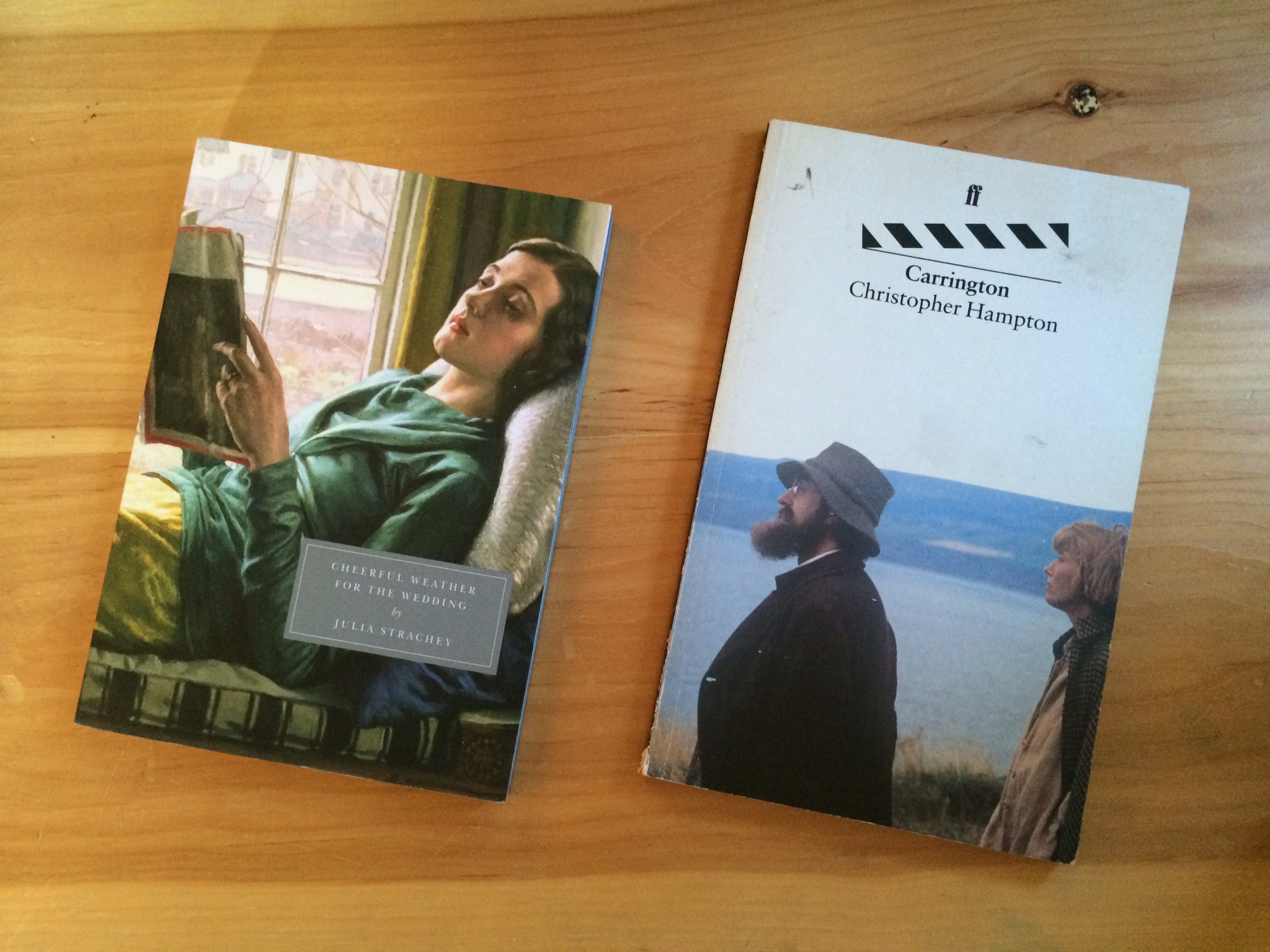
So the novella arrived and I realized that the author is Julia Strachey, who was the niece of writer Lytton Strachey, who is one of the subjects of Christopher Hampton’s screenplay Carrington, which I read a little while ago, whose main subject is the artist Dora Carrington, who painted the author portrait of Julia Strachey on the back (not pictured) of Cheerful Weather for the Wedding.

Bam! IMG_5462

So. The novella first. It is not, it turns out, remotely like Steel Magnolias except for the fact that it begins on the morning of a wedding. In this case, it’s March and a gale is blowing through the Thatcham house and grounds as twenty-three-year-old Dolly prepares for her wedding. Mrs. Thatcham fusses over details, gives contradictory orders regarding luncheon, and fails to notice the general unhappiness of pretty much every person in the house: Kitty, the younger, slightly boorish sister of the bride, Robert and Thomas, young cousins who cannot get along because Tom is bullying the younger boy over his socks, and Joseph, a friend of Dolly’s who’s in quite the rush to see the bride. And then there’s Dolly herself, who’s bracing herself with the better part of a bottle of rum.

It sounds like the set up for a Kaufman and Hart play, but if you imagine Kaufman and Hart done by a combination of Virginia Woolf, Dorothy Parker, and E.M. Forster, you’ll be on the right track. It’s a deeply odd little book, but one that features some fine writing, a nice twist at the end, excellent characterization, and a very interesting motif of carefully depicted light: For example: “sunlight fell in dazzling oblongs” (12), “brassy yellow sunlight” (26) and “dazzling white light” (47) meet green twilight at one point and lilac heat haze (for which I can’t find page numbers). Recommended.

Now, Carrington: I thought this was a play when I picked it up at a used bookstore in Hyannis, but it’s the screenplay to the 1995 film starring Emma Thompson and Jonathan Pryce, which I missed when it premiered because (a) I was 11 and (b) I was repeat-watching Sense and Sensibility, another Emma Thompson flick (I love her). Of course, now I’m dying to see it because it’s about the 1920s Bloomsbury folk and their usually doomed attempts to find happiness within unconventional—-to put it mildly—-living arrangements, and I’m a sucker for 1920s English artistic angst. Also I read Lytton Strachey’s Elizabeth and Essex about seven or eight years ago and wondered mightily about the no-doubt fabulous person who wrote it; here’s part of the answer.

Essentially, Carrington is a story about the difficulty of being romantically interested in someone who can only be platonically (in the modern sense) interested in you. And it’s about gender and sexual nonconformity, art, and family. But mostly it’s about love. It’s gorgeously written and unfortunately impossible to quote out of context, but I highly recommend it. I’ll let you know if and when I find the movie on Netflix.

What about you, Dear Readers? Any bookish coincidences striking you lately?

“My vegetable love should grow / Vaster than empires, and more slow”: Andrew Marvell’s “To His Coy Mistress”

Photo courtesy Colton Brown via Unsplash

Photo courtesy Colton Brown via Unsplash

As you might have noticed, Dear Readers, I am very fond of sixteenth- and seventeenth-century poets, like Thomas Wyatt, John Donne, and of course, one William Shakespeare. One of my favorite courses in college was on Renaissance (English) literature, in which Professor Richard Dutton introduced us (well, me at least, I shouldn’t speak for everyone else) to Milton, Marlowe, and Andrew Marvell (and other poets whose last names did not begin with ‘m.’).

You probably know Marvell from other writers’ allusions to  his poem “To His Coy Mistress,” or from the poem itself:

To His Coy Mistress

Had we but world enough and time,
This coyness, lady, were no crime.
We would sit down, and think which way
To walk, and pass our long love’s day.
Thou by the Indian Ganges’ side
Shouldst rubies find; I by the tide
Of Humber would complain. I would
Love you ten years before the flood,
And you should, if you please, refuse
Till the conversion of the Jews.
My vegetable love should grow
Vaster than empires and more slow;
An hundred years should go to praise
Thine eyes, and on thy forehead gaze;
Two hundred to adore each breast,
But thirty thousand to the rest;
An age at least to every part,
And the last age should show your heart.
For, lady, you deserve this state,
Nor would I love at lower rate.
       But at my back I always hear
Time’s wingèd chariot hurrying near;
And yonder all before us lie
Deserts of vast eternity.
Thy beauty shall no more be found;
Nor, in thy marble vault, shall sound
My echoing song; then worms shall try
That long-preserved virginity,
And your quaint honour turn to dust,
And into ashes all my lust;
The grave’s a fine and private place,
But none, I think, do there embrace.
       Now therefore, while the youthful hue
Sits on thy skin like morning dew,
And while thy willing soul transpires
At every pore with instant fires,
Now let us sport us while we may,
And now, like amorous birds of prey,
Rather at once our time devour
Than languish in his slow-chapped power.
Let us roll all our strength and all
Our sweetness up into one ball,
And tear our pleasures with rough strife
Through the iron gates of life:
Thus, though we cannot make our sun
Stand still, yet we will make him run.


It’s an excellent poem to read aloud—one of the best “carpe diem” poems in English, its irony and occasionally grotesque imagery undercutting its initial urgent tone. For an amusing riposte to Marvell, have a look at Annie Finch’s “Coy Mistress” at the Poetry Foundation.

Recommended Reading: All That Followed, by Gabriel Urza

Gorgeous cover---one of the best I've seen this year.

Gorgeous cover—one of the best I’ve seen this year.

Gabriel Urza’s All That Followed* is a quiet book about dramatic events.

Set in the Basque Country, the novel is told from three perspectives: Joni, an older American teacher who’s been living in Muriga since the 1940s; Mariana, a young widow whose husband José was abducted and killed five years before the novel opens; and Iker Abarzuza, the young man imprisoned in the Salto del Negro for that murder.

When the novel opens, the 2004 train bombings in Madrid have reminded everyone in Muriga of a time they’d rather forget: when the usual simmering tension between separatist protestors (many of them teenagers) and the forces of order boiled over into violence. Joni, Mariana, and Iker recall the fateful weeks leading up to José’s kidnapping and the roles they played, knowingly and not, in each other’s lives.

There’s no one dark secret or startling revelation at the end of the novel, though each of the main characters reveals something closely guarded—a troubled family, a personal failing, a lapse in judgment. Instead, this is a quietly gripping novel about choice and community, as well as the dangers and exhilaration of both. All three major characters struggle to find their place in Muriga, Joni because even after fifty years he’s still an outsider (he speaks Spanish but not Basque), Mariana because she feels hemmed in by her marriage, and Iker because he’s a teenager who’s not sure whether to take the path of revolution or personal fulfillment.

I came to this book knowing very little of Basque culture (aside from what I picked up from Malcom Brooks’s Painted Horses), and it was fascinating to see it from the perspective of characters living in it, but at some remove, rather like the way a reader feels when absorbed in a book. (Mr. Urza, by the way, has lived in the Basque region and his family is from the area). Though it was at times difficult to keep track of the different timelines in the novel, I appreciated the novelist’s command of subtly-shifting characters, and decision not to dwell on the sensational aspects of the story.

Mr. Urza’s writing is graceful and neat, his descriptions of the town and its inhabitants memorable. The last lines in paragraphs often pack an emotional punch, as here:

In the summers I would return from a day at San Jorge to find Nerea in the kitchen beating a half dozen eggs—a fork in one hand, a new translation of an Orwell novel in the other—wearing one of my work shirts unbuttoned and open against the afternoon heat. These are the days against which I have measured the rest of my life. (120)

All That Followed is an extremely promising debut. Recommended.

[And, fellow Buckeyes who remember Denney Hall: you’ll like, as I did, the acknowledgments pages with the list of Ohio State professors, wonderful people all.]

*I received a copy of this book from the publisher for review purposes, which did not affect the content of my review.