“All glam-glow, all twinkle and gold”: Tracy K. Smith’s “Don’t You Wonder, Sometimes?” (RIP David Bowie)

Tracy K. Smith-Bowie

Since David Bowie has left us for what I’m guessing must be some sort of starsplitting transcendent plane, it’s only appropriate this week to feature Tracy K. Smith’s gorgeous and evocative “Don’t You Wonder, Sometimes?” from her appropriately titled collection Life on Mars

The poem has been making the rounds this week—justifiably so—because it hones in on the multi-persona man as a way to consider the big questions about time, space, death, and belief. In the poem, Bowie is both an otherworldly immortal figure and one of us—just immeasurably cooler (literally, in part two of the poem). I pretty much want to quote the whole poem right now, so please read it. 

Bowie was an avid reader, and if you’re craving more bookish Bowie goodness, head over to BookRiot to check out their list (from summer 2015) of all things books and Bowie.

Turns out I can’t resist quoting the poem:


And how many lives

Before take-off, before we find ourselves

Beyond ourselves, all glam-glow, all twinkle and gold?


Safe travels, Starman.

bowie-reading

Recommended Reading: The Bassoon King, by Rainn Wilson

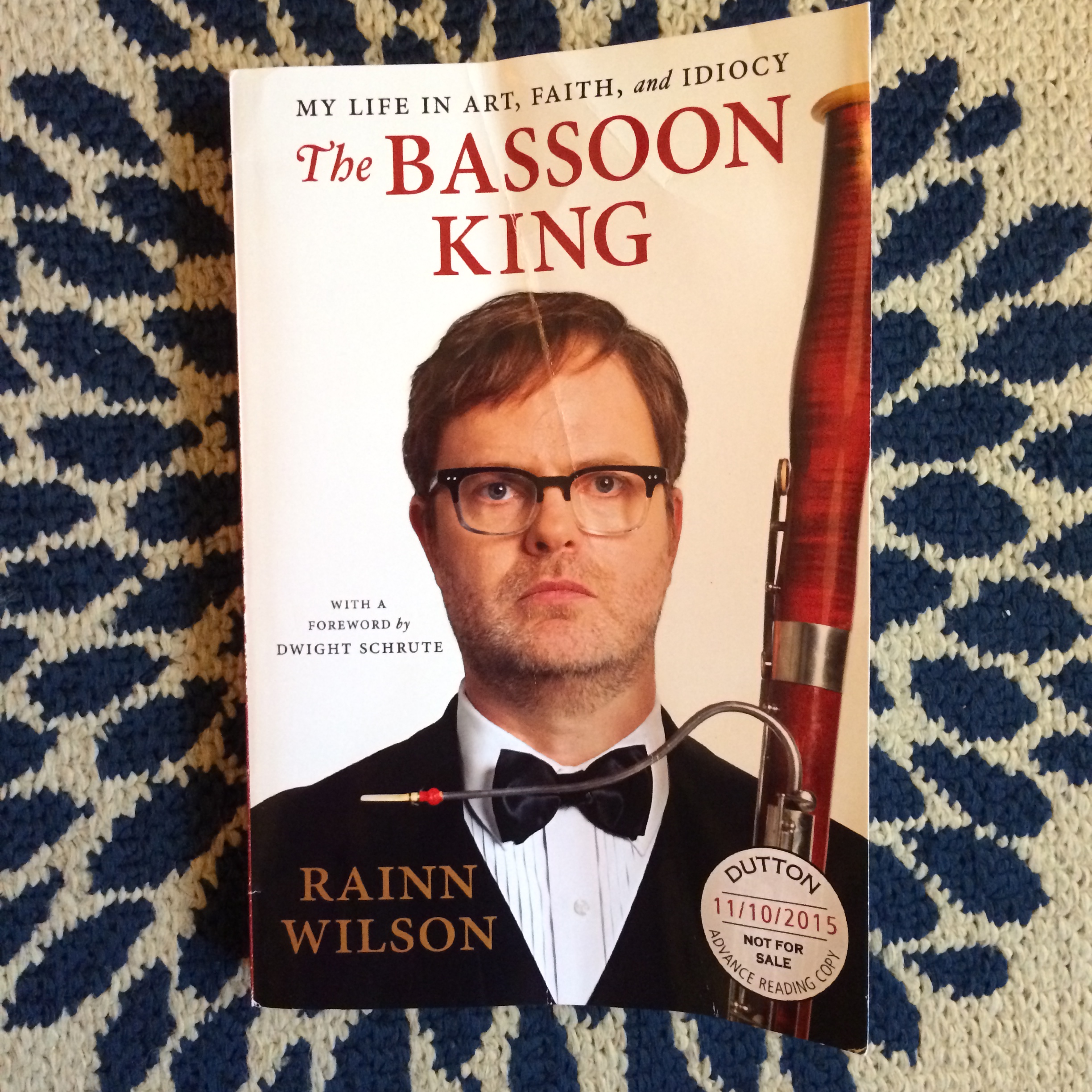
IMG_5784Celebrity memoirs—with exceptions for those written by people named Tina Fey and Amy Poehler—are not my genre of choice. But I couldn’t resist Rainn Wilson’s The Bassoon King*, partly because the title is hilarious, partly because I’ve noted with interest the actor’s advocacy for the persecuted adherents of his religion, the Bahá’í Faith (which he’s written a handy primer about, included at the end of the book), but mostly because The Office is one of my all-time favorite shows, and of course I want to better understand the man behind Dwight Schrute.

The Bassoon King is a charming catalogue of its author’s oddities and interests, which include 80s records, experimental theatre, and comic sidekicks. If you pick it up to be amused, you won’t be disappointed; Mr. Wilson is unfailingly self-deprecating, has a seemingly endless store of anecdotes from his teen years as what can only be described as a major nerd (takes one to know one, folks), and plenty of stories and harmless gossip about his work in movies and TV.

The two facets of the book I found most interesting were Mr. Wilson’s account of his unusual upbringing and the focus on the considerable amount of acting training he undertook, both in school (at Tufts and later NYU) and later in a touring company and various productions (from Shakespeare in the Park to his Broadway flop).

Rainn Wilson’s parents divorced when he was a small child (of his appearance as a baby, he writes, “Picture an ashen manatee with a tiny human face”), and he and his father ended up in Nicaragua, where they in short order found themselves living in a very odd jungle-y sort of town with a new stepmother, Kristin. Understandably, Mr. Wilson’s memories of his period are quite vivid (“like Technicolor acid-dream postcards, spliced and pasted together, flickering in a mental strobe light”); his descriptions of the various Nicaraguan beasties—including a pet sloth named Andrew—are laugh-out-loud funny, and, I can tell you from personal experience, most worth reading aloud to a 4-year-old.

Particularly affecting is his empathy for his parents (his birth-mother, Shay; Robert, his father, a writer and artist who sacrificed a great deal for the family; and Kristin). Shay and Robert both had horrific childhoods but thankfully did not continue the cycle of abuse; all three adults were supportive of the author’s adolescent adventures in geekdom (D&D, of course) and nerdom (chess club, model UN, bassoon, and drama, his niche) and his desire to become an actor. In fact, one of my critiques of the book is that we lose sight of these figures in Mr. Wilson’s later life; I particularly wanted to know how his father felt about the actor’s eventual re-acceptance of his childhood faith after a period of Bohemian rebellion.

If you weren’t a theater nerd in high school, it might be hard to imagine just how much training actors (as opposed to reality stars) go through, and how truly bizarre some of that training looks (grown people jumping around a stage as various animals or body parts? Check.). Mr. Wilson does an excellent job of showing just how much training, failure, serendipity, and experience lay behind his successful portrayal of Dwight. My favorite revelation: he took a clowning workshop with Gates McFadden. As in Beverly Crusher from Star Trek: The Next Generation. And it was awesome.

The Bassoon King is a memoir that covers more spiritual ground than most that I’ve read; Mr. Wilson is an unabashed believer and advocates strongly for his beliefs (but I do wish he would refrain from lumping all atheists together as materialists). He discusses his venture called Soul Pancake (source of Kid President videos, apparently, which I have heard of but not seen), a site devoted to asking people to “chew on life’s big questions,” and his advocacy, along with his wife Holiday Reinhorn, for the Mona Foundation, which supports grassroots education movements in developing countries. Together they founded Lidé, an initiative for “empowerment through the arts for women and girls” in Haiti. Mr. Wilson is clearly passionate about this endeavor and I would have liked to read more about it.

I recommend The Bassoon King to fans of The Office, budding actors, anyone interested in the Bahá’í Faith, and readers looking for something generally light and funny as a palate cleanser between denser reads.

Readers, what’s your favorite celebrity memoir?

*This is a review of a publisher’s advance reading copy of this book. This did not affect the content of my review.

“Light larking”: Floyd Skloot’s “Handspun”

About a year ago, I wrote a quick post about poems related to knitting, an activity I find myself frantically trying to finish most holiday seasons (this year I made three scarves, four cowls, four headbands, and I still owe my son a pair of slippers). I much prefer knitting in a more leisurely fashion, and I love seeing the complex projects skilled knitters (I am not among this number) produce—delicate lace, shawls worked with intarsia so that they look like tapestries, that sort of thing. Most of the best projects I see are made with gorgeous wool, to which I am sensitive if not downright allergic, and some are even made with handspun varieties.

Spinning is an art I’ll never practice, but I do love reading about it. And if you’re ever out in Colorado, the Denver Art Museum features a whole floor devoted to textile arts; when I visited a volunteer was demonstrating how she spins wool into yarn at home. It was absolutely fascinating, and I recommend popping by if you’re able.

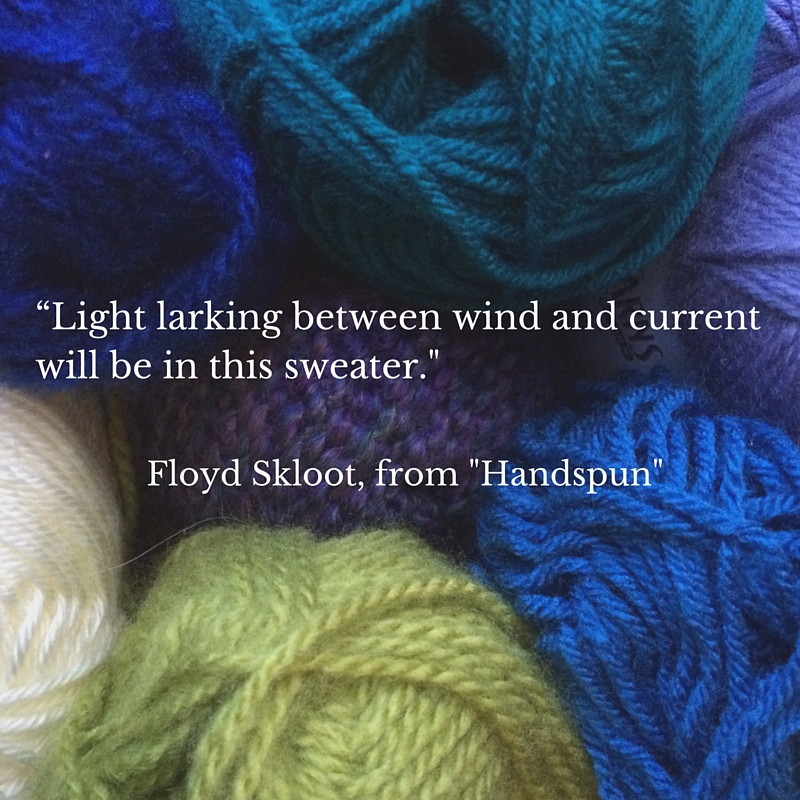
Floyd Skloot Handspun quoteWhich brings me to the poem of the week, Floyd Skloot’s “Handspun,” which was featured in this week’s American Life in Poetry series, curated by Ted Kooser (I highly recommend signing up for the weekly email; Mr. Kooser chooses brief, relatable poems, which are paired with his pithy introductions). In this poem, the speaker watches his wife as she begins yarn for a “summer sweater,” one meant to be worn in summer and one that captures in its colors some of summer’s light.

I like the sensory detail of this poem (it features sound and texture and imagery), and I like the way circularity is subtly emphasized: the swivel chair, the spinning wheel, the sun, the woman “ringed” by yarn—all suggesting the act of spinning itself.  The “swollen river” too might be considered  circular, or at least circulating in nature.

But my favorite line is “Light larking between wind and current / will be in this sweater.” What a verb. What a linebreak.

By the way, if you were wondering why the poet’s last name sounds familiar, it might be because he’s the father of Rebecca Skloot, author of the mega-successful The Immortal Life of Henrietta Lacks (which apparently everyone except me has read).

Do you have a favorite poem about one of your hobbies?


Recommended Reading: Our Souls at Night, by Kent Haruf

IMG_5751I’m so pleased to report that the first book I read this year is Kent Haruf’s excellent (and sadly, last) novel Our Souls at Night. Set in his fictional town of Holt, Colrado (the setting of his earlier novels, which I will now be adding to my reading list), the story begins when a widow, Addie, makes her neighbor Louis (a widower) an unusual proposition: come spend the night with her, so that the both have someone to share the darkness with.

Though wary of talk in their small town, Louis agrees, and sure enough, the small community is set abuzz by what it’s presumed Louis and Addie are up to (but what is, for the bulk of the novel, holding hands and talking). But neither Addie nor Louis is willing to alter their arrangement for appearance’s sake.

The arrival of Addie’s grandson Jamie does bring change. After his parents’ arguments and separation, the boy is lonely and often frightened, but Addie and Louis minister to him with calmness, routine, and simple pleasures: softball games, camping, the observation of tiny mice. When Addie’s son returns for Jamie, however, Louis and Addie find that his disapproval means more than their neighbors’.

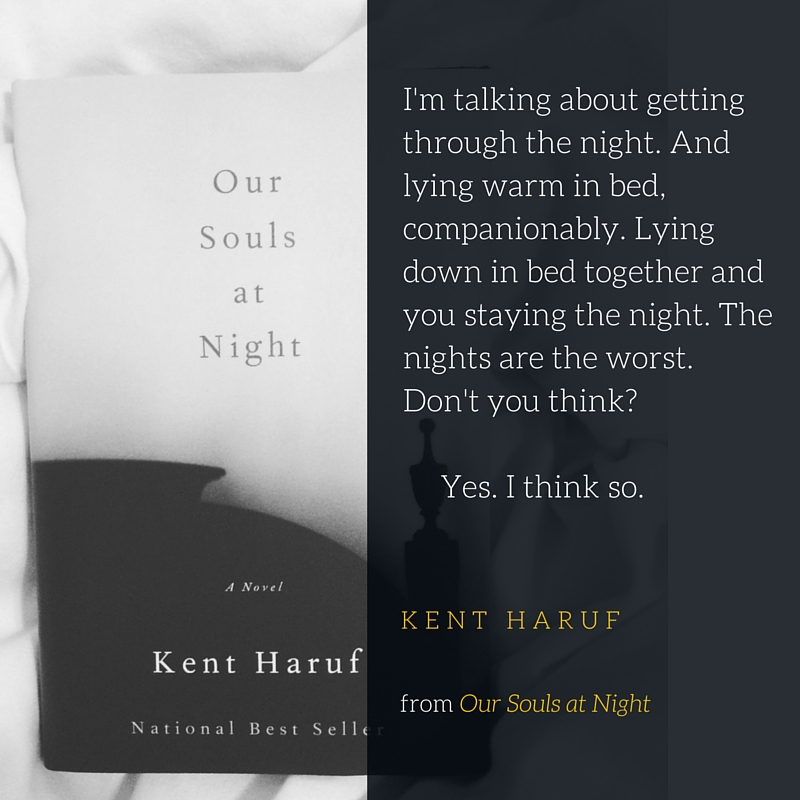
Our Souls at Night quoteThe story and style of Our Souls at Night are deceptively simple. Chapters and sentences tend to be short, and you’ll find few polysyllabic words, but so much is going on beneath the surface and in silences that it’s impossible not to recognize the incredible skill of a master writer. The novel reads quickly, gliding along smoothly until a line or an image snaps into focus, arresting momentum.

Apart from its style and simplicity, I loved this book for its focus on two main characters navigating the transition from late middle age into old age (Addie and Louis are about 70). So refreshing. While Our Souls at Night is set in the present (Jamie has a smartphone to call his mother), Addie and Louis’s world feels timeless, especially since they do things at a slower pace than that typically required by modern consumerism. As you might suspect, there’s quite a bit of nostalgic Americana in the book (fried-chicken picnics, men chewing the fat at a bakery; I love the detail of Louis carrying his pajamas to Addie’s house in a paper sack), but it’s not the treacly sort, since Addie and Louis’s old-fashioned routines are accompanied by the old-fashioned attitudes in Holt.

Our Souls at Night is highly recommended.

Have you read this book or any others by Kent Haruf? What did you think?

Happy New Year (with News!)

Happy New Year, Dear Readers!

As you might have noticed, after three years (happy birthday, dear blog) I’ve finally updated the look of the site a bit, though the posting schedule remains the same.

I’m not a resolution-maker, but this year I hope to read and write more than I did last year, and to more to bring poetry, in particular, to a wider readership.

Speaking of writing, you’ll soon be able to read my new advice column, Dear Clementine, on a new site called The Postscript. In order to dole out advice, however, I need someone to ask for it, so please do send your questions personal, profession, parental, or otherwise to: dearclementinepostscript[at]gmail[dot]com.

And while I’m engaged in shameless self-promotion: I’ve redone my professional website, which you can find at carolynoliver.net. It includes a very serious picture of me. Also other information.

What are your plans, reading and otherwise, for 2016?

2016

Some Questions and Comments Regarding Poetry

Dear Readers,

I was going to try to sum up my year in poetry reading in a rather long post with lots of quotations and best lines, but it’s been rather an eventful week around here (capped off by my husband’s grandmother’s near-miraculous recovery from severe hypothermia), and so I will be brief.

Comments and Questions:

  1. Reading poetry is a delight that I wish were more widespread.
  2. Fellow book bloggers: The vast majority of blog posts are about fiction and nonfiction, not poetry (mine included, if we’re talking about reviews and not the poem-of-the-week posts). Why is that? What would make reading poetry—say, five collections a year if you typically read about 75-125 books a year—appealing to you?
  3. Where do you, dear readers, read about poetry? Or, when you pick up a book of poems, what’s the impetus behind the choice?
  4. If you would like to read more poetry and you’re a regular around here, what can I do, or do better, to help?

And for the new year, I recommend a poem (of course): the suitably titled “New Year’s Poem” by the late Canadian poet Margaret Avison. It’s jeweled with lovely images, and the description of the party puts me in mind of a winter version of Mrs. Dalloway’s (eventually, everything comes back to Mrs. Dalloway).

Happy New Year, Dear Readers!

Recommended Reading: The Price of Salt, or Carol, by Patricia Highsmith

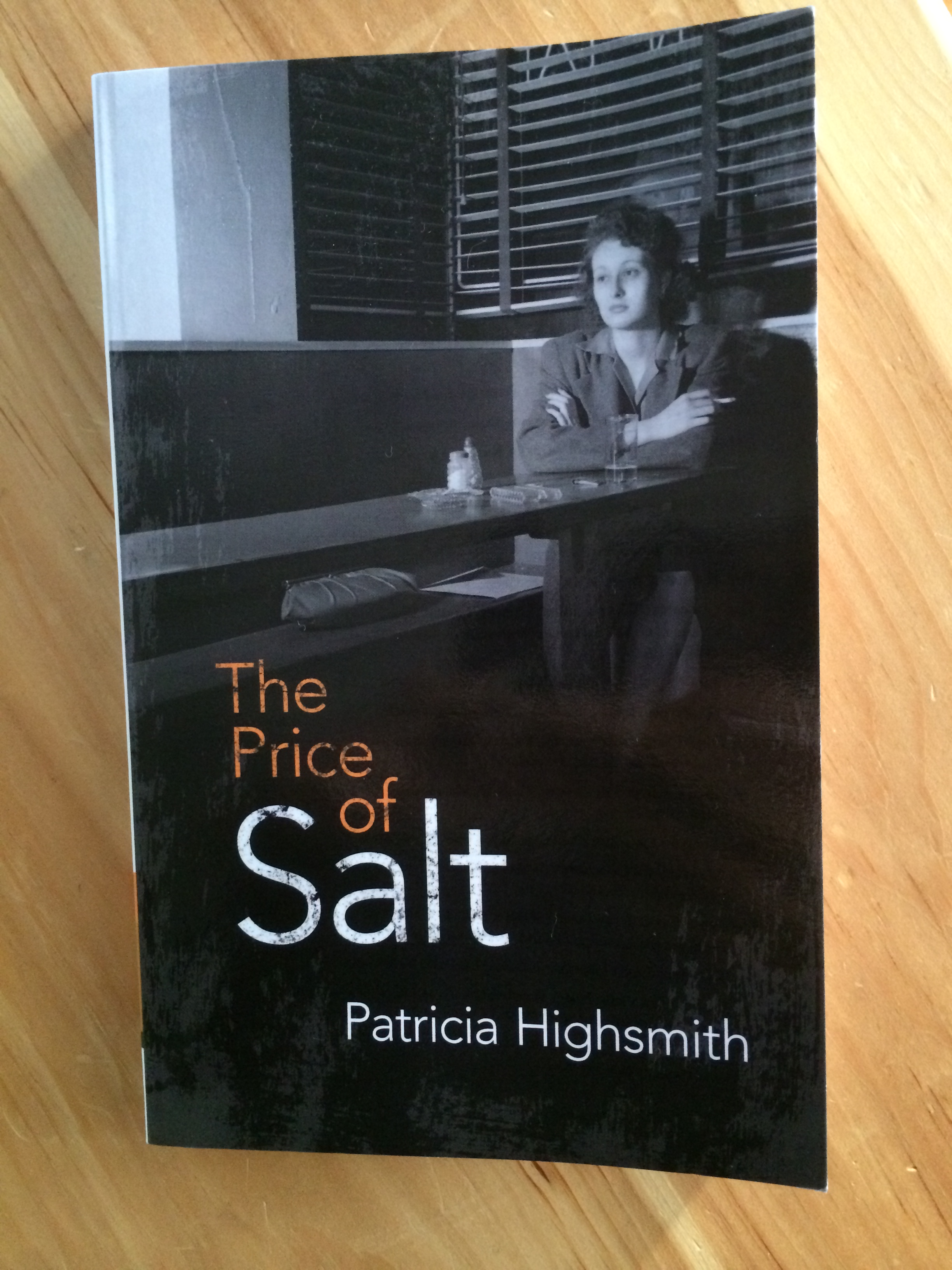
IMG_5747One of my all-time favorite movies is All About Eve, the 1950 Bette Davis classic about the Theatre (capital T, British spelling), ambition, friendship, and bumpy nights. Reading Patricia Highsmith’s The Price of Salt (also known as Carol, and the basis for the new film of that name) was like seeing another camera angle on 1950s New York.

Therese is an aspiring set designer with a boyfriend she doesn’t love (which he knows) and a temporary job in the toy department of a large New York department store when she sees Carol Aird across the counter. Carol is about ten years older and very beautiful; they are instantly drawn to each other, and when Therese sends Carol a Christmas card, the two women strike up an unusual friendship.

Carol is in the midst of a bitter divorce and custody battle, and without the prospect of seeing her daughter for months, she invites Therese on a winter road trip west. Therese accepts, and away from New York, the two are able to acknowledge their love for each other.

Unfortunately, Carol’s husband has hired a private investigator to follow them. Soon Carol is forced to choose between her daughter and Therese, with unexpected consequences. I don’t want to give away the ending, but let’s say that it isn’t the tragic one that you might expect from 50s lesbian pulp fiction (which this book has been billed as—in error, I’d say); it reminded me strongly of the ending of Mrs. Dalloway, actually.

I absolutely loved this book, so much that I wish I’d written a review straight off instead of waiting this long. It’s a book about women who are different from what their culture, their friends expect them to be, and there are wonderful lines that still resonate about envying those who always have a place in the world, living as a filled-in person, rather than a blank, and so on. I liked these lines about uncertainty:

“Was life, were human relations like this always, Therese wondered. Never solid ground underfoot. Always like gravel, a little yielding, noisy so the whole world could hear, so one always listened, too, for the loud, harsh step of the intruder’s foot.”

Patricia Highsmith is widely known for her psychological thrillers Strangers on a Train and The Talented Mr. Ripley (neither of which I’ve read), and the pacing of the second half of this book shows her ability to build extraordinary tension. However, it’s the first half of The Price of Salt that is going to stay with me. The writing is superbly detailed, while subtle visual cues abound (I’d love to write an essay on “green” in the novel, a color often associated with girls and very young women [think “salad days” and the early modern malady greensickness], but here used as Carol’s signature color). Therese’s perspective is wrought with such intensity that I occasionally had to put the book down to regroup; I think The Price of Salt gives the best evocation of love at first sight that I’ve ever read.

Even if midcentury LGBT fiction or psychological fiction aren’t in your wheelhouse, I recommend this book, not only for the writing, but also for its portrayal of a completely different America. The bits that at the time of its publication might have seemed mundane (what Therese thinks of as “the soldier substance that made up one’s life”)—buying a handbag and arranging to pick it up later, the etiquette of smoking, how people set up the timing of dates and meetings, the ability to pick up a job on no notice in a strange town—are tantalizingly interesting now.

I am dying to talk about this book with someone else who’s read it, so please let me know if you have. Have you seen the movie adaptation (Carol)? If so, what did you think? 

‘Twas the Night Before Christmas

IMG_5629After three years, the stars have aligned so that Christmas Eve and the poem of the week fall on the same day, and so a bit early (or roughly on time for European readers—hello there, European readers!):

A Visit from St. Nicholas

by Clement Clarke Moore

‘Twas the night before Christmas, when all through the house
Not a creature was stirring, not even a mouse;
The stockings were hung by the chimney with care,
In hopes that St. Nicholas soon would be there;
The children were nestled all snug in their beds;
While visions of sugar-plums danced in their heads;
And mamma in her ‘kerchief, and I in my cap,
Had just settled our brains for a long winter’s nap,
When out on the lawn there arose such a clatter,
I sprang from my bed to see what was the matter.
Away to the window I flew like a flash,
Tore open the shutters and threw up the sash.
The moon on the breast of the new-fallen snow,
Gave a lustre of midday to objects below,
When what to my wondering eyes did appear,
But a miniature sleigh and eight tiny rein-deer,
With a little old driver so lively and quick,
I knew in a moment he must be St. Nick.
More rapid than eagles his coursers they came,
And he whistled, and shouted, and called them by name:
“Now, Dasher! now, Dancer! now Prancer and Vixen!
On, Comet! on, Cupid! on, Donner and Blitzen!
To the top of the porch! to the top of the wall!
Now dash away! dash away! dash away all!”
As leaves that before the wild hurricane fly,
When they meet with an obstacle, mount to the sky;
So up to the housetop the coursers they flew
With the sleigh full of toys, and St. Nicholas too—
And then, in a twinkling, I heard on the roof
The prancing and pawing of each little hoof.
As I drew in my head, and was turning around,
Down the chimney St. Nicholas came with a bound.
He was dressed all in fur, from his head to his foot,
And his clothes were all tarnished with ashes and soot;
A bundle of toys he had flung on his back,
And he looked like a pedler just opening his pack.
His eyes—how they twinkled! his dimples, how merry!
His cheeks were like roses, his nose like a cherry!
His droll little mouth was drawn up like a bow,
And the beard on his chin was as white as the snow;
The stump of a pipe he held tight in his teeth,
And the smoke, it encircled his head like a wreath;
He had a broad face and a little round belly
That shook when he laughed, like a bowl full of jelly.
He was chubby and plump, a right jolly old elf,
And I laughed when I saw him, in spite of myself;
A wink of his eye and a twist of his head
Soon gave me to know I had nothing to dread;
He spoke not a word, but went straight to his work,
And filled all the stockings; then turned with a jerk,
And laying his finger aside of his nose,
And giving a nod, up the chimney he rose;
He sprang to his sleigh, to his team gave a whistle,
And away they all flew like the down of a thistle.
But I heard him exclaim, ere he drove out of sight—
“Happy Christmas to all, and to all a good night!”


Merry Christmas, Dear Readers! Wishing you peace, joy, and happy reading this week and in the new year.

Recommended Reading: 5 Books for Excellent Last-Minute Gifts

Tis the season for end-of-year best-of lists, and while I’m quite happy to endorse many of the critic’s favorites this year, it may be that you don’t know your last-minute giftees quite well enough to give them A Little Life or Fates and Furies or The Wake (excellent, but . . .).

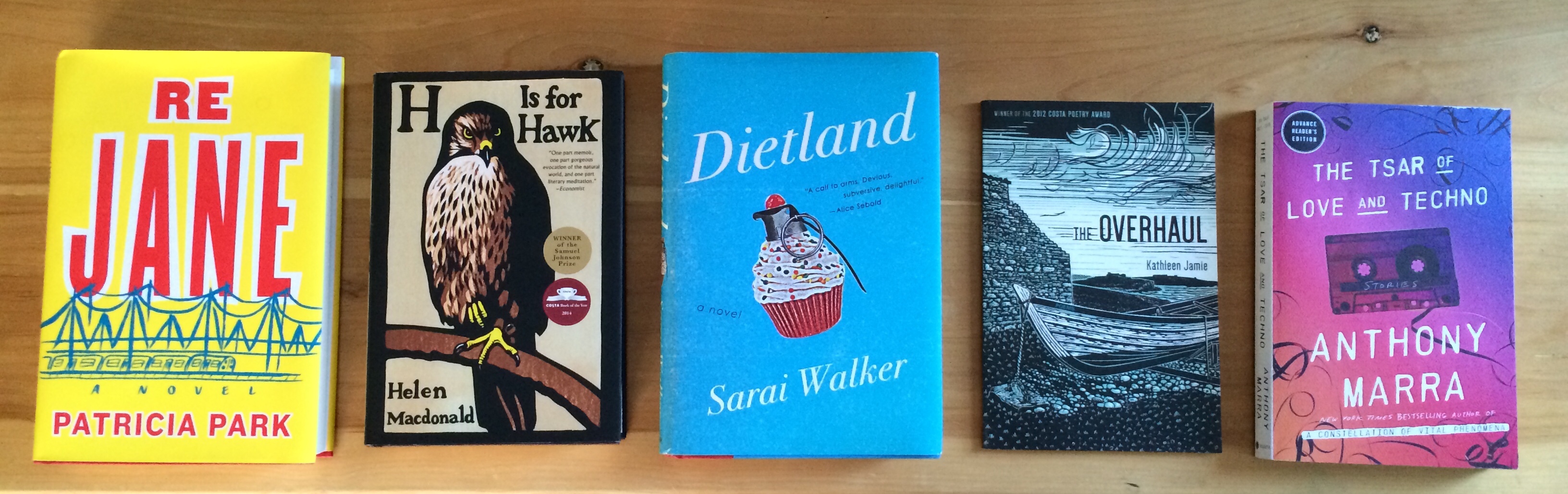
Herewith, in no particular order, five  2015 releases sure to please:

IMG_5680

Patricia Park, Re Jane: A modern take on perennial favorite Jane Eyre, this smart, funny novel is a must-read for any fans of Charlotte Brontë and modern retellings on your list.

Kathleen Jamie, The Overhaul: For the poetry fan who hasn’t read this Scottish poet and who craves a well-turned image and a gorgeous landscape. (Check out “The Whales,” part of which I have tattooed.)

Anthony Marra, The Tsar of Love and Techno: For anyone who loved A Constellation of Vital Phenomena, aficionados of the short story, or anyone who wants to be transported to a different time and place. (Bonus pick for fiction aficionados: Kitchens of the Great Midwest, by J. Ryan Stradal)

Helen Macdonald, H is for Hawk: For anyone who hasn’t read this year’s must-read memoir yet, a gripping blend of writing about grief, literature, and goshawks. (Bonus memoir recommendation: Hold Still, by Sally Mann)

Sarai Walker, Dietland: For feminists, proto-feminists, and anyone who is utterly exhausted by the fat-shaming and the dreaded “have you lost weight?” questions (twins, aren’t they?) that always seem worse around the holidays.

And you, Dear Readers? What are your last-minute book recommendations?

IMG_5678


“The snowsoft sift of the diatoms”: W. D. Snodgrass’s “Monet: Les Nymphéas'”

Close upOver the Thanksgiving holiday, we traveled to Cleveland to visit my family, and while we were there, we were lucky enough to see (thanks to my parents), a wonderful exhibit at the Cleveland Museum of Art called “Painting the Modern Garden: Monet to Matisse,” which explores the way the garden has influenced and appeared in art.

The showstopper of the exhibit is a very large (three panels brought together from three different museums) Monet painting of water lilies (the left panel is owned by the CMA; here’s a link). I’m used to seeing Monet’s  water lily paintings (he made over 200) on notecards and fridge magnets and postcards, but to see one on such a grand scale was thrilling. I couldn’t stop smiling, actually.

Here’s a W. D. Snodgrass poem, “Monet: ‘Les Nymphéas'” about Monet’s water lilies (les nymphéas in French) that in language evokes the dreamy quality of the paintings. I love the sounds of this poem, like these lines:

The snowsoft sift of the diatoms, like selves
Downdrifting age upon age through milky oceans;
    O slow downdrifting of the atoms;

Swoon. Have I ever mentioned that ‘o’ is my favorite letter? Some of the reason why is in this poem.

Also, is it just me, or is there something vaguely Miltonic about the images and the play with language here?

Readers, what’s your favorite ekphrastic poem? Also, seen any art lately?