The Poetry Concierge Recommends: Claudia Rankine

PoetryConcierge[The Poetry Concierge is an occasional feature here on Rosemary and Reading Glasses wherein I select a poem, poet, or book of poems for individual readers based on a short questionnaire. Come play along! Read the introductory post here, my first recommendation here, the reboot here, and then email me at: rosemaryandreadingglasses [at] gmail [dot] com.]

This week, our pilgrim in search of poetry is Jenny of Reading the End. 

1. When you read fiction, who’s your go-to author?

It’s so hard to choose just one! I’m going to say Maggie Stiefvater, because she’s the blend of creepiness and feelings and Societal Issues that I’m feeling very fond of right now.

2. If you read nonfiction, which subjects are most likely to interest you? (cultural history, science, biography, memoir, survival stories?)

Cultural studies is always good for me — anything that describes society with a keen eye, whether it’s our present society now or a time long past.

3. If you were stuck on a desert island for a week, which five books would you bring to keep you entertained?

I’d probably pick five from my TBR list relatively at random, depending on what my mood was like. Probably at least two hefty nonfiction books, to last me; a romance novel for funsies; a YA novel I’ve been anticipating for a while; and a big fat chunky novel that I’ve been putting off reading for a while, like East of Eden.

4. If you were on a five-year mission to Mars, which five books would you bring to keep you sane?

Angels in America, the Bible, Robert and Elizabeth Barrett Browning’s letters, Shakespeare, and Diana Wynne Jones’s Fire and Hemlock.

5. What kinds of questions are most likely to keep you up at night? (death, the nature of love, politics, environmental issues, meaning of life, end of the world, justice and injustice, etc?)

What will happen to the people I love (death sometimes, illness sometimes, lost jobs sometimes), and how frustrating it is that I don’t have the power to change it.

6. If you’ve read poetry before, what have you liked? What have you disliked?

I love June Jordan and CP Cavafy and Paradise Lost; I’ve never had any luck with poets who gaze at flowers like Wordsworth and Shelley (sorry, dudes).


So much to work with here! Jenny is an omnivorous reader after my own heart (and, confession, Wordsworth and Shelley have never been my favorites either).

First I focused on the creepy angle from Jenny’s answer to the first question, because that’s not something I see too often. It put me in mind of Louise Glück’s “All Hallows” or a handful of Emily Dickinson poems (nothing like a dead speaker for creepiness).

But then I circled back around to Jenny’s interest in social issues, which she not only mentions explicitly, but also shows in her literary picks (June Jordan, Shakespeare, Milton, Angels in America, the Bible, East of Eden). Audre Lorde leapt to mind (“Never to Dream of Spiders,” “Coal,” A Woman Speaks”), and I think Jenny might like those poems, and also Tracy K. Smith’s book Life on Mars (especially given what keeps Jenny up at night), but I thought choosing Life on Mars would be cheating since I’ve already recommended it. 

Then I wandered around my house full of books, and found the answer in the hallway: Claudia Rankine’s Citizen: An American Lyric, which I just read last week (two weeks ago, by the time you read this) and was about to return to the library.

IMG_6469Citizen won many, many awards (and got some unexpected media attention), and rightly so. It’s a hybrid of poetry, images and essay, a wide-ranging witnessing of how race and racism and race work in America (and it’s also fantastic sports writing, which I haven’t seen often mentioned). It combines the poet’s personal experiences (as in this excerpt, which you can hear Claudia Rankine read here), considerations of the media’s treatment of African American citizens, meditations on the injustices we’ve all seen in the news. It’s an important, formally exciting book (and so popular that my library still has a waitlist for it, even though it was published in 2014!).

I hope you have a chance to read Citizen, Jenny, and that it’s a pick that’s right for you!


Would you like the Poetry Concierge to make a recommendation for you? Check out the introductory post, and send your answers to the questionnaire, along with the name and/or blog you’d like posted with the reply, to rosemaryandreadingglasses [at] gmail [dot] com.

Recommended Reading: Jane Steele, by Lindsay Faye

Jane Steele book photo by Carolyn OliverReader, I adored Lindsay Faye’s Jane Steele*, a wickedly delicious riff on Jane Eyre (which is my favorite novel) recommended by Rory and Kay (a few possible spoilers in the latter review).

Having read and enjoyed Charlotte Brontë’s novel (though she does have suggestions for its heroine, like taking the pearl necklace with her so she can afford to feed herself), Jane Steele, self-confessed black-hearted murderess, sets out to write her own autobiography.

It is most enjoyable.

Jane Steele’s story mirrors her antecedent’s, as she’s well aware, quoting liberally from Jane Eyre and commenting on the ways in which her own tale differs (readers who know the novel well will also be amused by Ms. Faye’s deployment of relevant passages as epigraphs before each chapter). Orphaned young and possessed of an unpleasant aunt, this Jane becomes an inmate of an even more unpleasant school, Lowan Bridge (a play on Lowood, Jane Eyre’s school, and Cowan Bridge, which the Brontë sisters attended and became the inspiration for Lowood):

There is no practice more vexing than that of authors describing coach travel for the edification of people who have already traveled in coaches. As I must adhere to form, however, I will simply list a series of phrases for the unlikely reader who has never gone anywhere: think eggshell dawn-soaked curtains stained with materials unknown to science; rattling fit to grind bones to powder; the ripe stench of horse and driver and bog.

Now I have fulfilled my literary duties, I need only add that other girls traveling to school may not have dwelt quite so avidly upon the angular faces of police constables as I.

Though she arrives at school already, she thinks, a hardened murderess, Jane Steele is unprepared for the horrific conditions imposed on the pupils by the malicious headmaster Vesalius Munt.

As you can see from that last example, Ms. Faye has a talent for names, which frequently seem worthy of Dickens. She dedicates the novel to Nicholas Nickleby and Jane Eyre, and I found myself laughing at many of her Dickensian touches. The detail in the book is a pleasure to read, not only in the references to nineteenth-century peculiarities of dress and decor, but also in lines like “The December morning had been frigid, a pristine lace veil draped bridelike over the grounds” (and another nice Jane Eyre reference there).

After leaving a (short) trail of her tormentors’ bodies in her wake, Jane sets out for London with the one friend she’s acquired at school, a girl called Clarke. Together they use the skills they learned at Cowan Bridge (thievery and lying) to survive, and then Clarke’s lovely singing voice and Jane’s talents at writing macabre broadsides win them a roof over their heads and regular suppers.

I thought the London section of the novel—such a departure from Jane Eyre‘s settings—was quite good, and wished only that it had been a bit longer to flesh out more backstory.

Eventually, Jane learns that a governess is wanted at Highgate House, the manor where she grew up, and which she believes may be rightfully hers. She takes a pseudonym and presents herself to Mr. Sardar Singh, the butler, her new protege, Sahjara, and Mr. Charles Thornfield (of course), a wild-maned, glove-wearing, sardonic veteran of the Sikh Wars (a hero in the Byronic vein if ever there were one). Jane finds herself not only attempting to solve the mystery of her own origins, but also determined to learn more about the unusual household and its gruff master she comes to love more and more.

Jane Steele is wildly improbably (like Jane Eyre), ripe with black humor and occasional bouts of gore (unlike Jane Eyre), and a treat to read—“rollicking” is the word that leaps to mind. Jane may be a murderer, but the men she kills all richly deserve their untimely ends, and you may find, as I did, that you rather wish she’d pull her knife one more time before the end of the novel. She’s a plucky, brash, hilarious, and sincere; a worthy successor to Jane Eyre, a heroine for the original’s friends and foes alike. I’m delighted to recommend Jane Steele.

P.S. If you can’t get enough Jane Eyre fare, check out Patricia Park’s Re Jane, a modern retelling. 

P.P.S. If women taking just vengeance on terrible men is your thing, check out Dietland, by Sarai Walker. 

*I received a copy of this book from the publisher for review purposes, which did not affect the content of my review.

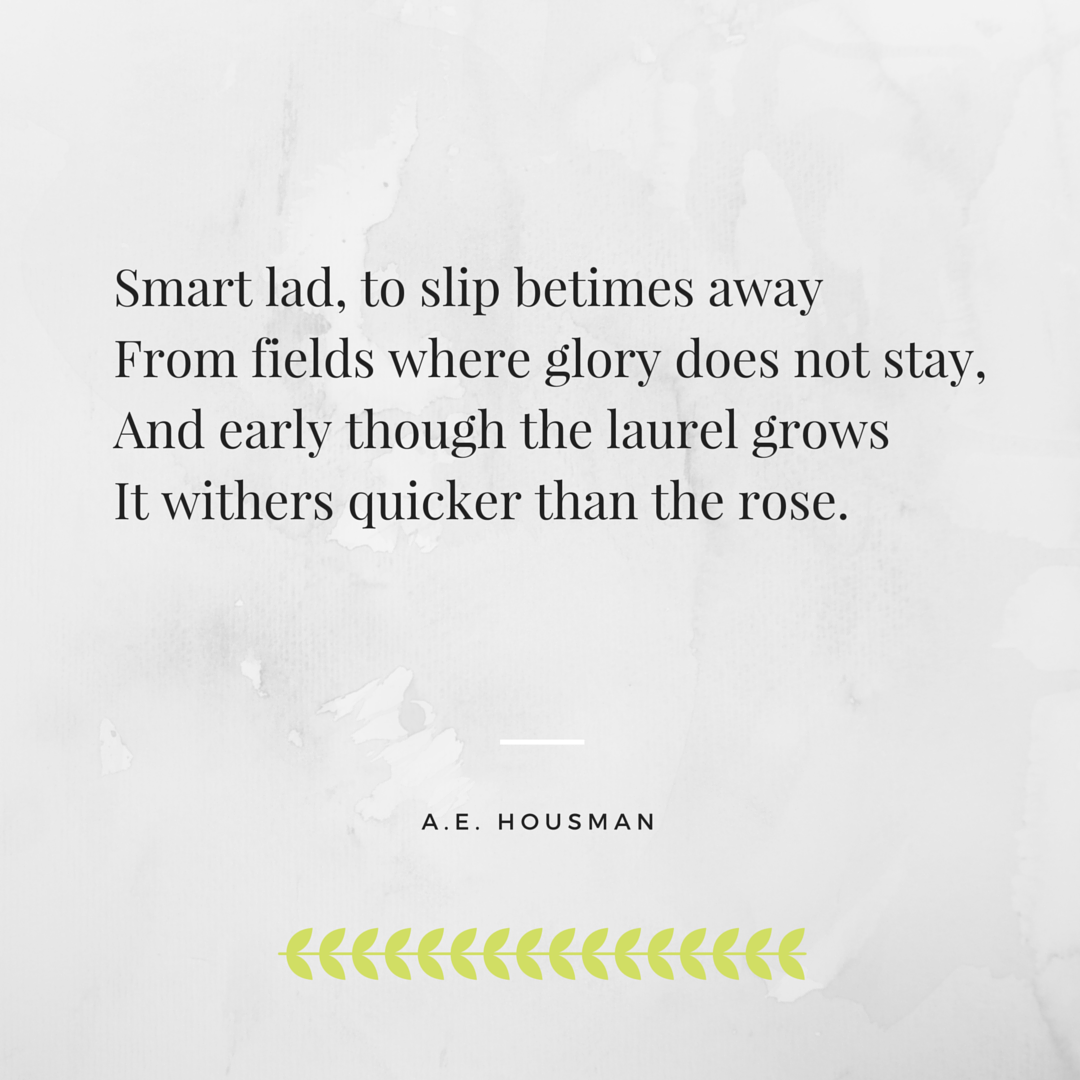
“And early though the laurel grows / It withers quicker than the rose.”

Readers might notice that on or around April 11 every year I post a poem like this one, in honor of someone I loved very much.


To an Athlete Dying YoungHousman

A. E. Housman

The time you won your town the race
We chaired you through the market-place;
Man and boy stood cheering by,
And home we brought you shoulder-high.

Today, the road all runners come,
Shoulder-high we bring you home,
And set you at your threshold down,
Townsman of a stiller town.

Smart lad, to slip betimes away
From fields where glory does not stay,
And early though the laurel grows
It withers quicker than the rose.

Eyes the shady night has shut
Cannot see the record cut,
And silence sounds no worse than cheers
After earth has stopped the ears.

Now you will not swell the rout
Of lads that wore their honours out,
Runners whom renown outran
And the name died before the man.

So set, before its echoes fade,
The fleet foot on the sill of shade,
And hold to the low lintel up
The still-defended challenge-cup.

And round that early-laurelled head
Will flock to gaze the strengthless dead,
And find unwithered on its curls
The garland briefer than a girl’s.


(Rest in peace, EVC.)

Recommended (Poetry) Reading: Ross Gay’s Catalog of Unabashed Gratitude

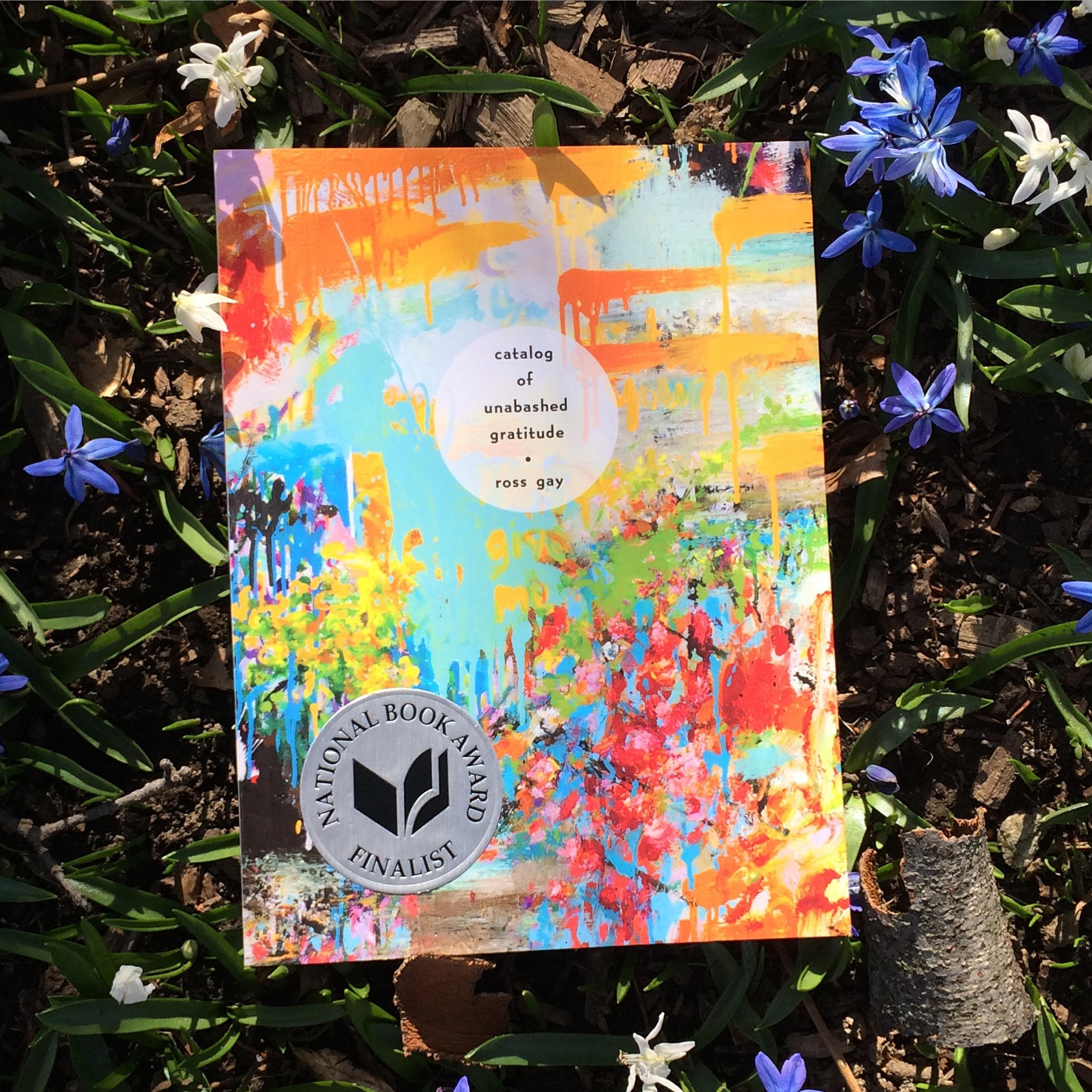
IMG_6414As I thought about how to describe Ross Gay’s Catalog of Unabashed Gratitude, I found myself turning into some sort of very specific thesaurus: his work is ebullient, irrepressible, joyous, boisterous. I loved it without reservation.

In this collection you’ll find a wonderful poem about strangers in a city gathering to pick figs from an overladen tree; an epithalamion (one that I would have liked at my own wedding); a searing, funny, furious elegy for the poet’s friend Don Belton; reflective poems about the poet’s parents; many poems celebrating gardens, orchards, and green growing things.

It took me a bit to adjust to Mr. Gay’s lines, which are often quite short, with limited punctuation, but I came to find that these kinds of lines offered me the chance to be deeply attentive, unstrung from my usual way of seeing a line and automatically looking for the outlines of a sentence. Here are the first few lines of “Ode to the Puritan in Me”:

There is a puritan in me
the brim of whose
hat is so sharp
it could cut
your tongue out

I think my favorite poem in the collection might be the wholly unexpected “Last Will and Testament,” but since I couldn’t find it online, here’s a link to the collection’s title (and penultimate) poem, “Catalog of Unabashed Gratitude.”

I love the way the poem invites the reader in by opening with a direct address (“Friends”—a strategy you’ll see more than once in the collection), and then sweeps into an account of a dream. Now, like most people, I find other people’s dreams rather a trial to hear or read about, but not this one. In the dream is a command to speak, and so begins the catalog of gratitude, with an orchard sunk into colorfully acquired compost:

twirling dung with my pitchfork
again and again
with hundreds and hundreds of other people
we dreamt an orchard this way,
furrowing our brows,
and hauling our wheelbarrows,
and sweating through our shirts,
and two years later there was a party
at which trees were sunk into the well-fed earth,
one of which, a liberty apple, after being watered in
was tamped by a baby barefoot
with a bow hanging in her hair
biting her lip in her joyous work
and friends this is the realest place I know,


This poem is absolute magnificent; I was crying by the end of it. I highly recommend this remarkable book. 

If this quick review piques your interest, you might like:

Ross Gay’s tour of his garden in essay form

This correspondence in poems between Mr. Gay and poet Aimee Nezhukumatathil about their gardens. 

Recommend Reading: The Heart, by Maylis de Kerangal, translated by Sam Taylor

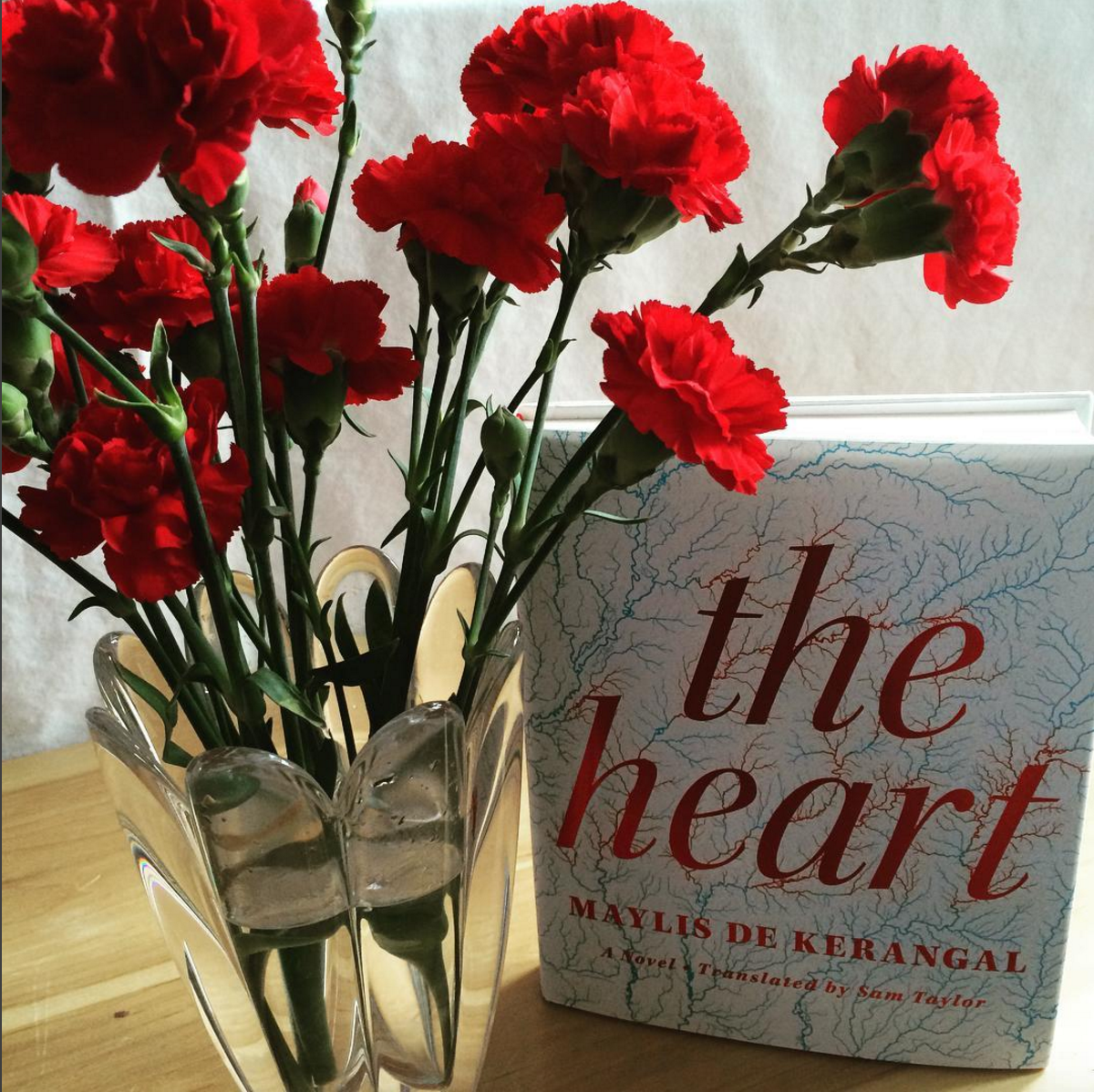
Screen Shot 2016-03-28 at 10.53.56 PMMaylis de Kerangal’s The Heart* is utterly brilliant, and deeply moving.

The novel takes place during a single day, beginning with the final hours of Simon Limbres, a teenager who is fatally injured in a car accident on the way home from an early-morning surfing excursion with friends. As the day unfolds, Ms. de Kerangal’s narrative spirals out to encompass all the people who are immediately affected by Simon’s death, from his separated parents, Marianne and Sean, his girlfriend Juliette, and the doctors, nurses, and specialists who care for Simon, and ultimately make sure that his death will give life to others. 

Ms. de Kerangal (and I should note here the excellent translation by Sam Taylor) is particularly gifted when evoking grief. When Marianne first gets the call that her son has been horribly injured, she captures perfectly that sense of fissure that tragedy generates: “Part of her life—a huge part, still warm, compact—was detaching itself from the present, toppling into the past, where it would fall away, disappear.” When Sean and Marianne sit stunned after Pierre Révol, the doctor in charge of the ICU, explains to them that while their son’s heart and lungs are working with the assistance of machines, he is fact brain dead:

How long does it take them before they accept death’s new regime? For now, there is no possible translation for what they are feeling; it strikes them down in a language that precedes language, from before words, before grammar, an unshareable language that is perhaps another name for pain. Impossible to extricate themselves from it, impossible to substitute another description for it, impossible to reconstruct it in another image. They are, at once, cut off from themselves and from the world that surrounds them.

Contrast this understanding of language with an earlier passage, in which the Pierre Révol

closes his eyes and smooths his skull, from the forehead to the occiput: suspected cerebral hemorrhage after a TBI, nonreactive coma, Glasgow 3—he uses this shared language, this language that banishes prolixity as time-wasting, forbids any notions of eloquence or seductiveness in articulation, abuses nouns, codes, and acronyms, this language where to talk is to describe or provide information about a body, to lay down the parameters of a situation in order that a diagnosis can be made, tests ordered, that the patient can be treated, saved: the power of concision. Révol absorbs each piece of information, then orders a body scan.

This is a novel about surfaces and depths, the complicated histories that underpin characters in the present moment. While Révol must deliver news every parent dreads in careful wording (the French procedure for organ donation is complicated, a delicate dance requiring perfect timing), he is not only a man of science and acronyms:

[ . . . ] and suddenly the idea crosses his mind of a constantly expanding universe, a place where cellular death will be the operator of metamorphoses, where death will shape the living like silence shapes noise, or darkness light, or the static the immobile—a fleeting intuition that persists on his retina even as his eyes refocus on the computer screen, that sixteen-inch rectangle irradiated with black light where the cessation of all mental activity in Simon Limbre’s brain is announced. Unable to connect the young man’s face with death, he feels his throat tighten. And yet he’s been working in this area for nearly thirty years. Thirty years.

All the characters are more than the role they play in Simon’s drama (parent, girlfriend, doctor, nurse, specialist). The nurse, Cordelia Owl, is waiting for a call from a lover, working on almost no sleep. We learn how Thomas Rémige, the hospital’s organ donor specialist, came to acquire a very rare songbird, and how he loves to sing. It is he who must sound out (again, in precisely couched language) Simon’s parents to see if they will allow the organ donation to proceed, and it is he Marianne and Sean charge with delivering their last message to their son, before his heart stops beating.

And then there’s Claire, the middle-aged woman in whose chest Simon’s heart will beat, a translator, in a beautiful bit of writerly playfulness, working on the Brontës’ early poems:

Sometimes she feels she is replacing the painful contractions of her sick organ with a fluid back-and-forth, between her native French and the English she has learned, and that this reciprocal movement is digging a crevice inside her, a new cavity. She’d had to learn a new language in order to understand her own, so she wondered if this new heart would allow her better understand herself: I’m clearing a space for you, my heart, I’m making you a home.

In French, the original title of this novel was Réparer les vivants (Mend the Living), which perhaps gives a better sense of the novel’s depths, its fascination not only with the meaning of death, but how life breaks and is refashioned in its wake, through love and medicine and language. Ms. Kerangal favors long sentences, in which subjects roll and reappear like the waves Simon loves so much, and which allow complex ideas and feelings room to breathe. Though very often, I felt my own breath taken away.

Highly recommended reading.

And please, please consider becoming a registered organ donor if you aren’t one already.

*I received a copy of this novel from the publisher for review purposes, which did not affect the content of my review.

No Joke: The Poetry Concierge Returns

PoetryConciergeDear Readers,

Remember way back in the mists of time when I spent a few months as the self-dubbed Poetry Concierge? I’m bringing the feature back for this year’s National Poetry Month. Read on, and put me to work handpicking poems!


Was the last time you read poetry sometime during a high school English class? Do you want to love poetry, but don’t know where to start? Are you slightly embarrassed that you can’t remember the last time you bought a book of poems?

Friends, I’m here to help. I’m your poetry concierge.

Yes, this April — and for the rest of the life of this blog, I hope — I’ll be available to lead you to the sweet springs of verse, where you may sip or swill to your heart’s content.

Here’s how to help your Poetry Concierge help you:

Send me an email [rosemaryandreadingglasses (at) gmail (dot) com] with your name as you’d like it to appear, a link to your blog or website if you’d like, and answers (as specific as possible) to the following questions:

1. When you read fiction, who’s your go-to author?

2. If you read nonfiction, which subjects are most likely to interest you? (cultural history, science, biography, memoir, survival stories?)

3. If you were stuck on a desert island for a week, which five books would you bring to keep you entertained?

4. If you were on a five-year mission to Mars, which five books would you bring to keep you sane?

5. What kinds of questions are most likely to keep you up at night? (death, the nature of love, politics, environmental issues, meaning of life, end of the world, justice and injustice, etc?)

6. If you’ve read poetry before, what have you liked? What have you disliked?

7. Would you like your name and/or blog to be published on Rosemary and Reading Glasses along with your recommendation?

8. (optional) Are you looking for a poem or poet to help you through a tough time, or to help you answer a question? If so, please explain.

I’ll read your answers and come up with a poet, a poem, or even a book for you to try out (maybe even more than one!).

As soon as I can, I’ll publish your answers to the questionnaire, and my recommendation, on Rosemary and Reading Glasses (with your name removed, if you so choose). If you want to report back on what you think of my choice, all the better! If you have a poetry emergency, (proposal, wedding, retirement, etc.), please be sure to tell me that, preferably in bold print. 

Poetry Concierge posts won’t appear on any set schedule, but I’d love to make a few recommendations soon, in honor of National Poetry Month, so bring on those questionnaires!

Yours in verse,

Carolyn the Poetry Concierge


Previous Poetry Concierge picks:

Natasha Trethewey

Dorothy Parker

Margaret Atwood

Tracy K. Smith and Anne Carson

Ashley Anna McHugh and Rebel Angels: 25 Poets of the New Formalism

Rumi

Sharon Olds

Li-Young Lee

Samuel Taylor Coleridge

Robert Frost

“we can say at least the lettuce loved the rain”: Lisa Olstein’s “Dear One Absent This Long While”

Lisa Olstein_Dear One Absent This Long WhileLisa Olstein’s “Dear One Absent This Long While” is a lovely poem, and especially appropriate for the rainy early spring we’re having here, when “everything blooms coldly.”

In what I thought of as an unsent letter, the speaker addresses the absent person—though the poem leaves open the identity of the missing loved one—revealing how she’s been so anxious to see him or her that she’s mistaken “leaves in the wind,” “the retreating shadow of a fox, daybreak” for the return of the absent loved one.

In the meantime, the speaker (solitary, we understand, since the other who wait are the cat and the stove—stoves in poems always remind me of Bishop’s “Sestina,” by the way) takes to planting to pass the time:

June efforts quietly.
I’ve planted vegetables along each garden wall


so even if spring continues to disappoint
we can say at least the lettuce loved the rain.
Initially stopped short by the unusual verb choice in that first line (“June efforts quietly”), I’ve since come to like it; it suggests the whole month is gathering its forces with the speaker, to try to wait out this rainy, lonely period.
What do you make of the last three stanzas? There’s the contrast of the new gardening tools with the practice of eulogies (eulogies that either describe animals or describe people using animals as metaphors) and the suggestion of death and decay (the “unrabbited” woods instead of the fecundity associated with rabbits). The beloved’s name is spoken by leaves that somehow chatter (like books?)–but are the leaves on the trees, or lying dead on the forest floor? Lots to think about.


Recommended Reading: Free Men, by Katy Simpson Smith

IMG_6219“Three men, none alike, asking to see each other, to be seen. Each pursuing a wild fancy that only this country, with all its contradictions, can permit”: these are the characters in Katy Simpson Smith’s Free Men*, her second novel after the acclaimed The Story of Land and Sea (my review here).

In Free Men, which is based on a 1788 historical incident, Ms. Smith returns to the American South in the eighteenth century, weaving a tale of three men—Bob, Cat, and Istillicha—who form an unlikely bond in the muggy woods of what is now Alabama. Bob has escaped from enslavement at a sugar plantation, though he’s left behind his wife and two daughters; Cat is a troubled white man from the Carolinas, an orphan whose behavior is as unpredicatable as his origins are inscrutable; Istillicha is a Muskogee (Creek) man who’s been forced out of his town’s leadership, and who now seeks revenge.

All three are pursued by Le Clerc, a Frenchman employed by the Muskogee as a tracker. Le Clerc, who is a sort of proto-anthropologist, is sent to punish them after report reaches his chief that the trio has murdered a trading party under the chief’s protection.

The unusual grouping fascinates Le Clerc, and he delays capturing them in order to better understand them, and the new country in which he finds himself, through observation:

There is a desperation about these men that suggests they do not reside on the rung of the criminal but, like all men here, are pursuing what might be called advancement, or hope. Their success or failure will, I can’t help but believe, be a reflection on the project of this country. And yet I am the only man on their trail, the only man who may behold their fates. This strikes me as peculiarly lonely.

Free Men brought to mind Joseph Boyden’s The Orenda, in that both novels hone in on a small set of diverse characters to explore major historical shifts. By telling the stories of Bob, Cat, Istillicha, Le Clerc, and Winna (Bob’s wife) in turn, Ms. Smith paints a compelling portrait of the varied experiences of people living in this small corner of North America. Each of the three pursued men narrates his personal history in the past tense, which shifts to the present when they describe their roles in the murders and their attempt to disappear westward.

This shift in tense highlights how what we may perceive as the concerns of a history long passed are still with us today: the fluidity and stubborn intractability of race (“Down here,” says Bob, “color all depends on who you know, what people you can call your kin.”), how people come together or split away to make a country, the meaning of freedom itself. And Le Clerc’s framing narration reminds us that histories we read in school are written by those who claim victory, the privileged few, even when they cannot encompass the whole of the tale.

The pacing of Free Men is slow, allowing readers to experience the detailed richness of Ms. Smith’s prose; I think the pacing also gives one the sense of accompanying Istillicha, Bob, and Cat on their long walk into the wilderness, overhearing their conversations. As Bob says early in the novel, “talking is how to cross over all the big holes in the world.” Free Men takes part in that long conversation, thoughtfully and with assured grace.

*I received a copy of this book from the publisher for review purposes, which did not affect the content of my review.

“the flesh inside them once white and wet as snow”: Jennifer Grotz’s “The Snow Apples,” from Window Left Open

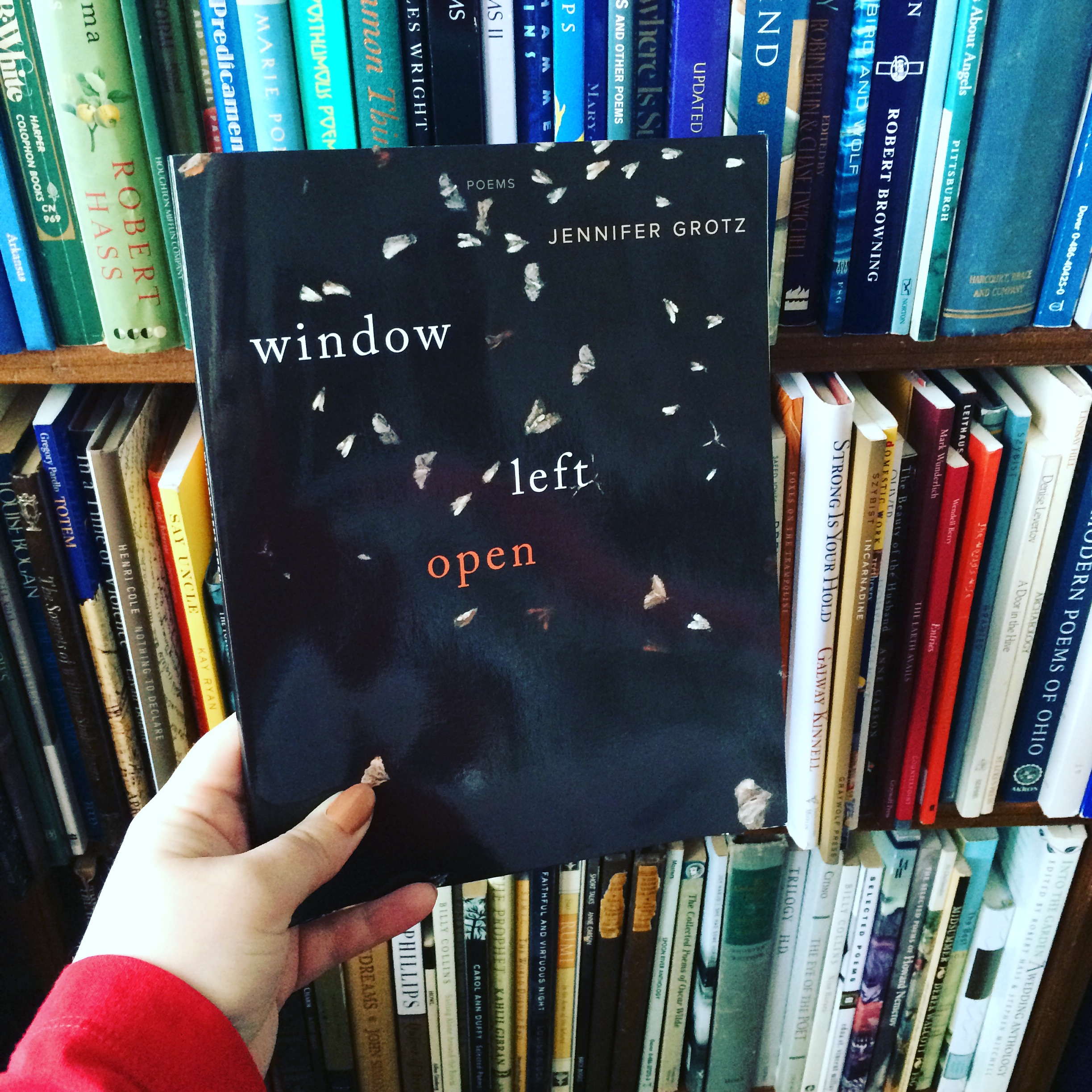
IMG_6313I’ve been slowly reading Jennifer Grotz’s third poetry collection, Window Left Open*, over the last three weeks, a keenly enjoyable experience because her poems invite the very kind of attentiveness that they demonstrate.

In “The Snow Apples,” which you can read here, the speaker considers the “Dulled, shrunken, nicked by wind-flung branches, / squirrel-pawed and beak-pierced, infested / macabre baubles hanging” from the apple tree in February, grasping the branches when most apples  fell together in  “a syncopation” in autumn. These winter apples the speaker compares to “a hard knot / deep in the core, something winter / winnow me down to.” I like the clever use of “core” here, the way the line breaks so that for a a moment the reader can imagine that the “hard knot” is “something winter.” The sadness of these “indegestible” apples “piled beneath the earth’s pelt of snow” is a disquieting, vivid metaphor for the speaker’s sense of disturbance in the long gray months.

Engagement with the natural world runs through Window Left Open, in which you’ll find (in just the first section) a forest with an “unending / staircase of roots worn silver like the soldered iron / that holds stained glass together,” snowflakes “denticulate as dandelion greens,” a display of living, giant cockroaches alongside pinned butterflies, rain “stately at first as punctuation,” a foreign city with “a gray, nearsighted river / one that massages the eyes, focuses / the sweeping birds that skim the water’s surface.”

The second section of the book finds the poet meditating on her time at a French monastery. There’s a poem about a piano in the Alps, one about the impossibility of glimpsing the entirety of a mountain from a window, another about a peacock “as strange as Mount Rushmore.” One of my favorites is called “Apricots,” which will make you see the fruit in a whole new way (“And the ripe ones, which felt like biting into / my own flesh, slightly carnivorous.”).

It’s tempting to go on quoting the memorable images in these poems; it’s harder to get at the sense of the speaker observing not only her world, but herself, and finding unexpected loveliness and unexpected fear, often at the same time. In “Poppies,” Ms. Grotz writes,  “Love is letting the world be half-tamed.” If you look closely enough at anything—an animal, a window, even a word—you’ll find a distancing peculiarity, and Ms. Grotz translates that feeling in these poems. She has a gift for making the familiar strange, and making the strange familiar. I highly recommend Window Left Open.

Further reading:

Ta-Nehisi Coates on “Poppies”

“Self-Portrait on the Street of an Unnamed Foreign City”

*I received a copy of this book from the publisher for review purposes, which did not affect the content of my review.

Recommended Reading: Rush Oh!, by Shirley Barrett

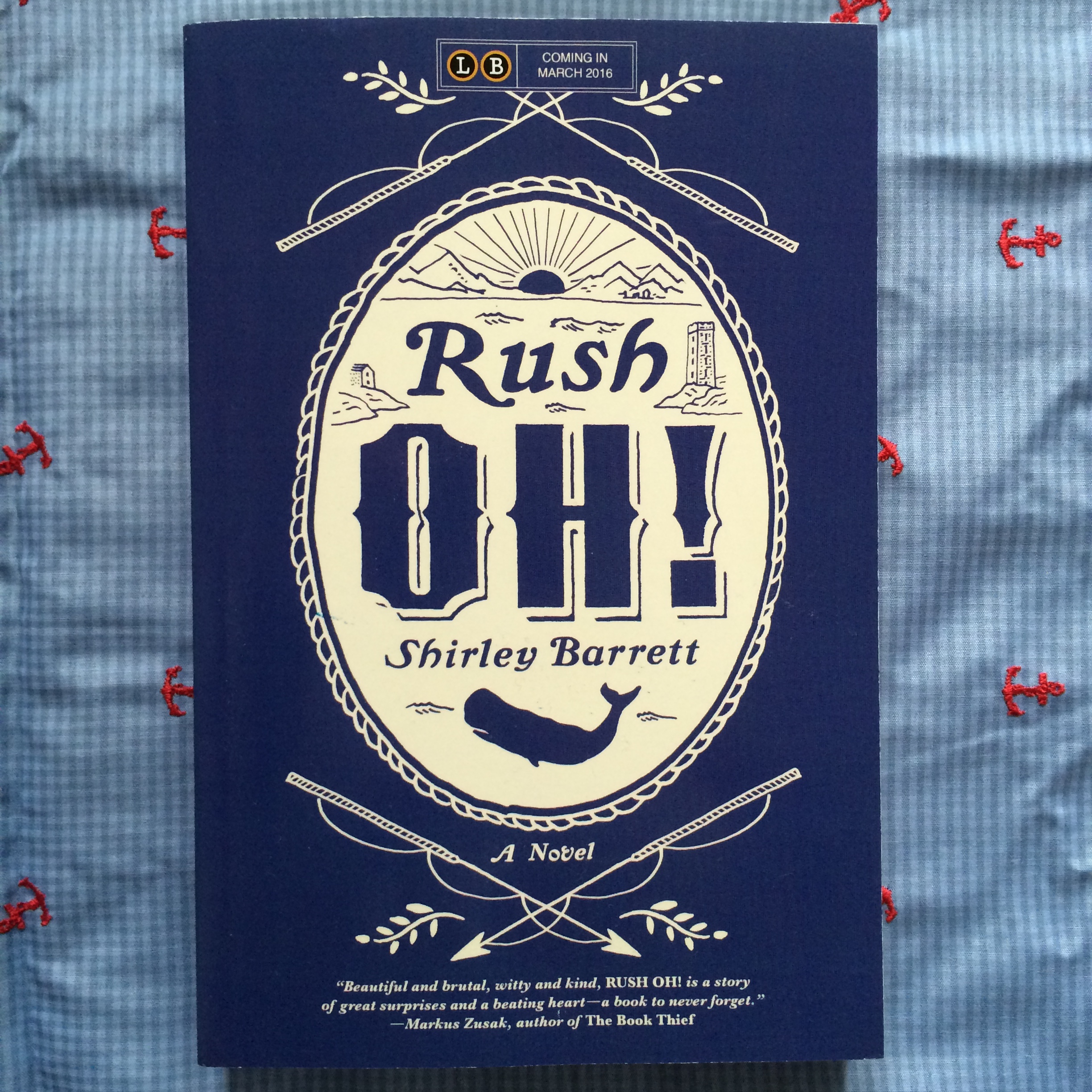
IMG_6257At one point when I was reading Rush Oh!*, Shirley Barrett’s debut novel about the 1908 whaling season in New South Wales, Australia, I found myself wondering what it would have been like if the men of the Pequod had popped home for supper every night.

Naturally, whalers are ill-mannered as a rule and boast enormous appetites—that is to be expected. What is less to be expected, however, is their extreme finickiness as regarding their “slops.” It seemed that each one of them suffered from some manner of digestive impairment which required the most fastidious tending. Bastable could not tolerate any form of marsupial, so kangaroo and wallaby were out of the question.

Nineteen-year-old Mary Davidson, Rush Oh!‘s narrator, goes on to note that other men in her father’s whaling crew object to oysters, rabbit (fresh and canned), stewed ibis, and anything under-salted.

I loved this novel—it’s quite funny, though as we learn, whaling is no laughing matter. Mary’s father, George Davidson (nicknamed “Fearless,” for good reason; he’s based on a real-life whaler of the same name) is in charge of two whaling boats that hunt whales in Twofold Bay—with the assistance of pod of orcas. These whales, called “the Killers” are led by Tom (a real whale), a mischievous and highly intelligent fellow, held in the whalers’ esteem and even, at times, affection.

During the whaling season (our summer, Australia’s winter), Mary is in charge of looking after her younger siblings (including a preteen pipe-smoker and Louisa, whose obstinacy is at least one one cause of her rivalry with Mary), tending the house, and feeding the whalemen, an arduous task since the season is not going well and their supplies are running quite low. When a handsome Methodist preacher joins the crew, Mary finds herself in a new boatload of trouble, so to speak.

For a novel that deals quite a bit with men “having to go out in all weather and row back and forth across the bay in endless pursuit of enraged leviathans,” Rush Oh! reminded me, oddly enough, not just of Moby Dick, but of The Country of the Pointed Firs (which I mentioned two weeks ago) and Anne of Green Gables. Rush Oh! is Mary’s memoir, and her voice sounds to me like the independent-minded writer who narrates scenes from coastal Maine life in The Country of the Pointed Firs, while the scrapes Mary gets into, the amusing encounters with town characters and creatures, and the episodic nature of the book are reminiscent of L.M. Montgomery’s beloved classic and its first few sequels. Ms. Barrett draws heavily on archival material, which gives the book’s already vivid setting a delightful sense of local color.

While I loved this book’s approach to history and humor, its more serious moments also deserve mention. Take this passage:

We looked about us at the empty sea. A strange atmosphere of melancholy stillness came over us as we waited, and it brought to mind the feeling as we had sat in church at my mother’s funeral, waiting for the service to commence. The organist had played “Abide with Me,” and I suppose he had been instructed to keep playing till the congregation settled, for I remember feeling that he would never stop, and at one point, when we thought he had finally finished and he started afresh, Harry had got the giggles and had had to be spoken to. Yet as long as that mournful dirge continued and we sat in the presence of my mother (for she lay in her coffin at the front of the church), it felt to me as if the family were suspended together (for the last time) somewhere between the earthly world and heaven.

Mary Davidson, with her quirks, quick mind, and terrific descriptive powers, is a character you’ll want to know better. Rush Oh! is out today in the U.S. from Little, Brown, and is recommended.

Postscript: If you’re a Moby-Dick fan, check out the Moby Dick Big Read, in which persons famous and not-famous each read a chapter of Melville’s tome (Benedict Cumberbatch. Need I say more?).

*I received a copy of this book from the publisher for review purposes, which did not affect the content of my review.