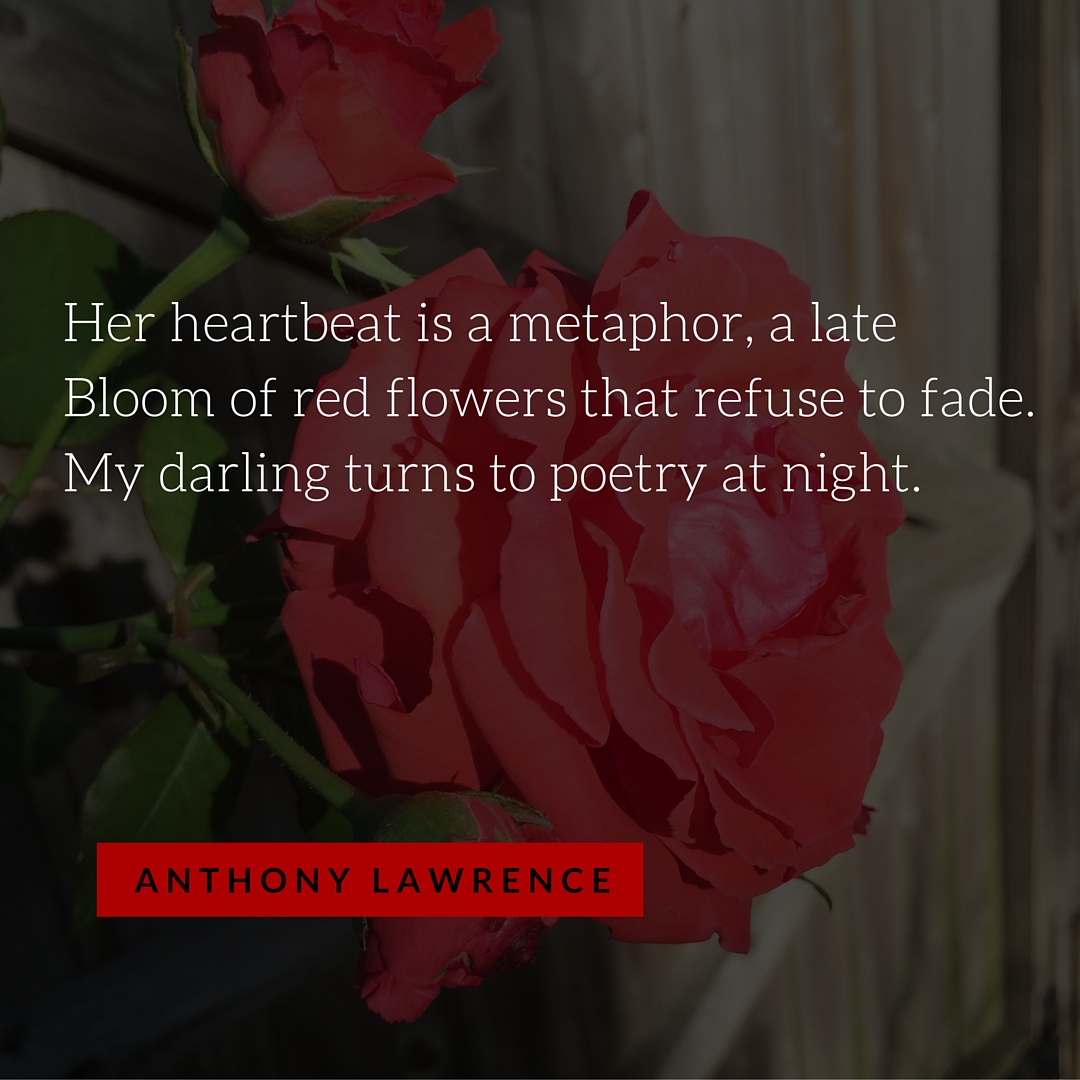
“Her heartbeat is a metaphor”: Anthony Lawrence’s “My Darling Turns to Poetry at Night”

Anthony Lawrence_My Darling Turns to Poetry at NightI happen to love formal poetry—and by that I mean poetry that adheres to a particular structure or set of rules, not poetry in top hat in tails. I happily read free verse, but there’s just something about a poet mastering a form (or sometimes breaking from it in a meaningful way) that tends to make my verse-loving heart go all aflutter.

As regular readers know, I do write poetry myself, but I have never written a satisfactory villanelle. When I read a masterful one like Anthony Lawrence’s “My Darling Turns to Poetry at Night” (out in this month’s issue of Poetry, dedicated to Australian poets), I almost want to stop trying.

Almost.

At first I thought the poem would be about the speaker’s beloved reading poetry (as in the way we might say “She turned back to her book”), but instead the speaker imagines her as poetry. It’s simply gorgeous.

Probably most famous example of the villanelle—at least in English, at least; French speakers, do weigh in—is Dylan Thomas’s “Do not go gentle into that good night” (used to great effect in Interstellar, now that I think about it), but I’ve always been partial to Elizabeth Bishop’s “One Art.” 

What’s your favorite villanelle?

5 Reasons I’m Glad I Read Ellen Prentiss Campbell’s The Bowl with Gold Seams

IMG_6764After I reviewed Ellen Prentiss Campbell’s excellent short story collection Contents Under Pressure this winter, we struck up a friendly correspondence via email, and so I think writing a straightforward review of her first novel,The Bowl with Gold Seams,* would fall into an ethical gray area.

However, I very much enjoyed the book, so instead, here are:

5 Reasons I’m Glad I Read The Bowl with Gold Seams
  1. The novel deals with difficult ethical dilemmas: Hazel Shaw, who narrates The Bowl with Gold Seams from the late 1980s, struggles to discern the right path forward when faced with accusations against one of the teachers at the boarding school she leads. As she ponders her choices, she encounters a figure from her past. When she was young woman, she worked as a secretary at a local hotel when it served as a detainment center for diplomatic prisoners (more on this below). She forged relationships with some of the “guests” while simultaneously processing her grief from a series of personal losses, leading to questions about honor, justice, and the shared experience of humanity.
  2. I learned something: Most of the narrative is set in Pennsylvania, at the Bedford Springs Hotel, which during the Second World War briefly became the detainment center for the Japanese ambassador to Germany (captured when the Allies took Berlin) along with his family and staff. I didn’t know that hotels served as (effectively) prisons during the war, while I’ve read about the shameful internment of Japanese Americans and about prisoner-of-war camps, I hadn’t given much thought to the fate of diplomatic prisoners until now.
  3. The writing is lovely: Ms. Campbell is a gifted storyteller, as I noted in my review of Contents Under Pressure, and I admired her portrait of the bright, strong, vulnerable Hazel, an observant and self-reflective narrator (“She loved him, I believe, but my father was married to his job, and in some quiet way, still married to my mother. I understand how that can be.”).
  4. It made me want to learn more about Quakers: Hazel and her father, the town jailer, are Quakers, and the school Hazel runs as an adult is a Quaker school. I found their methods and customs fascinating, so now I’m itching to read some good nonfiction about the Religious Society of Friends.  Any recommendations?
  5. I loved the way it plays with tropes: The Bowl with Gold Seams is a bildungsroman, but it’s also deeply engaged with how we continue to form our moral selves as adults. It’s a novel about the home front in World War II, but then brings the war to the home front with the introduction of the hotel as prison.

The Bowl with Gold Seams is available from Apprentice House, a small press based in Maryland.

[Readers, I’m curious: What do you think of this format for the occasional recommendation, as opposed to a standard review?]


*I received a copy of this book from the author for review consideration, which did not affect the content of this post.

“They were but sweet, but figures of delight”: Shakespeare in the Spring

Sonnet 98


“Nothing is so beautiful as spring,” wrote the poet Gerard Manley Hopkins. He didn’t live in Boston, where spring brings with it almost any weather; this week it’s wall-to-wall rain and gray. So here’s a little dose of Shakespeare in the hope of sunshine and optimal flower-viewing.


Sonnet 98

From you have I been absent in the spring,
When proud-pied April, dressed in all his trim,
Hath put a spirit of youth in everything,
That heavy Saturn laughed and leaped with him.
Yet nor the lays of birds, nor the sweet smell
Of different flowers in odour and in hue,
Could make me any summer’s story tell,
Or from their proud lap pluck them where they grew:
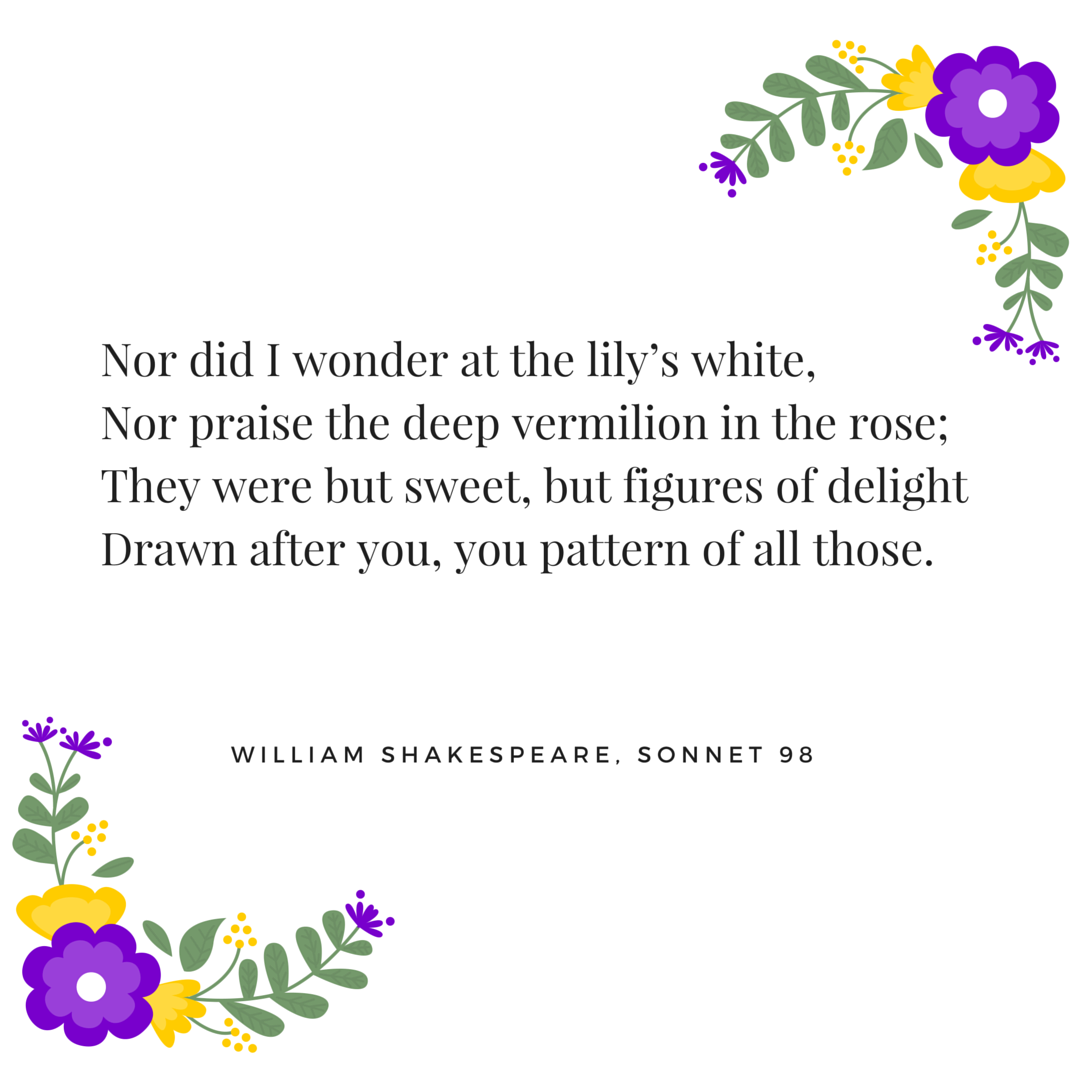
Nor did I wonder at the lily’s white,
Nor praise the deep vermilion in the rose;
They were but sweet, but figures of delight
Drawn after you, you pattern of all those.
    Yet seem’d it winter still, and, you away,

    As with your shadow I with these did play.

And as a bonus, here are a few of my favorite lines from A Midsummer Night’s Dream:

I know a bank where the wild thyme blows,
Where oxlips and the nodding violet grows,
Quite over-canopied with luscious woodbine,
With sweet musk-roses and with eglantine:
There sleeps Titania sometime of the night,
Lull’d in these flowers with dances and delight;
And there the snake throws her enamell’d skin,
Weed wide enough to wrap a fairy in

[It gets fairly nasty at this point, alas.]

Have you read any spring poems lately?

Recommended Reading: Claire Harman’s Charlotte Brontë: A Fiery Heart

IMG_6543Charlotte Brontë: A Fiery Heart is an excellent literary biography, and I’m so happy to have read it. The writing is assured and graceful, and the subject couldn’t be more interesting.

First, a caveat:

While Jane Eyre is my favorite novel, before I read Ms. Harman’s biography, I knew only the bare outline of Charlotte Brontë’s life. I knew that she was one of four (surviving) writer siblings, all of whom died very young. I knew that they lived on the moors, in a parsonage, and that at least a few of them died of tuberculosis (more on that in a bit). I knew Charlotte had attended a school she didn’t like (the basis for Lowood in Jane Eyre). I knew that she, Emily, and Anne published their first novels under pseudonyms.

That’s not much to go on, but in general I’m pretty comfortable loving books without knowing much about authors behind them (and in some cases, I imagine that’s a very good thing).

My point is that I came to this book as a beginner, not a Brontë fanatic (I’ve also read Wuthering Heights and Anne Carson’s amazing essay/poem regarding Emily in Glass, Irony, and God), so your mileage may vary if you’re already well versed in Brontëana.

I’d also point out that unlike some literary biographies, this one doesn’t offer a big dose of literary criticism (though the novels are discussed, of course), which I appreciate.

Ms. Harman frames the book with an account of Charlotte’s time as a student in Belgium, where her principal teacher—and the object of her unrequited affection–was the very Mr. Rochester-like Constantin Heger. This turned my perception of Charlotte as always parsonage-bound on its head, and I was intrigued to read Ms. Harman’s demonstration of the ways in which Jane Eyre was shaped by Charlotte’s lonely months in Belgium and the unsatisfying correspondence that followed, and by just how despondent Charlotte was:

But Charlotte was also struggling with the larger issue of how she would ever accommodate her strong feelings—whether of love for Heger, or her intellectual passions, or her anger at circumstances and feelings of thwarted identity—in the life that life seemed to have in store for her, one of patchy, unsatisfying employment, loneliness, and hard work. What was someone like her, a plain, poor, clever, half-educated, dependent spinster daughter, to do with her own spiritual vitality and unfettered imagination?

Aside from this frame, the book’s content appears in chronological order, beginning with background on Charlotte’s parents and then moving forward into her childhood (when she suffered the loss of her mother and two elder sisters, one of whom was a model for Helen Burns), adolescence, and adulthood. The Brontë household was an odd one; after his wife’s death Patrick Brontë dined alone, as did the stern aunt who came to raise Charlotte, Branwell, Emily, and Anne, and the children did not make friends in the village. They did create elaborate fictional worlds in secret (this secrecy would carry over into the daughters’ adult ventures) some set down in minuscule books (about two inches high) that still survive (and this may help to explain Charlotte’s woefully bad eyesight).

All four understood that their limited means necessitated that they make plans for useful employment as adults, and so the girls studied hard at various schools, expecting to become teachers or governesses. All of them hated leaving home, Emily most of all, but were all exceedingly bright pupils. (Branwell was similarly intelligent, but conceited, and his sisters ended up supporting him as he made a series of bad choices that culminated in opium addiction.)

The publication of the three sisters’ novels was a source of delight, but their felicity was short lived; Charlotte’s three siblings died, one after the other, in less than a year. The chapter about this terrible season in her life is simply gut-wrenching. I was in tears.

Charlotte herself died just a few years later, less than a month shy of her thirty-ninth birthday—not of tuberculosis, as was long supposed, but of hyperemesis gravidarum (essentially, extreme nausea and vomiting during pregnancy that can lead to dehydration and malnutrition—its most famous sufferer is Catherine, Duchess of Cambridge), as Ms. Harman conclusively proves. Though now treatable, it wasn’t in the 1850s, and so Charlotte essentially starved to death, in near-constant agony for the first and only months of her pregnancy.

This was the end of a lifetime of suffering, which included the loss of five siblings, her mother, and beloved friends. She was ill rather often, for many years had few outlets for her intelligence outside of her home, and loathed her work as a governess and teacher. Charlotte was also tormented by her own lack of beauty, which made socializing very difficult even when her publishing success meant that she was introduced to writers she admired, like Thackeray and Harriet Martineau.

And yet this brilliant, difficult, imaginative woman channeled her ambition, secret passions, and fierce sense of justice into books that have long outlived her—through almost sheer force of will.

Claire Harman’s book, which seamlessly incorporates letters and other archival material is a through portrait of this indomitable author. Reading this biography led me to admire Charlotte Brontë as a person just as much as I have admired her as an author.

The Poetry Concierge Recommends: Warsan Shire

PoetryConcierge[The Poetry Concierge is an occasional feature here on Rosemary and Reading Glasses wherein I select a poem, poet, or book of poems for individual readers based on a short questionnaire. Come play along! Read the introductory post here, my first recommendation here, the reboot here, and then email me at: rosemaryandreadingglasses [at] gmail [dot] com.]

This week, our pilgrim in search of poetry is Emily, who writes at The Bookshelf of Emily J.

1. When you read fiction, who’s your go-to author?

Joyce Carol Oates or John Steinbeck

2. If you read nonfiction, which subjects are most likely to interest you? (cultural history, science, biography, memoir, survival stories?)

I love cultural history. I just finished The Warmth of Other Suns about the great migration of African Americans from the south to other parts of the country. I learned so much and realized how much more we have left to do in terms of racial equality and acceptance.

3. If you were stuck on a desert island for a week, which five books would you bring to keep you entertained?

I would bring Blonde by Joyce Carol Oates, East of Eden by John Steinbeck, Angle of Repose by Wallace Stegner, The Age of Innocence by Edith Wharton, and A Tree Grows in Brooklyn by Betty Smith.

4. If you were on a five-year mission to Mars, which five books would you bring to keep you sane?

Oh wow. Maybe five books from Sophie Kinsella’s Shopaholic series because they always make me laugh.

5. What kinds of questions are most likely to keep you up at night? (death, the nature of love, politics, environmental issues, meaning of life, end of the world, justice and injustice, etc?)

My future and where academia will take me. I also get worried about issues with my kids. Sometimes nerves keep me up the day before a big presentation or a first day of teaching.

6. If you’ve read poetry before, what have you liked? What have you disliked?

I love William Wordsworth and William Blake. I had the opportunity to take a class on British lit as an undergrad, which included poetry, from Leslie Norris, a famed Welsh poet himself.


Well, for a while there I was stumped. Who to recommend? Elizabeth Barrett Browning (whose lifetime overlapped with Wordsworth’s, and whose poetry took on social issues of the day)? Emily’s favored Joyce Carol Oates, who is not only a prolific novelist, but also a poet? Langston Hughes (a contemporary of Steinbeck’s, and of course one of the great American poets)?

Possibilities abounded.

And then I watched Lemonade, the Beyonce visual album that came out this past weekend. The whole piece is utterly absorbing, but I found the poetry between songs most arresting of all. The poet is Warsan Shire, a British poet (she was born in Kenya and her parents are Somali) who earned fame with her 2011 short collection Teaching My Mother How to Give Birth. In late 2015 she was profiled in the New Yorker; Alexis Okeowo wrote of her first collection, “It’s a first-generation woman always looking backward and forward at the same time, acknowledging that to move through life without being haunted by the past lives of your forebears is impossible.” You can read a bit more about Warsan Shire here. 

Her poem “Home” was quoted in the New York Times, and by Benedict Cumberbatch in his impassioned plea for aid to refugees after the curtain call for Hamlet (I saw the NT live production in the movie theater). You can read the poem here. 

I think, given Emily’s interest in social issues and the movement of people and cultural history (Steinbeck, The Warmth of Other Suns) that Ms. Shire’s work, which deals with immigration, diaspora, family history, belonging, violence, and womanhood, will be appealing, and still a change of pace. While you can find a few of her poems online—they tend to be widely shared—you should be able to find Teaching My Mother How to Give Birth in your library or in bookstores, and look out for her first full-length collection to appear late this year.

P.S. For those nerves, I recommend Hazel Hall’s “Before Quiet.” And if you’re looking for even more poetry of social engagement, you might want to check out the Split This Rock festival.


Would you like the Poetry Concierge to make a recommendation for you? Check out the introductory post, and send your answers to the questionnaire, along with the name and/or blog you’d like posted with the reply, to rosemaryandreadingglasses [at] gmail [dot] com.


Recommended Reading: The Last Painting of Sara de Vos, by Dominic Smith

IMG_6466I loved Dominic Smith’s The Last Painting of Sara de Vos* so much that I tamed my instinct to race through it, and instead spent just under a week immersed in this gorgeous novel.

The narrative plays out in three times. In seventeenth-century Holland, Sara de Vos is an anomaly, a woman admitted to the Guild of St. Luke–the painter’s guild, though she’s allowed to paint only still lifes, rather than the landscapes she’s drawn to. After a family tragedy, however, she begins work on a painting later called At the Edge of a Wood, an almost eerie winter landscape scene.

More than two centuries later, in 1950s Manhattan, that painting hangs over the headboard of Rachel and Marty de Groot (a descendant of the painting’s original owner). Marty is a lawyer who seems to be gently tilting toward infidelity when he comes home one night to realize that the painting over his bed isn’t the one he grew up with; it’s a skilled forgery.

Halfway around the world and forty years later, Australian curator and art historian Ellie Shipley is putting the finishing touches on an exhibit of paintings in her specialization—Dutch women painters of the Golden Age—and wondering how it is that she’s close to so few people. Then she receives a phone call: the painting At the Edge of a Wood is on its way to the museum. The trouble is, it’s not the only one. One painting is a forgery, and she should know: she was the forger.

Mr. Smith weaves these three disparate lives together into a richly detailed tapestry of human connection, an exploration of art, love, and the opportunities women make for themselves.  The novel is absolutely gripping, with revelations more startling than you might think possible given that the action revolves around one obscure painting. And the writing is exquisite; even if you, like me, haven’t touched paint since fingers were the application method of choice, you’ll be transported into the world of stretched canvases, mixed pigments, the struggle to find just the right texture for the yellow paint. Even the ordinary is transformed in this book; a freezer becomes “a diorama of snowmelt and frosted meat hilltops”; a roof is “run through with dormer windows that jut out like tiny caves in a cliffside.” One of my favorite descriptions comes when Marty dismisses his wife’s fondness for Impressionists: when he “looks at certain Cézannes he sees blueish fuzz—the powdery bloom on the skin of a Concord grape.”

The Last Painting of Sara de Vos is a beautiful example of painting with words–and highly recommended.

*I received a copy of this book from the publisher for review consideration, which did not affect the content of my review.

Shakespeare 400: In Which I Rank the Plays

IMG_6530


In honor of the 400th anniversary of Shakespeare’s death, Dear Readers, I bring you a list you’ve all been too polite to clamor for:

Shakespeare’s Plays, Ranked in Order of My Personal Preference, with Sundry Quips & Commentary

(Because yes, I’ve read them all. Thanks, graduate school.)

  1. Hamlet (Of course.)
  2. Much Ado About Nothing (Beatrice is the Shakespearean heroine I’d find easiest to play. Just saying.)
  3. A Midsummer Night’s Dream (Delightful poetry, problematic ending, fond memories of high school. If you’d like to never see the play the same way again, try reading Jan Kott’s take on it.
  4. Henry V (An anti-war play about war, in my view. And it’s brilliant, of course.)
  5. As You Like It (Recommended particularly for North Carolina legislators.)
  6. Antony and Cleopatra (Oh, for my salad days teaching this play! Also, I saw it at the Barbican when I was 15; Alan Bates played Antony, and Frances de la Tour [perhaps known to you as Madame Maxine in the Harry Potter movies] was a fantastic Cleopatra, appearing nude in her final scenes. )
  7. Richard III (No matter historians’ efforts, Richard’s reputation will never recover.)
  8. Twelfth Night (See 5, above.)
  9. King Lear (I can’t decide whether I’d rather see Patrick Stewart or Ian McKellan in the title role. The “never” line at the end is gutting. )
  10. The Tempest (How is it that I’ve never seen this play live?)
  11. The Winter’s Tale (This was my jam when I used to think about maternal mortality in early modern lit. I still think it’s a trip. Apparently so does Jeanette Winterson.)
  12. Macbeth (Few things make me wish I’d been alive a hundred plus years ago, but then there’s this painting.)
  13. King John (Weren’t expecting that, were you? I like this because I’ve read it much less often than I’ve read the major comedies and tragedies, so it sounds fresh every time, and it’s really, really good. Underrated, this one.)
  14. The Taming of the Shrew (Funny and horrifying at the same time; fun to wrestle with, as a feminist.)
  15. Richard II (Gorgeous poetry here, and such a politically charged play! The Earl of Essex had it staged before he himself staged a rebellion against Elizabeth I.)
  16. Othello (My dad once saw a production of this with James Earl Jones and Christopher Plummer. I’ve never gotten over my envy, despite quite a bit of therapy.)
  17. Romeo and Juliet (God, Romeo is such a nitwit. But that doesn’t mean I can’t quote huge chunks of this play [don’t judge me for being 13 when the Leonard DiCaprio version came out . . . and then playing the nurse in high school.].)
  18. Henry IV Part 1 (In which Prince Hal is one calculating sonofabitch, and we all fall for Falstaff.)
  19. Cymbeline (Is it a romance? A tragicomedy? A comedy? Who knows? Woolf quotes from it in Mrs. Dalloway, which has to be an endorsement of some kind, right?)
  20. Coriolanus (I have a feeling Volumnia would do well on Game of Thrones.)
  21. The Merchant of Venice (Go Portia! Also, I think best read in conversation with Marlowe’s The Jew of Malta.)
  22. Henry IV Part 2 (I love the scene between the dying Henry and Hal: “busy giddy minds / With foreign quarrels.” A sound politico, that Henry IV.)
  23. Julius Caesar (Oh hi, tenth grade memorization assignment.)
  24. All’s Well That Ends Well (There’s a bed trick, and if that’s not intriguing, I don’t know what is. Also, Bertram reminds me of the generic rom-com bad guy.)
  25. Measure for Measure (Here’s another bed trick. And I’m a fan of the pre-Dickensian name “Mistress Overdone”–the owner of a brothel.)
  26. Henry VIII (Neatly sidesteps all that nasty beheading business. The play that literally burned the house down.)
  27. Love’s Labour’s Lost (Honorificabilitudinitatibus. This is the play for word nerds.)
  28. Titus Andronicus (Gleefully gory. “Alarbus’ limbs are lopped” is quite the line.)
  29. The Merry Wives of Windsor (Quite silly.)
  30. Troilus and Cressida (So very unpleasant.)
  31. Henry VI Part 1 (If you’re going to read these–and you should at least once, just for Margaret of Anjou–you might as well read them in order.)
  32. Henry VI Part 2
  33. Henry VI Part 3
  34. The Two Noble Kinsmen (Chaucerian, and thus best enjoyed with a large glass of mead.)
  35. Two Gentlemen of Verona (There’s a dog in this one, which is a good thing for the audience.)
  36. Pericles, Prince of Tyre (This is sort of like Shakespeare leaving the office early for a three-martini lunch. Or, come to think of it, arriving at the office late after a three-martini lunch.)
  37. The Comedy of Errors (Even the greats have to start somewhere.)
  38. Timon of Athens (Ugh.)

And the poems, you say?

  1. The Sonnets (Of course.)
  2. Venus and Adonis (Shakespearean smut, and it’s delightful)
  3. The rest.

So, happy Shakespeare 400! May we all be in good health to celebrate his 500th birthday, in a mere 48 years!).

What’s your favorite play of Shakespeare’s (or sonnet)? 

The Poetry Concierge Recommends: Mary Oliver

PoetryConcierge[The Poetry Concierge is an occasional feature here on Rosemary and Reading Glasses wherein I select a poem, poet, or book of poems for individual readers based on a short questionnaire. Come play along! Read the introductory post here, my first recommendation here, the reboot here, and then email me at: rosemaryandreadingglasses [at] gmail [dot] com.]

This week, our pilgrim in search of poetry is Audra at Unabridged Chick. 

1. When you read fiction, who’s your go-to author?

Penelope Lively

2. If you read nonfiction, which subjects are most likely to interest you? (cultural history, science, biography, memoir, survival stories?)

Biographies of authors

3. If you were stuck on a desert island for a week, which five books would you bring to keep you entertained?

Rebecca, The True Confessions of Charlotte Doyle, Kristin Lavransdatter, The Doomsday Book, and Good Omens

4. If you were on a five-year mission to Mars, which five books would you bring to keep you sane?

Kristin Lavransdatter, The Sparrow, Far From the Madding Crowd, The Moon Is A Harsh Mistress, and some Norton edition that is ten thousand of those onion-paper thin pages of all Western lit or something.

5. What kinds of questions are most likely to keep you up at night? (death, the nature of love, politics, environmental issues, meaning of life, end of the world, justice and injustice, etc?)

The loss of my child, politics, women’s rights, community violence

6. If you’ve read poetry before, what have you liked? What have you disliked?

Like Dylan Thomas and Sharon Olds, H.D. and Diane Wakoski. Diane Ackerman and Anna Akhmatova. Dislike old school guys or stuff with too many allusions that I can’t figure out.


(optional) Are you looking for a poem or poet to help you through a tough time, or to help you answer a question? If so, please explain.

Yes — I’m feeling so conflicted about work and creative endeavors — stressed and unhappy. I need advice, or a pep talk, or something. Centering, maybe.


Just like last week, there’s so much to work with here! Audra is into classics, sci-fi, some truly photo (60)great poetry (shout out to Anna Akhmatova!), a novelist I can’t believe I haven’t encountered before (putting Penelope Lively on my TBR immediately)–so many directions to choose from. I had Wislawa Szymborska, Margaret Atwood, and June Jordan in mind.

But it’s Audra’s answer to that last question that struck me as the most important, and one poet immediately leapt to mind: Mary Oliver*.

Chances are you’ve heard of Mary Oliver, since she’s one of the best-selling poets in the United States (though I confess I only started reading her work a few years ago). She’s the author of many collections and the recipient of many awards.

I recommend in particular House of Light (1990). Here’s a bit I wrote about the collection a few years ago:

A native of Northeast Ohio, Ms. Oliver now resides on Cape Cod (her poems celebrate its interior marshes more than its seashore), and since I grew up in Cleveland and now live in Boston (and married a man from Cape Cod), her poems often feel homey and familiar to me. I love the intimacy of her observations, the feeling, almost, of conversation. This feeling of casual grace is remarkable, because elsewhere Ms. Oliver has written that she revises most poems forty or fifty times!

I think this collection is right for Audra because of the contemplative feel and focus and nature often feel centering, while a few poems are galvanizing, like the famous “The Summer Day”: “Tell me, what is it you plan to do / with your one wild and precious life?”

A huge question, but with this book in hand, one feels better prepared to face it.

Audra, I hope this recommendation is helpful! Thank you for writing in.

P.S. Audra, if you want some poetry with a sci-fi twist, you might also want to check out the panel “Stars in My Pocket Like Grains of Sand: Poetry and Science Fiction,” moderated by Heather Hughes, at the 2016 Massachusetts Poetry Festival later this month.


Would you like the Poetry Concierge to make a recommendation for you? Check out the introductory post, and send your answers to the questionnaire, along with the name and/or blog you’d like posted with the reply, to rosemaryandreadingglasses [at] gmail [dot] com.

*No relation to yours truly.
YA Foray: Jeff Zentner’s The Serpent King

IMG_6429About once a year*, I read a YA book to see what the youth are up to these days (or, what publishers think the youth want to read, I guess). I’m never disappointed, for while YA isn’t my go-to bookstore section, I think YA authors tend to be folks passionate about the lives of teenagers, and that passion shows in their work.

Enter Jeff Zenter’s debut novel The Serpent King. Set in rural Tennessee, the book follows three friends through their senior year of high school. Dill is a soulful and sad musician, haunted by family history and dogged by his father’s reputation (the former minister is in jail for possession of child pornography) and his mother’s refusal to acknowledge that he might want to leave Forrestville. Lydia is a savvy fashion blogger (and fan of Donna Tartt & Leonard Cohen, so I was contractually obligated to like her, despite her annoying tendency to brush off her privilege) who dreams of moving to New York, though she’ll miss her supportive, Trader Joe’s-loving, hybrid-driving parents. Travis has a rough time at home and at work in the lumberyard, but he copes by retreating into a Game of Thrones-like fandom, not caring what anybody (including Lydia) thinks of his all-black ensembles, dragon necklace, and staff.

The novel revolves mainly around Dill, who’s distressed not only at the prospect of losing Lydia (he’s got a crush), but also at his lack of prospects. His parents have made it clear that he’s responsible for helping to pay off the debts they incurred; his mother even thinks he ought to drop out of high school.

While the trajectory of the plot is somewhat predictable, I enjoyed reading this book because Mr. Zentner depicts a segment of the population that is often overlooked. Dill and his mother are flat-out poor, and Travis’s family is just scraping by. Despite her attitude towards Dill’s education, Mrs. Early is depicted as a person who’s making choices using the arithmetic she knows, one that’s bound up with job insecurity (even with multiple jobs), no health care, and mountains of debt. She’s not a sympathetic character, but she’s understandable, not a caricature, and I think that’s important. Mr. Zentner shows readers that circumstance is a powerful force in shaping character.

And so is friendship. Forrestville has its racists and bullies, but it’s also chock full of beauty and people of outstanding moral fiber if you know where to look, and the three heroes of the tale do. It’s a pleasure to hear the sounds of night insects with them, or visit a college campus through their eyes. This book is full of heart; Mr. Zentner clearly loves his subject, looking at rural Tennessee life with affection, and with eyes wide open to its flaws.

I’d recommend this book  to YA fans and to readers (like me) who dip into the genre just once in a while.

Have you read any YA books lately?

* 2013: Sara Farizan, If You Could Be Mine

2014: John Green, The Fault in Our Stars

Stephen Chbosky, The Perks of Being a Wallflower

2015: [I did say about once a year. It averages out, right?]

Three Recommendations Based on Sara Majka’s Cities I’ve Never Lived In

IMG_6462Sara Majka’s Cities I’ve Never Lived In* is a collection of stories profoundly concerned with isolation, so much so that at times I felt almost too distant from the action and the characters. Still, I was impressed by these glimpses of other lives, and impressed by Ms. Majka’s ability to seamlessly blend fiction and autobiography. The narrator of many of these stories is divorced and rather adrift; she collects stories as a way to connect. The people we read about are in many cases scraping by: a man who abandons his daughter in northern Maine when he can’t find work in their town; an artist who sells a piece he doesn’t have any right to sell; an grandfather looking after his grandkids while their mother works a ferry ride away. (It’s not a coincidence that islands feature prominently in the collection).

There are unsettling stories. People go missing; a whole island disappears; a young woman drowns. I sometimes felt as if I were reading through a mist, that Ms. Majka’s simple but subtle prose had lulled me into thinking I could easily understand these characters and these places. But that wasn’t the case.

I thought that instead of an extended review of Cities I’ve Never Lived In (you can read one here and another here), I’d try to give you a sense of it by recommending (somewhat) related works.

IMG_6534If you were to pair Cities I’ve Never Lived In with a painter, the immediate choice would be Edward Hopper. Though best known for Nighthawks, I’ve always preferred his stark New England Landscapes (like Hills, South Truro, held at the Cleveland Museum of Art) and his portraits of women in isolation, like Morning Sun, held at the Columbus Museum of Art).

IMG_6533


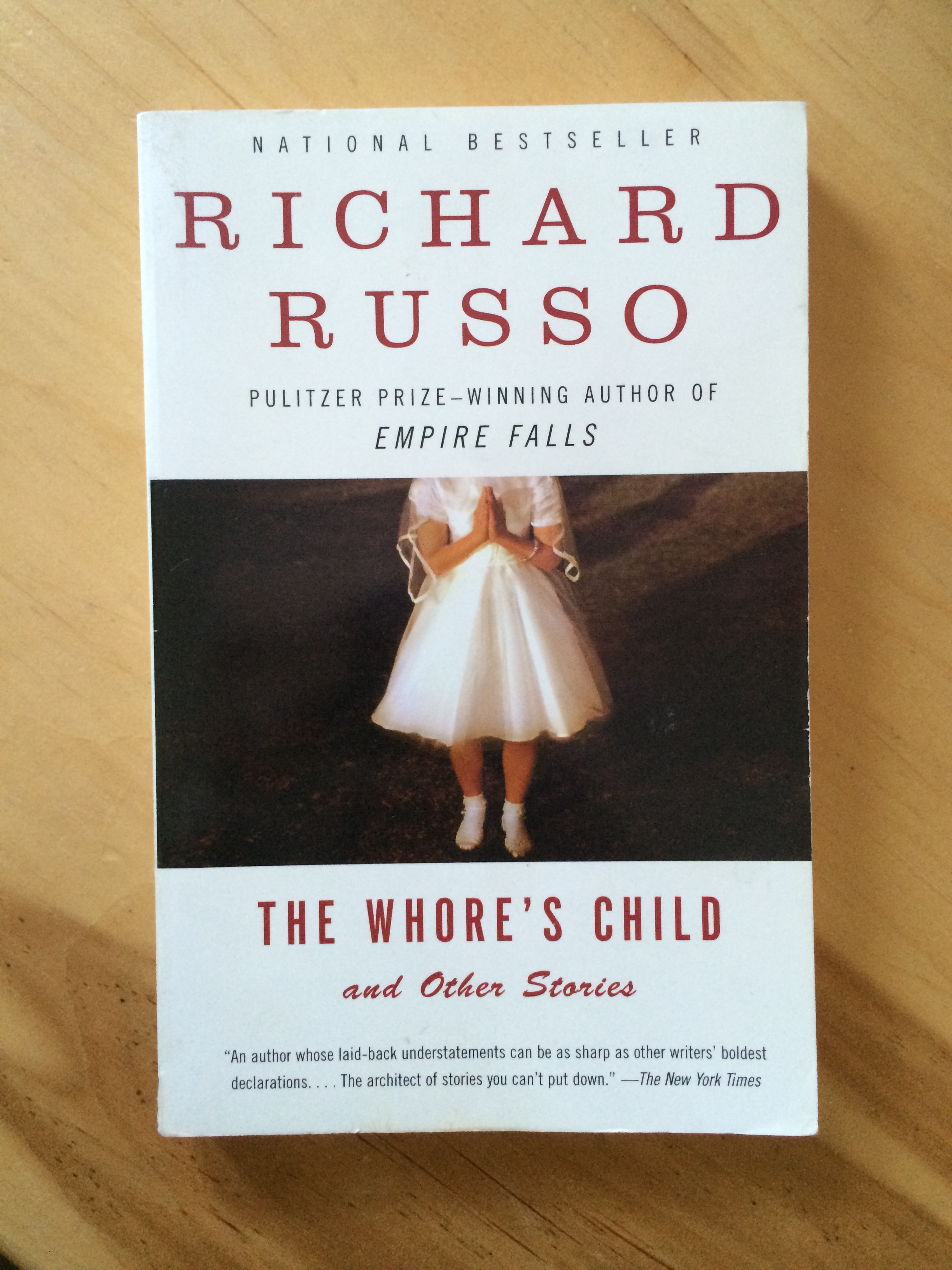
Richard Russo’s 2002 collection The Whore’s Child and Other Stories came to mind when I read Ms. Majka’s descriptions of life in economically depressed Maine. Mr. Russo is a chronicler of small-town New England and New York (state); if you liked the settings of Cities I’ve Never Lived In and are looking for stories with a different feel (more drama, varied narrators), you might give this collection a try.

And here’s the oddball of the bunch: Lost in Translation, the 2003 movie set in Tokyo that stars Bill Murray and Scarlett Johansson. Chances are you’ve seen it—I don’t know many people who haven’t—but the main narrator of Cities I’ve Never Lived In makes me think of Scarlett Johansson’s wandering and wistful Charlotte, and both works are explorations of loneliness and the impermanence of connection.

If you’ve read Cities I’ve Never Lived In, what other books or artwork did you connect it with?

*I received a copy of this book from the publisher for review purposes, which did not affect the content of my review.