Recommended Reading: Secessia, by Kent Wascom

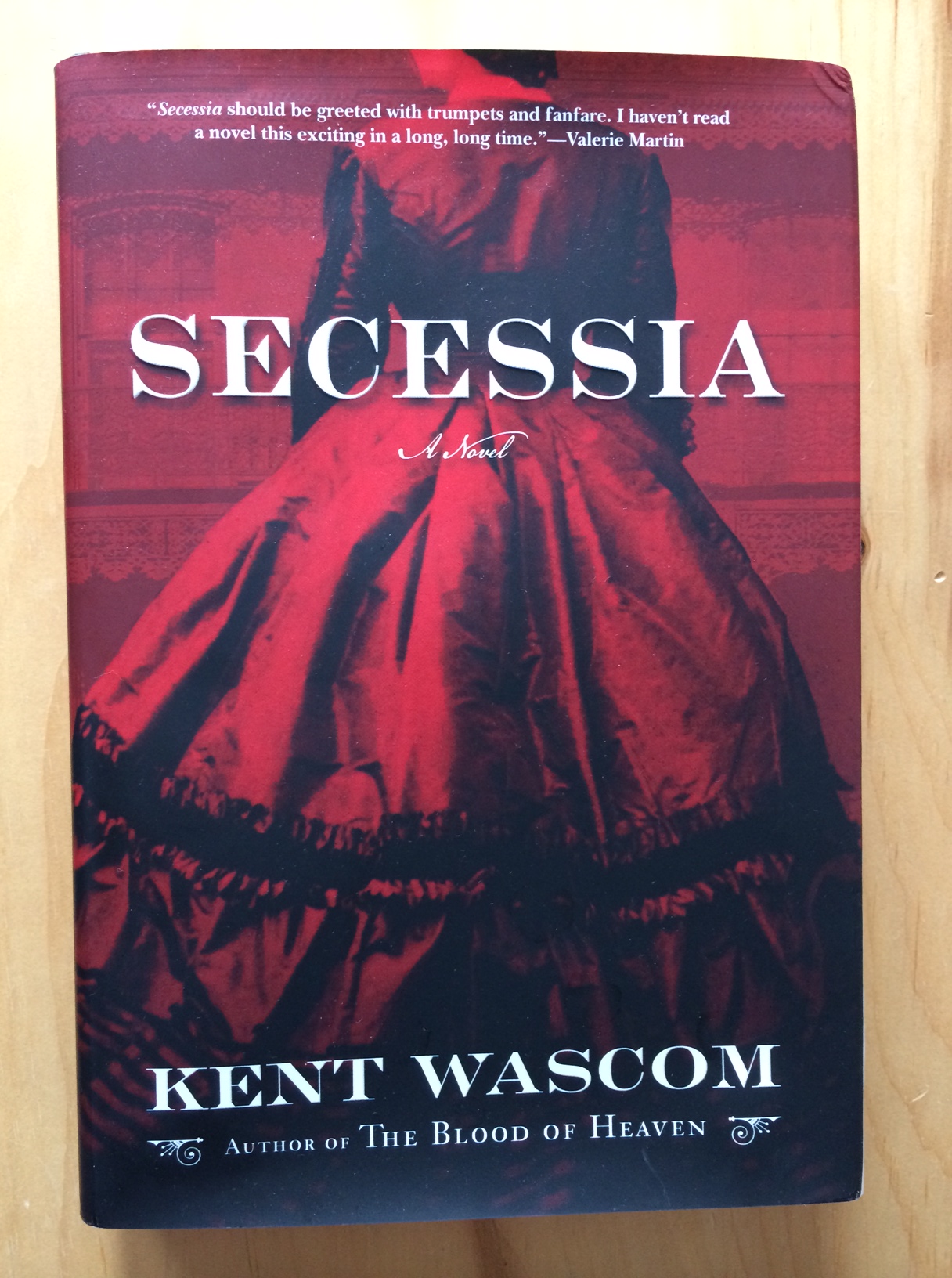
photo (55)In its first few pages, Kent Wascom’s Secessia,* which is out today, seems like an ode to to Edgar Allan Poe: a teenaged girl walks into a crowded masquerade with blood—not her own, it turns out—trickling down her chin. This is not your average Civil War novel.

Seldom have I read a book whose language evokes so well its setting. Mr. Wascom’s long, adjective-rich sentences sink the reader into 1862 New Orleans, a city slowly going mad with heat and hatred, a “new and wild world” on the brink of capture by Union forces.

The word that immediately leapt to mind when I started reading was “baroque”; the sentences are so over-populated with sound and imagery that they should topple under their own weight, but Mr. Wascom balances them expertly in brief chapters that propel the narrative inexorably forward. Here’s a small sample of the kind of language I’m talking about:

Thrown back upon the hands that have him hoisted high, an officiate of a ceremony of extraordinary violence, with boot heel he pulps one face, then another whose spouted teeth fall like wedding rice on her husband’s black coat; two of his bearers drop at Elise’s feet, and she has rushed too son, come to close, must spin and duck the whirligig of mayhem of which her husband is a master component. (33)

In this passage, Elise is searching for her son in the chaos of the city as the Union forces approach. Her much older husband, Angel Woolsack, was a major character in Mr. Wascom’s debut novel, The Blood of Heaven (which I haven’t read, but which received excellent reviews), and based on what we learn of him in Secessia, he sounds like he’d be right at home with most of Cormac McCarthy’s creations.

The novel’s point of view shifts among Elise, a mixed-race woman who passes for white; her only son, twelve-year-old Joseph; Marina Fandal, a Cuban orphan rescued by Union soldiers who takes an interest in Joseph; Emile Sabatier, a prominent doctor obsessed with disease and the girl he met at the masquerade nearly twenty years earlier; and General Benjamin Butler, the man who’s come to take charge of the city, and who will soon be called “the Beast.” Through their eyes we see New Orleans in a year of tremendous upheaval, which will affect them all.

New Orleans (and the South in general) is absolutely not romanticized in this book; it’s a morass of darkness, greed, and hypocrisy. Still, we don’t hear directly from any of the city’s enslaved residents, though certain household servants appear from time to time. Maybe that’s because Mr. Wascom is making a point about how only certain people’s voices were heard (Elise’s is heard because she passes for white), but I think the book would have been stronger if the author had turned his considerable talents in, say, Ligeia’s direction (perhaps she’ll appear in his next novel).

If you are a reader of historical fiction, or searching for a book that’s utterly different from everything else you’ve been reading, or want to start early with an author who’s going to be a master one day, look no further than Secessia.

Boston readers: Kent Wascom will be at Newtonville Books this Thursday, July 9, at 7p.m.

*I received a copy of this book from the publisher for review consideration, which did not affect the content of my review.

Recommended Reading: The Shepherd’s Life, by James Rebanks

Gorgeous cover; the photograph was taken by the author. And this book has some of the best endpapers I've ever seen.

Gorgeous cover; the photograph was taken by the author. And this book has some of the best endpapers I’ve ever seen.

When Helen MacDonald says a book is “bloody marvelous,” you can bet whatever you like that I will read that book, and you will come out a winner.

And so I read James Rebanks’s The Shepherd’s Life*, an account of current shepherding practices in England’s Lake District, a landscape which is perhaps familiar to you from the poetry of Wordsworth or Coleridge. If that’s the case, Mr. Rebanks, the shepherd whose Twitter account with its gorgeous photos has made his farm famous, has a bone to pick with your teachers:

My grandfather was, quite simply, one of the great forgotten silent majority of people who live, work, love, and die without leaving much written trace that they were ever here. He was, and we his descendants remain, essentially nobodies as far as anyone else is concerned. But that’s the point. Landscapes like ours were created by and survive through the efforts of nobodies. That’s why I was so shocked to be given such a dead, rich, white man’s version of its history at school. This is a landscape of modest hardworking people. The real history of our landscape should be a history of nobodies. (19)

Angered by the contempt shown his parents’ and grandparents’ occupation in school—he is fervent about his secondary education’s uselessness—Mr. Rebanks only later continued his formal education (at Oxford, no less; clearly his teachers missed an opportunity to reach a bright student). But by the time he reached his twenties he’d been educated in farm life for more than a decade. His family farm raises sheep. “We are a tiny part,” he writes, “of an ancient farming system and way of life that has somehow survived in these mountains because of their historic poverty, relative isolation, and because it was protected from change by the early conservation movement” (23).

The Shepherd’s Life is split into four parts that correspond with the seasons; each part is composed of short sections on shepherding practices, geography, Mr. Rebanks’s grandfather’s life, and Mr. Rebanks’s own life’s trajectory, all of which are sometimes intertwined. The sections that deal heavily with shepherding practices are the most successful and interesting in the book.

For example, Mr. Rebanks shows in vivid detail what it’s like to herd sheep in craggy fells, how important a good sheep dog is (they aren’t pets, though very deeply valued), and just how brutal the long days of lambing season are. In his world, “things are driven by the seasons and necessity, not by our will” (32).

In these pages, Mr. Rebanks makes the passionate and persuasive case that traditional farming is a way of life that is worthy of respect, and worth preserving. However, while there is a great deal of material in the book to help readers appreciate the very hard work that he and his family do (and that this work is not particularly remunerative; many farmers have second or third jobs to make ends meet), I didn’t feel there were enough concrete prescriptions for how to go about supporting it in practice.

The Shepherd’s Life is a book for those who want to immerse themselves in another kind of life, one that we might think has already vanished or that is so grindingly hard that people must want to escape it. To the contrary; Mr. Rebanks rails against what he perceives to be the degradations of the modern world, which doesn’t leave people much choice about how they live and work (which might sound odd coming from a shepherd whose family has worked the land for generations, but, given Mr. Rebanks’s biography, makes sense). During a summer in London, he thinks, “it’s like the gods are showing me how tough everyone else’s lives are and what I have left behind. I understand for the first time why people want to escape to places like where I live. I understand what national parks are for, so that people whose lives are always like this can escape and feel the wind in their hair and the sun on their faces” (179).

Despite this sentiment, he also chides the conservation movement, which, despite its acknowledged successes and ways of helping the Lake District, often at times seemed to value land more than people, to look down on traditional ways of raising food. He reminds us that “when local traditional farming systems disappear, communities become more and more reliant upon industrial commodity food products being transported long distances [. . .] They begin to lose the traditional skills that made those places habitable in the first place, making them vulnerable in a future that may not be the same as the present. No one who works in this landscape romanticizes wilderness” (218).

My reservations about this book are eclipsed by its positive aspects, but I would note that the style, though excellent when it comes to description, was not wholly to my taste; there is a tendency toward repetition that is at times awkward, and the inconsistent tenses were a bit maddening, making some parts of the work sound like strung-together blog posts. And it is a book very much about men (fathers and sons, and grandfathers), though women (family members and other shepherds) do make appearances. I would have liked to see a fuller picture of the no doubt grueling work the author’s mother, wife, and grandmother put into running the farm. Particularly troubling here are two or three passages in the middle of the book that seem to belittle the author’s grandmother’s concerns and experiences.

These reservations aside, The Shepherd’s Life is a fascinating book, and well worth reading. Recommended.

If you’re looking for more on sheep farming, you might look at Evie Wyld’s novel All the Birds, Singing, or, for a very different take, Sir Thomas More’s Utopia. For a perspective on modernity that I suspect Mr. Rebanks would find congenial, and because there’s no opportunity I won’t take to recommend it, you might consider picking up The Lord of the Rings.

*I received a copy of this book from the publisher for review consideration, which did not affect the content of my review.

Recommended Reading: Music for Wartime, by Rebecca Makkai

photo (54)Last year I read and loved Rebecca Makkai’s novel The Hundred-year House (Ms. Makkai was kind enough to agree to an interview, too), and so I was delighted to read that a collection of her short stories would appear this summer.

Music for Wartime is that collection, and it’s excellent. In well over a dozen stories spanning more than a decade of her writing career, Ms. Makkai traverses a wide landscape of emotion, space, and time, drawing from her family’s history (some of the strongest pieces in the collection are very short family legends) and her own power of invention.

In one story, an elephant dies mid-act in a small town during the 1940s, ushering in some very strange weather and serious questions for the local pastor. In another, a reality-TV producer steers contestants into producing perfect soundbites—and maybe toward falling in love. In “Painted Ocean, Painted Ship,” a professor accidentally shoots an albatross, and the hefty fine is just the beginning of her bad luck.

Often funny, often sad, and always graceful, these stories are linked by themes of art and war, or at least violence, as you might suspect from the title. You’ll find painters, sculptors, violinists, circus performers, and even Bach within these pages. It’s a tribute to Ms. Makkai’s virtuosity that it’s very difficult, often impossible, to tell which stories are earlier efforts and which are more recent. I was only disappointed when I turned the last page.

Boston Readers: You just missed Rebecca Makkai at Newtonville Books and Harvard Bookstore—sorry about that—but if you’re trekking up to Vermont this summer, you can hear her read in Burlington at Phoenix Books on July 28th at 7p.m.

*I received a copy of this book from the publisher for review purposes, which did not affect the content of my review.

“All of us dazzling in the brilliant slanting light”: Barbara Crooker’s “Strewn”

Not exactly right, but you get the idea.

Not exactly right, but you get the idea.

Last week, my uncle, who lives in Maine, came for a visit, which was excellent in all respects except that it was too short. And it just so happened that last week’s American Life in Poetry column, curated by Ted Kooser (which I highly recommend as a way to get into poetry–the poems are about the experiences of everyday life, and are always accessible) featured a poem by Barbara Crooker about the Maine coast.

“Strewn” is beautifully detailed. I love the list of broken shells that the speaker describes, and the idea of the sunlight on the beach like “a rinse / of lemon on a cold plate.” But it’s the turn at the end of the poem that brings the other people on the beach—and by extension the reader—into the speaker’s orbit that still resonates for me days after reading the poem.

Recommended Reading: Stir, by Jessica Fechtor

IMG_3839One of the pleasures of reading, the truism goes, is the pleasure of recognition. We see in characters or settings or allusions or experiences something  we know, which opens up into a whole host of secondary associations. And this is in addition to the delights of reading, in the first place, the text on the page, which the author has written without knowing just what kinds of associations it will call up in readers.

This brings me to Jessica Fechtor’s moving memoir, Stir: My Broken Brain and the Meals That Brought Me Home*, which is out today, and which was so peppered with moments of recognition for me that I kept nodding in appreciation (more on this in a little while).

When she was twenty-eight, Ms. Fechtor’s calm, happy life veered quite suddenly off course. On a run one morning, an aneurysm in her brain burst, and suddenly the Harvard graduate student found herself close to death. Over the next few months, she endured multiple surgeries and infections (which left her with a facial deformity), lost the sight in one eye, and found she couldn’t taste anymore. Her plans to start a family with her husband were put on hold, as was her dissertation.

This is one of the best narratives of illness (and recovery) that I’ve ever read, in part because Ms. Fechtor gives readers not just the story of her illness, but of her life before it; a bit about her childhood, more about her time in college, and most of all about the charming love story she shares with Eli, her husband. Her family and friends make this book come alive, their support for Ms. Fechtor a testament not only to their loyalty and steadfastness, but to the love she inspires in them.

As a narrator, she’s a careful, unflinching examiner of both joy and pain, and her own thinking:

I was furious with myself […] for ever thinking that health was something I could count on. I’d always had excellent luck and my genes were enviable. No broken bones, maybe one cold a year, great-grandmothers and great-great aunts who lived into their nineties. I took care of myself. I ate oatmeal and kale. I flossed. I followed the rules that were supposed to keep me safe.

Don’t get me wrong–I’d imagined illness. Critical, devastating, out-of-nowhere illness. I was right there in the imagined hospital rooms of my worst nightmares, alongside Eli or a parent or a friend. Only I was never the one in bed. I was the big-hearted helper, the devoted cheerleader. I brought the cookies. (148)

When it turns out that she’s the patient in the bed, it was eating and cooking that helped Ms. Fechtor pave a way forward from the terrifying experience. Food and illness are always linked, of course; food helps us get well, or signals that we’re well, or tells someone we wish them well (who hasn’t delivered a casserole?). In Stir, Ms. Fechtor shares more than twenty-five recipes that have been meaningful to her, from a simple tomato soup, to her mother-in-law’s cholent and kugel, to pan-roasted salmon and baked apricots with cardamom pistachios. I loved the recipe-writing here: there’s enough backstory to give a sense of connection to the recipe’s origins, and enough detail to be precise and helpful, but they’re never overwrought.

And you know the recipes are going to be good, because Ms. Fechtor is the force behind the blog Sweet Amandine, which she started during her recovery as a distraction from all the trappings of illness (as she points out, “Being sick is like walking around with a microscope strapped to your face at all times with your own body squished beneath the slide” [187].). It’s a gorgeous blog (this is coming from someone who used to be a food blogger), and I highly recommend it, unless you’re hungry and lacking the prospect of a good meal in the near future.

The recipes are part of the recognition I was talking about at the beginning of this review; there’s a cookie recipe from the Hi-Rise Bread Company in Cambridge (one town over from where I live), a recipe for a gorgeous golden-clear chicken broth that reminds me of the matzoh ball soup my best friend’s mother makes (Hi, Mrs. Klein!), and—wait for it—Corbo’s cassata cake.

Cleveland readers know what I’m talking about: an unbelievably decadent white cake with layers of custard, strawberries, and whipped cream. It’s a cake that has bittersweet associations for me, but I’d still never turn down a slice.

The cake makes an appearance in the book because Ms. Fechtor grew up in Cleveland; I did too, as you’ve probably gathered. And our graduate student years overlapped in adjacent towns, so all the Boston landmarks, culinary and otherwise, resonated with me, as did quite a few other details. And her meditations on what it’s like to be sick struck a nerve for me as well.

I loved Stir for all those pings of recognition, for the recipes, for Ms. Fechtor’s charming, serious, and thoughtful voice. And I’m grateful to have read it because she articulated something I’ve wanted and failed to say for years. Predictably, she started hearing “everything happens for a reason” from well-meaning people trying to offer solace. But, she writes,

I don’t see it that way at all. To me, only the first part is clear: Everything happens. Then other things happen, and other things, still. Out of each of these moments, we make something. Any number of somethings, in fact.

What comes of our own actions becomes the “reason.” It is no predestined thing. We may arrive where we are by way of a specific path—we can take just one at a time—but it’s never the only one that could have led to our destination. Nor does a single event, even a string of them, point decisively to a single landing spot. There are infinite possible versions of our lives. Meaning is not what happens, but what we do with what happens when it does. (106)

Stir is a wonderful book, one that I highly recommend. One day, almost certainly, we’ll all find ourselves as the patient in the bed, or the one bringing the cookies. This book will help either way.

*I received a copy of this book from the publisher for review consideration, which did not affect the content of my review.

“Then he unlocked the back door / and stepped out into the garden”: Paula Meehan’s “My Father Perceived as a Vision of St Francis”

Photo courtesy Breno Machado via Unsplash

Photo courtesy Breno Machado via Unsplash

A few weeks ago, I was reading about contemporary Irish poetry (living life in the fast lane, as always), and I learned a little bit about Paula Meehan, named the Ireland Professor of Poetry in 2013. The Irish Times had a feature about her this winter, in which Ciaran Carty wrote,

“It’s more than 40 years, and nine books, since Meehan emerged from childhood in the inner city Dublin tenements to give voice to the disenfranchised everywhere, less in anger than with compassion and an intuitive understanding that, through verse, imbued their lives and memories with mythic dignity.”

Sounds pretty good to me.

Professor Meehan’s poems are a little tricky to find–she doesn’t have an entry at The Poetry Foundation, which is my go-to poetry site, but you can read “Ashes” at Poets.org. The poem that really caught my eye was this one: “My Father Perceived as a Vision of St Francis,” over at The Poetry Project, which is a site devoted to Irish poetry. It’s a lovely poem, anchored in everyday detail, but transcendent all the same.

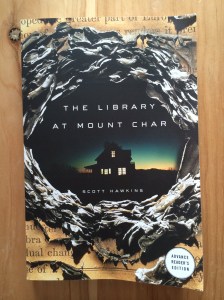
Off the Reading Path: The Library at Mount Char, by Scott Hawkins

The title sounds promising: The Library at Mount Char*. I’m bookish; naturally I love libraries. This book should be right about my alley. Right?photo (50)

Well, no—but somehow Scott Hawkins’s debut was pretty fun reading.

The protagonist’s name is Carolyn, which is my name. It’s not a particularly unusual name—I’ve met a half dozen other Carolyns in the last thirty years—but it’s not Jessica or Emma or Katie, names I run across in books pretty frequently, nor is it a strange enough name that authors often choose it to set their characters apart. What I’m trying to say is that it is really weird to keep reading your own name when not accustomed to doing so, especially when the book’s first sentence is: “Carolyn, blood-drenched and barefoot, walked alone down the two-lane stretch of blacktop that the Americans called Highway 78.”

See? Oh, and don’t worry: it gets worse for Carolyn. Much worse.

The Library at Mount Char is a book that’s way, way out of my reading comfort zone (it might be in Rory’s, for those of you, like me, who love being vicariously scared through Fourth Street Review): it’s very violent, and the genre is a cross between horror and contemporary urban fantasy, with quite a bit of Jacobean revenge tragedy thrown in. It’s a bit like Neil Gaiman’s American Gods (which I loved), I suppose. Maybe that’s why I simply could not stop reading it.

It’s disturbing and horrifying, sure, but it takes place in a world that is not ours, which makes the violence almost theatrical. Think Titus Andronicus. It is also a deeply bizarre book; it went in directions I certainly didn’t anticipate, and while I had one major plot point figured out in the beginning of the novel, it’s a testament to Mr. Hawkins’s power of invention that the book managed to surprise me in almost every chapter.

By now you’re probably wondering what this deeply bizarre, inventive, and violent book is about. It’s tricky to give you a plot without giving too much away, but here goes: Carolyn is a very special kind of librarian, one of twelve people taken in as children by Father after all their parents died. Each of them is an expert in his or her own (strange) catalogue, but Father is master of them all, and his power is unmatchable: he can bend the rules of time and space, and to disobey him is to suffer.

When the book opens, Father is missing, and the library that contains his secrets and his power is up for grabs. Carolyn wants in—very badly.

The Library at Mount Char is not for the faint of heart, but if you want a wild ride, some serious thinking about family, nature versus nurture, cruelty, and love, you might want to give this book a try. I didn’t love all of it—quite a bit is downright unpleasant, and I have some issues with the ending, which I would love to talk about with somebody—but I kept turning pages in surprise.

What’s the last book that took you out of your reading comfort zone?

*I received a copy of this book from the publisher for review consideration, which did not affect the content of my review

Visiting the South: Gwendolyn Knapp’s After a While You Just Get Used to It: A Tale of Family Clutter

No offense intended toward its residents (the vast majority of those I’ve met have been delightful), but as a general rule*, but I visit the South (meaning here the deep South, east of Texas) only in books or recipes, leaving the living there to souls braver and sturdier than I. I dislike heat, humidity, large flying insects, large crawling insects, the prospect of encountering reptiles capable of swallowing me or my limbs whole, swamps, Confederate flags, and okra.

However, I do like tales of swamp adventurers, almost anything fried, stories about terrifying fauna and rare flora, regional idioms, and the idea of warm weather in the winter.

photo (51)This is why reading about the South is so enjoyable: all of the interest, none of the sweat. And I tend to read nonfiction about the region: Midnight in the Garden of Good and Evil, The Orchid Thief (original, I know). And now After a While You Just Get Used to It: A Tale of Family Clutter** by Gwendolyn Knapp. Strictly speaking, this memoir isn’t about Florida, where Ms. Knapp grew up, or New Orleans, where she now lives and works, but her writing is so evocative of place that I could practically feel the boggy heat blowing through the window.

Ms. Knapp’s world is populated by colorful characters, many of them her own family members, including her mother, Margie, who can’t stop accumulating stuff; her Aunt Susie, an addict with a good-for-nothing boyfriend; and her sister Molly, who can’t wait to escape their house. There is all sorts of drama of the holiday, funeral, dating, and interstate-move variety, framed in Ms. Knapp’s observant and wry voice.

The book is a series of chronologically ordered vignettes, often jumping quite a few years in time, which makes for easily digestible, fast-paced reading, if an incomplete picture of the author’s life. After a While You Just Get Used to It, as its title suggests, tends toward the matter-of-fact acceptance of the way things are, even if the way things are is a pretty horrible state of affairs. It’s Southern Gothic as life-writing, essentially.

While mostly I cringed for Gwendolyn as she deals with her family, her own health problems, difficult jobs, and a series of unfortunate boyfriends, I also laughed. I’m glad Ms. Knapp is inviting readers to visit her world.

*I have made exceptions for one beach, several airports, and one wedding (worth it, J & P!)

** I received a copy of this book from the publisher for review consideration, which did not affect the content of my review.

A Tale of Two Cookbooks

Before I was a book blogger, I was a food blogger.

It’s true. Mr. O and I ran a humble blog (not modesty—the photography was mostly mine, which is to say, poor) about our cookery for a couple of years, which we both loved, but eventually fell by the wayside (baby, digestive disease, the usual).

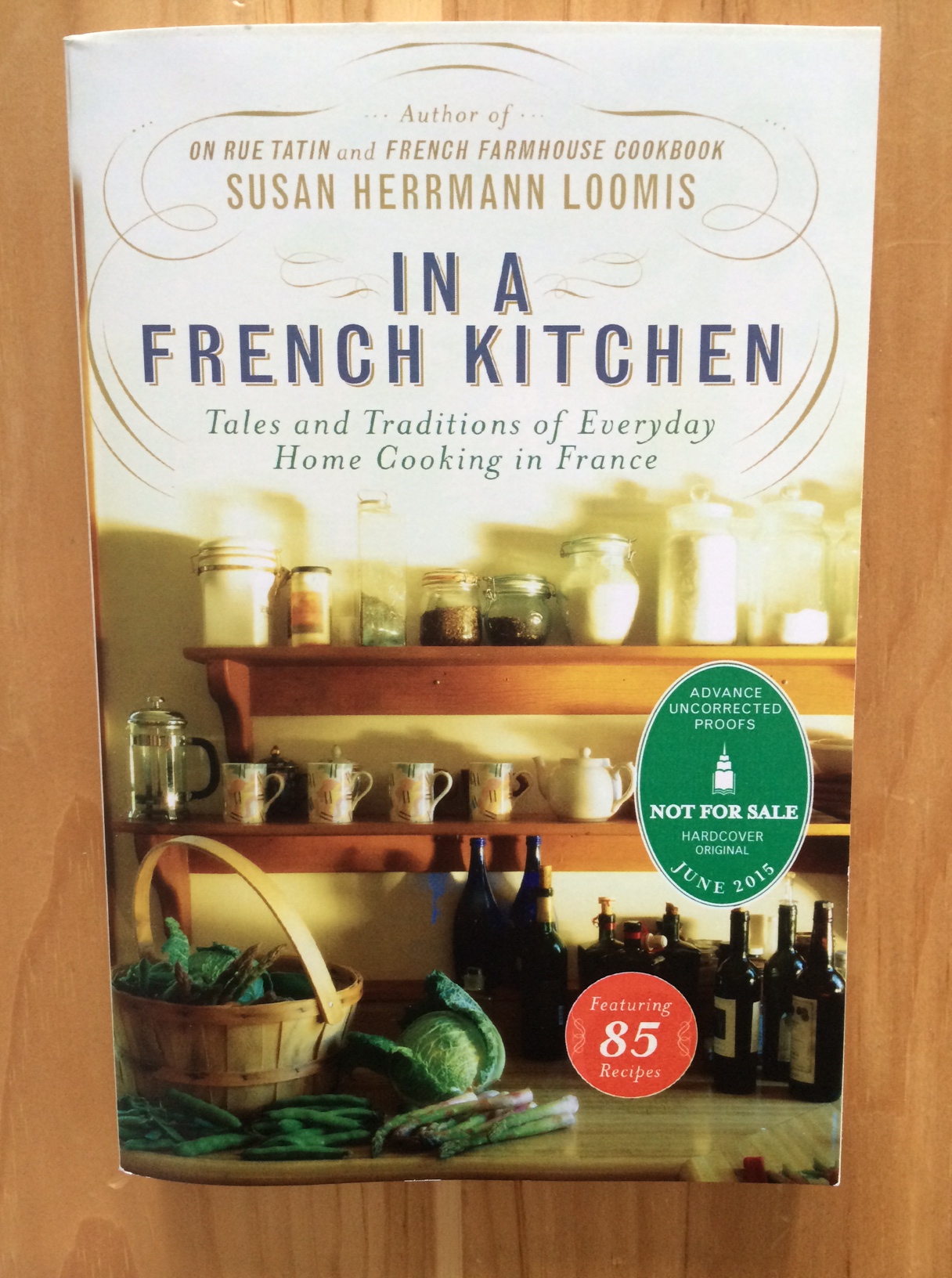
photo (47)Point is, I love food, so I hope you’ll indulge a turn from the literary and toward the culinary this week. I read cookbooks for fun, and the only thing I truly miss about having cable is the cooking shows. So when Susan Herrmann Loomis’s In a French Kitchen: Tales and Traditions of Everyday Home Cooking in France* arrived, I was ready to sink my teeth into it.

It’s a cheerful book about traditional French home cooking, accompanied by recipes that fit in with the theme of each chapter, like salad, cheese, grandmotherly cooking, pantry staples, even leftovers. The food sounds absolutely mouthwatering, but what’s even more fun to read about are the gustatory and cooking habits of Ms. Loomis’s friends and acquaintances in her adopted town. The French eat quite a lot of sugar, it turns out—which you wouldn’t think—and are very particular about cheeses, which of course you would think. And Sunday lunches last six hours, which sounds heavenly.

In a French Kitchen is not to be taken as prescriptive, I think; most of us do not have access to the kinds of gardens, markets, boulangeries, and state-funded daycare that make possible the kind of cooking Ms. Loomis describes.

In some ways, the book feels a little retro; Ms. Loomis notes approvingly how French women look great all the time, wearing high heels while they stir at the stove, while also noting, light as you please, that it’s the rare French man who cooks at home. Like I said, retro, and honestly a little grating when you factor in that Ms. Loomis never notes the social structures in France that (a) make it possible for people (read: women, mothers) to cook frequently and (b) make it seem like no problem that men aren’t expected to cook.

In the end, though, In a French Kitchen is a book that makes you dream about retiring to France, eating your way through every recipe, and making every lunch a French Sunday lunch.

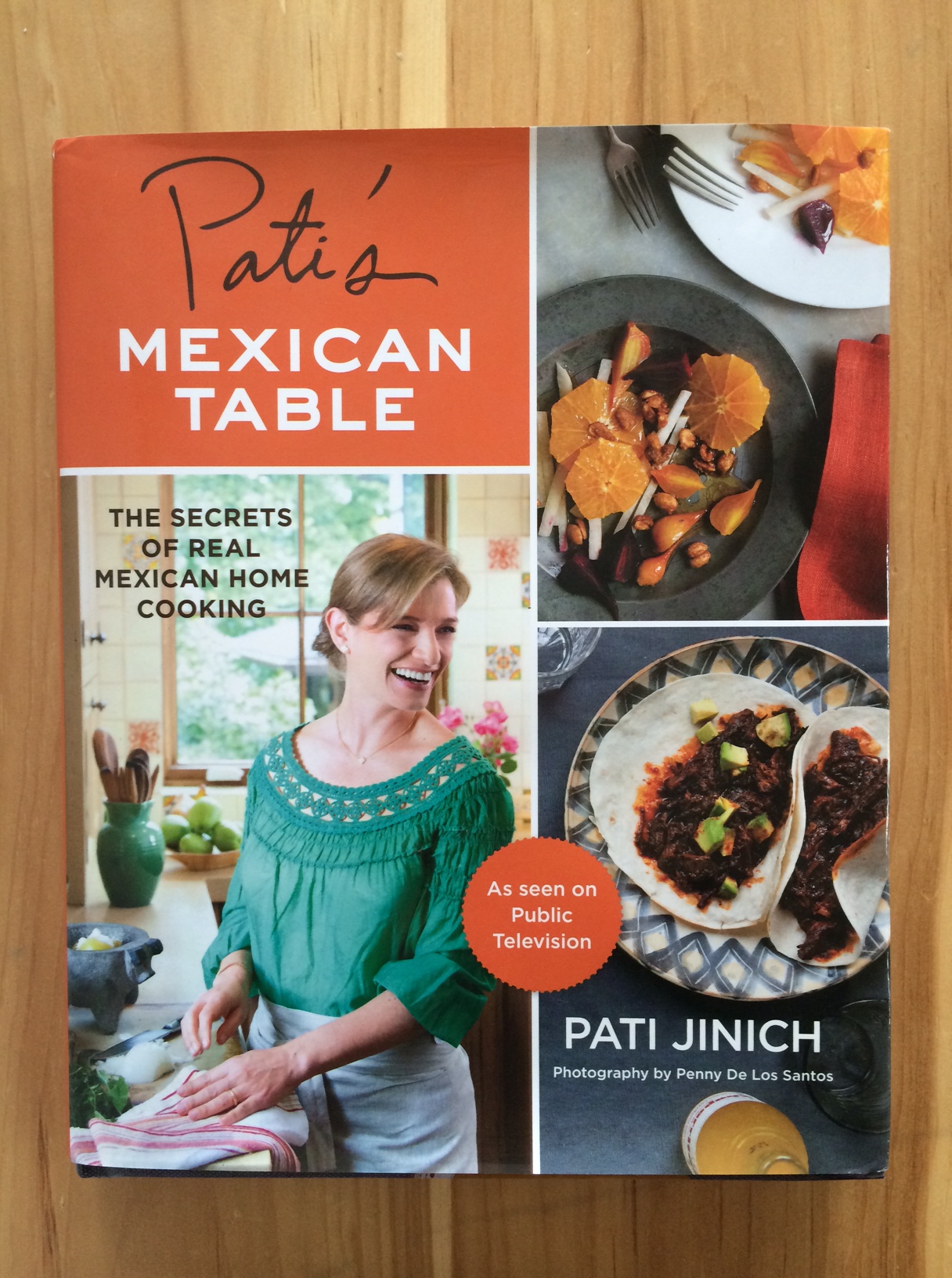
photo (48)My other cookbook reading of late has been Pati’s Mexican Table: The Secrets of Real Mexican Home Cooking, by Pati Jinich. Ms. Jinich has a cooking show on PBS of the same name, which I’ve loved watching; her recipes look intoxicatingly good and Ms. Jinich is friendly, welcoming presenter. I’ve had my eye on the cookbook for months, and I happened to find a copy of it on sale at Sherman’s Books in Portland, Maine, much to my delight.

It’s a great read, because there’s so much to learn about Mexican culture and food (Ms. Jinich’s grandmother was a survivor of the Nazi concentration camps, who combined her own food traditions with Mexico’s), and because Ms. Jinich provides plenty of tips about using ingredients that might be unfamiliar, like how to char poblanos or how to make tamarind syrup. I’ve made three recipes from the book and they’ve all been exquisite, requiring not even an extra pinch of salt. I’ve never had so much fun with a food processor. Try the salsa verde, and you’ll be looking in your local bookshop for Pati’s Mexican Table too.

*I received a copy of this book from the publisher for review consideration, which did not affect the content of my review.
Colorado Reading

I don’t know about you, but I find I hardly ever get as much reading done on vacation as I think I will. And that’s okay; usually it means there’s been sightseeing and visiting and talking late at night and eating and museum-going aplenty.

As I mentioned not too long ago, recently we visited family and friends in Denver, which was delightful. I brought along War of the Encyclopaedists, which I started and finished on the trip, as well as Annie Proulx’s Close Range: Wyoming Stories. I figured something with a Western vibe that I could read in short chunks would be a good choice, and it was, if grimmer than expected. Close Range includes Brokeback Mountain, the basis of the movie of the same name, and all things considered it’s one of the brighter stories in the collection. Close Range is visceral reading—Ms. Proulx has an extraordinary gift for rendering place, and her characters are both strange and real.

photo (46)That’s two books, and extraordinary restraint in book-packing on my part, I must say. There’s a reason for that: I had a list of about a dozen bookstores I wanted to visit in Denver, Colorado Springs, and Boulder, but I only made it to two (guess I’ll just have to go back, darn).

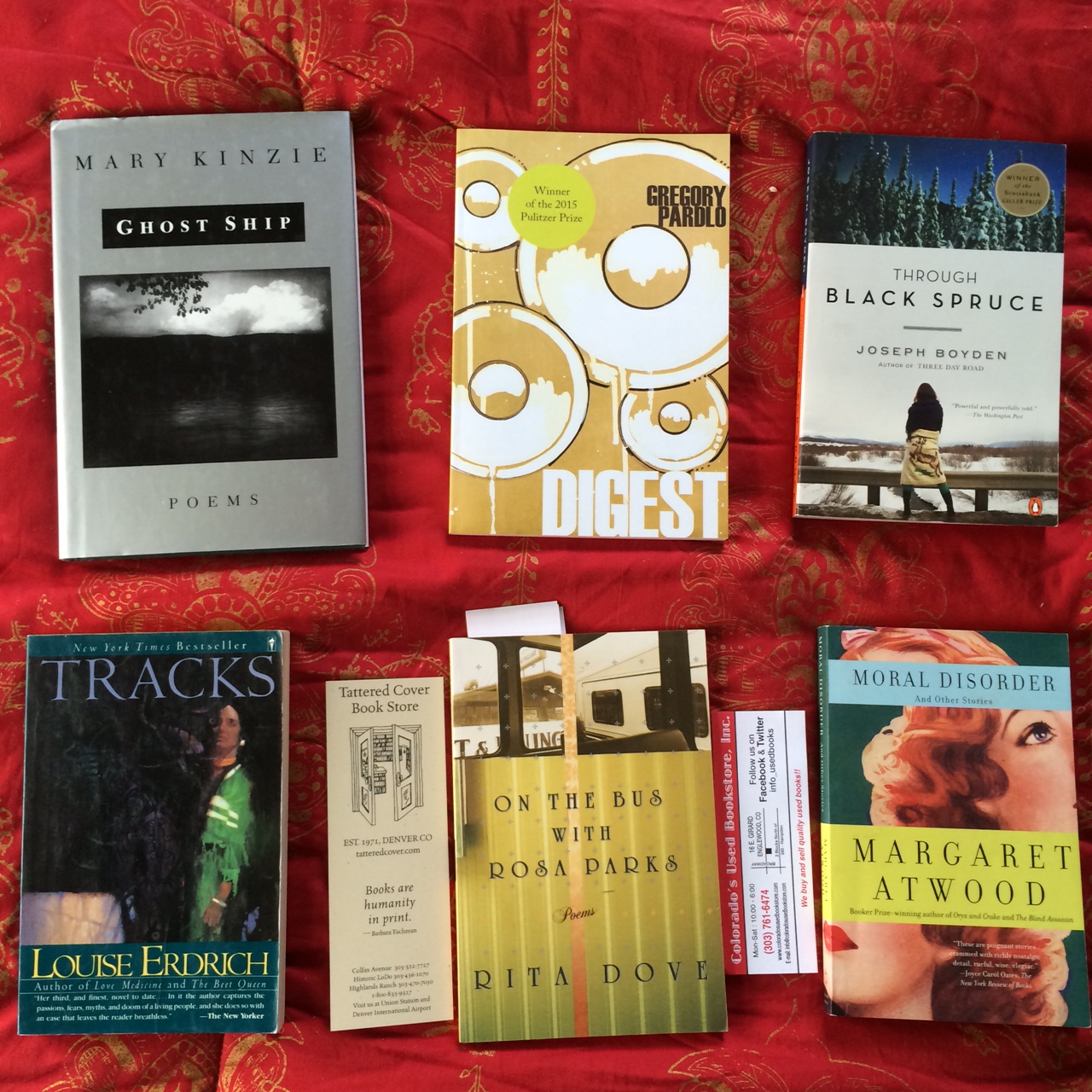
First up was the Tattered Cover, Denver’s largest and most famous independent bookstore. It has several outposts, and I visited the store on Colfax, where I picked up Gregory Pardlo‘s Pulitzer-Prize winning Digest. I read it over the next few days and finished it on the plane, and I highly recommend it. The poems are about origins and identity, fatherhood and what it means to be American. They’re very, very good, and packed with intellectual energy; I want to re-read them all again.

Next I went to one of my uncle’s favorite bookstores, Colorado’s Used Bookstore in Englewood. It’s an unassuming store, with a huge selection of genre paperbacks, an eclectic poetry section, and a huge set of back rooms for nonfiction and trade paperbacks. The woman I met, who I believe owns the store, was very friendly and helpful, and pointed out that they sell books online, including hard-to-find books.

At Colorado’s Used Bookstore I found Ghost Ship by Mary Kinzie and On the Bus with Rosa Parks, by Rita Dove (both poetry), Moral Disorder (a collection of Margaret Atwood stories), Joseph Boyden’s Through Black Spruce (I loved The Orenda and Three-day Road) and Louise Erdrich’s Tracks (still can’t stop thinking about The Round House). I can’t wait to dive into these.

Next time in Colorado, I’ll be trying for those other ten bookstores, and I’d like to look up some Colorado writers before I go, to find their work in its native habitat.

And what about you, Dear Readers? Do you race through books on vacation, or pack more than you can read?