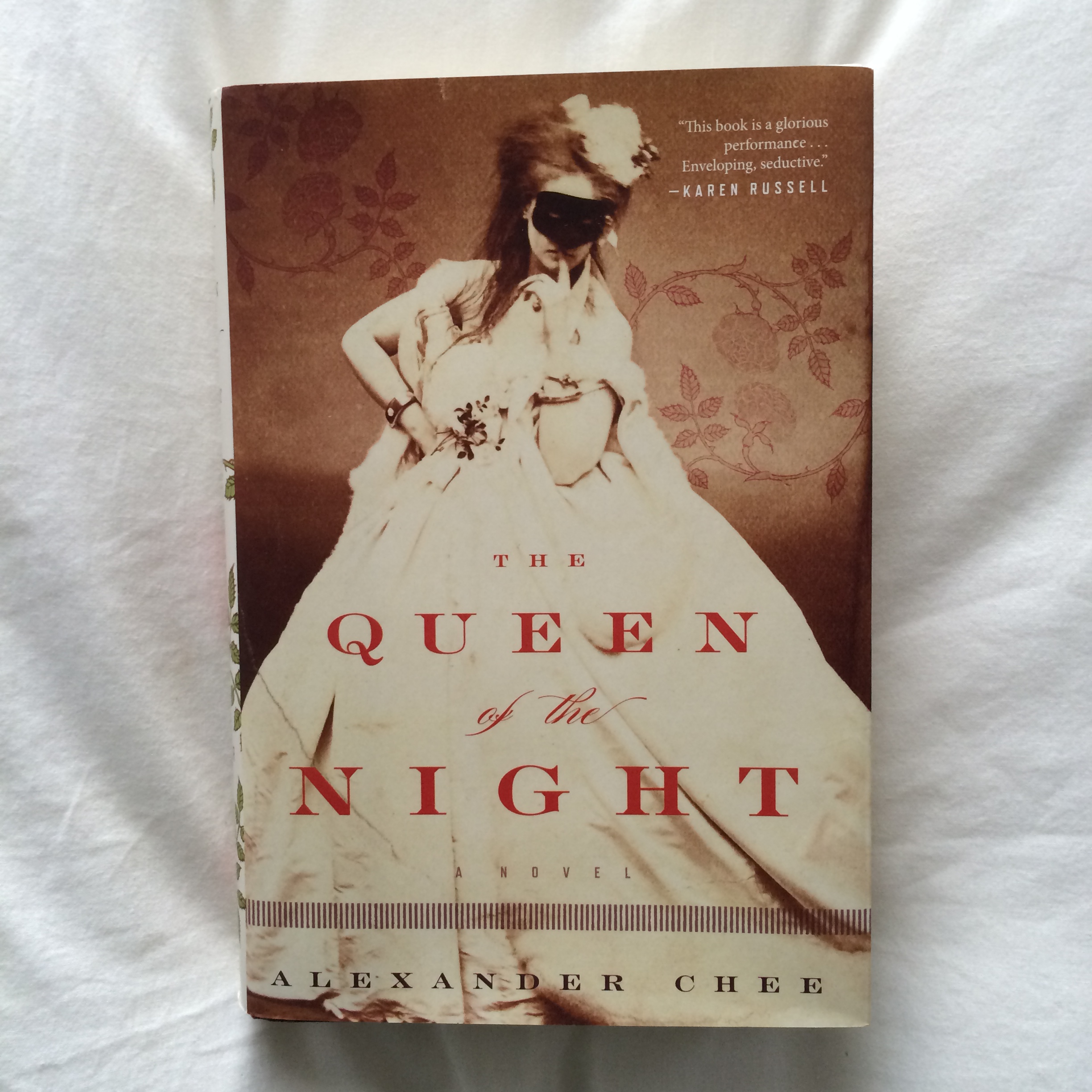
Recommended Reading: Alexander Chee’s The Queen of the Night

IMG_6002“There was a question I wanted answered more than I wanted anything else, and it could take my life to answer it. The question was, What could I be?”

Opera fans will no doubt recognize the name of the soprano role (requiring two very difficult arias) from Mozart’s The Magic Flute in the title of Alexander Chee’s second novel, The Queen of the Night*. This is appropriate not only because the novel borrows, to some extent, the structure and themes of that opera, but because it is a virtuoso performance, showcasing its author’s range, technical skill, and complete command of its characters’ complexities. This is a novel about love, identity, deception, sacrifice, courage, calling, and tragedy.

As The Queen of the Night opens, soprano sensation Lilliet Berne is the talk of late-nineteenth-century Paris, and she’s just been made an impressive offer: a mysterious composer, supposedly the protégé of her friend Verdi, is writing an opera based on a novel, and he wants her to create the starring role. This is the one accolade that has eluded her in a short but distinguished career. However, when she realizes with alarm that the novel is based on her own life—a life, with all its secrets, that’s been carefully masked—she must go in search of old enemies and friends to determine the intentions behind the work.

Thus we’re drawn into the story of Lilliet’s absorbing, fantastic life, filled with the highs and lows of grand opera, with its patterns, as she notes, of alternating victory and defeat. From the frozen farmland of Minnesota to a traveling circus in France, from Paris’s houses of ill repute to the basement of the Tuileries palace, Lilliet’s next step is always unexpected.

“How many women are you?” a lover asks her. “A legion,” she replies. She’s a farmer’s daughter, a bareback horse rider in a circus, a courtesan, a servant, a spy, and a soprano. Each role is a mask (one of her teachers, asking her to perform emotions with her facial expression, not her eyes, even says, “Your face appears to be only a mask . . . if you can master this, you can give and never give away anything.”), a necessary deception when nobody she knows can be trusted.

Mr. Chee’s command of his characters and setting is astounding; it’s hard to fathom just how much research went into the novel (though the acknowledgments section gives us a hint; I wonder how much was left on the cutting room floor) to produce gorgeous, detailed passages like these:

The trunks were made by Louis Vuitton in a pale gray known as Trianon gray, her favorite gray. It was as if the Empress were secretly something enormous, disassembled in the morning dark, her various parts in the neat rows of boxes and trunks we’d prepared and brought up to the surface.

The period detail throughout the novel is amazing, as are Mr. Chee’s evocations of the different historical figures Lilliet encounters, from Eugenie, Empress of the French, to the mezzo, composer, and teacher Pauline Viardot, the Verdis, George Sand, and Ivan Turgenev. His descriptions of music are beautiful, and I found myself seeking out arias from Carmen, The Magic Flute, and Il Trovatore for the first time in some years (I studied opera in high school, but clearly my life went in a very different direction, Dear Readers).

The Queen of the Night’s grand style and thematic intensity falters only in occasional cases of editorial oversight (for example, at one point Lilliet stands, narrates a bit, and is then helped to stand again, unnecessarily). But in a novel this long and this complex, I almost feel that this is a quibble.

A recommended pairing.

A recommended pairing.

I highly recommend The Queen of the Night. It’s a grand entertainment, and a moving story, like the best operas themselves.

Near the end of the book, Lilliet says,

I think you can never know what you can live without. I think you can never know what you will live through. Only when the disaster arrives and you are there does the depth of your real inner resources reveal itself, and not a moment before.

The Queen of the Night is the tale of what one woman can live without, and what she can live through. Up to the last page, you won’t be sure whether her pattern ends with victory or defeat, but you’ll be cheering, like all Lilliet’s admirers, “Vive La Générale!”

*I received a copy of this book from the publisher for review purposes, which in no way affected the content of my review.

Recommended Reading: Contents Under Pressure, by Ellen Prentiss Campbell

IMG_5925A woman facing an unplanned pregnancy while struggling with her relationship with her own parents; a marine biologist who desperately wishes to become a fish; an older woman bidding her beloved country inn farewell; a young mother grieving the loss of her youngest son; wives contemplating the possible ends of their marriages; a little girl desperate to learn how to ride a bicycle to please her institutionalized father: these are some of the characters in Ellen Prentiss Campbell’s exquisite book of short stories, Contents Under Pressure*.

In each of the eleven stories that make up this slim volume, Ms. Campbell balances precise description with unspoken tension; the result is stories that are spellbinding in their realism.

In “Depth Perception,” from which the collection’s title phrase is drawn, a young woman struggles to find the right time to tell her partner that she is unexpectedly pregnant; meanwhile, her adoptive parents’ marriage is a quiet shambles. “Lily operated like a seismograph sensing the shifting plates beneath the surface of her parents’ relationship,” Ms. Campbell writes.

Fractured or troubled marriages appear in several other stores, like “Peripheral Vision,” in which a couple dresses as Jack and Jackie Kennedy for a Washington, DC Halloween party. Behind her mask, Meg wonders if she should leave her husband, and an encounter with a fortune teller doesn’t clarify matters.

The sense of place is strong in all stories; some are set in Washington, others in a small Pennsylvania town in the foothills of the Alleghenies. One of my favorites is “Shade Gardening,” set in Washington in 1962. A young couple, devastated by the death of their young son but holding their family together for the sake of their other child moves into an unusual house just before the start of the Cuban missile crisis. It’s a tender but unflinching portrait of a woman’s grief and resiliency.

Ms. Campbell’s main characters are women and girls from a range of social classes, backgrounds, and ages; I was delighted by the freshness of each story, the graceful writing that makes storytelling look easy, but is in fact the hallmark of a very gifted author. This collection is highly recommended.

I also recommend this gorgeous essay by Ellen Prentiss Campbell, “Creative Defiance,” at Fiction Writers Review.

*I received a copy of this book from the author for review purposes, which in no way affected the content of my review.

“Various long midwinter Glooms. / Various Solitary and Terrible Stars”: Alice Oswald’s “Various Portents”

AliceOswald_VariousPortentsI’m partial to poems that are lists; it’s always impressive when a poet can give an impression of action, or set a mood, simply by making a list of items.

Alice Oswald is a poet I know nothing about, but a quick look at her biography at The Poetry Foundation intrigued me; I’m now itching to read Memorial, her treatment of the Iliad, and Dart, a book that’s based on her research into the history of the community around a river in Devon, England.

“Various Portents” is subtly ominous and a bit wintry; it made me think of Game of Thrones (though no, I still haven’t read the book). What do you think of the poem?

Recommended Reading: My Name is Lucy Barton, by Elizabeth Strout

IMG_5831I picked up My Name is Lucy Barton*, the new novel from acclaimed author Elizabeth Strout, expecting to read a chapter or two and then come back to it the next day.

Seventy pages later, I looked up to realize that my tea had gone cold and that I’d meant to be asleep half an hour earlier. Reluctantly, I put the book aside. I finished it in one sitting the next evening.

Like Kent Haruf’s Our Souls at Night, this novel’s slimness belies its author’s complete mastery of form and character and ability to delve into complex psychological territory.

In the 1980s, Lucy Barton is a thirty-something woman confined to the hospital for weeks due to an unforeseen complication after an appendectomy. Her husband loathes hospitals and seldom visits; she misses her young daughters terribly. To Lucy’s utter surprise, her mother arrives unannounced to visit her; the two had been effectively estranged for many years.

Lucy (from a point more than two decades in the future; she is a writer) recalls their conversations, mostly about neighbors and acquaintances fallen on hard times. Elliptically, these talks cover the ground of her childhood, as Lucy gingerly remembers the desperate poverty of her rural Illinois upbringing. The family lived in a garage until she was eleven; she was locked into a truck cab when both her parents had to work and couldn’t afford a babysitter; she stayed in school as long as possible after classes because it was warm.

That poverty was tangled with abuse, as we slowly come to realize, and more difficult to understand, with love. Untethered from her family after her marriage and move to New York, Lucy desperately craves her mother’s affection—the evidence of which is her journey to a strange city and quiet refusal to leave her daughter’s side, venturing even into the bowels of the hospital when Lucy is taken away for tests—and more than that, her acknowledgment of their troubled past.

Isolation and loneliness are Lucy’s ever-present companions; one imagines her reading Forster’s prescriptive “only connect” and seeking, day after day, to do just that. Her writing is one attempt to bridge the gap between her memories and her present life—that is why, I think, she often refines her sentences, and reflects on what she’s just said to her mother, seeking precision on the one hand and internal clarity on the other. Writing about a friend, she notes, “I see now that he recognized what I did not: that in spite of my plenitude, I was lonely. Lonely was the first flavor I had tasted in my life, and it was always there, hidden inside the crevices of my mouth, reminding me.”

This is a gorgeous, thoughtful book that seeks to understand characters too often missing from contemporary novels (or reduced to cheap stereotypes), illuminating our common condition (who among us, no matter how loved and loving, does not recognize that we die alone?) with grace. It is, in a way, a plea for kindness. Highly recommended.

*I received a copy of this book from the publisher for review purposes, which did not affect the content of my review.

Review: Where My Heart Used to Beat, by Sebastian Faulks

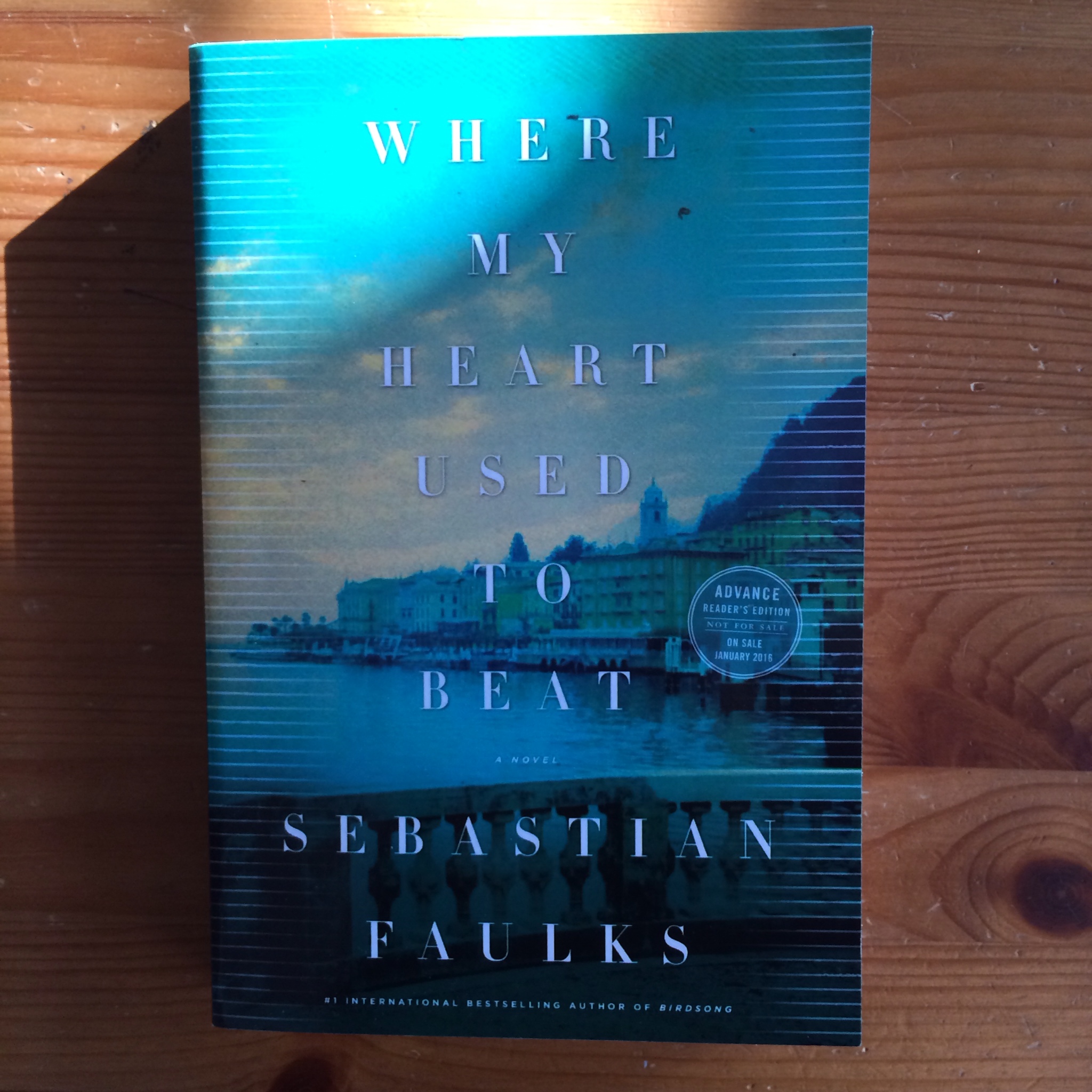
IMG_5830Where My Heart Used to Beat* is the first of Sebastian Faulks’s novels that I’ve read (his best known, Birdsong, is on my mental list of World War I novels to read); I found it both challenging and absorbing.

The novel is a deep dive into the character of Robert Hendricks, its narrator. A psychiatrist practicing in 1980 London, he receives an unexpected letter from older man, Dr. Pereira, who resides on a small island off the coast of France. Dr. Pereira, also a psychiatrist, realized after he came across Robert’s book that the younger man might be the son of a man he served with during World War I; he invites Robert to visit the island, offering both to share reminiscences of his father and an suggestion that Robert might like to be his literary executor.

Intrigued, Robert accepts the invitation, only to find that Pereira has no intention of revealing what he knows all at once; instead, he wants first to hear about Robert’s memories of his own war (World War II) and the different challenges of his life as part of an attempt to understand the depredations and despair of the twentieth century (Robert has, by this point, mostly given into despair). As the younger doctor faces the dark pieces of his life that he’s tried to shut away—sometimes narrating them to Pereira, sometimes to an imagined reader (an effect which is occasionally disconcerting)—we are drawn deeper into the recesses of his mind, with uncertain results.

While I’m glad that I stayed with the novel because its extended exploration of the protagonist was in the end rewarding, what I found challenging initially was the character himself. Much of Robert Hendrick’s background is unremarkable, given his generation; his father died during World War I; he worked hard in school and earned a scholarship to college; he went on to fight in his own war and then returned home to begin a successful career in a difficult specialty. But he has what some would term “intimacy issues”; high on my list of fictional tropes I’d be happy never to see again is the quasi-lonely middle-aged man who pays for sex and spends time remembering and judging the bodies of women he’s slept with. After one short-term affair implodes, Robert relates,

Unpleasant though it was, the sense of rupture and the vista of solitude it opened up didn’t feel traumatic; they felt more like a reversion to the norm. I had been here before: I was an habitué of loneliness, which was in any case the underlying condition of mankind from which the little alliances and dependencies we make are only a diversion.

Despite what was for me an inauspicious beginning to the novel, the quality of Mr. Faulks’s prose kept me reading. He pays special attention to Robert’s war experience; particularly well written and harrowing is the description of the British landing in Italy and subsequent trench battles at Anzio in 1944 (which I came to the book woefully untutored in). This is the setup for the great mystery and formative event of Robert’s life: the loss of his first and only love, an Italian woman he refers to as “L.”

Robert and Pereira share a humane view of mental illness, showing great respect for their patients and questioning what exactly the meaning of “madness” is. While I often found that their discussions lacked nuance, and that Robert’s further reflections, like his references to Eliot and the Aeneid, were too direct, the intricacies of this odd and yet ordinary character remained compelling.

If anything, I think Where My Heart Used to Beat is in part a modern, novelistic twist on Dante’s Inferno; Pereira is the Virgil leading Robert’s Dante into the hell (with some rather mundane circles, some indeed hellish) of his own mind, a mind obsessed with a lost Italian woman.

I’d recommend this book to readers interested in deep characterization, strong war writing, and English life in the interwar period (Mr. Faulks shows his excellent command of detail when writing about Robert’s boyhood); if you like a love story balanced with a heaping portion of non-romantic material, this is a novel for you.

Readers, what’s your favorite book about World War II?

*I received a copy of this book from the publisher for review purposes, which did not affect the content of my review.

Recommended Reading: My Brilliant Friend, by Elena Ferrante, Translated by Ann Goldstein

Yes, it’s just as good as everyone’s been saying—and I’m very glad I waited to read it.

IMG_5767

No doubt you’ve heard of the Neapolitan novels, the quartet of books by Italian writer Elena Ferrante (whose identity is not known; she’s used a pen name since her first novel was published more than twenty years ago) and translated by Ann Goldstein.

I do wish someone would give Ann Goldstein a medal, because the translation is superb, as far as this non-Italian speaker can tell—it flows exactly as it should; one never stops to think of it as a translation.

My Brilliant Friend tells of the childhood and adolescence of Elena (or Lenu), the narrator, and Lila, her enigmatic, incredibly, almost dangerously intelligent friend. Both girls are sensitive, inquisitive, brave, desirous of accomplishment; but Lila has “the characteristic of absolute determination,” while Elena sometimes flounders, unsure of herself, looking to Lila as an anchor. Their subtle competition with each other wends through the novel, as Elena reaches back into her memory to understand her friend and rival. This is best bildungsroman I’ve read since Jane Eyre, though of course completely different in scope and setting. Lila and Elena, both born in 1944, live in a rough neighborhood on the fringes of Naples; parents hitting children and husbands hitting wives are commonplace. In their neighborhood wealth stands out, as do book smarts, though neither is particularly welcome; Elena recalls, “we grew up with the duty to make it difficult for others before they made it difficult for us.”

The structure of the novel reminded me of a sidewinder; it moves forward, but often by moving sideways. Elena sets a scene—a confrontation with rock-throwing boys after school (considerably less tame than a similar scene in Anne of Green Gables, by the way)—only to skip away laterally and return to it later. Ms. Ferrante is so talented, though, that these parries and feints aren’t jarring, but fluid.

I put off reading these books for two reasons, one good and one bad. The bad reason is that I find the covers off-putting, though thematically appropriate. The good reason, or the reasonable reason, perhaps, is that each installment of the series appeared a year apart, the last in September 2015; I suspected, based on the praise I heard, that I would not want to wait before delving into each subsequent novel. That suspicion was correct; within a half hour of finishing My Brilliant Friend, I was twenty pages into The Story of a New Name. I can’t wait to see what happens, how Lila and Elena will illuminate each other’s lives.


“All glam-glow, all twinkle and gold”: Tracy K. Smith’s “Don’t You Wonder, Sometimes?” (RIP David Bowie)

Tracy K. Smith-Bowie

Since David Bowie has left us for what I’m guessing must be some sort of starsplitting transcendent plane, it’s only appropriate this week to feature Tracy K. Smith’s gorgeous and evocative “Don’t You Wonder, Sometimes?” from her appropriately titled collection Life on Mars

The poem has been making the rounds this week—justifiably so—because it hones in on the multi-persona man as a way to consider the big questions about time, space, death, and belief. In the poem, Bowie is both an otherworldly immortal figure and one of us—just immeasurably cooler (literally, in part two of the poem). I pretty much want to quote the whole poem right now, so please read it. 

Bowie was an avid reader, and if you’re craving more bookish Bowie goodness, head over to BookRiot to check out their list (from summer 2015) of all things books and Bowie.

Turns out I can’t resist quoting the poem:


And how many lives

Before take-off, before we find ourselves

Beyond ourselves, all glam-glow, all twinkle and gold?


Safe travels, Starman.

bowie-reading

Recommended Reading: The Bassoon King, by Rainn Wilson

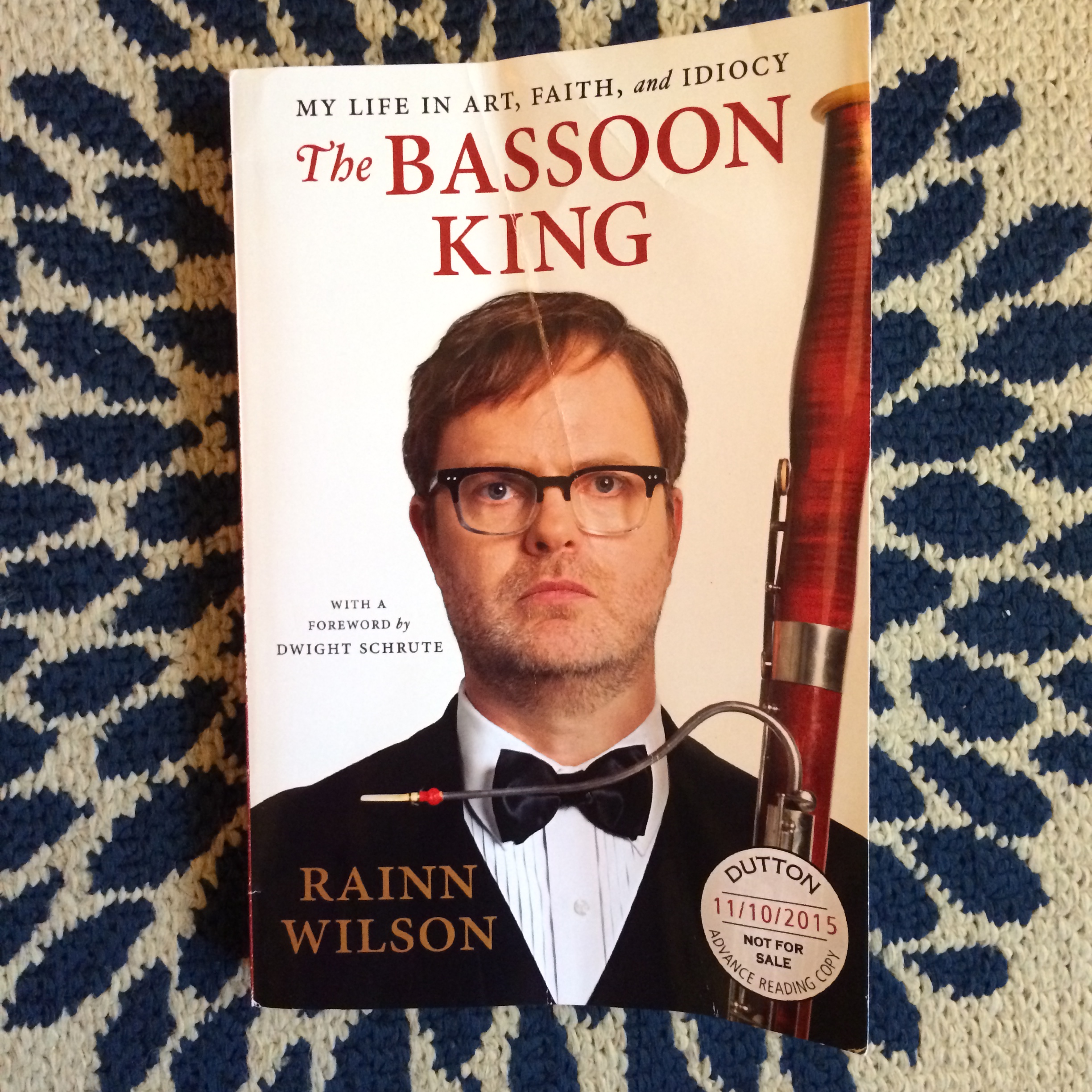
IMG_5784Celebrity memoirs—with exceptions for those written by people named Tina Fey and Amy Poehler—are not my genre of choice. But I couldn’t resist Rainn Wilson’s The Bassoon King*, partly because the title is hilarious, partly because I’ve noted with interest the actor’s advocacy for the persecuted adherents of his religion, the Bahá’í Faith (which he’s written a handy primer about, included at the end of the book), but mostly because The Office is one of my all-time favorite shows, and of course I want to better understand the man behind Dwight Schrute.

The Bassoon King is a charming catalogue of its author’s oddities and interests, which include 80s records, experimental theatre, and comic sidekicks. If you pick it up to be amused, you won’t be disappointed; Mr. Wilson is unfailingly self-deprecating, has a seemingly endless store of anecdotes from his teen years as what can only be described as a major nerd (takes one to know one, folks), and plenty of stories and harmless gossip about his work in movies and TV.

The two facets of the book I found most interesting were Mr. Wilson’s account of his unusual upbringing and the focus on the considerable amount of acting training he undertook, both in school (at Tufts and later NYU) and later in a touring company and various productions (from Shakespeare in the Park to his Broadway flop).

Rainn Wilson’s parents divorced when he was a small child (of his appearance as a baby, he writes, “Picture an ashen manatee with a tiny human face”), and he and his father ended up in Nicaragua, where they in short order found themselves living in a very odd jungle-y sort of town with a new stepmother, Kristin. Understandably, Mr. Wilson’s memories of his period are quite vivid (“like Technicolor acid-dream postcards, spliced and pasted together, flickering in a mental strobe light”); his descriptions of the various Nicaraguan beasties—including a pet sloth named Andrew—are laugh-out-loud funny, and, I can tell you from personal experience, most worth reading aloud to a 4-year-old.

Particularly affecting is his empathy for his parents (his birth-mother, Shay; Robert, his father, a writer and artist who sacrificed a great deal for the family; and Kristin). Shay and Robert both had horrific childhoods but thankfully did not continue the cycle of abuse; all three adults were supportive of the author’s adolescent adventures in geekdom (D&D, of course) and nerdom (chess club, model UN, bassoon, and drama, his niche) and his desire to become an actor. In fact, one of my critiques of the book is that we lose sight of these figures in Mr. Wilson’s later life; I particularly wanted to know how his father felt about the actor’s eventual re-acceptance of his childhood faith after a period of Bohemian rebellion.

If you weren’t a theater nerd in high school, it might be hard to imagine just how much training actors (as opposed to reality stars) go through, and how truly bizarre some of that training looks (grown people jumping around a stage as various animals or body parts? Check.). Mr. Wilson does an excellent job of showing just how much training, failure, serendipity, and experience lay behind his successful portrayal of Dwight. My favorite revelation: he took a clowning workshop with Gates McFadden. As in Beverly Crusher from Star Trek: The Next Generation. And it was awesome.

The Bassoon King is a memoir that covers more spiritual ground than most that I’ve read; Mr. Wilson is an unabashed believer and advocates strongly for his beliefs (but I do wish he would refrain from lumping all atheists together as materialists). He discusses his venture called Soul Pancake (source of Kid President videos, apparently, which I have heard of but not seen), a site devoted to asking people to “chew on life’s big questions,” and his advocacy, along with his wife Holiday Reinhorn, for the Mona Foundation, which supports grassroots education movements in developing countries. Together they founded Lidé, an initiative for “empowerment through the arts for women and girls” in Haiti. Mr. Wilson is clearly passionate about this endeavor and I would have liked to read more about it.

I recommend The Bassoon King to fans of The Office, budding actors, anyone interested in the Bahá’í Faith, and readers looking for something generally light and funny as a palate cleanser between denser reads.

Readers, what’s your favorite celebrity memoir?

*This is a review of a publisher’s advance reading copy of this book. This did not affect the content of my review.

Recommended Reading: Our Souls at Night, by Kent Haruf

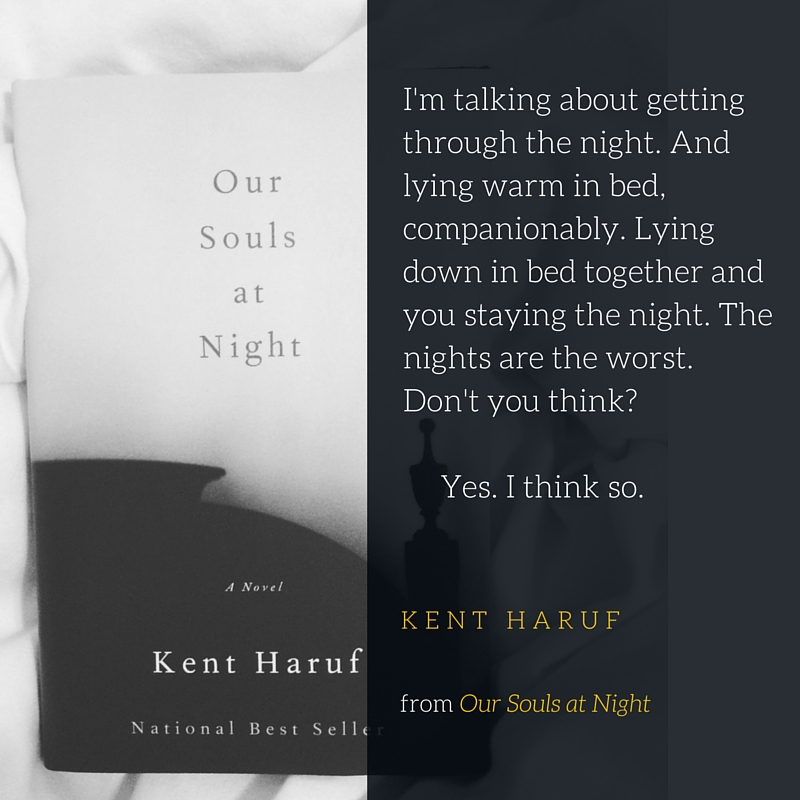
IMG_5751I’m so pleased to report that the first book I read this year is Kent Haruf’s excellent (and sadly, last) novel Our Souls at Night. Set in his fictional town of Holt, Colrado (the setting of his earlier novels, which I will now be adding to my reading list), the story begins when a widow, Addie, makes her neighbor Louis (a widower) an unusual proposition: come spend the night with her, so that the both have someone to share the darkness with.

Though wary of talk in their small town, Louis agrees, and sure enough, the small community is set abuzz by what it’s presumed Louis and Addie are up to (but what is, for the bulk of the novel, holding hands and talking). But neither Addie nor Louis is willing to alter their arrangement for appearance’s sake.

The arrival of Addie’s grandson Jamie does bring change. After his parents’ arguments and separation, the boy is lonely and often frightened, but Addie and Louis minister to him with calmness, routine, and simple pleasures: softball games, camping, the observation of tiny mice. When Addie’s son returns for Jamie, however, Louis and Addie find that his disapproval means more than their neighbors’.

Our Souls at Night quoteThe story and style of Our Souls at Night are deceptively simple. Chapters and sentences tend to be short, and you’ll find few polysyllabic words, but so much is going on beneath the surface and in silences that it’s impossible not to recognize the incredible skill of a master writer. The novel reads quickly, gliding along smoothly until a line or an image snaps into focus, arresting momentum.

Apart from its style and simplicity, I loved this book for its focus on two main characters navigating the transition from late middle age into old age (Addie and Louis are about 70). So refreshing. While Our Souls at Night is set in the present (Jamie has a smartphone to call his mother), Addie and Louis’s world feels timeless, especially since they do things at a slower pace than that typically required by modern consumerism. As you might suspect, there’s quite a bit of nostalgic Americana in the book (fried-chicken picnics, men chewing the fat at a bakery; I love the detail of Louis carrying his pajamas to Addie’s house in a paper sack), but it’s not the treacly sort, since Addie and Louis’s old-fashioned routines are accompanied by the old-fashioned attitudes in Holt.

Our Souls at Night is highly recommended.

Have you read this book or any others by Kent Haruf? What did you think?

Recommended Reading: The Price of Salt, or Carol, by Patricia Highsmith

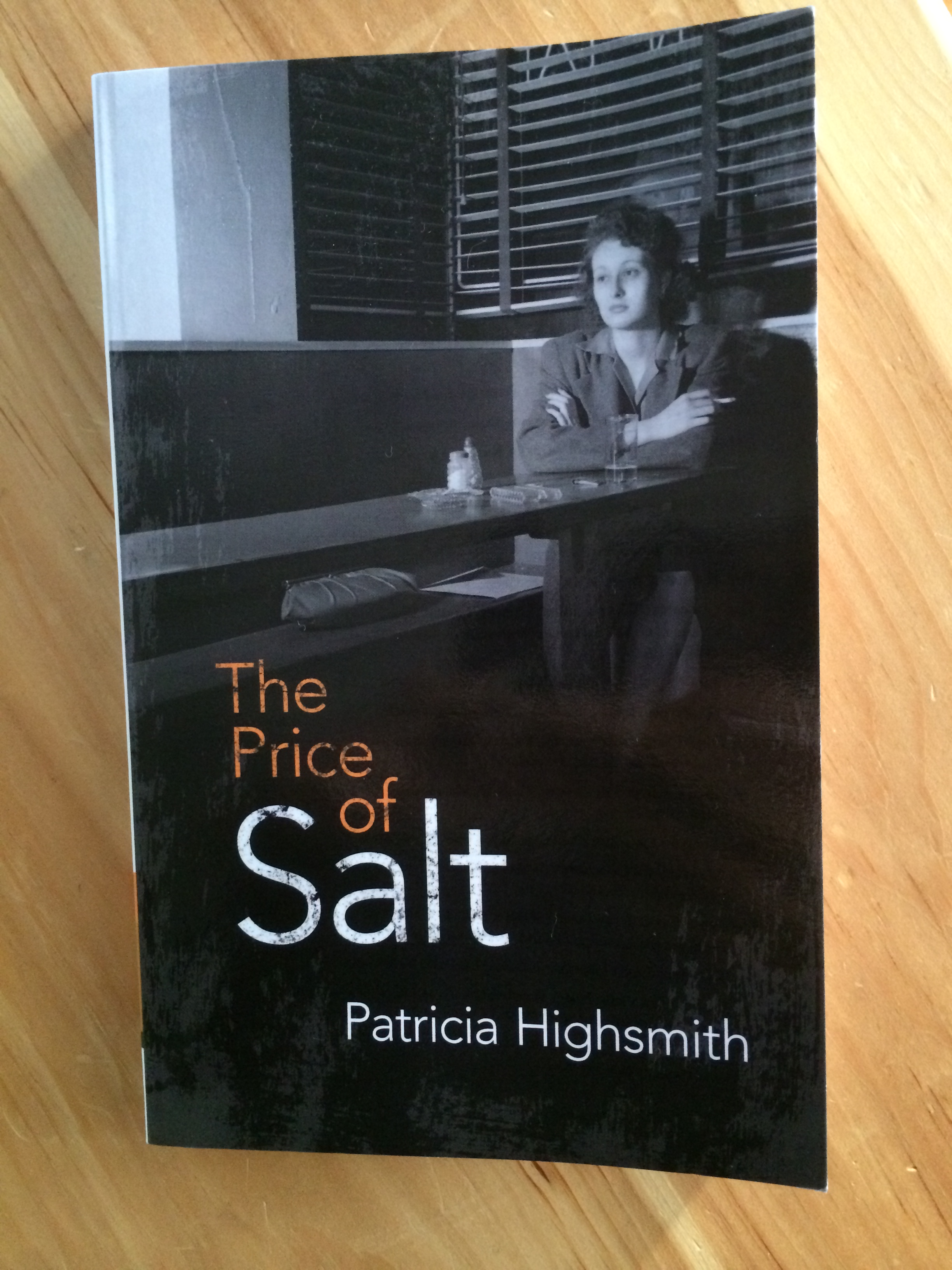
IMG_5747One of my all-time favorite movies is All About Eve, the 1950 Bette Davis classic about the Theatre (capital T, British spelling), ambition, friendship, and bumpy nights. Reading Patricia Highsmith’s The Price of Salt (also known as Carol, and the basis for the new film of that name) was like seeing another camera angle on 1950s New York.

Therese is an aspiring set designer with a boyfriend she doesn’t love (which he knows) and a temporary job in the toy department of a large New York department store when she sees Carol Aird across the counter. Carol is about ten years older and very beautiful; they are instantly drawn to each other, and when Therese sends Carol a Christmas card, the two women strike up an unusual friendship.

Carol is in the midst of a bitter divorce and custody battle, and without the prospect of seeing her daughter for months, she invites Therese on a winter road trip west. Therese accepts, and away from New York, the two are able to acknowledge their love for each other.

Unfortunately, Carol’s husband has hired a private investigator to follow them. Soon Carol is forced to choose between her daughter and Therese, with unexpected consequences. I don’t want to give away the ending, but let’s say that it isn’t the tragic one that you might expect from 50s lesbian pulp fiction (which this book has been billed as—in error, I’d say); it reminded me strongly of the ending of Mrs. Dalloway, actually.

I absolutely loved this book, so much that I wish I’d written a review straight off instead of waiting this long. It’s a book about women who are different from what their culture, their friends expect them to be, and there are wonderful lines that still resonate about envying those who always have a place in the world, living as a filled-in person, rather than a blank, and so on. I liked these lines about uncertainty:

“Was life, were human relations like this always, Therese wondered. Never solid ground underfoot. Always like gravel, a little yielding, noisy so the whole world could hear, so one always listened, too, for the loud, harsh step of the intruder’s foot.”

Patricia Highsmith is widely known for her psychological thrillers Strangers on a Train and The Talented Mr. Ripley (neither of which I’ve read), and the pacing of the second half of this book shows her ability to build extraordinary tension. However, it’s the first half of The Price of Salt that is going to stay with me. The writing is superbly detailed, while subtle visual cues abound (I’d love to write an essay on “green” in the novel, a color often associated with girls and very young women [think “salad days” and the early modern malady greensickness], but here used as Carol’s signature color). Therese’s perspective is wrought with such intensity that I occasionally had to put the book down to regroup; I think The Price of Salt gives the best evocation of love at first sight that I’ve ever read.

Even if midcentury LGBT fiction or psychological fiction aren’t in your wheelhouse, I recommend this book, not only for the writing, but also for its portrayal of a completely different America. The bits that at the time of its publication might have seemed mundane (what Therese thinks of as “the soldier substance that made up one’s life”)—buying a handbag and arranging to pick it up later, the etiquette of smoking, how people set up the timing of dates and meetings, the ability to pick up a job on no notice in a strange town—are tantalizingly interesting now.

I am dying to talk about this book with someone else who’s read it, so please let me know if you have. Have you seen the movie adaptation (Carol)? If so, what did you think?