“People say — This is how the world works”: Emily Mohn-Slate’s “Needlework”

Emily Mohn-Slate -Needlework-This week’s poem is very new; “Needlework” was just published in Tupelo Quarterly. Emily Mohn-Slate is a poet and teacher, and I had the pleasure of meeting and becoming friendly with her in graduate school (you can read more about Emily here).

I loved “Needlework” as soon as I read it. I’m interested in poems about people’s working lives and poems about everyday events (breakfast, phone calls, walks), and this poem is about both. There’s both a playfulness (the references to the gym and the treadmill–working out–in a poem about work) and a seriousness to it. This stanza–

My father told me to do what I loved to do — one third of my life
will be work. Every day, he arrived home ashen,
hiked the basement stairs broken by long pauses.

–is to me the crucial one (Note how all the stanzas are built to resemble stairs. And the description of the speaker’s father reminds me of Robert Hayden’s brilliant “Those Winter Sundays”). How many of us have been told to do what we love, and how many of us find ourselves instead doing a job we merely stand?

I think the poems suggests that the key to avoiding misery in the work that is one third of one’s life is finding something to love in the work, no matter what it is. Take the men who “cut off the trees’ hands.” This doesn’t seem, at first glance, like loveable work, to prune away something that’s alive (reinforced by the use of “hands” for branches), and yet the speaker thinks she hears “them singing,” an echo of the hum of the machines in the first stanza.

It’s a poem that bears re-reading, and I hope you’ll find it as rewarding as I have.

What’s your favorite poem about work?
“I never saw light that way / again”: Dorothea Grossman’s “The Two Times I Loved You Most In a Car”

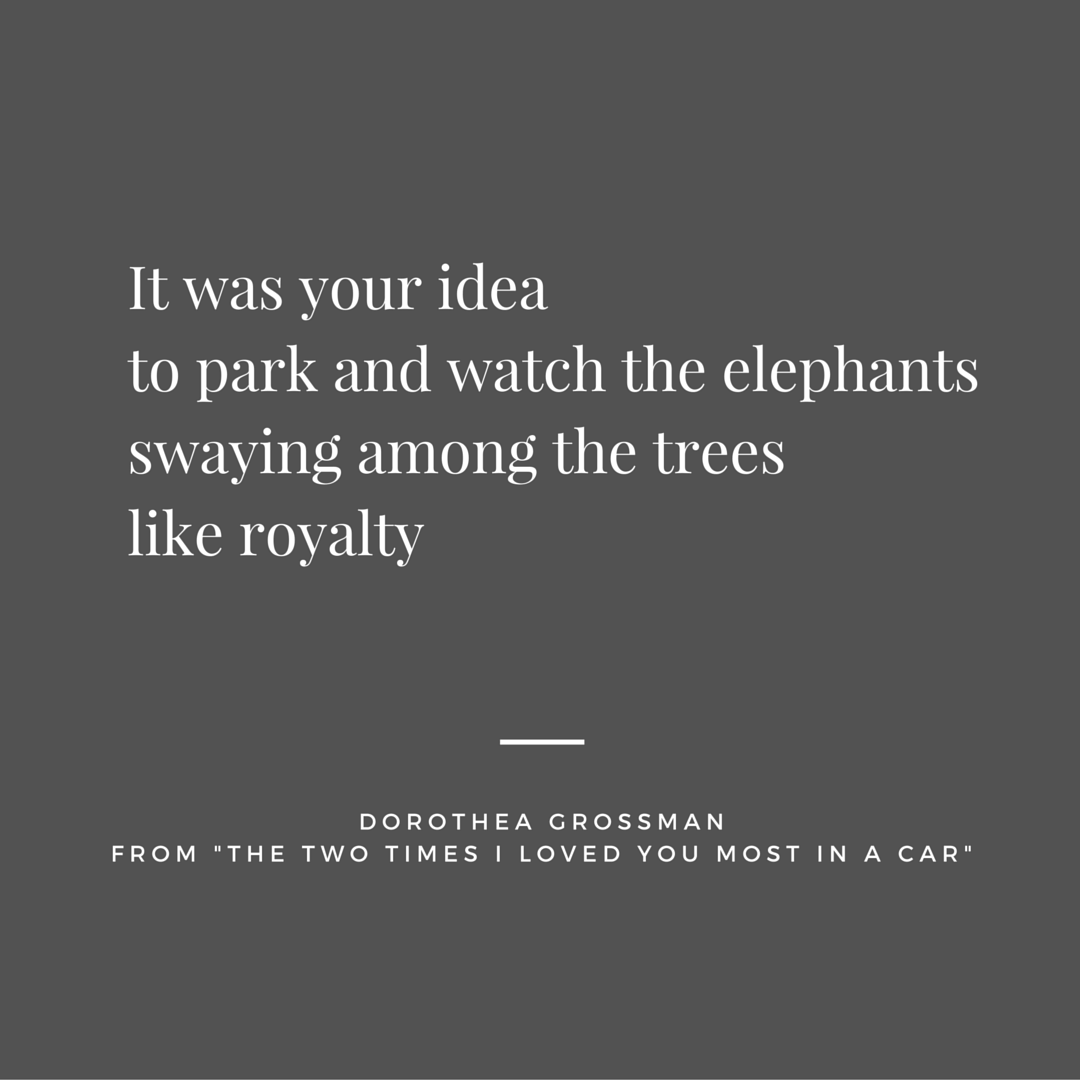
Dorothea GrossmanA tip of the hat to my friend, poet Ashley McHugh, for bringing Dorothea Grossman’s “The Two Times I Loved You Most In a Car” to my attention. In this two-stanza poem, the speaker recalls two instances in which sensory experience startled her: the quietness of elephants swaying among palm trees, and the appearance of stars in the desert night sky.

(You can read more about Dorothea Grossman here and here.

It’s a beautiful little poem; I’ve been thinking about who the addressed person is (A partner? A parent? A friend?).

What do you think? If you were to write a poem on the same subject, which two experiences would you write about?


13 Poems for Galentine’s Day

Friends, there’s a holiday this weekend that we should be celebrating with mimosas, flowers, and massive quantities of waffles with whipped cream.

I’m talking, of course, about Galentine’s Day.

What’s Galentine’s Day, you say?

giphy

It’s only the best day of the year, according to notable Pawnee citizen Leslie Knope.

Galentine’s Day is February 13, and it’s the day when “friends leave their husbands and their boyfriends at home and just kick it breakfast style. Ladies celebrating ladies. It’s like Lilith Fair, minus the angst. Plus, frittatas!” Sorry dudes, but uteruses before duderuses, you know what I mean?

Anyway, Leslie Knope competes only with C.J. Cregg for the title of “Carolyn’s Favorite Fictional Female Government Official,” and let me tell you, those ladies would throw the best planned and wittiest Galentine’s brunch this fine nation has ever seen.

I like to think that brunch would feature readings hand-selected for participants by Leslie Knope; as dedicated Parks and Rec fans know, she once matched poetry with Scotch in a way that moved even the stolid Ron Swanson.

So, in honor of Leslie Knope and in celebration of Galentine’s Day, here are 13 poems on friendship by female poets. Some are elegiac, some are sad, some are funny, some are opaque, some are straightforward—but all are by talented ladies, and I hope you like them.

Happy Galentine's Day!Patricia Spears Jones, “What Beauty Does”

Regan Huff, “Occurrence on Washburn Avenue” 

Elizabeth Woody, “Girlfriends” 

Katherine Philips, “Friendship’s Mystery, To my Dearest Lucasia”

Tess Gallagher, “Love Poem to Be Read to an Illiterate Friend”

Bernadette Mayer,“On Gifts for Grace”

Rebecca Lindenberg, “Letter to a Friend, Unsent”

Jessica Greenbaum, “I Had Just Hung up from Talking to You”

Margaret Kaufman, “Photo, Brownie Troop, St. Louis, 1949” 

Colette Labouff Atkinson, “Perhaps this verse would please you better—Sue—(2)”

Carolyn Kizer, “October 1973”

Lucilla Perillo, “The Garbo Cloth”

Eloise Klein Healy, “The Beach at Sunset”


What will you be reading to celebrate Galentine’s Day?

“Various long midwinter Glooms. / Various Solitary and Terrible Stars”: Alice Oswald’s “Various Portents”

AliceOswald_VariousPortentsI’m partial to poems that are lists; it’s always impressive when a poet can give an impression of action, or set a mood, simply by making a list of items.

Alice Oswald is a poet I know nothing about, but a quick look at her biography at The Poetry Foundation intrigued me; I’m now itching to read Memorial, her treatment of the Iliad, and Dart, a book that’s based on her research into the history of the community around a river in Devon, England.

“Various Portents” is subtly ominous and a bit wintry; it made me think of Game of Thrones (though no, I still haven’t read the book). What do you think of the poem?

“recast in our image”: Lisel Mueller’s “Things”

Mueller_ThingsI like naming things; maybe you do, too. I have a velvet chair named Daisy (it was my friend’s chair first; when she was young it was orange, but now it’s faded to a golden yellow), and once we had fish named Dunder, Mifflin, Don Draper, Giles, and Admiral Ackbar.

Lisel Mueller’s poem “Things” points out the ways in which, over time, we’ve named parts of objects after ourselves. It reminds me a bit of Heather McHugh’s poem “Etymological Dirge” in the way it offers us a new way to think about words we use every day.

What’s your favorite poem about an everyday object?

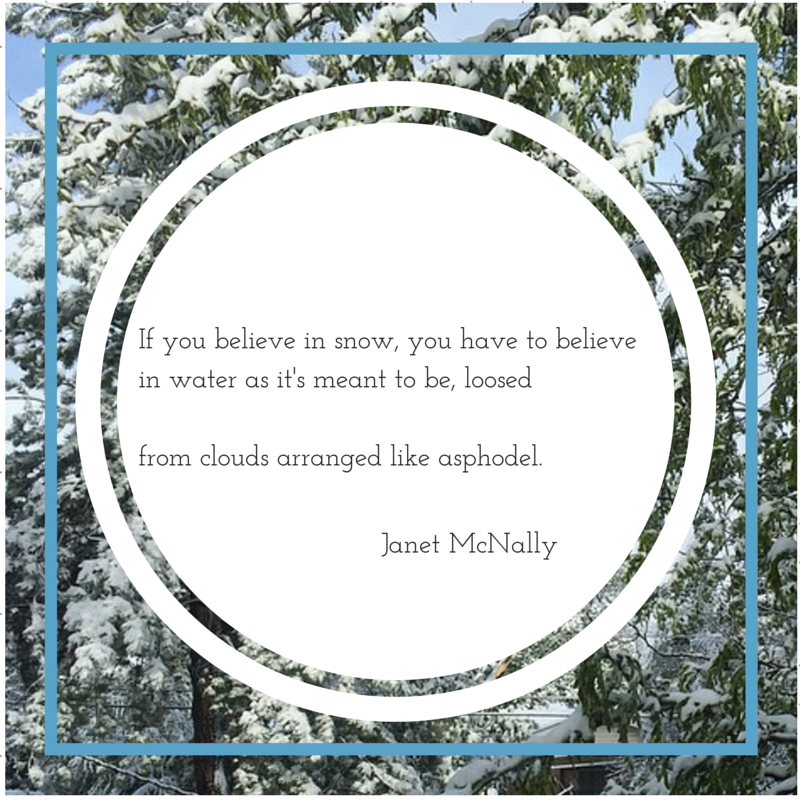
“clouds arranged like asphodel”: Janet McNally’s “Maggie Says There’s No Such Thing as Winter”

Janet McNally_Maggie SaysJanet McNally’s “Maggie Says There’s No Such Thing as Winter” is a gorgeous gem of a poem, tender and clear-eyed.

The speaker sits with Maggie in summer, under the shade of a tree, as Maggie strings blue stones together; Maggie has memory trouble (the language suggests she may have been in a coma), and has difficulty processing the speaker’s gentle descriptive reminder of the way seasons change, a change enacted in the poem itself, which begins with an invocation of winter (something I’m sure Ms. McNally, who teaches at Canisius College in Buffalo, knows a bit about) and then travels into summer and beyond.

This is a rather colorless description, I’m afraid, of a very fine poem. Here are my favorite lines:

She forgets that sometimes things don’t stay
where you leave them, that the sky fades

to white even before snow begins
to fall.

What’s your favorite poem about winter?

“Light larking”: Floyd Skloot’s “Handspun”

About a year ago, I wrote a quick post about poems related to knitting, an activity I find myself frantically trying to finish most holiday seasons (this year I made three scarves, four cowls, four headbands, and I still owe my son a pair of slippers). I much prefer knitting in a more leisurely fashion, and I love seeing the complex projects skilled knitters (I am not among this number) produce—delicate lace, shawls worked with intarsia so that they look like tapestries, that sort of thing. Most of the best projects I see are made with gorgeous wool, to which I am sensitive if not downright allergic, and some are even made with handspun varieties.

Spinning is an art I’ll never practice, but I do love reading about it. And if you’re ever out in Colorado, the Denver Art Museum features a whole floor devoted to textile arts; when I visited a volunteer was demonstrating how she spins wool into yarn at home. It was absolutely fascinating, and I recommend popping by if you’re able.

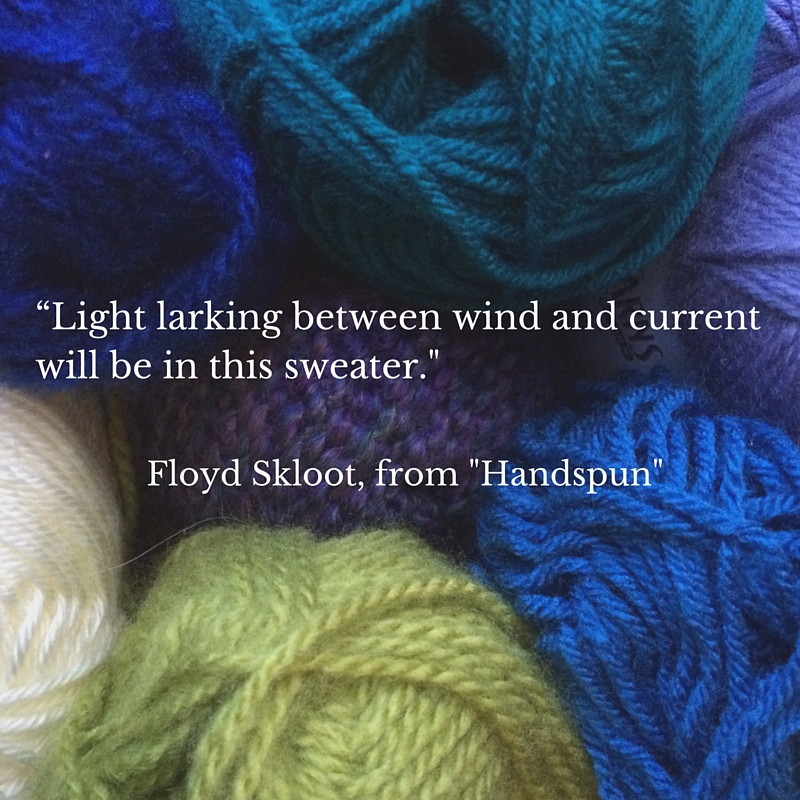
Floyd Skloot Handspun quoteWhich brings me to the poem of the week, Floyd Skloot’s “Handspun,” which was featured in this week’s American Life in Poetry series, curated by Ted Kooser (I highly recommend signing up for the weekly email; Mr. Kooser chooses brief, relatable poems, which are paired with his pithy introductions). In this poem, the speaker watches his wife as she begins yarn for a “summer sweater,” one meant to be worn in summer and one that captures in its colors some of summer’s light.

I like the sensory detail of this poem (it features sound and texture and imagery), and I like the way circularity is subtly emphasized: the swivel chair, the spinning wheel, the sun, the woman “ringed” by yarn—all suggesting the act of spinning itself.  The “swollen river” too might be considered  circular, or at least circulating in nature.

But my favorite line is “Light larking between wind and current / will be in this sweater.” What a verb. What a linebreak.

By the way, if you were wondering why the poet’s last name sounds familiar, it might be because he’s the father of Rebecca Skloot, author of the mega-successful The Immortal Life of Henrietta Lacks (which apparently everyone except me has read).

Do you have a favorite poem about one of your hobbies?


Some Questions and Comments Regarding Poetry

Dear Readers,

I was going to try to sum up my year in poetry reading in a rather long post with lots of quotations and best lines, but it’s been rather an eventful week around here (capped off by my husband’s grandmother’s near-miraculous recovery from severe hypothermia), and so I will be brief.

Comments and Questions:

  1. Reading poetry is a delight that I wish were more widespread.
  2. Fellow book bloggers: The vast majority of blog posts are about fiction and nonfiction, not poetry (mine included, if we’re talking about reviews and not the poem-of-the-week posts). Why is that? What would make reading poetry—say, five collections a year if you typically read about 75-125 books a year—appealing to you?
  3. Where do you, dear readers, read about poetry? Or, when you pick up a book of poems, what’s the impetus behind the choice?
  4. If you would like to read more poetry and you’re a regular around here, what can I do, or do better, to help?

And for the new year, I recommend a poem (of course): the suitably titled “New Year’s Poem” by the late Canadian poet Margaret Avison. It’s jeweled with lovely images, and the description of the party puts me in mind of a winter version of Mrs. Dalloway’s (eventually, everything comes back to Mrs. Dalloway).

Happy New Year, Dear Readers!

‘Twas the Night Before Christmas

IMG_5629After three years, the stars have aligned so that Christmas Eve and the poem of the week fall on the same day, and so a bit early (or roughly on time for European readers—hello there, European readers!):

A Visit from St. Nicholas

by Clement Clarke Moore

‘Twas the night before Christmas, when all through the house
Not a creature was stirring, not even a mouse;
The stockings were hung by the chimney with care,
In hopes that St. Nicholas soon would be there;
The children were nestled all snug in their beds;
While visions of sugar-plums danced in their heads;
And mamma in her ‘kerchief, and I in my cap,
Had just settled our brains for a long winter’s nap,
When out on the lawn there arose such a clatter,
I sprang from my bed to see what was the matter.
Away to the window I flew like a flash,
Tore open the shutters and threw up the sash.
The moon on the breast of the new-fallen snow,
Gave a lustre of midday to objects below,
When what to my wondering eyes did appear,
But a miniature sleigh and eight tiny rein-deer,
With a little old driver so lively and quick,
I knew in a moment he must be St. Nick.
More rapid than eagles his coursers they came,
And he whistled, and shouted, and called them by name:
“Now, Dasher! now, Dancer! now Prancer and Vixen!
On, Comet! on, Cupid! on, Donner and Blitzen!
To the top of the porch! to the top of the wall!
Now dash away! dash away! dash away all!”
As leaves that before the wild hurricane fly,
When they meet with an obstacle, mount to the sky;
So up to the housetop the coursers they flew
With the sleigh full of toys, and St. Nicholas too—
And then, in a twinkling, I heard on the roof
The prancing and pawing of each little hoof.
As I drew in my head, and was turning around,
Down the chimney St. Nicholas came with a bound.
He was dressed all in fur, from his head to his foot,
And his clothes were all tarnished with ashes and soot;
A bundle of toys he had flung on his back,
And he looked like a pedler just opening his pack.
His eyes—how they twinkled! his dimples, how merry!
His cheeks were like roses, his nose like a cherry!
His droll little mouth was drawn up like a bow,
And the beard on his chin was as white as the snow;
The stump of a pipe he held tight in his teeth,
And the smoke, it encircled his head like a wreath;
He had a broad face and a little round belly
That shook when he laughed, like a bowl full of jelly.
He was chubby and plump, a right jolly old elf,
And I laughed when I saw him, in spite of myself;
A wink of his eye and a twist of his head
Soon gave me to know I had nothing to dread;
He spoke not a word, but went straight to his work,
And filled all the stockings; then turned with a jerk,
And laying his finger aside of his nose,
And giving a nod, up the chimney he rose;
He sprang to his sleigh, to his team gave a whistle,
And away they all flew like the down of a thistle.
But I heard him exclaim, ere he drove out of sight—
“Happy Christmas to all, and to all a good night!”


Merry Christmas, Dear Readers! Wishing you peace, joy, and happy reading this week and in the new year.

“The weary ones, the sad, the suffering, / All found their comfort in the holy place”: Emma Lazarus’s “In the Jewish Synagogue at Newport”

New_colossusI was poking about, looking for a Chanukah poem to feature in honor of the holiday (and Happy Chanukah, Dear Readers), when I came across a poem that speaks a bit to the holiday itself, but even more to our present moment. Please bear with me as I come around to the poem.

A personage who shall not be named (like the J.K. Rowling villain he seems so desperate to emulate) is voicing repulsive xenophobia, indifferent to the plight of thousands upon thousands of people fleeing violence and seeking no more than what most Americans take for granted: the right to live freely in peace, to pursue happiness. This person, and any who claim to be interested in the Founding Fathers, would do well to recall George Washington’s 1790 letter to the Jewish congregation of Newport, Rhode Island, assuring them—often persecuted in other lands for their religion—of their welcome in America. Herewith, an excerpt:

The citizens of the United States of America have a right to applaud themselves for having given to mankind examples of an enlarged and liberal policy — a policy worthy of imitation. All possess alike liberty of conscience and immunities of citizenship.

It is now no more that toleration is spoken of as if it were the indulgence of one class of people that another enjoyed the exercise of their inherent natural rights, for, happily, the Government of the United States, which gives to bigotry no sanction, to persecution no assistance, requires only that they who live under its protection should demean themselves as good citizens in giving it on all occasions their effectual support.

[…]

May the children of the stock of Abraham who dwell in this land continue to merit and enjoy the good will of the other inhabitants — while every one shall sit in safety under his own vine and fig tree and there shall be none to make him afraid.

May the father of all mercies scatter light, and not darkness, upon our paths, and make us all in our several vocations useful here, and in His own due time and way everlastingly happy.

G. Washington [emphasis mine]

It was the synagogue of this very congregation, the oldest synagogue still standing in America, that inspired Emma Lazarus to write “In the Jewish Synagogue at Newport,” a lovely poem that muses on the plight of exiles and the comforts of shared devotion, and should recall to us all—believers and non-believers alike—the great privilege of living in a country in which freedom of religion is enshrined in law, and the great wisdom, the necessary humanity, of embracing people of goodwill of all faiths, or none at all.

If the name Emma Lazarus sounds familiar, it’s because she’s also the poet whose verses famously adorned a plaque inside the Statue of Liberty:

The New Colossus

Not like the brazen giant of Greek fame,
With conquering limbs astride from land to land;
Here at our sea-washed, sunset gates shall stand
A mighty woman with a torch, whose flame
Is the imprisoned lightning, and her name
Mother of Exiles. From her beacon-hand
Glows world-wide welcome; her mild eyes command
The air-bridged harbor that twin cities frame.
“Keep, ancient lands, your storied pomp!” cries she
With silent lips. “Give me your tired, your poor,
Your huddled masses yearning to breathe free,
The wretched refuse of your teeming shore.
Send these, the homeless, tempest-tost to me,
I lift my lamp beside the golden door!”


Light and not darkness upon our paths, friends.


To donate to the UNCHR, the UN Refugee Agency, click here. 

To donate to UNICEF, click here. 

To donate to Save the Children, click here.