“All glam-glow, all twinkle and gold”: Tracy K. Smith’s “Don’t You Wonder, Sometimes?” (RIP David Bowie)

Tracy K. Smith-Bowie

Since David Bowie has left us for what I’m guessing must be some sort of starsplitting transcendent plane, it’s only appropriate this week to feature Tracy K. Smith’s gorgeous and evocative “Don’t You Wonder, Sometimes?” from her appropriately titled collection Life on Mars

The poem has been making the rounds this week—justifiably so—because it hones in on the multi-persona man as a way to consider the big questions about time, space, death, and belief. In the poem, Bowie is both an otherworldly immortal figure and one of us—just immeasurably cooler (literally, in part two of the poem). I pretty much want to quote the whole poem right now, so please read it. 

Bowie was an avid reader, and if you’re craving more bookish Bowie goodness, head over to BookRiot to check out their list (from summer 2015) of all things books and Bowie.

Turns out I can’t resist quoting the poem:


And how many lives

Before take-off, before we find ourselves

Beyond ourselves, all glam-glow, all twinkle and gold?


Safe travels, Starman.

bowie-reading

“Light larking”: Floyd Skloot’s “Handspun”

About a year ago, I wrote a quick post about poems related to knitting, an activity I find myself frantically trying to finish most holiday seasons (this year I made three scarves, four cowls, four headbands, and I still owe my son a pair of slippers). I much prefer knitting in a more leisurely fashion, and I love seeing the complex projects skilled knitters (I am not among this number) produce—delicate lace, shawls worked with intarsia so that they look like tapestries, that sort of thing. Most of the best projects I see are made with gorgeous wool, to which I am sensitive if not downright allergic, and some are even made with handspun varieties.

Spinning is an art I’ll never practice, but I do love reading about it. And if you’re ever out in Colorado, the Denver Art Museum features a whole floor devoted to textile arts; when I visited a volunteer was demonstrating how she spins wool into yarn at home. It was absolutely fascinating, and I recommend popping by if you’re able.

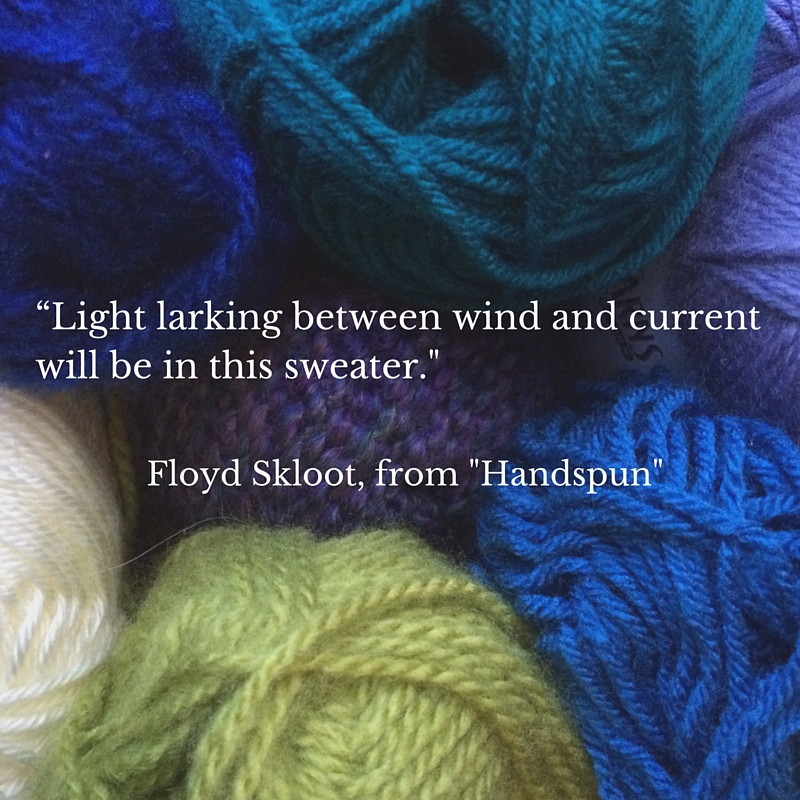
Floyd Skloot Handspun quoteWhich brings me to the poem of the week, Floyd Skloot’s “Handspun,” which was featured in this week’s American Life in Poetry series, curated by Ted Kooser (I highly recommend signing up for the weekly email; Mr. Kooser chooses brief, relatable poems, which are paired with his pithy introductions). In this poem, the speaker watches his wife as she begins yarn for a “summer sweater,” one meant to be worn in summer and one that captures in its colors some of summer’s light.

I like the sensory detail of this poem (it features sound and texture and imagery), and I like the way circularity is subtly emphasized: the swivel chair, the spinning wheel, the sun, the woman “ringed” by yarn—all suggesting the act of spinning itself.  The “swollen river” too might be considered  circular, or at least circulating in nature.

But my favorite line is “Light larking between wind and current / will be in this sweater.” What a verb. What a linebreak.

By the way, if you were wondering why the poet’s last name sounds familiar, it might be because he’s the father of Rebecca Skloot, author of the mega-successful The Immortal Life of Henrietta Lacks (which apparently everyone except me has read).

Do you have a favorite poem about one of your hobbies?


Happy New Year (with News!)

Happy New Year, Dear Readers!

As you might have noticed, after three years (happy birthday, dear blog) I’ve finally updated the look of the site a bit, though the posting schedule remains the same.

I’m not a resolution-maker, but this year I hope to read and write more than I did last year, and to more to bring poetry, in particular, to a wider readership.

Speaking of writing, you’ll soon be able to read my new advice column, Dear Clementine, on a new site called The Postscript. In order to dole out advice, however, I need someone to ask for it, so please do send your questions personal, profession, parental, or otherwise to: dearclementinepostscript[at]gmail[dot]com.

And while I’m engaged in shameless self-promotion: I’ve redone my professional website, which you can find at carolynoliver.net. It includes a very serious picture of me. Also other information.

What are your plans, reading and otherwise, for 2016?

2016

Recommended Reading: The Price of Salt, or Carol, by Patricia Highsmith

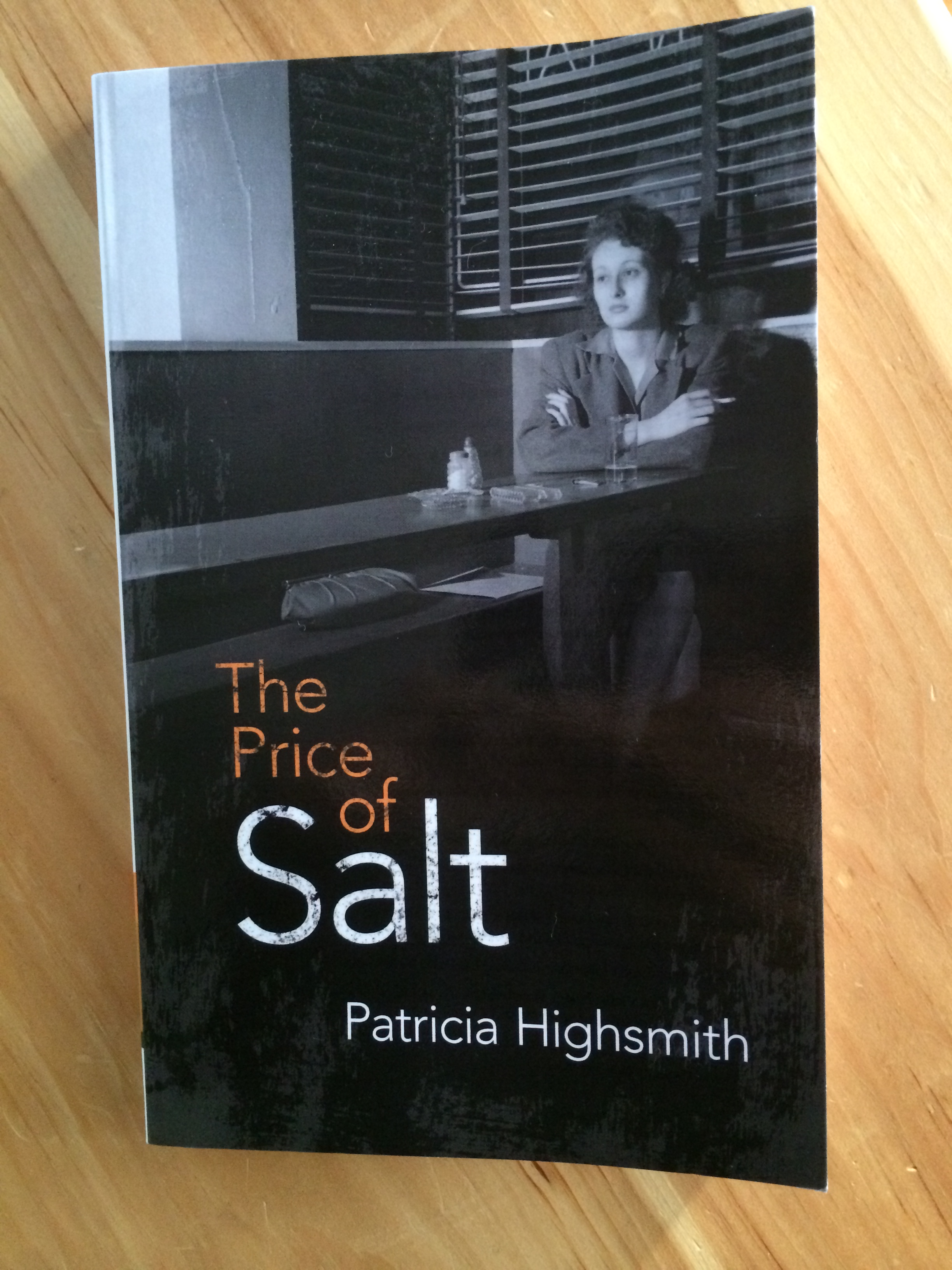
IMG_5747One of my all-time favorite movies is All About Eve, the 1950 Bette Davis classic about the Theatre (capital T, British spelling), ambition, friendship, and bumpy nights. Reading Patricia Highsmith’s The Price of Salt (also known as Carol, and the basis for the new film of that name) was like seeing another camera angle on 1950s New York.

Therese is an aspiring set designer with a boyfriend she doesn’t love (which he knows) and a temporary job in the toy department of a large New York department store when she sees Carol Aird across the counter. Carol is about ten years older and very beautiful; they are instantly drawn to each other, and when Therese sends Carol a Christmas card, the two women strike up an unusual friendship.

Carol is in the midst of a bitter divorce and custody battle, and without the prospect of seeing her daughter for months, she invites Therese on a winter road trip west. Therese accepts, and away from New York, the two are able to acknowledge their love for each other.

Unfortunately, Carol’s husband has hired a private investigator to follow them. Soon Carol is forced to choose between her daughter and Therese, with unexpected consequences. I don’t want to give away the ending, but let’s say that it isn’t the tragic one that you might expect from 50s lesbian pulp fiction (which this book has been billed as—in error, I’d say); it reminded me strongly of the ending of Mrs. Dalloway, actually.

I absolutely loved this book, so much that I wish I’d written a review straight off instead of waiting this long. It’s a book about women who are different from what their culture, their friends expect them to be, and there are wonderful lines that still resonate about envying those who always have a place in the world, living as a filled-in person, rather than a blank, and so on. I liked these lines about uncertainty:

“Was life, were human relations like this always, Therese wondered. Never solid ground underfoot. Always like gravel, a little yielding, noisy so the whole world could hear, so one always listened, too, for the loud, harsh step of the intruder’s foot.”

Patricia Highsmith is widely known for her psychological thrillers Strangers on a Train and The Talented Mr. Ripley (neither of which I’ve read), and the pacing of the second half of this book shows her ability to build extraordinary tension. However, it’s the first half of The Price of Salt that is going to stay with me. The writing is superbly detailed, while subtle visual cues abound (I’d love to write an essay on “green” in the novel, a color often associated with girls and very young women [think “salad days” and the early modern malady greensickness], but here used as Carol’s signature color). Therese’s perspective is wrought with such intensity that I occasionally had to put the book down to regroup; I think The Price of Salt gives the best evocation of love at first sight that I’ve ever read.

Even if midcentury LGBT fiction or psychological fiction aren’t in your wheelhouse, I recommend this book, not only for the writing, but also for its portrayal of a completely different America. The bits that at the time of its publication might have seemed mundane (what Therese thinks of as “the soldier substance that made up one’s life”)—buying a handbag and arranging to pick it up later, the etiquette of smoking, how people set up the timing of dates and meetings, the ability to pick up a job on no notice in a strange town—are tantalizingly interesting now.

I am dying to talk about this book with someone else who’s read it, so please let me know if you have. Have you seen the movie adaptation (Carol)? If so, what did you think? 

Recommended Reading: 5 Books for Excellent Last-Minute Gifts

Tis the season for end-of-year best-of lists, and while I’m quite happy to endorse many of the critic’s favorites this year, it may be that you don’t know your last-minute giftees quite well enough to give them A Little Life or Fates and Furies or The Wake (excellent, but . . .).

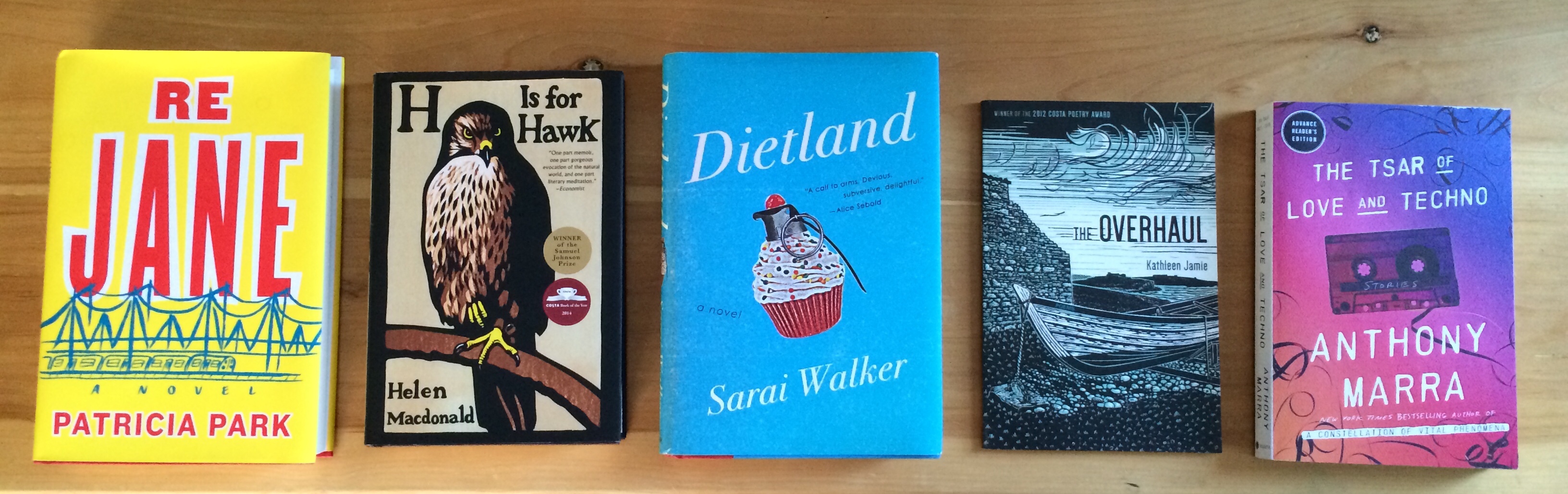
Herewith, in no particular order, five  2015 releases sure to please:

IMG_5680

Patricia Park, Re Jane: A modern take on perennial favorite Jane Eyre, this smart, funny novel is a must-read for any fans of Charlotte Brontë and modern retellings on your list.

Kathleen Jamie, The Overhaul: For the poetry fan who hasn’t read this Scottish poet and who craves a well-turned image and a gorgeous landscape. (Check out “The Whales,” part of which I have tattooed.)

Anthony Marra, The Tsar of Love and Techno: For anyone who loved A Constellation of Vital Phenomena, aficionados of the short story, or anyone who wants to be transported to a different time and place. (Bonus pick for fiction aficionados: Kitchens of the Great Midwest, by J. Ryan Stradal)

Helen Macdonald, H is for Hawk: For anyone who hasn’t read this year’s must-read memoir yet, a gripping blend of writing about grief, literature, and goshawks. (Bonus memoir recommendation: Hold Still, by Sally Mann)

Sarai Walker, Dietland: For feminists, proto-feminists, and anyone who is utterly exhausted by the fat-shaming and the dreaded “have you lost weight?” questions (twins, aren’t they?) that always seem worse around the holidays.

And you, Dear Readers? What are your last-minute book recommendations?

IMG_5678


‘Tis the Season: Donating Books

IMG_5636Perhaps, Dear Readers, you, like me, have a few books in need of new homes this holiday season. Maybe you’re clearing shelf space in anticipation of Santa leaving a few tomes under the tree, or maybe Hanukkah’s end finds you with more books than you expected.

There are many fine places to donate books; here are four where books from our house are headed this year.

Prison Book Program

This listing is for Massachusetts, but there are many similar programs that might be geographically closer to you. Book bloggers take note: ARCs are generally accepted by prison book programs.

Van Buren Family Shelter

This is a new shelter in Columbus, Ohio (home of my beloved alma mater) which I learned about from writer and professor Michelle Herman. She writes that about 250 children come through the shelter every month, and so volunteers are organizing a children’s book drive:

“The goal is to provide access to a library of books to every child, but also to send each child out of the shelter with two books of her or his own, and thus to collect at least 10,000 books now (or now-ish)–to cover the first two years or so. The organizers are contacting publishers, bookstores, libraries, and schools, as well as everyone they know, and I offered to expand the network to everyone I know. You could too, if you had a mind to. They are accepting new or gently used children’s books, which can be sent directly to the shelter.”

If you have new or gently used children’s books to send, the address is:

Van Buren Shelter
595 Van Buren Dr
Columbus OH
43223

Our Local Library

Prison book programs typically don’t accept hardcovers, so we donate ours to our local public library, where they might circulate, but more likely will be sold in the ongoing library book sale to raise funds for library improvements and outreach.

Epilepsy Foundation New England

The New England chapter of the Epilepsy Foundation collects all sorts of household goods donated by the community, including books.

I’m sure there are many other worthy places to donate books, and I’d be happy to hear about your favorites!

Comics Round Up

I know, Dear Readers: that’s a post title you probably didn’t expect from these quarters.

I’m unpredictable.

Given my nearly unassailable geek credentials, comics should be situated squarely in my wheelhouse, but two factors have stood in the way:

  1. I hate cartoons. With limited exceptions, I find them aesthetically displeasing and grating to the ear (my son’s current favorite, Paw Patrol, is the worst offender right now). Pixar movies are fine because they’re made for adults to enjoy, but I have been done with Disney movies for many years (and that’s not even taking into consideration the deplorable antifeminist and heteronormative sentiments of most of them). South Park, The Simpsons, Futurama, anything on Adult Swim: sorry, no. For years, I though of comics as cartoons in paper form.
  2. I like to have all the information. I realize that’s broad, so let me re-frame: I like to start a story from the very beginning with confidence that there will be an ending of some sort; if a story is particularly gripping, I like to know that I can read (or watch) the next installment pretty much immediately. This is why it’s been hard for me to get into Dr. Who; even if we started at the reboot, I’ll feel as though I’m missing quite a bit—and of course there’s no way I’m catching up on decades’ worth of TV any time soon. This is also why I’ve been waiting to start the Kingkiller Chronicles and to move on to Ann Leckie‘s Ancillary Sword (although the third book in that trilogy is out now, so I suppose I could). And that’s why I’ve never been interested in jumping into Marvel or D.C. comics—it would be virtually impossible to catch up after all these years. And since I associated comics with superheroes for a long time, it didn’t really occur to me that other kinds of comics might be out there.

So, for most of my reading life, I happily disregarded the existence of comics.

But then someone somewhere on the vast interwebs posted about a new comic called Saga; the first volume (collecting issues one through six) of this fantasy space opera features an interspecies couple on the cover, with the armed mother breastfeeding.

I am so totally here for that.

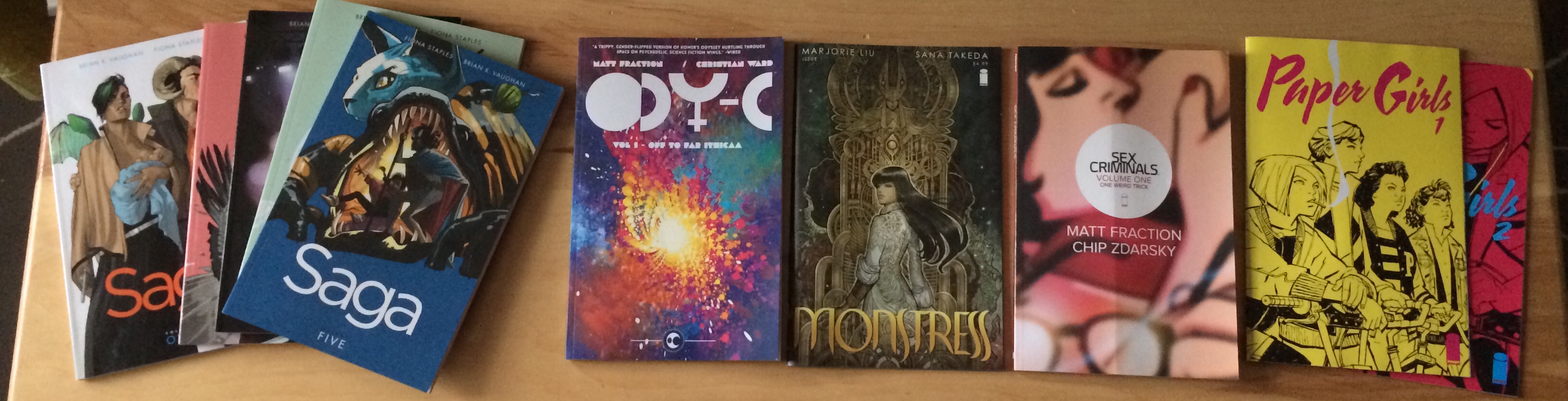
I bought it immediately, and now I’m hooked. It’s so much fun to read—think the best parts of Dune and Star Wars with pulp elements and a love story—and Fiona Staples’s art is just gorgeous, awash in color—it perfectly complements Brian Vaughan’s text. Saga was the gateway drug to a bunch of other comics (all out from Image, now that I think about it) that I read this year. Here’s my rundown of what to read and what to skip.

IMG_5638

Saga (Brian K. Vaughan & Fiona Staples): Definitely read this if you like sci-fi. There are now five volumes out and I’ve loved all of them, but I’d say the first two are perhaps the strongest. Note that Saga is intended for an adult audience: there’s some sex, a great deal of violence, and mature themes throughout.

ODY-C (Matt Fraction & Christian Ward): I wanted to love this, since it’s a gender-twisted version of the Odyssey set in space. While the artwork is really something—it seems like it wants to splatter off the page, and the colors combinations are inventive—I found two major sources of disappointment. One was the style of the writing, which was going for the archaic feel of some Odyssey translations but too often ended up as mangled syntax. The other was the gender-bending—I’m all for it in theory, but the artwork and writing combined portrayed female sexuality as monstrous (part of a long tradition)—and I don’t think the inventiveness of the project was enough to redeem it. Skip this one.

Monstress (Marjorie Liu & Sana Takeda): The art in this comic, described as “a dark fantastic adventure set in an alternate 1900s Asia,” is absolutely gorgeous, all the more remarkable for its limited palette. The story is complex; the main character, Maika, is on a mission of vengeance, infiltrating an enemy stronghold for reasons that weren’t fully clear in the first issue. It seemed that all or nearly all the characters are female, which was refreshing (you’ll notice that Ms. Liu, Ms. Takeda, and Ms. Staples are the only women among the writers and artists I’ve listed here). I’d love to see where this story goes, but given how dense it is—novelistic, almost—I think I’m going to wait for the first collection to come out before I continue reading. Recommended, though.

Sex Criminals Vol. 1: One Weird Trick (Matt Fraction & Chip Zdarsky): This came highly recommended from a few sources. I liked the hilarious title and the ridiculous premise (the main character, a librarian, discovers that time stops whenever she has an orgasm, and when she meets another person who shares her talent, hijinks ensue), but I just wasn’t into the storyline. Maybe it became more interesting in later issues, but I can’t stop time with any weird trick, alas, and life is short, so I’m afraid I won’t be finding out. Lots of other readers were really into this comic, so I’d recommend checking it out at the library.

Paper Girls (Brian K. Vaughan & Cliff Chiang, plus Matt Wilson and Jared Fletcher): I’m only a couple issues into this comic, but I like it quite a bit. Four paper delivery girls in Ohio (hey Buckeyes!) in the 80s are trying to finish their route in the wee hours of Halloween, but run across more trouble than they anticipated. This review in the Onion’s A.V. Club is spot-on. I’m not going to run out to buy every issue, but I’d definitely pick up the volume of collected issues when it comes out. I’d recommend it to any Goonies fans out there.

That’s it for this year, Dear Readers. Have you read any comics this year? What did you like? What should I be looking for next year?

P.S. If you’re a comics fan who’s stumbled across this post, let me take this opportunity to recommend a novel: Michael Chabon’s The Amazing Adventures of Kavalier & Clay. The title doesn’t lie; it’s one of my favorite books.

“We see you, see ourselves and know / That we must take the utmost care / And kindness in all things”: Joy Harjo’s “Eagle Poem”

Happy Thanksgiving, Dear (American) Readers! Here’s a poetry post from a couple of years back that I think I might like to make a yearly tradition. I’d be happy to know what your favorite Thanksgiving poems are if you’d care to note them in the comments. Safe travels and hearty toasts to all.


I’m not a religious person, but many people I treasure are very religious, and I’m always

"Eagle silhouette" Image courtesy of Gualberto107 at FreeDigitalPhotos.net

“Eagle silhouette” Image courtesy of Gualberto107 at FreeDigitalPhotos.net

grateful for their prayers and their generosity of spirit. Joy Harjo’s “Eagle Poem” gives me a way to think about prayer that is comforting and uplifting without listing toward the dogmatic.

For that reason, I think “Eagle Poem” is the perfect poem for Thanksgiving week, when we give thanks in our own ways, both secular and spiritual, for what we have and what we have not.

Reading Coincidences

I am a person who finds coincidences delightful. (I wonder, are you?)

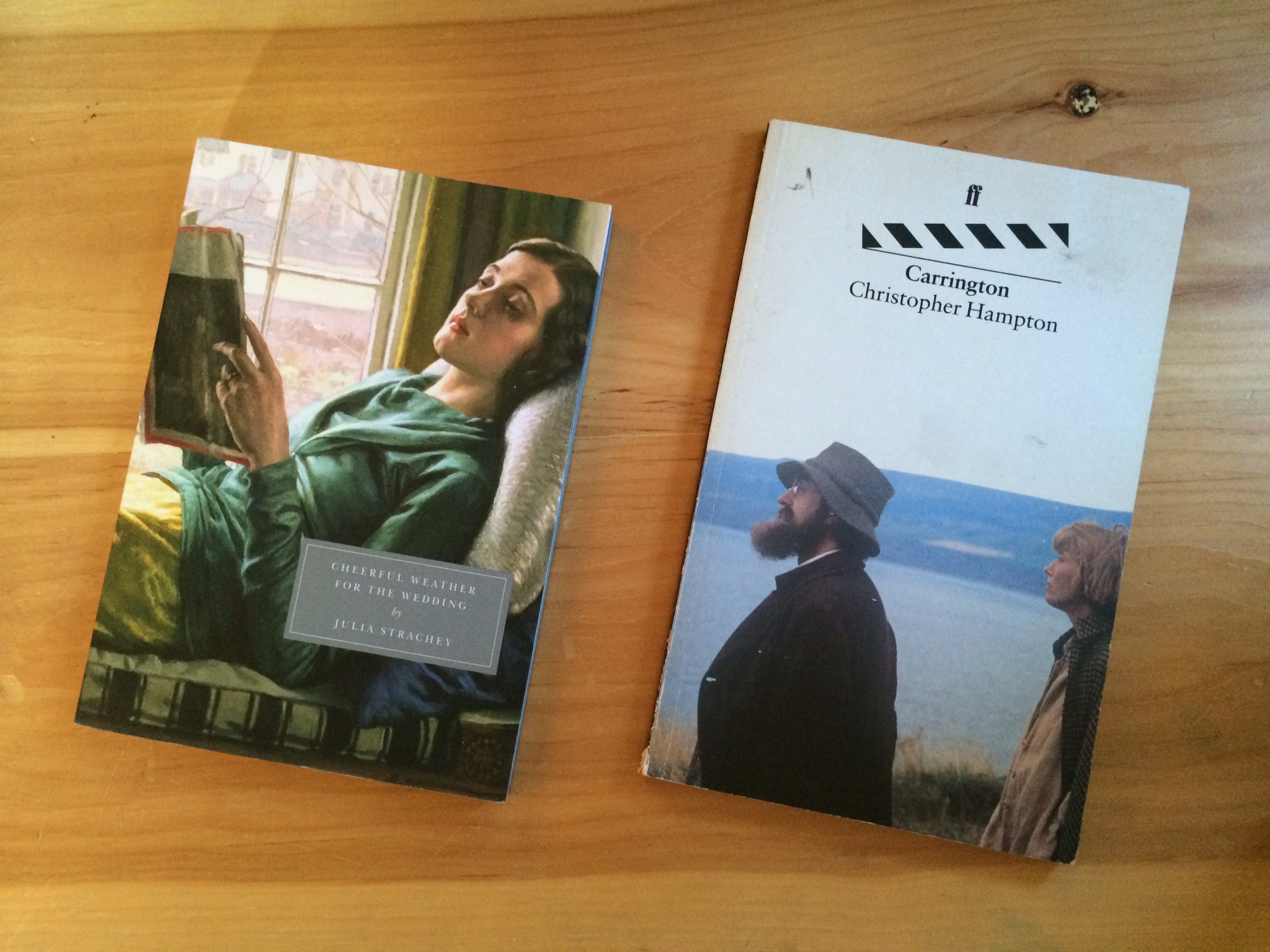
Not too long ago, I read Kay’s review of Cheerful Weather for the Wedding (which made me think of the opening sequence in Steel Magnolias, and yes, if you were wondering, I am basically a 30-something married version of Ouiser), and therefore ordered it, and then Laura of Reading in Bed put it on her list for Novellas in November, an event she’s doing with founder Rick at the Book-a-Week Project. It was meant to be.

So the novella arrived and I realized that the author is Julia Strachey, who was the niece of writer Lytton Strachey, who is one of the subjects of Christopher Hampton’s screenplay Carrington, which I read a little while ago, whose main subject is the artist Dora Carrington, who painted the author portrait of Julia Strachey on the back (not pictured) of Cheerful Weather for the Wedding.

Bam! IMG_5462

So. The novella first. It is not, it turns out, remotely like Steel Magnolias except for the fact that it begins on the morning of a wedding. In this case, it’s March and a gale is blowing through the Thatcham house and grounds as twenty-three-year-old Dolly prepares for her wedding. Mrs. Thatcham fusses over details, gives contradictory orders regarding luncheon, and fails to notice the general unhappiness of pretty much every person in the house: Kitty, the younger, slightly boorish sister of the bride, Robert and Thomas, young cousins who cannot get along because Tom is bullying the younger boy over his socks, and Joseph, a friend of Dolly’s who’s in quite the rush to see the bride. And then there’s Dolly herself, who’s bracing herself with the better part of a bottle of rum.

It sounds like the set up for a Kaufman and Hart play, but if you imagine Kaufman and Hart done by a combination of Virginia Woolf, Dorothy Parker, and E.M. Forster, you’ll be on the right track. It’s a deeply odd little book, but one that features some fine writing, a nice twist at the end, excellent characterization, and a very interesting motif of carefully depicted light: For example: “sunlight fell in dazzling oblongs” (12), “brassy yellow sunlight” (26) and “dazzling white light” (47) meet green twilight at one point and lilac heat haze (for which I can’t find page numbers). Recommended.

Now, Carrington: I thought this was a play when I picked it up at a used bookstore in Hyannis, but it’s the screenplay to the 1995 film starring Emma Thompson and Jonathan Pryce, which I missed when it premiered because (a) I was 11 and (b) I was repeat-watching Sense and Sensibility, another Emma Thompson flick (I love her). Of course, now I’m dying to see it because it’s about the 1920s Bloomsbury folk and their usually doomed attempts to find happiness within unconventional—-to put it mildly—-living arrangements, and I’m a sucker for 1920s English artistic angst. Also I read Lytton Strachey’s Elizabeth and Essex about seven or eight years ago and wondered mightily about the no-doubt fabulous person who wrote it; here’s part of the answer.

Essentially, Carrington is a story about the difficulty of being romantically interested in someone who can only be platonically (in the modern sense) interested in you. And it’s about gender and sexual nonconformity, art, and family. But mostly it’s about love. It’s gorgeously written and unfortunately impossible to quote out of context, but I highly recommend it. I’ll let you know if and when I find the movie on Netflix.

What about you, Dear Readers? Any bookish coincidences striking you lately?

“to paper my wall with rejection slips”: W.S. Merwin’s “Berryman”

Photo by Viktor Jakovlev via Unsplash

Photo by Viktor Jakovlev via Unsplash

I don’t write much about my non-blog, non-job-related writing for a variety of reasons. One is that there’s precious little time for that writing, so writing about it seems like a waste of that time. Another is that I get a great many rejections. Six in a week? Been there.Three in one day? Yep. Two rejections (from different magazines) in two minutes? Yes, it’s possible.

This is, as you might suspect, discouraging.

Plenty of articles, lists, and even whole magazines are dedicated to encouraging and advising writers, both new and seasoned, in the face of almost certain rejection. I sample these prescriptions for perseverance occasionally, but the best I have ever found is a poem (surprise? probably not).

In “Berryman,” poet W. S. Merwin (he’s prolific, but most likely you’ve encountered his translations of Neruda) describes the advice John Berryman (most famous for The Dream Songs) gave him as a young writer. I love the whole poem, but especially these lines:

as for publishing he advised me
to paper my wall with rejection slips
and the closing two stanzas:
I had hardly begun to read
I asked how can you ever be sure
that what you write is really
any good at all and he said you can’t
you can’t you can never be sure
you die without knowing
whether anything you wrote was any good
if you have to be sure don’t write


And there you have it.