Last Week’s Reading: March 5 – 11

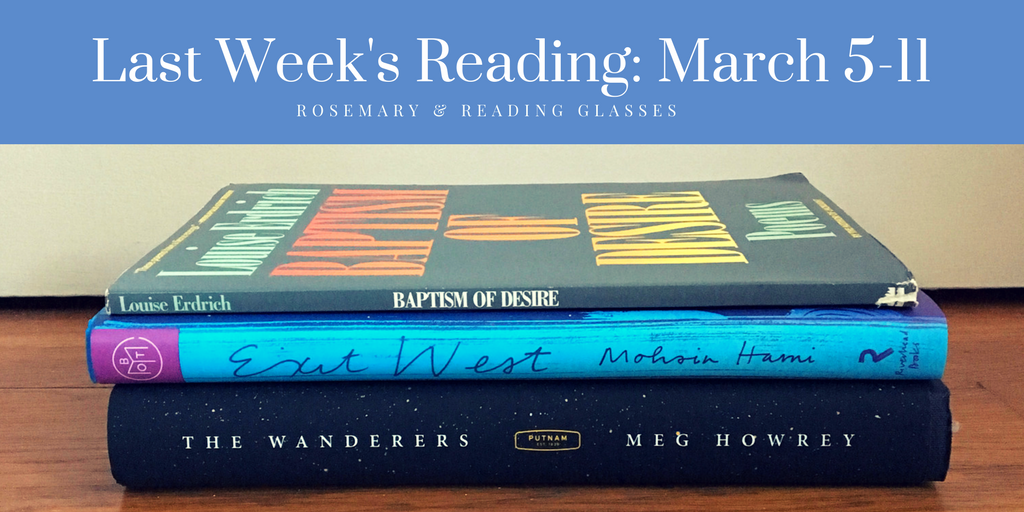
The Wanderers, by Meg Howrey: I’ll post a longer review of this book soon, so for now I’ll just say that I loved it. The hook: three astronauts undertake a long-term simulated mission to Mars, and both they and the loved ones they leave behind struggle with isolation and epiphanies during their experience.

Exit West, by Mohsin Hamid: What a lovely novel. Exit West has that graceful fluidity that seems effortless but of course isn’t effortless at all, but the result of a writer’s very hard work. It’s about Saeed and Nadia, two young people falling in love as their city falls apart, destroyed in the conflict between government forces and militants. The pair begin to hear rumors of doors not between rooms, but between countries—doors that have been appearing all over the world. Soon migration doesn’t require a passport, but merely steps through an (unguarded door); the trouble becomes what to do once you find yourself on a beach in Greece, or a mansion in London, or a mountainside in California. As Nadia and Saeed navigate through strange new worlds, Mr. Hamid breaks up their narrative with vignettes of other migrants, giving a global feel to an otherwise intimate narrative. Beautiful writing and a timely tale. Highly recommended.

Baptism of Desire, by Louise Erdrich: I enjoyed this 1989 collection, Ms. Erdrich’s second, just as much as her first (Jacklight). The first group of poems plays with Catholic imagery and theology, while the second section includes narrative poems about various characters (like Mary Kroger, the butcher’s wife). The third section, my favorite, is a long poem, “Hydra,” about both the mythological figure and pregnancy. The prose tale of “Potchikoo’s Life After Death” makes up the fourth section (I don’t think I’ve seen a story in a short collection like this before, but I enjoyed it thoroughly). Poems about marriage, domestic life, and the natural world close this strong collection. You can read Baptism of Desire‘s first poem, “Fooling God,” at the Poetry Foundation.

What are you reading these days?

Last Week’s Reading: February 26 – March 4

last-weeks-reading-february-26-march-4

Pearl, translated by Simon Armitage: One rainy day, three or four years ago, our son had mercifully decided to nap and we, exhaustion-stunned, took to our computers and came across a documentary that featured Simon Armitage talking about walking through England and his verse translation of Sir Gawain and the Green Knight. It was so calming and interesting that I’ve never forgotten it (though, alas, I’ve never gotten around to reading the poem, either). This medieval poem is believed to be by the same anonymous author of Sir Gawain, and Mr. Armitage was asked to make a new translation, an exceedingly complicated task given the structure of the original poem (which appears side-by-side with the translation, I was happy to find). Pearl is a parent’s lament for a lost child and also an extended religious dream-vision, and I found it quite moving. Mr. Armitage’s explanatory note that precedes the poem is a model of brevity and regard for readers, too. (If you’d like a longer review, I recommend this one.)

Tooth and Claw, by Jo Walton: Somewhere I read the pitch that this novel is like Sense and Sensibility with dragons, but that’s not quite right. To be sure, all the characters in this unusual novel are dragons, but the plot owes more to Dickens and Trollope (the latter mentioned in Ms. Walton’s acknowledgments) than Austen. A family gathers around a dying patriarch, prepared to split his fortune—and his corpse, perhaps even more valuable. Conflicts, confessions, and proposals ensue in this grotesque and cruel society that is not so very different from its nineteenth-century English model. For its twisty-turny plot and confident and playful imagining of a draconian society, recommended.

Praise Song for the Day, by Elizabeth Alexander: This handsome chapbook from Graywolf Press is a bound copy of Ms. Alexander’s 2008 inaugural poem. Occasional poetry always seems like such a tall order, and “Praise Song for the Day” takes on the challenge with finesse. A lovely poem, and a reminder of happier times. You can read it here.

Nabokov’s Butterfly, by Rick Gekoski: This book, titled Tolkien’s Gown (much more appealing, I have to say) in the UK, is a collection of essays and radio talks-turned essays about rare books, the specialty of its author (Mr. Gekoski is also the author of a new novel, Darke; it was Rebecca’s review that led me to this book—thanks, Rebecca!). Nabokov’s Butterfly is amusing and pleasantly inclined toward gossip and name-dropping—I don’t know about you, but I love juicy tidbits about famous authors who’ve departed this realm and as such can’t be said to mind—with plenty of interesting details about particular copies of important and unusual books. I can’t say that I loved every chapter or agreed with every one of Mr. Gekoski’s literary judgments, but I’d recommend this for bibliophiles for a bit of light fun.

And speaking of light fun, and not pictured because I read it in e-book form:

Do You Want to Start a Scandal, by Tessa Dare: Those of you who are long-time readers may remember that I took part in a readalong of a paranormal romance novel in 2013 ( Intro | Part 1 | Part 2 | Part 3). It did not go well; my exact words at the end were, “I can tell you with assurance, dear readers, that it will be many a year before I read another romance novel.” “Many” in this case seems to be four-ish years, since on Jenny’s recommendation, I have indeed read another romance novel, this time featuring standard humans, bodice ripping, and English country house parties. And it was delightful. Frothy, funny (intentionally funny—like with jokes, not bad writing), feminist in the sense that consent is sought (and enthusiastically granted): just the thing if you need a break from heavy reading and/or the news.

Last Week’s Reading: February 19-25

last-weeks-reading-february-19-25

Lincoln in the Bardo, by George Saunders: I confess that this is the first George Saunders book I’ve read, and now I get what all the hype is about. The novel takes place on one night, in the graveyard where young Willie Lincoln’s body has been delivered. His grieving father, faced with the loss of his son and the looming loss of his country (the war is not going well), visits the cemetery, to the surprise of the resident ghosts. Mr. Saunders stretches the form of the novel in unexpected directions, and the result is polyphonous, nuanced, joyful and terrible, and—dare I say it?—Joycean, in a good way. Highly recommended.

Between the World and Me, by Ta-Nehisi Coates: Everything there is to say about this book, a father’s letter to his son about moving through American life in a black body, has already been said, I think, but: yes, it’s searing, bleak, and galvanizing. And the writing is beautiful. Highly recommended.

Peacock & Vine, by A. S. Byatt: As an object, this book is covetable—gorgeous thick paper, a carefully chosen font, around 50 full-page photos—but I closed it and wished for more. It’s an essay, A. S. Byatt is careful to say, that through various lenses considers the lives and work of the artists Mariano Fortuny and William Morris. I knew a bit about Morris coming into the book, but nothing about textile designer Fortuny, and in both cases I felt out of my depth because of my lack of knowledge. Byatt’s writing is gorgeous, of course—is there a writer who can describe color better?—but I think this book is best suited for people particularly interested in the two designers. Made me want a Fortuny coffee-table book, though.

Look, by Solmaz Sharif: In Look, Ms. Sharif’s debut collection, poetry is an act of witnessing, even when what is witnessed is erasure. These poems focus on the way war destroys or maims the body, relationships, and language itself. A powerful, sad, cohesive collection. Highly recommended.

(The library was good to me this week, as you can see. Wish I’d had time to write longer reviews!)

Last Week’s Reading: February 12-18

last-weeks-reading-feb-12-18

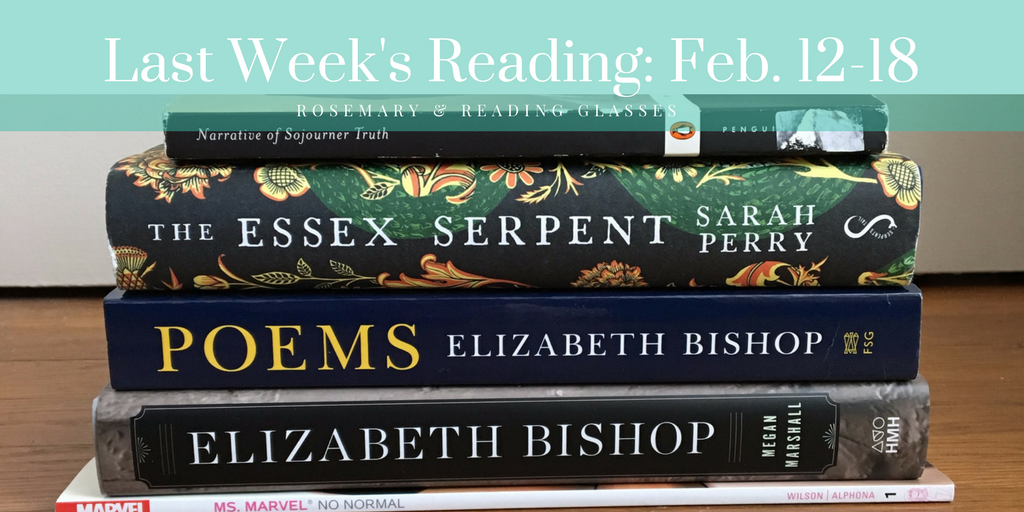
Elizabeth Bishop: A Miracle for Breakfast, by Megan Marshall: Full marks to this illuminating biography of one of the twentieth century’s best poets. You can read my in-depth review here.

Poems, by Elizabeth Bishop: Thanks to Ms. Marshall’s biography, I succumbed to the temptation to update my version of Bishop’s complete poems. This volume contains all her published poetry, several uncollected pieces, translations, and some works in progress—a feast, by any measure.

The Essex Serpent photo copyright Carolyn OliverThe Essex Serpent, by Sarah Perry: From the moment I saw the cover of this novel, I coveted it. Last month I ordered in from the UK, not willing to wait until its summer release here—and goodness, I’m glad I did. The plot: In 1893, Cora Seaborne, a recently widowed amateur natural historian, sets out from London with her son and her friend/nanny/maid to visit Essex, where she hopes to make exciting discoveries and escape the oppressive memories of her marriage. Further up the coast, fear ripples through a small village after a series of unsettling events lead many to believe that the legendary Essex serpent has returned. Cora hopes that the beast turns out to be a living fossil, while William Ransome, the local curate, believes lack of faith is responsible for his parishioners’ panic. When Will and Cora meet, their intelligence and opposing beliefs draw them together like magnets, and the nature of friendship is tested. The supporting characters are finely drawn and the setting is sumptuous—this is a novel you’ll want to devour. Mark your calendars for June 6, U. S. readers.

The Narrative of Sojourner Truth: Had I known more about Sojourner Truth’s life, I probably would have chosen to read Nell Irvin Painter’s biography of the legendary abolitionist and suffragist instead of this primary source (Nell Irvin Painter also wrote the very helpful introduction to this book). Because Sojourner Truth could neither read nor write, her story was necessarily mediated through amanuenses. The Narrative is composed of three parts written or compiled at different times by different figures, and while some of Truth’s speech is set down, it’s hard to tell if it’s an exact transcription (almost all of the work is in the third person, and the first co-writer offers her own opinions freely). Still, I’m glad I read it, since I learned more about Truth’s ordeals as a slave in New York, her years as an itinerant preacher, and her unstinting efforts on behalf of freed persons after the Civil War.

Ms. Marvel Volume 1: No Normal, by G. Willow Wilson, drawn by Adrian Alphona: I loved the concept of this comic, but I think it’s geared for readers younger than I am. Kamala Khan, a sixteen-year-old Muslim girl living in Jersey City with her Pakistani American family, discovers she has shapeshifting abilities. Becoming Ms. Marvel is no easy task, as she needs to learn how to channel her new powers while simultaneously navigating tricky relationships with her friends, family, and classmates. Essentially, this is a more complex and interesting version of the Spider-Man story, and I’d definitely recommend it for teen readers.

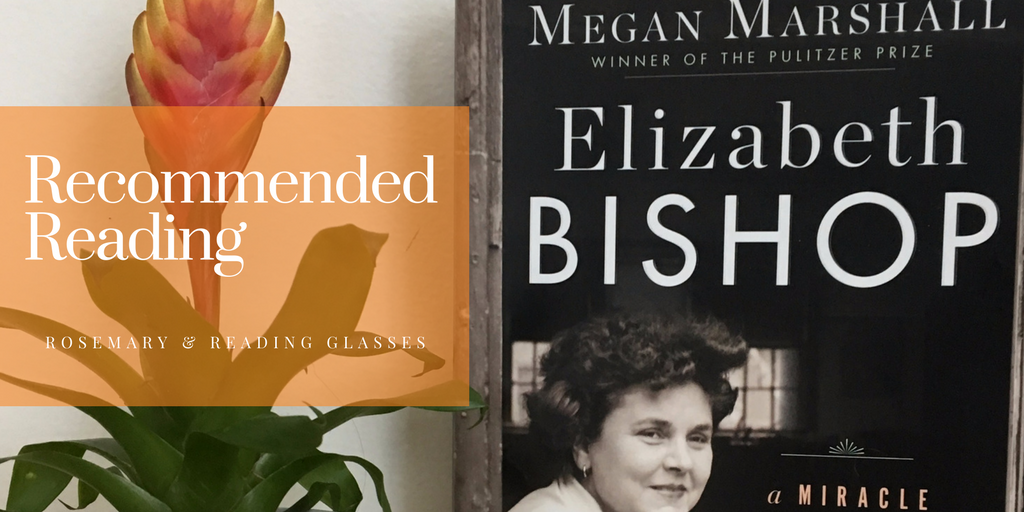
Recommended Reading: Megan Marshall’s Elizabeth Bishop: A Miracle for Breakfast

elizabeth-bishop-miracle-for-breakfast-photo-copyright-carolyn-oliver

Since reading a few of Elizabeth Bishop’s poems as a teenager, I’ve always enjoyed my encounters with her work, but felt the poet was inscrutable, always at arm’s length, despite the fact that I live in the city where she was born and where she’s buried. I don’t feel that way any longer, thanks to Megan Marshall’s Elizabeth Bishop: Miracle for Breakfast,* a smooth-reading, revelatory new biography of one of the twentieth century’s best and most private poets.

Elizabeth Bishop biography photo copyright Carolyn OliverMs. Marshall, who won the Pulitzer for her biography of Margaret Fuller, structures the book around the six end words of Bishop’s first sestina (an intricate and demanding verse form), “Miracle for Breakfast”: coffee, crumb, balcony, miracle, sun, river. Each of these six chapters explores a major phase of Bishop’s life, from her childhood spent bouncing among various relatives to her unexpected late-in-life romance. Interspersed are Ms. Marshall’s brief reflections regarding how she came to be one of Bishop’s last students, in a verse-writing seminar at Harvard in the late 1970s—an unusual touch, and enlightening. Here’s a bit from one seminar meeting: “‘I don’t believe poetry can be taught,” she started in, looking straight out at us, yet somehow managing not to meet anyone’s gaze. Her level weapon needs no sight. ‘But we’ll do what we can with the time we’ve got.’ A tentative smile. Should we have laughed?”

This is a book about love and work, and the balance between the two. Bishop’s slim oeuvre is about one hundred poems, nearly all of them exquisite. Ms. Marshall shows us just how difficult it was for Bishop to write, how she labored and labored over many drafts, how she abandoned many promising poems that didn’t reach perfection. Her output fluctuated with her often turbulent emotional life; she also suffered from alcoholism, which led to injury and heartache and lost writing time.

Understandably, much has been made of Elizabeth Bishop’s long friendship with her fellow poet Robert Lowell, but while giving Cal, as Bishop called him, his due, Ms. Marshall focuses more on the poet’s romantic relationships (crushes, affairs, long-term arrangements) with women—especially Lota de Macedo Soares (functionally, they were married) and, much later, with Alice Methfessel—relationships it’s much easier for Ms. Marshall to explore in 2017 than it was for biographers working before the cultural shift in favor of gay rights.

After Alice Methfessel’s death in 2009, letters came to light that revealed not only the extent of her relationship with Elizabeth Bishop, but also harrowing details about Bishop’s early life. Her father died when she was still an infant, and when she was still a small child her mother was confined to an asylum for the mentally ill. After time happily spent with her maternal grandparents in Nova Scotia (recalled in short stories decades later), Elizabeth was sent to live with her grander relations in Worcester, Massachusetts. Unhappy and out of place there, she at first didn’t mind being sent, yet again, to other relatives, this time  to her uncle and aunt living in gritty towns north of Boston, but her uncle’s predatory advances ensured that she stayed at camps, boarding school, and with friends as often as possible.

After college at Vassar, she traveled and lived in various locations before settling down with Lota for a long stint in Brazil, punctuated by visits to and from friends, before returning to the United States, where she began to teach.

Bishop mined her travels and her  memories for material, and Ms. Marshall delicately balances the particulars of Bishop’s life with thoughtful readings of her poems, including “The Shampoo,” “The Fish,” “Filling Station,” “The Armadillo,” “In the Waiting Room,”  and, of course, “One Art.”  While some biographies seek to use biographical information to ferret out meaning from writing, Ms. Marshall’s approach is much more nuanced; here, life and art inform each other, in conversation. In a lovely reading of “One Art,” she shows how the poem changed over the course of its seventeen drafts, and how Bishop “merged the two great disasters of her adult life” in the details. “Elizabeth had been practicing the art of losing since infancy,” she writes. “[A]rt had become her one means of mastery. “One Art” was the elegy she had wanted for so long to write.”

Elizabeth Bishop was gifted and troubled, touched by inspiration and despondency both. This biography is a fitting tribute to all her complexity as an artist and a human being.

* I received a copy of this book from the publisher for review consideration, which did not affect the content of my review.

Last Week’s Reading: February 5 – February 11

last-weeks-reading-february-5-11

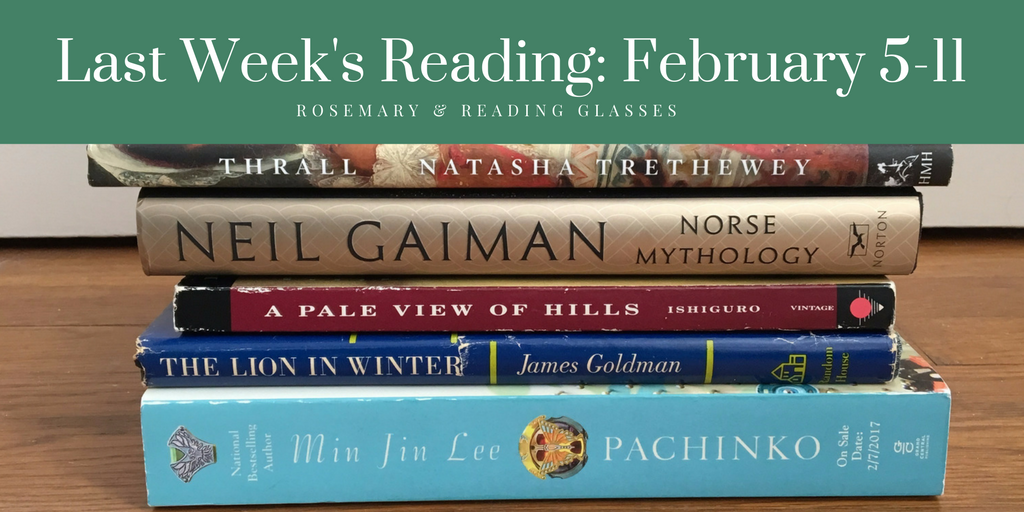
Pachinko, by Min Jin Lee: I loved this family saga about Korean immigrants in twentieth-century Japan. You can read my full review here.

The Lion in Winter, by James Goldman: I grew up watching the film adaptation (starring Peter O’Toole, Katharine Hepburn, Anthony Hopkins, and Timothy Dalton) of this 1966 play, and I was delighted to find that the screenplay matches the script almost exactly. It’s a firecracker of a play about Henry II, Eleanor of Aquitaine, and their scheming sons, brought to life with some of the wittiest, cruelest banter you’ve ever read. My copy, which I found at Loganberry Books in Cleveland, is a first edition, and it includes stills from the first production–imagine my surprise at seeing a very, very young Christopher Walken in these pages! Perfect escapist reading.

Thrall, by Natasha Trethewey: This 2012 collection by former Poet Laureate Natasha Trethewey is brilliant. Thrall takes as its focus the poet’s interracial background, interrogating classic paintings that depict mixed-race people and themes and exploring the poet’s relationship with her white father. Two of my favorites from this beautiful, necessary, American collection: “Rotation” and “Enlightenment.”

Norse Mythology, by Neil Gaiman: I’ve been looking forward to this book for months, and Neil Gaiman did not disappoint. In these tales, he brings the Norse gods to life—wise but fallible Odin, hulking Thor, dangerous Loki (and he points out that much of what must have been passed down about goddesses and other female figures has been, alas, lost—hence the disproportionate number of myths about male figures). A gifted storyteller and fascinating legends makes for a classic combination. Gorgeous cover, too.

A Pale View of Hills, by Kazuo Ishiguro: A subtle, unnerving novel about a woman, Etsuko, who recalls one hot, eventful summer in post-war Nagasaki decades later, after she’s moved to England. Her older daughter has recently committed suicide, and her younger daughter comes to visit Etsuko at her country home. The writing is atmospheric and outwardly serene, but malaise creeps beneath the surface. I’m amazed at Mr. Ishiguro’s skill in showing how characters mean exactly the opposite of what they say. Even more amazing is that A Pale View of Hills was his first novel. Recommended.

Recommended Reading: Pachinko, by Min Jin Lee

pachinko-rosemary-and-reading-glasses-review

Since I finished reading Min Jin Lee’s wonderful novel Pachinko*, I’ve been thinking about family sagas. The appeal is perspective, I think; as readers we’re able to see the lives of multiple generations with a wholeness we are not afforded in the course of our own lives.

We know our own stories intimately, of course, and our parents’ and children’s pretty well, if we’re fortunate enough to enjoy close relationships with them, but then those third generations on the outside—our grandparents and our grandchildren—are beyond our ken in most respects. No matter how much I adored my grandmother (and I adored her very much), I couldn’t really know what it was like for her to grow up during the Depression, or what the atmosphere was like one the night she watched the Moon landing, or why she liked gardenias. And if I’m lucky enough to have grandchildren, I will not live long enough to see the sorrows and triumphs of their middle age; I cannot imagine the political and technological differences between their era and my own.

It’s a pleasure to feel these limitations lifted (if only for a little while, and only in fiction) in a novel as expansive, humane, and well written as Ms. Lee’s Pachinko, which begins, “History has failed us, but no matter.”

img_3691-2We meet first an unnamed couple, the grandparents of Sunja, Pachinko‘s center and beating heart. Hardworking and thrifty, these two have only one son, kind and loyal, who in turn marries a hardworking woman named Yanjing, Sunja’s mother. Mother and daughter work hard at the boardinghouse they run on a small islet near Busan, in Korea, and it seems that Sunja will take her mother’s place one day—until she becomes pregnant. In the early 1930s, in their community, the shame is unbearable, but a young missionary staying with them offers to marry Sunja and bring her with him to Japan, where he is to work as a minister, and where his brother and sister-in-law are waiting for him.

In Japan, Sunja, grateful for the kindness of her gentle new husband and the friendship of her sister-in-law Kyunghee, tries to forget her lover and settle into her new life. But Koreans in Japan are treated very badly, and soon, with war upon them, the family is struggling to survive.

Sunja’s two children, Noa and Mozasu, both born in Japan, grow up feeling as if they don’t have a home, exactly. Japan will not accept them as citizens; Korea, now split, may not take them in. They face this heartbreaking conundrum in different ways: Noa studies hard to become a “model” Korean, wishing he could blend in and pass for Japanese; Mozasu determines to make the best of things and finds lucrative employment at a pachinko parlor, an industry dominated by Koreans.

Pachinko, an arcade game rather like pinball, but with an element of gambling, is an apt metaphor for the role of history in the novel. For Sunja and her family, the sweep of history deals them many, many hardships and the occasional bout of good fortune, but always their ethnicity marks them as different from those they live among. And for Sunja, Yangjin, and Kyunghee, their sex also reduces their options (economically, politically, and within the family) without reducing their labor. Ms. Lee has written not only a searing novel about the immigrant experience and an extraordinarily evocative historical novel, but also one that subtly and yet relentlessly shows readers the value—and the price—of women’s work.

Ms. Lee’s writing is fluid and expressive, keeping the reader firmly planted in the twentieth-century homes and workplaces of her characters. Here’s Sunja, making candy to sell in Osaka, remembering her home:

Yeongdo, their little rocky island, stayed impossibly fresh and sunny in her memory though she hadn’t been back in twenty years. When Isak tried to explain heaven, she had imagined her hometown as paradise–a clear, shimmering beauty. Even the memory of the moon and stars in Korea seemed different than the cold moon here; no matter how much people complained about how bad things were back home, it was difficult for Sunja to imagine anything but the bright, sturdy house that her father had taken care of so well by the green, glassy sea, the bountiful garden that had given them watermelons, lettuces and squash, and the open air market that never ran out of anything delicious. When we was there, she had not loved it enough.

Pachinko is a gorgeous novel that asks nuanced questions about home, faith, and family, questions asked in new ways with each new generation. When the last of Sunja’s family members is introduced, I wished the novel would keep going, so I could learn what would happen to him, too. But the story never ends, does it?

* I received a copy of this book from the publisher for review purposes, which did not affect the content of my review.
Last Week’s Reading: January 22-28

last-weeks-reading-january-22-28

January 22-28, 2017: A sci-fi classic, a new feminist classic, vignettes in verse,  a much-awarded novel worth the hype, and thirty-year-old poetry that’s still fresh.

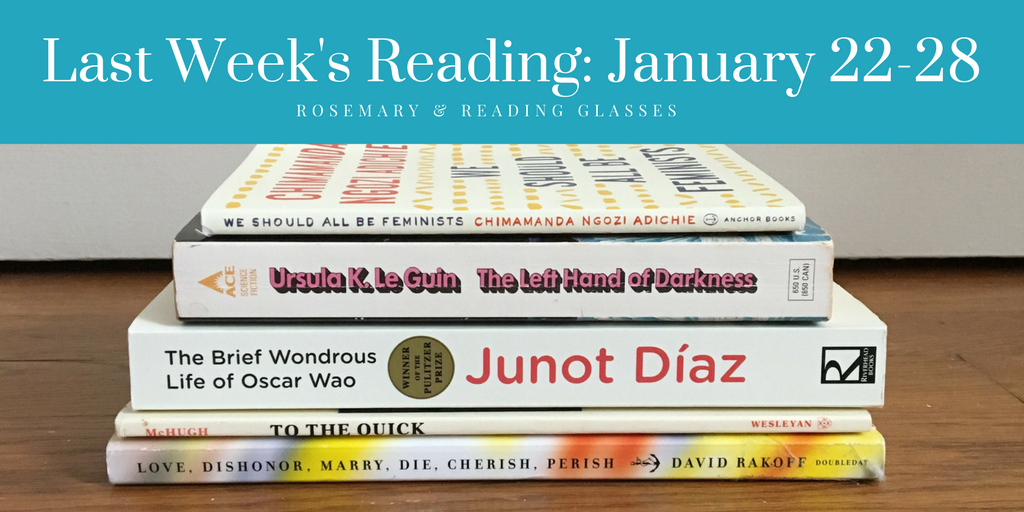
We Should All Be Feminists, by Chimamanda Ngozie Adichie: The perfect primer on feminism, eloquent and brief. This would make an excellent gift for high school students in need of a brief introduction to the concept and will rally, I think, those who hesitate to call themselves feminists.

The Left Hand of Darkness, by Ursula K. Le Guin: I’ve had this 1969 sci-fi classic  on my shelves for twenty years, but I’m rather glad I didn’t read it at twelve. Though short—my mass-market paperback is 300 pages—it’s dense, complicated, and incredibly intelligent. Genly Ai is an envoy from a group of planets (think the Federation, but more abstract) assigned to persuade the inhabitants of the planet Gethen (translated, it means Winter–it’s essentially a populated Hoth) to join the Ekumen. Gethenians have a complicated system of etiquette and honor called shifgrethor, but even more confounding for Ai is their lacked of fixed sexuality; they are neither male nor female (all characters are called “he,” a convention Ann Leckie reverses in the excellent Ancillary Justice). The world-building is sublime, the pace of revelation superb–we struggle to understand this culture as Genly does, and in the process Ms. Le Guin asks us to think deeply about exploration, friendship, and patriotism. Highly recommended.

Love, Dishonor, Marry, Die, Cherish, Perish, by David Rakoff: The world lost a funny, sad voice when David Rakoff died in 2012 at the age of 47. If you loved his essay collection Fraud (I did), you’ll find this book quite different–it’s a short novel made of vignettes in verse. It’s grim and witty at the same time, a catalogue of cruelties and kindnesses and most of all, I think, our vulnerabilities. Those looking for an unusual reading experience should pick it up.

The Brief Wondrous Life of Oscar Wao, by Junot Díaz: Deserves every accolade it’s received, and then some. I put off reading this novel because I have limited patience for the male bildungsroman, but my expectations were confounded. Oscar is lovable and tragic, but the story doesn’t belong to him alone; Mr. Díaz takes long excursions into the backgrounds of his mother and sister, giving the book a roundedness and depth I didn’t anticipate. Yunior, the narrator and sometime authorial-alter-ego, is a fantastic narrator, steeped in nerd culture, frenetic, profane and and so full of life that it seems he’s physically propelling words across the page (even in the footnotes). I loved, loved, loved this novel.

To The Quick, by Heather McHugh: Heather McHugh’s wordplay (see “Etymological Dirge”) is fantastic, almost dizzying. This 1987 collection is beautiful and smart and tough. These poems will cut you to the quick. Need proof? Just read “The Amenities.” 

Last Week’s Reading: January 15-21

last-week-reading-january-15-21

A dystopian classic, two collections by Poets Laureate, sci-fi shorts, a nonfiction juggernaut, and a powerful play.

Well, Dear Readers, here we are. And here’s what I read last week.

The Handmaid’s Tale, by Margaret Atwood: Even more frightening now than when I first read it ten years ago. If you haven’t read this classic yet, now might be a pretty good time.

On the Bus with Rosa Parks, by Rita Dove: I bought this collection in Denver last year, and finally read it on Martin Luther King Day. It’s excellent, particularly in the way the title sequence allows us to see the sweep of historical events through individual experience. The poems grouped in “Cameos” and “Black on a Saturday Night” reminded me of Natasha Trethewey’s Domestic Work; you might try reading the collections together. And bookish folk will love the poems “Maple Valley Branch Library, 1967” and  “The First Book.”

The Immortal Life of Henrietta Lacks, by Rebecca Skloot: I finally got a library card for our new city’s system, and then proceeded (finally) to read this medical and social history that practically everyone else has read in the six or so year since it came out. I was impressed by the volume of research Ms. Skloot conducted and the sensitivity with which she handled the stories of Henrietta Lacks’s family, but I did wish for more background on cell science and advances made with HeLa cells. If you read the book when it came out, you might want to head over to this website to read updates about the project.

Arrival (original published as Stories of Your Life and Others), by Ted Chiang: I bought this collection because I very much want to see Arrival (unfortunately, I missed it in theaters), and I like to read source material first. “Story of Your Life,” which is the basis for the movie, is exceptionally good, one of the very best short stories—though it feels like a super-compressed novel—I’ve ever read. Stunning, and by that I mean I felt stunned after I read it. Also very impressive was “Tower of Babylon,” which leads off the collection. The other six stories (most of the stories in the book are very long for short stories, by the way) were interesting, but not quite my cup of tea, stylistically; they seemed, with exception of “Seventy-two Letters,” like sustained thought experiments. All the stories, however, reveal a deeply thoughtful mind at work, and offer more questions than answers; I’m glad I read them.

The Laramie Project, by Moisés Kaufman and the Members of Tectonic Theater Project: This play must have been (must be) incredibly powerful in performance. It’s an exploration of Laramie, Wyoming’s reaction to the brutal murder of Matthew Shepherd in 1998. The members of the theater group traveled to Wyoming six times in eighteen months to interview friends of Matthew, friends of the perpetrators, police officers, students, religious leaders, and other townspeople; the words gathered in the interviews were shaped into the work. The Laramie Project is an act of radical witness; it’s impossible not to be moved by it.

Notes on the Assemblage, by Juan Felipe Herrera (current United States Poet Laureate): The poems in this collection are political and personal, full of lamentation and exuberance. You’ll find calls to action, pleas for remembrance, elegies, riffs that feel like jazz, Spanish and English talking to each other and not speaking. “Borderbus” was for me the standout poem—heartbreaking and unforgettable.


P. S. Given the busy news cycle this weekend, you might not have focused on the destructive and deadly storms in the South this weekend. If you’d like to support disaster relief efforts, here’s a link to the Red Cross donations page.  You can also check out Pinebelt Relief.

Nolite te bastardes carborundorum, Dear Readers. See you next week.

Last Week’s Reading

last-weeks-reading-jan-8-14

January 8-14: A haunting novel in translation, debut fiction from a poet, a ghost story, a highly acclaimed play, and a poet I wish I’d read years ago.

Human Acts photo by Carolyn OliverSouth Korean writer Han Kang won the Man Booker International Prize for The Vegetarian (which I haven’t read); Human Acts*, which you can find at your local bookstore today, is the next of her novels to be translated into English by Deborah Smith. It is absolutely riveting, though quite hard to read, given the subject matter. The subject is the viciously quelled 1980 Gwanju Uprising, and the lens is the life and death of one boy, Dong-ho. In chapters that shift focus among different people who knew Dong-ho (well or tangentially), the author explores trauma, resilience, memory, witness, and questions of the soul. At what cost do survivors of torture bear witness to their sufferings? How do ordinary people find the strength to resist brutal injustice? How ought we to feel about being human when humans can be despicable creatures—or brave and kind? Human Acts is a devastating, brilliant book.

img_3538After reading Human Acts, I needed something a bit lighter to take the edge off, and Lillian Boxfish Takes a Walk, by Kathleen Rooney, was just the ticket. Eighty-something Lillian Boxfish decides to end 1984 by taking a walk around her beloved New York City, reflecting on a life lived to the very fullest—if not always happily. Lillian has verve, and her recollections of working in the advertising department at Macy’s in the 1930s are wonderful (especially if you’re missing Mad Men); the character is based on Margaret Fishback, the highest paid woman in advertising during her heyday. This novel is light but not fluffy; the emphasis on connection was sensitive rather than mawkish. I generally loved the company of Lillian’s sharp mind (with the exception of several instances of fat-shaming, which, please, dear authors, can we dispense with?).

Less delightful was Gillian Flynn’s The Grown Up. Originally included in a short story anthology, the tale would, I suspect, be better served in that format, rather than as a standalone book (it was included in this month’s Book of the Month mailing). It’s a ghost story with a twist; I found it more grotesque than thrilling, and the ending, alas, didn’t satisfy.

img_3496One of the last books I read in 2016 was John Patrick Shanley’s Doubt; I couldn’t resist the temptation to make the next play I read Proof, David Auburn’s Pulitzer Prize winner (2001). Sometimes I forget how much I love reading drama (I used to teach it), though I’m happy when plays like these remind me. I suspect I don’t read drama often because it doesn’t get the hype in book-world (where, for good or ill, I spend much of my time) that fiction, nonfiction, and even poetry do. I wonder why that is. Anyway, Proof is about math, mental illness, and family. It’s very, very good.

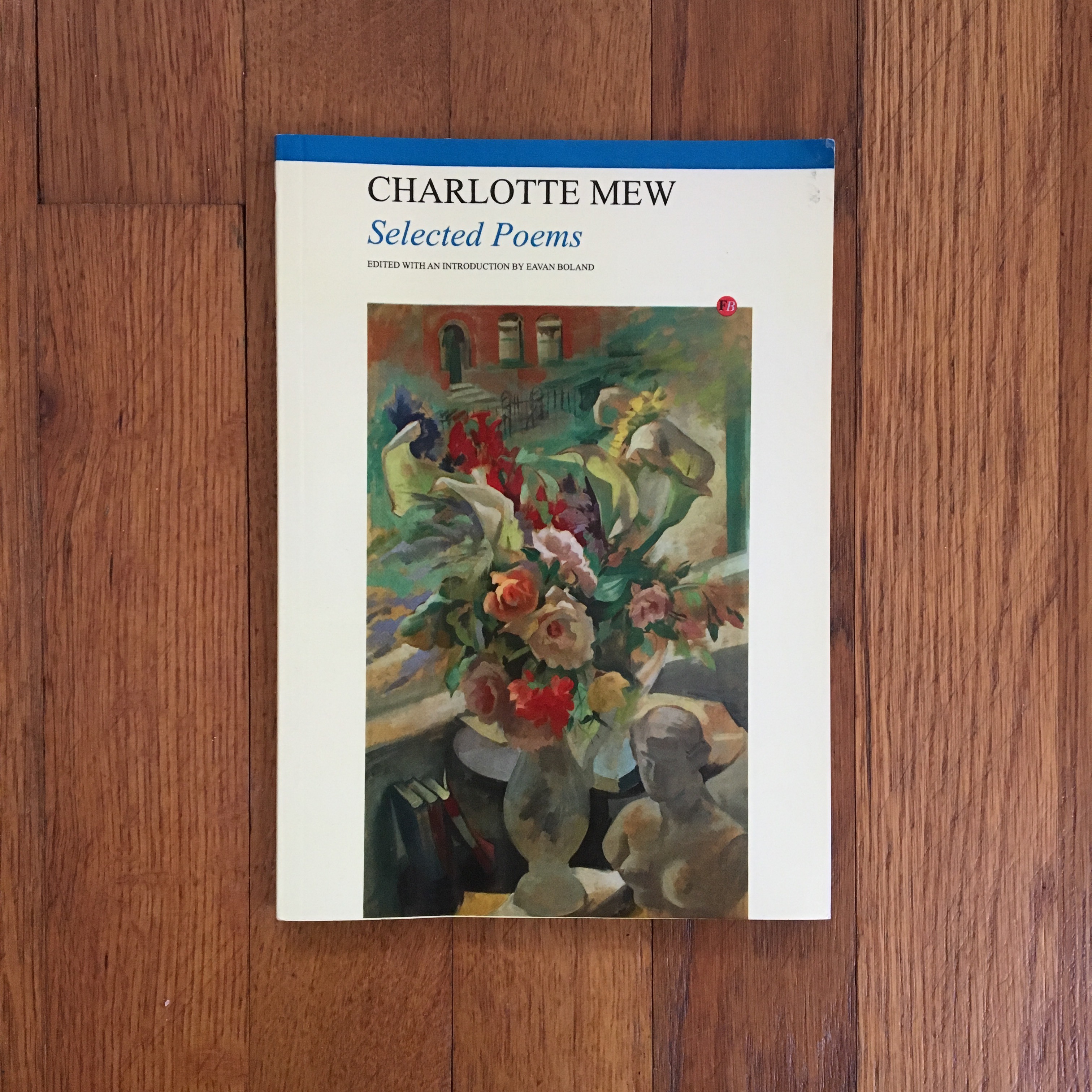
fullsizerender-13Last week, I finally read Charlotte Mew’s Selected Poems (edited and introduced by Irish poet Eavan Boland). Mew came highly recommended by friend and poet Emily Mohn-Slate, and I am kicking myself, Dear Readers that I (a.) didn’t pick up this book ages ago and (b.) didn’t read it as soon as it arrived as a birthday present. Charlotte Mew (1869-1928) is an utterly tragic figure, but her poems are marvels—lines like none I’ve ever read before: part Victorian, part Georgian, part Modernist, and all deeply moving.  I cried twice reading this slim volume, and friends, I do not cry easily when it comes to poetry.


*I received a copy of this book from the publisher for review consideration, which did not affect the content of my review.

I’m not sure this weekly reading wrap-up is going to be a regular feature, but I’m running with it for now!