Death of a Poet

The first time I met Eric, one warm evening in late May, I told him how much I hated the title of one of his poems. (I am a noted conversationalist.)  We were at a party unveiling the latest edition of the college lit magazine, which I’d worked on, and two or three of Eric’s poems had been selected for publication, including the one I fought vehemently against because of its horrid title. (It really was bad.)

Totally unfazed, Eric grinned, told me I was wrong, and joined the magazine’s staff in the fall so that we could bicker more frequently. He walked me home every Monday night, always laughing.

Two years later, we finally realized that we were madly in love with each other.

Three months and twenty-seven days before our wedding day — seventeen months and two days after our first kiss at Logan airport — Eric was dead.

That was six years ago today.


In the six years since Eric died (I am allergic to euphemisms, at least when it comes to death), I’ve never been able to write coherently about our few years together, his death, or the aftermath. Over the past month I’ve written pages and pages of material, but it’s too much to post here, though it was, in the greater scheme of things, an ordinary tragedy. There was no bomb, no gun, no collapsing bridge, no drunk driver. No earthquake or tsunami or tornado or wasting disease. There was no one, nothing to blame, but there is so much to tell.

I could tell you about how much Eric loved his family and his best friend, Andy, his generosity of spirit, his quick wit, his inimitable brand of hard-edged sensitivity. But then I’d have to tell you about Eric’s walk (jaunty, purposeful, often with a cup of black coffee in hand), his laugh, his eyes, his fearlessness, the long tails on his handwritten ‘y’s, his inexplicable love for soccer, Miller High Life, and rap.

I could tell you about his poetic exploits (he wrote a sonnet composed of advertising slogans, and it worked), about the funny, bawdy, homely, happy poems he dashed off two or three times a week for me, about the play he wrote without telling anyone. I could tell you how the last time we talked I said I thought some of the poems in his thesis were ours, too personal to share. But then I’d need to tell you how we laughed about brazier/brassiere, how proud I was when he was published, how modest he was when other poets praised his work.

I could tell you about screaming into my apartment’s floor after Eric’s father called to tell me he was dead (the carpet was beige and cream with little brown fibers threaded through its flat twists, like loose hairs). But then I’d have to tell you about smashing glasses in the kitchen, curling up next to my best friend and hearing my mom ask him through the phone if I was vomiting, because I was sobbing so hard — and I wouldn’t be past the first two hours.

I could tell you that it is absurd (one of Eric’s favorite words) to be twenty-three years old and shopping for a black dress when there’s a perfectly good meringue of a wedding dress at home that you won’t ever wear. It’s absurd to wonder if there are support groups for almost-widows (There weren’t.). But then I’d have to tell you the absurdity of trying to explain your fiancé’s best qualities to a minister who’s never met either of you before, the absurdity of listening to a woman who verifies your relationship with the dead man in the casket twenty feet away and says, “Just think! All those birthdays! All those Christmases! And your wedding!”

I could tell you what it’s like to think that the evidence of spring around you is worse than absurd — it’s obscene. Obscene that all those flowers and budding trees are licked with sunshine when your beloved’s body is going down, down, down into the dark earth where you can’t follow. But then I’d have to tell you about reading an autopsy report, a calm account of your lover’s body cut to pieces, learning, at the last, just how heavy a heart can be.

You see, April really is the cruelest month.

The truth is, I’ve never written before about the aftermath of Eric’s death because to remember it, for me, is to relive it.  One memory leads to another, and another, and another; what I’ve written here is only a fraction of what’s still in my mind. I can hear our wedding rings clinking on a chain around my neck, can see the anguish in his mother’s eyes, can taste the dust from the gravel road into the graveyard. I did not — do not — handle bereavement with grace or humor or equanimity or courage or any admirable quality at all, really. The desire to write these things down is mostly selfish, an attempt to share the witness of grief, to excise just a few of those memories.

That’s one half of the truth. The other half is that love is stronger than death.

What’s stronger than the awful memories of the week of Eric’s death and burial is the enormous power of the acts of love that happened in the weeks and months and years that followed. If I were to list every person who was kind to me, to Eric’s family, to my family, you’d be reading for hours. I kept every message, every letter, every note sent with flowers; impossible as it seems, I remember every person at the wake and funeral, every kind word then and after, and my gratitude is unceasing.  For every agonizing memory, there are two or three filled with images of love. Most of them are so specific that I can’t write about them here without infringing on other people’s privacy;  so suffice to say that when life felt most unlivable, somehow kindness always appeared in one of its many guises — a cornucopia of grace that I’m convinced saved my life.


There’s a particular solace that books can give, the sense that someone else has been there before you, has staked out the country, is holding out a rough-hewn cup when you’ve been so thirsty for so long that you’ve forgotten the taste of water. Mercifully, the last book I had to teach before the summer was The Razor’s Edge, and I’d never understood it better. I re-read C.S. Lewis’s A Grief Observed. My friend gave me Ann Hood’s Comfort. And there was poetry — so much poetry: Edna St. Vincent Millay, Emily Dickinson, Carol Ann Duffy, W. H. Auden, Milton, A. E. Housman.

And finally the ghost of Miss Havisham appeared and I decided that while I had no intention of falling in love ever again, I also had no intention of withering away in my apartment, or forever provoking (kind) looks of pity.

And so, about a year after Eric died, I found myself in a little Italian restaurant, sitting across from a tall near-stranger with warm brown eyes. He was shy, funny, serious, and, as I learned later, very kind and very gentle. I told him about Eric and my almost-widowhood on that first date, and he looked me in the eyes when he said he was sorry. He emailed me and asked for another date the same night. And in the last five years, he’s listened whenever I needed to talk about Eric.

It was confusing, at first, to fall in love when I still loved Eric; but finally I realized that I will never stop loving him. After all, we love relatives who’ve died, don’t we? The condition of their existence does not alter our love.


Last year, around this time, I wrote a little about what it’s like now to feel this mixture of love and sadness. For now, I can’t improve upon it, so here it is:

The end of a long story of mine is that I own the poetry collection of someone I loved very deeply and who died much too young.  In the beginning I kept our collections separate, and thought that someday I’d try to read through them as a way to work through my grief. But over time the project receded, and our collections have melded together so thoroughly that often I don’t know the provenance of a particular book.

This morning, my little son, H, and I were looking over the shelves to find a poem to work on this week, and I was drawn to Richard Wilbur’s New and Collected Poems (1989), which won the Pulitzer (Wilbur’s second). It’s a thick volume, and I found several promising poems, full of sly wit and concrete images, but nothing that shook me by the shoulders and said “This one!”

Until, that is, as my son fell asleep in my arms, I read the title of the last section: The Beautiful Changes, the title of Wilbur’s first book of poetry, published in 1947, when he was twenty-six (oh, to have the touch of genius!). My hands shook a little; I know these poems, “Cicadas” and “O.” I’ve read poems that talk to them.

And the last poem in the book, in the collection, is “The Beautiful Changes,” and it expresses, for me, what has happened since I lost this person I loved, whose fingers turned these very pages. Through the madness and the crushing weight of sorrow, the images that I cannot un-see, life and consolation reached out and found me.

I knew, without looking, that if I opened the inside back cover, I’d find three angular initials, and that they wouldn’t be mine.

But now the poem is ours.


Portrait of His Beloved120_517293792055_8906_n

John Donne knew a compass could draw
the face of a clock, but not the face
of his woman. To the young poet,
did this difference mean anything?

He knew her hands, no matter how gentle,
held him, in the end, the same way
as the clock’s hands held him.

To be away from her was to know
the hour. It was to know death
could be any unknown moment.

He loved her likeness, because
it was its moment kept in its frame.
Looking gave him time to ignore
the strange numbers never smiling.

Eric Van Cleve, 2006


Recommended Reading: Michelle Huneven’s Off Course

photo (68)Cressida Hartley, a graduate student in economics and a casual artist, has retreated to her parents’ A-frame in California’s Sierras to finish her dissertation, a venture that she hopes will take a few months. Instead, it’s years before she comes down off the mountain, years in which she veers both slightly and wildly off course from the life she had planned.

Michelle Huneven’s fourth novel, Off Course* is a delicate character study, one that is deeply rooted in setting. Like her Shakespearean namesake, Cress is at times difficult to like, but always believable, always human — flawed and interesting. Her dissertation languishes while Cress is willingly seduced by the jolly (and non-monogamous) owner of the local lodge, a gathering place for the mountain’s residents and visitors. This affair, quick to to start and quick to finish, would have necessitated only a minor course correction on Cress’s part — but then she meets an intriguing — and married — carpenter.

This is the sort of affair that serves as the backstory or the amusing antics of the best friend/sidekick in romantic comedies, but Ms. Huneven spins the relationship into a masterpiece of characterization. What seems incomprehensible — why an intelligent, feminist, career-oriented woman would spend years of her life on a man who’s often emotionally unavailable and always married — is made comprehensible by the way the novel tracks Cress’s decisions and delays, the disturbances in her understanding of herself. Though she’s an economist, Cress neglects the cost-benefit analysis that could save her grief; and yet, how does one put a price on love?

What I loved most about this novel was Ms. Huneven’s attentiveness to the setting. The land, the sky, the weather, the animals of the Sierras — all seem to seduce Cressida just as much as the men who live on the mountain. If she were a professional artist, she thinks, she would have wanted to work in landscapes. The double edge of the landscape’s isolation and consolation slices through Off Course, exposing not only the tradeoffs Cress makes, but our own concessions to love.

Tomorrow: An Interview with Michelle Huneven, Author of Off Course

*My thanks to the publisher for sending me an advance copy of this novel in exchange for an honest review.

The Poetry Concierge Recommends

. . . a poem for Katie of 5cities6women!

Katie, in addition to being a blogger and all-around awesome human, is also my friend and neighbor, and she kindly reminded me last weekend that I meant to start up the Poetry Concierge (I sure need a logo, don’t I?).

I’m delighted that Katie wrote in with answers to the Poetry Concierge questionnaire so we can kick off the series in style.

1. When you read fiction, who’s your go-to author?

Not to be difficult, but I don’t have a go-to author for fiction. Lately, I just grab whatever new, well-reviewed or personally recommended stuff I can find. When I was reading lots of short stories, I read everything I could by Stacey Richter and TC Boyle and Lorrie Moore, but now I’m on novels and it’s all random.

2. If you read nonfiction, which subjects are most likely to interest you? (cultural history, science, biography, memoir, survival stories?)

Memoir, history, anthropology, travel stories

3. If you were stuck on a desert island for a week, which five books would you bring to keep you entertained?

Catch-22 (read it); Sea of Hooks (reading it); Love, Anger, Madness: A Haitian Tryptich (reading it very slowly); Americanah (want to read it); My Date with Satan (read it)

4. If you were on a five-year mission to Mars, which five books would you bring to keep you sane?

5 books for 5 years? Yikes! Ok, for fiction, Catch-22 again, Jazz, and Cloud Atlas; for nonfiction, Wade Davis’s The Wayfinders (just seems appropriate), and a TBD book on dealing with claustrophobia

5. What kinds of questions are most likely to keep you up at night? (death, the nature of love, politics, environmental issues, meaning of life, end of the world, justice and injustice, etc?)

Nothing keeps me up at night because I’m possibly narcoleptic. I guess if I had to pick something though, I’d say meaning of life and death, and whether I’m doing the right things to make the most of my time here on this planet.

6. If you’ve read poetry before, what have you liked? What have you disliked?

I’ve always liked the WWI poets and the Beats, especially Diane diPrima. I like ee cummings, and TS Eliot but often feel like I don’t fully understand him. I’ve liked the little bit of Catherine Pierce I’ve read recently, but I don’t generally speaking have an allegiance to any particular poet or style – though I’m always really impressed with a good villanelle.


Ok, so here’s hoping I get this right. Based on Katie’s answers, I’m recommending:

“Myth,” by Natasha Trethewey

Why? Well, here are a few reasons:

  • It’s a modified villanelle
  • As a modified villanelle that works like a palindrome, its structure is repetitive and circular, qualities associated with Catch-22 (as I understand it; I admit to never having read the novel). The attention to form often characterizes the poetry of World War One, as well.
  • It meditates on the meaning and perception of death, and the permeability of sleep
  • Natasha Trethewey is the current Poet Laureate of the United States — she’s the real deal.

Katie, I hope you like “Myth”!


Would you like the Poetry Concierge to make a recommendation for you? Check out the introductory post, and send your answers to the questionnaire, along with the name and/or blog you’d like posted with the reply, to rosemaryandreadingglasses [at] gmail [dot] com.

“The Wind is sewing with needles of rain”: Hazel Hall’s “Two Sewing”

Yesterday was the (of late) rare fine day here in Boston, so my son and I were able to take a long walk (without coats!). Finally, it felt a bit like spring, with the crocuses blooming in confirmation:

photo (67)

Crocuses are a particular favorite of mine, so I looked for a poem that mentions them. Some heavy hitters cropped up in my search: Tennyson, Browning, even Oscar Wilde. However, it was a little poem called “Two Sewing” that caught my eye. I love everything about this poem: the combination of the natural and the domestic, the subtle rhyme, the well-chosen phrases, the repetition that encodes the sound of rain on windows.

In other words, I’m delighted to have come across, quite by accident, Hazel Hall. I hadn’t heard of her before, but what I learned led me to order the edition of her collected poems that came out in 2000 (not to be had in our library system, alas).

Hazel Hall (1886-1924) used a wheelchair from childhood until her death, and she spent most of her adult life in Portland, Oregon (OSU Press is the publisher of her Collected Poems). She helped to support her family by working as a seamstress, an occupation that’s reflected in the metaphors of “Two Sewing.” You can read John Witte’s Introduction to the Collected Poems here; he writes,

Hall’s poems seem on their surfaces tidy, sometimes as strictly and gorgeously embellished as her needlework. Yet close under their surfaces we sense the seething of a restless intelligence. Beginning with the materials at hand–her limited mobility, her isolation and loneliness, her gifts with needlework and words, and her exquisite grief–Hazel Hall fashioned in the short span of her career a poetry of startling achievement and durability.

I can’t wait to read more.

You can read “Two Sewing” at Poets.org.

Literary Wives: The Zookeeper’s Wife

literarywives2If you’re new to Literary Wives, here’s the summary: I’ll be joining bloggers Ariel, Audra, Emily, Cecilia, Kay, and Lynn as we post every other month about a different book with the word “wife” in the title. When we read these books, we have two questions in mind:

1. What does this book say about wives or the experience of being a wife?

2. In what way does this woman define “wife”—or in what way is she defined by “wife”?

This month, we’re talking about Diane Ackerman’s 2007 book The Zookeeper’s Wife. We invite you to join the discussion by commenting on our blogs (links below) or posting your own review on our shiny new Facebook page.


photo (66)The Zookeeper’s Wife is the first nonfiction book we’ve read together as a group.  I looked forward to reading the book for many reasons. My grandfather is a World War II veteran (Eighth Air Force), and close family friends, husband and wife, flew in the RAF and fought in the Dutch Resistance, respectively. I’ve also had the honor of meeting Holocaust survivors, thanks to the Maltz Museum of Jewish History, which is located near my hometown. Several of my high school friends’ grandparents were Holocaust survivors, too. All of which is to say that World War II feels more immediate to me than wars that, chronologically, are much closer to my own lifetime (Korea, Vietnam, even the Gulf War, which I remember seeing reports about on TV). I’m always interested to read another account of people who experienced the war.

Diane Ackerman traces the story of Jan and Antonina Zabinski (the eponymous zookeeper and his wife), who ran the Warsaw Zoo before the outbreak of World War II in September 1939. Like many other non-Jewish Poles, the Zabinskis risked their lives to save Jews and others hunted by the Nazis during the war; more than three hundred people passed through the zoo on their way to safety. Of all the countries affected by the Holocaust, Poland is the country with the most citizens deemed Righteous Among the Nations (non-Jews who risked their lives to save Jews) by Yad Vashem. The Zabinskis were two of those citizens.

Their story deserves to be told. The pair went to great lengths to help others at the risk of not only their own lives, but the life of their young son. Guests at the Zoo often hid in plain sight; one of the Zabinskis’ strategies was to keep the Zoo and its villa pulsing with comings and goings, visitors, friends, and family all the time. The Germans even kept an arms dump on zoo grounds, yards away from the empty animal enclosures where Guests were sometimes hidden. As you can imagine, the risk of discovery was great, and the Zabinskis and their Guests survived several close calls.

The Zabinskis’ story is a fascinating tale of courage and human connection, but I’m not sure Ms. Ackerman was the right person to tell it. I think her goal was to tell the story of quiet acts of domestic heroism and tenacity (as exemplified by Antonina), and that’s why she focuses less on Jan’s work with the underground Home Army, or a straightforward telling of the Zabinskis’ activities during the war and more on the story of the zoo and its animals. Chronicling domestic heroism is an admirable goal, and certainly the book’s strongest moments are those that detail Antonina’s efforts to retain a sense of normalcy and beauty in the midst of terror,  but I kept feeling that people were shortchanged in this book. I would have preferred a book about the Warsaw Zoo with a more equitable focus on its residents — permanent and Guests — or a book that chronicled the lives of women in Warsaw (maybe five or six) who saved lives from home.

Ms. Ackerman is a naturalist and poet, and while at times I found her highly detailed descriptions of locations in Warsaw and everyday life in occupied Poland immensely helpful, at other times I thought that her prose was too purple (yes, even I admit there is such a thing), distracting from the story at the center of The Zookeeper’s Wife. In one instance, especially, I found her voice New-Age-y and her questions insensitive toward her subjects’ privacy. Of her meeting with the Zabinskis’ son, Rys, she writes:

No doubt he found some of my questions odd– I hoped to learn about his mother’s scent, how she walked, her gestures, her tone of voice, how she wore her hair. To all such inquiries, he answered “average,” or “normal,” and I soon realized those were memory traces he either didn’t visit or didn’t wish to share. (312)

Memory traces? Really?

Though the book is organized in roughly chronological order, Ms. Ackerman’s narration is so choppy that it was difficult for me to remember what was happening at any particular time in the zoo.  Time and again it seemed that people dropped out of the story, only to reappear near the end or not at all; sometimes it seemed the author was more interested in describing the antics of animals than the heroism of people. And very often — too often — I put the book down so I could research a name on the internet because people weren’t given enough page-time. Irena Sendler — if you haven’t heard of her, stop reading me and go look her up — appears just three times in the book, despite the fact that she was (a) an amazing heroine and (b) a Guest (person in hiding) at the zoo.

While the focus of The Zookeeper’s Wife is World War II and the events preceding it, I also felt that the book stopped too suddenly at the end of the war; we receive very little information about Jan and Antonina during the Cold War years. I would have liked to learn how they managed under a new totalitarian regime after working so effectively against another.

Ultimately, as you can probably tell, I found this to be a frustrating read. The Zookeeper’s Wife may be worth a read if you’re looking for a stepping stone into the stories of occupied Poland during World War II, or if you’re interested in early-twentieth-century zoo-keeping, or the Nazis’ interest in animal breeding (there’s a bibliography in the back of the book). I’m glad I learned about Antonina and Jan, but I wish it had been in a different format.


And now, on to the Literary Wives questions:

1. What does this book say about wives or the experience of being a wife?

The Zookeeper’s Wife focuses on the difficulties of Antonina’s position as a wife, it’s at its best. Antonina can’t ask too many questions about Jan’s underground activities, but she tacitly accepts the danger that he places the family, just as she openly accepts Guests into their home. She maintains the facade of an ordinary housewife during the Nazi occupation of Warsaw, a facade which keeps her family and Guests safe. At the same time, she does perform the tasks expected of a wife at the time — keeping the house, budgeting, teaching her son — plus those tasks concomitant with running a house full of pets — all under extreme stress. Part of being a wife, for her, is waiting to see if Jan will come home alive every day, and facing terrifying and dangerous situations on her own, in her own home. There is no safe space for her during the war.

Here’s my favorite sentence in the book: “One of the most remarkable things about Antonina was her determination to include play, animals, wonder, curiosity, marvel, and a wide blaze of innocence in a household where all dodged the ambient dangers, horrors, and uncertainties. That takes a special stripe of bravery rarely valued in wartime” (166).

2. In what way does this woman define “wife”—or in what way is she defined by “wife”?

Antonina’s mental and physical toughness notwithstanding, she did defer to Jan in many respects, like a “traditional” housewife, and I found it irritating when he referred to her as “timid.” On the other hand, he acknowledged her bravery often and publicly:

“Antonina was a housewife,” he told Danka Narnish, of another Israeli paper, “she wasn’t involved in politics or war, and was timid, and yet despite that she played a major role in saving others and never once complained about the danger.” (314)

I don’t think I’d say that she defines “wife” or is herself defined by the term.

Please visit the other Literary Wives bloggers to get their takes on the book! 

Emily at The Bookshelf of Emily J. 

Audra at Unabridged Chick

Ariel at One Little Library

Cecilia at Only You

Kay at WhatMeRead

Lynn at Smoke and Mirrors

An Interview with Chris Beckett, Author of Dark Eden

Yesterday I reviewed Chris Beckett’s excellent new novel, Dark Eden. Mr. Beckett graciously agreed to be interviewed via email. 

How would you describe the inception of Dark Eden? What was the writing process like?

Chris Beckett Photo courtesy of the author.

Chris Beckett
Photo courtesy of the author.

CB: As is often the case with my stories, Dark Eden grew very slowly.   In 1992, I came up with a short story called ‘The Circle of Stones’, which included one of the crucial scenes from the book, was set in a sunless world, and centered on four characters who were to evolve in the book into John, Tina, Jeff and Gerry.  In 2006 I wrote the short story ‘Dark Eden’ which provides the back story for the novel (it can be found in my collection The Turing Test).   Although I had the idea from the beginning that there might be the basis for a novel here, the prompt to start work on it in earnest actually came from my daughter Nancy, who saw the title ‘Dark Eden’ and said it would be a great name for a book.  (So it is!  So good that there are at least two other books and a computer game with the same name!)

As I’ve said elsewhere, I believe the idea for a sunless world with luminous trees probably came from staring at the screen of the antiquated computer I owned in 1992: one of those ones with shining green letters on a black screen.   But at the core of the book were two things: the idea of a loss which cannot be undone (the loss of Earth), and the idea of a violent, ugly transgressive act which is nevertheless in some way necessary.  These were the things I needed to write about (for whatever reason), the incentive to keep going I suppose you could say, and the sunless world proved to be a perfect setting for what I wanted to do.   Once the book was underway, it seemed to flow pretty easily.  Perhaps you’d expect that, since it had been marinating in my head for the better part of twenty years!

You write on your website that your experience as a social worker has informed your writing. Was this the case for Dark Eden?

photo (65)CB: The book that is most obviously linked with my career as a social work is my second novel Marcher (which will come out later this year in an extensively rewritten new edition).   However, since my social work career involved dealing with unhappy families, that may well have made a contribution to my conception of the troubled Family of Eden, clinging together in their dark world.   (I don’t know though.  That could just have come from my own childhood!)

How did you go about conducting research for the novel?

CB: I did no serious research at all.   I think I’m a reasonably well-informed person, and I just relied on my own knowledge, imagination and my ability to think things through.  (I knew for instance, that bioluminescent life forms are found on Earth in the depths of the sea where the light of the sun can’t reach.)  I’m rather proud of the fact that some of the things I dreamed up back in 1992 turn out, on further reading, to have a scientific basis.  There really are rogue planets without suns, it really is possible that a planet with a hot core could sustain life and liquid water, there really are whole ecosystems, right now and here on Earth, which are powered by geothermal energy rather than by sunlight.

Which writers do you read while writing? Do your reading choices change depending on the writing project at hand?

CB: I don’t have a conscious strategy about what to read while I’m writing.   I guess I avoid reading anything too similar to the project I have underway, so as to avoid getting my own ideas tangled up with someone else’s.   I think it may also be the case that when I’m in the thick of writing a book, I become less interested in reading fiction generally, and more inclined to read non-fiction. (The fuel for fiction-writing should be reality, perhaps, rather than other fiction?)   Sometimes I don’t read at all.  At night, my wife will lie in bed reading a novel and I’ll just stare at the ceiling mulling over the story I’m working on.

I understand that a sequel to Dark Eden will be published in the UK this year. Are there any other writing projects on your horizon?

CB: Yes, the sequel to Dark Eden is called Mother of Eden, and is set some two Earth centuries on.   It will indeed be coming out in the UK later this year – and in the US also, though the date has not yet been fixed.

As I mentioned above, my novel Marcher will also come out in a new UK edition this year, and I have begun work on a new novel, provisionally entitled Slaymaker, which is set on Earth in the near future and deals with the politics of a hotter and less habitable world.   But it’s early days on that one, so I won’t say any more about it at present.

I have the beginnings of an idea also for a third Eden novel, but let’s see how the second one goes down first.

I hope to find time to write some more short stories too.  Short stories were what I was first known for and I love writing them, but I haven’t done many for a while.

My thanks again to Mr. Beckett for his time and generous answers. You can read an excerpt from Dark Eden here, and you can learn more about Mr. Beckett and his work on his website, http://www.chris-beckett.com/

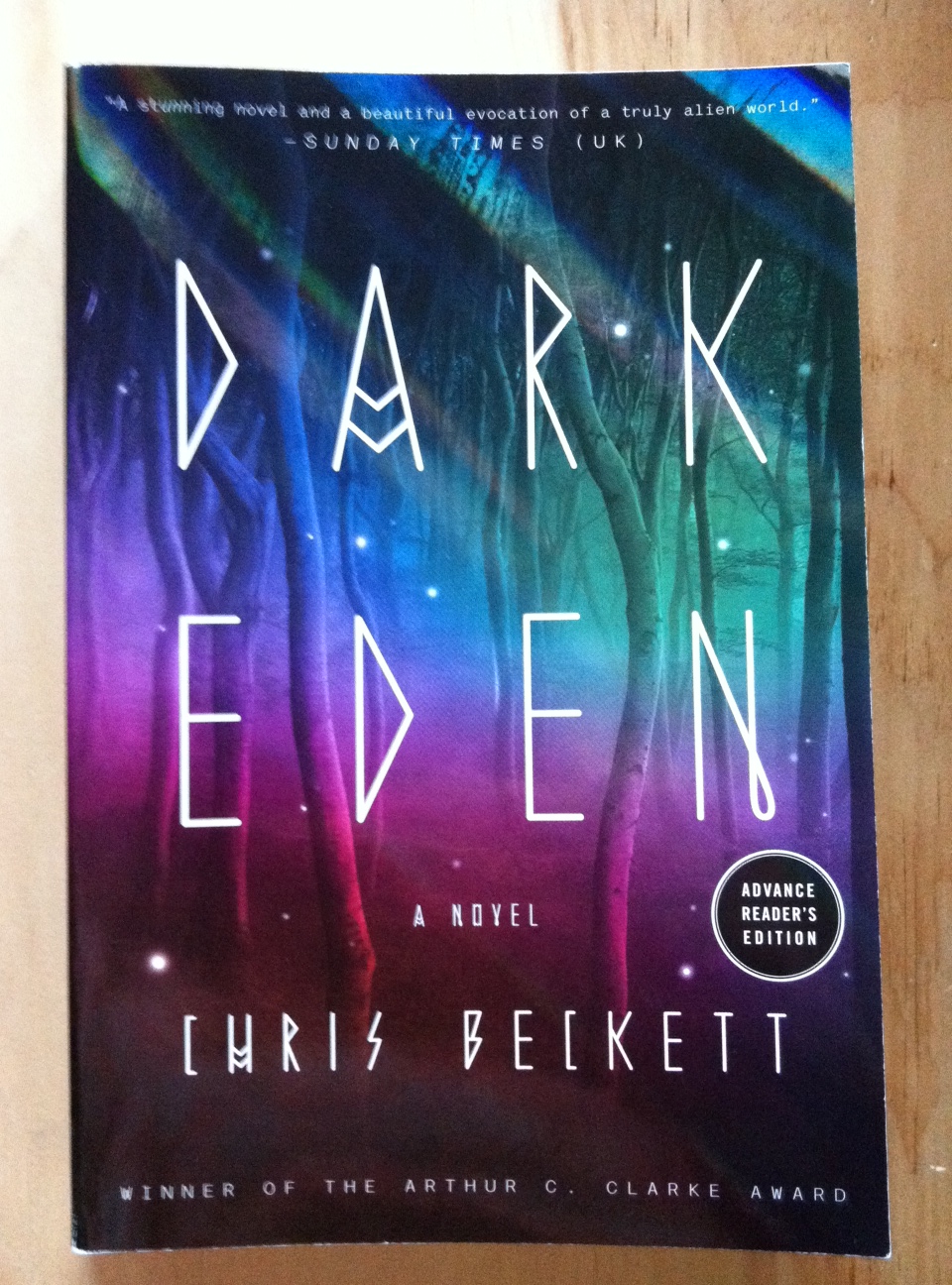
New and Recommended Reading: Chris Beckett’s Dark Eden

Anthropology meets sci-fi meets adventure meets myth-making meets bildungsroman meets philosophy in Chris Beckett’s remarkable new novel, Dark Eden*.

photo (65)On a planet without a visible sun, the Family lives in the glow of phosphorescent trees, waiting to be rescued by the people of their ancestors. Time is measured in terms of “wakings” and “womb-times”; Siren-like singing panthers kill in the forest, and giant worms lurk in the glowing trees. Eden is a frightening place even before the Family’s internal problems are taken into account. Years of inbreeding have produced genetic abnormalities in the small population; their vocabulary is dwindling; their oral tradition and laws and methods of keeping the peace are all strained to the point of breaking. Even food is becoming scarce.

The 532 inhabitants of Eden hear legends of a world where “lecky-tricity” made things move, where there was a sun in the sky, where people could make ships that left the world itself. And soon, the stories tell them, a “Landing Veekle” will take them back to that world.

But young John Redlantern isn’t content to wait. A cross between Prometheus and Cain, John wants to explore beyond the Family’s living area and hunting grounds, to remake Eden as a permanent home for the Family. He wants to do the unthinkable: traverse Snowy Dark, where the cold can kill and the darkness is absolute. It’s dangerous, and worse, it’s heretical. What will happen to the Family if their most closely-held beliefs are challenged?

Dark Eden‘s world-building is excellent, and refreshing, since it’s neither Star-Trekkian (gadgets and gizmos and talking computers) nor Hunger Games-style dystopian (our own world in a terrible mess). Don’t get me wrong — I love Star Trek and The Hunger Games. But it’s wonderful to read something fresh, that answers a question I wish I’d thought to ask: what would a primitive culture look like if it evolved on an alien planet from a tiny population with prior experience of technology and advanced culture?

It turns out that the intentions of the initial population matter a great deal; the Family’s founders attempted to give their children a good chance at long-term survival, insisting, for instance, that children go to school, that histories be preserved, that women and men are equal. As I mentioned above, the gender politics in the novel are fascinating; the Family doesn’t quite have a matriarchal power structure, but paternity isn’t tracked and sexual violence is unheard of in Eden.

One of Dark Eden’s best aspects is the author’s attention to linguistic detail. Over generations, vocabulary changes and some kinds of speech atrophy (oh, my poor subjunctive!). So, for example, in the Family’s oral/aural culture, some pronunciations are off (“lecky-trickety”), and intensifiers like “very” have been lost. To convey that something is “very cold,” John Redlantern or Tina Spiketree would say, “cold cold.” On the other hand, English slang (“bloke”) and personal euphemisms (“slipping” for “sex”) remain, perfectly out of place in an alien world.

Dark Eden‘s story is John Redlantern’s, in many respects, but he is not the sole narrator. Mr. Beckett chooses his other narrators carefully to give a rounded perspective on the world and John’s actions. Given the limited vocabulary all the narrators work with, the resulting polyphony is all the more impressive. This is literary sci-fi at its best, and highly recommended reading.

Tomorrow: An interview with Chris Beckett, author of Dark Eden

*My thanks to the publisher for sending me advance copy of this novel in exchange for an honest review.

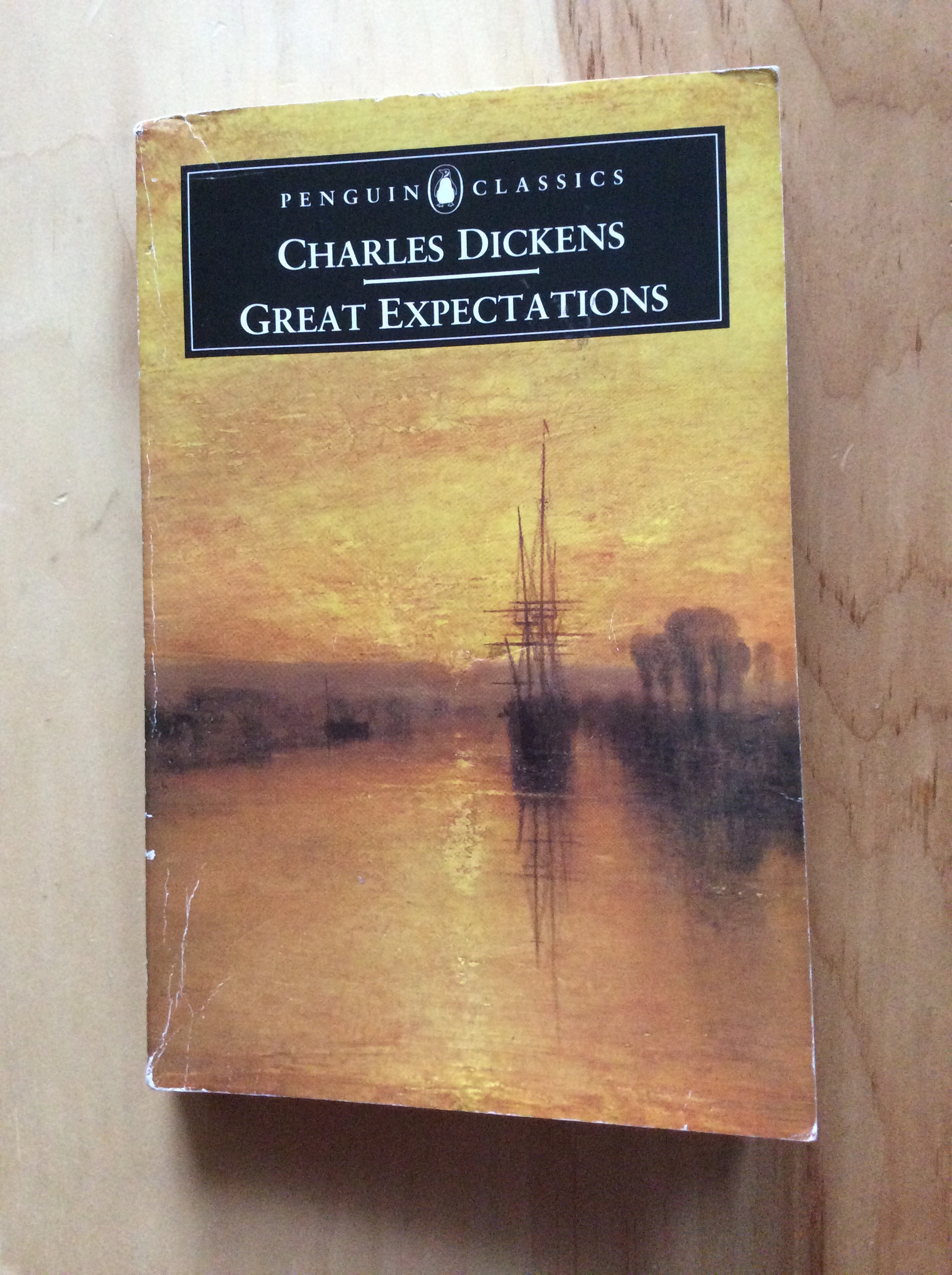
What Larks!: Dickens Re-evaluated

My fourteen-year-old self is going to think I’m Madame DeFarge. And not just because I learned how to knit a few years ago. No, it’s more the face-of-evil-betrayal thing.

I liked Great Expectations.

Horror of horrors: it appears that Mr. Dickens and I have come to an understanding.

I last read Great Expectations in the ninth grade — fifteen years ago, give or take. The following photo (64)year brought A Tale of Two Cities, which I will never read again thanks to truly irritating Lucie Mannette and her golden thread, and then I had a long break from Dickens until Hard Times popped up in a graduate seminar six or seven years ago, a break punctuated only by sporadic forays into David Copperfield.

Before this reading of Great Expectations, my major Dickensian complaints consisted of: Dickens’s long-windedness, his lack of subtlety, the tidy way that characters prove related to one another. Seriously. It felt like reading a nineteenth-century version of Crash sometimes.

Honestly, I put Great Expectations on my Classics Club list not from any noble intention to re-evaluate my own notoriously long-lived literary grudges (see: Steinbeck, Faulkner), but because at the time I thought I might like to read Havisham (still haven’t gotten around to it), and I like to read literary reimaginings with the original text firmly in mind. (Why I wanted to read Havisham is a story for another post.) When I decided was peer pressured into participating into the Classics Club Spin selection, I popped Great Expectations onto the spin list in position number 20, dead last, never thinking for a moment that it would really be picked.

I suppose I’ll be taking 5% chances more seriously from now on.


Great Expectations is Dickens’s penultimate completed novel, and though my edition clocks in at 484 pages (excluding notes and introduction), it’s one of the shortest of Dickens’s novels (which may halfway explain my change of heart). Unrequited love, the pursuit of wealth and status, the plight of the poor, and the nature of guilt are themes traced through the novel.

On the bleak marshes of Kent, Pip, a young orphan, has no expectations at all when the novel begins, except perhaps a slap upside the head from his sister, or a kind word from her blacksmith husband, Joe Gargery (the pair are raising him). A chance encounter with a runaway convict causes Pip no end of fright and guilt, until those emotions are eventually crowded out by his love for and anxiety over Estella, the cold and contemptuous ward of the ghastly Ms. Havisham. Notified one day that a mysterious benefactor wishes Pip to become a gentleman, Pip leaves his home, Joe, and Estella behind, setting out for London and the issuance of his “great expectations.” Once there, however, the new wealth that confers upon Pip the status of gentleman also separates him from the people he loves, and, often, the best parts of himself. Great Expectations is largely concerned with the forces, both internal and external, that shape Pip’s character.

The novel’s narration is an older (and perhaps wiser) Pip, who looks on his childhood self’s foibles and his adolescent self’s willful errors with an uncompromisingly honest eye. His narration is wry, emotional, often funny. Pip meets a typical cast of Dickensian characters on his road: Jagger, the unscrupulous, clever, perpetually hand-washing lawyer; Joe, the gentle blacksmith, unfailingly tender-hearted, too convinced of his own unworthiness to correct Pip’s faults; Mr. Wopsle, the ridiculous cleric-turned-actor; Miss Havisham, withering and decaying in her own bitter memories.

And Wemmick, my favorite character in the novel. Wemmick is, I think, Dickens’s embodiment of modernity and practicality. While tender-hearted and thoughtful at home, caring for his deaf father (“The Aged Parent”) and sneaking his arm around proper Miss Skiffins’s waist, Wemmick transforms into an entirely different creature at Jaggers’s office, where he works as a clerk. He remonstrates with clients, ignores their tears, and carries out his duties without any regard to the suffering around him. It’s as if he shuts down his emotions as a form of self-preservation; otherwise, how could he bear what he sees every day? I suspect that this is Dickens’s commentary on the kind of person one must become to survive in — though not change — the modern world.

I know I didn’t appreciate Wemmick fifteen years ago because he came as a total surprise to me. What I also failed to see as a fourteen-year-old was Dickens’s marvelous sense of humor — abundantly evident in caricature studies, if you will, but here particularly in bleak, black humor. The novel’s second paragraph, after Pip explains the origin of his name in the first, is an extended joke. Pip explains how he derived a sense of his parents’ characters and his siblings’ physical attitudes from their tombstones:

As I never saw my father or my mother, and never saw any likeness of either of them (for their days were long before the days of photographs), my first fancies regarding what they were like were unreasonably derived from their tombstones. The shape of the letters on my father’s, gave me an odd idea that he was a square, stout, dark man, with curly black hair. From the character and turn of the inscription, “Also Georgiana Wife of the Above,” I drew a childish conclusion that my mother was freckled and sickly. To five little stone lozenges, each about a foot and a half long, which were arranged in a neat row beside their grave, and were sacred to the memory of five little brothers of mine,—who gave up trying to get a living, exceedingly early in that universal struggle,—I am indebted for a belief I religiously entertained that they had all been born on their backs with their hands in their trousers-pockets, and had never taken them out in this state of existence.

The tragic death of five infant boys transmuted into the image of children born with trousers on, relaxed and jaunty — how strange, how macabre, how childishly innocent!

Take, then, the next paragraph:

Ours was the marsh country, down by the river, within, as the river wound, twenty miles of the sea. My first most vivid and broad impression of the identity of things seems to me to have been gained on a memorable raw afternoon towards evening. At such a time I found out for certain that this bleak place overgrown with nettles was the churchyard; and that Philip Pirrip, late of this parish, and also Georgiana wife of the above, were dead and buried; and that Alexander, Bartholomew, Abraham, Tobias, and Roger, infant children of the aforesaid, were also dead and buried; and that the dark flat wilderness beyond the churchyard, intersected with dikes and mounds and gates, with scattered cattle feeding on it, was the marshes; and that the low leaden line beyond was the river; and that the distant savage lair from which the wind was rushing was the sea; and that the small bundle of shivers growing afraid of it all and beginning to cry, was Pip.

Pip introduces us to his child-self at the moment of self-realization, at the moment when he places himself within the context of his surroundings. And we learn what remains, for most of the novel, Pip’s defining characteristic: fearfulness. As a child, Pip fears his sister and her abuse, fears for his own safety once he’s met the convict, fears Estella’s coldness, fears becoming trapped in his provincial town with a respectable profession. Later he fears what people will think of him if acts a certain way; he even fears the boy he hires to be his valet. And of course he fears losing Estella, and fears that his convict will not forget him.

Though Pip-the-narrator never excuses his own (sometimes deplorable) behavior, in the background Dickens always seems to be saying, “consider the circumstances!”; take, for example, the paragraph I have just cited. Dickens emphasizes that Pip’s parents and brothers are dead; the churchyard overgrown with nettles suggests that the church (or religion) will be of little help to Pip (and indeed religion plays little role in the story); and the bleakness of the physical environment suggests that even nature will not be a comfort to Pip. Great Expectations provoked more marginalia for me than any other book this year — just look at the layering of adjectives that describe Pip’s surroundings: raw, bleak, overgrown, dark, flat, low, leaden, distant, savage. A fearsome environment for a “small bundle of shivers.”

Here’s part of Dickens’s description of the convict: “A man who had been soaked in water, and smothered in mud, and lamed by stones, and cut by flints, and stung by nettles, and torn by briars.” Textbook “good” writing — all action verbs — but the convict is the object of the actions; all these things have happened to him. What wonder then that he wants to become a man of action, to make things happen himself? What wonder then that he acts savagely to instill fear in a mere child?

(The characters for whom Dickens reserves real contempt are those who lack circumstances dire enough to mitigate their behavior: the second convict, Pip’s sister, the pompous bully Pumblechook, Herbert’s non-maternal mother.)

I’ve rambled on and only covered the first two pages of the novel — as you might imagine, the rest provoked plenty of commentary in the margins. I couldn’t help but think, as I read, that I must be missing things that would be obvious to people who specialize in Victorian literature (hi, Joanna!), people I’ve regarded with incredulity for years because they make a regular habit of reading Dickens. I’m sorry that it’s taken me so long to remake Wemmick’s acquaintance, and Joe Gargery’s, and I plan on reading Great Expectations again.

But don’t count on me reading Tale of Two Cities anytime soon.


A final aside, Dear Readers, for those who’ve read Milton and those who are considering the plunge: here are the last lines of Volume I, as Pip is about to embark upon his “great expectations”:

We changed again, and yet again, and it was now too late and too far to go back, and I went on. And the mists had all solemnly risen now, and the world lay spread before me.

Compare these passages, from Paradise Lost, Book XII:

from the other hill
To their fixed station all in bright array
The cherubim descended, on the ground
Gliding meteorous as evening mist
Ris’n from a river o’er the marish glides
And gathers ground fast at the laborer’s heel
Homeward returning.

and

The world was all before them, where to choose
Their place of rest, and Providence their guide.
They hand in hand with wand’ring steps and slow
Through Eden took their solitary way

See what Dickens did there? Pip may be off to find his great expectations, but Paradise is behind him. And then, we must ask, what kind of paradise was it?