The Poetry Concierge Recommends: Sharon Olds

[The Poetry Concierge is an occasional feature here on Rosemary and Reading Glasses wherein I select a poem, poet, or book of poems for individual readers based on a short questionnaire. Come play along! Read the introductory post here, my first recommendation here, and then email me at: rosemaryandreadingglasses [at] gmail [dot] com. ]

This week, our pilgrim in search of poetry is Laura, who writes about things bookish at Reading In Bed.

1. When you read fiction, who’s your go-to author?

This is hard, there’s no one author who is perfect in my eyes. I might say Michael Ondaatje because I’m in love with him right now. Or I might say David Adams Richards, who if you haven’t read him, lists Faulkner, Dostoyevsky and Emily Bronte among his influences, which sounds about right.

2. If you read nonfiction, which subjects are most likely to interest you? (cultural history, science, biography, memoir, survival stories?)

Personal essays, feminism

3. If you were stuck on a desert island for a week, which five books would you bring to keep you entertained?

Astray by Emma Donoghue
The Many Lives and Secret Sorrows of Josephine B, Sandra Gulland
The Crimson Petal and the White, Michel Faber
High Fidelity, Nick Hornby
The Tenant of Wildfell Hall by Anne Bronte (haven’t read it yet FYI but it’s calling to me)

4. If you were on a five-year mission to Mars, which five books would you bring to keep you sane?
Love in the Time of Cholera
A Confederacy of Dunces
The Stone Angel
Mercy Among the Children
Having trouble with #5!

5. What kinds of questions are most likely to keep you up at night? (death, the nature of love, politics, environmental issues, meaning of life, end of the world, justice and injustice, etc?)
 

Nature of love 80+% of the time

6. If you’ve read poetry before, what have you liked? What have you disliked?

I like prose that reads like poetry. See comment about The English Patient above. In high school I liked John Donne. I liked The Inferno.


Like Kay last week, Laura’s given me lots to work with here: a wide range of authors (not surprising, I guess, since her one of her reading lists is 1001 books long), varied in tone, themes, and style; defined interests; and an openness to poetry in general.

Now, I was tempted to cheat a little and recommend Michael Ondaatje right off (maybe The Cinnamon Peeler?), but I suspect Laura’s thought of that one already. Given her interests in feminism and personal essays, though, I started thinking about feminist poets: Audre Lorde, Adrienne Rich, Carol Ann Duffy, Katha Pollitt, Carmen Giménez Smith (by no means is this an exhaustive list). I think Laura would like the work of any of these poets (and I was inches from choosing Audre Lorde’s “Now That I Am Forever with Child” but I can’t find an online source with copyright permission, so try your local library for her Collected Poems.).

That said, I think the work of Sharon Olds would appeal to Laura, and so I’m recommending Strike Sparks: Selected Poems 1980-2002, which I think gives a rounded view of her work up until that point (she’s published two collections since then; Stag’s Leap won the 2013 Pulitzer for poetry.

Ms. Olds draws on her personal experiences and familial relationships (and not infrequently, her sex life) to construct poems that are simultaneously deeply personal and startlingly universal. While her work is sometimes controversial because of its sexual content, I’m guessing Laura won’t bat an eye after that time we read a paranormal romance.

For now though, Dear Readers, here’s a G-rated but jarring poem to get you started with Sharon Olds:

“I Could Not Tell”

Laura, I hope you’ll find poems you love in this book (Michael Ondaatje did!).  Thanks for writing in!


Would you like the Poetry Concierge to make a recommendation for you? Check out the introductory post, and send your answers to the questionnaire, along with the name and/or blog you’d like posted with the reply, to rosemaryandreadingglasses [at] gmail [dot] com.
The Poetry Concierge Recommends: Two Books (oh my!)

[The Poetry Concierge is an occasional feature here on Rosemary and Reading Glasses wherein I select a poem, poet, or book of poems for individual readers based on a short questionnaire. Come play along! Read the introductory post here, my first recommendation here, and then email me at: rosemaryandreadingglasses [at] gmail [dot] com. ]

This week, our pilgrim in search of poetry is Abby, who blogs about invertebrate marine biology over at The Spineless Life. Weren’t expecting that, were you? Abby and I attended the same high school, walked the boards of the same stage, and now she’s an awesome scientist-ninja.

1. When you read fiction, who’s your go-to author?

My go-to authors change as I read through all of their material. Among people still writing, I am partial to John Irving and Ian McEwan, but also have a very strong liking for Steinbeck, Zola, and Edith Wharton (among recent favorites). Oh, and C.P. Snow.

2. If you read nonfiction, which subjects are most likely to interest you? (cultural history, science, biography, memoir, survival stories?)

I spend all day reading technical science writing, but I still love popular science, as well as travel memoirs. I frequently pick up histories and biographies but rarely make it through.

3. If you were stuck on a desert island for a week, which five books would you bring to keep you entertained?

5 books for a week? Oof. Let’s go with a book of nature essays by David Quammen, The Glass Bead Game (Hesse), Atonement, Slaughterhouse Five, and Wuthering Heights. (actually, that’s a nice cross-section of my strange reading habits right there.)

4. If you were on a five-year mission to Mars, which five books would you bring to keep you sane?
5 books for 5 years is actually easier, because my to-read list is full of long ones that would require that sort of time. War & Peace (no really, Anna Karenina is a favorite of mine), In Search of Lost Time (does that count as a single book?), Stephen Jay Gould’s The Structure of Evolutionary Theory, and to balance all of this heft, Paris to the Moon (Adam Gopnik, already read and loved), and A Tree Grows in Brooklyn (also a favorite).

5. What kinds of questions are most likely to keep you up at night? (death, the nature of love, politics, environmental issues, meaning of life, end of the world, justice and injustice, etc?)
 

Hm. Climate change. My love life. The meaning of family. The state of the academic job market.

6. If you’ve read poetry before, what have you liked? What have you disliked?

I love things that rhyme and have meter, and really don’t like things that don’t. I adore Poe and Longfellow, and “O Captain My Captain” and “The Charge of the Light Brigade” and “In Flanders Field” and pretty much everything else that you would find in an anthology of familiar, comforting verse. When I find something new that I really like, it has some element of familiarity — the rhyming scheme or the rhythm. French surrealism and I did not mix well.


There may have been a fist pump in my vicinity when I read the first phrase of Abby’s last answer: “I love things that rhyme and have meter.” Me too, ladyfriend, and while I’ll read pretty much any kind of poetry out there, there’s something sweet and satisfying about ye olde formalism.

Or, for that matter, the New Formalism. Yes, my Dear Readers, just like 90s fashion, formalism is back. Well, it never really went away (neither did 90s fashion, judging by the amount of flannel that’s lived in my closet for the intervening years), but let’s set that aside for the moment while I recommend post-World War II poetry for Abby.

Given Abby’s fearlessness toward long reading assignments (War and Peace, In Search of Lost Time), I’m going to be daring and recommend two books:

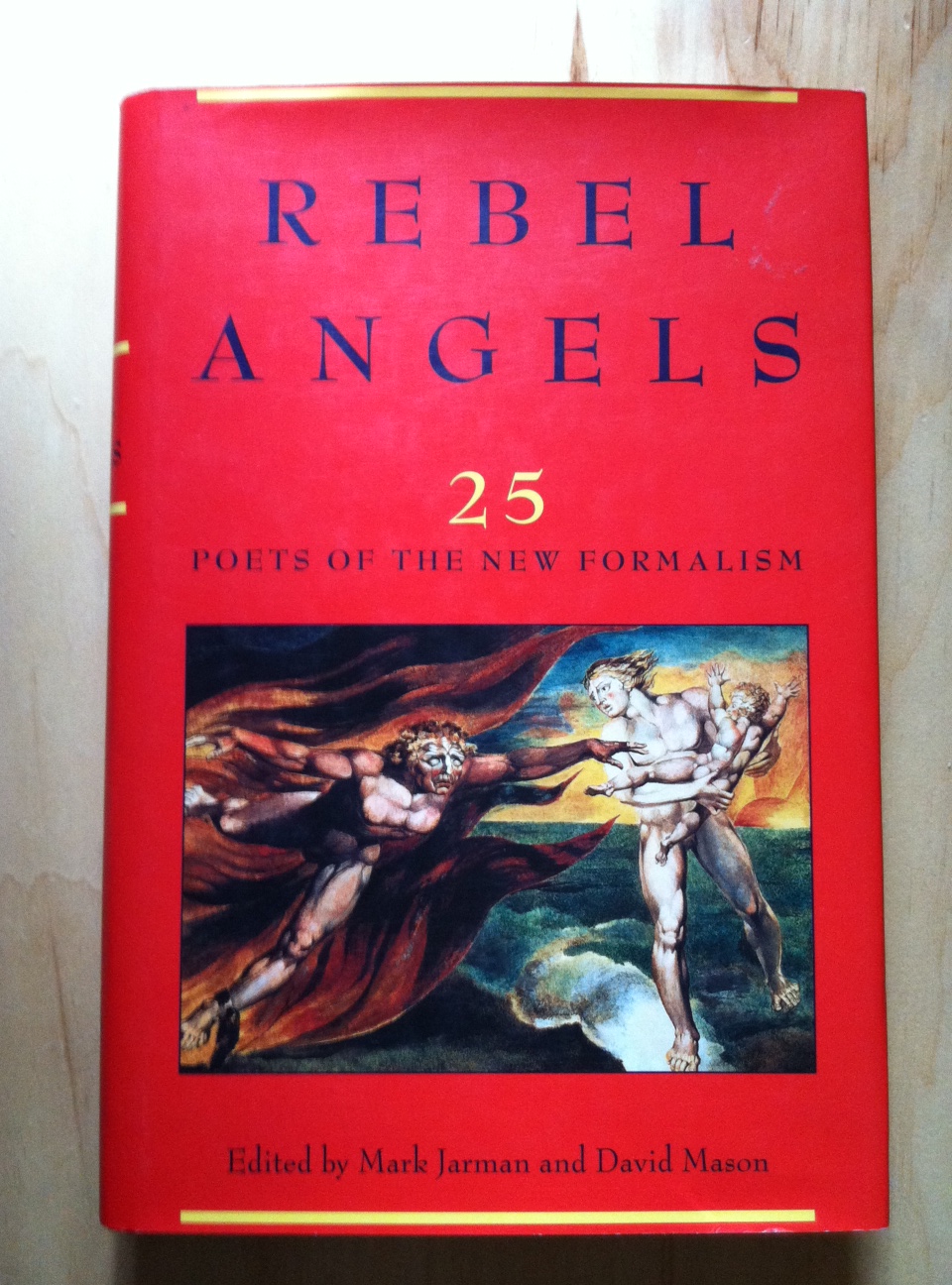
photo (73)Rebel Angels: 25 Poets of the New Formalism came out in 1996, and it’s a great sample of newer formalist work. As with all anthologies, not every poem will appeal to every reader, but I think Abby will find lots to like here. I’d especially recommend the poems by Andrew Hudgins, professor of poetry at The Ohio State University, fabulous reader, and friend of several friends.


photo (72)One of Professor Hudgins’s former students is Ashley McHugh, and it’s her luminous debut, Into These Knots, that I’m also recommending. (Full disclosure: Ashley is a friend, and I’ve met Andrew Hudgins a few times, and been regaled with tales of his workshops more times than I can count.)  Ms. McHugh is an especially accomplished sonneteer, as you’ll see when you read this poem, “The Unquarried Blue of Those Depths is All But Blinding,” which she wrote for her now-husband.

Abby, I hope you’ll find poems you love in these books. Thanks for writing in!


Would you like the Poetry Concierge to make a recommendation for you? Check out the introductory post, and send your answers to the questionnaire, along with the name and/or blog you’d like posted with the reply, to rosemaryandreadingglasses [at] gmail [dot] com.

Coming Soon: The Bees, by Laline Paull

When I was a child, I hated Watership Down.

I think most of my dislike was bound up in the movie, which I found frightening — to this day, the only memories I have of it are images of cartoon rabbits spouting blood — because the writing itself didn’t make an impression on me. Reading synopses now, I suspect that if I tried it again I’d find it deeply aggravating for its attitude toward female characters.

imageI bring this up because Laline Paull’s The Bees* (out May 6 from Ecco) is garnering praise that compares it to Watership Down, and so I’m here to tell you that if you didn’t like Watership Down, you might still like The Bees — I did, very much.

Like Watership Down, The Bees‘s main characters are nonhumans, in this case — you guessed it — bees. Flora 717 is born ugly, deviating far enough from the norms of her hive that she’s about to be killed when an older, powerful bee steps in to save her life. Flora, she thinks, might be useful; she decides to allow Flora to live on a temporary basis.

As a member of the lowest caste of bees — a sanitation worker — Flora is surprised to find herself in the nursery feeding infants, but that’s just the first twist that’s in store for her. The hive mantra is “Accept, Obey, Serve,” which Flora, devoted to the queen (as are her sisters) tries desperately to follow as she faces dangers both within and without the hive: the vicious Fertility Police, a marauding wasp, and the unwelcome attentions of the hive’s overfed and pampered drones. Flora’s role in the story changes as she grows and learns; sometimes she seems like a Cinderella figure, or a questing knight, or Katniss Everdeen, or Offred. She’s a compelling heroine with six legs and an acute sense of smell — courageous, loyal, fierce, hardworking.

The Bees is not a book suitable for children; Ms. Paull does not shy away from the violence and cruel practicalities of life in the hive (an interviewer suggested that some scenes were reminiscent of Game of Thrones, to which Ms. Paull replied: “Game of Drones!”). The book doesn’t suggests that bees — one of the most complex and successful animal species — survive despite the violence, but that their society in some ways requires it. In fact, some of these scenes are so strange that I thought “there’s no way bees behave this way’; after a little research, I realized, yes, they do. I loved that this book prompted me to learn something outside of my general areas of interest.

While the novel’s environmental message is none too subtle, Ms. Paull does keep the focus on character development and extraordinary descriptions of hive structures and practices from the bees’-eye view. The pacing is brisk and careful, and the bees’ world feels totally new (believe me, you’ll never look at a candle or a jar of honey the same way again). The Bees is an absorbing, imaginative debut, and perfect late-spring reading.

*I received a copy of this book from the publisher in exchange for an honest review. 

The Poetry Concierge Recommends: Dorothy Parker

[The Poetry Concierge is an occasional feature here on Rosemary and Reading Glasses wherein I select a poem, poet, or book of poems for individual readers based on a short questionnaire. Come play along! Read the introductory post here, my first recommendation here, and then email me at: rosemaryandreadingglasses [at] gmail [dot] com. ]

This week, our pilgrim in search of poetry is Kay, who blogs about books over at WhatMeRead.

1. When you read fiction, who’s your go-to author?

I don’t know that I have just one go-to author, but maybe Jane Austen. I reread all her books every few years.

2. If you read nonfiction, which subjects are most likely to interest you? (cultural history, science, biography, memoir, survival stories?)

History and biography/memoir (but not usually celebrity biography/memoir) are my favorite nonfiction subjects. I read mostly biographies about figures from history, and literary people or artists.

3. If you were stuck on a desert island for a week, which five books would you bring to keep you entertained?

I would need a big book for the island, so that might be Bleak House. I would need something funny, so that might be something by Georgette Heyer, maybe Cotillion. I would need something I hadn’t read before, maybe another book by Halldor Laxness. I have The Fish Can Sing on my Wish List, so let’s pick that one. I would need something that makes me cry about someone else, so maybe Sense and Sensibility. I would need something about resourceful people to keep me encouraged, so maybe Life After Life by Kate Atkinson. I just read Robinson Crusoe, so I would NOT take that!

4. If you were on a five-year mission to Mars, which five books would you bring to keep you sane?
Hmmm, you’re really trying to make me think, aren’t you? If I was on a five-year mission to Mars, at least I would know I was coming back, so maybe that would be a different choice than the island all right. I’m thinking big books that feel like friends and I can read over and over again: David Copperfield, Jane Eyre, Cloud Atlas or The Thousand Autumns of Jacob De Zoet, maybe read The Luminaries again, and something with beautiful language I can puzzle over, maybe something I haven’t read by Nabokov.

5. What kinds of questions are most likely to keep you up at night? (death, the nature of love, politics, environmental issues, meaning of life, end of the world, justice and injustice, etc?)
 

I actually write reviews in my head at night after I finish a book. Sigh. Also, sometimes work.

6. If you’ve read poetry before, what have you liked? What have you disliked?

I have liked Frost, ee cummings, Shakespeare’s sonnets, some Yeats that isn’t too obscure, some Edna St. Vincent Millay. I have not liked Ezra Pound, because I don’t understand him at all. I have not liked some of the romantic poets, because they have too many allusions to things I don’t know enough about to understand them. Also, I think Keats and Wordsworth are boring. I generally don’t like really long poems, because I find I can’t concentrate on them long enough.


Well, I admit that I’m nervous with this pick, because not only is Kay a very sophisticated

reader, but she’s also read everything (it seems), and she doesn’t pull her punches. On the

Dorothy Parker | Image courtesy Wikimedia commons

Dorothy Parker | Image courtesy Wikimedia commons

other hand, someone who’s liked Shakespeare, ee cummings, and Edna St. Vincent Millay (oh Edna, you’re my favorite) gives me lots of leeway in choosing a poet to recommend. I thought about Howard Nemerov, Seamus Heaney, and Louise Glück, and I think their poetry (judiciously selected) would have been just fine for our purposes.

But Kay makes me laugh with her often acerbic reviews, and for someone whose go-to author is Jane Austen, I think urbane, mordant wit is called for. Enter: Dorothy Parker.

A screenwriter, poet, and satirist, Dorothy Parker is celebrated for her impeccable way with the bon mot, her short and snappy poems with the bite at the end, and her perennial quotability (seriously, she’s on this Kate Spade tote.).

Here are two of her poems, with characteristically deceptive titles: “Interview” and “Love Song.”  Let’s also call “Interview” our poem of the week, shall we?

Kay, I hope these poems make you laugh. Thanks for writing in!


Would you like the Poetry Concierge to make a recommendation for you? Check out the introductory post, and send your answers to the questionnaire, along with the name and/or blog you’d like posted with the reply, to rosemaryandreadingglasses [at] gmail [dot] com.

Recommended Reading: Evie Wyld’s All the Birds, Singing


20140423-140244.jpgEvie Wyld’s All the Birds, Singing* is a terrifying novel, combining bump-in-the-night horror with the kind of terror inspired by the cruelty of ordinary human beings. More than once I had to put the book down because the writing was so intense I could feel my heart pounding, and that’s pretty unusual in my reading experience.

Something — or someone — is killing Jake Whyte’s sheep. She lives alone on an unidentified British island with only her sheep and her dog (named Dog) for company, resolutely refusing calls to socialize with other locals. She’s an outsider in more way than one, though isolated, it seems, by choice. But the death of her sheep forces her into contact with other people as she searches for answers: Don, a kindly neighbor; Lloyd, a stranger whose agenda is unclear; and neighborhood kids with maybe more than mischief on their minds.

While Jake wonders who’s gutting her sheep, the reader wonders how Jake ended up on island by herself, and why she’s so gruff and frightened. As Jake works on her mystery in the present day (using the past tense), alternating chapters take us back to the past, in which Jake narrates the events that led to her leaving Australia for England, and how, exactly, she started raising sheep. These past-chapters unfurl backwards, but are narrated in the present tense, lending a firghtening immediacy to Jake’s memories of violence and fear.

Ms. Wyld’s writing is fierce, clear, and perfectly detailed. Her deft touch finds the perfect balance between intimacy and mystery as she brings Jake to life. Take this paragraph, from the first chapter:

I slammed the fridge and leant my head against it. Stupid to have become so comfortable. The fridge hummed back in agreement. Stupid to think it wouldn’t all fall to shit. That feeling I’d had when I first saw the cottage, squat and white like a chalk pebble at the black foot of the downs, the safety of having no one nearby to peer in at me — that felt like an idiot’s lifetime ago. I felt at the side of the fridge for the axe handle.

It’s the kind of writing that offers new questions even as it answers others. All the Birds, Singing is brilliant and brutal, and highly recommended.

*My thanks to the publisher for sending an advance review copy of the book in exchange for an honest review.

“Once I walked out and the world / rushed to my side”: Mark Wunderlich’s The Earth Avails

photo (70)Brimming with life and color, Mark Wunderlich’s collection The Earth Avails* is the perfect book to read on Earth Day. In these poems, the natural world is both celebrated and mourned in a speaker’s voice that is sometimes measured, sometimes impassioned, and always thoughtful.

In his Notes on the poems, Mr. Wunderlich explains that upon reading a nineteenth-century small book of German prayers found in his family’s home, as well as Heaven-letters, “folk-religious documents” from the eighteenth and nineteenth centuries, he adapted these documents into poems (69). Roughly half the poems in The Earth Avails take the form of prayers or Heaven Letters; in their posture of supplication, in their evocations of simple desires (“spare the orchards from hail”), they nonetheless suggest that the power addressed is the power of language itself, building in rumbling, crescendoing couplets.

In adapting these older forms, Mr. Wunderlich has written poems with an utterly fluid sense of time. A poem might include charms against flooding or pests or disease — common enough nineteenth-century agrarian concerns — but then mention at its end a detail that places the poem in a contemporary world. The juxtaposition is pleasantly jolting, showing us just how rooted we are in the past — and how far we are from it — while offering the promise that the sense of connection to the land we think we’ve lost could be recovered.

Many of the poems reflect the landscape, both interior and exterior, of Mr. Wunderlich’s home in the Hudson Valley. The word that kept coming to mind as a I read was “renovation,” not only in the sense of rebuilding a structure, like the house here with its “crumbling cow-hair plaster mending the wall,” but also in its etymological sense of “to make new again.” The poems in The Earth Avails make the natural world new again, giving us fresh eyes to see the coyote with mange, or “the green worms / ciphering the cabbages’ leaves” or the wild boar’s “rusty wool along the belly.”  These poems reflect engagement with other nature poets (Robert Frost came to mind more than once, and “Sand Shark” would be a perfect companion piece for anyone teaching Elizabeth Bishop’s “The Fish”), and since I’ve just read The Poetic Species, I couldn’t help thinking about the ways in which this volume works at the intersection of the humanities and the sciences.

I think you can probably tell that I loved these poems. I highly recommend The Earth Avails.

The featured poem of the week is “Prayer for a Birthday,” by Mark Wunderlich, which appears in The Earth Avails. You can read the poem, and a short comment from the poet, on Poets.org.

*My thanks to the publisher for sending me a copy of this book in exchange for an honest review.

The Poetry Concierge Recommends: Robert Frost

[The Poetry Concierge is an occasional feature here on Rosemary and Reading Glasses wherein I select a poem, poet, or book of poems for individual readers based on a short questionnaire. Come play along! Read the introductory post here, my first recommendation here, and then email me at: rosemaryandreadingglasses [at] gmail [dot] com.]

This week, our pilgrim in search of poetry is Tania, who runs (along with Kirt) Write Readsa blog and Canadian reading book club podcast.

1. When you read fiction, who’s your go-to author?

I can only pick one? Okay, Margaret Laurence …but there are so many others!! 

2. If you read nonfiction, which subjects are most likely to interest you? (cultural history, science, biography, memoir, survival stories?)

Travel, Political/Social Commentary and anything by Bill Bryson.

3. If you were stuck on a desert island for a week, which five books would you bring to keep you entertained?

The Diviners by Margaret Laurence
I Shall Wear Midnight by Terry Pratchett
The Name of the Wind by Patrick Rothfuss
The Decameron by Boccacccio
The Rebel Angels by Robertson Davies

4. If you were on a five-year mission to Mars, which five books would you bring to keep you sane?

An Abundance of Katherines by John Green
Sunshine Sketches of a Little Town by Leacock
The Diviners by Margaret Laurence
The Name of the Wind by Patrick Rothfuss
Asterios Polyp by Mazzuchelli

5. What kinds of questions are most likely to keep you up at night? (death, the nature of love, politics, environmental issues, meaning of life, end of the world, justice and injustice, etc?)
 

Meaning of life
Justice/Injustice

6. If you’ve read poetry before, what have you liked? What have you disliked?

I’ve liked a lot of T.S. Eliot. I’ve liked more story-telling poems and less of the random images and symbols that I don’t understand poetry 🙂


Ok, so this is a tricky one, because I haven’t read any of the books that Tania lists! (Well, excerpts from The Decameron, and I’ve read one Bill Bryson book, but still.) However, with a little poking around, I got the sense that Tania likes well-developed characters, vignette-like structures, and a strong sense of place. It’s these last two qualities, in particular, that lead me to recommend that American poet everyone thinks he knows, Robert Frost.

Modern in sensibility, if not in form, Frost’s poetry is rooted in nature, and the woods of New England, in particular. Many of his poems read like vignettes, records of small moments in country life, whether everyday (“Stopping by Woods on a Snowy Evening”) or horrific (“‘Out, out–‘”). Darkness lurks around the edges of the very poems that are so often celebrated for their beauty and felicitous phrasing; isolation, death, and despair walk in the woods, too.

Take Robert Frost’s “The Wood-Pile”, which I think might be just right for Tania. The speaker is far from home, walking through a frozen swamp, and before we can wonder why, we’re distracted by the flighty bird that’s leading the speaker on, and then by the wood-pile, orderly but abandoned, out in the woods. There’s so much going on with that wood-pile that I’ll let you discover it for yourself.  I hope you’ll like this poem, Tania, and Robert Frost’s work, too!


Would you like the Poetry Concierge to make a recommendation for you? Check out the introductory post, and send your answers to the questionnaire, along with the name and/or blog you’d like posted with the reply, to rosemaryandreadingglasses [at] gmail [dot] com.

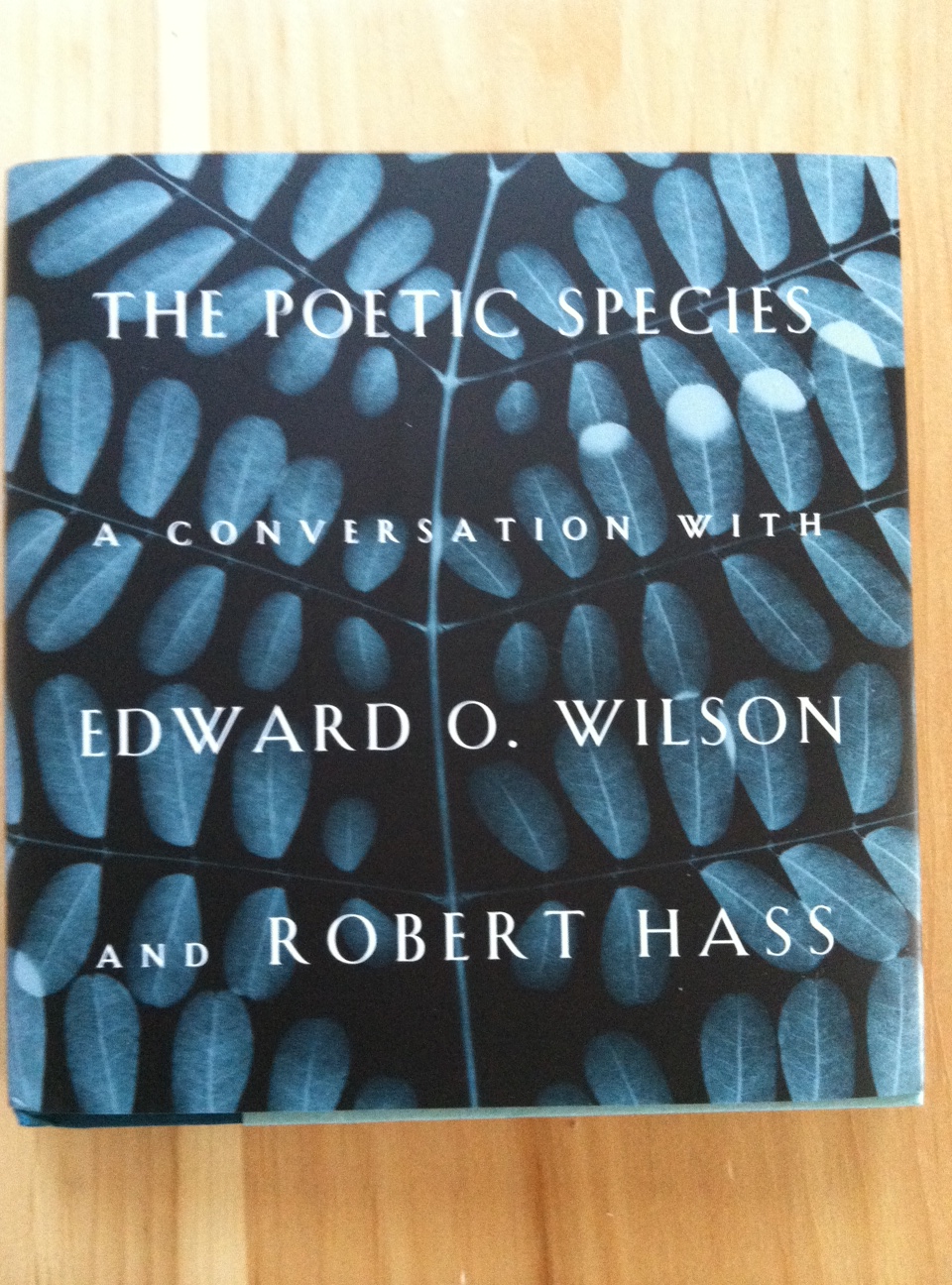
Recommended Reading: The Poetic Species: A Conversation with Edward O. Wilson and Robert Hass

photo (69)This slim volume — beautifully designed, by the way — is the record of a conversation between two careful thinkers: Edward O. Wilson (better known as E. O. Wilson, perhaps), a biologist famous for his work on ants and his sometimes controversial theories about evolution, and Robert Hass, a highly acclaimed poet, essayist and environmentalist who is a former Poet Laureate.The event — think a long-form TED dialogue — took place in late 2012, was co-sponsored by Poets House and the American Museum of Natural History.

As Lee Briccetti writes in the Foreword to The Poetic Species*, “Poetry is not purely associative. Science is not purely analytic. All skilled human production depends on subtle networks of cognitive capacities and the ability to transition between them” (23). Professor Wilson and Professor Hass came together to talk about the ways that science and the humanities inform each other, and how thinkers in both disciplines might come together to protect the natural world.

The first part of the discussion traces Professor Wilson’s theory of the perpetual conflict embedded in human nature (and yes, the question of “human nature” is, as it’s often maddeningly put in the academy, “vexed”): a tendency toward altruism with regard to members of one’s social group (and concomitant hostility toward outside groups), and the impulse to act selfishly at the individual level. Professor Hass notes, “the dance of the tension between these two things must constitute something of what we mean by consciousness, by the experience of having choice and free will and moral life. A productive oscillation between a social self and a private, individual self, in each person and in the species” (40-41). He goes on to suggest that this kind of oscillation appears in art, between form and departure from form, between what makes us comfortable and what challenges us and makes us uncomfortable.

Professor Wilson, too, emphasizes the connection between biology and art: “I’ve suggested many times that the humanities, and especially the creative arts, are the natural history of Homo sapiens” (48). In his view, “The creative arts are the sharing of our inner desires and humanity’s struggle. The humanities are our way of understanding and managing the conflict between the two levels that created Homo sapiens” (53). Put another way, in Robert Hass’s words: “At a very simple level, poetry can give us someone to talk to. To read is, in that way, to have your inner life acknowledged by somebody else’s” (78).

(As you can probably tell, I’d love to quote great swaths of the dialogue in this review, but then I’d run the risk of quoting the whole book; every page offers something worth contemplating. I’d love to see more collaborations of this kind in print, and I’d happily read another conversation between E.O. Wilson and Robert Hass. While The Poetic Species takes the initial format of Professor Hass interviewing Professor Wilson about his work, and works from that point, I’d like to read another conversation in which Professor Wilson questions Professor Hass about the natural elements in his poetry (which is deeply rooted in the environment of northern California). Given Professor Wilson’s admission, in his own list of suggested reading, that he does not read literature for its own sake, perhaps this is wishful thinking.)

The last third of The Poetic Speciesis an impassioned plea for conservation of wildernesses, a plea to take the initiative to save places and species that are in danger of disappearing. Wilson says, “I’m spending more and more of the time I have left on national parks” (67). Both men encourage education of young people in both biology and the humanities to promote environmental stewardship; Wilson suggests that education should go beyond facts and terms — “it’s somehow got to be made into a story” (76). Common Core creators, take note.

Reflecting on elegant solutions in math and sciences, Hass says, “Beauty sends out ripples, like a pebble tossed in a pond, and the ripples as they spread seem to evoke among other things a stirring of curiousity. The aesthetic effect of a Vermeer painting is a bit like that. Some paradox of stillness and motion. Desire appeased and awakened” (79). That’s how science and poetry work — we solve one problem, come to one possible solution, and another question presents itself — like endless webs that spin outward and outward to gather us all in.

The Poetic Species is a fascinating foray into the ways we’re connected to each other and the natural world — highly recommended reading.

*My thanks to the publisher for sending me an advance review copy of this book in exchange for an honest review.

The Poetry Concierge Recommends Margaret Atwood

[The Poetry Concierge is an occasional feature here on Rosemary and Reading Glasses wherein I select a poem, poet, or book of poems for individual readers based on a short questionnaire. Come play along! Read the introductory post here, my first recommendation here, and then email me at: rosemaryandreadingglasses [at] gmail [dot] com. ]

This week, our pilgrim in search of poetry is Naomi, who blogs about books over at Consumed by Ink.

1. When you read fiction, who’s your go-to author?

Already, this is a hard question.  I don’t do a lot of re-reading, but there are some authors who I’ve read many of their books:  Margaret Atwood, Ann Patchett, Geraldine Brooks, L. M. Montgomery, Lois Lowry, Michael Crummey.

2. If you read nonfiction, which subjects are most likely to interest you? (cultural history, science, biography, memoir, survival stories?)

Probably memoirs, survival stories, and historical figures.

3. If you were stuck on a desert island for a week, which five books would you bring to keep you entertained?

Ok, a week isn’t too long.  I would probably want to bring 5 books I haven’t read yet, which means I don’t know what they’d be.  A couple on my TBR pile that would be good to bring to a desert island would be Rockbound by Frank Day and The Republic of Nothing by Lesley Choyce. Nothing scary or spooky please.  Maybe something funny, like Christopher Moore and another Will Ferguson book.  One more-maybe a good love story.

4. If you were on a five-year mission to Mars, which five books would you bring to keep you sane?
5 years is much longer than a week, so I would have to either bring books that I know I would like to re-read, or bring some big chunksters.  I have never read Middlemarch, so maybe that one.  A big, fat Dickens to take my time with.  Jane Eyre would be nice to have – I would definitely re-read that one.  The Time Traveler’s wife, so I would have lots of time to get it all straight.  Lastly, either Roots or Lonesome Dove.  I have never read Lonesome Dove, and my mother says I should, but if I took Roots I would know that I already love it.  If I was allowed to count a series as 1 book (which I probably am not), I would bring the Anne books.

5. What kinds of questions are most likely to keep you up at night? (death, the nature of love, politics, environmental issues, meaning of life, end of the world, justice and injustice, etc?)
 

I’m most likely to be kept up at night thinking about the nature of love, or environmental issues and how they will someday affect the way we live.  Also, I sometimes try to make sense of societal rules, and how I might like to change some of them.

6. If you’ve read poetry before, what have you liked? What have you disliked?

I don’t like poetry that takes a long time to figure out what the person is getting at.  So, I like to be able to know what the poet is saying, whether she’s describing something or telling a story.  When I think of poetry I like, I always think of A.A. Milne’s poems for children (no laughing).  I still love them, and have several memorized. Also, I just thought I would add a little challenge for you.  Along with whatever you choose for me, do you think you might also be able to come up with a Canadian suggestion as well?  If possible.  I actually had been looking at the library for one to read for this month, but didn’t have any luck. 


For Naomi, I’m recommending a Canadian poet who’s more famous for her novels: Margaret Atwood. Yes, THE Margaret Atwood, author of The Handmaid’s Tale, The Blind Assassin, and Oryx and Crake, among many other highly-regarded novels. Ms. Atwood is also a distinguished poet whose collections include The Circle Game, The Animals in That Country, Morning in the Burned House, and, most recently, The Door.

(I almost feel like I’m cheating since Naomi wrote in first answer that Margaret Atwood is one of her go-to novelists, but then again, the questionnaire is meant to be revelatory, right?)

I also think Ms. Atwood’s work is right for Naomi because of their mutual interest in environmental issues and social justice. And Naomi’s pick of Christopher Moore as an author whose novel she’d take to a desert island tells me that she has a great sense of humor, and Margaret Atwood’s work is full of humorous touches. Furthermore, some of the authors and books Naomi singled out for attention deal with women who are isolated in some way, like Jane Eyre, or Anne Shirley (as in Anne of Green Gables); the speaker of the particular poem I’ve picked out for Naomi (though I’m recommending Margaret Atwood’s work as a whole) feels isolated by her profession.

Here’s “The Loneliness of the Military Historian,” by Margaret Atwood.

Naomi, I hope you’ll like this poem’s careful deployment of startling imagery, the strong narrative voice, and its message. Thanks for writing in!


Would you like the Poetry Concierge to make a recommendation for you? Check out the introductory post, and send your answers to the questionnaire, along with the name and/or blog you’d like posted with the reply, to rosemaryandreadingglasses [at] gmail [dot] com.

An Interview with Michelle Huneven, Author of Off Course

Yesterday I reviewed Michelle Huneven’s beautifully-crafted new novel, Off Course. Ms. Huneven graciously agreed to be interviewed via email. 

How would you describe the inception of Off Course? What was the writing process like?

Michelle Huneven (c) Karen Tapia

Michelle Huneven
(c) Karen Tapia

MH: As often happens with me, I started out with one book in mind, but another one happened.  I had wanted to write a novel that charted a woman’s life from childhood to a version of stable adulthood with some years en route spent lost to trouble. Well, that book didn’t happen.  In Off Course, I started right where my heroine,  Cressida Hartley, at age 28, turns off the beaten path.  She’s at a perilous, vulnerable stage, when she’s done with school and about to set forth in life.  She should be settling into a career and making at least general decisions about marriage and family. But first, she has to write her dissertation. For whatever reason, she can’t get going on it. She just can’t.  She makes herself ever-available to distraction and gets lured away from her friends, family, and self. Or, to quote the epigraph, “demons arrive singly and in droves, often taking the form of men.”

In terms of process, I  tried something new with Off Course, which was to write a certain number of words a day. 1000, I think, which is a lot. Too many.  This was not an effective method for me.  To meet my daily goal, I wrote a lot of dreck, some of which stuck to the book for a long time and interfered with plot and shaping. Also, I had to go back and fix every damn sentence. Did forcing myself to produce at such a rate prove a worthwhile exercise for my imagination?  No.
The setting for much of the novel sometimes seems like another character in Off Course. How did you decide to set the novel in the Sierras?

photo (68)MH: My parents had a cabin high up in the Southern Sierras, so it was a geography and community with which I was deeply familiar. I went up to the cabin as a kid, although not with the strict regularity that Cress’s parents dragged her to their A-frame.  I also lived in our cabin briefly when I was trying to write my first novel.

I disliked going to the cabin as a child; I appreciated the landscape more when I lived there as a young adult, even though that wasn’t the happiest time of my life.  But I loved going back there in my mind all the years and months that I was writing Off Course.  The landscape, with its rocks and trees, trails and wild animals, was all there in memory, just waiting to be closely observed.

I did try to go back to the area a few years ago to do research for the book, but a freak snowstorm in May forced me to turn back at 6000 feet.
Cress’s graduate work is in economics, and her dissertation focuses on art in the marketplace. Are readers meant to think of the mountainside community as a kind of marketplace, too, with commodities beyond those merely bought and sold?

MH: The mountain community certainly had its own a singular, improvisational economy. It was tricky for anyone to make a living up there, but then again, for some of my characters, it was the only kind of place where they could make a go of it. The developer of The Meadows was a here-today, gone-tomorrow drunk, but because he was the only person selling property up there, customers had to deal with him.  The fellow who ran the lodge (who charged customers whatever he felt like) and the contractor who built vacation homes (and sometimes overran his bids by more than 100%) could not have stayed in business had there been any, more viable businesses to compete with them.

To get closer to your question— this community seems to be a place where all bets are off.  There’s a whiff of the numinous, of ether, a high altitude queasiness and an out-of-time holiday hilarity that allows certain emotional and financial transactions to occur there, antics that might be out of the question at lower elevations.  One of my readers happily described life on the mountain as “an all day sex party.” Another described it as “an erotic eden.” Both comments point to a rarefied atmosphere where there’s a certain relaxation of inhibitions and a willingness to work the margins of romantic possibility.

Readers may not know that in addition to being a novelist, you’re also a journalist and food writer. If you were choosing a meal to complement a reading of Off Course, what would be on the menu?

MH: Oh gosh—nothing very good for you! We’d start with a bowl of pozole: a clear fragrant broth made from pork, chicken, and chiles, with bits of meat and  plump multicolored kernels of hominy.  Dinner itself would be a pot roast simmered all day in beer with masses of onions.  I’d serve it with chard or kale sauteed—just this once–with bacon.  There would be buttermilk biscuits with sweet butter and a green salad dressed with local olive oil—although to be truer to the spirit of mountain life, you’d probably toss it with that weirdly-flecked Wishbone Italian dressing that’s been in the refrigerator door for at least two years.  Dessert would be peach cobbler made from Bisquick and canned peaches served with ice cream that is slightly crystallized, from melting a bit on the long drive up the mountain and then living too long in a freezer.

What’s a question you hope readers will take away from Off Course?

MH: Is a great, passionate, all-consuming, sometimes-rapturous, obsessive love—a love that could hijack years and potentially cause scarring, if not real damage to its players—something to be desired?  Is the experience worth the pain?

My husband says this question is too one-sided, but he underestimates the romantics among us.

What kinds of writing projects are you planning next?

MH: I have been writing short stories for the past year and a half.  Recently, I’ve started two books, one a historical novel about a brilliant but wrongheaded scientist who once lived on my property and the other a novel about a church and its search for a new minister.  Both take place close by to where I live, in beautiful Altadena, CA.

My thanks again to Ms. Huneven for her time and wonderfully generous answers. You can read more about Ms. Huneven, and Off Course, on Ms. Huneven’s website, www.michellehuneven.com. Follow Michelle Huneven on Twitter: @MHuneven