Recommended Reading: The Miniaturist, by Jessie Burton

The MiniaturistJessie Burton’s The Miniaturist* begins with the well-attended funeral of a person with no friends, and that’s just the beginning of its many mysteries.

Months before this funeral, Petronella Oortman steps up, alone, to the door of her new husband’s house. Johannes Brandt is not home — a state of affairs that’s nearly normal, as she comes to learn — and she faces the household servants and her new sister-in-law on her own. Like the second Mrs. DeWinter in Daphne du Maurier’s Rebecca, Nella is young, inexperienced, and unaccustomed to great wealth. And like Mrs. Danvers, Nella’s sister-in-law Marin knows weakness when she sees it.

It is 1686.

Amsterdam is prosperous, pious, and deeply committed to maintaining the appearance of both. Johannes is a highly successful merchant, but success has its perils, of course. He keeps Nella at a distance, though she does manage to glean a little information about his professional life. It’s when he gives her a wedding gift — a cabinet intricately designed as a replica of their house — that the narrative takes off. It is an unusual and expensive gift on its own, but Johannes also gives Nella carte blanche to “furnish” the house as she likes.

She contacts a miniaturist, and soon she finds that the miniaturists productions are eerily perfect. They’re beautifully crafted, but the level of detail suggests that the miniaturist knows more about the household than a stranger should.

As Nella settles into her new life, she attempts to unravel the secrets all around her — the miniaturist’s, her husband’s, Marin’s — and finds some unraveled for her without any trying. And not one of those secrets is safe.

Ms. Burton’s painterly writing brings late-seventeenth-century Amsterdam to blooming life. The sensory detail of the novel is remarkable (a dog “moves like spilled liquid, masterless, a chess piece rolling out of place” [115]), almost calculated to outshine the still-lifes we know from museums that hang in the Brandts’ home.

The pace of revelation is excellent, the characters are interesting (I do love fascinating, unlikeable women like Marin). I liked the novel’s unflinching gaze at its own unpleasant events, too. My quibble is with the ending; part of it was too neatly tied off, and part of it felt withheld, in an unsatisfying way. Given the whole of the book, however, this a minor critique, and shouldn’t stop you from picking up The Miniaturist.

*I received a copy of this book from the publisher for review purposes, which did not affect the content of my review.

Recommended Reading: Joss Whedon: The Biography, by Amy Pascale

Dear Readers, it has probably not escaped your notice that I am a glasses-wearing, reference-section-having, sci-fi-and-semi-colon-loving, Battlestar-Galactica-quoting, James-Kirk-and-Jane-Austen-action-figure-owning Nerd-Geek.

(A Nerd-Geek, according to me, is one who is inclined to passionate devotion to both things bookish [nerdy] and things in the science/sci-fi/fantasy realm [geeky]. I realize that the terminology of nerdom and geekdom is not without substantial controversy, but I hope that you will overlook that controversy, just this once.)

photo (117)Amy Pascale’s Joss Whedon: The Biography* is a book tailor-made for the Nerd-Geeks, because it concerns the Nerd-Geek King, Joss Whedon. Joss Whedon inspires unbelievably rabid fandom across the Nerd/Geek spectrum; and even if you’re not one of his vocal fans, chances are you’ve seen and liked his work. Did you like The Avengers? Toy Story? Speed? See, you like Joss Whedon.

Though he’s now helming the bazillion-dollar Marvel superhero movie franchises, in his salad days Joss (which is what Ms. Pascale calls him) created TV shows: Buffy the Vampire Slayer, Angel, Dollhouse, and our dearly beloved, dearly departed Firefly.

I should admit, here, that I came late to the Joss Whedon fan club. There’s no way my parents would have allowed me to watch a show with “Vampire Slayer” in the title when I was a teenager (or really, most shows without “Jeopardy!” in the title), but even if that were an option, I found the blonde Buffy I saw in ads totally off-putting (if only I’d known about Willow!).

Fast forward ten years. I was so deeply entrenched in reading for my grad school oral exams that I would have watched reality TV with a smile on my face. My not-quite-yet-husband, so deeply supportive of my weird interests, was watching Netflix, and asked me to take a break, put down whatever seventeenth-century obstetrics manual I was reading (no, really.), and watch Buffy with him. I laughed. But then I looked up the series on Wikipedia, fell into a wiki-hole about Joss Whedon and feminism**, and went to sit on the couch.

We watched all of Buffy in about a month. It was awesome.

Then we watched Firefly — which I put off for a long time because I knew it had been canceled after just one season and I was sure I’d get too attached to the characters — and I became a Joss Whedon fan for life.

Amy Pascale has been a Joss Whedon fan much longer than I have; she was part of the Buffy online fan club and is clearly an enthusiastic supporter of Joss Whedon’s work. In fact, Ms. Pascale’s biography is for the most part a history of Joss’s career, accompanied by supporting material about his relationships with family and friends (who double as co-workers) and education. This is, I think, as it should be; Ms. Pascale’s subject is not a nineteenth-century president, but a living and breathing human being who, presumably, doesn’t want to talk over-much about his personal life, and is surrounded by friends and family who respect his wishes.

As a professional biography, the book is excellent, and will appeal mostly to readers already familiar with Joss’s work (some great anecdotes in here, folks). Ms. Pascale meticulously delves into Joss’s career, focusing in particular on the many setbacks he experienced and learned from as he went from a sitcom staff writer to a script doctor to the creator of his own shows. In the process, Ms. Pascale gives us the outlines of Joss’s created shows (with, unsurprisingly, a particular emphasis on Buffy); if you haven’t watched them yet and want to be surprised about plots and characters, hold off on reading the book. There are a few bits of juicy gossip (I didn’t know how much tension rolled through the Buffy set in the later seasons), some wonderful anecdotes (Alan Tudyk and a recall button — seriously great) and some surprising information for newcomers to the Whedonverse (apparently season six of Buffy was not well received by fans).

Throughout the book, we see Joss as a fundamentally creative and kind person, though not one without foibles and quirks. His work ethic is astounding, his creative process weep-worthy for those of us who struggle to string together words into coherent sentences (first drafts of scripts are in his head; what comes out on paper is the final product). Ms. Pascale does a particularly nice job highlighting his loyalty to collaborators, who often become friends (Nathan Fillion wrote the Foreword to the book). If you saw Joss Whedon’s modernized Much Ado About Nothing (2013), and I hope you did, you will have noted many familiar faces — cast members from Buffy, Angel, and The Avengers, Firefly — and names among the company.

Much Ado About Nothing was filmed with cobbled-together money and equipment in the home that Joss shares with his wife, Kai Cole, and children. That’s how he spent his vacation between shooting and editing The Avengers.

Shakespeare and superheroes. All hail the King of the Nerd-Geeks. (So say we all.)

*I received a copy of this book from the publisher for review purposes, which did not affect the content of my review.

** Joss Whedon is a vocal feminist. Yes, I know that the shows are sometimes problematic, and that The Avengers pretty well flunks the Bechdel Test, but then there’s this, from a speech Joss gave in 2006. Most of it is included in Joss Whedon: The Biography, and you can find a video here. In it, Joss interviews himself about a question that comes up endlessly.

So, Joss, I, a reporter, would like to know, why do you always write these strong women characters?

I think it’s because of my mother. She really was an extraordinary, inspirational, tough, cool, sexy, funny woman and that’s the kind of woman I’ve always surrounded myself with. It’s my friends, particularly my wife, who is not only smarter and stronger than I am but, occasionally taller too. But, only sometimes, taller. And, I think it — it all goes back to my mother.

So, why do you write these strong women characters?

Because of my father. My father and my stepfather had a lot to do with it, because they prized whit and resolve in the women they were with above all things. And they were among the rare men who understood that recognizing somebody else’s power does not diminish your own. When I created Buffy, I wanted to create a female icon, but I also wanted to be very careful to surround her with men who not only had no problem with the idea of a female leader, but, were in fact, engaged and even attracted to the idea. That came from my father and stepfather — the men who created this man, who created those men, if you can follow that.

So, why do you create these strong, how you say, the women — I’m in Europe now, so, it’s very, it’s international — these — I don’t know where though — these strong women characters?

Well, because these stories give people strength, and I’ve heard it from a number of people, and I’ve felt it myself, and its not just women, its men, and I think there is something particular about a female protagonist that allows a man to identify with her that opens up something, that he might — an aspect of himself — that he might be unable to express — hopes and desires — he might be uncomfortable expressing through a male identification figure. So it really crosses across both and I think it helps people, you know, in — in that way.

So, why do you create these strong women characters?

Cause they’re hot.

But, these strong women characters…

Why are you even asking me this?! This is like interview number 50 in a row. How is it possible that this is even a question? Honestly, seriously, why are you — why did you write that down? Why do you — Why aren’t you asking a hundred other guys why they don’t write strong women characters? I believe that what I am doing should not be remarked upon, let alone honored and there are other people doing it. But, seriously, this question is ridiculous and you just gotta stop.

So, why do you write these strong women characters?

Because equality is not a concept. It’s not something we should be striving for. It’s a necessity. Equality is like gravity, we need it to stand on this earth as men and women, and the misogyny that is in every culture is not a true part of the human condition. It is life out of balance and that imbalance is sucking something out of the soul of every man and women who’s confronted with it. We need equality, kinda now.

So, why do you write these strong female characters?

Because you’re still asking me that question.

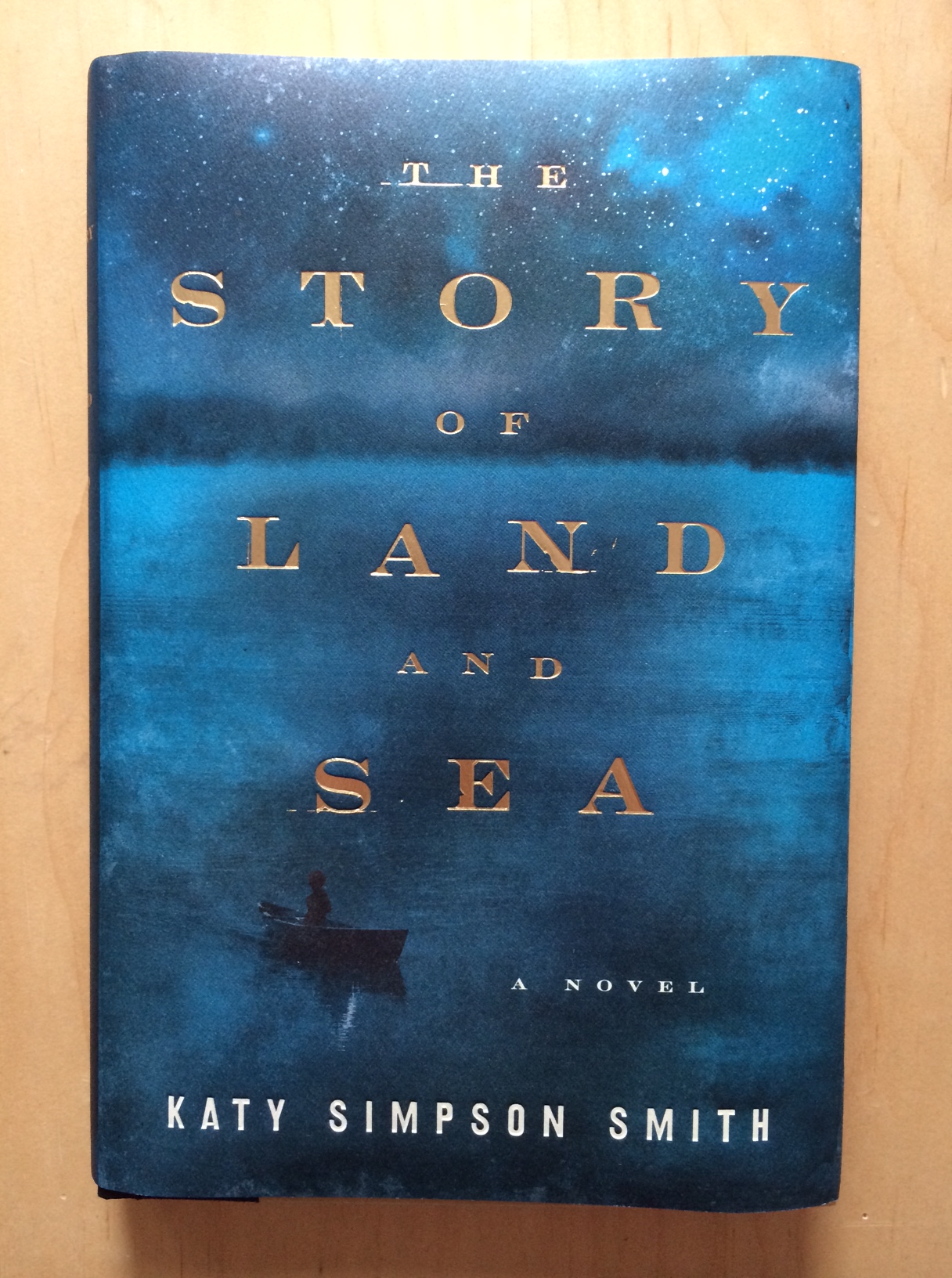
Recommended Reading: Katy Simpson Smith’s The Story of Land and Sea

photo (116)Katy Simpson Smith’s luminous debut novel is The Story of Land and Sea*, a careful, spare tale of family in late-eighteenth-century America.

What interested me first in the novel was Paul Yoon’s advance praise; I loved his novel Snow Hunters, which was published last year. (Mr. Yoon teaches at the Bennington Writing Seminars, which Ms. Smith attended.) Like Snow Hunters, The Story of Land and Sea often reads like poetry; Ms. Smith’s prose is extraordinarily graceful.

Graceful and powerful, too — at a mere 240 pages, The Story of Land and Sea contains so much material that a lesser novelist might have molded it into a sprawling 500-page book, or even a trilogy. Yet Ms. Smith’s compact style is highly evocative and time and place, and studded with descriptive jewels.  For instance, one character picking roses “prefers the blossoms with petals tightly packed, like women’s skirts” (176-77); another “comes downstairs in bare feet, her head feeling crowded with sharp rocks” (18).

Told in three parts spanning twenty-odd years, the novel orbits around three parent-child pairings in a coastal North Carolina town: John and his daughter Tabitha, Asa and his daughter Helen (later John’s wife and Tabitha’s mother), and Moll and her son Davy.

John is a former pirate. Asa is a respected landowner. Moll is a slave — Helen’s slave.

These three parents love their children with ferocity, even in the face of overwhelming obstacles and losses. All the characters are rendered with compassion and imbued with full emotional ranges. The role faith (and despair) plays in the novel is incredibly nuanced, especially as it intersects with the most terrible of American institutions: slavery.

The Story of Land and Sea is a story of parents and children, but it is also a story of how America came to be, how a nation conceived in the hope of freedom came into the world blighted with the cancer of enslavement. It reveals the terrible price of the loss of empathy, or its fundamental lack.

Moll, who needs freedom most, is the least free of all the characters, so constrained that she cannot bring herself to love the children she bears after Davy:

Two years passed before her second child, and by then she understood that these babies belonged to someone else. Love was weakness. Love was acknowledging the rightness of the world, and this she could not do. The children were beautiful and they deserved affection and she would do her almighty best, but her firstborn son was the last thing she allowed herself to cherish. (167)

The Story of Land and Sea is an unflinching look at the worst and the best of human nature, a beautiful meditation on American origins, and a compelling family saga. Highly recommended reading.

*I received a copy of this book from the publisher for review purposes, which did not affect the content of my review.

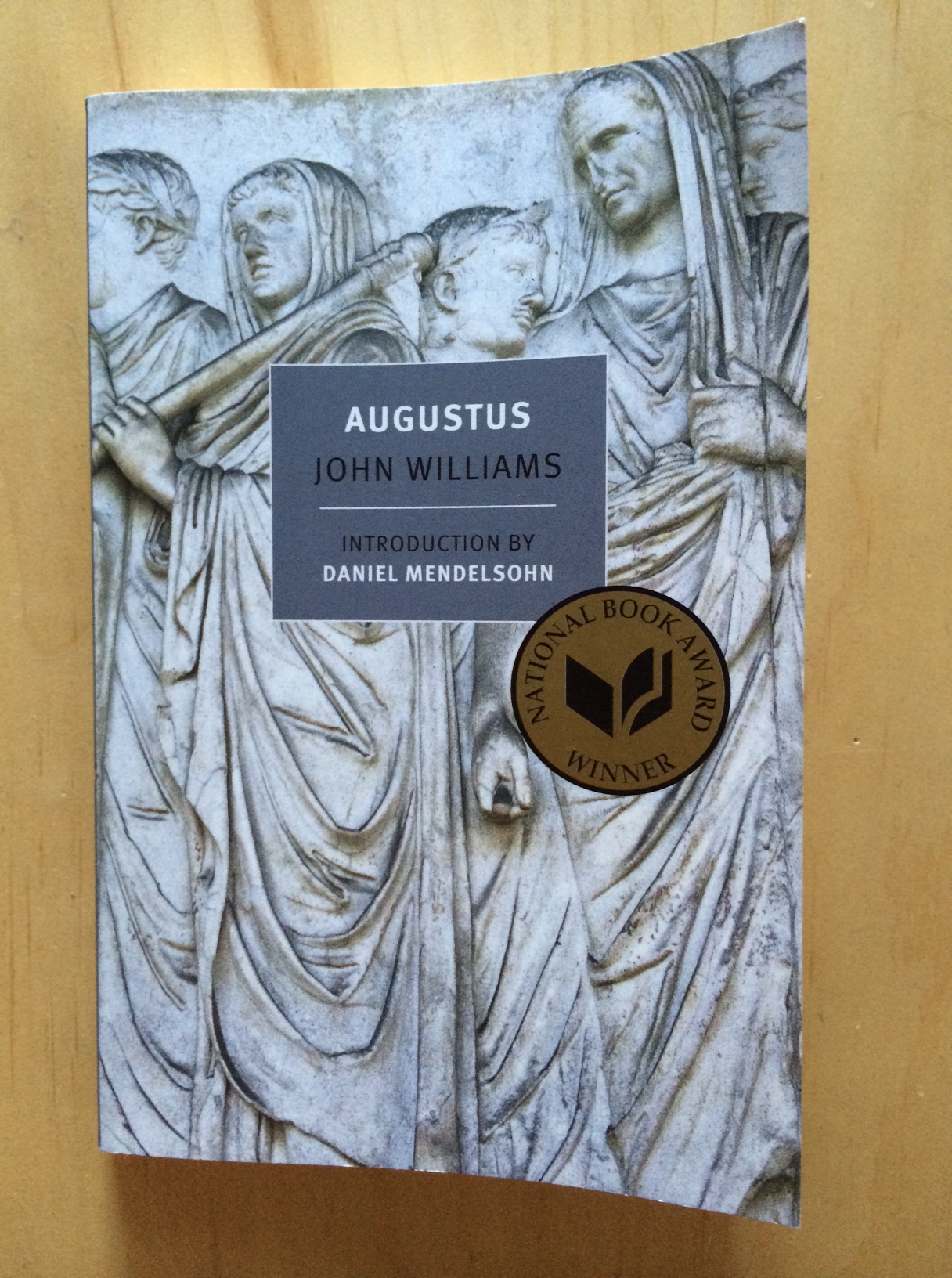
Recommended Reading: Augustus, by John Williams

“For Octavius Caesar is Rome; and that, perhaps, is the tragedy of his life.”

photo (115)John Williams’s Augustus* is relentlessly brilliant. It is one of the best books I have ever read.

First published in 1972 to widespread acclaim (it won the National Book Award in 1973), and re-released Tuesday by New York Review Books Classics, Augustus is the third of John Williams’s three novels; the second, Stoner, has been receiving a great deal of critical attention lately. We appear to be in the midst of a Williams renaissance, and I’m all for it.

Augustus is an epistolary novel that chronicles the life of its Gaius Octavius, later Gaius Julius Caesar Octavianus (or Octavian, or Octavius Caesar), who became the Roman emperor Augustus. Augustus ushered Rome into an era of peace and prosperity after the death of his uncle, Julius Caesar — but not, as this novel makes clear, without great personal cost.

Readers who pick up the novel might want first to brush up a bit on classical Roman history and personages, or watch two of the most entertaining spectacles on Roman history every produced: the star-studded film epic Cleopatra (1963) and the equally star-studded  BBC tv-series I, Claudius (1976), based on the Robert Graves novel of the same name. Cleopatra, which features Elizabeth Taylor in the title role, is simply fabulous (and eminently quotable); Roddy McDowall’s Octavian is cold, calculating, and very young, a sort of icy wunderkind. We are not meant to like him. The Augustus of I, Claudius (played by Brian Blessed), is a jovial, kindly fellow who just wants peace and quiet and a break from his wife’s schemes. (I, Claudius is rather like HBO programming before HBO: sex, violence, top-notch acting, and great source material. It’s Game of Thrones without the dragons. Also, Patrick Stewart with hair: need I say more?)

Augustus‘s portrayal of the man is completely different, because it is only in the book’s brief and final section that we are able to look directly at him, at the way he sees himself. The first two sections are formed by correspondence, diary excerpts, and other documentation from figures who orbit Augustus. The first section chronicles the young Octavius’s rise to power through political acumen, battlefield victories, and strategic marriages; it is a success story, even though its central figure is by no means a saint. The second section delves into the now-emperor’s personal life, with its many missteps and disappointments, chiefly regarding Augustus’s only daughter, Julia.

In both sections, we see Octavius (or Augustus) in profile, as Williams pieces together a collage of the man from portraits by his friends, enemies, and observers. Julius Caesar, Cicero, Marc Antony, Horace, Virgil, Agrippa, Maecenas, Ovid, Cleopatra, Livia, Julia — they’re all in the book, all vivid characters themselves (it’s particularly wonderful to read how seriously Williams takes the female characters). I’ve never seen the epistolary form used to such perfect effect.

Williams’s technical mastery is overwhelmingly good; style, pacing, plotting, and thematic considerations all balanced. His command of the material is unimpeachable (he does acknowledge poetic license with facts and timelines, as necessary).  Each character is identifiable by his or her style of writing, but Williams never caricatures, never attempts to make a person memorable by inflating his or her worst or best characteristics. Livia plots and schemes, to be sure, but she’s not the arch-villainess of I, Claudius; she’s an ambitious and ruthless person, but still a person.

While much historical fiction recreates lost worlds through sumptuous (and enjoyable) description, Williams brings Rome to life through plain but subtle language, evoking the philosophy and outlook of a culture in transition. And since Rome — as a republic and as an empire — was a model for the founders of America, Augustus suggests many parallels and warnings about our own historical moment. (Look for an absolutely killer final line.)

While it is a novel about a poilitcal figure, Augustus is just as interested in the man: the father, brother, and friend who built an empire. In the novel’s last section, an elderly Augustus writes one last letter to an absent friend, reflecting on his life and the choices he made for the good of Rome. In the end, writes Augustus,

I have come to believe that in the life of every man, late or soon, there is a moment when he knows beyond whatever else he might understand, and whether he can articulate the knowledge or not, the terrifying fact that he is alone, and separate, and that he can be no other than the poor thing that is himself. (293)

Augustus is simply not to be missed. Masterful, elegant, erudite, and approachable. A sublime reading experience.

*I received a copy of this book from the publisher for review purposes, which did not affect the content of my review.

In Brief: Essay Edition

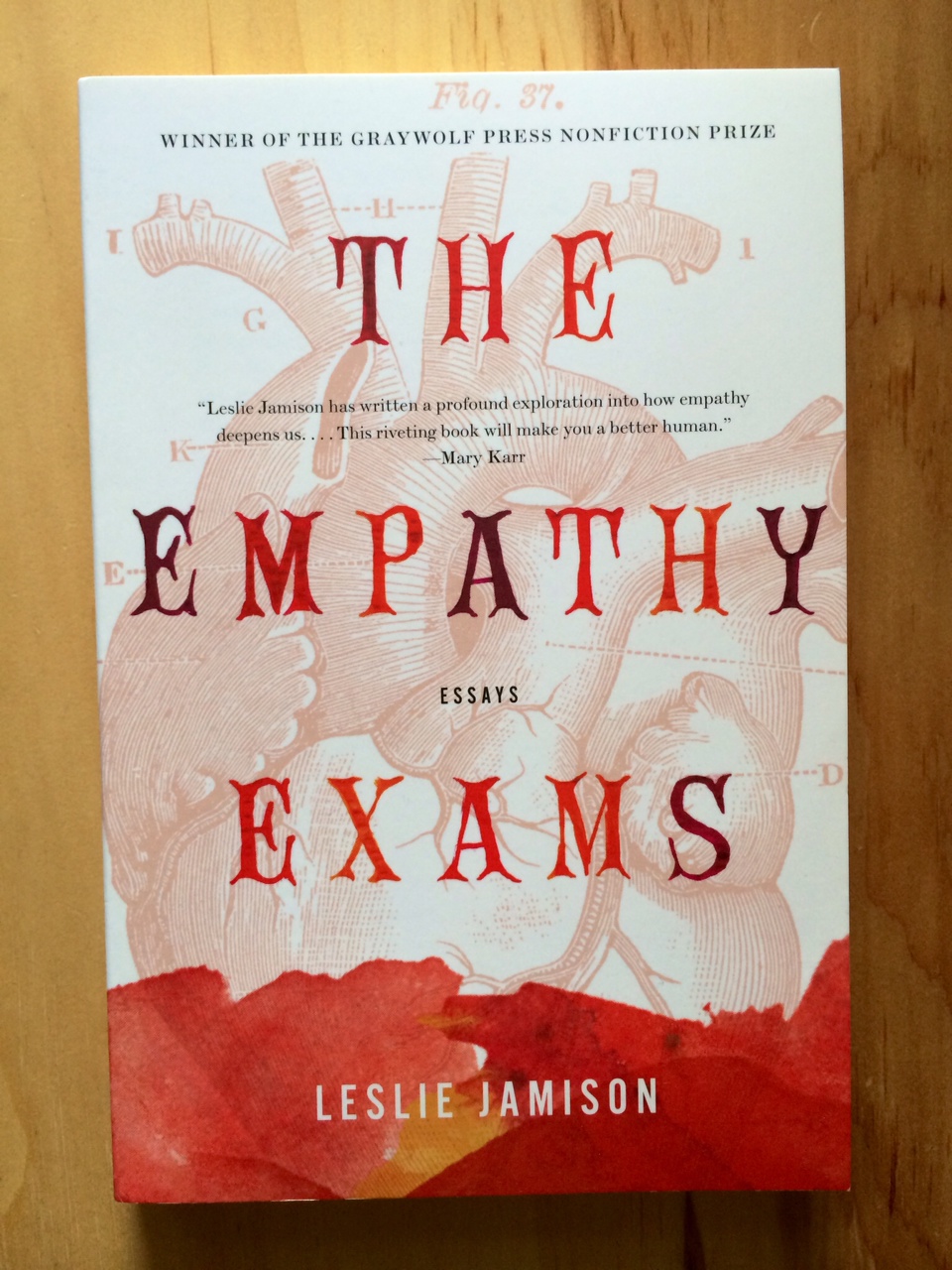
The Empathy Exams: Essays*
by Leslie Jamison

photo (111)Unless you’ve been hiding from all forms of media for the last few months, you’ve no doubt heard the overwhelming praise for this collection of essays, winner of Graywolf Press’s Nonfiction Prize. I am pleased to report that The Empathy Exams deserves all the good press.

In these intensely personal meditations, Ms. Jamison turns her sharp wits on herself, examining her experiences, faults, successes, and privilege as she writes about empathy and how we deploy it. Anyone who’s ever had a difficult experience conveying pain in a medical environment will find material of great interest here, but Ms. Jamison reaches beyond the medical in essays about prison, mining, an extreme endurance race, and the history of artificial sweeteners, among other topics. Her essays vary in length and form, expanding the parameters of the genre and allowing the reader the pleasure of wondering what will come next even as the insights from the previous essay are still being digested. The final essay, “Grand Unified Theory of Female Pain,” is a tour de force, and an absolute must-read.

Don’t Get Too Comfortable: The Indignities of Coach Class, the Torments of Low Thread Count, the Never-Ending Quest for Artisanal Olive Oil, and Other First World Problems
by David Rakoff

photo 5 (2)Last year, I reviewed David Rakoff’s 1997 collection, Fraud, which was in some ways responsible for me being forced to sit through a Steven Seagal marathon, and which is one of the funniest books I’ve ever read, so funny that it had me choking with laughter.

Don’t Get Too Comfortable (2005) finds Mr. Rakoff in a less jocular mood, skewering American consumerism in its many forms. Don’t get me wrong — a society that produces Hooters Air richly deserves skewering, but in these essays, laced as they are with humor, I felt a sense of bitterness, which simply wasn’t what I was expecting, though maybe I should have been, given the collection’s title. Still, essays on edible foraging in Central Park and the zaniness of fashion week are worth the price of admission.

*I received a copy of this book from the publisher for review purposes, which did not affect the content of my review.

Recommended Reading: Land of Love and Drowning, by Tiphanie Yanique

photo 3 (7)Tiphanie Yanique’s debut novel, Land of Love and Drowning*, is one of the most unusual and spellbinding family sagas I’ve ever read. Set over six decades in the Virgin Islands, the narrative revolves around two strikingly beautiful, and strikingly different, sisters.

Anette and Eeona are the children of one Captain Bradshaw and his wife Antoinette, two volatile people who keep secrets from each other, their children, and maybe even themselves. Both have high hopes and expectations when the Virgin Islands trade hands from Danish to American rule in the early 1900s, hopes that are dashed. Their children are left orphaned, and when Anette and Eeona begin to navigate their straitened financial and social circumstances, the story takes flight.

Though they’re both bound to love the wrong kind of man, the sisters are different in terms of temperament, tastes, education, and worldview. Heavily influenced by her mother, Eeona longs to escape from the Virgin Islands (and from the responsibility of raising Anette); she’s aware of her beauty’s perilous power, and takes care to isolate herself in many ways. Given her education and upbringing, it’s no surprise that the sections of the narrative written in Eeona’s voice showcase her careful choice of words and formal style.

Anette, on the other hand, is much more open and frank (with other people) than her sister. Her voice is rendered in dialect; she’s warm and funny and curious, open to all kinds of experiences, even if they land her in trouble. While Eeona is wary of love and male attention, Anette welcomes what comes her way, accepting the devotions of three very different, but good men.

What this review can’t convey adequately is the grace with which Ms. Yanique renders her portrait of the Virgin Islands in a century of upheaval and change (war, tourism, protest movements, and a hurricane all affect the characters), and the deft way in which she weaves magical realism into the narrative to explore characters and emotions.  Land of Love and Drowning is a beautiful, vibrant book, and I hope it brings more attention not only to the talented Ms. Yanique, but also to Caribbean literature.

Coming Soon: An Interview with Tiphanie Yanique, author of Land of Love and Drowning

*I received a copy of this book from the publisher for review purposes, which did not affect the content of my review.

In Brief: Recent Works in Translation

Sworn Virgin*
by Elvira Dones
Translated from the Italian by Clarissa Botsford

photo 3 (6)In Albania’s mountains, there’s a tradition in which it’s possible for a woman to become a man. If a family loses all its men, to blood feud or war or sickness, a woman can step forward, put on men’s clothing, and live the rest of her life as a man. If, that is, she forswears sex, marriage, and children.

Elvira Dones, an Albanian writer, explores this phenomenon (which you can read about here) in the fictional Sworn Virgin, which was originally published in Italian.

We meet Hana as she’s preparing to leave her life in Albania — and her identity as Mark — behind for a new life in America. The transition is a difficult one in many respects, reflecting the terrible challenge she faced nineteen years earlier, when she became Mark.

At the time, Albania was under oppressive Communist rule, and Hana had left her mountain home, and her beloved aunt and uncle, to study literature in Tirana. For reasons that slowly become clear as the novel progresses, Hana puts aside her hopes and her ambitions, and becomes a chain-smoking, heavy drinking shepherd in a mountain village without modern amenities. And she lives as Mark until she simply can’t anymore.

Ms. Dones has a gift for slowly opening up her characters — Hana, her family, her romantic interests, her cousins who take care of Hana in America. Hana’s decision to become Mark isn’t fully explained until the end of the novel (and for this reason I don’t recommend reading the Foreword until you’ve finished the book), and it’s depicted with care and compassion. Equally compassionate is Ms. Dones’s exploration of how Hana adjusts to becoming a woman again, to gaining her independence, learning English, and navigating American customs as a newly-arrived immigrant. Sworn Virgin is a fascinating novel, and highly recommended.


The Burning of the World: A Memoir of 1914*
by Béla Zombory-Moldován
Translated by Peter Zombory-Moldován

photo (114)Part of a larger autobiographical work, this slim volume was found, painstakingly edited, and translated by the author’s grandson; it appears for the first time (in any language) thanks to New York Review Books Classics.

The summer of 1914 found Hungarian artist Béla Zombory-Moldován enjoying a holiday with friends. When the war broke, he was summoned for duty, leaving the holiday for home to gather supplies and bid his family and city farewell. Just a few weeks later, Zomobory-Moldován fought in one of the war’s earliest battles, in Galicia, where he and his men had to fashion dugouts in the absence of tools. He was very badly wounded, and returned to Budapest to recover from his injuries and shell-shock; he soon realized that nothing would be the same again.

The Burning of the World was eye-opening for me, presenting as it does an under-read national perspective (Hungarian) and since it recounts experiences on the Easter Front, when I (along with most readers, I suspect) am accustomed to reading memoirs of trench warfare on the Western Front. In addition, Peter Zombory-Moldován’s Introduction gives an excellent thumbnail sketch of Hungarian history and pre-war life, as well as answering the reader’s questions about his grandfather’s eventual fate.

As in many war memoirs, we see the poor decisions of superior officers that lead to senseless deaths, and the quick onset of disillusionment. The memoir has a modernist feel; the author writes in the present tense, and is focused on his own interiority as much as his surroundings. (In one section, his attempt to recover some pre-war spirit in one of his favorite haunts sounds like something from The Sun Also Rises.) Zombory-Moldovan’s descriptions are carefully constructed and highly memorable; he describes shell fire as “the sound of a watermelon being struck with a stick” (44).

The Burning of the World is essential reading for anyone with serious interest in the war, Hungarian history, or memoir. Highly recommended.


So Long, Marianne: A Love Story*
by Kari Hesthamar
Translated from the Norwegian by Helle V. Goldman

photo 4 (6)As we’ve established, I love Leonard Cohen, and I think the rest of the world should too. So Long, Marianne takes its title from one of his most famous songs; the subject of both the song and the book is Marianne Ihlen. Though Leonard Cohen features prominently in the publicity materials, this book is Marianne’s biography (she doesn’t meet Cohen until halfway through the book). Born into a middle-class family in Norway, as a young woman Marianne had a turbulent relationship with the novelist Axel Jensen, traveling with him through Europe and eventually settling on the Greek island of Hydra. The two married, but not long after Marianne gave birth to their son, Axel abandoned them. Leonard Cohen had met the Jensens before their separation and was immediately smitten with Marianne, and soon the two began a love affair that lasted throughout most of the 1960s.

Though reading about Marianne’s relationship with the self-obsessed Axel was often frustrating, I found this book to be an interesting portrait of life lived without the comforting certainties of long-term plans or even everyday routines. Marianne’s self-confidence, as it emerges after her separation and during her relationship with Leonard Cohen, is something to cheer for.

I also loved the details about life on Hydra during the 60s — the market, the local restina, even the weather. When Marianne and Axel arrived in the late 50s, it was rustic, with few foreigners living there; by the time Marianne moved away, Hydra was home to a thriving expatriate artists’ colony.

For Leonard Cohen fans, So Long Marianne features a small selection of previously unpublished material (letters, poems, photographs), and confirmation that yes, Leonard is the kind of man who treats women with kindness and respect, even at the end of a relationship. But we knew that already.

*I received copies of these books from their respective publishers for review purposes, which did not affect the content of my reviews.

Recommended Reading: Malcolm Brooks’s Painted Horses

photo 2 (18)Malcolm Brooks’s debut novel, Painted Horses*, is a Western that’s not limited to the West. It’s ambitious, engaging, and sure to be the start of a long literary career.

In 1956, graduate student Catherine LeMay is hired by the Smithsonian to spend a few months in Montana proving that a canyon set to be destroyed by a proposed dam isn’t the site of any artifacts of archaeological significance. Catherine made a name for herself in London, and wjile North American archaeology isn’t her field of expertise, she’s eager to prove up to the challenge, facing down doubts from her parents, her fiancé, and her colleagues.

In Montana, Catherine is daunted by the canyon “as deep as Satan’s own appetites” and finds her guide, a horse breaker named Jack Allen, more adversarial than helpful. Still, in the small town near the canyon she finds people sympathetic to her project: Mr. Caldwell, a gas station owner and former dam worker himself; Miriam, a young Native American woman with loyalties to both the past and the future; and John H, a mysterious horseman with a penchant for painting and a knack for coming across Catherine when she least expects it.

The novel revolves around Catherine and John H. Their histories are slowly revealed as their paths start to intersect, and it’s in John H’s sections that Mr. Brooks’s writing shines brightest. John H is in many ways a classic Western (and Hemingway) hero: strong, silent, skilled, and deeply wounded by what he’s witnessed. By giving John H an early life far from Montana, and war experiences in Europe, Mr. Brooks expertly shows the lure of the West as it was.

Painted Horses is a novel of competing interests, particularly the perils of preservation and progress. Catherine in some ways embodies this tension, focused as she is on preserving history, while at the same time, both as a woman in a male-dominated field and also as an Easterner acclimating to the West, embodying different kinds of progress. John H, too, appears as a relic of a way of life that’s dead or dying, while also carrying with him the scars of the modern world. Like the best literature, Painted Horses offers more questions than answers, and resists easy political interpretations by giving us Miriam, who whirls in traditional tribal dances but wonders whether her family, too, shouldn’t want power and light.

The novel is filled to the brim with beautiful scenery, and unexpected scenes; a woman lining her eyes with kohl, a grove of carved aspens, a particular hat trod underneath a horse’s hoof. Mr. Brooks pokes fun at some of the Western’s favorite tropes; for every laconic horse breaker or sheep herder in Painted Horses, there is a character who speaks in paragraphs, a loquaciousness that seems unusual and a bit funny. Also unexpected, but most welcome, are the novel’s many references to Basque culture and language.

Painted Horses is a pleasure to read, bringing together as it does painting, history, archaeology, horses, and landscape into sharp focus. It’s a gorgeous exploration of the American West on the knife’s edge of change.

Coming soon: An interview with Malcolm Brooks, author of Painted Horses

*I received a copy of this book from the publisher for review purposes, which did not affect the content of my review.

If Roxane Gay is a Bad Feminist, Sign Me Up

photo 1 (20)The first time I saw the name Roxane Gay was on Facebook (see? It’s not altogether terrible). I’d just seen a trailer for The Help, and thought to myself: “Um, doesn’t that movie seem racist to anyone else?” A friend linked to a piece by Roxane Gay detailing her dismay over the film’s depictions of race in the 1960s south, which are, to say it in academic-speak, problematic. The essay was very, very good, and you can read it here.

Three summers later, it’s the year of Roxane Gay (or, at least that’s what I’m calling it). Her novel An Untamed State (review here) was published to critical acclaim this spring, and Bad Feminist* is available tomorrow. It’s a collection of Ms. Gay’s essays (most, if not all, previously published elsewhere), and you shouldn’t miss it.

Ms. Gay’s essays are short, intense views of a lively mind at work. They vary widely in tone, ranging from the hilarious (the world of competitive Scrabble) to the horrific (Ms. Gay’s traumatic experience of sexual assault as a girl). Her essay on rape culture, “The Careless Language of Sexual Violence,” in which she takes the New York Times to task (among others), ought to be required reading in high school (and, apparently, newsrooms).

Many of Bad Feminist‘s essays consider books, movies, and TV shows from the perspective of race or gender — Ms. Gay’s takes on The Hunger Games, Girls, and Django Unchained are a pleasure to read — showcasing Ms. Gay’s considerable prowess as a cultural critic. She is equally comfortable talking about “high” literary culture and Lifetime movies; this is the perfect book for anyone who’s a pop culture aficionado.

Here’s one of my favorite passages, on Quentin Tarantino:

But Django Unchained isn’t even really a movie about slavery. Django Unchained is a spaghetti western set during the 1800s. Slavery is a convenient, easily exploited backdrop. As with Inglorious Basterds using World War II, Tarantino once again managed to find a traumatic cultural experience of a marginalized people that has little to do with his own history, and used that cultural experience to exercise his hubris for making farcically violent, vaguely funny movies that set to right historical wrongs from a very limited, privileged position. (222)

Yes, yes, yes. Thank you.

Despite what the book’s title suggests, Ms. Gay is a wonderful feminist: engaged, interested and interesting, funny, respectful of others’ differing views. My politics overlap Ms. Gay’s, but not completely; even when we fundamentally disagree, I found much to consider in her arguments. Ms. Gay doesn’t espouse one right way of being feminist, and that’s a message we could all stand to remember. Bad Feminist is a book for feminists and for those who won’t call themselves feminists; it’s a book for everybody. Highly recommended.

*I received a copy of this book from the publisher for review purposes, which did not affect the content of my review.