“Let now the chimneys blaze / And cups o’erflow with wine”

Here’s a poem to warm up with — Renaissance poet and musician Thomas Campion’s (1567-1620) “Now Winter Nights Enlarge”:

Now Winter Nights Enlarge

Now winter nights enlarge
    The number of their hours;
And clouds their storms discharge
    Upon the airy towers.
Let now the chimneys blaze
    And cups o’erflow with wine,
Let well-turned words amaze
    With harmony divine.
Now yellow waxen lights
    Shall wait on honey love
While youthful revels, masques, and courtly sights
    Sleep’s leaden spells remove.
This time doth well dispense
    With lovers’ long discourse;
Much speech hath some defense,
    Though beauty no remorse.
All do not all things well;
    Some measures comely tread,
Some knotted riddles tell,
    Some poems smoothly read.
The summer hath his joys,
    And winter his delights;
Though love and all his pleasures are but toys,
    They shorten tedious nights.


I like the physicality of this poem, the concession that the chill and storms of winter require light, and wine, and company to be borne, even if “love and all his pleasures are but toys.”

Paradise Lost, Books III and IV: Oh, Milton.

Feel free to read the Paradise Lost Readalong introductory post here, and catch up on Books I and II here.

ParadiseLostReadalong

Books III and IV of Paradise Lost are, for me, the most difficult to grapple with. Book III is, for the most part, an exercise in Milton’s brand of theology (which I find unconvincing) and Book IV contains some of the very worst of Milton’s views on gender hierarchy. So in today’s post, I’m going to wrestle (in a limited way) with these issues. But first: the summary.

Book III begins with the invocation to light, one of the poem’s most famous passages. Within the invocation, the poem transitions from the darkness of Hell to the light of Heaven, where God the Father tells the Son and the heavenly hosts what is to come: Satan’s successful temptation of Eve and Adam and the Fall. However, the Father also plans to offer humanity grace, but only if a suitable sacrifice can be offered to satisfy the demands of justice. The Son offers to become that sacrifice; the Father accepts, and orders the angels to praise the Son. Meanwhile, Satan reaches the Limbo of Vanity, and from there goes  to the gate of Heaven. Disguising himself as a lesser angel, he finds Uriel, regent of the sun, and asks directions to the home of humankind. He “alights first on Mount Niphates.”

In Book IV, we finally reach Eden, and meet Adam and Eve. Satan, after much internal debate, reaffirms his evil purpose, and descends into the Garden (enacting yet another fall). The garden, as well as Adam and Eve, are at last described. Satan stalks the human pair, and learns that God has forbidden them to eat of the Tree of Knowledge. Meanwhile, Uriel, having recognized Satan as a bad angel by  his wild gesticulations on Mount Niphates, warns Gabriel (who’s in charge of security in Paradise) that an evil spirit is skulking about. Gabriel sends two angels to check on Adam and Eve as they sleep, and they find Satan crouched at Eve’s ear, tempting her in a dream. Brought to Gabriel, he plans to resist, but a sign from Heaven sends him flying out of Paradise.

Here’s what I’m mulling over this week:

The Problem of Evil

Book III finds Milton confronting the problem of evil (why does an all-loving, all-powerful God allow Evil to exist? Why does he allow the Fall to occur?). He presents his solution in the most Miltonic way imaginable: by putting his theories in the mouth of God (the Father) himself. He prefaces this excursion with the invocation to “holy light” (3.1), recalling his invocation to the Muse (Holy Spirit) in Book I, in which he asked,

What in me is dark
Illumine, what is low raise and support
That to the heighth of this great argument
I may assert Eternal Providence
And justify the ways of God to men. (1.22-26)

God’s omniscience means that he mixes his tenses rather indiscriminately, so that even though, in linear time, the Fall hasn’t yet happened, God can accuse Adam and Eve of ingratitude, explaining that he created them “sufficient to have stood though free to fall” (3.99). He goes on to ask his audience (rhetorically) if he hadn’t given men and angels free will, “what proof could they have giv’n sincere / Of true allegiance, constant faith, or love” (3.103-04). He dismisses his own foreknowledge as an influence on those who choose to sin, and makes a distinction between those who sinned without deception (the bad angels) and those tempted and deceived (men). The latter will receive mercy, tempered with justice; the former will languish in Hell.

Kingship

When the Son offers to be the sacrifice demanded by justice (though Milton never explains why an omnipotent God feels bound by justice), the Father praises him and anoints him “universal king” (3.317).  In Milton’s view, true kingship is born of sacrifice and sanctity, not a will to power. Earthly kinship, in Milton’s theology, is an echo of Satan’s desire to usurp the heavenly throne, to reign as a tyrant.

Hypocrisy

(This passage speaks for itself.)

So spake the false dissembler unperceived,
For neither man nor angel can discern
Hypocrisy, the only evil that walks
Invisible except to God alone
By His permissive will through Heav’n and Earth.
And oft, though Wisdom wake, Suspicion sleeps
At Wisdom’s gate and to Simplicity
Resigns her charge while Goodness thinks no ill
Where no ill seems (3.681-89)

The Garden and the Nature of Work

Milton’s triumphant, lovely description of Paradise is too long to quote here. The garden is wild, dripping with fecundity and lush growth; Milton compares it with modern planned gardens, praising Paradise’s luxurious profusion. Here all manner of beasts and birds and plants live harmoniously (Adam and Eve are vegetarians; fruit practically offers itself to them, and they use the husks to scoop water from accommodating streams.). This natural world (and the pair’s bower of bliss) contrasts with the demons’ artificial edifice in Hell, just as humans’ prelapsarian work (tending the garden) contrasts with Fallen labor (Mulciber will teach men to, “with impious hands / [Rifle] the bowels of their mother Earth / for treasures better hid” [1.686-88].).

Gender Hierarchy

It’s always difficult for me to suppress a groan when I read the first description of Adam and Eve in Book IV. Both are beautiful, more beautiful than any other humans will ever be, but Milton is careful to describe their relationship in terms of hierarchy:

Though both
Not equal as their sex not equal seemed:
For contemplation he and valor formed,
For softness she and sweet attractive grace:
He for God only, she for God in him. (3.296-99)

Coming from a man whose views on marriage and sexuality were, for his day, very progressive (In the 1640s, Milton was widely excoriated for the tract Doctrine and Discipline of Divorce, in which he advocated companionate marriage — a meeting of the minds — and the right to divorce if the spouses were not compatible emotionally. And he’s no prude — Adam and Eve clearly have sex before the Fall.), this declaration always disappoints me, even if it doesn’t surprise me.

However, scholars have pointed to several ways in which Milton ameliorates Eve’s subservient position. Foremost among these is the simple fact that Eve is the poem’s best poet. Adam’s declarative sentences are leaden read next to Eve’s lovely, flowing lines. Even Satan doesn’t compose as well as she does; his syntax is too sinuous, too studded with outbursts. Eve speaks in melodious paragraphs. Here’s an example of the way Eve undercuts her own stated submission with glorious poetry:

To whom thus Eve, with perfect beauty adorned:
My author and disposer, what thou bidd’st
Unargu’d I obey; so God ordains.
God is thy law, thou mine: to know no more
Is woman’s happiest knowledge and her praise.
With thee conversing I forget all time,
All seasons and their change: all please alike.
Sweet is the breath of morn, her rising sweet,
With charm of earliest birds; pleasant the sun,
When first on this delightful land he spreads
His orient beams, on herb, tree, fruit, and flow’r,
Glist’ring with dew; fragrant the fertile earth
After soft showers; and sweet the coming-on
Of grateful evening mild; then silent night,
With this her solemn bird, and this her moon,
And these the gems of heav’n, her starry train:
But neither breath of morn when she ascends
With charm of earliest birds, nor rising sun
On this delightful land, nor herb, fruit, flower,
Glist’ring with dew, nor fragrance after showers,
Nor grateful evening mild, nor silent night,
With this her solemn bird, nor walk by moon
Or glittering starlight, without thee is sweet.
But wherefore all night long shine these? for whom
This glorious sight, when sleep hath shut all eyes? (4.634-58)

Or consider Eve’s account of her creation, the first to appear in the poem, at lines 440-91 . I’ll talk about it next time, when we venture into books V and VI on January 30th.

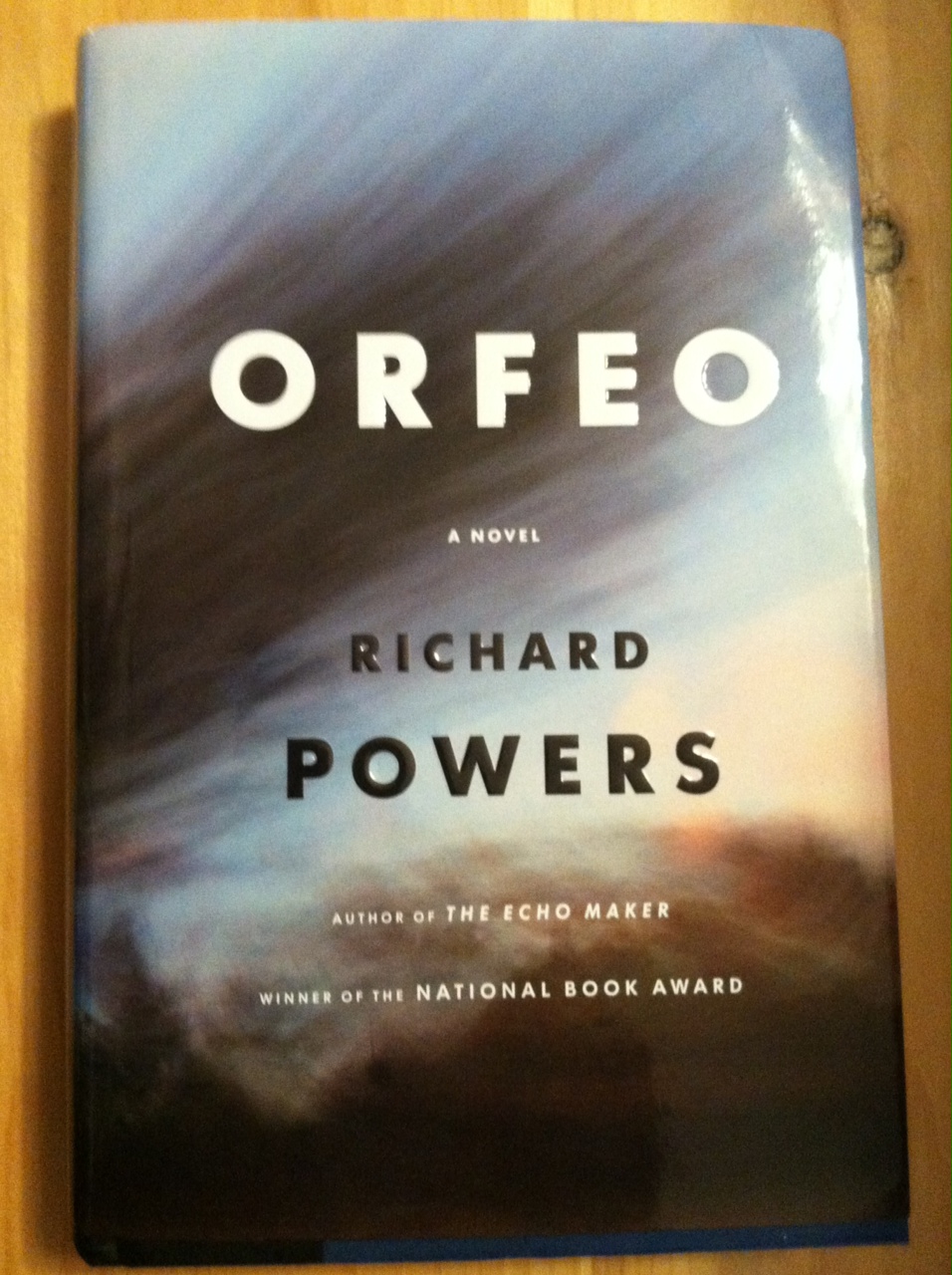
Coming Soon: Orfeo*, by Richard Powers

OrfeoIt’s January 17th, and I’m confident that I just read the book that will top my (mental) list of books published in 2014: Orfeo, by Richard Powers.

Yes, it’s that good.

When the feds come knocking on Peter Els’s door, concerned about his hobby — experimenting with the genetics of a less-than-safe bacterium — the seventy-year-old avant-garde composer assumes that their misapprehension about his motives will evaporate with the slightest scrutiny. Then he finds his home cordoned off by police tape and his belongings stuffed into cartons, and he decides to run.  As he sets out to make amends with the people he loves most before what he believes will be his inevitable capture, Els reconstructs the movements and suites of his own past.

Mr. Powers’s novels deal with the intersections of technology with art and life (this novel, his eleventh, is not the first to take genetics and music as its subject); they’re intensely intelligent, showcasing Mr. Powers’s nearly unbelievable erudition (he’s the recipient of not only the National Book Award, but also a MacArthur Fellowship — the “genius” grant). Orfeo is no exception. In the past, some reviewers have suggested that the cerebral splendor of Mr. Powers’s novels comes at the cost of emotional heft, but not so with Orfeo. As Peter Els tries to make meaning out of the complicated patterns of his life and his art, the reader witnesses love and friendship in fragile permutations both familiar and fresh.

Orfeo‘s lyrical beauty draws the reader in swiftly. Els experiences the world through sound, and we hear what he hears, from staccato birdsong to Messiaen’s Quartet for the End of Time, in passages so lovely and richly visual that they could describe paintings. I’ve never read music described so well.  I trained as a singer when I was younger, thinking, maybe, that I’d study opera at a conservatory — but I could not (and can’t) read music. Orfeo made me both wistful and grateful for that missed path.

In Gain (1997), Powers draws connections between the corporation and cancer, and here, in Orfeo, he draws our attention to the ever-expanding powers of the surveillance state and the ways it creeps into everyday life — even into the production of music (Powers’s description of Shostakovich’s Fifth Symphony is haunting, wonderful). Because what Peter Els is trying to do is to extract music from his life, and then engineer that music back into life itself:

He couldn’t begin to tell her. Life. Four billion years of chance had written a score of inconceivable intricacy into every living cell. And every cell was a variation on that same first theme, splitting and copying itself without end through the world. All those sequences, gigabits long, were just waiting to be auditioned, transcribed, arranged, tinkered with, added to by the same brains that those scores assembled. A person could work in such a medium–wild forms and fresh sonorities. Tunes for forever, for no one.

Dangerous work. But then, art is dangerous. Richard Powers would know.

Orfeo will be released on January 20th.

* My thanks to W. W. Norton for sending an advance copy of Orfeo in exchange for an honest review.

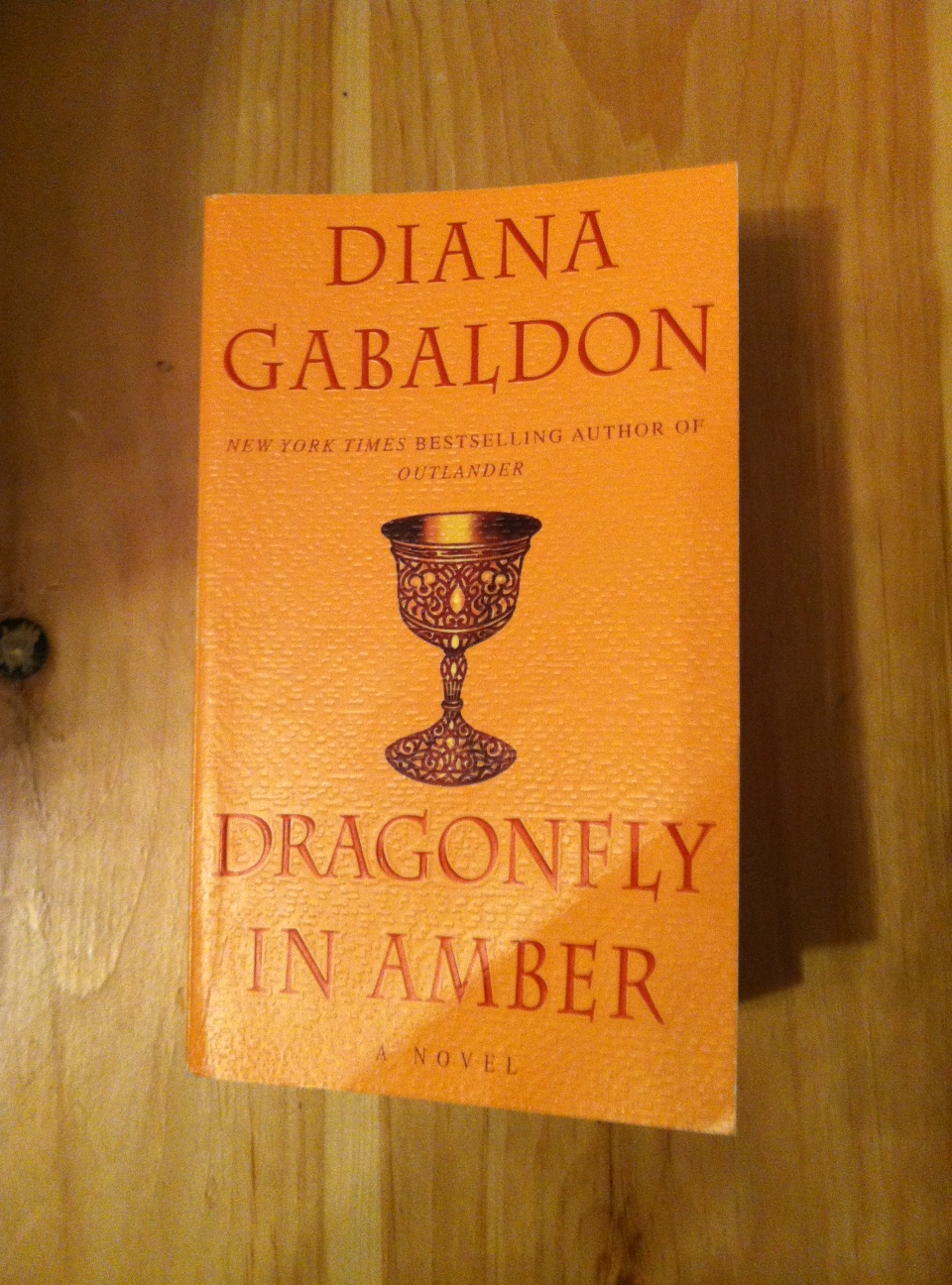
Recommended Reading (and a Classics Club Checkmark): Outlander and Dragonfly in Amber, by Diana Gabaldon

photo 1 (14)About two hundred pages into Diana Gabaldon’s Outlander, it occurred to me that somewhere out there is an HBO executive repeatedly berating himself or herself for not acquiring the TV rights to the seven (soon to be eight)-book-long series. Sex, violence, accents, great costuming possibilities, episodic structure, and a huge built-in audience of (largely female) fans? Good grief. It’s a series just waiting to happen. And it will happen, on Starz, this summer. Someone please offer to get me cable, because Ronald D. Moore is producing, and I think we all know how much I loved his Battlestar Galactica.

Before I get into the Claire & Jamie festivities, a funny story: A couple months ago, my friends (who also happen to be neighbors) were talking books at our consciousness-raising rap group (aka Wine Night), and Elena mentioned Outlander, and gave a rough outline of the plot. This rang a bell. Well, two bells, actually. Outlander had appeared on a best-of-classic sci-fi list, so I’d added it to my in-progress Classics Club list over the summer. But that’s not what came to mind first.

As a teenager, I came across Dragonfly in Amber, the first of Outlander‘s sequels, in the local library. I liked the title, and had no idea it was part of a series, so I just started flipping through. Oddly enough, the book kept falling open at some pretty steamy scenes (I’m looking at you, patrons of the Bertram Woods branch). Despite the fact that my parents never once in my life stopped me from reading a book, nor hovered over me while I read or browsed books, I was too chicken to check it out. So, rebel that I was, I’d pop by the shelf from time to time while I was in the library to read a chapter or two. I was a couple hundred pages in when someone took the book out, and I never found out what happened to Claire and Jamie. In fact, I forgot all about the book until Elena and a glass of pinot noir shook it loose from my uncooperative memory.Dragonfly in Amber

Onto the books. As per usual, I will give you advance warning of spoilers, which in this case appear at the end of the post.

Both Outlander and Dragonfly in Amber are door-stops: 850 and 947 pages, respectively (my editions are the mass-market paperbacks). And they’re tricky to classify by genre; let’s go with 55% historical fiction, 35% romance, and 10% SF-F.

The premise: Claire Beauchamp Randall, a former army nurse, is on holiday with her husband, Frank, in the Scottish Highlands. Frank’s a historian with a particular interest (which Claire doesn’t share) in the Jacobite risings of the eighteenth century, so naturally he finds plenty to occupy his time on their trip. On an outing, Claire, an amateur herbalist/botanist, gets too close to a circle of standing stones, only to find herself transported to 1743 — two years before the disastrous Jacobite Rising of 1745 (Bonnie Prince Charlie and all that). Disoriented and confused, it takes her some time to discover when and where she is. As an Englishwoman, she’s an “outlander,” a sassenach, and her position is most precarious.

Which is not to say that 1743 Scotland doesn’t have its perks: adventure, intrigue, professional pride (Claire quickly gains a reputation as a skilled healer), and an extremely good-looking young man named Jamie, who has his own set of problems (price on his head, a sadistic English army captain interested in him, etc.). Needless to say, events conspire to put Jamie and Claire very much in each other’s way as they attempt to navigate through the Highlands’ natural and political terrain. Much danger (and sex) ensues as Claire is forced to choose between her past and her present.

Outlander follows the pair to the end of 1743; Dragonfly in Amber picks up where Outlander leaves off, and includes a long foray into France (happily, Claire and Jamie both speak perfect French.) as they try to stop the Rising before it begins, with the help of Claire’s foreknowledge. But time is tricky stuff, as any good sci-fi fan knows.

Ms. Gabaldon doesn’t write literary fiction, and that’s just fine — because she does write rollicking adventure with excellent pacing. Near the end of Outlander, the tension was so extreme that I had to put the book down and catch my breath. The historical detail is intriguing, especially since the reader makes discoveries alongside Claire. If there’s a woman perfectly suited for dangerous time travel, it’s Claire: she’s quick-thinking, brave, very intelligent, and possessed of numerous practical skills thanks to her training as a nurse. She’s pleasant company as a narrator. Jamie’s a puzzle at first; he has all of the attributes you’d expect (strong, tall, brave, loyal, suitably appreciative of heroine,etc.), but he’s also very young and, for the most part, respectful toward women. Actually, sometimes I thought he seemed too much like a thirty-five year-old man, rather than a twenty-three-year-old; the author’s point that people grew up faster in centuries past is well taken, but sometimes Jamie’s emotional maturity is no verra believable, ye ken?

Sorry, couldn’t resist. Won’t happen again.

Bottom line: these are deliciously entertaining and diverting books, but if you prefer your fiction free of gore and bodice-ripping, look somewhere else.

Spoilers Ensue. Also, TW: sexual violence and child abuse.

Both novels include scenes of rape and attempted rape, and Dragonfly in Amber has a particularly horrifying account of a child being raped. In all cases the rapists (eventually) meet the eighteenth century version of justice, and in all instances rape is not glorified or glamorized, but shown as brutal and causeless. The victims are not blamed.

The villain in  Outlander is the aforementioned sadistic English captain, Jack Randall (just to complicate matters, he’s Frank’s ancestor.). Randall’s particular interest is the sexual debasement and torture of men (though he’s perfectly happy to beat Claire, and attempt to rape her too) — and he’s got his eye on Jaimie. I’ll get back to that in a second, but first, here’s my major philosophical issue with the books: Jack Randall is described, by Claire in 1968, as a pervert, and it’s not clear to me that what she’s describing is his sadism, rather than his homosexuality (which is referred to more than once). For that matter, why does the only gay character in the two books have to be a pedophile, rapist, and sadist? I realize that homosexuality wasn’t even a term in use in the eighteenth century, and that Outlander was published in 1991, but c’mon. Of course, I haven’t read the next 5,000 pages of the series, so maybe I’m speaking too soon.

UPDATE: Kay from WhatMeRead tells me that there’s a non-vilified gay character in another of Ms. Gabaldon’s books.

UPDATE 2: I’m happy to be wrong — please scroll down in the comments to read Ms. Gabaldon’s (!) clarification on this point.

Anyway. True to conventional romance tropes, Jamie rescues Claire from attempted rape at least twice in Outlander alone, but at the end of the book, something I’ve never seen in fiction happens. Jamie, condemned to hang, is in prison, and Claire’s first rescue attempt fails. Jack Randall is about to have her raped by one of his minions and then killed, but Jaime trades her life for his acquiescence to Jack Randall’s predilections. Basically, he consents to be raped and tortured to save Claire’s life.

And that’s exactly what happens. There’s no last-minute saving of his “honor.” Claire does manage to organize a rescue, but Jaime suffers for hours first. The last act of the novel is Claire’s struggle to help Jamie heal, physically and psychologically, from his experience (he does). These scenes are excruciating to read, but I was impressed by Ms. Gabaldon’s turning a romance trope on its head.

Guest Post: CJ from ebookclassics on Dubliners, by James Joyce

Backstory: In December, Rick at Another Book Blog organized a bookish Secret Santa event. A group of bloggers agreed to read a book suggested by someone else, and then post a review to that someone else’s blog. I was lucky enough to draw CJ from ebookclassics, and suggested that she read Dubliners, by James Joyce. Here’s her post. — Carolyn O


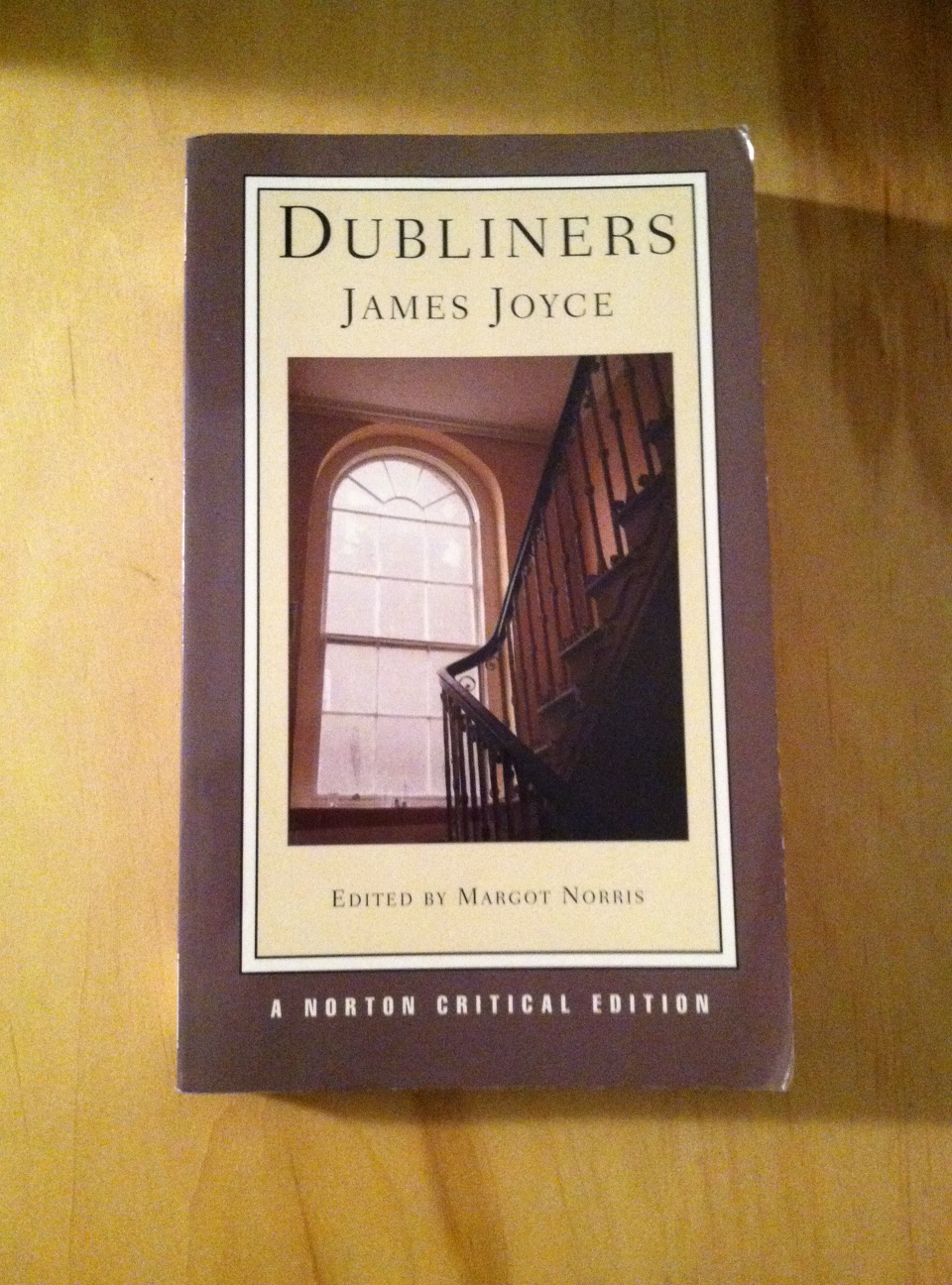
DublinersDubliners, by the Irish writer and poet James Joyce, is a collection of short stories depicting the lives of middle class men and women from Dublin during the early 20th century. Joyce writes each story starkly with little detail or background, and in a style he described as “scrupulous meanness”. This has often given readers the false impression that nothing happens in the stories. I laugh when I remember reading the first story, Three Sisters, because I was like, “That’s it?” It ended so suddenly.

However, Joyce is attempting to capture a moment in time when a character realizes something deeply important about themselves, whether good or bad, which is why the word epiphany is so heavily associated with this collection. My own epiphany was that it is not about what is happening in the story, but the emotions that are churning beneath the surface. Through the characters, the reader encounters sadness, regret, loneliness, confusion, anger, frustration and love of all dimensions. Some characters release their emotions loudly, publicly and towards other people. Others keep everything bottled up inside like acid eating away at their souls. But no matter where they go or what they do, the characters bring their emotions along with them like heavy baggage. Joyce said, “Dubliners is about how we are everywhere – it’s the experience of modern urban life.”

Truthfully, I found the stories sad and hopeless. That’s if I understood the story in the first place! I didn’t understand what some stories were about until researching the collection. So yes, someone did have to spell out to me that a story about a man falling down the stairs was about religion. I did relate to the twin themes of “being stuck”, and to me that meant either having some kind of obligation whether to family or a job, and “paralysis” or the inability of characters to make changes or move forward as a result. It made me think of how life just happens and sometimes people have toed the line so long, the habit is deep in every fibre of their muscles. Choosing the path of least resistance is automatic.

I have to give a special mention to The Dead which is supposed to be Joyce’s short story masterpiece. Tied in with the themes of “being stuck” and “paralysis”, the main character, Gabriel, gives a moving speech in the story about moving forward from the past to focus on the present. He said, “Our path through life is strewn with many such sad memories: and were we to brood upon them always we could not find the heart to go on bravely with our work among the living. We have all of us living duties and living affections which claim, and rightly claim, our strenuous endeavours.” However, by the end of the night he is an emotional wreck, dwelling on whether it is better to die young and have no past, or grow old and be plagued by mistakes and bitterness. The contradiction being on the outside he openly encouraged letting go of the past, but on the inside was torturing himself with it.

Dubliners was my first experience with James Joyce and I have Carolyn from Rosemary and Reading Glasses to thank for making the introduction. Although I found the stories sad and even downright depressing, I cannot deny Joyce is a masterful storyteller and writes so poignantly about human experience and the tedium of everyday life. I didn’t connect with any particular character or story, but I could appreciate the emotions and themes Joyce wanted to write about. Sad stories won’t deter me from enjoying more of his work in the future. In fact, I had an epiphany that sad stories can sometimes be the best stories.

 — CJ at ebookclassics

“Sundays too my father got up early”

Collected Poems of Robert HaydenRobert Hayden’s “Those Winter Sundays” is often anthologized, and deservedly so. A moving meditation on parents and children from the not-so-safe remove of adulthood, the poem reaches its plaintive, universal question in just three stanzas.

In the first stanza, the rhymes and alliteration (“weekday weather,” for instance) underscore the repetitiveness of the speaker’s father’s labor (“Sundays too my father got up early” [emphasis mine]); this father doesn’t rest even on the traditional day of rest.

In the second stanza, the “I” appears; the speaker includes himself in those who never thanked his father for his efforts. The same stanza, though, undercuts the father’s act of kindness, since the child fears “the chronic angers of that house.” The sense of icy brittleness expands — hard “c” sounds repeat throughout the poem — to encompass not only the winter cold, but also the chill of strained familial relationships.

The third stanza turns again, as we learn that the speaker’s father not only warmed the house, but polished the boy’s good shoes, presumably for church, an image meant to echo, I think, the biblical story of Christ washing the disciples’ feet. Our knowledge, built on the adult speaker’s point of view, that the father performed these acts of love alone and unthanked — whatever his faults may have been — brings us to the final couplet, in which the speaker asks what we all ask of ourselves at some point, thinking of those who care for us:

What did I know, what did I know
of love’s austere and lonely offices?

Paradise Lost, Books I and II: You know a book is great when you can’t wait to start talking about Satan.

[If you missed the introductory post, click here.]

ParadiseLostReadalongIt’s here at last: the first reaction post for the Paradise Lost Readalong! Joining me in reading things unattempted yet in prose or rhyme will be these fine folks:

Please head on over to their blogs to read their perspectives on the poem.

I’ve lost count of how many times I’ve read Paradise Lost — at least seven times, but quite possibly more. Like any great work of art, it withstands repeated scrutiny, always offering something new to the reader.

Still, this is the first time I’ve posted about Paradise Lost, and it’s rather overwhelming — there’s so much to talk about. I mulled over what to write for a couple days, and decided that posting a summary of the action and a few stand-out passages/themes seems like a workable plan. I’m open to suggestions, though, so if I’m not covering something you want to talk about, let me know in the comments, won’t you?

So: the summary.

Book I begins with an invocation to the muse in which the poet/speaker sets out the scope of the work and its trajectory, as well as his own ambitions. From there, we move to a view of Satan, stunned on a lake of fire, surrounded by his rebellious followers (one-third of Heaven’s host). Satan rouses himself, and the others, and they convene to discuss what they should do next — whether they should resign themselves to their lot in Hell, or make open war on Heaven, or attempt some middle course.

Book II begins with the demonic conclave, the result of which is that Satan will undertake a one-angel journey through Chaos to seek out the ‘Earth’ that was spoken of in Heaven, to see what use of it he can make for his own ends. His way out of Hell is barred by two terrible figures, Sin and Death, who reveal their familial relation with Satan. They allow him to pass, and Satan finds his way to Earth: “Thither full fraught with mischievous revenge / Accurst, and in a cursèd hour, he hies” (2.1054-55).

Here’s what struck me on this read:

Milton’s Audacity: Sure, he calls on the Muse’s (in this case, the Holy Spirit; this isn’t your Grandma’s pagan epic, after all) aid, but his purpose is to JUSTIFY THE WAYS OF GOD TO MEN. Sheesh. Along the way, he plans to explain the source of all fallen human history — essentially improving upon the Bible — and he plans to do so in a blank verse epic poem. Amazing. And the audacity is justified; the epic similes are just that, the catalogue of demons is like some kind of Hendrix guitar solo, and Satan— well, that’s where I’m going next.

Satan: I know — everyone talks about Milton’s Satan, and there’s a good reason for that. He’s the most likable devil you’re unlikely to meet, and it’s amazing what Milton does with him. In Book I, Satan reads like a tragic hero, the leader of a lost (and yes, evil) cause:

What though the field be lost?
All is not lost: th’ unconquerable will
And study of revenge, immortal hate
And courage never to submit or yield–
And what is else not to be overcome? (1.105-109)

and

Farewell happy fields
Where joy forever dwells! Hail horrors, hail
Infernal world! And thou, profoundest Hell,
Receive thy new possessor, one who brings
A mind not to be changed by place or time!
The mind is its own place and in itself
Can make a Heaven of Hell, a Hell of Heaven. (1.249-255)

It’s this combination of charisma, truth, falsehood, and evil that makes Satan so very dangerous. By Book II, however, Milton pulls back some of the heroic constructs around Satan — his physical size, his precedence among his peers, his persuasive speech — to reveal the tyrant beneath (and for Milton, tyrant is pretty much the worst moniker one can earn). Satan sits “High on a throne of royal state” (2.1), but he’s not the only king in Hell; Moloch is described as a “sceptered king” (2.43), while Beëlzebub, rising to speak, is described thusly:

Deep on his front engrav’n
Deliberation sat and public care
And princely counsel in his face yet shone,
Majestic though in ruin. (2.302-05; emphasis mine)

Still, among these Satan is still preeminent, the only fallen angel willing to make the dangerous journey out of Hell (and the only one smart enough to be certain that he takes full credit for his courage):

None among the choice and prime
Of those Heav’n-warring champions could be found
So hardy as to proffer or accept
Alone the dreadful voyage till at last
Satan, whom now transcendent glory raised
Above his fellows with monarchal pride
Conscious of highest worth, unmoved thus spake:
[. . .]
But I should ill become this throne, O peers
And this imperial sov’reignty adorned
With splendor, armed with pow’r, if aught proposed
And judged of public moment in the shape
Of difficulty or danger could deter
Me from attempting. Wherefore do I assume
These royalties and not refuse to reign,
Refusing to accept as great a share
Of hazard as of honor, due alike
To him who reigns?
[. . .]
Thus saying rose
The monarch and prevented all reply (2.423-29; 445-54; 466-67)

Fascinating, isn’t he? He’s about to lead the equivalent of a one-man away team onto a hostile planet (bet you thought I couldn’t work Star Trek into this post — ha!), which is admirable and brave, and yet his purposes are nothing but evil. Extraordinary character development.

Sin and Death: The only king who comes close to Satan’s power is, of course, Death:

The other shape
(If shape it might be called that shaoe had none
Distinguishable in member, joint, or limb,
Or substance might be called that shadow seemed,
For each seemed either): black it stood as night,
Fierce as ten furies, terrible as Hell
And shook a dreadful dart. What seemed his head
The likeness of a kingly crown had on. (2.666-73)
Creepy, no? An admission: I’ve spent so much time poring over the disgusting descriptions of Sin and Death (fun fact: my research was on obstetrics & gynecology in early modern literature, which is weirdly relevant here) that I just don’t have the energy to write about it again. The passage is gross, replete with incest and bowel-devouring hounds (really!), Paradise Lost‘s very own trippy excursion into allegory. Start reading around line 650 if you’re interested.

I was going to talk about Milton as proto-environmentalist (I might even bring in some JRR Tolkien, because that’s how I roll), but that’ll have to wait for next week, since I’m afraid I’ve gone on too long.

See you again on January 20th for Books III and IV!

A Non-Review Recommendation of Jane Austen’s Persuasion

persuasionLet us assume, please, that we all agree Jane Austen is a genius and reading her books is an experience equivalent to eating chocolate bon-bons and sipping champagne (or Scotch, if you’re of my inclination) while the sun sets on a perfect late-spring day as a string quartet plays Bach on your mansion’s terrace.

Thus I will spare you discussion of why I love Jane Austen, which is pretty much why everyone else loves Jane Austen, and move on to the particular pleasures of Persuasion, her last completed novel.

Persuasion concerns Anne Elliot, a woman in her late twenties who once had an understanding with a young naval officer, an understanding that was given up under the well-meaning influence of a family friend, Lady Russell. In the intervening years Anne has not married and Captain Wentworth has made a name and fortune for himself; thanks to Anne’s father’s profligacy, the two meet again when Frederick’s sister and brother-in-law rent the Elliott estate. However, Frederick has not forgiven her for what he feels was a grievous error on her part, and as other romantic interests present themselves, it seems as if the two will never reconcile.

Persuasion is my favorite of Austen’s novels, and I limit myself to a reading every three years or so. What struck me on this reading — perhaps because I was reading To the Lighthouse at the same time — was the immense interiority of the novel — so much of the writing focuses on Anne’s emotions and reasoning. Akin more to Elinor Dashwood than Elizabeth Bennet or Emma Woodhouse, Anne feels deeply but does not permit herself to give vent to those feelings. What distinguishes her from Fanny Price (I’ve never much cared for Fanny) is her sense of duty, her inward nature turned outward to comfort and help those around her, however undeserving they may be. In other words, Fanny comes across as a victim, acted upon by others, while Anne is fully-realized rational agent. Perhaps her age has something to do with her maturity and kindness (she is selfless, but not a martyr); she’s roughly ten years older than Austen’s other heroines.

In addition to Anne’s charms as a heroine, Persuasion also offers delightful bits and pieces of advice and food for thought. Here are a few of my favorites.

Still true of any two readers:

” [. . . ] and they walked together for some time, talking as before of Mr. Scott and Lord Byron, and still as unable, as before, and as unable as any other two readers, to think exactly alike of the merits of either [. . .]” (90)

Good for parents to keep in mind:

“When any two young people take it into their heads to marry, they are pretty sure by perseverance to carry their point, be they ever so poor, or ever so imprudent, or ever so little likely to be necessary to each other’s ultimate comfort. This may be bad morality conclude with, but I believe it to be the truth.” (199)

To keep in mind during election years: 

“Mr. Elliot was rational, discreet, polished, — but he was not open. There was never any burst of feeling, any warmth of indignation or delight, at the evil or good of others. This, to Anne, was a decided imperfection. Her early impressions were incurable. She prized the frank, the open-hearted, the eager character beyond all others. Warmth and enthusiasm did captivate her still. She felt that she could so much more depend upon the sincerity of those who sometimes looked or said a careless or a hasty thing, than of those whose presence of mind never varied, whose tongue never slipped.” (131)

How we book bloggers might describe ourselves:

” ‘Give him a book and he will read all day long.’ [. . . ] ‘He will sit poring over his book, and not know when a person speaks to him, or when one drops one’s scissors, or any thing that happens.'” (108)

And perhaps the greatest fictional love letter ever:

I can listen no longer in silence. I must speak to you by such means as are within my reach. You pierce my soul. I am half agony, half hope. Tell me not that I am too late, that such precious feelings are gone for ever. I offer myself to you again with a heart even more your own than when you almost broke it, eight years and a half ago. Dare not say that man forgets sooner than woman, that his love has an earlier death. I have loved none but you. Unjust I may have been, weak and resentful I have been, but never inconstant. You alone have brought me to Bath. For you alone I think and plan. Have you not seen this? Can you fail to have understood my wishes? I had not waited even these ten days, could I have read your feelings, as I think you must have penetrated mine. I can hardly write. I am every instant hearing something which overpowers me. You sink your voice, but I can distinguish the tones of that voice when they would be lost on others. Too good, too excellent creature! You do us justice, indeed. You do believe that there is true attachment and constancy among men. Believe it to be most fervent, most undeviating, in
F. W.” (191)

By the way, my favorite film adaptation of Persuasion is the 1995 film version with Amanda Root and Ciarán Hinds. It is, I think, the truest film adaptation of Austen I’ve ever seen.

What’s your favorite Austen novel? Have you read Persuasion? What did you think?

“After snowstorms my father / shoveled the driveway where it lay”

snow footprintsA tip o’ the hat is due to Ted Kooser and the American Life in Poetry project for this week’s poem, because I don’t think I would have found it otherwise. Thomas R. Moore’s “Removing the Dross” is a poem about snow shoveling, particularly apropos given the arctic freeze in North America this week.

The speaker’s father has a particular method of shoveling, so precise that it reminded me of a Hemingway hero’s expertise in camping. The imagery, diction, and rhythm of the poem come together in a particularly satisfying way.

Let me know what you think! Favorite lines or images?

What the Kids Are Reading: The Fault in Our Stars, by John Green

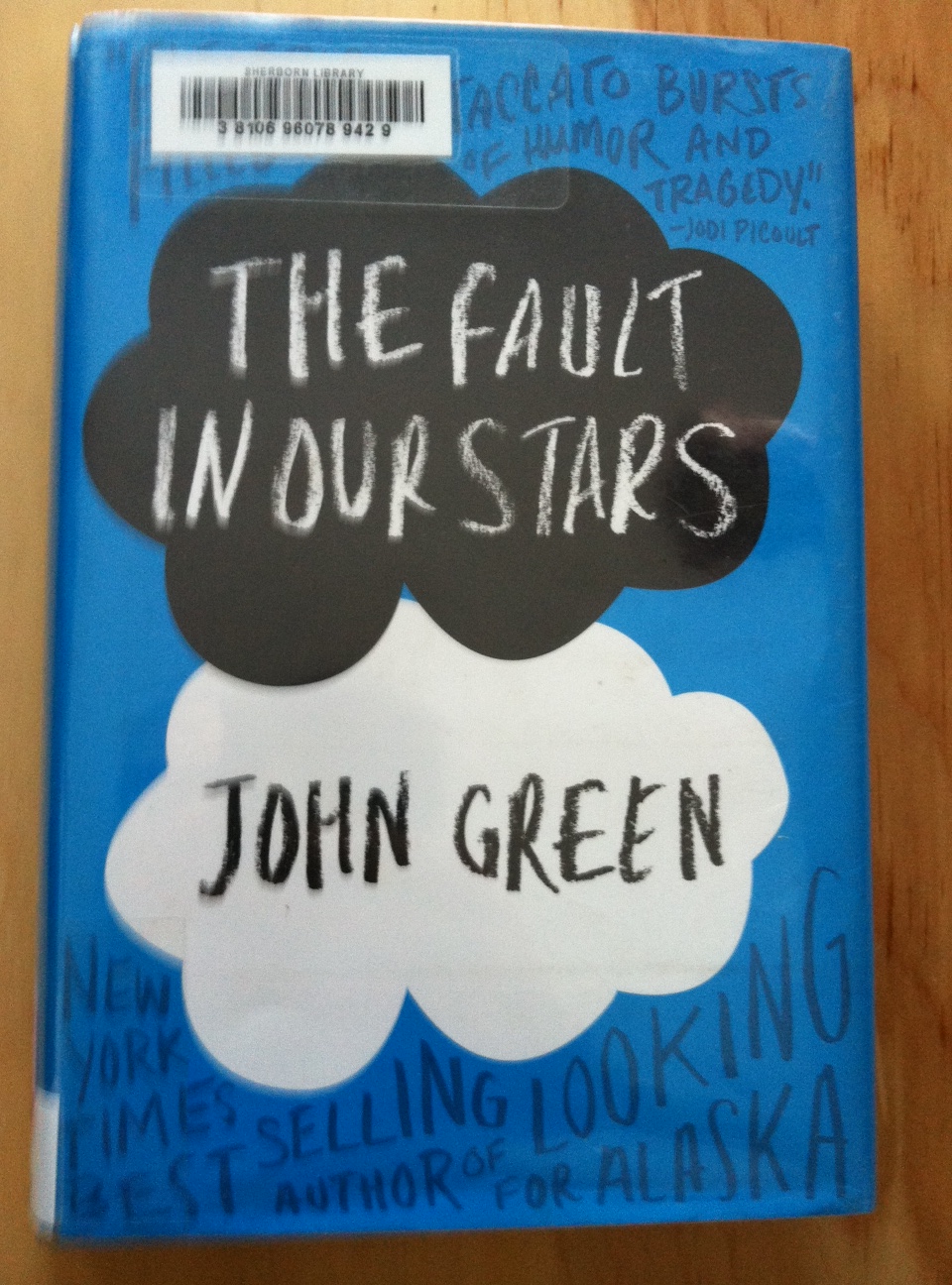
The Fault in Our StarsI realize that I may be the last literate person to have read this novel since it was published two years ago this month. Generally speaking, I try to avoid anything filed under “What Teens Are Reading” at Barnes and Noble (yes, I was in there exchanging things), despite my occasional forays into YA. But The Fault in Our Stars has been so widely acclaimed that I felt safe joining the library wait list.

Sidebar: Was the term “YA” around when we were younger? I’m 29, for the record, and I don’t remember seeing “YA” as a teenager, although it’s possible that I missed it because I was pretentious enough then to turn up my nose at a wide swath of literature (What’s that you say? I’m still pretentious? I don’t want to bite my thumb at you, but . . . ) and hated being categorized as a “teen.”  I did read a bunch of Judy Blume novels in grade school (Yes, grade school. My second grade teacher couldn’t figure out what to do with me during class reading time, so she handed me Are You There God? It’s Me, Margaret. I was really confused, and a search through the bathroom cabinets didn’t help much.) I remember leafing through them in the library —  to this day, I can’t really keep a straight face around anyone named Ralph — but I don’t remember how I found them.

My point, which got lost somewhere in there, is that I don’t see Forever .  . . (don’t worry, didn’t read that one in second grade) shelved near the Boyles and Byatts these days, and maybe that’s a trend that’s been around for awhile. Then again, sometimes I can’t find Neil Gaiman books anywhere except the SF/F fantasy section, so maybe we should all band together and protest the isolation of genre fiction. Or do separate genre markers make it easier to find something along the lines of what you like?

But I digress.

Spoilers Ensue. You have been warned. I’ll let you know when it’s safe to read again. 

I loved The Fault in Our Stars, even if it meant that I started my New Year by sobbing all over my favorite sweatshirt and causing my two-year-old to worry about Elmo’s health. It’s a testament to the writing that I knew just what was coming by page 18 (“Osteosarcoma sometimes takes a limb to check you out. Then, if it likes you, it takes the rest.”), but I still wanted to keep reading. Hazel and Augustus are hilarious, winning characters, perfectly imperfect, precocious but never precious. The book treats people with illnesses as people, which is rarer than it ought to be, and I thought the medical issues were handled well.

Here’s where the book first won me over: “There is only one thing in this world shittier than biting it from cancer when you’re sixteen, and that’s having a kid who bites it from cancer” (8).  It’s the rare adolescent-centered book that fully acknowledges the burdens of parents, and this is one of them. I happen to be personally conversant with untimely death, and now, as a parent, I can tell you that, yes, being the parent would be worse.

I wonder, and I’d be pleased to know if you have the answer: Is this book as popular as boys as it is with girls? I know that it was mostly girls who read Twilight (tried some of that in an effort to get to know my students’ tastes: disaster.), but I can see how The Fault in Our Stars would appeal to boys, too.

As I read, part of my mind was engaged thinking about texts that I’d teach with The Fault in Our Stars, since it’s a commonly-read book among high school students and people entering college. It’s a dream of a book for English nerds, with tons of discussions about metaphors and books; Laura at Reading in Bed has a great post on the allusions in the book (and I agree with her critique about the sex scene too).

End of Spoilers.

Here’s a short list of books that I think would complement The Fault in Our Stars, not just from a teaching standpoint, but from a general reader’s standpoint too.

W;t, by Margaret Edson. A play about an English professor dying from ovarian cancer. Brilliant, beautiful, full of John Donne. I’ve taught it three or four times, and college students (freshmen to seniors) have loved it. There’s quite a bit here about how the medical establishment dehumanizes patients, and I think the de-emphasis on hospitals in The Fault in Our Stars would provide a good counterpoint and spur discussion about lenses in literature.

Gain, by Richard Powers. The best novel about cancer I’ve ever read (sorry, John Green). It’s dense, engaged with history and what it’s like to be human and sick. It both is and is not historical fiction, environmental fiction.

Never Let Me Go, by Kazuo Ishiguro. If you missed this book, go read it immediately. It’s stunning. I won’t give away the plot because it’s so exquisitely rendered. Like The Fault in Our Stars, it features young adults facing circumstances entirely out of their control, and navigating though first loves at the same time.

What would you add to the list? What did you think of The Fault in Our Stars?