The Poetry Concierge Recommends: Robert Frost

[The Poetry Concierge is an occasional feature here on Rosemary and Reading Glasses wherein I select a poem, poet, or book of poems for individual readers based on a short questionnaire. Come play along! Read the introductory post here, my first recommendation here, and then email me at: rosemaryandreadingglasses [at] gmail [dot] com.]

This week, our pilgrim in search of poetry is Tania, who runs (along with Kirt) Write Readsa blog and Canadian reading book club podcast.

1. When you read fiction, who’s your go-to author?

I can only pick one? Okay, Margaret Laurence …but there are so many others!! 

2. If you read nonfiction, which subjects are most likely to interest you? (cultural history, science, biography, memoir, survival stories?)

Travel, Political/Social Commentary and anything by Bill Bryson.

3. If you were stuck on a desert island for a week, which five books would you bring to keep you entertained?

The Diviners by Margaret Laurence
I Shall Wear Midnight by Terry Pratchett
The Name of the Wind by Patrick Rothfuss
The Decameron by Boccacccio
The Rebel Angels by Robertson Davies

4. If you were on a five-year mission to Mars, which five books would you bring to keep you sane?

An Abundance of Katherines by John Green
Sunshine Sketches of a Little Town by Leacock
The Diviners by Margaret Laurence
The Name of the Wind by Patrick Rothfuss
Asterios Polyp by Mazzuchelli

5. What kinds of questions are most likely to keep you up at night? (death, the nature of love, politics, environmental issues, meaning of life, end of the world, justice and injustice, etc?)
 

Meaning of life
Justice/Injustice

6. If you’ve read poetry before, what have you liked? What have you disliked?

I’ve liked a lot of T.S. Eliot. I’ve liked more story-telling poems and less of the random images and symbols that I don’t understand poetry 🙂


Ok, so this is a tricky one, because I haven’t read any of the books that Tania lists! (Well, excerpts from The Decameron, and I’ve read one Bill Bryson book, but still.) However, with a little poking around, I got the sense that Tania likes well-developed characters, vignette-like structures, and a strong sense of place. It’s these last two qualities, in particular, that lead me to recommend that American poet everyone thinks he knows, Robert Frost.

Modern in sensibility, if not in form, Frost’s poetry is rooted in nature, and the woods of New England, in particular. Many of his poems read like vignettes, records of small moments in country life, whether everyday (“Stopping by Woods on a Snowy Evening”) or horrific (“‘Out, out–‘”). Darkness lurks around the edges of the very poems that are so often celebrated for their beauty and felicitous phrasing; isolation, death, and despair walk in the woods, too.

Take Robert Frost’s “The Wood-Pile”, which I think might be just right for Tania. The speaker is far from home, walking through a frozen swamp, and before we can wonder why, we’re distracted by the flighty bird that’s leading the speaker on, and then by the wood-pile, orderly but abandoned, out in the woods. There’s so much going on with that wood-pile that I’ll let you discover it for yourself.  I hope you’ll like this poem, Tania, and Robert Frost’s work, too!


Would you like the Poetry Concierge to make a recommendation for you? Check out the introductory post, and send your answers to the questionnaire, along with the name and/or blog you’d like posted with the reply, to rosemaryandreadingglasses [at] gmail [dot] com.

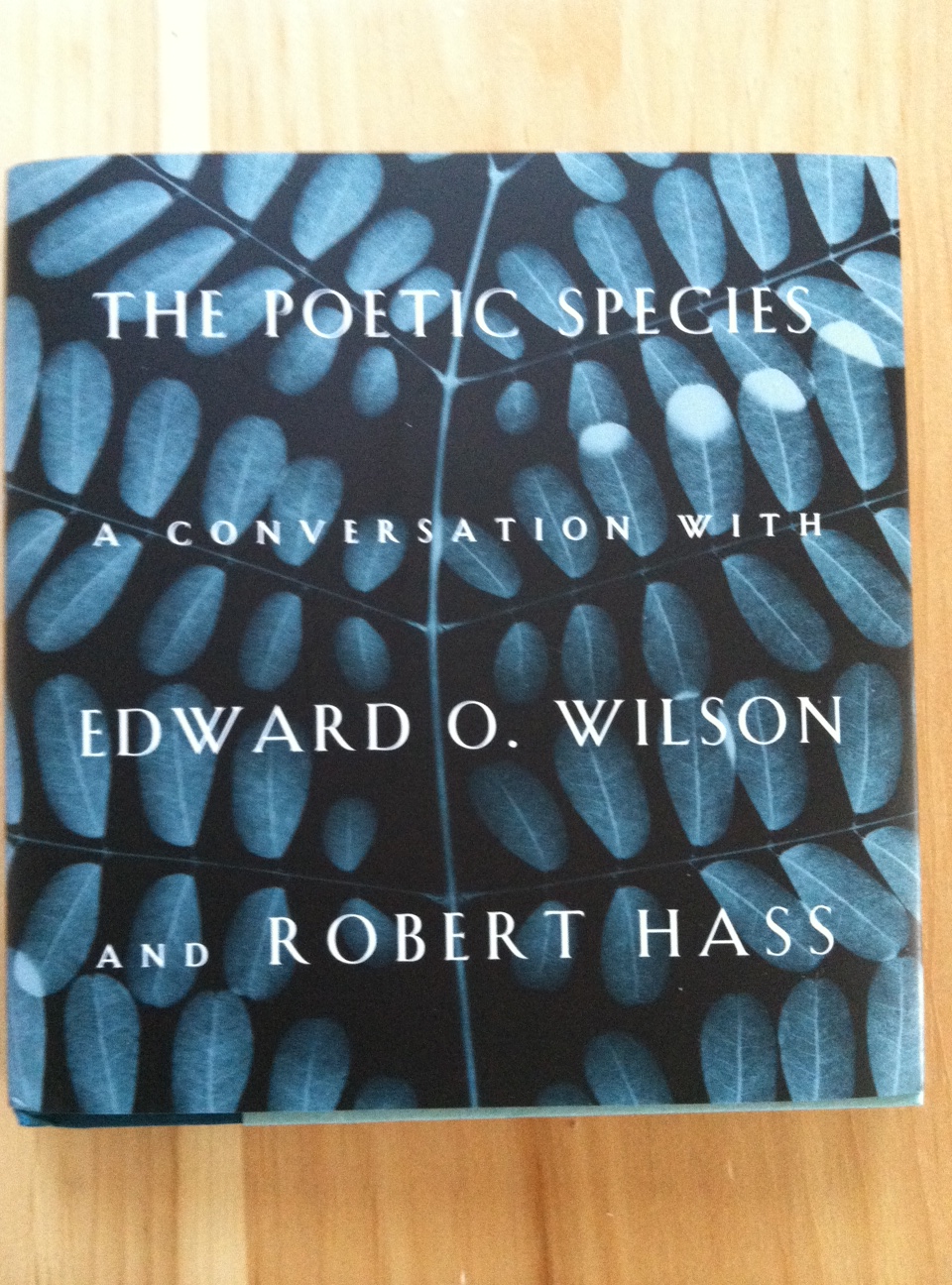
Recommended Reading: The Poetic Species: A Conversation with Edward O. Wilson and Robert Hass

photo (69)This slim volume — beautifully designed, by the way — is the record of a conversation between two careful thinkers: Edward O. Wilson (better known as E. O. Wilson, perhaps), a biologist famous for his work on ants and his sometimes controversial theories about evolution, and Robert Hass, a highly acclaimed poet, essayist and environmentalist who is a former Poet Laureate.The event — think a long-form TED dialogue — took place in late 2012, was co-sponsored by Poets House and the American Museum of Natural History.

As Lee Briccetti writes in the Foreword to The Poetic Species*, “Poetry is not purely associative. Science is not purely analytic. All skilled human production depends on subtle networks of cognitive capacities and the ability to transition between them” (23). Professor Wilson and Professor Hass came together to talk about the ways that science and the humanities inform each other, and how thinkers in both disciplines might come together to protect the natural world.

The first part of the discussion traces Professor Wilson’s theory of the perpetual conflict embedded in human nature (and yes, the question of “human nature” is, as it’s often maddeningly put in the academy, “vexed”): a tendency toward altruism with regard to members of one’s social group (and concomitant hostility toward outside groups), and the impulse to act selfishly at the individual level. Professor Hass notes, “the dance of the tension between these two things must constitute something of what we mean by consciousness, by the experience of having choice and free will and moral life. A productive oscillation between a social self and a private, individual self, in each person and in the species” (40-41). He goes on to suggest that this kind of oscillation appears in art, between form and departure from form, between what makes us comfortable and what challenges us and makes us uncomfortable.

Professor Wilson, too, emphasizes the connection between biology and art: “I’ve suggested many times that the humanities, and especially the creative arts, are the natural history of Homo sapiens” (48). In his view, “The creative arts are the sharing of our inner desires and humanity’s struggle. The humanities are our way of understanding and managing the conflict between the two levels that created Homo sapiens” (53). Put another way, in Robert Hass’s words: “At a very simple level, poetry can give us someone to talk to. To read is, in that way, to have your inner life acknowledged by somebody else’s” (78).

(As you can probably tell, I’d love to quote great swaths of the dialogue in this review, but then I’d run the risk of quoting the whole book; every page offers something worth contemplating. I’d love to see more collaborations of this kind in print, and I’d happily read another conversation between E.O. Wilson and Robert Hass. While The Poetic Species takes the initial format of Professor Hass interviewing Professor Wilson about his work, and works from that point, I’d like to read another conversation in which Professor Wilson questions Professor Hass about the natural elements in his poetry (which is deeply rooted in the environment of northern California). Given Professor Wilson’s admission, in his own list of suggested reading, that he does not read literature for its own sake, perhaps this is wishful thinking.)

The last third of The Poetic Speciesis an impassioned plea for conservation of wildernesses, a plea to take the initiative to save places and species that are in danger of disappearing. Wilson says, “I’m spending more and more of the time I have left on national parks” (67). Both men encourage education of young people in both biology and the humanities to promote environmental stewardship; Wilson suggests that education should go beyond facts and terms — “it’s somehow got to be made into a story” (76). Common Core creators, take note.

Reflecting on elegant solutions in math and sciences, Hass says, “Beauty sends out ripples, like a pebble tossed in a pond, and the ripples as they spread seem to evoke among other things a stirring of curiousity. The aesthetic effect of a Vermeer painting is a bit like that. Some paradox of stillness and motion. Desire appeased and awakened” (79). That’s how science and poetry work — we solve one problem, come to one possible solution, and another question presents itself — like endless webs that spin outward and outward to gather us all in.

The Poetic Species is a fascinating foray into the ways we’re connected to each other and the natural world — highly recommended reading.

*My thanks to the publisher for sending me an advance review copy of this book in exchange for an honest review.

The Poetry Concierge Recommends Margaret Atwood

[The Poetry Concierge is an occasional feature here on Rosemary and Reading Glasses wherein I select a poem, poet, or book of poems for individual readers based on a short questionnaire. Come play along! Read the introductory post here, my first recommendation here, and then email me at: rosemaryandreadingglasses [at] gmail [dot] com. ]

This week, our pilgrim in search of poetry is Naomi, who blogs about books over at Consumed by Ink.

1. When you read fiction, who’s your go-to author?

Already, this is a hard question.  I don’t do a lot of re-reading, but there are some authors who I’ve read many of their books:  Margaret Atwood, Ann Patchett, Geraldine Brooks, L. M. Montgomery, Lois Lowry, Michael Crummey.

2. If you read nonfiction, which subjects are most likely to interest you? (cultural history, science, biography, memoir, survival stories?)

Probably memoirs, survival stories, and historical figures.

3. If you were stuck on a desert island for a week, which five books would you bring to keep you entertained?

Ok, a week isn’t too long.  I would probably want to bring 5 books I haven’t read yet, which means I don’t know what they’d be.  A couple on my TBR pile that would be good to bring to a desert island would be Rockbound by Frank Day and The Republic of Nothing by Lesley Choyce. Nothing scary or spooky please.  Maybe something funny, like Christopher Moore and another Will Ferguson book.  One more-maybe a good love story.

4. If you were on a five-year mission to Mars, which five books would you bring to keep you sane?
5 years is much longer than a week, so I would have to either bring books that I know I would like to re-read, or bring some big chunksters.  I have never read Middlemarch, so maybe that one.  A big, fat Dickens to take my time with.  Jane Eyre would be nice to have – I would definitely re-read that one.  The Time Traveler’s wife, so I would have lots of time to get it all straight.  Lastly, either Roots or Lonesome Dove.  I have never read Lonesome Dove, and my mother says I should, but if I took Roots I would know that I already love it.  If I was allowed to count a series as 1 book (which I probably am not), I would bring the Anne books.

5. What kinds of questions are most likely to keep you up at night? (death, the nature of love, politics, environmental issues, meaning of life, end of the world, justice and injustice, etc?)
 

I’m most likely to be kept up at night thinking about the nature of love, or environmental issues and how they will someday affect the way we live.  Also, I sometimes try to make sense of societal rules, and how I might like to change some of them.

6. If you’ve read poetry before, what have you liked? What have you disliked?

I don’t like poetry that takes a long time to figure out what the person is getting at.  So, I like to be able to know what the poet is saying, whether she’s describing something or telling a story.  When I think of poetry I like, I always think of A.A. Milne’s poems for children (no laughing).  I still love them, and have several memorized. Also, I just thought I would add a little challenge for you.  Along with whatever you choose for me, do you think you might also be able to come up with a Canadian suggestion as well?  If possible.  I actually had been looking at the library for one to read for this month, but didn’t have any luck. 


For Naomi, I’m recommending a Canadian poet who’s more famous for her novels: Margaret Atwood. Yes, THE Margaret Atwood, author of The Handmaid’s Tale, The Blind Assassin, and Oryx and Crake, among many other highly-regarded novels. Ms. Atwood is also a distinguished poet whose collections include The Circle Game, The Animals in That Country, Morning in the Burned House, and, most recently, The Door.

(I almost feel like I’m cheating since Naomi wrote in first answer that Margaret Atwood is one of her go-to novelists, but then again, the questionnaire is meant to be revelatory, right?)

I also think Ms. Atwood’s work is right for Naomi because of their mutual interest in environmental issues and social justice. And Naomi’s pick of Christopher Moore as an author whose novel she’d take to a desert island tells me that she has a great sense of humor, and Margaret Atwood’s work is full of humorous touches. Furthermore, some of the authors and books Naomi singled out for attention deal with women who are isolated in some way, like Jane Eyre, or Anne Shirley (as in Anne of Green Gables); the speaker of the particular poem I’ve picked out for Naomi (though I’m recommending Margaret Atwood’s work as a whole) feels isolated by her profession.

Here’s “The Loneliness of the Military Historian,” by Margaret Atwood.

Naomi, I hope you’ll like this poem’s careful deployment of startling imagery, the strong narrative voice, and its message. Thanks for writing in!


Would you like the Poetry Concierge to make a recommendation for you? Check out the introductory post, and send your answers to the questionnaire, along with the name and/or blog you’d like posted with the reply, to rosemaryandreadingglasses [at] gmail [dot] com.

An Interview with Michelle Huneven, Author of Off Course

Yesterday I reviewed Michelle Huneven’s beautifully-crafted new novel, Off Course. Ms. Huneven graciously agreed to be interviewed via email. 

How would you describe the inception of Off Course? What was the writing process like?

Michelle Huneven (c) Karen Tapia

Michelle Huneven
(c) Karen Tapia

MH: As often happens with me, I started out with one book in mind, but another one happened.  I had wanted to write a novel that charted a woman’s life from childhood to a version of stable adulthood with some years en route spent lost to trouble. Well, that book didn’t happen.  In Off Course, I started right where my heroine,  Cressida Hartley, at age 28, turns off the beaten path.  She’s at a perilous, vulnerable stage, when she’s done with school and about to set forth in life.  She should be settling into a career and making at least general decisions about marriage and family. But first, she has to write her dissertation. For whatever reason, she can’t get going on it. She just can’t.  She makes herself ever-available to distraction and gets lured away from her friends, family, and self. Or, to quote the epigraph, “demons arrive singly and in droves, often taking the form of men.”

In terms of process, I  tried something new with Off Course, which was to write a certain number of words a day. 1000, I think, which is a lot. Too many.  This was not an effective method for me.  To meet my daily goal, I wrote a lot of dreck, some of which stuck to the book for a long time and interfered with plot and shaping. Also, I had to go back and fix every damn sentence. Did forcing myself to produce at such a rate prove a worthwhile exercise for my imagination?  No.
The setting for much of the novel sometimes seems like another character in Off Course. How did you decide to set the novel in the Sierras?

photo (68)MH: My parents had a cabin high up in the Southern Sierras, so it was a geography and community with which I was deeply familiar. I went up to the cabin as a kid, although not with the strict regularity that Cress’s parents dragged her to their A-frame.  I also lived in our cabin briefly when I was trying to write my first novel.

I disliked going to the cabin as a child; I appreciated the landscape more when I lived there as a young adult, even though that wasn’t the happiest time of my life.  But I loved going back there in my mind all the years and months that I was writing Off Course.  The landscape, with its rocks and trees, trails and wild animals, was all there in memory, just waiting to be closely observed.

I did try to go back to the area a few years ago to do research for the book, but a freak snowstorm in May forced me to turn back at 6000 feet.
Cress’s graduate work is in economics, and her dissertation focuses on art in the marketplace. Are readers meant to think of the mountainside community as a kind of marketplace, too, with commodities beyond those merely bought and sold?

MH: The mountain community certainly had its own a singular, improvisational economy. It was tricky for anyone to make a living up there, but then again, for some of my characters, it was the only kind of place where they could make a go of it. The developer of The Meadows was a here-today, gone-tomorrow drunk, but because he was the only person selling property up there, customers had to deal with him.  The fellow who ran the lodge (who charged customers whatever he felt like) and the contractor who built vacation homes (and sometimes overran his bids by more than 100%) could not have stayed in business had there been any, more viable businesses to compete with them.

To get closer to your question— this community seems to be a place where all bets are off.  There’s a whiff of the numinous, of ether, a high altitude queasiness and an out-of-time holiday hilarity that allows certain emotional and financial transactions to occur there, antics that might be out of the question at lower elevations.  One of my readers happily described life on the mountain as “an all day sex party.” Another described it as “an erotic eden.” Both comments point to a rarefied atmosphere where there’s a certain relaxation of inhibitions and a willingness to work the margins of romantic possibility.

Readers may not know that in addition to being a novelist, you’re also a journalist and food writer. If you were choosing a meal to complement a reading of Off Course, what would be on the menu?

MH: Oh gosh—nothing very good for you! We’d start with a bowl of pozole: a clear fragrant broth made from pork, chicken, and chiles, with bits of meat and  plump multicolored kernels of hominy.  Dinner itself would be a pot roast simmered all day in beer with masses of onions.  I’d serve it with chard or kale sauteed—just this once–with bacon.  There would be buttermilk biscuits with sweet butter and a green salad dressed with local olive oil—although to be truer to the spirit of mountain life, you’d probably toss it with that weirdly-flecked Wishbone Italian dressing that’s been in the refrigerator door for at least two years.  Dessert would be peach cobbler made from Bisquick and canned peaches served with ice cream that is slightly crystallized, from melting a bit on the long drive up the mountain and then living too long in a freezer.

What’s a question you hope readers will take away from Off Course?

MH: Is a great, passionate, all-consuming, sometimes-rapturous, obsessive love—a love that could hijack years and potentially cause scarring, if not real damage to its players—something to be desired?  Is the experience worth the pain?

My husband says this question is too one-sided, but he underestimates the romantics among us.

What kinds of writing projects are you planning next?

MH: I have been writing short stories for the past year and a half.  Recently, I’ve started two books, one a historical novel about a brilliant but wrongheaded scientist who once lived on my property and the other a novel about a church and its search for a new minister.  Both take place close by to where I live, in beautiful Altadena, CA.

My thanks again to Ms. Huneven for her time and wonderfully generous answers. You can read more about Ms. Huneven, and Off Course, on Ms. Huneven’s website, www.michellehuneven.com. Follow Michelle Huneven on Twitter: @MHuneven

Death of a Poet

The first time I met Eric, one warm evening in late May, I told him how much I hated the title of one of his poems. (I am a noted conversationalist.)  We were at a party unveiling the latest edition of the college lit magazine, which I’d worked on, and two or three of Eric’s poems had been selected for publication, including the one I fought vehemently against because of its horrid title. (It really was bad.)

Totally unfazed, Eric grinned, told me I was wrong, and joined the magazine’s staff in the fall so that we could bicker more frequently. He walked me home every Monday night, always laughing.

Two years later, we finally realized that we were madly in love with each other.

Three months and twenty-seven days before our wedding day — seventeen months and two days after our first kiss at Logan airport — Eric was dead.

That was six years ago today.


In the six years since Eric died (I am allergic to euphemisms, at least when it comes to death), I’ve never been able to write coherently about our few years together, his death, or the aftermath. Over the past month I’ve written pages and pages of material, but it’s too much to post here, though it was, in the greater scheme of things, an ordinary tragedy. There was no bomb, no gun, no collapsing bridge, no drunk driver. No earthquake or tsunami or tornado or wasting disease. There was no one, nothing to blame, but there is so much to tell.

I could tell you about how much Eric loved his family and his best friend, Andy, his generosity of spirit, his quick wit, his inimitable brand of hard-edged sensitivity. But then I’d have to tell you about Eric’s walk (jaunty, purposeful, often with a cup of black coffee in hand), his laugh, his eyes, his fearlessness, the long tails on his handwritten ‘y’s, his inexplicable love for soccer, Miller High Life, and rap.

I could tell you about his poetic exploits (he wrote a sonnet composed of advertising slogans, and it worked), about the funny, bawdy, homely, happy poems he dashed off two or three times a week for me, about the play he wrote without telling anyone. I could tell you how the last time we talked I said I thought some of the poems in his thesis were ours, too personal to share. But then I’d need to tell you how we laughed about brazier/brassiere, how proud I was when he was published, how modest he was when other poets praised his work.

I could tell you about screaming into my apartment’s floor after Eric’s father called to tell me he was dead (the carpet was beige and cream with little brown fibers threaded through its flat twists, like loose hairs). But then I’d have to tell you about smashing glasses in the kitchen, curling up next to my best friend and hearing my mom ask him through the phone if I was vomiting, because I was sobbing so hard — and I wouldn’t be past the first two hours.

I could tell you that it is absurd (one of Eric’s favorite words) to be twenty-three years old and shopping for a black dress when there’s a perfectly good meringue of a wedding dress at home that you won’t ever wear. It’s absurd to wonder if there are support groups for almost-widows (There weren’t.). But then I’d have to tell you the absurdity of trying to explain your fiancé’s best qualities to a minister who’s never met either of you before, the absurdity of listening to a woman who verifies your relationship with the dead man in the casket twenty feet away and says, “Just think! All those birthdays! All those Christmases! And your wedding!”

I could tell you what it’s like to think that the evidence of spring around you is worse than absurd — it’s obscene. Obscene that all those flowers and budding trees are licked with sunshine when your beloved’s body is going down, down, down into the dark earth where you can’t follow. But then I’d have to tell you about reading an autopsy report, a calm account of your lover’s body cut to pieces, learning, at the last, just how heavy a heart can be.

You see, April really is the cruelest month.

The truth is, I’ve never written before about the aftermath of Eric’s death because to remember it, for me, is to relive it.  One memory leads to another, and another, and another; what I’ve written here is only a fraction of what’s still in my mind. I can hear our wedding rings clinking on a chain around my neck, can see the anguish in his mother’s eyes, can taste the dust from the gravel road into the graveyard. I did not — do not — handle bereavement with grace or humor or equanimity or courage or any admirable quality at all, really. The desire to write these things down is mostly selfish, an attempt to share the witness of grief, to excise just a few of those memories.

That’s one half of the truth. The other half is that love is stronger than death.

What’s stronger than the awful memories of the week of Eric’s death and burial is the enormous power of the acts of love that happened in the weeks and months and years that followed. If I were to list every person who was kind to me, to Eric’s family, to my family, you’d be reading for hours. I kept every message, every letter, every note sent with flowers; impossible as it seems, I remember every person at the wake and funeral, every kind word then and after, and my gratitude is unceasing.  For every agonizing memory, there are two or three filled with images of love. Most of them are so specific that I can’t write about them here without infringing on other people’s privacy;  so suffice to say that when life felt most unlivable, somehow kindness always appeared in one of its many guises — a cornucopia of grace that I’m convinced saved my life.


There’s a particular solace that books can give, the sense that someone else has been there before you, has staked out the country, is holding out a rough-hewn cup when you’ve been so thirsty for so long that you’ve forgotten the taste of water. Mercifully, the last book I had to teach before the summer was The Razor’s Edge, and I’d never understood it better. I re-read C.S. Lewis’s A Grief Observed. My friend gave me Ann Hood’s Comfort. And there was poetry — so much poetry: Edna St. Vincent Millay, Emily Dickinson, Carol Ann Duffy, W. H. Auden, Milton, A. E. Housman.

And finally the ghost of Miss Havisham appeared and I decided that while I had no intention of falling in love ever again, I also had no intention of withering away in my apartment, or forever provoking (kind) looks of pity.

And so, about a year after Eric died, I found myself in a little Italian restaurant, sitting across from a tall near-stranger with warm brown eyes. He was shy, funny, serious, and, as I learned later, very kind and very gentle. I told him about Eric and my almost-widowhood on that first date, and he looked me in the eyes when he said he was sorry. He emailed me and asked for another date the same night. And in the last five years, he’s listened whenever I needed to talk about Eric.

It was confusing, at first, to fall in love when I still loved Eric; but finally I realized that I will never stop loving him. After all, we love relatives who’ve died, don’t we? The condition of their existence does not alter our love.


Last year, around this time, I wrote a little about what it’s like now to feel this mixture of love and sadness. For now, I can’t improve upon it, so here it is:

The end of a long story of mine is that I own the poetry collection of someone I loved very deeply and who died much too young.  In the beginning I kept our collections separate, and thought that someday I’d try to read through them as a way to work through my grief. But over time the project receded, and our collections have melded together so thoroughly that often I don’t know the provenance of a particular book.

This morning, my little son, H, and I were looking over the shelves to find a poem to work on this week, and I was drawn to Richard Wilbur’s New and Collected Poems (1989), which won the Pulitzer (Wilbur’s second). It’s a thick volume, and I found several promising poems, full of sly wit and concrete images, but nothing that shook me by the shoulders and said “This one!”

Until, that is, as my son fell asleep in my arms, I read the title of the last section: The Beautiful Changes, the title of Wilbur’s first book of poetry, published in 1947, when he was twenty-six (oh, to have the touch of genius!). My hands shook a little; I know these poems, “Cicadas” and “O.” I’ve read poems that talk to them.

And the last poem in the book, in the collection, is “The Beautiful Changes,” and it expresses, for me, what has happened since I lost this person I loved, whose fingers turned these very pages. Through the madness and the crushing weight of sorrow, the images that I cannot un-see, life and consolation reached out and found me.

I knew, without looking, that if I opened the inside back cover, I’d find three angular initials, and that they wouldn’t be mine.

But now the poem is ours.


Portrait of His Beloved120_517293792055_8906_n
John Donne knew a compass could draw
the face of a clock, but not the face
of his woman. To the young poet,
did this difference mean anything?

He knew her hands, no matter how gentle,
held him, in the end, the same way
as the clock’s hands held him.

To be away from her was to know
the hour. It was to know death
could be any unknown moment.

He loved her likeness, because
it was its moment kept in its frame.
Looking gave him time to ignore
the strange numbers never smiling.

Eric Van Cleve, 2006
 

Recommended Reading: Michelle Huneven’s Off Course

photo (68)Cressida Hartley, a graduate student in economics and a casual artist, has retreated to her parents’ A-frame in California’s Sierras to finish her dissertation, a venture that she hopes will take a few months. Instead, it’s years before she comes down off the mountain, years in which she veers both slightly and wildly off course from the life she had planned.

Michelle Huneven’s fourth novel, Off Course* is a delicate character study, one that is deeply rooted in setting. Like her Shakespearean namesake, Cress is at times difficult to like, but always believable, always human — flawed and interesting. Her dissertation languishes while Cress is willingly seduced by the jolly (and non-monogamous) owner of the local lodge, a gathering place for the mountain’s residents and visitors. This affair, quick to to start and quick to finish, would have necessitated only a minor course correction on Cress’s part — but then she meets an intriguing — and married — carpenter.

This is the sort of affair that serves as the backstory or the amusing antics of the best friend/sidekick in romantic comedies, but Ms. Huneven spins the relationship into a masterpiece of characterization. What seems incomprehensible — why an intelligent, feminist, career-oriented woman would spend years of her life on a man who’s often emotionally unavailable and always married — is made comprehensible by the way the novel tracks Cress’s decisions and delays, the disturbances in her understanding of herself. Though she’s an economist, Cress neglects the cost-benefit analysis that could save her grief; and yet, how does one put a price on love?

What I loved most about this novel was Ms. Huneven’s attentiveness to the setting. The land, the sky, the weather, the animals of the Sierras — all seem to seduce Cressida just as much as the men who live on the mountain. If she were a professional artist, she thinks, she would have wanted to work in landscapes. The double edge of the landscape’s isolation and consolation slices through Off Course, exposing not only the tradeoffs Cress makes, but our own concessions to love.

Tomorrow: An Interview with Michelle Huneven, Author of Off Course

*My thanks to the publisher for sending me an advance copy of this novel in exchange for an honest review.

The Poetry Concierge Recommends

. . . a poem for Katie of 5cities6women!

Katie, in addition to being a blogger and all-around awesome human, is also my friend and neighbor, and she kindly reminded me last weekend that I meant to start up the Poetry Concierge (I sure need a logo, don’t I?).

I’m delighted that Katie wrote in with answers to the Poetry Concierge questionnaire so we can kick off the series in style.

1. When you read fiction, who’s your go-to author?

Not to be difficult, but I don’t have a go-to author for fiction. Lately, I just grab whatever new, well-reviewed or personally recommended stuff I can find. When I was reading lots of short stories, I read everything I could by Stacey Richter and TC Boyle and Lorrie Moore, but now I’m on novels and it’s all random.

2. If you read nonfiction, which subjects are most likely to interest you? (cultural history, science, biography, memoir, survival stories?)

Memoir, history, anthropology, travel stories

3. If you were stuck on a desert island for a week, which five books would you bring to keep you entertained?

Catch-22 (read it); Sea of Hooks (reading it); Love, Anger, Madness: A Haitian Tryptich (reading it very slowly); Americanah (want to read it); My Date with Satan (read it)

4. If you were on a five-year mission to Mars, which five books would you bring to keep you sane?

5 books for 5 years? Yikes! Ok, for fiction, Catch-22 again, Jazz, and Cloud Atlas; for nonfiction, Wade Davis’s The Wayfinders (just seems appropriate), and a TBD book on dealing with claustrophobia

5. What kinds of questions are most likely to keep you up at night? (death, the nature of love, politics, environmental issues, meaning of life, end of the world, justice and injustice, etc?)

Nothing keeps me up at night because I’m possibly narcoleptic. I guess if I had to pick something though, I’d say meaning of life and death, and whether I’m doing the right things to make the most of my time here on this planet.

6. If you’ve read poetry before, what have you liked? What have you disliked?

I’ve always liked the WWI poets and the Beats, especially Diane diPrima. I like ee cummings, and TS Eliot but often feel like I don’t fully understand him. I’ve liked the little bit of Catherine Pierce I’ve read recently, but I don’t generally speaking have an allegiance to any particular poet or style – though I’m always really impressed with a good villanelle.


Ok, so here’s hoping I get this right. Based on Katie’s answers, I’m recommending:

“Myth,” by Natasha Trethewey

Why? Well, here are a few reasons:

  • It’s a modified villanelle
  • As a modified villanelle that works like a palindrome, its structure is repetitive and circular, qualities associated with Catch-22 (as I understand it; I admit to never having read the novel). The attention to form often characterizes the poetry of World War One, as well.
  • It meditates on the meaning and perception of death, and the permeability of sleep
  • Natasha Trethewey is the current Poet Laureate of the United States — she’s the real deal.

Katie, I hope you like “Myth”!


Would you like the Poetry Concierge to make a recommendation for you? Check out the introductory post, and send your answers to the questionnaire, along with the name and/or blog you’d like posted with the reply, to rosemaryandreadingglasses [at] gmail [dot] com.

“The Wind is sewing with needles of rain”: Hazel Hall’s “Two Sewing”

Yesterday was the (of late) rare fine day here in Boston, so my son and I were able to take a long walk (without coats!). Finally, it felt a bit like spring, with the crocuses blooming in confirmation:

photo (67)

Crocuses are a particular favorite of mine, so I looked for a poem that mentions them. Some heavy hitters cropped up in my search: Tennyson, Browning, even Oscar Wilde. However, it was a little poem called “Two Sewing” that caught my eye. I love everything about this poem: the combination of the natural and the domestic, the subtle rhyme, the well-chosen phrases, the repetition that encodes the sound of rain on windows.

In other words, I’m delighted to have come across, quite by accident, Hazel Hall. I hadn’t heard of her before, but what I learned led me to order the edition of her collected poems that came out in 2000 (not to be had in our library system, alas).

Hazel Hall (1886-1924) used a wheelchair from childhood until her death, and she spent most of her adult life in Portland, Oregon (OSU Press is the publisher of her Collected Poems). She helped to support her family by working as a seamstress, an occupation that’s reflected in the metaphors of “Two Sewing.” You can read John Witte’s Introduction to the Collected Poems here; he writes,

Hall’s poems seem on their surfaces tidy, sometimes as strictly and gorgeously embellished as her needlework. Yet close under their surfaces we sense the seething of a restless intelligence. Beginning with the materials at hand–her limited mobility, her isolation and loneliness, her gifts with needlework and words, and her exquisite grief–Hazel Hall fashioned in the short span of her career a poetry of startling achievement and durability.

I can’t wait to read more.

You can read “Two Sewing” at Poets.org.

Literary Wives: The Zookeeper’s Wife

literarywives2If you’re new to Literary Wives, here’s the summary: I’ll be joining bloggers Ariel, Audra, Emily, Cecilia, Kay, and Lynn as we post every other month about a different book with the word “wife” in the title. When we read these books, we have two questions in mind:

1. What does this book say about wives or the experience of being a wife?

2. In what way does this woman define “wife”—or in what way is she defined by “wife”?

This month, we’re talking about Diane Ackerman’s 2007 book The Zookeeper’s Wife. We invite you to join the discussion by commenting on our blogs (links below) or posting your own review on our shiny new Facebook page.


photo (66)The Zookeeper’s Wife is the first nonfiction book we’ve read together as a group.  I looked forward to reading the book for many reasons. My grandfather is a World War II veteran (Eighth Air Force), and close family friends, husband and wife, flew in the RAF and fought in the Dutch Resistance, respectively. I’ve also had the honor of meeting Holocaust survivors, thanks to the Maltz Museum of Jewish History, which is located near my hometown. Several of my high school friends’ grandparents were Holocaust survivors, too. All of which is to say that World War II feels more immediate to me than wars that, chronologically, are much closer to my own lifetime (Korea, Vietnam, even the Gulf War, which I remember seeing reports about on TV). I’m always interested to read another account of people who experienced the war.

Diane Ackerman traces the story of Jan and Antonina Zabinski (the eponymous zookeeper and his wife), who ran the Warsaw Zoo before the outbreak of World War II in September 1939. Like many other non-Jewish Poles, the Zabinskis risked their lives to save Jews and others hunted by the Nazis during the war; more than three hundred people passed through the zoo on their way to safety. Of all the countries affected by the Holocaust, Poland is the country with the most citizens deemed Righteous Among the Nations (non-Jews who risked their lives to save Jews) by Yad Vashem. The Zabinskis were two of those citizens.

Their story deserves to be told. The pair went to great lengths to help others at the risk of not only their own lives, but the life of their young son. Guests at the Zoo often hid in plain sight; one of the Zabinskis’ strategies was to keep the Zoo and its villa pulsing with comings and goings, visitors, friends, and family all the time. The Germans even kept an arms dump on zoo grounds, yards away from the empty animal enclosures where Guests were sometimes hidden. As you can imagine, the risk of discovery was great, and the Zabinskis and their Guests survived several close calls.

The Zabinskis’ story is a fascinating tale of courage and human connection, but I’m not sure Ms. Ackerman was the right person to tell it. I think her goal was to tell the story of quiet acts of domestic heroism and tenacity (as exemplified by Antonina), and that’s why she focuses less on Jan’s work with the underground Home Army, or a straightforward telling of the Zabinskis’ activities during the war and more on the story of the zoo and its animals. Chronicling domestic heroism is an admirable goal, and certainly the book’s strongest moments are those that detail Antonina’s efforts to retain a sense of normalcy and beauty in the midst of terror,  but I kept feeling that people were shortchanged in this book. I would have preferred a book about the Warsaw Zoo with a more equitable focus on its residents — permanent and Guests — or a book that chronicled the lives of women in Warsaw (maybe five or six) who saved lives from home.

Ms. Ackerman is a naturalist and poet, and while at times I found her highly detailed descriptions of locations in Warsaw and everyday life in occupied Poland immensely helpful, at other times I thought that her prose was too purple (yes, even I admit there is such a thing), distracting from the story at the center of The Zookeeper’s Wife. In one instance, especially, I found her voice New-Age-y and her questions insensitive toward her subjects’ privacy. Of her meeting with the Zabinskis’ son, Rys, she writes:

No doubt he found some of my questions odd– I hoped to learn about his mother’s scent, how she walked, her gestures, her tone of voice, how she wore her hair. To all such inquiries, he answered “average,” or “normal,” and I soon realized those were memory traces he either didn’t visit or didn’t wish to share. (312)

Memory traces? Really?

Though the book is organized in roughly chronological order, Ms. Ackerman’s narration is so choppy that it was difficult for me to remember what was happening at any particular time in the zoo.  Time and again it seemed that people dropped out of the story, only to reappear near the end or not at all; sometimes it seemed the author was more interested in describing the antics of animals than the heroism of people. And very often — too often — I put the book down so I could research a name on the internet because people weren’t given enough page-time. Irena Sendler — if you haven’t heard of her, stop reading me and go look her up — appears just three times in the book, despite the fact that she was (a) an amazing heroine and (b) a Guest (person in hiding) at the zoo.

While the focus of The Zookeeper’s Wife is World War II and the events preceding it, I also felt that the book stopped too suddenly at the end of the war; we receive very little information about Jan and Antonina during the Cold War years. I would have liked to learn how they managed under a new totalitarian regime after working so effectively against another.

Ultimately, as you can probably tell, I found this to be a frustrating read. The Zookeeper’s Wife may be worth a read if you’re looking for a stepping stone into the stories of occupied Poland during World War II, or if you’re interested in early-twentieth-century zoo-keeping, or the Nazis’ interest in animal breeding (there’s a bibliography in the back of the book). I’m glad I learned about Antonina and Jan, but I wish it had been in a different format.


And now, on to the Literary Wives questions:

1. What does this book say about wives or the experience of being a wife?

The Zookeeper’s Wife focuses on the difficulties of Antonina’s position as a wife, it’s at its best. Antonina can’t ask too many questions about Jan’s underground activities, but she tacitly accepts the danger that he places the family, just as she openly accepts Guests into their home. She maintains the facade of an ordinary housewife during the Nazi occupation of Warsaw, a facade which keeps her family and Guests safe. At the same time, she does perform the tasks expected of a wife at the time — keeping the house, budgeting, teaching her son — plus those tasks concomitant with running a house full of pets — all under extreme stress. Part of being a wife, for her, is waiting to see if Jan will come home alive every day, and facing terrifying and dangerous situations on her own, in her own home. There is no safe space for her during the war.

Here’s my favorite sentence in the book: “One of the most remarkable things about Antonina was her determination to include play, animals, wonder, curiosity, marvel, and a wide blaze of innocence in a household where all dodged the ambient dangers, horrors, and uncertainties. That takes a special stripe of bravery rarely valued in wartime” (166).

2. In what way does this woman define “wife”—or in what way is she defined by “wife”?

Antonina’s mental and physical toughness notwithstanding, she did defer to Jan in many respects, like a “traditional” housewife, and I found it irritating when he referred to her as “timid.” On the other hand, he acknowledged her bravery often and publicly:

“Antonina was a housewife,” he told Danka Narnish, of another Israeli paper, “she wasn’t involved in politics or war, and was timid, and yet despite that she played a major role in saving others and never once complained about the danger.” (314)

I don’t think I’d say that she defines “wife” or is herself defined by the term.

Please visit the other Literary Wives bloggers to get their takes on the book! 

Emily at The Bookshelf of Emily J. 

Audra at Unabridged Chick

Ariel at One Little Library

Cecilia at Only You

Kay at WhatMeRead

Lynn at Smoke and Mirrors

Introducing: The Poetry Concierge

Dear Readers,

Was the last time you read poetry sometime during a high school English class? Do you want to love poetry, but don’t know where to start? Are you slightly embarrassed that you can’t remember the last time you bought a book of poems?

Friends, I’m here to help. I’m your new poetry concierge! (Should I trademark that?)

Yes, this April — and for the rest of the life of this blog, I hope — I’ll be available to lead you to the sweet springs of verse, where you may sip or swill to your heart’s content.

Here’s how to help your new Poetry Concierge help you:

Send me an email [rosemaryandreadingglasses (at) gmail (dot) com] with your name as you’d like it to appear, a link to your blog if you’d like, and answers (as specific as possible) to the following questions:

1. When you read fiction, who’s your go-to author?

2. If you read nonfiction, which subjects are most likely to interest you? (cultural history, science, biography, memoir, survival stories?)

3. If you were stuck on a desert island for a week, which five books would you bring to keep you entertained?

4. If you were on a five-year mission to Mars, which five books would you bring to keep you sane?

5. What kinds of questions are most likely to keep you up at night? (death, the nature of love, politics, environmental issues, meaning of life, end of the world, justice and injustice, etc?)

6. If you’ve read poetry before, what have you liked? What have you disliked?

7. Would you like your name and/or blog to be published on Rosemary and Reading Glasses along with your recommendation?

I’ll read your answers and come up with a poet, a poem, or even a book for you to try out (maybe even more than one!).

Within a week or two (if you haven’t heard from me by then, comment on ye olde blog) I’ll publish your answers to the questionnaire, and my recommendation, on Rosemary and Reading Glasses (with your name removed, if you so choose). If you want to report back on what you think of my choice, all the better!

[UPDATE: The volume of responses is more than I expected — hooray! — so it’s possible your recommendation may be delayed beyond two weeks. If you have a poetry emergency, though (proposal, wedding, retirement, etc), please be sure to tell me!]

Poetry Concierge posts won’t appear on any set schedule, but I’d love to make a few recommendations soon, in honor of National Poetry Month, so bring on those questionnaires!

Yours in verse,
Carolyn the Poetry Concierge