“Tonight, nothing is long enough—“

Robert Creeley’s “The Tunnel” is short and difficult, taking aim at three weighty subjects: love, time, and death. I think I’ve read it twenty times now, and I still don’t grasp the whole meaning. I hold on to one stanza and another slips away. I love its concise complexity, and cleverness. Just look at the first line: “Tonight, nothing is long enough–” — the line ends with a long (em-) dash! The line itself is drawn out, lengthened by its punctuation and the pause that follows the end of every line in poetry. What a mind at work.

Read it here, and please tell me what you make of it!

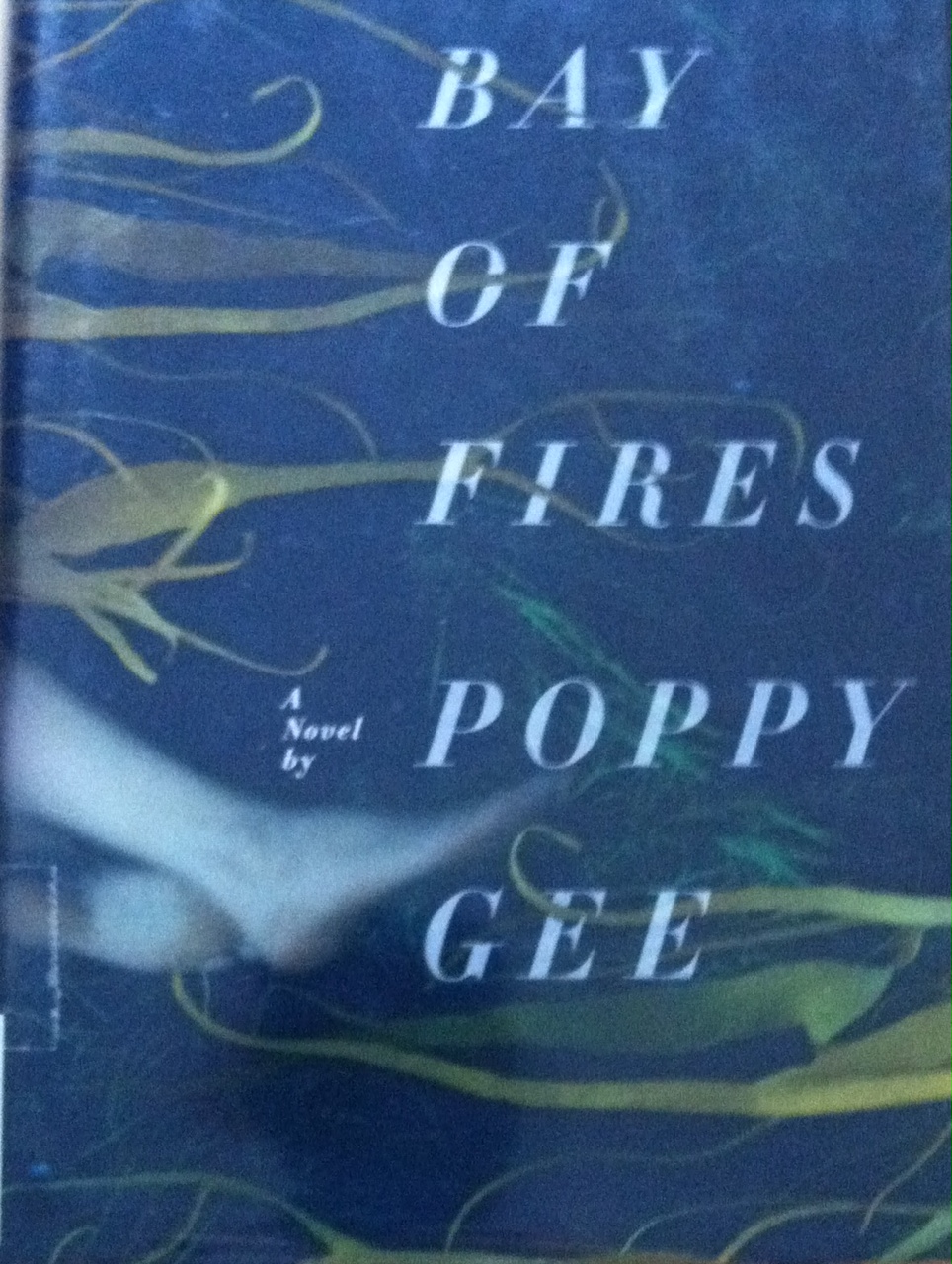
Recommended Reading: Bay of Fires, by Poppy Gee

It was this book’s title that led me to pull it off the shelf, as well as the understated cover design. I didn’t realize, at the time, that the Bay of Fires is a real place in Tasmania, a large island off Australia’s southern coast.

Bay of Fires cover

Here’s the setup: Sarah, after some bad decisions, ends up at home for the holidays, unsure what to do next. While she’s thinking it over, she’s one of two people to discover a young woman’s body on the beach, and for the next week, she and a down-on-his-luck reporter try to solve the mystery of the young woman’s disappearance.

Now, before I read Ms. Gee’s novel, I knew nothing about Tasmania, other than that it is an island and the namesake of a small, fierce marsupial creature. But one of this novel’s best features is its strong sense of place; Ms. Gee describes the scrub, the ocean, the rock pools, and the small community on the bay in fresh detail. Often, scenery escapes me, because I’m so focused on characters (with exceptions: Jane Eyre, The Lord of the Rings, and A Midsummer Night’s Dream come to mind). However, I think I was jolted out of my reading habits by the reversed seasons — the novel takes place around Christmas and New Year’s Day, and yet it’s summer.

Equally refreshing is Bay of Fires‘s main character, Sarah Avery. Deeply flawed, she is nonetheless tenacious, strong, and good. You know, a person, not a caricature of womanhood. For awhile, Ms. Gee’s focus on Sarah’s physical strength and fitness annoyed me, until I realized that her fitness is an integral part of her character, and informs many of her decisions over the novel’s course. She’s an original, interesting character, who sometimes reminded me of Starbuck from Battlestar Galactica. If you loved Starbuck, you’ll love Sarah.

Here’s my final recommendation: I thought I had the mystery solved on page 107 (of 371), and I kept reading. I was only half right, and the novel kept me guessing til the very end. I’ll be looking for Poppy Gee’s next book.

Feeling Restless After The Ten-Year Nap

The Ten-Year Nap finds four friends, women who live in New York, contemplating the choices they made about parenting and professions. The four all gave up their careers about ten years ago (hence the title), and some regret the decision; others are comfortable with the lives they’ve chosen.

The Ten-Year Nap 

It’s a testament to the talents of Meg Wolitzer that even thought I didn’t care for this book, I still borrowed two more of her novels from my local library. She’s very, very funny — keep an eye out for Amy Lamb’s reaction to her son’s favored reading material.

The novel follows all four women, plus one more character who drives the plot, and then veers off to show vignettes in the lives of women related the main characters. I felt that the novel never settled, as if Ms. Wolitzer couldn’t decide which person she was most interested in exploring; there’s fodder here for two or three novels.

Another aggravation for me was the jacket copy (no surprise there), which described the characters as middle class. Um, no. Maybe two of them are middle class by New York standards, as my friend Katie pointed out, but by any other standard these women are wealthy, wealthy, wealthy, with the luxury of choosing whether or not to parent their children at home.

Occasionally they glance at the lives of the less fortunate. Roberta, for instance, flutters in and out of left-wing activism; at the private boys’ school attended by three of the friends’ sons, poor children of color are invited for a yearly visit that is halted after an incident (there’s not too much plot to give away here, but nonetheless, I refrain.). Even Jill, whose adopted daughter comes from an understaffed Russian orphanage, spends her mental energy focused on herself, without much thought for the other children left without adoptive parents.  I found these women unlikable, but I suspect Ms. Wolitzer is trying to point out foibles that we might find in ourselves: a tendency, no matter our political leanings, toward self-centeredness. We draw back from the world we see out the window.

The Ten Year-Nap also made me uncomfortable because it hits close to home. I’m the at-home parent to our son, and though he’s too small for school now, I do wonder what I will do, how I will feel, when he’s ten, or twelve, or fifteen. Even if I wanted to enter the workforce right now (I’m ambivalent, given H’s age), or go back to grad school to finish my PhD, we couldn’t afford it. Yes, you read that right. Daycare is so expensive here that it’s cheaper for me to stay home than to work as a teacher. And for other women the situation is reversed: they can’t afford not to work. As I often explain, it’s a complicated calculus, one that will probably hold for the next few years, though I hope not forever. I love my child and will do my best to see that he arrives safely at adulthood as a kind and loving person, and I think that’s a worthy goal, a worthy and difficult occupation. But I want to contribute something more to the world —not necessarily something better, just something more.

To me, The Ten-Year Nap implies that the women it follows had done something wrong, some disservice to themselves, by parenting their children at home. Even the title is diminutive, implying that the women are childish (not a rest or a sleep, but a nap). Maybe it’s the suggestion that these women are asleep to themselves that I find annoying; why can’t one be oneself and an at-home parent too?

Have you read the novel? What did you think?
“My last things will be the first things slipping from me”; RIP Seamus Heaney

Maria Popova has put together a beautiful tribute to Seamus Heaney, and I cannot improve upon her work and Seamus Heaney’s own words. However, I can recommend that you seek out one of his books as soon as you can. I like to read the poems in spring, when it’s lightly raining and I can imagine that the earth and the grass I smell are really in Ireland.

This week, in honor of Mr. Heaney, I’m reading his poem “Mint,” from The Spirit Level (1996), included in the collection Opened Ground. It’s not about the fresh smell of the herb, or the glorious color; this mint, in the speaker’s childhood yard, appears “like a clump of small dusty nettles” (l. 1). From this opening, the speaker projects into the future; these early memories will be the last to slip away from him at the end of his life. The turn into the final stanza is so unexpected — I hope you’ll read it for yourself.

I’m so grateful that poets and poetry are part of our world.