New and Recommended Reading: Chris Beckett’s Dark Eden

Anthropology meets sci-fi meets adventure meets myth-making meets bildungsroman meets philosophy in Chris Beckett’s remarkable new novel, Dark Eden*.
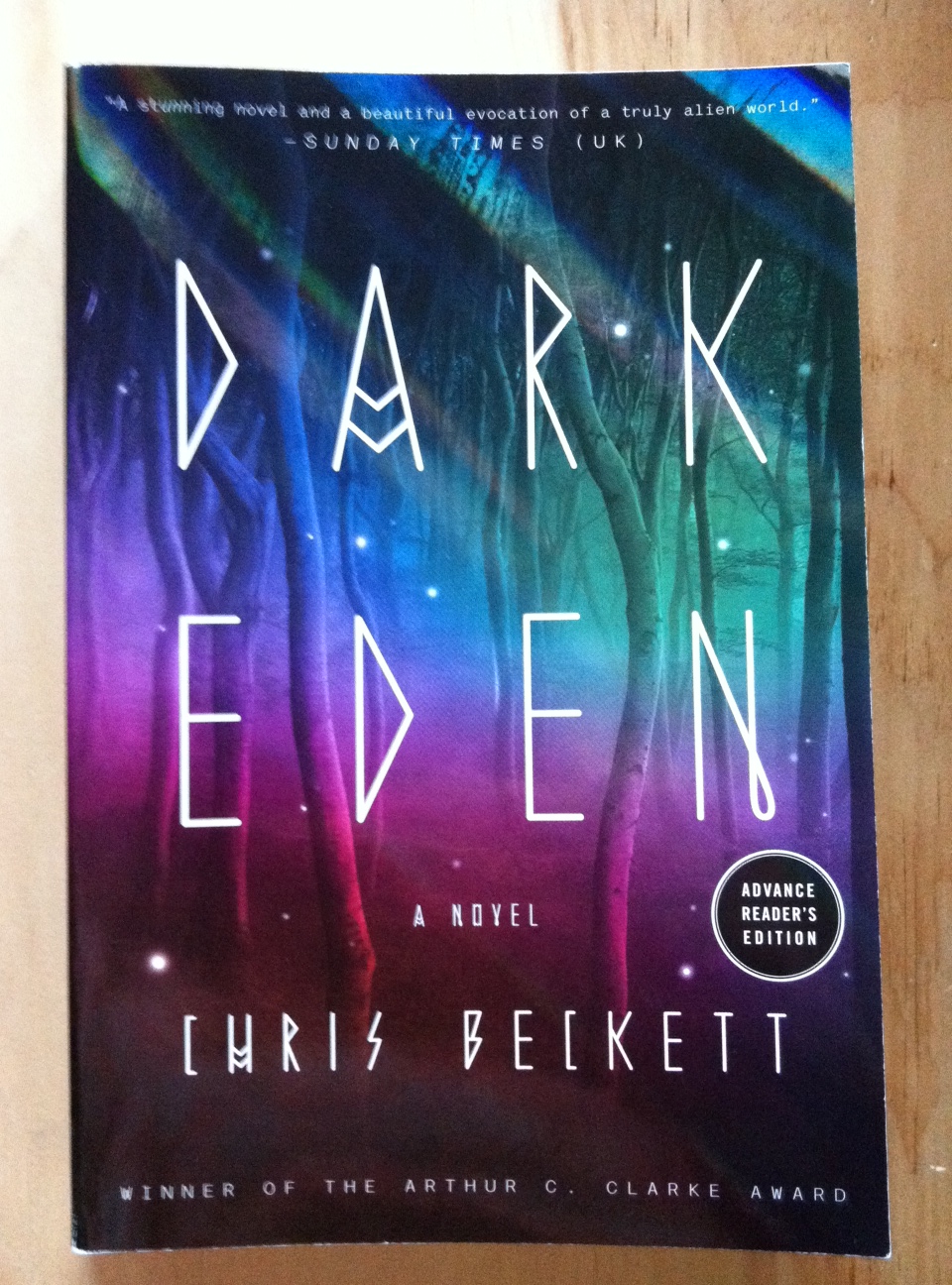
photo (65)On a planet without a visible sun, the Family lives in the glow of phosphorescent trees, waiting to be rescued by the people of their ancestors. Time is measured in terms of “wakings” and “womb-times”; Siren-like singing panthers kill in the forest, and giant worms lurk in the glowing trees. Eden is a frightening place even before the Family’s internal problems are taken into account. Years of inbreeding have produced genetic abnormalities in the small population; their vocabulary is dwindling; their oral tradition and laws and methods of keeping the peace are all strained to the point of breaking. Even food is becoming scarce.

The 532 inhabitants of Eden hear legends of a world where “lecky-tricity” made things move, where there was a sun in the sky, where people could make ships that left the world itself. And soon, the stories tell them, a “Landing Veekle” will take them back to that world.

But young John Redlantern isn’t content to wait. A cross between Prometheus and Cain, John wants to explore beyond the Family’s living area and hunting grounds, to remake Eden as a permanent home for the Family. He wants to do the unthinkable: traverse Snowy Dark, where the cold can kill and the darkness is absolute. It’s dangerous, and worse, it’s heretical. What will happen to the Family if their most closely-held beliefs are challenged?

Dark Eden‘s world-building is excellent, and refreshing, since it’s neither Star-Trekkian (gadgets and gizmos and talking computers) nor Hunger Games-style dystopian (our own world in a terrible mess). Don’t get me wrong — I love Star Trek and The Hunger Games. But it’s wonderful to read something fresh, that answers a question I wish I’d thought to ask: what would a primitive culture look like if it evolved on an alien planet from a tiny population with prior experience of technology and advanced culture?

It turns out that the intentions of the initial population matter a great deal; the Family’s founders attempted to give their children a good chance at long-term survival, insisting, for instance, that children go to school, that histories be preserved, that women and men are equal. As I mentioned above, the gender politics in the novel are fascinating; the Family doesn’t quite have a matriarchal power structure, but paternity isn’t tracked and sexual violence is unheard of in Eden.

One of Dark Eden’s best aspects is the author’s attention to linguistic detail. Over generations, vocabulary changes and some kinds of speech atrophy (oh, my poor subjunctive!). So, for example, in the Family’s oral/aural culture, some pronunciations are off (“lecky-trickety”), and intensifiers like “very” have been lost. To convey that something is “very cold,” John Redlantern or Tina Spiketree would say, “cold cold.” On the other hand, English slang (“bloke”) and personal euphemisms (“slipping” for “sex”) remain, perfectly out of place in an alien world.

Dark Eden‘s story is John Redlantern’s, in many respects, but he is not the sole narrator. Mr. Beckett chooses his other narrators carefully to give a rounded perspective on the world and John’s actions. Given the limited vocabulary all the narrators work with, the resulting polyphony is all the more impressive. This is literary sci-fi at its best, and highly recommended reading.

Tomorrow: An interview with Chris Beckett, author of Dark Eden

*My thanks to the publisher for sending me advance copy of this novel in exchange for an honest review.

Recommended Reading: The Flight of the Silvers, by Daniel Price

photo (55)“Time rolled to a stop on the Massachusetts Turnpike.”

That’s the first line of Daniel Price’s refreshing novel The Flight of the Silvers*, one of the most entertaining time-travel stories I’ve read in years. This first line signals not only that we’re in for some weird time-bending stuff but also that the author is interested in realism, not just the fireworks of mind-bending world-building. (Don’t worry, there’s that, too.)

As children, two sisters, Amanda and Hannah, witness time stand still when three mysterious and quite possibly malevolent strangers inexplicably rescue them from a — relatively speaking of course — mundane accident (near Chicopee, for my fellow Mass Pike-goers).

Seventeen years later, Amanda and Hannah are as different as two sisters can be, and yet, they, along with four strangers, are rescued from the end of the world by the silver bracelets snapped over their wrists by the same shadowy figures from the Massachusetts Turnpike.

Then the really weird stuff begins.

In their new world, which, refreshingly, is neither utopia nor dystopia, just a topia (ok, alt-topia), the six strangers navigate an America they don’t understand (that’s where the very cool world-building comes in) and personal powers that surprise and shock them. (I don’t want to give too much away, but think X-Men meets time travel meets Terminator 2. Kinda.) The forces tracking them are powerful in different ways, and are largely unfriendly, to say the least: the menacing, powerful strangers who saved them from apocalypse; an FBI-type agent hoping not to get an NSA-like agency involved; a group of strangers with their own superpowers and everything to lose; and a psychopath from their own America with a nasty grudge.

Two squabbling, sisters, one recovering alcoholic, one boy genius with possible sociopathic tendencies, one teenage girl, and one cynical comic-book artist attempt to evade them all without losing themselves in the process. While The Flight of the Silvers is a rollicking and often funny piece of speculative fiction, Mr. Price also asks questions about community, isolation, family, and immigration that figure prominently in our own place and time.

And a final word to the wise, dear readers: The Flight of the Silvers is the first in a multi-part series, and from where I sit, there’s no way it won’t become a film franchise.

*My thanks to Blue Rider Press for sending a review copy of The Flight of the Silvers.

Tomorrow: An interview with Daniel Price, author of The Flight of the Silvers

Recommended Reading: Fahrenheit 451, by Ray Bradbury

Yes, it’s another installment in Books Carolyn Is Utterly Embarrassed Not to Have Read by Now.

Image courtesy of Manostphoto/ Freedigitalphotos.net

Image courtesy of Manostphoto/ Freedigitalphotos.net

As a voracious reader and lover of sci-fi, it’s pretty amazing that Fahrenheit 451 has missed my to-read pile for so long. Maybe it’s because the contours of the story are so familiar; I felt going in as if I already knew the plot.

Something that startled me was the sheer number of technological advances that Bradbury saw coming in 1953 (because of his long career, I’d always assumed that Fahrenheit was a late 60s/ early 70s book — quite wrongly): wall-sized TV screens, in-ear headphones, drones. I wonder if Suzanne Collins was thinking of the Mechanical Hound when she created some of the monsters in The Hunger Games trilogy.

I’ll skip the plot summary, since you’ve probably got the gist of it, and instead highlight my favorite section: Montag’s meeting with Grayson and the other people of the book, who remind themselves, “we’re nothing more than dust jackets for books, of no significance otherwise.” Grayson goes on to tell Montag how great works of literature are preserved: “Why, there’s one town in Maryland, only twenty-seven people, no bomb’ll ever touch that town, is the complete essays of a man named Bertrand Russell” (179; the grammar’s a little off, but I can’t tell if that’s Grayson’s overexcitement or a faulty edition at work). I found the work of memory, the instinct to preserve ideas and language, deeply moving.

I wonder, though, if regarding oneself as merely a dust jacket for a book is entirely admirable. Certainly there’s a sense embedded in this idea of taking a larger, longer perspective (I’m reminded of Carl Sagan and the blue dot, or Rick’s speech at the end of Casablanca), a way of realizing our individual insignificance over the span of time. On the other hand, one person with a great deal of insight, or fortitude, or kindness, can change the world for the better. But I suppose you do need the world.

Recommended Reading: Shift, by Hugh Howey

When Dust comes out this August, I’ll be first in line to buy the complete Silo trilogy, without even reading the last one first. These books are just so fun—suspenseful, inventive page-turners.

My practice is never to reveal spoilers, and I won’t start here. So really, I can’t say too much about the plot because you must read Wool first. Shift answers some of Wool‘s questions and will leave the reader with many more to ponder before the final installment comes out.

If anyone out there has read Hugh Howey’s other novels, I’d love to hear what you thought of them!

Recommended Reading: Wool, by Hugh Howey

Each year, our town library chooses an all-town summer reading book, and then hosts events related to the book in the fall. I love summer reading, and I love talking about books with other people, so I’ve been looking forward to checking out this summer’s book.  Two years ago the book was Rocket Boys, by Homer Hickam (a great memoir, which later became October Sky, one of my favorite movies), and last year the town read To Kill a Mockingbird.

This year, I’d never heard of the book, but only a few display copies were left out, so I asked a reference librarian about it. She said the seventy-five copies the library had ordered flew off the shelves so fast that they’d had to buy another thirty, of which only six were left the next day.

The book is Wool, by Hugh Howey. Here’s part of what Jill, a reference librarian at the WFPL, has to say about it:

Why have you probably never heard of it?  Because it was a self-published work by an unknown author. That means it was not in most libraries or bookstores, there were no print ads for it in magazines, and review attention was sparse at best.  Yet this novel managed to gather an army of loyal readers who passed it on, one copy at a time, to family, friends, and co-workers, slowly building it into a New York Times bestseller.  That all of this took place outside the confines of the traditional publishing model is testament to the direct relationship that now exists between the writer and the reader.

I was a little skeptical at first, but I liked the title, liked the idea of reading some sci-fi, and liked the heft of the paperback (I love paperbacks), so I started it that night.

Holy cow. This book is scary.

I had to force myself not to read ahead: that’s how suspenseful Wool can be. Howey’s pacing is spot-on, the short chapters enhancing the uneasiness of the frightening world he’s created. No spoilers, as usual, but praise is due to Howey for his tough, and admirable, female characters. Highly recommended, whether or not you’re a fan of sci-fi.