Forget Brangelina. Forget Liz Taylor and Richard Burton. The best on-screen/off-screen chemistry of all time goes to Humphrey Bogart and Lauren Bacall. 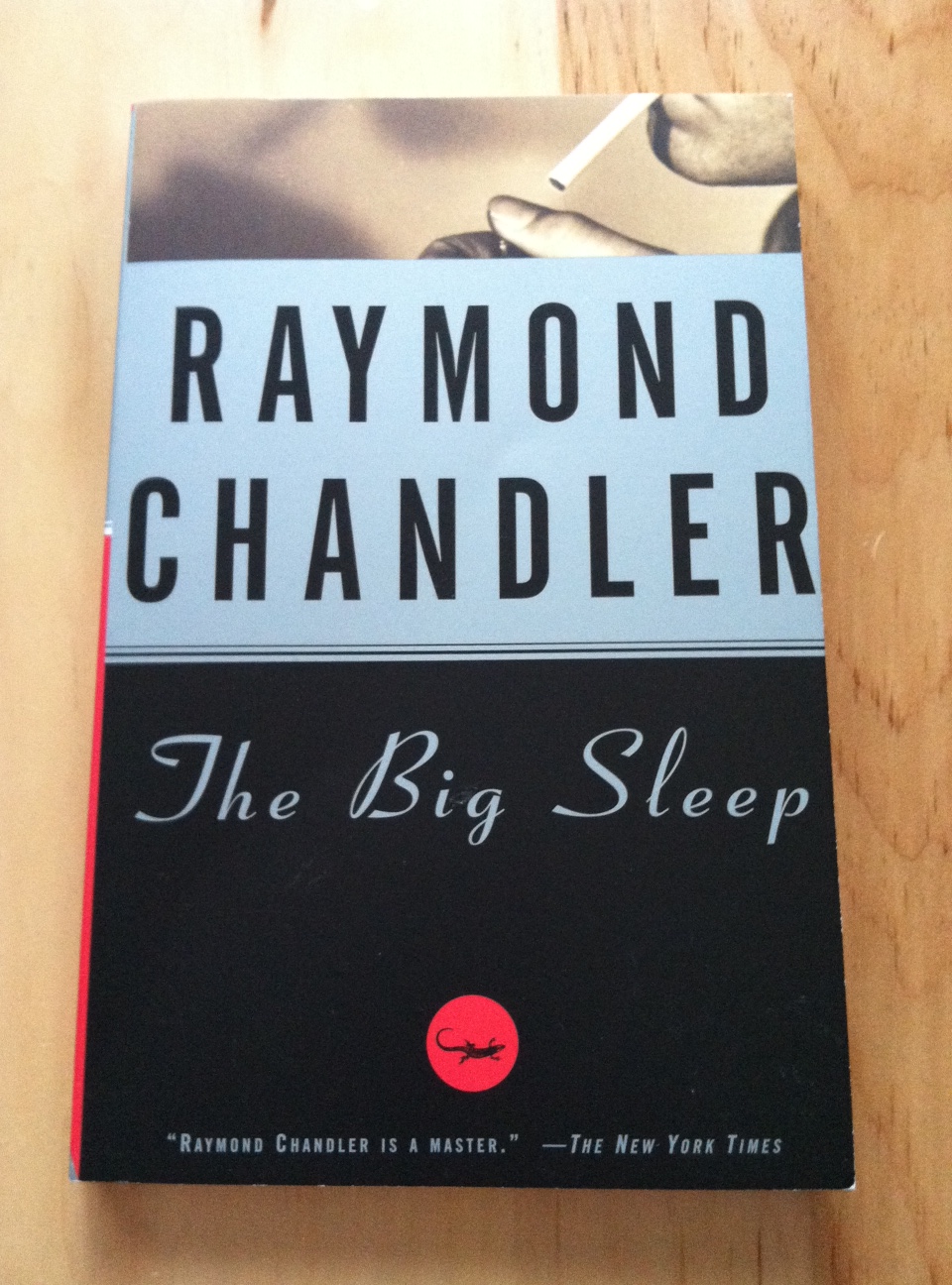
Seriously. Watch the first half-hour of To Have and Have Not (1944) and you’ll be floored when you hear Bacall deliver her first line (it was her first movie, at 19). Wow-za. Plus, you can feel that you’re doing something literary, since the film is based (very loosely, I admit) on Hemingway’s novel of the same name, and the screenplay was co-written by William Faulkner. Yeah, THE Faulkner.
Anyway. I love all the Bogie & Bacall movies, but The Big Sleep (1946) is far and away my favorite. It’s dark, it’s scary, it’s engrossing. So naturally I put Raymond Chandler’s The Big Sleep (1939), his first novel, on my Classics Club list.
I knew the contours of the plot from the movie, but I was surprised just how much darker in tone the novel is.
Here’s the set-up: A dying millionaire calls in private detective Philip Marlowe to investigate some “gambling” debts accrued by the younger of his two wild daughters, Carmen. Marlowe’s investigation spins outward to include men and women caught up in blackmail, pornography (the movie elides this one — thanks, Hollywood censors!), murder, gambling, and disappearances. Nobody’s innocent.
Marlowe’s a great character: a cynic trying to do the right thing, curious to a fault, more interested in solving a puzzle than preserving his personal safety. A perfect fit for Bogart. Marlowe narrates, and the prose matches his style — keenly observant, hard-boiled, thorough. Never, ever florid or sentimental.
There’s some squirm-inducing material from this vantage point, nearly seventy-five years later. Marlowe isn’t overly fond of women, for one thing. Carmen may be a psychotic, drug-addled brat, but slapping her around just seems wrong. And the novel brings up homosexuality (very well hidden in the movie), but only in the context of scorn (“queen” and “fairy” is standard language in the novel). Unpleasant, very unpleasant. Here’s a telling line: about a character who’s committed murder and who was another man’s lover: “He was afraid of the police, of course, being what he is” (110). Homosexuality is clearly coded as deviance, as “other,” as part of the criminal underground that Marlowe finds himself caught up in.
These issues aside, it’s a great crime novel, great writing, and highly recommended.
 Rosemary and Reading Glasses