“All night it will say one name”: Tess Gallagher’s “Under Stars”

Photo by Blair Fraser via Unsplash

Photo by Blair Fraser via Unsplash

I am very fond of letters, though I am a terrible correspondent, so I loved the opening of Tess Gallagher’s poem “Under Stars,” which imagines what a letter does in a mailbox overnight:

The sleep of this night deepens
because I have walked coatless from the house
carrying the white envelope.
All night it will say one name
in its little tin house by the roadside.

Ms. Gallagher is a poet who I’m just starting to read. I learned from the biographical note on the Poetry Foundation’s site that she is also a short story writer, and I think this remark about how she approaches writing poetry and prose is illuminating:

Of the differences between writing prose and poetry, she said in an interview with Willow Springs: “I feel like prose comes much more from outside me than poetry does. Poetry is intimate and more generated in my own theater, shall we say. But in prose I have to be responsive to that story that’s coming to me and there has to be some part of me that goes out to meet it.”

I wonder how many other writers feel that way.

If you’re a Tess Gallagher fan, please let me know which poems and collections I should seek out!

On Poetry for Children

Photo courtesy Daniela Cuevas via Unsplash.

Photo courtesy Daniela Cuevas via Unsplash.

A long time ago—so long ago that I can’t find the post (although, to be fair, I only had the patience to look for three minutes or so)—I wrote about looking for poems for children. Nursery rhymes and jokey sorts are all very well, but I am a woman of distinctly unsaint-like patience (see parenthetical above), and when possible, I prefer children’s entertainment that is also meant to be palatable to adults (such as Pixar movies and a remarkable number of children’s books, which I would be happy to list in a later post if anyone is interested). Not for me are Saturday morning cartoons, Berenstain Bears, or The Wiggles, and I’m afraid to say that our son is deprived of these things thanks to his mother’s intransigence.

So some time ago, I thought to myself, “well, I should make a list of poems that aren’t meant for children but that they might like anyway,” since they seem to go over pretty well in our house (the principle applies to music, too, by the way). Edward Lear’s nonsense poems are great fun, and H likes Robert Frost quite a bit; I think the rhythms of formal poetry, particularly iambic pentameter, are soothing.

Of course, I was quite sure to file the idea in my Cabinet of Good Intentions I’ll Forget I Ever Had ™, where it remained until just a few days ago when I found that Lemony Snicket has done all the work for me.

So in lieu of a poem of the week, Dear Readers, I invite you to head over to the Poetry Foundation’s website and enjoy the hilarious introduction he’s written and the portfolio of poems he’s collected. 

Celebrated Days

10405657_10106229416396525_3529221544828816157_nDear Readers, it seems like just yesterday I was writing about We Do! American Leaders Who Believe in Marriage Equality, and now look where we are! We’ve been celebrating not only the wonderful news about marriage equality over the past week with family and friends, but also the birth of our friends’ first baby (hi K and T and baby E!). Here’s an Emily Dickinson poem that reminds us to treasure, to celebrate, the present.

Emily Dickinson
Forever – is composed of Nows –

Forever – is composed of Nows –
‘Tis not a different time –
Except for Infiniteness –
And Latitude of Home –

From this – experienced Here –
Remove the Dates – to These –
Let Months dissolve in further Months –
And Years – exhale in Years –

Without Debate – or Pause –
Or Celebrated Days –
No different Our Years would be
From Anno Dominies –

“All of us dazzling in the brilliant slanting light”: Barbara Crooker’s “Strewn”

Not exactly right, but you get the idea.

Not exactly right, but you get the idea.

Last week, my uncle, who lives in Maine, came for a visit, which was excellent in all respects except that it was too short. And it just so happened that last week’s American Life in Poetry column, curated by Ted Kooser (which I highly recommend as a way to get into poetry–the poems are about the experiences of everyday life, and are always accessible) featured a poem by Barbara Crooker about the Maine coast.

“Strewn” is beautifully detailed. I love the list of broken shells that the speaker describes, and the idea of the sunlight on the beach like “a rinse / of lemon on a cold plate.” But it’s the turn at the end of the poem that brings the other people on the beach—and by extension the reader—into the speaker’s orbit that still resonates for me days after reading the poem.

“Then he unlocked the back door / and stepped out into the garden”: Paula Meehan’s “My Father Perceived as a Vision of St Francis”

Photo courtesy Breno Machado via Unsplash

Photo courtesy Breno Machado via Unsplash

A few weeks ago, I was reading about contemporary Irish poetry (living life in the fast lane, as always), and I learned a little bit about Paula Meehan, named the Ireland Professor of Poetry in 2013. The Irish Times had a feature about her this winter, in which Ciaran Carty wrote,

“It’s more than 40 years, and nine books, since Meehan emerged from childhood in the inner city Dublin tenements to give voice to the disenfranchised everywhere, less in anger than with compassion and an intuitive understanding that, through verse, imbued their lives and memories with mythic dignity.”

Sounds pretty good to me.

Professor Meehan’s poems are a little tricky to find–she doesn’t have an entry at The Poetry Foundation, which is my go-to poetry site, but you can read “Ashes” at Poets.org. The poem that really caught my eye was this one: “My Father Perceived as a Vision of St Francis,” over at The Poetry Project, which is a site devoted to Irish poetry. It’s a lovely poem, anchored in everyday detail, but transcendent all the same.

“a way to attain a life without boundaries”: Juan Felipe Herrera’s “Let Me Tell You What a Poem Brings”

Photo courtesy Modestas Urbonas via Unsplash.

Photo courtesy Modestas Urbonas via Unsplash.

The new Poet Laureate of the United States has just been announced! Juan Felipe Herrera will take up the post in September, the first Chicano poet to do so. He is also the former poet laureate of California. You can read more about him in this Los Angeles Times piece and in this Poetry Foundation profile.

In honor of Mr. Herrera, this week’s poem is “Let Me Tell You What a Poem Brings.” Poetry on poetry can be a bit fussy and pretentious, but here the poem takes readers on a sort of breathless tour, and we end up someplace completely different from where we started, a place where we are “thirsty” but where we are drawn into “alarming waters” that nonetheless invite us to “bathe” and “play.” It’s an inventive, exciting poem that conjures up the best of what poetry can do.

“painted like a fresh prow / stained among the salt weeds”: H.D.’s “Sea Iris”

From our landlady's collection, which is also pretty great.

From our landlady’s collection, which is also pretty great.

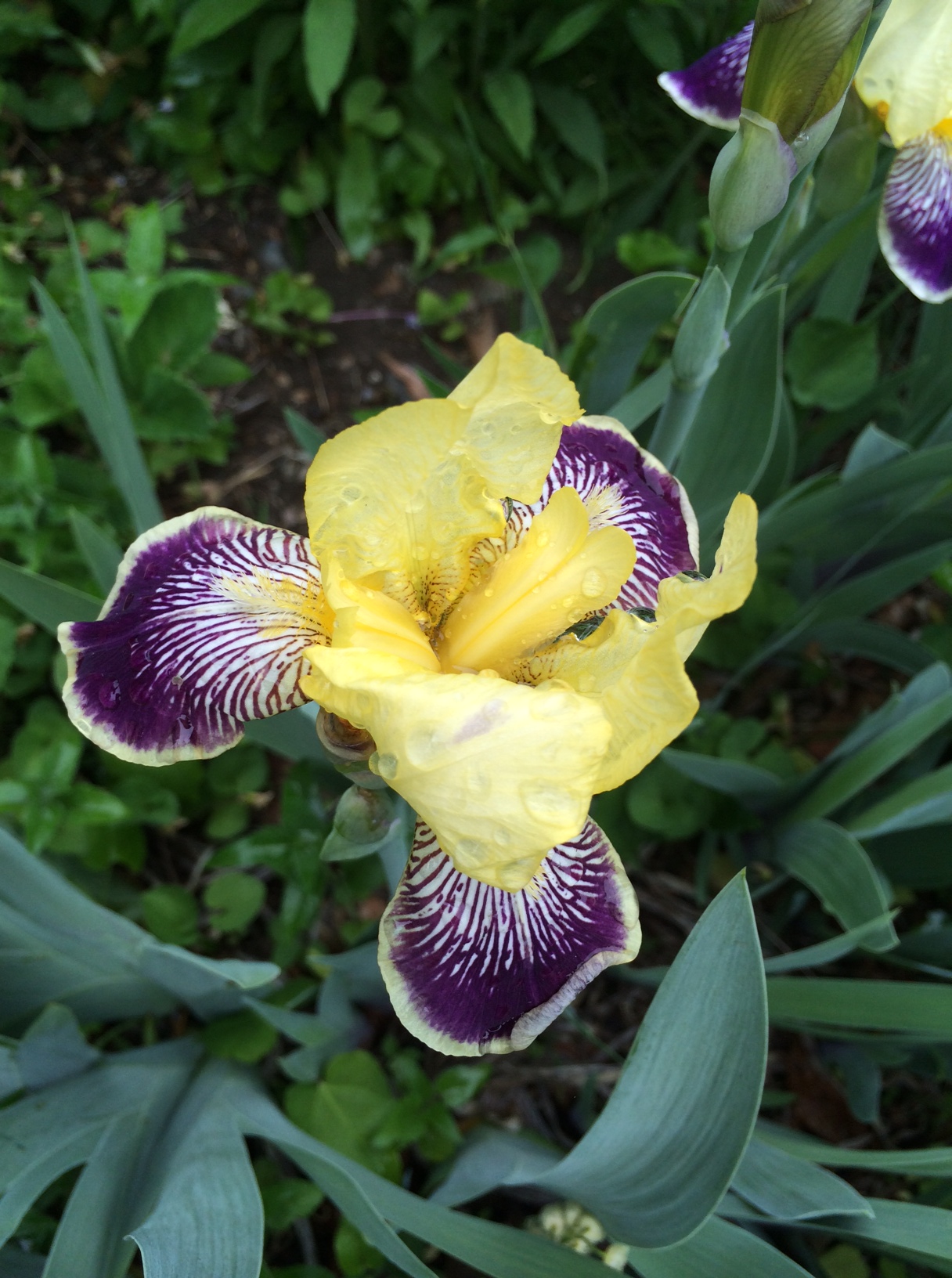
One of the many great things about our little corner of neighborhood is the parade of gorgeous, multi-hued irises that line our neighbors’ walkway. The blooms are huge, big enough for me to see the splotches of color from my kitchen window, and they always make me happy. Here’s H.D.‘s imagist poem called “Sea Iris,” which I love.


SEA IRIS

I

Weed, moss-weed,
root tangled in sand,
sea-iris, brittle flower,
one petal like a shell
is broken,
and you print a shadow
like a thin twig.
Fortunate one,
scented and stinging,
rigid myrrh-bud,
camphor-flower,
sweet and salt—you are wind
in our nostrils.

II

Do the murex-fishers
drench you as they pass?
Do your roots drag up colour
from the sand?
Have they slipped gold under you—
rivets of gold?
Band of iris-flowers
above the waves,
you are painted blue,
painted like a fresh prow
stained among the salt weeds.


You can read more from H.D.’s collection Sea Garden at Project Gutenberg, here. 

“only by the wildflower meadow”: David Mason’s “In the Mushroom Summer”

A view from Rocky Mountain National Park

A view from Rocky Mountain National Park

Last week, we visited family and friends in Colorado, which was just delightful (I hope to write a book-themed post about the trip, but you know my track record on posts I plan to write). The scenery is gorgeous, of course, and we were treated to quite an array of weather, starting with heavy snow and including rain, mist, thunderstorms, and brilliant sunshine.

I just came across this little poem by David Mason, called “In the Mushroom Summer,” that gives a good sense of what the mountain landscape looks like in the rain. I love the way the speaker knows how high he’s climbed only by the sight of the flowers in an alpine meadow.

Do tell: Do you have a favorite poem about a place you’ve traveled?

“the whole stunning contraption of girl and rope”: Gregory Pardlo’s “Double Dutch”

photo (41)This year’s winner of the Pulitzer Prize for poetry is Gregory Pardlo, who is the author of two books of poetry (Totem and Digest) and the recipient of many awards. In its citation, the Pulitzer committee called the collection “clear-voiced poems that bring readers the news from 21st Century America, rich with thought, ideas and histories public and private.”

Now, as is often the case, I find myself not well enough acquainted with this poet, but I’m going to be on the lookout for his books, especially after reading “Double Dutch,” which is gorgeous, and I’m quite sure the best poem about jump-roping ever written. Like the ropes crossing over each other as the girls turn them, each line of the poem crosses another. What Mr. Pardlo does with light in this poem is stupendous; a painter could make a series out of the images without ever seeing the subjects of the poem in the flesh.

[Note to the Dear Readers: I’m trying an experiment this week wherein the weekly poetry post appears on Thursday and the usual book review/recommendation appears on Tuesday. I’m pretty confident that this will affect absolutely nobody’s life, but if you hate or love the new arrangement, please let me know.]

“a flower sprang, lilylike, more brilliant / than the purples of Tyre”: Louise Glück’s “Hyacinth”

photo (35)I wish I’d been able to celebrate National Poetry Month with more fanfare, Dear Readers—next year, I hope, will be different—but I hope you’ve had the chance to read a poem or two more than usual. In fact, I’d love to hear about what you’ve been reading, so please let me know in the comments which poems you’ve liked recently (slow to respond though I am, always begging your pardon).

This past weekend friends visited us for dinner and conversation, and brought with them beautiful stems of hyacinth from their garden. The whole apartment smells like spring. It happens to be one of my very favorite flowers, so here is a poem by one of my very favorite poets, Louise Glück, to go with it, though I think you’ll see that her poem is much more somber than the flower.