“Sometimes the most beautiful poetry can be about simple things, like a cat, or a flower or rain. You see, poetry can come from anything with the stuff of revelation in it. Just don’t let your poems be ordinary. Now, who’s next?”*

O Captain! My Captain!
by Walt Whitman

O Captain! my Captain! our fearful trip is done,
The ship has weather’d every rack, the prize we sought is won,
The port is near, the bells I hear, the people all exulting,
While follow eyes the steady keel, the vessel grim and daring;
But O heart! heart! heart!
O the bleeding drops of red,
Where on the deck my Captain lies,
Fallen cold and dead.

O Captain! my Captain! rise up and hear the bells;
Rise up—for you the flag is flung—for you the bugle trills,
For you bouquets and ribbon’d wreaths—for you the shores a-crowding,
For you they call, the swaying mass, their eager faces turning;
Here Captain! dear father!
The arm beneath your head!
It is some dream that on the deck,
You’ve fallen cold and dead.

My Captain does not answer, his lips are pale and still,
My father does not feel my arm, he has no pulse nor will,
The ship is anchor’d safe and sound, its voyage closed and done,
From fearful trip the victor ship comes in with object won;
Exult O shores, and ring O bells!
But I with mournful tread,
Walk the deck my Captain lies,
Fallen cold and dead.

_______________

“We don’t read and write poetry because it’s cute. We read and write poetry because we are members of the human race. And the human race is filled with passion. Medicine, law, business, engineering, these are noble pursuits, and necessary to sustain life. But poetry, beauty, romance, love, these are what we stay alive for. To quote from Whitman: ‘O me, o life of the questions of these recurring, of the endless trains of the faithless, of cities filled with the foolish. What good amid these, o me, o life?’ Answer: that you are here. That life exists, and identity. That the powerful play goes on, and you may contribute a verse. That the powerful play goes on and you may contribute a verse. What will your verse be?”*

–from Dead Poets Society, script by Tom Schulman

“His leaden act was done”: C. Day Lewis’s “Epitaph for an Enemy”

A week or two ago, Emily wrote a post about the movie adaptation of Ender’s Game (haven’t seen, never will, thanks for asking), and how, on the whole, books are generally better than their film adaptations. Then asked her readers if they could think of any movies that are better than the books they’re based on.

The one that immediately leaps to mind for me is The Last of the Mohicans (1992), Michael Mann’s loose adaptation of James Fenimore Cooper’s 1826 novel. I did not care for the novel, to say the least, though many people love it.

The movie features a gorgeous soundtrack, excellent acting (some awesome Daniel Day-Lewis strong-but-silent action), inaccurate portrayals of historic events, and scenery that’s beautiful but that doesn’t pass for upstate New York, even 250 years ago upstate New York.

It is, despite its flaws, magnificent.

This is supposed to be a poetry post, so: Emily’s question made me think of The Last of the Mohicans, which made me think of Daniel Day-Lewis, which made me think of C. Day-Lewis (the ‘C’ is for Cecil), who was Daniel’s father. And C. Day Lewis was a poet.

He was also a successful writer of detective fiction (under the pseudonym Nicholas Blake), a friend to many other notable poets of his day (including W.H. Auden and Stephen Spender), and the poet laureate of Great Britain. You can read a brief biography and highlights of his major works here. 

Day-Lewis’s short but powerful “Epitaph for an Enemy” is this week’s poem of the week; let me know what you think!

“the light blue sea / Of your acquaintance”: Kenneth Koch’s “In Love with You”

I confess that I am not particularly well versed (poetry joke!) in the New York School poets. I’ve read a bit of Ashberry and a bit more Frank O’Hara, but never much Kenneth Koch. It hasn’t been a conscious omission; I simply found other poets first who claimed my attention.

Last week Kenneth Koch’s “In Love with You” popped up in my inbox as the Poetry Foundation’s poem of the day, and I was hooked by its exuberance, its vitality; it features non-ironic exclamation points!

While I admire many love poems, most of them are so intimate, so particular to a person or time or place that I find myself distanced from them. Like Whitman’s poems (at least for me), however, “In Love with You”‘s specificity crescendoes into a feeling of overwhelming universality. And I love a love poem that makes me grin.

Now, if you’ll excuse me, I’m off to find a book of Kenneth Koch’s poetry.

Do you have a favorite grin-worthy love poem?

The Poetry Concierge Recommends: Samuel Taylor Coleridge

[The Poetry Concierge is an occasional feature here on Rosemary and Reading Glasses wherein I select a poem, poet, or book of poems for individual readers based on a short questionnaire. Come play along! Read the introductory post here, my first recommendation here, and then email me at: rosemaryandreadingglasses [at] gmail [dot] com. ]

This week, our pilgrim in search of poetry is the blogger who goes by Stressing Out Student (SOS).

1. When you read fiction, who’s your go-to author?

I don’t read much of any particular author. I usually look for the content to interest me before expecting the style to interest me. But the author I’ve read the most of would likely be John Steinbeck.

2. If you read nonfiction, which subjects are most likely to interest you? (cultural history, science, biography, memoir, survival stories?)

Psychology, behaviorial/social sciences, how the mind/people work

3. If you were stuck on a desert island for a week, which five books would you bring to keep you entertained?

Good Omens by Terry Pratchett and Neil Gaiman, The Etymologicon by Mark Forsyth, horror short story anthology, The Stranger by Albert Camus, When You Are Engulfed in Flames by David Sedaris

4. If you were on a five-year mission to Mars, which five books would you bring to keep you sane?

The Stranger, Cannery Row by John Steinbeck, Crime and Punishment by Fyodor Dostoevsky, Broom of the System by David Foster Wallace, 1984 by George Orwell

5. What kinds of questions are most likely to keep you up at night? (death, the nature of love, politics, environmental issues, meaning of life, end of the world, justice and injustice, etc?)

Am I doing the right thing? How can I know to do the right things at the right times? What does the future hold?

6. If you’ve read poetry before, what have you liked? What have you disliked?

I’ve liked:
“The Grasshopper” by E.E. Cummings
“I Wandered Lonely as a Cloud” by William Wordsworth
“Dream within a Dream” Edgar Allan Poe
All of Shel Silverstein

Dislike…
“Ode on a Grecian Urn” John Keats


Well, when I saw Terry Pratchett and Neil Gaiman on SOS’s list of favorite authors, I thought, ha! Edgar Allan Poe! — only to have my first thought dashed in question 6 (yes, if you tell me you like a poet, I do feel obliged to find a new one for you to like).

Enter Samuel Taylor Coleridge, poet and critic, rehabilitator of Shakespeare and Milton, and perhaps the most productive opium addict the world has ever seen. His writing influenced Wordsworth and the rest of the Romantics (and he was one himself, of course), some of his most famous poems tell strange and fantastic stories (a la Pratchett & Gaiman), and the workings of the human mind are certainly at the forefront of his poetic concerns.

(And if SOS is interested in what the future holds, perhaps she’ll have fun imagining the endings to “Kubla Kahn and “Christabel.”)

This week’s poem of the week, and the poem I especially commend to SOS, is “The Rime of the Ancient Mariner,” first published in Lyrical Ballads (though this links to a later version). Why? Check out the listing of its subjects given by the Poetry Foundation: “Religion, Crime & Punishment, Living, Social Commentaries, Seas, Rivers, & Streams, Horror, Faith & Doubt, Nature, Christianity, Weather, Death, Mythology & Folklore, Animals, God & the Divine.”

This poem’s got it all. Except romance, and hey, we can all use a break from that once in a while, right?

SOS, I hope you find something to love in these poems. Thanks for writing in!


Would you like the Poetry Concierge to make a recommendation for you? Check out the introductory post, and send your answers to the questionnaire, along with the name and/or blog you’d like posted with the reply, to rosemaryandreadingglasses [at] gmail [dot] com.

Maryann Corbett’s “Finding the Lego”

I promise that the Poetry Concierge feature here on Rosemary & Reading Glasses will return. Really. And if you’d like a poetry recommendation, please do write in!

With thanks to my husband,  whose Lego Ghostbusters car I photographed.

With thanks to my husband, whose Lego Ghostbusters car I photographed.

Today, however, I must point you to Maryann Corbett’s “Finding the Lego” — featured this week as part of Ted Kooser’s American Life in Poetry series, because the title alone is fabulous. Please consider this poem my shout-out to friends and fellow bloggers who are also parents (and grandparents, and aunts and uncles). And if anyone knows of a funny poem involving Legos and parenthood (Ms. Corbett’s is on the serious side), I’d love to read it.

Charlotte Boulay’s “Watson and the Shark” from Foxes on the Trampoline

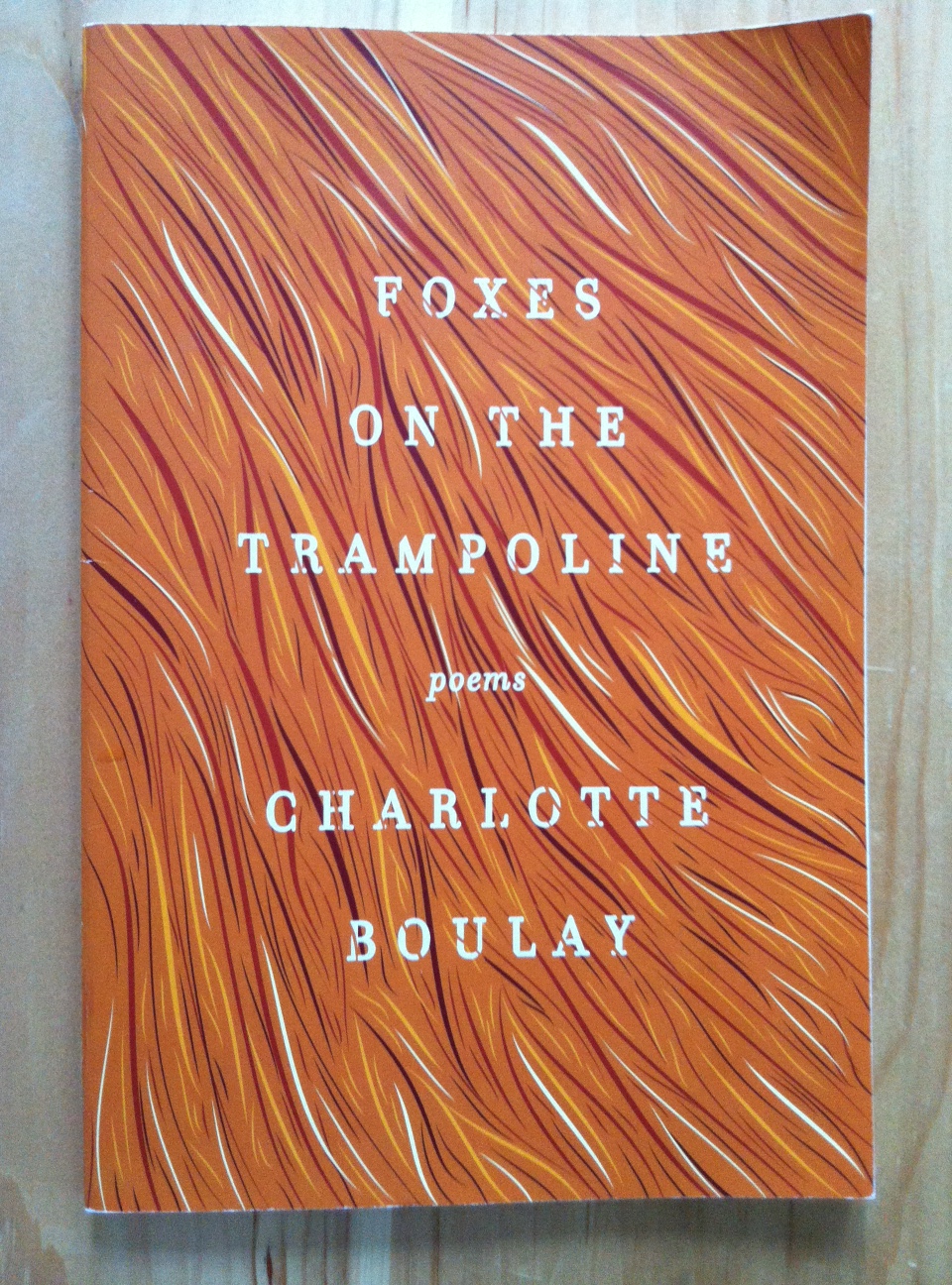
photo (100)Charlotte Boulay is Ecco’s first addition to its roster of poets since 2008 (a roster that includes contemporary poetry heavyweights Robert Hass and Jorie Graham, among others). Having read Ms. Boulay’s debut collection, Foxes on the Trampoline*, I see why Ecco is excited to be publishing her work.

Ms. Boulay is attentive to the power of individual words; poems like “Calenture” and “Changeling” consider the experiences these words conjure up, as well as their connotations, with startling immediacy.

The collection as a whole is grounded in its speaker’s wide range experience, reflecting Ms. Boulay’s travels in France and India. In “Pallikoodam” (which means “school”) the speaker recalls, “We lived with animals: small lizards / darting up the walls, lines of tiny / imperious ants” before going on to remember the ways she found comfort after watching (on television) the towers fall on September 11, and how she and her companion “woke in the mornings / to hear someone singing, softly / as she swept the yard clean.” This combination — of otherness and familiarity, radical change and the routines of ordinary life — resonates deeply in Foxes on the Trampoline.

You can read a selection of Charlotte Boulay’s poems on the Boston Review site, including our poem of the week, “Watson and the Shark.” In this poem, the speaker remembers a childhood encounter with the famous John Singleton Copley painting of the same name (the copy he made of his original version), which is on view at Boston’s Museum of Fine Arts (we just visited the MFA this past weekend, so this poem jumped out at me. The last stanza is amazing.

*I received a copy of this book from the publisher in exchange for an honest review.

Siegfried Sassoon’s “The General”

Siegfried Sassoon survived World War I and was one of its most famous poets; he was a mentor to Wilfred Owen and friend to Robert Graves (who I’ll be writing about in another post). Sassoon is one of the characters in Pat Barker’s Regeneration, the first in a remarkable trilogy of books about the war (and yes, I’ll be writing a Pat Barker post too).

Sassoon was an officer in the Royal Welsh Fusiliers, beloved by his men and given the nickname “Mad Jack” for his daring exploits, which often amounted to near-suicide missions.

In 1917, Sassoon sent a three-paragraph letter (which you can read in full here) to his commanding officer and several newspapers (it was read later in Parliament) protesting the war. Here’s the second paragraph:

I have seen and endured the sufferings of the troops and I can no longer be a party to prolong these sufferings for ends which I believe to be evil and unjust. I am not protesting against the conduct of the war, but against the political errors and insincerities for which the fighting men are being sacrificed.

Though he could have been court-martialed for sending the letter, Sassoon was instead declared unfit for duty — thanks to the offices of his friend Robert Graves — and sent to convalesce at Craiglockhart hospital. (This “convalescence” is the subject of Regeneration.)

In 1918, Sassoon published Counter-Attack And Other Poems, a slim volume that includes some of his best work. Like Owen and Rosenberg, Sassoon writes of the grim and grisly sights of war, in poems whose immediacy is driven home by the use of dialogue. He reserves special contempt for those who do not fight themselves — the press, women, generals, even himself, haunted by ghosts in the poem “Sick Leave”:

In bitter safety I awake, unfriended;
And while the dawn begins with slashing rain
I think of the Battalion in the mud.
“When are you going out to them again?
Are they not still your brothers through our blood?”

Sassoon decided to return to the front to fight in solidarity with his men, to do his best to protect them from the enemy — even if that enemy was the man supposedly leading them all. Here’s the bitter, nearly-funny poem “The General”:

“Good morning, good morning,” the general said,
When we met him last week on our way to the line.
Now the soldiers he smiled at are most of ’em dead,
And we’re cursing his staff for incompetent swine.
“He’s a cheery old card,” muttered Harry to Jack
As they slogged up to Arras with rifle and pack.

But he did for them both by his plan of attack.


You can read the full text of Counter-Attack and Other Poems at Project Gutenberg or Bartleby.

Isaac Rosenberg’s “Break of Day in the Trenches”

One of the undeservedly under-read poets of World War I is Isaac Rosenberg. Like Wilfred Owen, Rosenberg died in 1918, and so the promise of his poetry was cut short along with his life. The many contradictions in his work are perhaps best summarized in a paragraph from The Poetry Foundation’s brief biography:

Isaac Rosenberg may be remembered as a Jewish-English poet, or a poet of war, but his poetry stretches beyond those narrow categories. Since Rosenberg was only twenty-eight when he died, most critics have tended to treat his corpus as a promising but flawed start, and they wonder if he would have become a great poet had he lived. Rosenberg’s status as an English poet is thus still debated: he was a Jewish poet, he was an English poet; he was a war poet, he was a painter-poet; he was a young poet; he was a great poet and a minor poet. In his brief career, Rosenberg created a small selection of poems and a great many questions.

Self-portrait in a Pink Tie, 1914 Isaac Rosenberg Source: Imperial War Museum, via Wikimedia Commons

Self-portrait in a Pink Tie, 1914
Isaac Rosenberg
Source: Imperial War Museum, via Wikimedia Commons

“Break of Day in the Trenches” is, I think, a masterful poem, and the poem of Rosenberg’s featured today; his other poems aren’t to be missed, though. For example, his bleak humor breaks loose in “Louse Hunting,” and “Dead Man’s Dump” is sheer visceral horror in a poem.

Rosenberg’s speaker/soldier in “Break of Day in the Trenches” is a man who’s in the thick of war, watching the darkness “crumble” into dawn — a dangerous time favored for “going over the top” to attack enemy trenches. The only sign of life in the trenches, besides our speaker, is the “queer sardonic rat” who grazes his hand as he reaches for a poppy on the parapet. In the nightmare world of war, it’s only the rat who can afford “cosmopolitan sympathies” — moving freely (and feeding well) on both sides of no man’s land. The speaker addresses the rat bitterly:

It seems you inwardly grin as you pass
Strong eyes, fine limbs, haughty athletes,
Less chanced than you for life,
Bonds to the whims of murder,
Sprawled in the bowels of the earth,

The torn fields of France.

He wonders what the rat sees in the soldiers’ eyes as the mortars and shells fall from the sky, these soldiers who resemble the carefree youths of prewar poetry, or the boys marching in propaganda posters. As if turning from an answer he doesn’t want to hear, the speaker readjusts his focus in the poem’s final lines:

Poppies whose roots are in man’s veins
Drop, and are ever dropping;
But mine in my ear is safe—

Just a little white with the dust.

Poppies, associated with sleep and death, are the symbol of this war in particular; people in the UK, Canada, Australia, and New Zealand still wear the poppy on Armistice Day, or Remembrance Day as it’s known there, or Veterans Day, as it’s known here (the stars of Harry Potter attended at least one premiere with the red-orange flowers pinned to their clothes), and sometimes for the days in November leading up to the 11th.  You’ll notice here in the United States that around patriotic holidays the VFW hands out “Buddy” poppies in thanks for contributions to its veterans’ assistance programs.

In Europe during the Great War, the red poppy was a weed that grew over battlefields, no man’s land, and near the trenches. In Rosenberg’s poem, these poppies grow out the blood of killed men, perhaps men the speaker has watched die. Like the men, the poppies “Drop, and are ever dropping” — except for the one the speaker has tucked behind his ear, in small act of defiance toward the death that surrounds him. It’s not an uncomplicated gesture; the poppy, plucked, will die, and the dust suggests the inevitable end of humankind: “for dust thou art, and unto dust shalt thou return.”

Wilfred Owen, Rupert Brooke, and The Great War

As most of you know, this year marks the centenary of World War I. Although the war did not officially begin until the end of July 1914, its precipitating event — the assassination of Archduke Franz Ferdinand of Austria in Sarajevo — took place on June 28, 1914. To mark the centenary, this June, and for the rest of the summer, I’ll be writing from time to time about the literature of the Great War, since it’s a special interest of mine.

This month, weekly poetry posts will feature poetry of the First World War, and so you’ll notice that the Poetry Concierge will take a brief hiatus, appearing sometimes on Fridays before picking back up in July.

photo (84)Today I’d like to point out two of the war’s most famous poems, Rupert Brooke’s “The Solider” and Wilfred Owen’s “Dulce et Decorum Est.” I am neither the first nor the last to place the two poems side-by-side, but it’s an instructive experience, I think.

Both Brooke and Owen were British soldiers, and both were writing poetry before the war began. Both died during the war. Brooke died in 1915 of an infection following a mosquito bite, before experiencing the horrors of trench warfare. Owen, on the other hand, experienced the full terrors of life and death in the trenches. He was killed on November 4, 1918, and his mother learned of death on Armistice Day, just one week later.

Brooke was a writer of pleasant, light verse; had he lived, it seems unlikely that his work would have surpassed the popularity of his short sonnet sequence 1914, in which “The Soldier” appears. Like John McCrae’s “In Flanders Fields,” the poem approaches death with sadness, but concludes that death is noble in the service of patriotism. Here are “The Solider”‘s famous opening lines:

If I should die, think only this of me:
      That there’s some corner of a foreign field
That is for ever England.


“Think only this” — not “think about why I died, and others like me.” Such sentiments, of course — though they capture the  pre-war atmosphere with gracious diction and memorable phrasing — are obliterated by poems like Wilfred Owen’s “Dulce et Decorum Est“. Here are its opening lines:

Bent double, like old beggars under sacks,
Knock-kneed, coughing like hags, we cursed through sludge,
Till on the haunting flares we turned our backs,

And towards our distant rest began to trudge.

The juxtaposition of the verse’s formal components with its brutal content is just one part of Owen’s brilliance. The poem describes a gas attack; the speaker is haunted by the vision of the man who couldn’t get his mask on in time. Initially, the speaker is distanced from the dying man thanks to his own gas mask: “Dim through the misty panes and thick green light, / As under a green sea, I saw him drowning.” Then, an incredibly well-placed stanza break, and a switch from the past to to the present tense to bring the sense of immediacy, already created by the detailed language, home: “In all my dreams before my helpless sight, / He plunges at me, guttering, choking, drowning.” Drowning without water.

The poem deserves to be read in its entirety, but if you’re squeezed for time, here are its blazing final lines, addressed to the audience — Brooke’s audience — that hasn’t seen war firsthand:

If you could hear, at every jolt, the blood
Come gargling from the froth-corrupted lungs,
Obscene as cancer, bitter as the cud
Of vile, incurable sores on innocent tongues,—
My friend, you would not tell with such high zest
To children ardent for some desperate glory,
The old Lie: Dulce et decorum est

Pro patria mori.

For those of you who cut Latin class from time to time: Dulce et decorum est pro patria mori, drawn from one of Horace’s odes, means “How sweet and honorable it is to die for one’s country.”

The Poetry Concierge Recommends: Rumi

[The Poetry Concierge is an occasional feature here on Rosemary and Reading Glasses wherein I select a poem, poet, or book of poems for individual readers based on a short questionnaire. Come play along! Read the introductory post here, my first recommendation here, and then email me at: rosemaryandreadingglasses [at] gmail [dot] com. ]

This week, our pilgrim in search of poetry is Mark, a friend of some friends, who doesn’t blog.


1. When you read fiction, who’s your go-to author?

E.L. Doctorow, Philip Roth, Isaac Beshevis Singer, Doris Lessing. But I haven’t read much fiction in a long time. If I had the time I’d like to start again.

2. If you read nonfiction, which subjects are most likely to interest you?

I mostly read non-fiction. Buddhist Writings, Vedic Writings, exposes like The Shock Doctrine, Memoirs, Psychology, Myths, Physics/Spirituality

3. If you were stuck on a desert island for a week, which five books would you bring to keep you entertained?

Portnoy’s Complaint, The Sportswriter, Women Who Run With the Wolves, The Beatles, The Dharma Bums.

4. If you were on a five-year mission to Mars, which five books would you bring to keep you sane?

The Science of Yoga (Taimni), a recommended Walt Whitman book, Women Who Run With Wolves, BioCentrism by Robert Lanza, a collection of Isaac Bashevis Singer short stories.

5. What kinds of questions are most likely to keep you up at night?

The meaning of life and how to write my memoirs.

6. If you’ve read poetry before, what have you liked? What have you disliked?

Never really read much poetry. Though I’d like to figure it out someday.


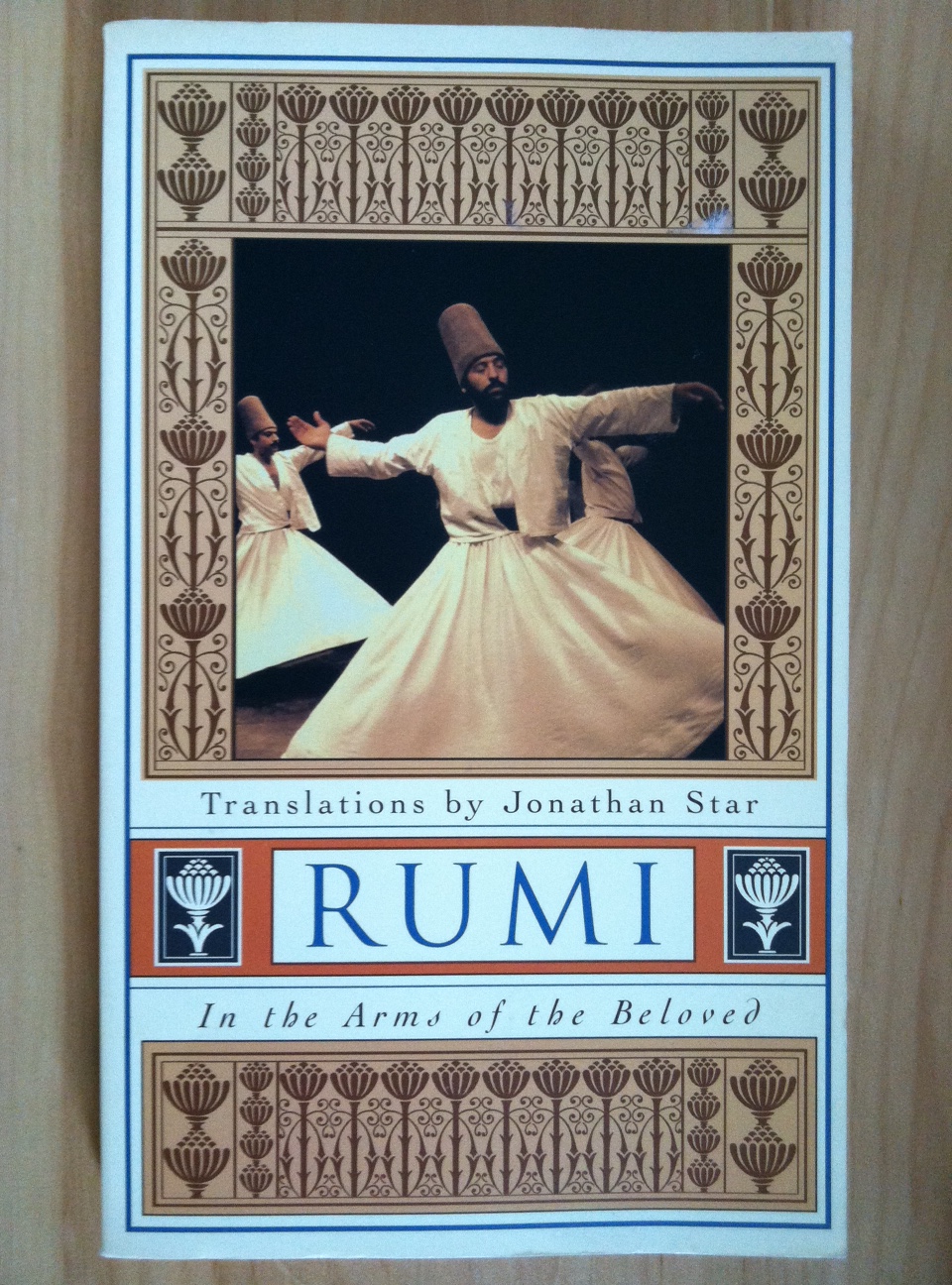
photo (79)Given Mark’s interest in spirituality, myths, and mysticism, I’m recommending the poetry of Jalāl ad-Dīn Muhammad Rūmī, or, as he’s know in the English-speaking world, Rumi.

Rumi was a poet, theologian, and Sufi mystic who lived in the thirteenth century; his work is immensely popular and there are many, many editions of his poems available. I’ve been happy with the one I bought in high school, Rumi: In the Arms of the Beloved, translated by Jonathan Star. The translations are clear, while retaining a sense of mystery, and the book includes a helpful glossary of unfamiliar terms.


Mark, I hope you’ll like reading poetry by Rumi. Thanks for writing in!


Would you like the Poetry Concierge to make a recommendation for you? Check out the introductory post, and send your answers to the questionnaire, along with the name and/or blog you’d like posted with the reply, to rosemaryandreadingglasses [at] gmail [dot] com.