“Why, oh why, the doily?”: Elizabeth Bishop’s “Filling Station”

This weekend, I was reading a very interesting essay on the correspondence between Robert Lowell and Elizabeth Bishop (Austin Allen’s “Their Living Names”), when it struck me that I’ve never featured Elizabeth Bishop on the site.

My high school English classes featured shockingly little poetry; I can remember the novels we read, but the only poems that spring to mind, besides a sonnet or two, are Eliot’s “The Hollow Men,” Langston Hughes’s “Harlem,” Thomas Hardy’s “Channel Firing” (which I’m pretty sure was on a mock-AP test), Cummings’s “anyone lived in a pretty how town” and Elizabeth Bishop’s “Filling Station.”

I remember “Filling Station” in particular because nobody in our class knew that “Esso” was a brand of gasoline (it’s an older name for Exxon-Mobile, still used in countries outside the United States), and so we found that line frustrating as we worked on the poem as a class. Bishop’s “big hirsute begonia” is the first time I remember hearing the word “hirsute,” and I’ve never forgotten it.

The details of the poem serve to highlight absence and presence: the presence of the father and sons and the dog, all dirty and greasy, but seemingly content, and the absence of the figure who put out the wicker furniture, waters the plant, and who embroidered the doily.

I liked the poem in high school, for its leap from first to last line, and as an adult I think I better see the way Bishop points to the kinds of work people do: visible work, like running a filling station, and the quieter, almost invisible work of caring and beautifying. The results of that kind of work are often hiding in plain sight, even if the worker—the “somebody”—is absent.

Two Poems on Poetry

I love reading writers on writing — interviews with authors about how they work, where they work, why they write, and so on. The Guardian has a series on writers’ rooms that I love to pop into now and again; here’s Seamus Heaney’s.

This week I’m reading two very different poems about poetry and writing poetry. Charles Wright is the current United States Poet Laureate; his poem “Reunion” is short, and very personal. He ends the poem with,

I write poems to untie myself, to do penance and disappear
Through the upper right-hand corner of things, to say grace.

Archibald MacLeish’s “Ars Poetica” is a playful, self-contradictory riff on Horace’s famous work of the same name, a set of guidelines for the crafting of poetry. In his rather famous and formulation,

A poem should not mean
But be.

What are your favorite poems about poetry?


Two notes from the poetry world:

Apparently a treasure-trove of lost Neruda poems has been found. (The Guardian)

Charles Simic’s tribute to his friend Mark Strand is wonderful, moving, human. (NYRB)


“in a foyer of evenings”: Joanna Klink’s “Auroras”

It’s been cold—not brutally cold, but cold—in Boston lately, and as often happens in January, I’ve been thinking about summer, and all the things I like about it (I will forget all those things as soon as it is July, 95 degrees, and muggy). Recently, I also learned that there is such a thing as a dark sky park, a place low enough in light pollution to give you a great view of the stars, so now I’m daydreaming about a trip to one of them this summer.

“Auroras,” by Joanna Klink, makes me think of summer and stars. I love its opening lines: “It began in a foyer of evenings / The evenings left traces of glass in the trees.” That’s a wonderful image: the last of the daylight caught in the tree branches while the sky above them turns black.


In other poetry-related news:

Michael Klein’s review of Mark Wunderlich’s The Earth Avails in The Boston Review is excellent.

I thoroughly enjoyed this interview with Susan Howe on The Poetry Foundation’s website. I haven’t read much of her poetry, so if you can recommend the book I should start with, please leave a note!

“erasing absence”: Christopher Buckley’s “On the Eiffel Tower”

1909687_520858518315_5793_nAfter the terrible events in Paris last week, I found myself looking for poems about the city, but none of the ones I came across really conveyed everything I wanted them to, which makes sense—how could they when I wanted to much?

In the end, I thought I’d recommend this poem about the Eiffel Tower. Christopher Buckley’s “On the Eiffel Tower” isn’t about crisis, or free speech, or facing the worst among us with all that we can muster of our best. What it is about is the way human minds can fill the sky with something beautiful, a monument of iron lace that’s stood for more than a hundred years of war and peace.

Vive la liberté.

Correction (August 23, 2020): The original version of this post mistakenly conflated Christopher Buckley, poet, with Christopher Buckley, satirist. I regret the error, and thank the reader who brought it to my attention.

“Letters swallow themselves in seconds”: Naomi Shihab Nye’s “Burning the Old Year”

Here’s a poem for the new year by acclaimed (and prolific) poet Naomi Shihab Nye.

It’s called “Burning the Old Year” and I love its mix of quotidian objects (“lists of vegetables”) and the blazing metaphor (papers “sizzle like moth wings / marry the air”). Then there’s the sharp turn to absence, like the strike of a clock, and a blistering finish:

only the things I didn’t do
crackle after the blazing dies.
It’s a neat, complex little poem, and I’d love to hear what you think of it.

“Arbolé, arbolé . . .”

Today’s poetry post is in honor of Joyce Wilson (1924-2014), who studied Spanish and French literature and was a writer herself.

I love this poem, called “Arbolé, arbolé” after its first line, by Federico García Lorca; it’s deceptively simple, almost fable-like in its repetition and use of color. But what is the “grey arm of the wind” around her waist? Does it hold her back? Protect her? Why this girl? As with so many others, I have more questions than answers about this poem.

I hope you’ve all had a wonderful holiday with family, friends, and happy reading.

“free it when they are freed”: Marianne Moore’s “The Paper Nautilus”

photo (2)I had wonderful luck at a bookstore yesterday, finding The Complete Poems of Marianne Moore and Margaret Atwood’s Selected Poems (1965-1975), which is particularly excellent because I already had the companion volume, and wondered if I’d ever come across the first volume in the wild.

Marianne Moore is one of America’s most revered poets, but I am afraid that my knowledge of her work is quite limited, so I’m happy to have the chance to puzzle over some of her very fine poetry. Her images are deep and complex, and her subjects often begin with animals, as in “The Paper Nautilus,” the poem I’m thinking about this week. At first I thought that the animal in question was a variety of nautilus, but the reference to “eight arms” tipped me off that it’s a type of octopus, named after its egg case, which Moore so beautifully describes. That was just the first of many surprises in a poem that turns and undulates like the argonaut underwater.

“The Paper Nautilus” is a fascinating, multi-layered poem that I feel I’m just beginning to get a feel for. I hope you’ll tell me what you think.

Two Poems for Knitting

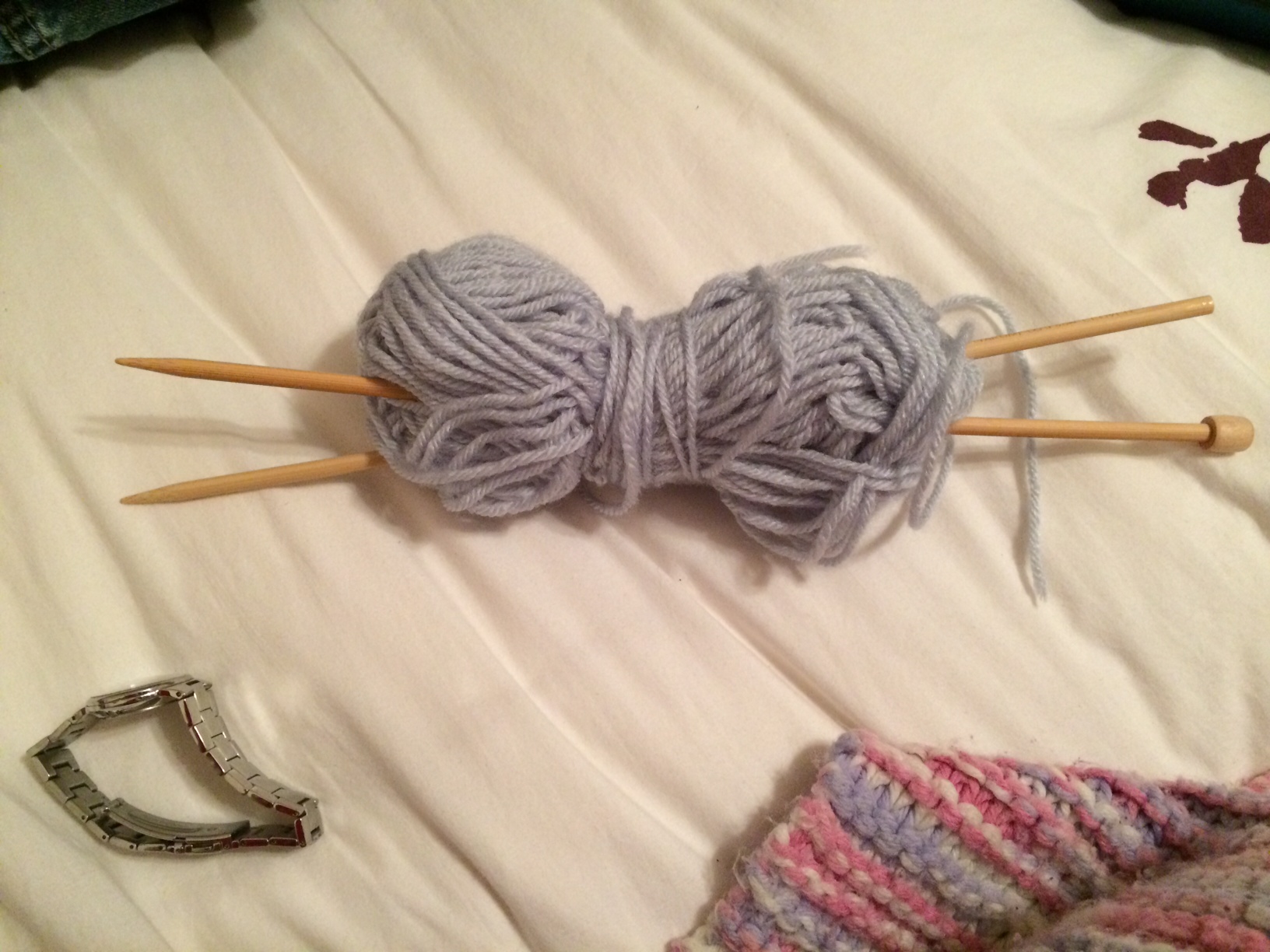
photoIn late November and into December, I often find myself knitting at night, rushing to catch up with projects destined to become Christmas presents.

I am not a very skilled knitter; I can make rectangles (scarves, small blankets) and things that can be made out of rectangles (leg warmers, arm warmers, bags, vastly oversized laptop covers . . . ). I can’t cable, use double-pointed needles, read a pattern, or reliably tell you what a slip-stitch is. Though I was taught by a talented and generous knitter, I am fairly sure that I’m holding the yarn the wrong way.

Still, I love knitting. I like seeing yarn curved and curled into something new and useful (well, mostly useful), and the sense of satisfaction that comes from weaving in the yarn ends on a scarf or a baby blanket. I’m not good enough that I can take my eyes off the work, so I usually knit while listening to a movie or TV show I’ve seen ten times before and chatting with my husband. It’s all very companionable.

Anyway, today I went looking for poems that talk about knitting, and I found a few; here are my two favorites.

The first, Ciarán Carson’s “The Fetch,” is just wickedly cool (that’s a technical term, by the way); it’s about waking, dreaming, loss, the sea, and distance, and features a nice Dickens reference, too. It’s so good I’m putting his book For All We Know on my Christmas wish list.

The second poem links knitting and waves as well. “A simple co-creator, I trust in simple decorum,” says the speaker of Cory Wade’s “Knitting Litany.” An incredibly skilled knitter, the speaker conjures a list of flora and fauna that descend from her needles, and imagines the waves she builds and builds.

Now, who’s going to teach me how to crochet?

In Memoriam: Claudia Emerson

Poet Claudia Emerson, who won the Pulitzer Prize in 2006 for her collection Late Wife, died last Thursday.

Her other collections include Pinion (a long poem in two voices), Pharaoh, Pharaoh, and The Opposite House, which is forthcoming in 2015.

Here’s her graceful poem “Pitching Horseshoes,” recommended by a friend who studied with Ms. Emerson some years ago.

——-

Last week I posted a short note about Mark Strand; poet Mark Wunderlich (whose most recent collection, The Earth Avails, I reviewed here) has written a lovely tribute to Strand, which I highly recommend. You can find it here, on Bennington’s faculty blog. 

“This morning / when the chill that rises up from the ground is warmed”: Linda Hogan’s Dark. Sweet.

Last year around Thanksgiving, I talked at little about Joy Harjo’s “Eagle Poem,” and I think I’d like to make it a tradition on the blog to feature poems by Native American poets during Thanksgiving week.

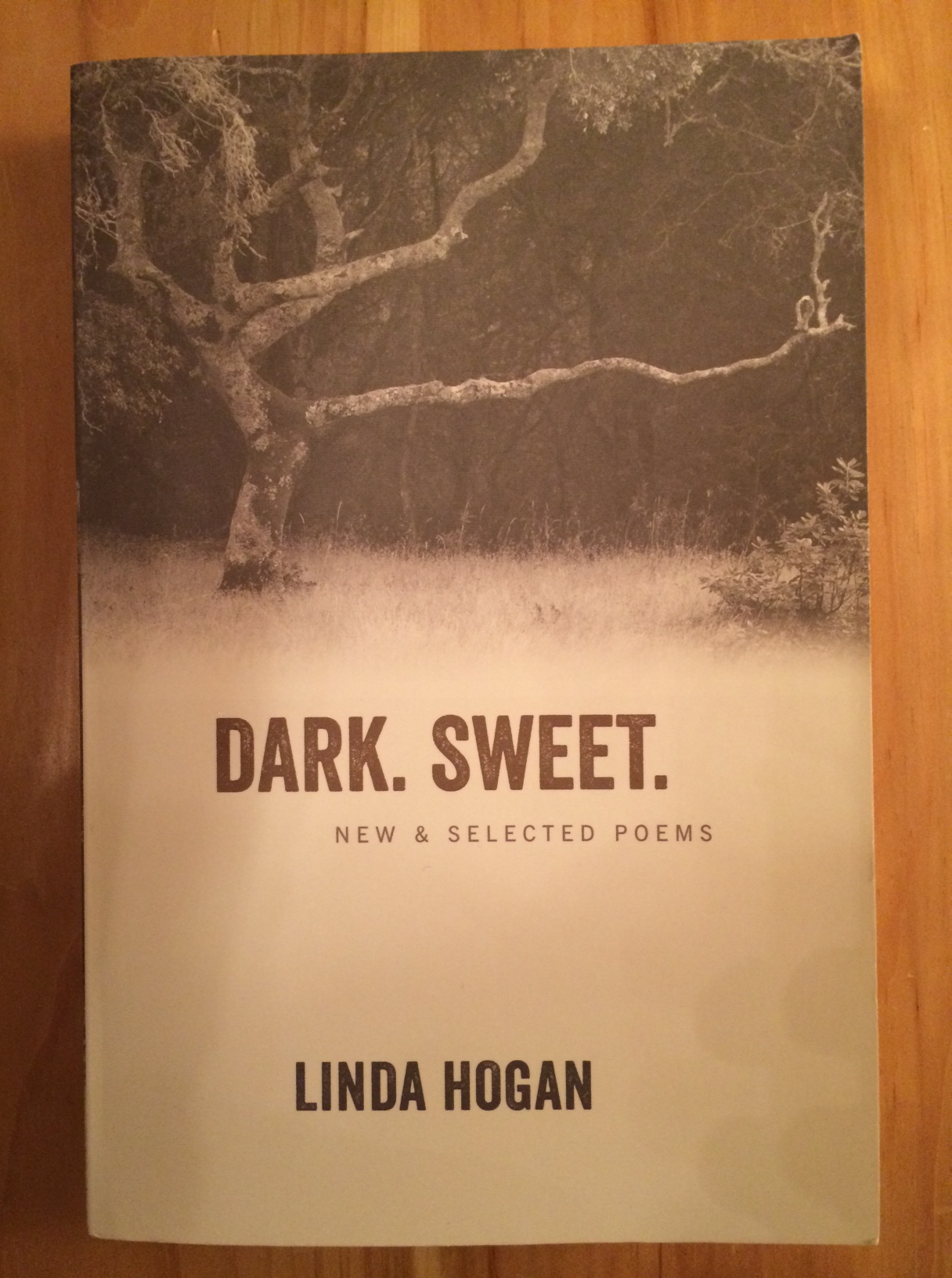
photo (9)I just finished reading Dark. Sweet.*, Linda Hogan’s new and selected poems, and I highly recommend it. Ms. Hogan, a writer and environmentalist, is a member of the Chickasaw Nation, and her poetry reflects both historical and contemporary Native American experience. Her poetry is deeply engaged with nature and personal experience; I loved its lyricism and its emotional engagement. The poems are particularly powerful in they way they capture the tension between the importance of place—rocks, trees, animals, water—and a profound and abiding sense of displacement.

That sense of displacement is evident early in the collection; take the poem “Heritage,” in which the speaker recalls the gifts and images she associates with her family: “From my family I have learned the secrets / of never having a home” (19).

Sometimes a poem drew me in with specific detail, like “Saving,” in which the speaker describes how she, and her mother, and her daughter save things “for good” as my family would say–the clothes that are too nice to wear, the “best towels”—and then expands from the carpe diem note into an exploration of the darkness at the end of each day and the ways we can step out of time.

In “Disappearances,” the speaker recalls traveling with a woman whose “eyes were full”

with the certain knowledge
that it is a good thing to be alive
and safe
and loving every small thing
every step we take on earth. (41)

All things to be thankful for—because, as we know too well, or maybe not well enough, not everyone is safe, or alive, or able to love every step we take on earth.

If you’d like to read one of Ms. Hogan’s poems in full, you can read the marvelous “Deer Dance” on her website (scroll down), and the Poetry Foundation has also collected some of her poems here.

*I received a copy of this book from the publisher for review purposes, which did not affect the content of my review.