“larklike over the wheat”: Ted Kooser’s “So This Is Nebraska”

Photo courtesy of Jordan McQueen via Unsplash.

Photo courtesy of Jordan McQueen via Unsplash.

It’s been hot in Boston this week, certainly more hot than I like (which, to be fair, is not very hot at all), but not as hot as it could be. One of the hottest days I remember involved driving through Nebraska in summertime, years ago, when the temperature outside was 106 degrees. I don’t think I’ve seen a thermometer hit that temperature in all the years since.

“So This is Nebraska,” by former poet laureate Ted Kooser, describes that kind of hot day, though with far more attention to detail than I can conjure from memory. And oddly enough, it made me feel a little cooler.

By the way, there’s a bar before the poem that has a recording of Ted Kooser reading the poem. It’s great.

Writer to Watch: Nuala O’Connor

IMG_4252Nuala O’Connor’s Miss Emily* is an upstairs/downstairs novel about Emily Dickinson and an imagined Irish maid-of-all-work. While it is Ms. O’Connor’s first novel published in the United States, she has published two novels, short stories, and poetry in the U.K. and Ireland, where she often writes under the name Nuala Ní Chonchúir.

Miss Emily takes place over the course of a year or so, when 18-year-old Ada Concannon leaves Ireland for America, where she finds work in Amherst with the odd but locally esteemed Dickinson family. Chapters alternate between Ada’s voice and that of Emily Dickinson, who in her mid-30s is headed toward the seclusion she’s well known for. Despite the gaps in age, class, education, and origins, Ada and Emily form a friendship, trading recipes and observations about goings-on in the natural world.

The novel’s strongest aspects include its descriptions, particularly Ada’s recollections of Dublin and her grandmother’s cottage, and Ms. O’Connor’s rendering of Emily’s facility with language and adept way with peculiar images. Readers fond of realistic renderings of everyday life in historical fiction will find much to please them here.

Miss Emily moves very fast, thanks to its short chapters that change perspective, but I would have preferred a longer version with more expansion on the Dickinson family’s relationships and those within Ada’s family. Readers conversant with Emily Dickinson’s biography will pick up on the family dynamics, but those who don’t know much about the poet may find themselves lost at times.

Without giving too much away, I’d also add that I found the novel’s ending disappointing, shifting agency away from the main characters we’ve spent so much time with in favor of male characters who aren’t as fully drawn. In the last quarter of the novel, Emily and Ada react to events, rather than choosing their own paths, which is unfortunate and not in keeping with the tone of the novel’s first half.

Despite these issues, I’d still recommend Miss Emily for a quick summer read, and I’d be happy to read more of Ms. O’Connor’s writing, particularly her poetry. And I suspect that after you read this book, you’ll be curious to see, as I am, the Homestead, the Dickinson family home. I’ve lived about two hours from it for years, and I’m sorry to say I haven’t been to see it—but I hope to get out to Amherst later this summer, Emily Dickinson’s own words in hand.

You can read more about Nuala O’Connor here. And if you’re interested in visiting the Emily Dickinson Museum, you can read more about it here. 

*I received a copy of this book from the publisher for review consideration, which did not affect the content of my review.

 

“the world it becomes”: Louise Erdrich’s “Turtle Mountain Reservation”

IMG_3990Ever since I read The Round House (brief review here), I’ve been on the lookout for Louise Erdrich’s books. In Vermont a few weeks ago, at Brattleboro Books, I found a copy of Jacklight (1984), her first collection of poetry, which, though it’s now thirty years old, still feels fresh, full of sharp observations and unexpected turns of phrase. I’ve been reading it slowly, finishing up last week. The poems tell stories that reflect Ms. Erdrich’s Native American and German American background; several are accompanied by short, explanatory notes or epigraphs, which is a poetic practice I happen to love.

I recommend the whole collection, but this week I’ll point you toward “Turtle Mountain Reservation,” the last poem in the book. Dedicated to the poet’s grandfather, it’s a powerful meditation on heritage, aging, and change.

Summer Reading, Two Ways

Long ago, when the world was still getting used to Pierce Brosnan was James Bond, I started reading Ian Fleming’s novels at my grandmother’s house, where the slim paperbacks, spines emblazoned with the title and the minimalist “/Fleming” had been left behind by my uncles. (Thankfully, I didn’t start with The Spy Who Loved Me.)

Since then, I’ve had a fondness for both short books and spy novels, which, despite their content, tend to make me think of open windows, box fans, and tomato sandwiches eaten with one hand. They’re summer books, at least for me, serving as quick palate cleansers between heavier main courses.

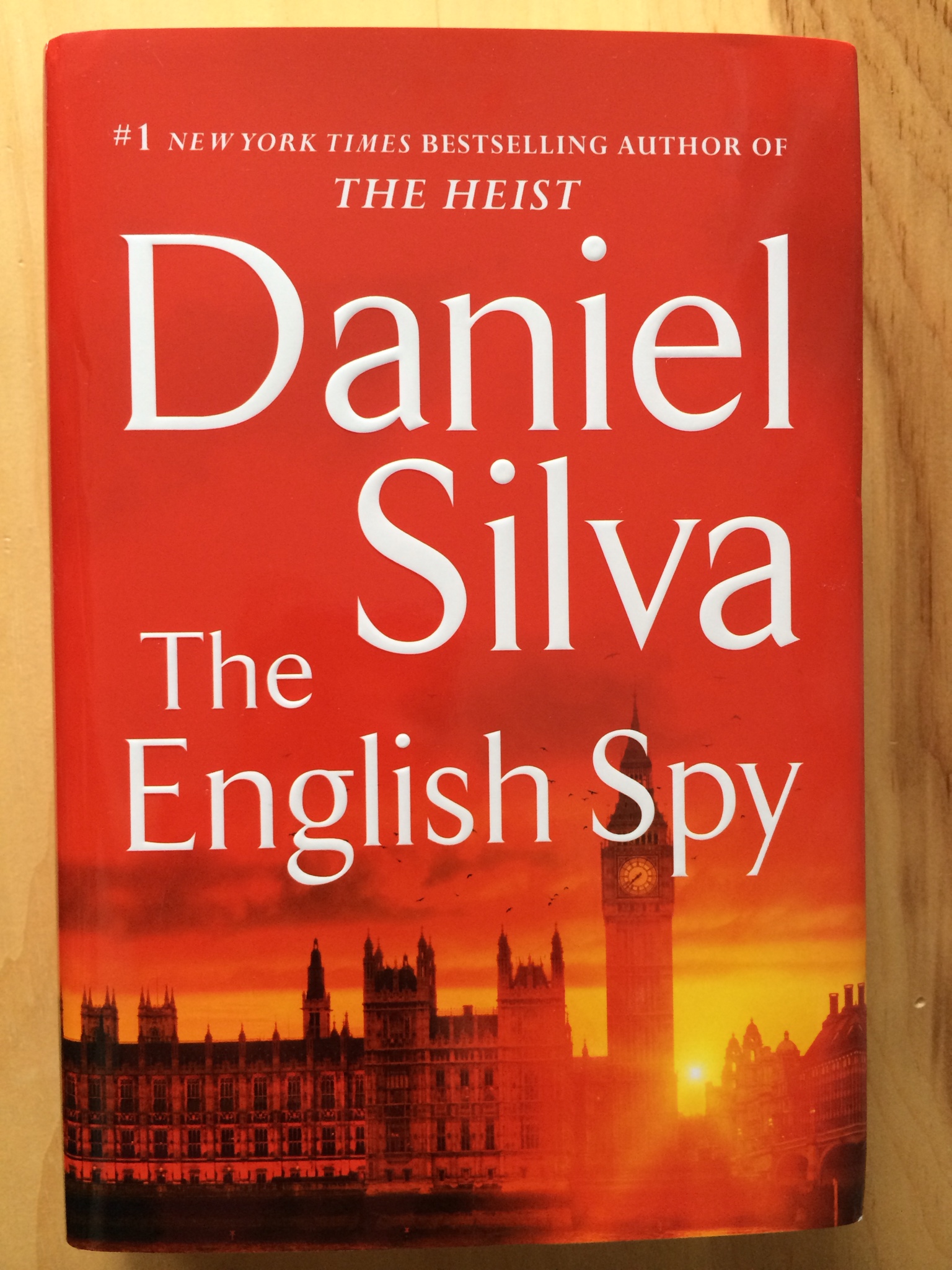
IMG_4137And so I was happy to zip through Daniel Silva’s The English Spy*, which is, I learned, the latest installment in a long series of best-selling novels (which appear most summers) featuring Gabriel Allon, an Israeli spy and art restorer. I should note here that I haven’t read any of Mr. Silva’s previous novels, but I had no trouble jumping into the story and getting a sense of the characters, so don’t let prior unfamiliarity stop you from picking up the book.

The book opens when a skilled assassin sinks the yacht carrying a certain (unnamed) English former princess; Gabriel is called in to help find the killer, and he recruits an old friend to help him. Together they track the bomber, who has ties to an ultra-violent faction of the IRA and various terrorist organizations. And of course, as in any good espionage thriller, there’s always a bigger fish.

The English Spy features plenty of action and twists, memorable minor characters, and solid writing. It’s violent, but not unusually so for a spy novel, and features far fewer adult shenanigans or gadgets and far more politics than your average James Bond book (or movie, for that matter). More Patriot Games than Goldfinger. It’s a fun, fast read.

Now, I promised summer reading two ways. There’s quick-reading genre fiction, like The English Spy, and then, at least for me, short, serious fiction.

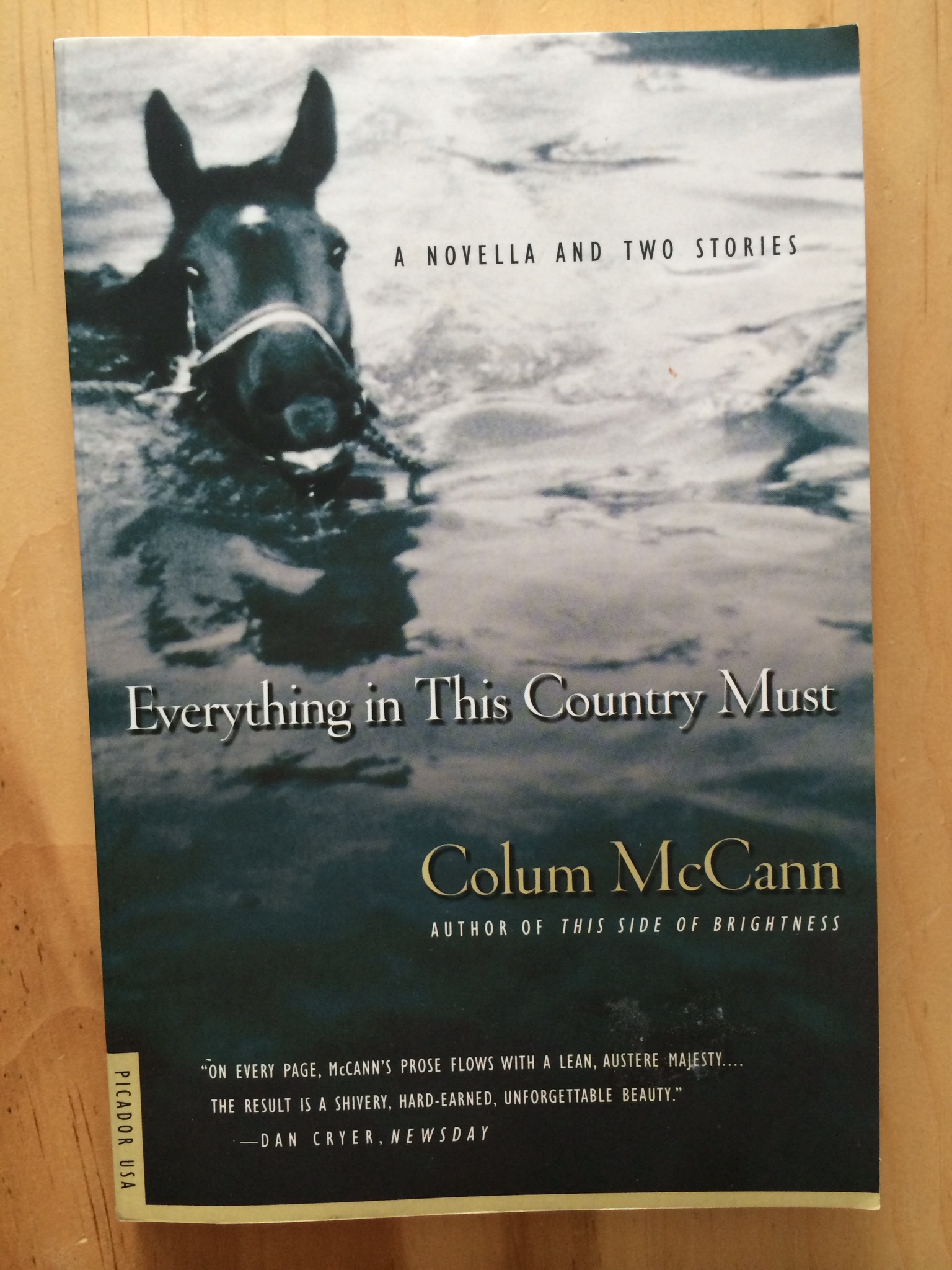
IMG_4138Colum McCann’s Everything in This Country Must (2001) is the latter, a mini-collection of two short stories and a novella. All three take place in Northern Ireland during the “troubles” (which made me pick it up after The English Spy‘s focus on the IRA), and all three feature young people and their parents trying to negotiate the uncertain world they find themselves in. In the title story, a girl and her father try to save their horse, unwillingly helped by British soldiers. In the second short story, a boy conceals his involvement in helping his mother make supplies for the Protestant marches. In the novella, Hunger Strike, a boy and his mother move to a small trailer in a new town, and the boy flounders in his anger as they live out the days of his uncle’s hunger strike.

The writing is just gorgeous, simple with impeccably-placed figurative language. These are bruising, brilliant stories; the book is a small masterpiece. Highly recommended.

*I received a copy of this book from the publisher for review consideration, which did not affect the content of my review.

On Poetry for Children

Photo courtesy Daniela Cuevas via Unsplash.

Photo courtesy Daniela Cuevas via Unsplash.

A long time ago—so long ago that I can’t find the post (although, to be fair, I only had the patience to look for three minutes or so)—I wrote about looking for poems for children. Nursery rhymes and jokey sorts are all very well, but I am a woman of distinctly unsaint-like patience (see parenthetical above), and when possible, I prefer children’s entertainment that is also meant to be palatable to adults (such as Pixar movies and a remarkable number of children’s books, which I would be happy to list in a later post if anyone is interested). Not for me are Saturday morning cartoons, Berenstain Bears, or The Wiggles, and I’m afraid to say that our son is deprived of these things thanks to his mother’s intransigence.

So some time ago, I thought to myself, “well, I should make a list of poems that aren’t meant for children but that they might like anyway,” since they seem to go over pretty well in our house (the principle applies to music, too, by the way). Edward Lear’s nonsense poems are great fun, and H likes Robert Frost quite a bit; I think the rhythms of formal poetry, particularly iambic pentameter, are soothing.

Of course, I was quite sure to file the idea in my Cabinet of Good Intentions I’ll Forget I Ever Had ™, where it remained until just a few days ago when I found that Lemony Snicket has done all the work for me.

So in lieu of a poem of the week, Dear Readers, I invite you to head over to the Poetry Foundation’s website and enjoy the hilarious introduction he’s written and the portfolio of poems he’s collected. 

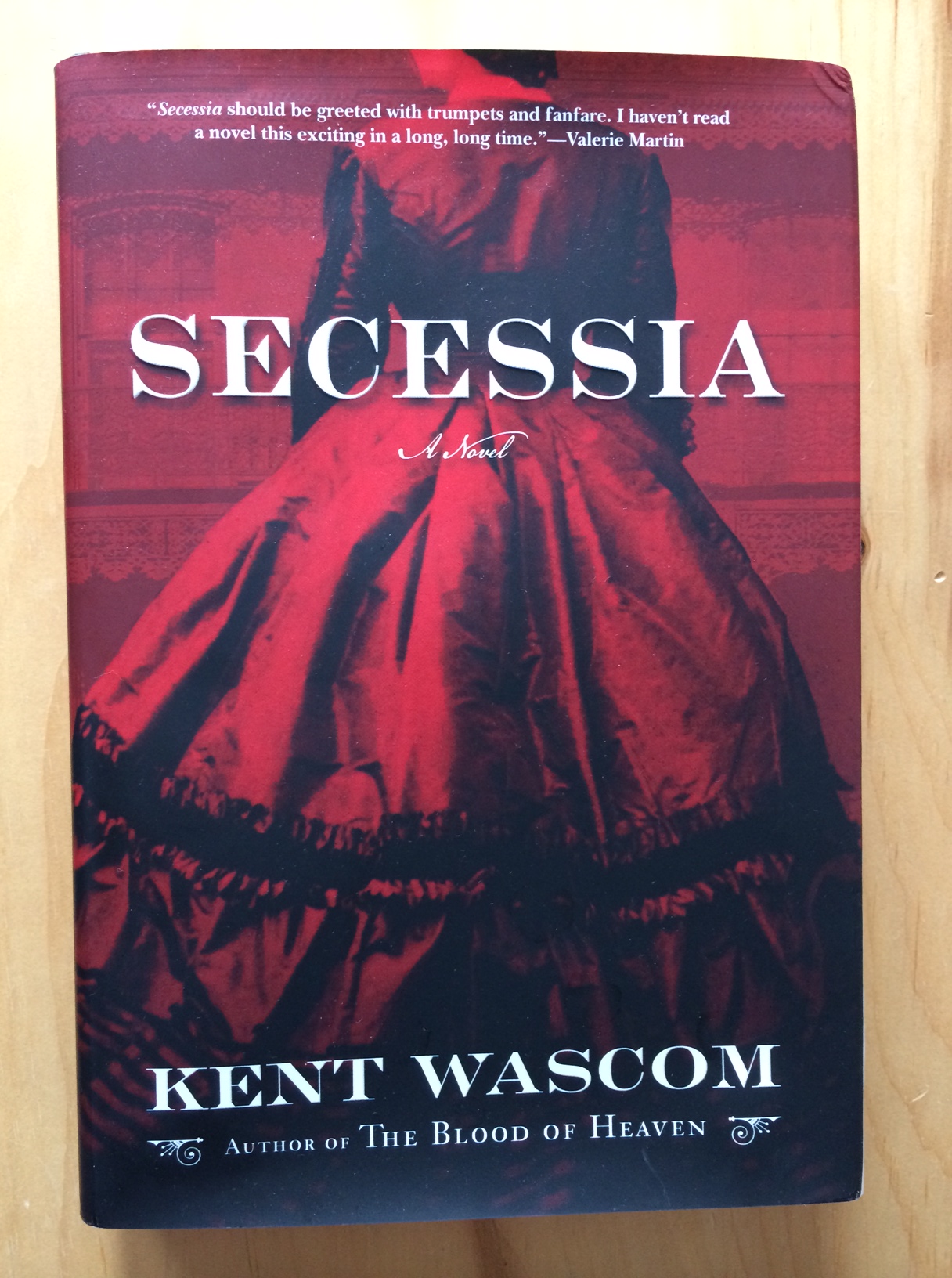
Recommended Reading: Secessia, by Kent Wascom

photo (55)In its first few pages, Kent Wascom’s Secessia,* which is out today, seems like an ode to to Edgar Allan Poe: a teenaged girl walks into a crowded masquerade with blood—not her own, it turns out—trickling down her chin. This is not your average Civil War novel.

Seldom have I read a book whose language evokes so well its setting. Mr. Wascom’s long, adjective-rich sentences sink the reader into 1862 New Orleans, a city slowly going mad with heat and hatred, a “new and wild world” on the brink of capture by Union forces.

The word that immediately leapt to mind when I started reading was “baroque”; the sentences are so over-populated with sound and imagery that they should topple under their own weight, but Mr. Wascom balances them expertly in brief chapters that propel the narrative inexorably forward. Here’s a small sample of the kind of language I’m talking about:

Thrown back upon the hands that have him hoisted high, an officiate of a ceremony of extraordinary violence, with boot heel he pulps one face, then another whose spouted teeth fall like wedding rice on her husband’s black coat; two of his bearers drop at Elise’s feet, and she has rushed too son, come to close, must spin and duck the whirligig of mayhem of which her husband is a master component. (33)

In this passage, Elise is searching for her son in the chaos of the city as the Union forces approach. Her much older husband, Angel Woolsack, was a major character in Mr. Wascom’s debut novel, The Blood of Heaven (which I haven’t read, but which received excellent reviews), and based on what we learn of him in Secessia, he sounds like he’d be right at home with most of Cormac McCarthy’s creations.

The novel’s point of view shifts among Elise, a mixed-race woman who passes for white; her only son, twelve-year-old Joseph; Marina Fandal, a Cuban orphan rescued by Union soldiers who takes an interest in Joseph; Emile Sabatier, a prominent doctor obsessed with disease and the girl he met at the masquerade nearly twenty years earlier; and General Benjamin Butler, the man who’s come to take charge of the city, and who will soon be called “the Beast.” Through their eyes we see New Orleans in a year of tremendous upheaval, which will affect them all.

New Orleans (and the South in general) is absolutely not romanticized in this book; it’s a morass of darkness, greed, and hypocrisy. Still, we don’t hear directly from any of the city’s enslaved residents, though certain household servants appear from time to time. Maybe that’s because Mr. Wascom is making a point about how only certain people’s voices were heard (Elise’s is heard because she passes for white), but I think the book would have been stronger if the author had turned his considerable talents in, say, Ligeia’s direction (perhaps she’ll appear in his next novel).

If you are a reader of historical fiction, or searching for a book that’s utterly different from everything else you’ve been reading, or want to start early with an author who’s going to be a master one day, look no further than Secessia.

Boston readers: Kent Wascom will be at Newtonville Books this Thursday, July 9, at 7p.m.

*I received a copy of this book from the publisher for review consideration, which did not affect the content of my review.
Celebrated Days

10405657_10106229416396525_3529221544828816157_nDear Readers, it seems like just yesterday I was writing about We Do! American Leaders Who Believe in Marriage Equality, and now look where we are! We’ve been celebrating not only the wonderful news about marriage equality over the past week with family and friends, but also the birth of our friends’ first baby (hi K and T and baby E!). Here’s an Emily Dickinson poem that reminds us to treasure, to celebrate, the present.

Emily Dickinson
Forever – is composed of Nows –

Forever – is composed of Nows –
‘Tis not a different time –
Except for Infiniteness –
And Latitude of Home –

From this – experienced Here –
Remove the Dates – to These –
Let Months dissolve in further Months –
And Years – exhale in Years –

Without Debate – or Pause –
Or Celebrated Days –
No different Our Years would be
From Anno Dominies –

Recommended Reading: The Shepherd’s Life, by James Rebanks

Gorgeous cover; the photograph was taken by the author. And this book has some of the best endpapers I've ever seen.

Gorgeous cover; the photograph was taken by the author. And this book has some of the best endpapers I’ve ever seen.

When Helen MacDonald says a book is “bloody marvelous,” you can bet whatever you like that I will read that book, and you will come out a winner.

And so I read James Rebanks’s The Shepherd’s Life*, an account of current shepherding practices in England’s Lake District, a landscape which is perhaps familiar to you from the poetry of Wordsworth or Coleridge. If that’s the case, Mr. Rebanks, the shepherd whose Twitter account with its gorgeous photos has made his farm famous, has a bone to pick with your teachers:

My grandfather was, quite simply, one of the great forgotten silent majority of people who live, work, love, and die without leaving much written trace that they were ever here. He was, and we his descendants remain, essentially nobodies as far as anyone else is concerned. But that’s the point. Landscapes like ours were created by and survive through the efforts of nobodies. That’s why I was so shocked to be given such a dead, rich, white man’s version of its history at school. This is a landscape of modest hardworking people. The real history of our landscape should be a history of nobodies. (19)

Angered by the contempt shown his parents’ and grandparents’ occupation in school—he is fervent about his secondary education’s uselessness—Mr. Rebanks only later continued his formal education (at Oxford, no less; clearly his teachers missed an opportunity to reach a bright student). But by the time he reached his twenties he’d been educated in farm life for more than a decade. His family farm raises sheep. “We are a tiny part,” he writes, “of an ancient farming system and way of life that has somehow survived in these mountains because of their historic poverty, relative isolation, and because it was protected from change by the early conservation movement” (23).

The Shepherd’s Life is split into four parts that correspond with the seasons; each part is composed of short sections on shepherding practices, geography, Mr. Rebanks’s grandfather’s life, and Mr. Rebanks’s own life’s trajectory, all of which are sometimes intertwined. The sections that deal heavily with shepherding practices are the most successful and interesting in the book.

For example, Mr. Rebanks shows in vivid detail what it’s like to herd sheep in craggy fells, how important a good sheep dog is (they aren’t pets, though very deeply valued), and just how brutal the long days of lambing season are. In his world, “things are driven by the seasons and necessity, not by our will” (32).

In these pages, Mr. Rebanks makes the passionate and persuasive case that traditional farming is a way of life that is worthy of respect, and worth preserving. However, while there is a great deal of material in the book to help readers appreciate the very hard work that he and his family do (and that this work is not particularly remunerative; many farmers have second or third jobs to make ends meet), I didn’t feel there were enough concrete prescriptions for how to go about supporting it in practice.

The Shepherd’s Life is a book for those who want to immerse themselves in another kind of life, one that we might think has already vanished or that is so grindingly hard that people must want to escape it. To the contrary; Mr. Rebanks rails against what he perceives to be the degradations of the modern world, which doesn’t leave people much choice about how they live and work (which might sound odd coming from a shepherd whose family has worked the land for generations, but, given Mr. Rebanks’s biography, makes sense). During a summer in London, he thinks, “it’s like the gods are showing me how tough everyone else’s lives are and what I have left behind. I understand for the first time why people want to escape to places like where I live. I understand what national parks are for, so that people whose lives are always like this can escape and feel the wind in their hair and the sun on their faces” (179).

Despite this sentiment, he also chides the conservation movement, which, despite its acknowledged successes and ways of helping the Lake District, often at times seemed to value land more than people, to look down on traditional ways of raising food. He reminds us that “when local traditional farming systems disappear, communities become more and more reliant upon industrial commodity food products being transported long distances [. . .] They begin to lose the traditional skills that made those places habitable in the first place, making them vulnerable in a future that may not be the same as the present. No one who works in this landscape romanticizes wilderness” (218).

My reservations about this book are eclipsed by its positive aspects, but I would note that the style, though excellent when it comes to description, was not wholly to my taste; there is a tendency toward repetition that is at times awkward, and the inconsistent tenses were a bit maddening, making some parts of the work sound like strung-together blog posts. And it is a book very much about men (fathers and sons, and grandfathers), though women (family members and other shepherds) do make appearances. I would have liked to see a fuller picture of the no doubt grueling work the author’s mother, wife, and grandmother put into running the farm. Particularly troubling here are two or three passages in the middle of the book that seem to belittle the author’s grandmother’s concerns and experiences.

These reservations aside, The Shepherd’s Life is a fascinating book, and well worth reading. Recommended.

If you’re looking for more on sheep farming, you might look at Evie Wyld’s novel All the Birds, Singing, or, for a very different take, Sir Thomas More’s Utopia. For a perspective on modernity that I suspect Mr. Rebanks would find congenial, and because there’s no opportunity I won’t take to recommend it, you might consider picking up The Lord of the Rings.

*I received a copy of this book from the publisher for review consideration, which did not affect the content of my review.
Recommended Reading: Music for Wartime, by Rebecca Makkai

photo (54)Last year I read and loved Rebecca Makkai’s novel The Hundred-year House (Ms. Makkai was kind enough to agree to an interview, too), and so I was delighted to read that a collection of her short stories would appear this summer.

Music for Wartime is that collection, and it’s excellent. In well over a dozen stories spanning more than a decade of her writing career, Ms. Makkai traverses a wide landscape of emotion, space, and time, drawing from her family’s history (some of the strongest pieces in the collection are very short family legends) and her own power of invention.

In one story, an elephant dies mid-act in a small town during the 1940s, ushering in some very strange weather and serious questions for the local pastor. In another, a reality-TV producer steers contestants into producing perfect soundbites—and maybe toward falling in love. In “Painted Ocean, Painted Ship,” a professor accidentally shoots an albatross, and the hefty fine is just the beginning of her bad luck.

Often funny, often sad, and always graceful, these stories are linked by themes of art and war, or at least violence, as you might suspect from the title. You’ll find painters, sculptors, violinists, circus performers, and even Bach within these pages. It’s a tribute to Ms. Makkai’s virtuosity that it’s very difficult, often impossible, to tell which stories are earlier efforts and which are more recent. I was only disappointed when I turned the last page.

Boston Readers: You just missed Rebecca Makkai at Newtonville Books and Harvard Bookstore—sorry about that—but if you’re trekking up to Vermont this summer, you can hear her read in Burlington at Phoenix Books on July 28th at 7p.m.

*I received a copy of this book from the publisher for review purposes, which did not affect the content of my review.

“All of us dazzling in the brilliant slanting light”: Barbara Crooker’s “Strewn”

Not exactly right, but you get the idea.

Not exactly right, but you get the idea.

Last week, my uncle, who lives in Maine, came for a visit, which was excellent in all respects except that it was too short. And it just so happened that last week’s American Life in Poetry column, curated by Ted Kooser (which I highly recommend as a way to get into poetry–the poems are about the experiences of everyday life, and are always accessible) featured a poem by Barbara Crooker about the Maine coast.

“Strewn” is beautifully detailed. I love the list of broken shells that the speaker describes, and the idea of the sunlight on the beach like “a rinse / of lemon on a cold plate.” But it’s the turn at the end of the poem that brings the other people on the beach—and by extension the reader—into the speaker’s orbit that still resonates for me days after reading the poem.