Recommended (Poetry) Reading: Ross Gay’s Catalog of Unabashed Gratitude

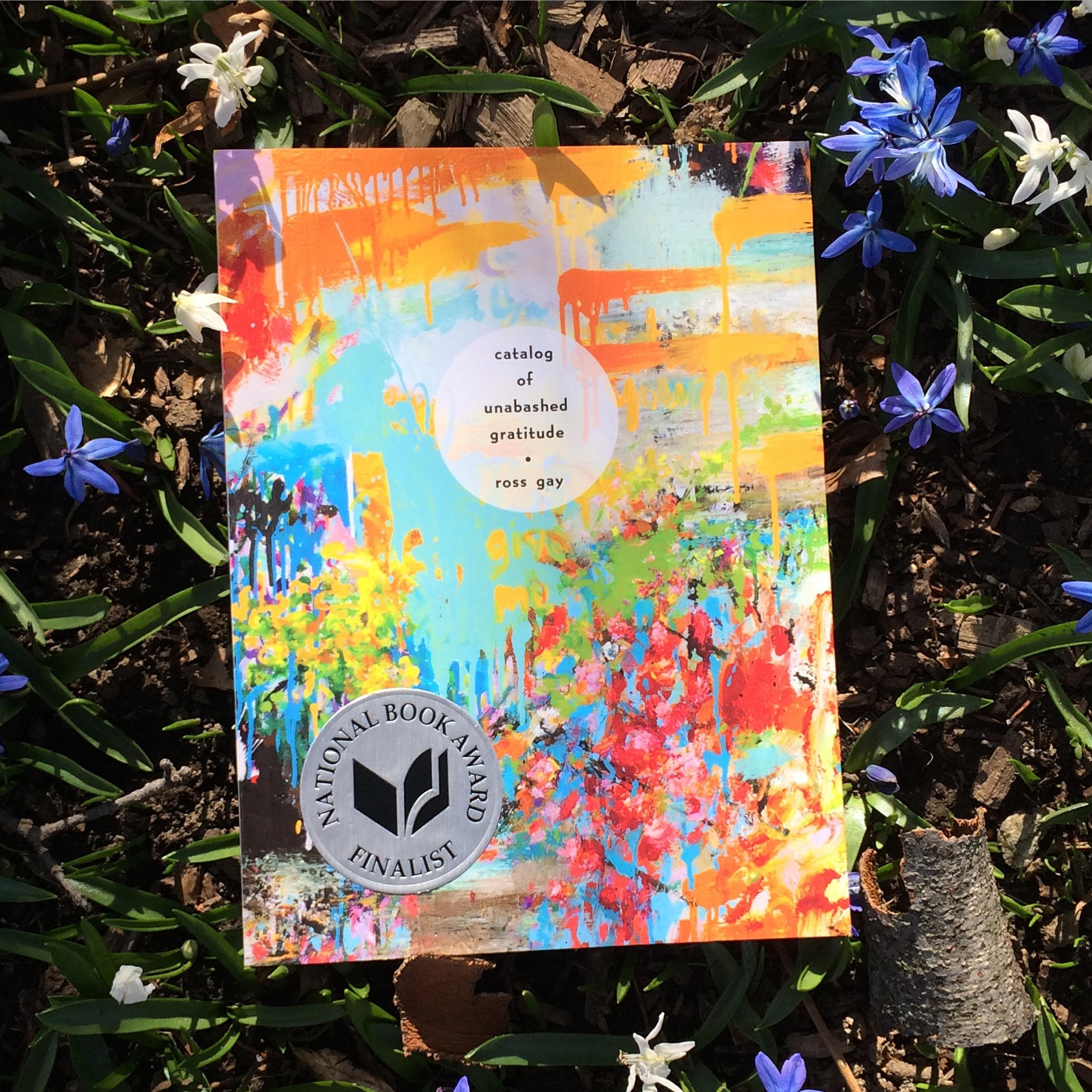
IMG_6414As I thought about how to describe Ross Gay’s Catalog of Unabashed Gratitude, I found myself turning into some sort of very specific thesaurus: his work is ebullient, irrepressible, joyous, boisterous. I loved it without reservation.

In this collection you’ll find a wonderful poem about strangers in a city gathering to pick figs from an overladen tree; an epithalamion (one that I would have liked at my own wedding); a searing, funny, furious elegy for the poet’s friend Don Belton; reflective poems about the poet’s parents; many poems celebrating gardens, orchards, and green growing things.

It took me a bit to adjust to Mr. Gay’s lines, which are often quite short, with limited punctuation, but I came to find that these kinds of lines offered me the chance to be deeply attentive, unstrung from my usual way of seeing a line and automatically looking for the outlines of a sentence. Here are the first few lines of “Ode to the Puritan in Me”:

There is a puritan in me
the brim of whose
hat is so sharp
it could cut
your tongue out

I think my favorite poem in the collection might be the wholly unexpected “Last Will and Testament,” but since I couldn’t find it online, here’s a link to the collection’s title (and penultimate) poem, “Catalog of Unabashed Gratitude.”

I love the way the poem invites the reader in by opening with a direct address (“Friends”—a strategy you’ll see more than once in the collection), and then sweeps into an account of a dream. Now, like most people, I find other people’s dreams rather a trial to hear or read about, but not this one. In the dream is a command to speak, and so begins the catalog of gratitude, with an orchard sunk into colorfully acquired compost:

twirling dung with my pitchfork
again and again
with hundreds and hundreds of other people
we dreamt an orchard this way,
furrowing our brows,
and hauling our wheelbarrows,
and sweating through our shirts,
and two years later there was a party
at which trees were sunk into the well-fed earth,
one of which, a liberty apple, after being watered in
was tamped by a baby barefoot
with a bow hanging in her hair
biting her lip in her joyous work
and friends this is the realest place I know,


This poem is absolute magnificent; I was crying by the end of it. I highly recommend this remarkable book. 

If this quick review piques your interest, you might like:

Ross Gay’s tour of his garden in essay form

This correspondence in poems between Mr. Gay and poet Aimee Nezhukumatathil about their gardens. 

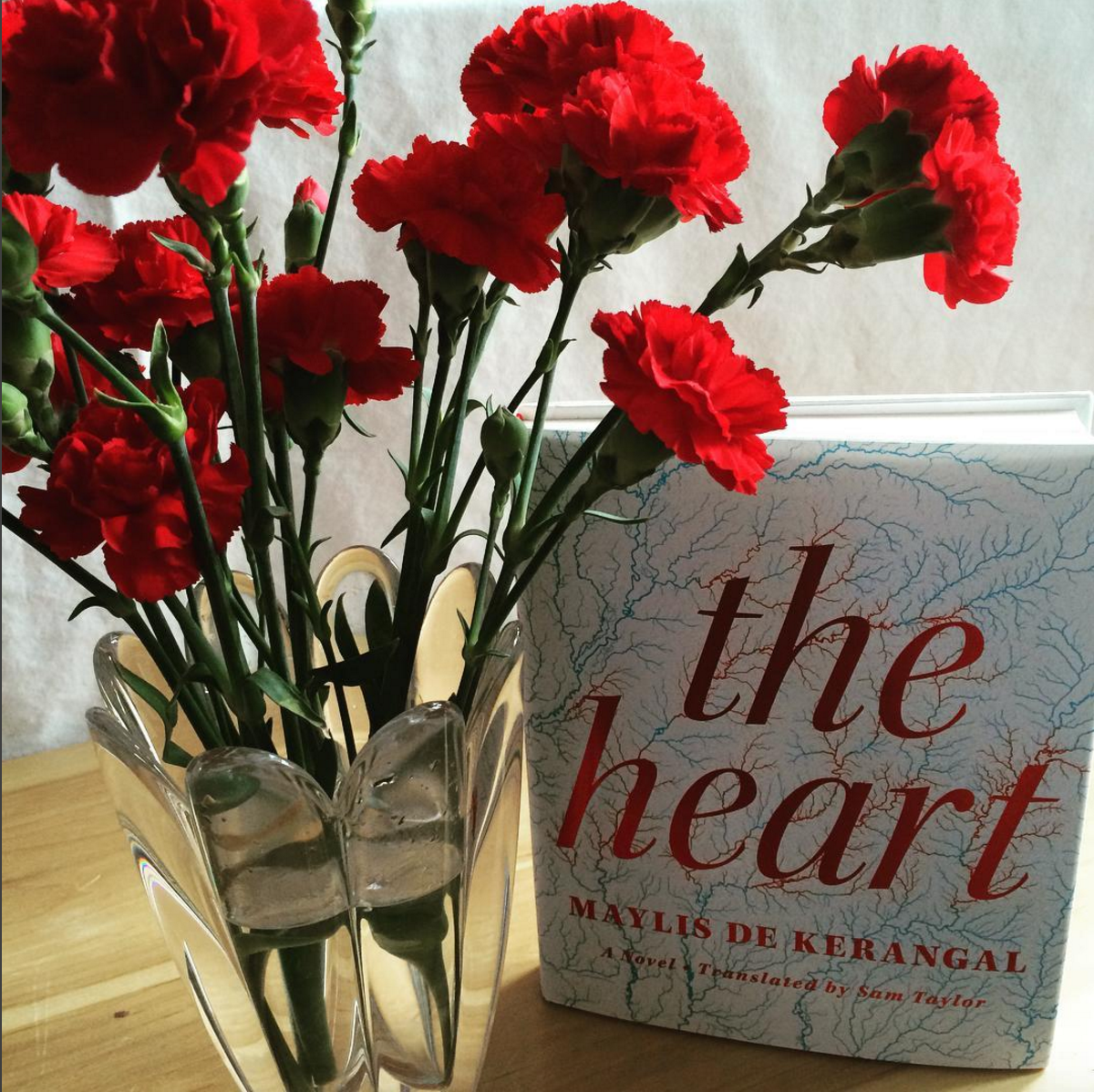
Recommend Reading: The Heart, by Maylis de Kerangal, translated by Sam Taylor

Screen Shot 2016-03-28 at 10.53.56 PMMaylis de Kerangal’s The Heart* is utterly brilliant, and deeply moving.

The novel takes place during a single day, beginning with the final hours of Simon Limbres, a teenager who is fatally injured in a car accident on the way home from an early-morning surfing excursion with friends. As the day unfolds, Ms. de Kerangal’s narrative spirals out to encompass all the people who are immediately affected by Simon’s death, from his separated parents, Marianne and Sean, his girlfriend Juliette, and the doctors, nurses, and specialists who care for Simon, and ultimately make sure that his death will give life to others. 

Ms. de Kerangal (and I should note here the excellent translation by Sam Taylor) is particularly gifted when evoking grief. When Marianne first gets the call that her son has been horribly injured, she captures perfectly that sense of fissure that tragedy generates: “Part of her life—a huge part, still warm, compact—was detaching itself from the present, toppling into the past, where it would fall away, disappear.” When Sean and Marianne sit stunned after Pierre Révol, the doctor in charge of the ICU, explains to them that while their son’s heart and lungs are working with the assistance of machines, he is fact brain dead:

How long does it take them before they accept death’s new regime? For now, there is no possible translation for what they are feeling; it strikes them down in a language that precedes language, from before words, before grammar, an unshareable language that is perhaps another name for pain. Impossible to extricate themselves from it, impossible to substitute another description for it, impossible to reconstruct it in another image. They are, at once, cut off from themselves and from the world that surrounds them.

Contrast this understanding of language with an earlier passage, in which the Pierre Révol

closes his eyes and smooths his skull, from the forehead to the occiput: suspected cerebral hemorrhage after a TBI, nonreactive coma, Glasgow 3—he uses this shared language, this language that banishes prolixity as time-wasting, forbids any notions of eloquence or seductiveness in articulation, abuses nouns, codes, and acronyms, this language where to talk is to describe or provide information about a body, to lay down the parameters of a situation in order that a diagnosis can be made, tests ordered, that the patient can be treated, saved: the power of concision. Révol absorbs each piece of information, then orders a body scan.

This is a novel about surfaces and depths, the complicated histories that underpin characters in the present moment. While Révol must deliver news every parent dreads in careful wording (the French procedure for organ donation is complicated, a delicate dance requiring perfect timing), he is not only a man of science and acronyms:

[ . . . ] and suddenly the idea crosses his mind of a constantly expanding universe, a place where cellular death will be the operator of metamorphoses, where death will shape the living like silence shapes noise, or darkness light, or the static the immobile—a fleeting intuition that persists on his retina even as his eyes refocus on the computer screen, that sixteen-inch rectangle irradiated with black light where the cessation of all mental activity in Simon Limbre’s brain is announced. Unable to connect the young man’s face with death, he feels his throat tighten. And yet he’s been working in this area for nearly thirty years. Thirty years.

All the characters are more than the role they play in Simon’s drama (parent, girlfriend, doctor, nurse, specialist). The nurse, Cordelia Owl, is waiting for a call from a lover, working on almost no sleep. We learn how Thomas Rémige, the hospital’s organ donor specialist, came to acquire a very rare songbird, and how he loves to sing. It is he who must sound out (again, in precisely couched language) Simon’s parents to see if they will allow the organ donation to proceed, and it is he Marianne and Sean charge with delivering their last message to their son, before his heart stops beating.

And then there’s Claire, the middle-aged woman in whose chest Simon’s heart will beat, a translator, in a beautiful bit of writerly playfulness, working on the Brontës’ early poems:

Sometimes she feels she is replacing the painful contractions of her sick organ with a fluid back-and-forth, between her native French and the English she has learned, and that this reciprocal movement is digging a crevice inside her, a new cavity. She’d had to learn a new language in order to understand her own, so she wondered if this new heart would allow her better understand herself: I’m clearing a space for you, my heart, I’m making you a home.

In French, the original title of this novel was Réparer les vivants (Mend the Living), which perhaps gives a better sense of the novel’s depths, its fascination not only with the meaning of death, but how life breaks and is refashioned in its wake, through love and medicine and language. Ms. Kerangal favors long sentences, in which subjects roll and reappear like the waves Simon loves so much, and which allow complex ideas and feelings room to breathe. Though very often, I felt my own breath taken away.

Highly recommended reading.

And please, please consider becoming a registered organ donor if you aren’t one already.

*I received a copy of this novel from the publisher for review purposes, which did not affect the content of my review.
No Joke: The Poetry Concierge Returns

PoetryConciergeDear Readers,

Remember way back in the mists of time when I spent a few months as the self-dubbed Poetry Concierge? I’m bringing the feature back for this year’s National Poetry Month. Read on, and put me to work handpicking poems!


Was the last time you read poetry sometime during a high school English class? Do you want to love poetry, but don’t know where to start? Are you slightly embarrassed that you can’t remember the last time you bought a book of poems?

Friends, I’m here to help. I’m your poetry concierge.

Yes, this April — and for the rest of the life of this blog, I hope — I’ll be available to lead you to the sweet springs of verse, where you may sip or swill to your heart’s content.

Here’s how to help your Poetry Concierge help you:

Send me an email [rosemaryandreadingglasses (at) gmail (dot) com] with your name as you’d like it to appear, a link to your blog or website if you’d like, and answers (as specific as possible) to the following questions:

1. When you read fiction, who’s your go-to author?

2. If you read nonfiction, which subjects are most likely to interest you? (cultural history, science, biography, memoir, survival stories?)

3. If you were stuck on a desert island for a week, which five books would you bring to keep you entertained?

4. If you were on a five-year mission to Mars, which five books would you bring to keep you sane?

5. What kinds of questions are most likely to keep you up at night? (death, the nature of love, politics, environmental issues, meaning of life, end of the world, justice and injustice, etc?)

6. If you’ve read poetry before, what have you liked? What have you disliked?

7. Would you like your name and/or blog to be published on Rosemary and Reading Glasses along with your recommendation?

8. (optional) Are you looking for a poem or poet to help you through a tough time, or to help you answer a question? If so, please explain.

I’ll read your answers and come up with a poet, a poem, or even a book for you to try out (maybe even more than one!).

As soon as I can, I’ll publish your answers to the questionnaire, and my recommendation, on Rosemary and Reading Glasses (with your name removed, if you so choose). If you want to report back on what you think of my choice, all the better! If you have a poetry emergency, (proposal, wedding, retirement, etc.), please be sure to tell me that, preferably in bold print. 

Poetry Concierge posts won’t appear on any set schedule, but I’d love to make a few recommendations soon, in honor of National Poetry Month, so bring on those questionnaires!

Yours in verse,

Carolyn the Poetry Concierge


Previous Poetry Concierge picks:

Natasha Trethewey

Dorothy Parker

Margaret Atwood

Tracy K. Smith and Anne Carson

Ashley Anna McHugh and Rebel Angels: 25 Poets of the New Formalism

Rumi

Sharon Olds

Li-Young Lee

Samuel Taylor Coleridge

Robert Frost

Recommended Reading: Free Men, by Katy Simpson Smith

IMG_6219“Three men, none alike, asking to see each other, to be seen. Each pursuing a wild fancy that only this country, with all its contradictions, can permit”: these are the characters in Katy Simpson Smith’s Free Men*, her second novel after the acclaimed The Story of Land and Sea (my review here).

In Free Men, which is based on a 1788 historical incident, Ms. Smith returns to the American South in the eighteenth century, weaving a tale of three men—Bob, Cat, and Istillicha—who form an unlikely bond in the muggy woods of what is now Alabama. Bob has escaped from enslavement at a sugar plantation, though he’s left behind his wife and two daughters; Cat is a troubled white man from the Carolinas, an orphan whose behavior is as unpredicatable as his origins are inscrutable; Istillicha is a Muskogee (Creek) man who’s been forced out of his town’s leadership, and who now seeks revenge.

All three are pursued by Le Clerc, a Frenchman employed by the Muskogee as a tracker. Le Clerc, who is a sort of proto-anthropologist, is sent to punish them after report reaches his chief that the trio has murdered a trading party under the chief’s protection.

The unusual grouping fascinates Le Clerc, and he delays capturing them in order to better understand them, and the new country in which he finds himself, through observation:

There is a desperation about these men that suggests they do not reside on the rung of the criminal but, like all men here, are pursuing what might be called advancement, or hope. Their success or failure will, I can’t help but believe, be a reflection on the project of this country. And yet I am the only man on their trail, the only man who may behold their fates. This strikes me as peculiarly lonely.

Free Men brought to mind Joseph Boyden’s The Orenda, in that both novels hone in on a small set of diverse characters to explore major historical shifts. By telling the stories of Bob, Cat, Istillicha, Le Clerc, and Winna (Bob’s wife) in turn, Ms. Smith paints a compelling portrait of the varied experiences of people living in this small corner of North America. Each of the three pursued men narrates his personal history in the past tense, which shifts to the present when they describe their roles in the murders and their attempt to disappear westward.

This shift in tense highlights how what we may perceive as the concerns of a history long passed are still with us today: the fluidity and stubborn intractability of race (“Down here,” says Bob, “color all depends on who you know, what people you can call your kin.”), how people come together or split away to make a country, the meaning of freedom itself. And Le Clerc’s framing narration reminds us that histories we read in school are written by those who claim victory, the privileged few, even when they cannot encompass the whole of the tale.

The pacing of Free Men is slow, allowing readers to experience the detailed richness of Ms. Smith’s prose; I think the pacing also gives one the sense of accompanying Istillicha, Bob, and Cat on their long walk into the wilderness, overhearing their conversations. As Bob says early in the novel, “talking is how to cross over all the big holes in the world.” Free Men takes part in that long conversation, thoughtfully and with assured grace.

*I received a copy of this book from the publisher for review purposes, which did not affect the content of my review.

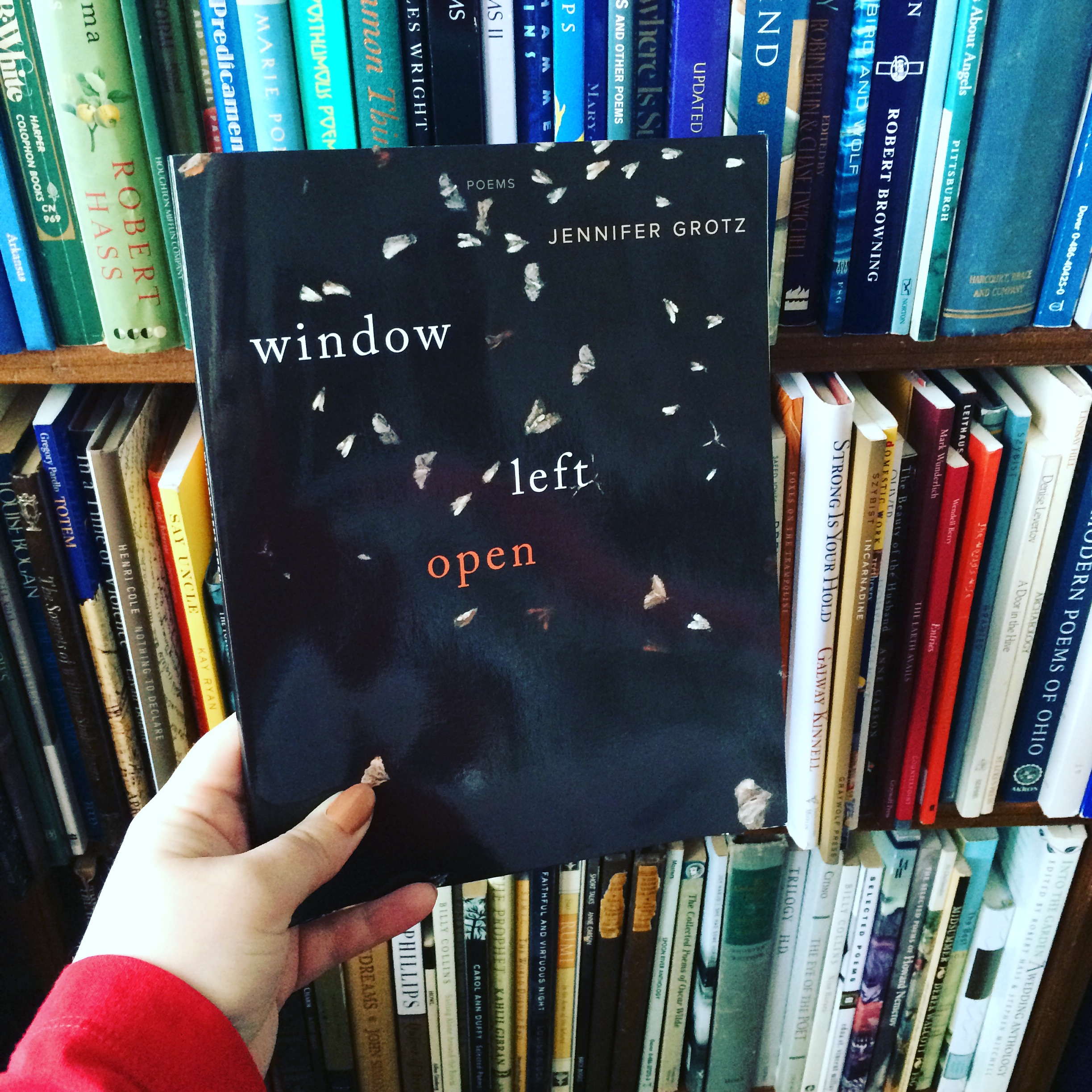
“the flesh inside them once white and wet as snow”: Jennifer Grotz’s “The Snow Apples,” from Window Left Open

IMG_6313I’ve been slowly reading Jennifer Grotz’s third poetry collection, Window Left Open*, over the last three weeks, a keenly enjoyable experience because her poems invite the very kind of attentiveness that they demonstrate.

In “The Snow Apples,” which you can read here, the speaker considers the “Dulled, shrunken, nicked by wind-flung branches, / squirrel-pawed and beak-pierced, infested / macabre baubles hanging” from the apple tree in February, grasping the branches when most apples  fell together in  “a syncopation” in autumn. These winter apples the speaker compares to “a hard knot / deep in the core, something winter / winnow me down to.” I like the clever use of “core” here, the way the line breaks so that for a a moment the reader can imagine that the “hard knot” is “something winter.” The sadness of these “indegestible” apples “piled beneath the earth’s pelt of snow” is a disquieting, vivid metaphor for the speaker’s sense of disturbance in the long gray months.

Engagement with the natural world runs through Window Left Open, in which you’ll find (in just the first section) a forest with an “unending / staircase of roots worn silver like the soldered iron / that holds stained glass together,” snowflakes “denticulate as dandelion greens,” a display of living, giant cockroaches alongside pinned butterflies, rain “stately at first as punctuation,” a foreign city with “a gray, nearsighted river / one that massages the eyes, focuses / the sweeping birds that skim the water’s surface.”

The second section of the book finds the poet meditating on her time at a French monastery. There’s a poem about a piano in the Alps, one about the impossibility of glimpsing the entirety of a mountain from a window, another about a peacock “as strange as Mount Rushmore.” One of my favorites is called “Apricots,” which will make you see the fruit in a whole new way (“And the ripe ones, which felt like biting into / my own flesh, slightly carnivorous.”).

It’s tempting to go on quoting the memorable images in these poems; it’s harder to get at the sense of the speaker observing not only her world, but herself, and finding unexpected loveliness and unexpected fear, often at the same time. In “Poppies,” Ms. Grotz writes,  “Love is letting the world be half-tamed.” If you look closely enough at anything—an animal, a window, even a word—you’ll find a distancing peculiarity, and Ms. Grotz translates that feeling in these poems. She has a gift for making the familiar strange, and making the strange familiar. I highly recommend Window Left Open.

Further reading:

Ta-Nehisi Coates on “Poppies”

“Self-Portrait on the Street of an Unnamed Foreign City”

*I received a copy of this book from the publisher for review purposes, which did not affect the content of my review.

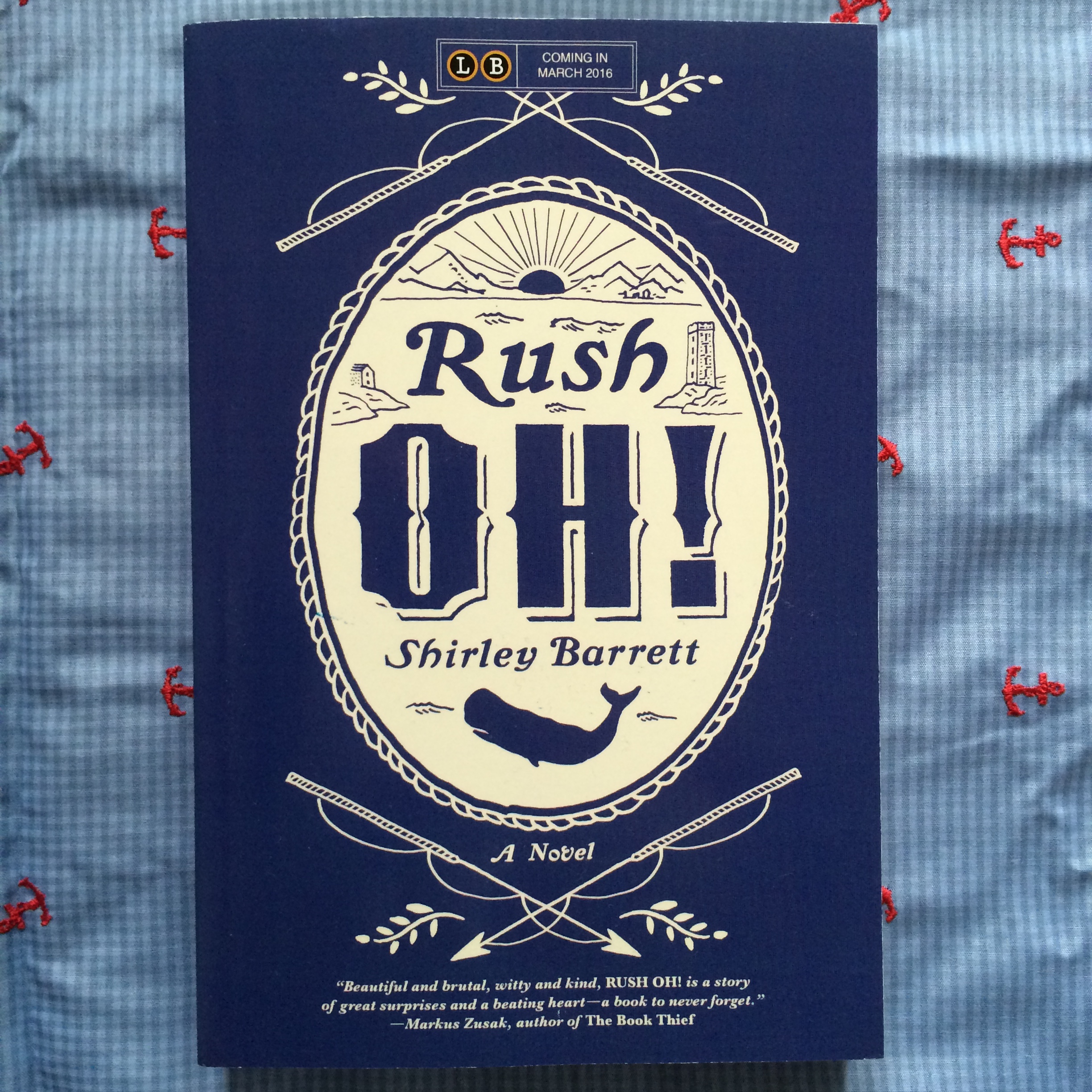
Recommended Reading: Rush Oh!, by Shirley Barrett

IMG_6257At one point when I was reading Rush Oh!*, Shirley Barrett’s debut novel about the 1908 whaling season in New South Wales, Australia, I found myself wondering what it would have been like if the men of the Pequod had popped home for supper every night.

Naturally, whalers are ill-mannered as a rule and boast enormous appetites—that is to be expected. What is less to be expected, however, is their extreme finickiness as regarding their “slops.” It seemed that each one of them suffered from some manner of digestive impairment which required the most fastidious tending. Bastable could not tolerate any form of marsupial, so kangaroo and wallaby were out of the question.

Nineteen-year-old Mary Davidson, Rush Oh!‘s narrator, goes on to note that other men in her father’s whaling crew object to oysters, rabbit (fresh and canned), stewed ibis, and anything under-salted.

I loved this novel—it’s quite funny, though as we learn, whaling is no laughing matter. Mary’s father, George Davidson (nicknamed “Fearless,” for good reason; he’s based on a real-life whaler of the same name) is in charge of two whaling boats that hunt whales in Twofold Bay—with the assistance of pod of orcas. These whales, called “the Killers” are led by Tom (a real whale), a mischievous and highly intelligent fellow, held in the whalers’ esteem and even, at times, affection.

During the whaling season (our summer, Australia’s winter), Mary is in charge of looking after her younger siblings (including a preteen pipe-smoker and Louisa, whose obstinacy is at least one one cause of her rivalry with Mary), tending the house, and feeding the whalemen, an arduous task since the season is not going well and their supplies are running quite low. When a handsome Methodist preacher joins the crew, Mary finds herself in a new boatload of trouble, so to speak.

For a novel that deals quite a bit with men “having to go out in all weather and row back and forth across the bay in endless pursuit of enraged leviathans,” Rush Oh! reminded me, oddly enough, not just of Moby Dick, but of The Country of the Pointed Firs (which I mentioned two weeks ago) and Anne of Green Gables. Rush Oh! is Mary’s memoir, and her voice sounds to me like the independent-minded writer who narrates scenes from coastal Maine life in The Country of the Pointed Firs, while the scrapes Mary gets into, the amusing encounters with town characters and creatures, and the episodic nature of the book are reminiscent of L.M. Montgomery’s beloved classic and its first few sequels. Ms. Barrett draws heavily on archival material, which gives the book’s already vivid setting a delightful sense of local color.

While I loved this book’s approach to history and humor, its more serious moments also deserve mention. Take this passage:

We looked about us at the empty sea. A strange atmosphere of melancholy stillness came over us as we waited, and it brought to mind the feeling as we had sat in church at my mother’s funeral, waiting for the service to commence. The organist had played “Abide with Me,” and I suppose he had been instructed to keep playing till the congregation settled, for I remember feeling that he would never stop, and at one point, when we thought he had finally finished and he started afresh, Harry had got the giggles and had had to be spoken to. Yet as long as that mournful dirge continued and we sat in the presence of my mother (for she lay in her coffin at the front of the church), it felt to me as if the family were suspended together (for the last time) somewhere between the earthly world and heaven.

Mary Davidson, with her quirks, quick mind, and terrific descriptive powers, is a character you’ll want to know better. Rush Oh! is out today in the U.S. from Little, Brown, and is recommended.

Postscript: If you’re a Moby-Dick fan, check out the Moby Dick Big Read, in which persons famous and not-famous each read a chapter of Melville’s tome (Benedict Cumberbatch. Need I say more?).

*I received a copy of this book from the publisher for review purposes, which did not affect the content of my review.

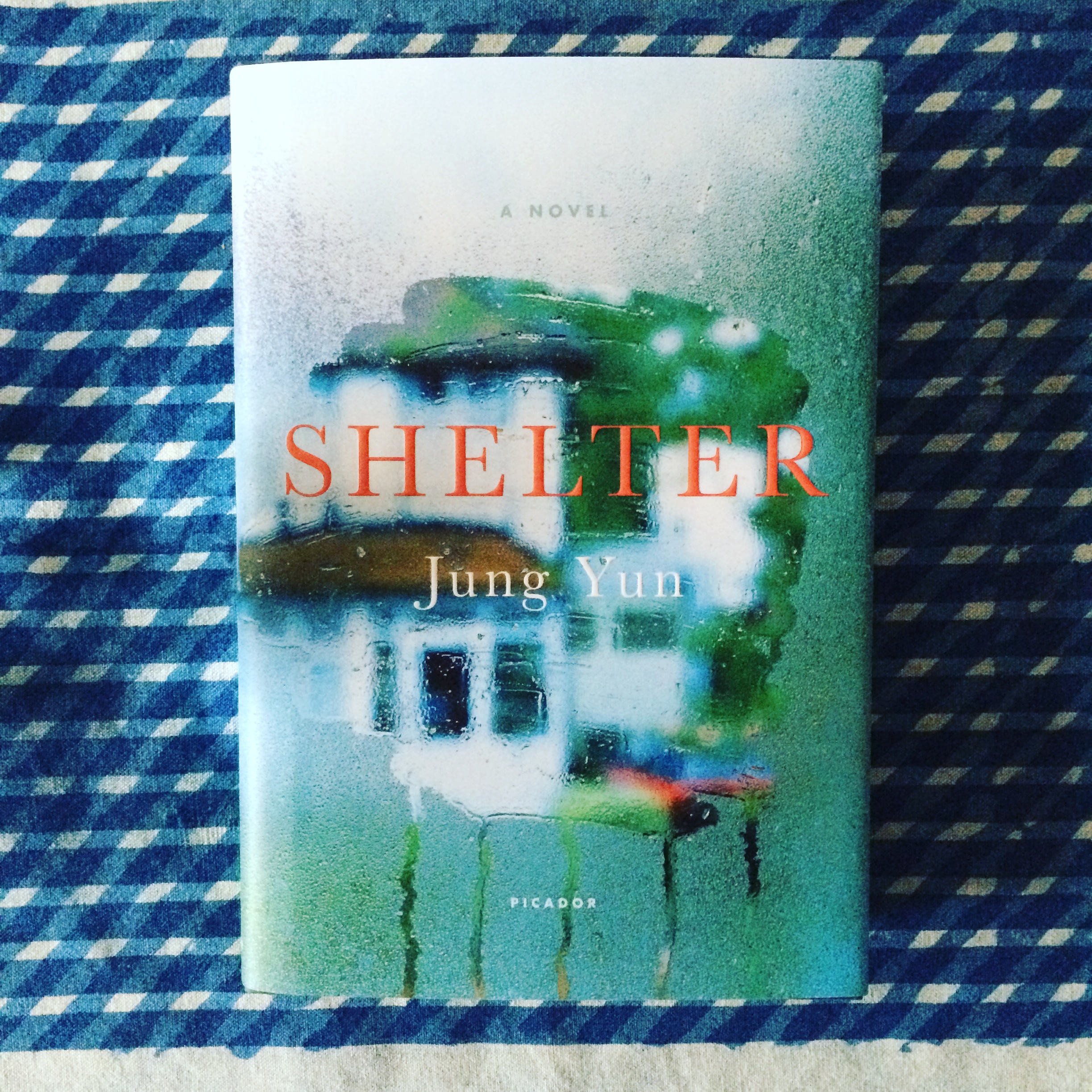
Recommended Reading: Shelter, by Jung Yun

IMG_6091When we meet Kyung and Gillian at the beginning of Shelter*, Jung Yun’s debut novel, they, like many Americans, are struggling financially. They’re pressed by student loan debt, credit card debt, and a mortgage they can’t afford. Their garbage disposal is broken and their four-year-old son, Ethan, wakes up too early. And just as a realtor is telling them that if they sell their home it will be at a tremendous loss, a woman, naked and screaming, appears in their backyard. It’s Kyung’s mother, Mae Cho.

This juxtaposition of the ordinary with shocking plot turns is the foundation of Shelter. Ms. Yun invites readers behind closed doors, where we find what is likely to be familiar—difficult family dynamics, strained relationships between generations and in-laws, worry over how to pay the grocery bill—and then what’s hidden beneath that familiarity: abuse, years of façades, and lives slowly falling to pieces.

(This is not a happy book, but it’s not without a redemption narrative, either.)

After Mae is taken to a hospital, Kyung, his father-in-law Connie, and brother-in-law Tim discover that Mae, Jin (her husband, Kyung’s father) and their housekeeper Marina have been victims of a home invasion and brutal assaults. In the aftermath, all three come to live with Kyung and Gillian, an arrangement that brings simmering tensions to a full-blown boil. As immigrants, the Chos were isolated in the Massachusetts town where Kyung and his father now teach at the nearby university; that isolation, Ms. Yun suggests, was one of the reasons why Jin’s abuse of Mae, and hers of Kyung, went unchecked. As an adult Kyung is desperate not to revisit his parents’ sins on his son, but this means he’s not sure how to parent him, exactly. And when his parents come to live with Kyung’s family, he’s forced to acknowledge the past every day, when he has heretofore maintained a dutiful but pronounced distance.

Kyung shakes his head, aware that they’re falling back into the same old pattern again, the one in which he pities her and tries to help and she treats him badly because she hates herself for needing him. It’s impossible to be near someone like this, someone who brings out the best and worst in him, who punishes his attempts to be kind.

For most of the summer, Kyung’s attempts “to manufacture a silver lining even if he runs the risk of suffocating in it” are thwarted by his own anger and a series of plot twists and turns that make this domestic drama read as fast as a thriller.

The novel’s focus on Kyung is both a strength and a weakness. It’s a strength because Ms. Yun has created an exquisite character study. Kyung is often unlikable, his actions hard to defend, but the reader is constantly forced to question how much of his life and how many of his choices have been shaped by a childhood completely devoid of love. On the other hand, the focus on Kyung I think detracts from the portraits of the other characters, particularly Mae and Gillian, and the ending focuses on his journey to some kind of redemption, which felt wrong since it comes at the expense of his wife and mother.

Nonetheless, this is a searing study of violence as a shaping force in contemporary lives. Recommended.

Boston Readers: Jung Yun will be in conversation with James Scott at Newtonville Books on Tuesday, March 22nd, at 7pm. 

*I received a copy of this book from the publisher for review purposes, which did not affect the content of my review.

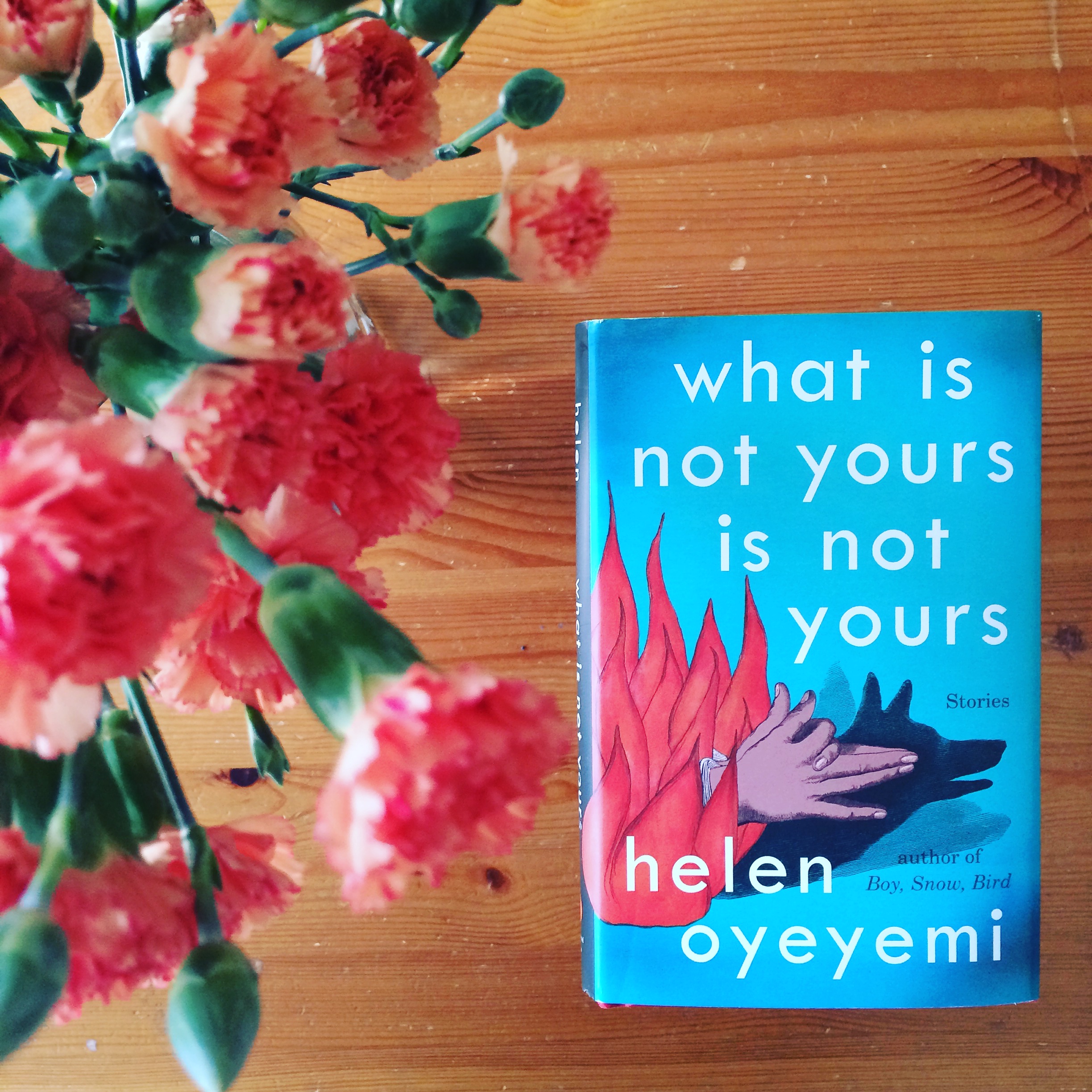
Recommended Reading: What Is Not Yours Is Not Yours, by Helen Oyeyemi

IMG_6120A couple of years ago, I had the pleasure of reading Helen Oyeyemi’s work for the first time (review of Boy, Snow, Bird here; interview with Ms. Oyeyemi here), and I’m delighted to report that What Is Not Yours Is Not Yours*, a collection of stories, is just as intriguing.

These nine stories (with titles like “Is Your Blood As Red As This?”  and “Presence” and “Dornička and the St. Martin’s Day Goose”) are billed as linked. And they are linked thematically, through a key and lock motif, and through their focus on characters’ secrets. However, as I read the first half of the book, I think I spent a bit too much time searching for connections between each story (primarily character and location); by the time I sat down to read the second half, I’d relaxed into the book’s thematic concerns. On the short story collection-connectedness spectrum (which I just made up), it’s closer to Rebecca Makkai’s Music for Wartime than, say, The Tsar of Love and Techno (Anthony Marra).

I loved these stories’ elegant strangeness, the feeling they gave me that I was not on firm ground, but instead racing to suss out the boundaries—or lack of boundaries—in Ms. Oyeyemi’s worlds. In stories like the aforementioned “Dornička and the St. Martin’s Day Goose” and “Drownings,” readers are set down in the world of a fable or fairytale, though closer to their grim origins than the sanitized cartoon versions of childhood. In “‘Sorry’ Doesn’t Sweeten Her Tea,” a teenage girl, incensed with her favorite pop star’s non-apology to a woman he’s beaten, enlists the help of a friend of her stepfather’s—and the goddess Hecate—to bring him to justice (the story is, among other things, a brilliant exploration of online and real-life bullying).

There’s a story about puppets, including one so real that s/he is mistaken for human; a story of a secret garden and the abandoned but not unloved women who might hold its key; a story of a land ruled by a tyrant whose drowned victims live in an underwater city; a story in which an unlikely sorority (The Homely Wench Society) conducts a raid on a rival fraternity in which they swap books (this last story is so charmingly, queerly British that I found myself grinning from ear to ear at the end). There’s a hotel (where “the furnishings are a mixture of dark reds and deep purples. Moving through the lobby is like crushing grapes and plums and being bathed in the resultant wine”) whose guests, once checked in, can never leave (though they can ask almost anything of the management). There’s a pair of therapists who choose themselves as test subjects for an experiment that shows them what might have happened in their lives.

This NPR profile (from 2014, when Boy, Snow, Bird was published) is wonderful, and I think does a better job than I am doing right now of conveying the “jolly gruesomeness” of Ms. Oyeyemi’s writing. In it, she talks about finding something about Eastern Europe that meshes with her outlook, and you can see in this collection that her travels in that part of the world have born fantastical fruit.

The writing in these pages is full of inventive detail, and it’s also supple; each story brings a shift in tone, from cheerful to suspenseful and back again. Always there’s the kind of tension that fully engages my attention, as here:

She sketched with an effort that strained every limb. Montse saw that the Señora sometimes grew short of breath though she’d hardly stirred. A consequence of snatching images out of the air—the air took something back.

One imagines that Ms. Oyeyemi is often breathless.

What Is Not Yours Is Not Yours is highly recommended, and available in the US today.

*I received a copy of this book from the publisher for review purposes, which did not affect the content of my review.


Recommended Reading: Black Wings Has My Angel by Elliott Chaze

IMG_6012You might have noticed, Dear Readers, that while I read omnivorously, I hardly ever read horror novels (come to think of it, can’t remember the last time I did). I don’t enjoy being frightened, though I know a good many people are devotees of monsters, atmospheric creepiness, or gore (or all three). By the same token, you won’t often find me reading anything that features child endangerment (didn’t care for it before I became a parent, and now even less so) or perusing the true-crime shelf.

But I love classic noir. Plenty of suspense and hard-boiled writing with none of the drawbacks of horror or modern crime fiction (though, to be fair, it has plenty of its own problems, like racism, homophobia, and misogyny; this is one of those cases of loving something despite its flaws, not because of them).

Generally I take my noir in straight-up film form—The Big Sleep, Double Indemnity, The Big Heat—but occasionally I dip into the print canon (here’s my review of The Big Sleep). Enter Elliott Chaze’s Black Wings Has My Angel (1953), apparently a classic in the genre that’s been languishing out of print for decades, but now revived by NYRB Classics.

Black Wings Has My Angel is noir in the mode of Double Indemnity: nobody’s a good guy, the narrator is the male protagonist, and that narrator is stuck on a blonde femme fatale.

In this case, the femme fatale is Virginia, a “ten-dollar tramp” with cream-colored hair, lavender eyes, and a Wellesley accent, whom Timothy Sunblade meets after he comes off a job (and, apparently, a prison escape) in the Deep South. Though he intends to cut her loose as he makes his way out West to plan a big heist, he finds, time and again, that he can’t do it. She’s beautiful, mysterious, and damn, can she drive a Packard.

So she becomes his partner, even though he’s half in love with her and half inclined to murder her (she’s not trustworthy, and she’s got capital-L law problems of her own). From Denver to New Orleans and back again, the duo suffer reversals and get everything they think they want (and Virginia wants to bathe in cold hard cash—literally), driven by greed and fear and a determined plan. Eventually, though, the ride comes to an end, as it must in a noir, with unexpected violence.

One of the impressive things about the book (and quite a bit of classic noir, film and print), is how much violence and sensuality come across without heaps of gore or, as they say, blue language. Here’s an example, after Virginia tells Tim just how much she hates gentlemen: “I threw her on the bed and she smiled up at me. For the next three hours I applied myself to proving I hadn’t become, and wouldn’t become, a gentleman.”

Not that it’s all sex and violence. Chaze has a way of vividly bringing a setting to life. I love the description of Virginia “out there on the thin green grass, watering, the high altitude sunlight making silver hyphens of the droplets.” And his is one of the few novels I’ve read that’s set exclusively in the West and South (I recently read Patricia Highsmith’s The Price of Salt, or Carol, which makes use of the road trip West in a very different way). Chaze sets up the two regions in sharp contrast:

I kept comparing the rocks and the sky with what we have down South and kind of gloating to think that the South, though lacking in chamber-of-commerce promotion, has the subtlest colors and teasingest smells a man could want. Out West all the smells are sucked up out of the baked land by the sun. And it’s as if all the colors in the ground are gobbled up by their sunsets, and so is the blue of the sky. The sky is high and pale and impersonal and you get the feeling it doesn’t belong to you at all, but that it is the property of the chamber of commerce. In the South the sky is humid and low and rich and it’s yours to smell and feel. In the West someone sees a flower growing on a mountain and he writes a whole damned pamphlet about it. In the South the roses explode out of the weeds in the yards of the poorest shanties. Blood red ones And pink ones–pink as that new girdle.

It’s the South, of course, with its “teasingist smells,” where Virgina and Timothy meet and later find themselves in the most trouble, the West where in the thin air the two seem to lose their oxygen—and their minds.

If you’re a fan of noir, I highly recommend Black Wings Has My Angel. Great pacing, snappy writing with memorable description, and a plot that’s surprising to the end.

P.S. Shoutout to the Cleveland Museum of Art, from whence comes the cover photograph by Erwin Blumenthald.


Recommended Reading: Ways to Disappear, by Idra Novey

IMG_5996Idra Novey’s debut novel, Ways to Disappear*, defies easy categorization. It’s part mystery, part literary meditation, part romance, part comedy—and all brilliant. I loved it.

Beatriz Yagoda, acclaimed Brazilian novelist with a fondness for cigars and online gambling, one day climbs an almond tree (cigar and suitcase in hand) and vanishes, leaving no word of her intentions with her two children, Raquel and Marcus, or with her American translator, a young woman named Emma.

“For so long, she’d willfully sought the in-between. She’d thought of herself as fated to live suspended, floating between two countries, in the vapor between languages. But too much vaporous freedom brought its own constraints. She now felt as confined by her floating state as other, more wholesome people were to the towns where they were born.”

After learning of the disappearance, Emma leaves Pittsburgh (and her fiancè, Miles) for Brazil, where an encounter with a violent loan shark is just the first sign that she’s in way over her head. Her presence isn’t exactly welcome by her author’s children, and she’s searching for Beatriz based clues from her books. Meanwhile, Beatriz may be leaving cryptic breadcrumbs for her wealthy and world-weary first publisher, Rocha, who begins a parallel search for the enigmatic writer.

It’s a wonderful setup for a novel, and Ms. Novey’s writing is top-notch. The heat of Brazil’s cities radiates from the page, her descriptions expertly woven from choice details (“a tall glass shipwrecked on the bar in a spill of caipirinha”). The glimpses of Beatriz’s own writing (mediated through Emma’s translations) are astoundingly unexpected and savagely beautiful, perhaps informed by Ms. Novey’s own work as a translator and poet. Brief chapters—the longest is four pages, I believe—are interspersed with modified dictionary entries, e-mail messages, and Brazilian news reports, giving this short book rapid-fire energy.

About her work with Beatriz, Emma thinks, “She’d remember a morning in Rio as no more than an orange glow over the ocean and use that light to illuminate the strange, dark boats of Beatriz’s images as she ferried them into English.”

What a metaphor. I highly recommend Ways to Disappear—you’ll want to ferried on this strange boat yourself.

*I received a copy of this book from the publisher for review purposes, which did not affect the content of my review.