“An interval like summer passed”: Jana Prikryl’s “New Life,” from The After Party

New Life

When I read Jana Prikryl’s The After Party* last week, I struggled to connect with most of the poems in the collection. I felt this was a failing on my own part; Ms. Prikryl is a senior editor at the New York Review of Books, my favorite non-book publication, and she has contributed poems to some of the best magazines in the world.

IMG_7418Still, while I respected the craft at work in these poems, and the ingenuity of “Thirty Thousand Islands,” a long poem in forty-two parts that makes up the second half of The After Party, it wasn’t until I read Dan Chiasson’s thoughtful review in The New Yorker that the collection really opened up for me. He examines The After Party through the lens of loss (Ms. Prikyl’s older brother died suddenly in 1995), while I’d been trying to understand the poems in the context of migration and exile.

I went back and re-read most of the book, and was rewarded.

This week I recommend Jana Prikryl’s “New Life,” which you can read at The Baffler**.

Its imagery is arresting (the opening lines are: “From the fields of a calendar, its snow / packed firmly into squares, I farmed you.”) as is the speaker’s address to the brother who lives in her memory. The form is unobtrusive, but underscores, I think, the control it takes to examine a deep loss.

What poems are you reading this week?

*I received a copy of this book from the publisher for review purposes, which did not affect the content of my review.

** Full disclosure: I occasionally work for The Baffler on a freelance basis.

“the upswept fog bank of her hair”: J. D. McClatchy’s “Three Dreams about Elizabeth Bishop”

Three Dreams about Elizabeth Bishop

Do you suppress the urge to roll your eyes whenever someone mentions “the crazy dream I had last night?” I know I do, or at least I sure hope so, since I don’t like offending people unnecessarily. Rarely are dreams of interest to anyone but the dreamers themselves (and psychoanalysts, I suppose).

The same holds true in fiction—I’ve been known to scan quickly through dream descriptions, looking for the “real” action to start—but recently I read a poem about dreams that I loved: J.D. McClatchy’s “Three Dreams about Elizabeth Bishop.” 

The poem’s three sections (for the three dreams) are packed with memorable images and lines, from the description of Bishop lying in state (like Lenin) and her eyes fluttering as Robert Lowell speaks to her (while the speaker looks on as a memorial wreath) to the “upswept fog bank of her hair” to the homely sight of two mugs with last night’s gin left on a deck come morning.

This is a poem I’ll come back to.

What do you think of the poem? Are there any poems about dreams that you like?

“Three people come where no people belong any more”: Hayden Carruth’s “Abandoned Ranch, Big Bend”

Abandoned Ranch, Big Bend

As I’ve mentioned before, I’m a big fan of the Poetry Foundation’s “Poem of the Day” emails. I don’t always love the featured poem, but I do appreciate the chance to sample the work of poets who are (let’s be honest, more often than not) unfamiliar to me. As a certified poetry pusher, I think you should sign up too!

Last week, one of the featured poems was “Abandoned Ranch, Big Bend” by Hayden Carruth, whom—and this is going to sound familiar—I don’t know much about. But now I’m on the hunt for more of his work, because anyone who titles a book of poems Scrambled Eggs and Whiskey is someone I want to know better (also, I’m going to go ahead and recommend to Leslie Knope that she pick that collection up for Ron’s birthday, for reasons I hope are obvious.)

Anyway, the poem drew me in with its intense descriptions (“Sun / on the corrugated roof is a horse treading”) of the scene: a man, woman, and child converge on an abandoned ranch. We don’t know why; “here are only / Dry cistern, adobe flaking, a lizard.” The scene feels timeless, like something out of the nineteenth century, until the introduction of the useless binoculars, which would only reveal the desert “spiral[ing] away.” And then we learn that the three people have been drawn to this place:

Summoned
From half across the world, from snow and rock,
From chaos, they arrived a moment ago, they thought,
In perfect fortuity.

And then it gets really creepy:

There is a presence emerging here in
Sun dance and clicking metal, where the lizard blinks
With eyes whetted for extinction; then swirling
Outward again, outward and upward through the sky’s
White-hot funnel. Again and again among the dry
Wailing voices of displaced Yankee ghosts
This ranch is abandoned to terror and the sublime.

I’m getting shades of Yeats there (am I the only one?), and the tone reminds me of the grim Westerns I’ve loved (like Kim Zupan’s The Ploughmen).

In a poem marked by repeated words like “summoned,” “pulsing,” “sun,” “horse,” “lizard,” the last lines arrive like a trickle of clear water:

They give him
The steady cool mercy of their unreproachful eyes.

For me, “Abandoned Ranch, Big Bend” is tantalizing, like a story with key plot points missing; the fun is filling them in.

What do you think of the poem?

P.S. Here’s the link to Big Bend National Park in Texas. Rory at Fourth Street Review visited the park not too long ago; here’s her post.

Recommended Reading: Jennifer Stewart Miller’s A Fox Appears

A Fox Appears

My friend Emily sent me  A Fox Appears by Jennifer Stewart Miller, and I’m so grateful she did (thanks, Emily!). This is a small gem of a book, “a biography of a boy in haiku,” as the subtitle has it.

In six sections, the poet gives us glimpses of her son’s early life through haiku. Maybe you, like me, spent a fifth-grade unit on haiku, struggling to conjure up nature imagery and conform to the 5/7/5-syllable format (those pesky articles and conjunctions, am I right?). As it turns out, rules are meant to be broken; the charming folks at the Academy of American Poets tell us that in modern haiku-writing, while some formal elements may lapse, “the philosophy of haiku has been preserved: the focus on a brief moment in time; a use of provocative, colorful images; an ability to be read in one breath; and a sense of sudden enlightenment and illumination.”

IMG_6829That is exactly what I found in A Fox Appears. As Ms. Miller shows, the haiku is an ideal form (perhaps the ideal form) for evoking a parent’s perspective of the fleeting phases of early childhood. These poems are perfectly, unexpectedly descriptive; their simplicity enhances their perceptiveness.

Here are a few of my favorites (with apologies since the line indents won’t come through):

I stroke the sole
of your foot — small toes
flick open like a fan.

Tiny hands —
fiddlehead ferns
waiting to unfurl.

Patient as stone
you drop stones
in the sea.

The washing machine
empties your pockets —
acorns acorns.

Across a green field
a bluebird flew —
you were at school.

Lovely, aren’t they?

Cats, the moon, stones, and feathers appear throughout this slim volume, tying together the observations and giving us a sense of the passing of seasons and years. And I should note too that Franklin Einspruch’s beautiful black and white gouache artwork complements the poems very well. A Fox Appears is a beautiful volume, and recommended. Thank you Emily!

Have you ever written haiku? Do you have a favorite?

“in the pleatpetal purring of mouthweathered May”: Karen Volkman’s “May”

IMG_6833A couple years ago, I reviewed Hailey Leithauser’s Swoop, a collection that plays with language so exuberantly that I found myself grinning over many of the poems.

I felt that same sense of exuberance–though tilted toward the macabre, I think–when I read Karen Volkman’s “May.”

In the poem’s couplets, “the old saw wind” dressed in May’s finery (“gaud gown and ruby reckoning”) “[s]ays, dance that skeletal startle the way I might.” In couplets the wind directs a kind of dance (“you one, you two, you three your cruder schemes, / you blanch black lurk and blood the pallid bone”) that’s more about evoking a sense of atmosphere through words that punch than about describing actual movement.

For me the poem captures those brief days in May when all the trees are blooming pink and white, but already on the cusp of discarding those petals—just waiting for the right breeze.

It’s a tricky poem, though; what do you think of it?


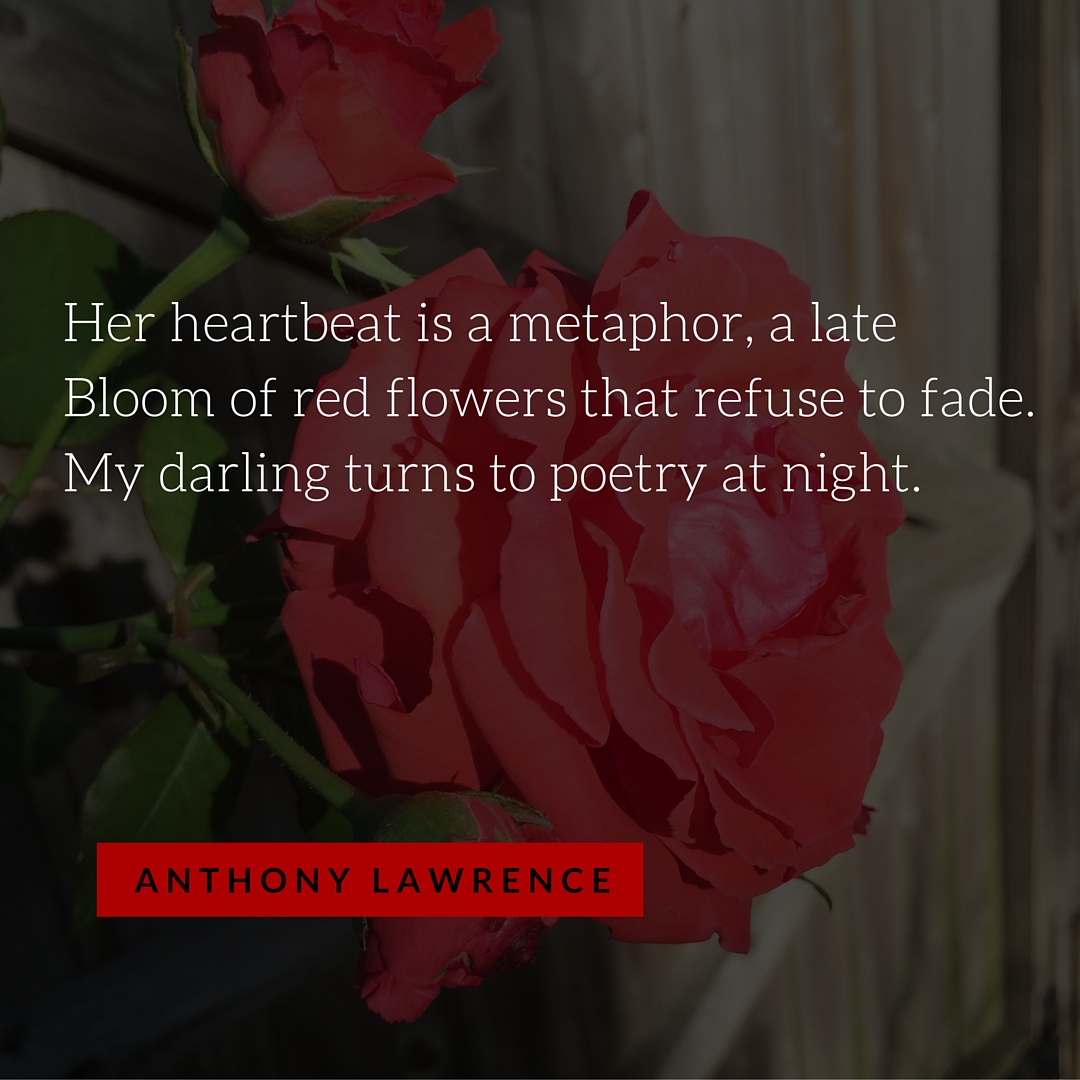
“Her heartbeat is a metaphor”: Anthony Lawrence’s “My Darling Turns to Poetry at Night”

Anthony Lawrence_My Darling Turns to Poetry at NightI happen to love formal poetry—and by that I mean poetry that adheres to a particular structure or set of rules, not poetry in top hat in tails. I happily read free verse, but there’s just something about a poet mastering a form (or sometimes breaking from it in a meaningful way) that tends to make my verse-loving heart go all aflutter.

As regular readers know, I do write poetry myself, but I have never written a satisfactory villanelle. When I read a masterful one like Anthony Lawrence’s “My Darling Turns to Poetry at Night” (out in this month’s issue of Poetry, dedicated to Australian poets), I almost want to stop trying.

Almost.

At first I thought the poem would be about the speaker’s beloved reading poetry (as in the way we might say “She turned back to her book”), but instead the speaker imagines her as poetry. It’s simply gorgeous.

Probably most famous example of the villanelle—at least in English, at least; French speakers, do weigh in—is Dylan Thomas’s “Do not go gentle into that good night” (used to great effect in Interstellar, now that I think about it), but I’ve always been partial to Elizabeth Bishop’s “One Art.” 

What’s your favorite villanelle?

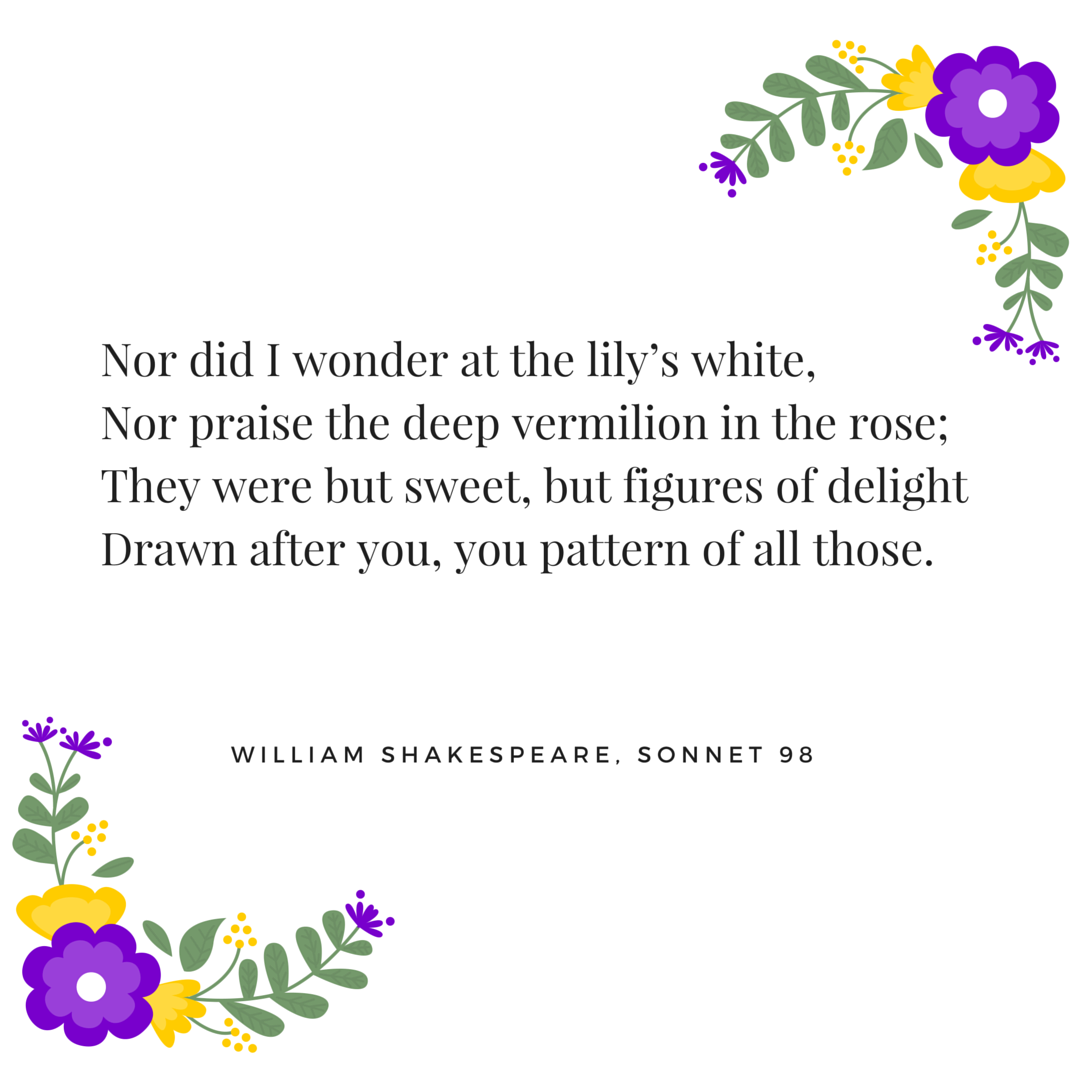
“They were but sweet, but figures of delight”: Shakespeare in the Spring

Sonnet 98


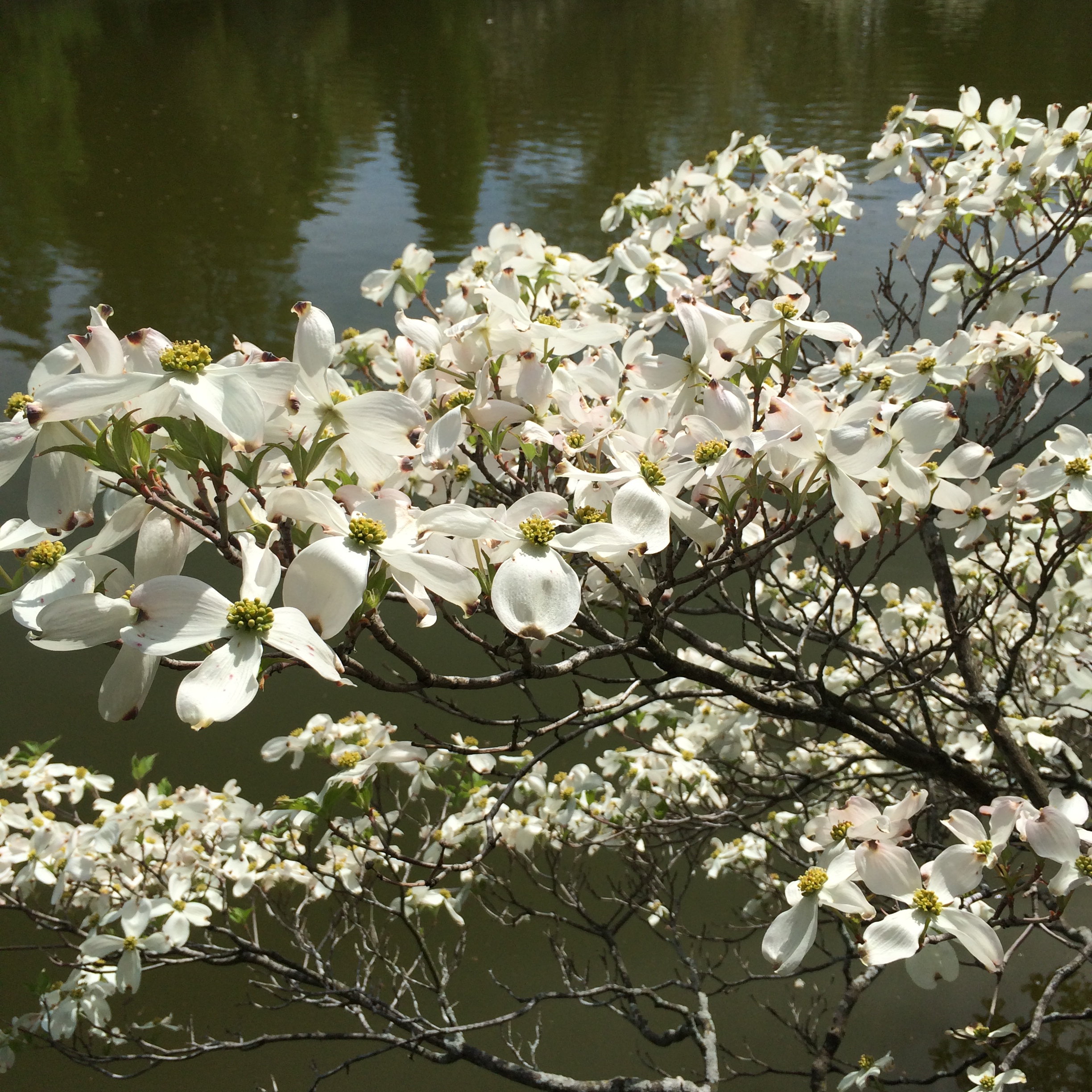
“Nothing is so beautiful as spring,” wrote the poet Gerard Manley Hopkins. He didn’t live in Boston, where spring brings with it almost any weather; this week it’s wall-to-wall rain and gray. So here’s a little dose of Shakespeare in the hope of sunshine and optimal flower-viewing.


Sonnet 98

From you have I been absent in the spring,
When proud-pied April, dressed in all his trim,
Hath put a spirit of youth in everything,
That heavy Saturn laughed and leaped with him.
Yet nor the lays of birds, nor the sweet smell
Of different flowers in odour and in hue,
Could make me any summer’s story tell,
Or from their proud lap pluck them where they grew:
Nor did I wonder at the lily’s white,
Nor praise the deep vermilion in the rose;
They were but sweet, but figures of delight
Drawn after you, you pattern of all those.
    Yet seem’d it winter still, and, you away,

    As with your shadow I with these did play.

And as a bonus, here are a few of my favorite lines from A Midsummer Night’s Dream:

I know a bank where the wild thyme blows,
Where oxlips and the nodding violet grows,
Quite over-canopied with luscious woodbine,
With sweet musk-roses and with eglantine:
There sleeps Titania sometime of the night,
Lull’d in these flowers with dances and delight;
And there the snake throws her enamell’d skin,
Weed wide enough to wrap a fairy in

[It gets fairly nasty at this point, alas.]

Have you read any spring poems lately?

The Poetry Concierge Recommends: Warsan Shire

PoetryConcierge[The Poetry Concierge is an occasional feature here on Rosemary and Reading Glasses wherein I select a poem, poet, or book of poems for individual readers based on a short questionnaire. Come play along! Read the introductory post here, my first recommendation here, the reboot here, and then email me at: rosemaryandreadingglasses [at] gmail [dot] com.]

This week, our pilgrim in search of poetry is Emily, who writes at The Bookshelf of Emily J.

1. When you read fiction, who’s your go-to author?

Joyce Carol Oates or John Steinbeck

2. If you read nonfiction, which subjects are most likely to interest you? (cultural history, science, biography, memoir, survival stories?)

I love cultural history. I just finished The Warmth of Other Suns about the great migration of African Americans from the south to other parts of the country. I learned so much and realized how much more we have left to do in terms of racial equality and acceptance.

3. If you were stuck on a desert island for a week, which five books would you bring to keep you entertained?

I would bring Blonde by Joyce Carol Oates, East of Eden by John Steinbeck, Angle of Repose by Wallace Stegner, The Age of Innocence by Edith Wharton, and A Tree Grows in Brooklyn by Betty Smith.

4. If you were on a five-year mission to Mars, which five books would you bring to keep you sane?

Oh wow. Maybe five books from Sophie Kinsella’s Shopaholic series because they always make me laugh.

5. What kinds of questions are most likely to keep you up at night? (death, the nature of love, politics, environmental issues, meaning of life, end of the world, justice and injustice, etc?)

My future and where academia will take me. I also get worried about issues with my kids. Sometimes nerves keep me up the day before a big presentation or a first day of teaching.

6. If you’ve read poetry before, what have you liked? What have you disliked?

I love William Wordsworth and William Blake. I had the opportunity to take a class on British lit as an undergrad, which included poetry, from Leslie Norris, a famed Welsh poet himself.


Well, for a while there I was stumped. Who to recommend? Elizabeth Barrett Browning (whose lifetime overlapped with Wordsworth’s, and whose poetry took on social issues of the day)? Emily’s favored Joyce Carol Oates, who is not only a prolific novelist, but also a poet? Langston Hughes (a contemporary of Steinbeck’s, and of course one of the great American poets)?

Possibilities abounded.

And then I watched Lemonade, the Beyonce visual album that came out this past weekend. The whole piece is utterly absorbing, but I found the poetry between songs most arresting of all. The poet is Warsan Shire, a British poet (she was born in Kenya and her parents are Somali) who earned fame with her 2011 short collection Teaching My Mother How to Give Birth. In late 2015 she was profiled in the New Yorker; Alexis Okeowo wrote of her first collection, “It’s a first-generation woman always looking backward and forward at the same time, acknowledging that to move through life without being haunted by the past lives of your forebears is impossible.” You can read a bit more about Warsan Shire here. 

Her poem “Home” was quoted in the New York Times, and by Benedict Cumberbatch in his impassioned plea for aid to refugees after the curtain call for Hamlet (I saw the NT live production in the movie theater). You can read the poem here. 

I think, given Emily’s interest in social issues and the movement of people and cultural history (Steinbeck, The Warmth of Other Suns) that Ms. Shire’s work, which deals with immigration, diaspora, family history, belonging, violence, and womanhood, will be appealing, and still a change of pace. While you can find a few of her poems online—they tend to be widely shared—you should be able to find Teaching My Mother How to Give Birth in your library or in bookstores, and look out for her first full-length collection to appear late this year.

P.S. For those nerves, I recommend Hazel Hall’s “Before Quiet.” And if you’re looking for even more poetry of social engagement, you might want to check out the Split This Rock festival.


Would you like the Poetry Concierge to make a recommendation for you? Check out the introductory post, and send your answers to the questionnaire, along with the name and/or blog you’d like posted with the reply, to rosemaryandreadingglasses [at] gmail [dot] com.


The Poetry Concierge Recommends: Mary Oliver

PoetryConcierge[The Poetry Concierge is an occasional feature here on Rosemary and Reading Glasses wherein I select a poem, poet, or book of poems for individual readers based on a short questionnaire. Come play along! Read the introductory post here, my first recommendation here, the reboot here, and then email me at: rosemaryandreadingglasses [at] gmail [dot] com.]

This week, our pilgrim in search of poetry is Audra at Unabridged Chick. 

1. When you read fiction, who’s your go-to author?

Penelope Lively

2. If you read nonfiction, which subjects are most likely to interest you? (cultural history, science, biography, memoir, survival stories?)

Biographies of authors

3. If you were stuck on a desert island for a week, which five books would you bring to keep you entertained?

Rebecca, The True Confessions of Charlotte Doyle, Kristin Lavransdatter, The Doomsday Book, and Good Omens

4. If you were on a five-year mission to Mars, which five books would you bring to keep you sane?

Kristin Lavransdatter, The Sparrow, Far From the Madding Crowd, The Moon Is A Harsh Mistress, and some Norton edition that is ten thousand of those onion-paper thin pages of all Western lit or something.

5. What kinds of questions are most likely to keep you up at night? (death, the nature of love, politics, environmental issues, meaning of life, end of the world, justice and injustice, etc?)

The loss of my child, politics, women’s rights, community violence

6. If you’ve read poetry before, what have you liked? What have you disliked?

Like Dylan Thomas and Sharon Olds, H.D. and Diane Wakoski. Diane Ackerman and Anna Akhmatova. Dislike old school guys or stuff with too many allusions that I can’t figure out.


(optional) Are you looking for a poem or poet to help you through a tough time, or to help you answer a question? If so, please explain.

Yes — I’m feeling so conflicted about work and creative endeavors — stressed and unhappy. I need advice, or a pep talk, or something. Centering, maybe.


Just like last week, there’s so much to work with here! Audra is into classics, sci-fi, some truly photo (60)great poetry (shout out to Anna Akhmatova!), a novelist I can’t believe I haven’t encountered before (putting Penelope Lively on my TBR immediately)–so many directions to choose from. I had Wislawa Szymborska, Margaret Atwood, and June Jordan in mind.

But it’s Audra’s answer to that last question that struck me as the most important, and one poet immediately leapt to mind: Mary Oliver*.

Chances are you’ve heard of Mary Oliver, since she’s one of the best-selling poets in the United States (though I confess I only started reading her work a few years ago). She’s the author of many collections and the recipient of many awards.

I recommend in particular House of Light (1990). Here’s a bit I wrote about the collection a few years ago:

A native of Northeast Ohio, Ms. Oliver now resides on Cape Cod (her poems celebrate its interior marshes more than its seashore), and since I grew up in Cleveland and now live in Boston (and married a man from Cape Cod), her poems often feel homey and familiar to me. I love the intimacy of her observations, the feeling, almost, of conversation. This feeling of casual grace is remarkable, because elsewhere Ms. Oliver has written that she revises most poems forty or fifty times!

I think this collection is right for Audra because of the contemplative feel and focus and nature often feel centering, while a few poems are galvanizing, like the famous “The Summer Day”: “Tell me, what is it you plan to do / with your one wild and precious life?”

A huge question, but with this book in hand, one feels better prepared to face it.

Audra, I hope this recommendation is helpful! Thank you for writing in.

P.S. Audra, if you want some poetry with a sci-fi twist, you might also want to check out the panel “Stars in My Pocket Like Grains of Sand: Poetry and Science Fiction,” moderated by Heather Hughes, at the 2016 Massachusetts Poetry Festival later this month.


Would you like the Poetry Concierge to make a recommendation for you? Check out the introductory post, and send your answers to the questionnaire, along with the name and/or blog you’d like posted with the reply, to rosemaryandreadingglasses [at] gmail [dot] com.

*No relation to yours truly.

The Poetry Concierge Recommends: Claudia Rankine

PoetryConcierge[The Poetry Concierge is an occasional feature here on Rosemary and Reading Glasses wherein I select a poem, poet, or book of poems for individual readers based on a short questionnaire. Come play along! Read the introductory post here, my first recommendation here, the reboot here, and then email me at: rosemaryandreadingglasses [at] gmail [dot] com.]

This week, our pilgrim in search of poetry is Jenny of Reading the End. 

1. When you read fiction, who’s your go-to author?

It’s so hard to choose just one! I’m going to say Maggie Stiefvater, because she’s the blend of creepiness and feelings and Societal Issues that I’m feeling very fond of right now.

2. If you read nonfiction, which subjects are most likely to interest you? (cultural history, science, biography, memoir, survival stories?)

Cultural studies is always good for me — anything that describes society with a keen eye, whether it’s our present society now or a time long past.

3. If you were stuck on a desert island for a week, which five books would you bring to keep you entertained?

I’d probably pick five from my TBR list relatively at random, depending on what my mood was like. Probably at least two hefty nonfiction books, to last me; a romance novel for funsies; a YA novel I’ve been anticipating for a while; and a big fat chunky novel that I’ve been putting off reading for a while, like East of Eden.

4. If you were on a five-year mission to Mars, which five books would you bring to keep you sane?

Angels in America, the Bible, Robert and Elizabeth Barrett Browning’s letters, Shakespeare, and Diana Wynne Jones’s Fire and Hemlock.

5. What kinds of questions are most likely to keep you up at night? (death, the nature of love, politics, environmental issues, meaning of life, end of the world, justice and injustice, etc?)

What will happen to the people I love (death sometimes, illness sometimes, lost jobs sometimes), and how frustrating it is that I don’t have the power to change it.

6. If you’ve read poetry before, what have you liked? What have you disliked?

I love June Jordan and CP Cavafy and Paradise Lost; I’ve never had any luck with poets who gaze at flowers like Wordsworth and Shelley (sorry, dudes).


So much to work with here! Jenny is an omnivorous reader after my own heart (and, confession, Wordsworth and Shelley have never been my favorites either).

First I focused on the creepy angle from Jenny’s answer to the first question, because that’s not something I see too often. It put me in mind of Louise Glück’s “All Hallows” or a handful of Emily Dickinson poems (nothing like a dead speaker for creepiness).

But then I circled back around to Jenny’s interest in social issues, which she not only mentions explicitly, but also shows in her literary picks (June Jordan, Shakespeare, Milton, Angels in America, the Bible, East of Eden). Audre Lorde leapt to mind (“Never to Dream of Spiders,” “Coal,” A Woman Speaks”), and I think Jenny might like those poems, and also Tracy K. Smith’s book Life on Mars (especially given what keeps Jenny up at night), but I thought choosing Life on Mars would be cheating since I’ve already recommended it. 

Then I wandered around my house full of books, and found the answer in the hallway: Claudia Rankine’s Citizen: An American Lyric, which I just read last week (two weeks ago, by the time you read this) and was about to return to the library.

IMG_6469Citizen won many, many awards (and got some unexpected media attention), and rightly so. It’s a hybrid of poetry, images and essay, a wide-ranging witnessing of how race and racism and race work in America (and it’s also fantastic sports writing, which I haven’t seen often mentioned). It combines the poet’s personal experiences (as in this excerpt, which you can hear Claudia Rankine read here), considerations of the media’s treatment of African American citizens, meditations on the injustices we’ve all seen in the news. It’s an important, formally exciting book (and so popular that my library still has a waitlist for it, even though it was published in 2014!).

I hope you have a chance to read Citizen, Jenny, and that it’s a pick that’s right for you!


Would you like the Poetry Concierge to make a recommendation for you? Check out the introductory post, and send your answers to the questionnaire, along with the name and/or blog you’d like posted with the reply, to rosemaryandreadingglasses [at] gmail [dot] com.