“a narrow plot of sand”: Natasha Trethewey’s “History Lesson” from Domestic Work

photo (23)Domestic Work is the first collection of poems by Natasha Trethewey, Poet Laureate of the United Sates from 2012 to 2014 and winner of the Pulitzer Prize. The collection won the inaugural Cave Canem Prize (an annual prize for the best first collection of poems by an African American poet), selected by Rita Dove. In both free verse and gorgeous formal poetry, these poems tell the stories of working-class African American people, focusing on men and women in the South in the twentieth century.

In her introduction to the book, Rita Dove writes, “With a steely grace reminiscent of those eight washerwomen [in the poem “Three Photographs”], she tells the hard facts of lives pursued on the margins, lived out under oppression and in scripted oblivion, with fear and a tremulous hope” (xi-xii).

It’s the tremulous hope that shines brightest in Domestic Work, but it’s a hope that flutters on the edges of a terrible past and an uncertain present. Take, for instance, “History Lesson.” At first, Trethewey describes a picture of herself as a small girl in a flowered bikini, toes curling in the sand “on a wide strip of Mississippi beach,” painting in vivid words the sense of the photo, and the bright sun of the day.

Then, at precisely the poem’s midpoint, the turn: “I am alone / except for my grandmother, other side.”

Now the focus shifts to the “history lesson” of the poem’s title, as Trethewey takes us back in time in two jumps. We learn that the poet’s grandmother is taking the picture in 1970—just “two years after they opened / the rest of this beach to us,” a chilling reminder of the cruelties of Jim Crow South; who could deny the pleasures of this beach, with its sun and its minnows, to a child?

And then the end of the poem completes the structure Trethewey has set up: it’s forty years since her grandmother (to whom the second half of the poem belongs)

stood on a narrow plot
of sand marked colored, smiling,

her hands on the flowered hips
of a cotton meal-sack dress.

The “meal-sack dress”  on is the visual counterpoint to the bikini Trethewey’s child-self wears, which seems like symbol of progress (out of poverty, and with only the beach behind it, not the dreadful sign). But then we remember that the picture of the poet is only two years past the end of the beach’s segregation, and progress—from “narrow plot” to “wide strip”—seems a fragile, fragile thing.


Recommended Reading: “The Kingfisher” and The Kingfisher, by Amy Clampitt

IThe Kingfisher on the couch picked up Amy Clampitt’s The Kingfisher at a used bookstore in Central Square sometime in January. It’s a gorgeous book in more ways than one; originally published in 1983, my copy is from the eighth printing in 1989, and it’s pristine. Heavy, unyellowed paper, gorgeous design. Well done, Knopf.

I came to the book knowing nothing about Amy Clampitt, but it was an utterly delectable reading experience; Clampitt’s facility with aural language reminded me of the fun I had reading Hailey Leithauser’s Swoop last year. (More on the language in a moment.)

As I read, I couldn’t believe I hadn’t heard more about this wonderful poet, and once I did a bit of research, I started to see why: born in 1920, Amy Clampitt died in 1994. The Kingfisher was her first major book, and remains her most famous.

My favorite poems in the book are those that appear first, largely set along the rocky Maine coastline (of which I am quite fond), but all six of the book’s wide-ranging sections are spectacular. The poems are erudite without being condescending (the poet provides notes after the text), controlled but bursting with language’s multitudinous possibilities. In these pages whales are “basking reservoirs of fuel” (116) and a poem about the Dakota hotel finds the speaker telling us “Grief / is original, but it / repeats itself: there’s nothing / more original it can do.”

Here are some lines from “The Cove”:

Where at low tide the rocks, like the
back of an old sheepdog or spaniel, are
rugg’d with wet seaweed, the cove
embays a pavement of ocean, at times
wrinkling like tinfoil, at others
all isinglass flakes, or sun-pounded
gritty glitter of mica; or hanging
intact, a curtain wall just frescoed
indigo, so immense a hue, a blue
of such majesty it can’t be looked at,
at whose apex there pulses, even
in daylight, a lighthouse, lightpierced
like a needle’s eye.

Stunning, yes?

The only other writer I’ve come across in the last half decade with Amy Clampitt’s command of English vocabulary is A.S. Byatt (who, by the way, Clampitt mentions in this fascinating interview with the Paris Review, which I highly recommend; unsurprisingly, she had great taste in poetry and fiction—she names Alice Munro as her favorite contemporary fiction writer 20 years before Ms. Munro won the Nobel). If (and I hope when) you pick up The Kingfisher, you’ll want a dictionary close at hand for words like these:

  • repoussé
  • pannicled
  • plissé
  • chrysoprase
  • grisaille
  • bizarrerie
  • catalpa
  • peplos
  • aconite
  • sozzled
  • gasconades
  • traghetto
  • curveting
  • loess
  • clepsydra
  • maguey

I could go on. At length.

I was enchanted by The Kingfisheryou can read the title poem here—and I hope you’ll let me know if you read it so we can compare notes, and maybe word lists.

“the beautiful, needful thing”: Robert Hayden’s “Frederick Douglass”

This past weekend marked the fiftieth anniversary of what has come to be known as Bloody Sunday, when peaceful protestors in Selma, Alabama marching for civil rights were brutally attacked by state troopers.

In honor of this anniversary, I suggest reading Robert Hayden’s “Frederick Douglass,” a powerful poem by one the twentieth century’s best American poets. Robert Hayden’s most anthologized poem is probably “Those Winter Sundays” (which I wrote about here). He was Consultant in Poetry to the Library of Congress—or, what is now known as Poet Laureate—the first African American poet to hold the post.

“He makes a world here out of frog songs / and packed earth”: Linda Gregg’s “Hephaestus Alone”

photo (15)Like so many others, I was sad to hear of the death of Leonard Nimoy on Friday. From afar, he seemed like a gentle man, thoughtful and interested in giving what he could to the world. He lived long and prospered, and wished the same for the rest of us.

Much as I love Spock, I’ve never been an aficionado of Mr. Nimoy’s poetry, though I did go hunting today for a poem to feature in his honor. I looked for poems about stars and Vulcan and Spock, but nothing stood out in particular until I came across a poem about Hephaestus (Vulcan is the Roman analogue of the Greek god). It occurred to me that while the behavior of most Vulcans on Star Trek is consistently cool and logical, more Apollonian than anything, underlying that rational exterior is a passionate interior, burning like the fire god’s furnaces, as Mr. Nimoy’s Spock demonstrated more than once.

In Linda Gregg’s poem “Hephaestus Alone,” we see the ardent creativity of the hammer-wielding, forge-tanned, lonely god Hephaestus. Crippled in one of his father’s rages, deserted by his wife, the god labors apart from his fellows, producing works of beauty and mechanical intricacy. Or so it goes in the myths. In this poem, undergirded by that history, we see Hephaestus producing images of the very gods he sets himself apart from, including Aphrodite:

He made his wife
so she contains the green-fleshed
melons of Lindos, thalo blue of the sea,
and one ripe peach at five in the morning.
He fashioned her by the rules, with love,
made her with rage and disillusion.

It’s an intriguing poem, and one that will remind me now of the creative person who gave us a new kind of Vulcan.

LLAP.

Eat, Drink, and Be Merry: Ben Jonson’s “Inviting a Friend to Supper”

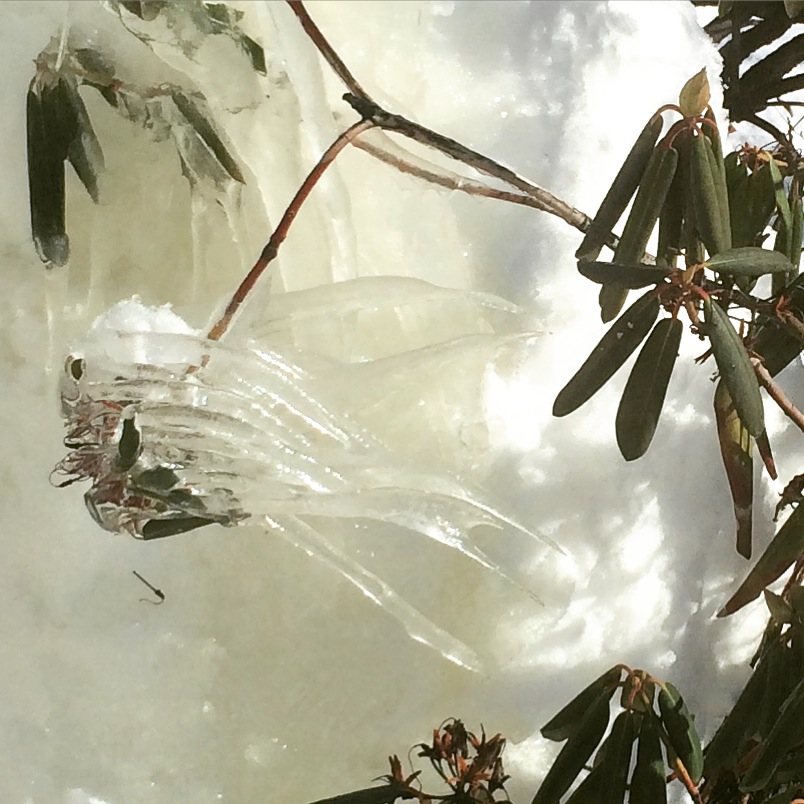
Sideways jellyfish icicle from the front window.

Sideways jellyfish icicle from the front window.

Unpleasant weather continues here in Boston (this weekend delivered the trifecta of snow, rain, and ice), and even hardened and hardy New Englanders agree that the last few weeks have been miserable. We’ve been staying put most weekends, venturing out for groceries and then settling in between bouts of shoveling.

Luckily, friends, like sunshine, have made brief but welcome appearances, and so in honor of friends who come to dinner, this week’s poem is Ben Jonson’s “Inviting a Friend to Supper.”

Jonson addresses his patron, William Herbert, with what I’d call a tone of amused deference. The feast he describes is quite something, even for a man of Jonson’s epicurean appetites: capers, olives, mutton, chicken, larks, other kinds of available fowl, a bit of salad, lemons, and, most importantly,

a pure cup of rich Canary wine,
Which is the Mermaid’s now, but shall be mine;
Of which had Horace, or Anacreon tasted,
Their lives, as so their lines, till now had lasted.
Tobacco, nectar, or the Thespian spring,
Are all but Luther’s beer to this I sing.

Hilarious (the Mermaid was a tavern, by the way). I’d like to try wine that good.

Now, our friendly dinners are never so grand or so well-appointed, and the wine has never been compared the Thespian spring, but the company, I’ll venture to say, is even better than William Herbert’s, and we are more grateful for our friends than Jonson was for Canary wine.

Ben Jonson
Inviting a Friend to Supper

Tonight, grave Sir, both my poor house, and I
Do equally desire your company;
Not that we think us worthy such a guest,
But that your worth will dignify our feast
With those that come, whose grace may make that seem
Something, which else could hope for no esteem.
It is the fair acceptance, Sir, creates
The entertainment perfect, not the cates.
Yet shall you have, to rectify your palate,
An olive, capers, or some better salad
Ushering the mutton; with a short-legged hen,
If we can get her, full of eggs, and then
Lemons, and wine for sauce; to these a cony
Is not to be despaired of, for our money;
And, though fowl, now, be scarce, yet there are clerks,
The sky not falling, think we may have larks.
I’ll tell you of more, and lie, so you will come:
Of partridge, pheasant, woodcock, of which some
May yet be there, and godwit, if we can;
Knat, rail, and ruff too. Howsoe’er, my man
Shall read a piece of Virgil, Tacitus,
Livy, or of some better book to us,
Of which we’ll speak our minds, amidst our meat;
And I’ll profess no verses to repeat.
To this, if ought appear which I not know of,
That will the pastry, not my paper, show of.
Digestive cheese and fruit there sure will be;
But that which most doth take my Muse and me,
Is a pure cup of rich Canary wine,
Which is the Mermaid’s now, but shall be mine;
Of which had Horace, or Anacreon tasted,
Their lives, as so their lines, till now had lasted.
Tobacco, nectar, or the Thespian spring,
Are all but Luther’s beer to this I sing.
Of this we will sup free, but moderately,
And we will have no Pooley, or Parrot by,
Nor shall our cups make any guilty men;
But, at our parting we will be as when
We innocently met. No simple word
That shall be uttered at our mirthful board,
Shall make us sad next morning or affright
The liberty that we’ll enjoy tonight.

“philocaly, philomath, sarcophilous—all this love,”: “For you, anthophilous, lover of flowers,” by Reginald Dwayne Betts

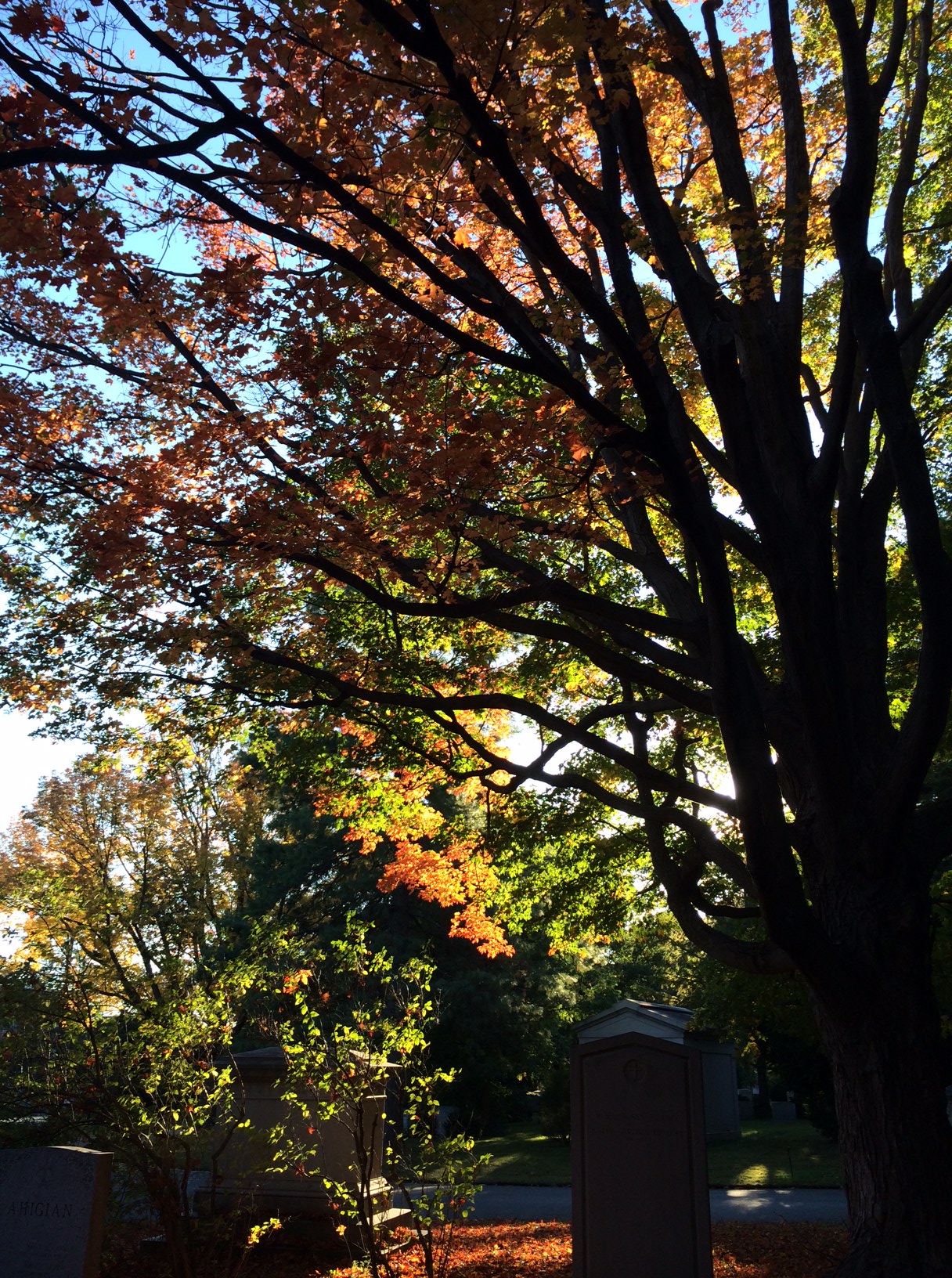
Fall trees in Mount Auburn Cemetery

Fall trees in Mount Auburn Cemetery

I love lists. So, apparently, does the rest of the world (see: Buzzfeed), and poets are no exception. Virtuoso lists are a feature of epic poetry, like Homer’s catalogue of ships, or Milton’s list of demons, or my personal favorite, the list of trees in Spenser’s Faerie Queene:

And foorth they passe, with pleasure forward led,
Ioying to heare the birdes sweete harmony,
Which therein shrouded from the tempest dred,
Seemd in their song to scorne the cruell sky.
Much can they prayse the trees so straight and hy,
The sayling Pine, the Cedar proud and tall,
The vine-prop Elme, the Poplar neuer dry,
The builder Oake, sole king of forrests all,
The Aspine good for staues, the Cypresse funerall.

The Laurell, meed of mightie Conquerours
And Poets sage, the Firre that weepeth still,
The Willow worne of forlorne Paramours,
The Eugh obedient to the benders will,
The Birch for shaftes, the Sallow for the mill,
The Mirrhe sweete bleeding in the bitter wound,
The warlike Beech, the Ash for nothing ill,
The fruitfull Oliue, and the Platane round,
The caruer Holme, the Maple seeldom inward sound.

(No, your screen isn’t playing tricks on you; Spenser wrote the Faerie Queene in a deliberately archaic style).

I’ve been thinking about lists and poetry because the Valentine’s Day poem of the day from The Poetry Foundation was Reginald Dwayne Betts’s “For you: anthophilous, lover of flowers,” which I read and immediately fell in love with (well-played, Poetry Foundation). It’s a catalogue of lovers, but not exactly in the sense you expect, and it’s gorgeous.

I wonder: which one are you?

“Why, oh why, the doily?”: Elizabeth Bishop’s “Filling Station”

This weekend, I was reading a very interesting essay on the correspondence between Robert Lowell and Elizabeth Bishop (Austin Allen’s “Their Living Names”), when it struck me that I’ve never featured Elizabeth Bishop on the site.

My high school English classes featured shockingly little poetry; I can remember the novels we read, but the only poems that spring to mind, besides a sonnet or two, are Eliot’s “The Hollow Men,” Langston Hughes’s “Harlem,” Thomas Hardy’s “Channel Firing” (which I’m pretty sure was on a mock-AP test), Cummings’s “anyone lived in a pretty how town” and Elizabeth Bishop’s “Filling Station.”

I remember “Filling Station” in particular because nobody in our class knew that “Esso” was a brand of gasoline (it’s an older name for Exxon-Mobile, still used in countries outside the United States), and so we found that line frustrating as we worked on the poem as a class. Bishop’s “big hirsute begonia” is the first time I remember hearing the word “hirsute,” and I’ve never forgotten it.

The details of the poem serve to highlight absence and presence: the presence of the father and sons and the dog, all dirty and greasy, but seemingly content, and the absence of the figure who put out the wicker furniture, waters the plant, and who embroidered the doily.

I liked the poem in high school, for its leap from first to last line, and as an adult I think I better see the way Bishop points to the kinds of work people do: visible work, like running a filling station, and the quieter, almost invisible work of caring and beautifying. The results of that kind of work are often hiding in plain sight, even if the worker—the “somebody”—is absent.

Two Poems on Poetry

I love reading writers on writing — interviews with authors about how they work, where they work, why they write, and so on. The Guardian has a series on writers’ rooms that I love to pop into now and again; here’s Seamus Heaney’s.

This week I’m reading two very different poems about poetry and writing poetry. Charles Wright is the current United States Poet Laureate; his poem “Reunion” is short, and very personal. He ends the poem with,

I write poems to untie myself, to do penance and disappear
Through the upper right-hand corner of things, to say grace.

Archibald MacLeish’s “Ars Poetica” is a playful, self-contradictory riff on Horace’s famous work of the same name, a set of guidelines for the crafting of poetry. In his rather famous and formulation,

A poem should not mean
But be.

What are your favorite poems about poetry?


Two notes from the poetry world:

Apparently a treasure-trove of lost Neruda poems has been found. (The Guardian)

Charles Simic’s tribute to his friend Mark Strand is wonderful, moving, human. (NYRB)


“in a foyer of evenings”: Joanna Klink’s “Auroras”

It’s been cold—not brutally cold, but cold—in Boston lately, and as often happens in January, I’ve been thinking about summer, and all the things I like about it (I will forget all those things as soon as it is July, 95 degrees, and muggy). Recently, I also learned that there is such a thing as a dark sky park, a place low enough in light pollution to give you a great view of the stars, so now I’m daydreaming about a trip to one of them this summer.

“Auroras,” by Joanna Klink, makes me think of summer and stars. I love its opening lines: “It began in a foyer of evenings / The evenings left traces of glass in the trees.” That’s a wonderful image: the last of the daylight caught in the tree branches while the sky above them turns black.


In other poetry-related news:

Michael Klein’s review of Mark Wunderlich’s The Earth Avails in The Boston Review is excellent.

I thoroughly enjoyed this interview with Susan Howe on The Poetry Foundation’s website. I haven’t read much of her poetry, so if you can recommend the book I should start with, please leave a note!

“erasing absence”: Christopher Buckley’s “On the Eiffel Tower”

1909687_520858518315_5793_nAfter the terrible events in Paris last week, I found myself looking for poems about the city, but none of the ones I came across really conveyed everything I wanted them to, which makes sense—how could they when I wanted to much?

In the end, I thought I’d recommend this poem about the Eiffel Tower. Christopher Buckley’s “On the Eiffel Tower” isn’t about crisis, or free speech, or facing the worst among us with all that we can muster of our best. What it is about is the way human minds can fill the sky with something beautiful, a monument of iron lace that’s stood for more than a hundred years of war and peace.

Vive la liberté.

Correction (August 23, 2020): The original version of this post mistakenly conflated Christopher Buckley, poet, with Christopher Buckley, satirist. I regret the error, and thank the reader who brought it to my attention.