“though chimneys smoke and blue concedes / to bluer home-time dark”

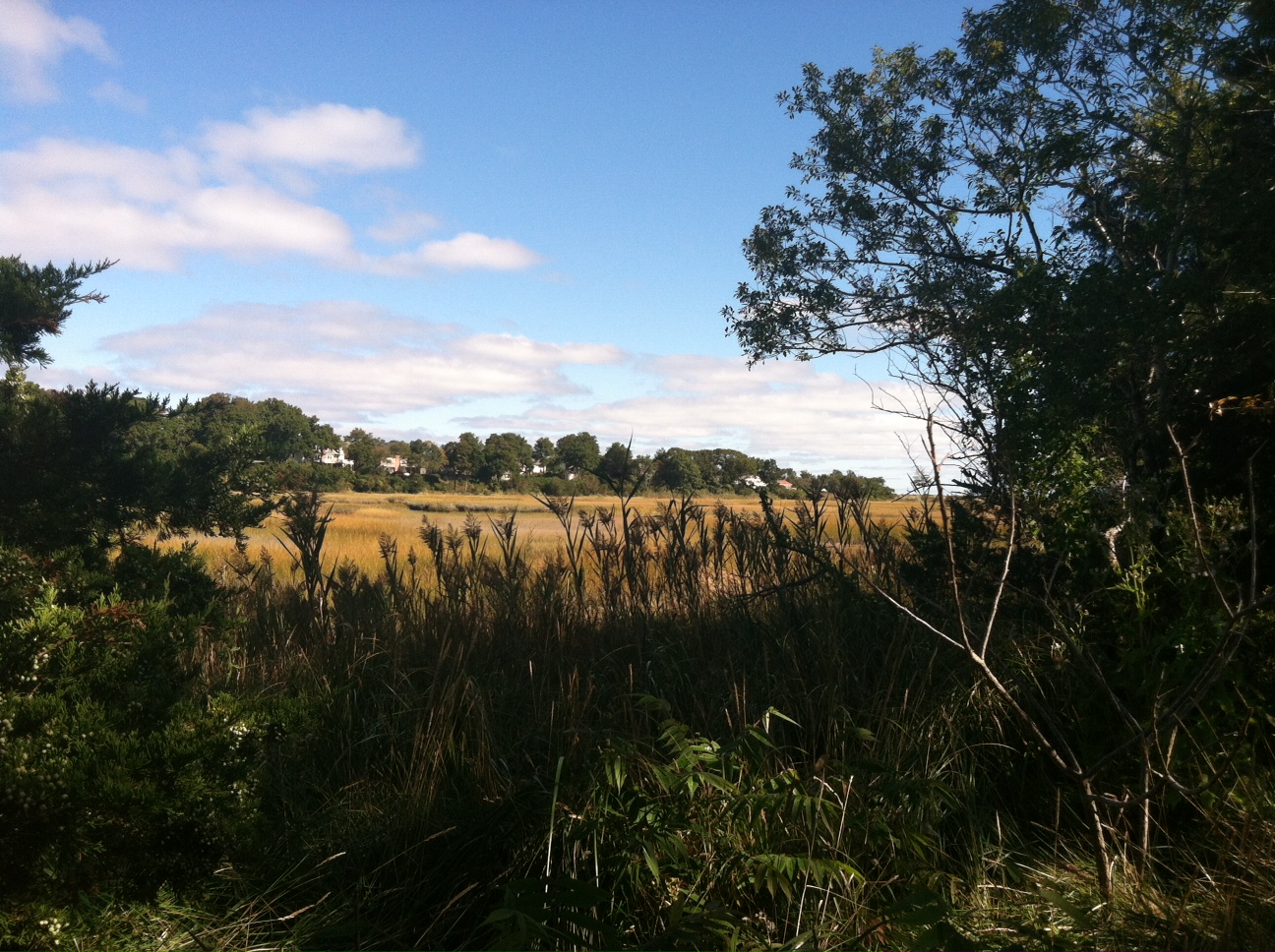
Sandwich Marsh in Fall, by CR OliverA very apropos poem this week: Jacob Polley’s “October,” which you can read here. I love formalist poetry (you might have noticed), and I think this poem is just lovely. In the first stanza, the speaker describes the change of the seasons, the way the sky-blue of summer six o’clock becomes the midnight blue of autumn six o’clock, graciously giving way (my favorite image in the poem, which I’ve quoted in this post’s title).

It’s a poem about change and continuity, perfect for a fall day. I hope you’ll read it and tell me what you think!

“And beyond them a stretch of open country / That strives into the sea.”

Ashley McHugh*, a poet and friend, directed my attention to this poem, “A Figure of Plain Force,” by Michael Heffernan (to be more precise, she pointed out the next poem on the page, but I was drawn to the first poem).

Grass by C.R. Oliver

In “A Figure of Plain Force,” the speaker considers “you,” a person turned into an open door in the early morning. We aren’t given anything about their relationship, or even the person’s gender, but I couldn’t help imagining the speaker as a child remembering his mother readying herself to meet the day. She might work on “nothing of consequence,” or perhaps she’ll fall into a whirl of activity to finish a task she’d left undone.

As you’ll note from the line I pulled for the title, the location is somewhere near the ocean, but when I read these lines:

In this condition you pretend to lean
Solidly into the open while you gather
The winds about you by deliberate grace
Turning you into a figure of plain force,
Careful and candid, never in a dither,
Given to nothing noisome or unclean.

I can’t help but think of a pioneer woman looking out onto a sea of prairie grass, formidable in her determination.

What’s your reaction to the poem?

*By the way, you should check out Ashley’s glorious first book, Into These Knots.

Why I Love Parks & Rec, or “O were my Love yon Lilack fair”

I love Parks and Recreation. Amy Poehler can do no wrong, of course, but it’s the show’s pitch-perfect blend of snark and heart that gets me every time. And also Ron Swanson. Oh Ron, you magnificent bastard, with your mustache and your Lagavulin and your love of breakfast food and pretty dark-haired women  . . .

Image courtesy zirconicusso / Freedigitalphotos.net

Image courtesy zirconicusso / Freedigitalphotos.net

(This is not the time to ask, friends, if I bought a waffle maker to ring in the show’s sixth season.)

As I was saying.

Mr. O and I delayed our viewing of the premiere by a day because he was out of town (an act of true love, as those three of you who follow me on Twitter know).  Well worth the wait, the show pushed its characters around with wit and gusto. Stop reading now if you care about spoilers. Look for the bold when I start a-chatting about poetry.

By far my favorite set piece: Ron on a Leslie-designed train trip through northern England and into Scotland, culminating in a visit to the Lagavulin distillery. But here’s the best part: Ron sitting on a green, craggy piece of land, reading the poetry of Scotland’s favorite son out loud — “O were my Love yon Lilack fair.” And tearing up. I sure did.

So, let’s talk about poetry and Scotch, and you’re safe to come back now, people who didn’t want to read spoilers. 

I came across Bobby Burns some time in college, but his genius didn’t truly hit home until I hosted an ersatz Burns supper when I was a young lass in grad school. In reality, it was more like a boozy birthday party with poetry (January 25th, if you were wondering, is Burns’s birthday). My friend Emily, having brought a fine single malt, performed another wondrous service, reciting “The Mouse” with an amazing Scots burr. It was a fine evening. I recommend hosting one such gathering yourself to keep off the winter chill. Here are the steps:

1. Make some food and buy a bottle of Scotch.
2. Invite your friends to bring a bottle of Scotch over.
3. Eat, drink, read Burns, and assign designated drivers. (Be safe and make good choices, as my college roommate’s mother liked to say.)

Now that I’ve assured you that I, like Ron Swanson, enjoy scotch, let me tell you that I also love the subjunctive, fast becoming a forgotten mood in English. If there’s a poet who loves the subjunctive, that poet is Robert Burns.

Here’s Burn’s “O were my Love yon Lilack fair”:

O were my Love yon Lilack fair,
Wi’ purple blossoms to the Spring;
And I, a bird to shelter there,
When wearied on my little wing.

How I wad mourn, when it was torn
By Autumn wild, and Winter rude!
But I was sing on wanton wing,
When youthfu’ May its bloom renew’d.

[O gin my love were yon red rose,
That grows upon the castle wa’!
And I mysel’ a drap o’ dew,
Into her bonnie breast to fa’!

Oh, there beyond expression blesst
I’d feast on beauty a’ the night;
Seal’d on her silk-saft faulds to rest,
Till fley’d awa by Phebus’ light!]

In other words, sic transit gloria mundi, but isn’t it something in the meantime?
“I prove a theorem and the house expands:”

Rita Dove’s poem “Geometry” is one I’ve been saving for fall, because the title reminds me of school (sorry, Mrs. A, but your ninth-grade classroom is still the only place I’ve ever tried to prove a theorem).  As you might guess from its first line (reproduced in this post’s title), it’s about the feeling of expansion that comes when you stretch your mind over unfamiliar pathways.

Image Courtesy Grant Cochrane / Freedigitalphotos.net

Image Courtesy Grant Cochrane / Freedigitalphotos.net

You can find “Geometry” in Ms. Dove’s Selected Poems, and you can read more about the poet and her work at the Poetry Foundation.

By the by: A couple weeks ago I highlighted Tami Haaland’s poem “A Colander of Barley,” and Ted Kooser (Poet Laureate, 2004-2006) selected it this week for his “American Life in Poetry” series. I love getting a poem in my inbox every week; you can sign up here.

“My skies rise higher and hang younger stars.”

I can’t tell you how much I love this poem, “Becoming Anne Bradstreet,” by Irish poet Eavan Boland. I love poems that “talk” to other poems, but I especially like the spare couplets in this poem, which traces connections, real and imagined, between the speaker (identifying as the poet) and Anne Bradstreet.

Image courtesy of Supertrooper / Freedigitalphotos.net

Image courtesy of Supertrooper / Freedigitalphotos.net

It’s also lovely to read how deeply affected a writer of poetry can be by being a reader of poetry.

“Tonight, nothing is long enough—“

Robert Creeley’s “The Tunnel” is short and difficult, taking aim at three weighty subjects: love, time, and death. I think I’ve read it twenty times now, and I still don’t grasp the whole meaning. I hold on to one stanza and another slips away. I love its concise complexity, and cleverness. Just look at the first line: “Tonight, nothing is long enough–” — the line ends with a long (em-) dash! The line itself is drawn out, lengthened by its punctuation and the pause that follows the end of every line in poetry. What a mind at work.

Read it here, and please tell me what you make of it!

“My last things will be the first things slipping from me”; RIP Seamus Heaney

Maria Popova has put together a beautiful tribute to Seamus Heaney, and I cannot improve upon her work and Seamus Heaney’s own words. However, I can recommend that you seek out one of his books as soon as you can. I like to read the poems in spring, when it’s lightly raining and I can imagine that the earth and the grass I smell are really in Ireland.

This week, in honor of Mr. Heaney, I’m reading his poem “Mint,” from The Spirit Level (1996), included in the collection Opened Ground. It’s not about the fresh smell of the herb, or the glorious color; this mint, in the speaker’s childhood yard, appears “like a clump of small dusty nettles” (l. 1). From this opening, the speaker projects into the future; these early memories will be the last to slip away from him at the end of his life. The turn into the final stanza is so unexpected — I hope you’ll read it for yourself.

I’m so grateful that poets and poetry are part of our world.

“Days are where we live.”

In a recent post on The Poetry Foundation’s website, Caitlin Kimball calls British poet Philip Larkin “that crown prince of misanthropic, socially awkward poet-librarians,” which is probably the best, funniest summation of Larkin’s whole ethos I’ve ever read. For me, reading Larkin’s poems are like sucking on lemons (I know, I know: terrible for one’s teeth. But I do it anyway.). There’s sourness, sure, but it only serves to highlight the brightness of the fruit, the taste like color.

Image courtesy of Pixomar / Freedigitalphotos.net

Image courtesy of Pixomar / Freedigitalphotos.net

In this poem, “Days,” it’s the turn that twists the knife; the first stanza lulls the reader into a little thought experiment, asking her to consider day as a place rather than as a time: “Where can we live but days?” Ay, there’s the rub.

Here’s the second and final stanza.

Ah, solving that question
Brings the priest and the doctor
In their long coats
Running over the fields.

“sun beating on abundance”

This week I’m working on a new(ish) poem by Tami Haaland, who is the poet laureate of Montana (nifty!): “A Colander of Barley.”  As I’m sure you’ve come to expect if you’re a regular reader of my Tuesday posts, it’s a short poem. In a single sentence, Ms. Haaland gives a beautifully concrete, sensory description of barley in a colander, linking it back to the grain in the field, in the truck. It’s a perfect poem for the late summer harvest season. Reading it made me want to bite into a tomato and savor these last sunny, hot days.

You can read “A Colander of Barley” on The Poetry Foundation’s website.

“they don’t pause, don’t buzz, don’t / fly up in fear and light again”

I’ve been itching to feature this poem all summer, but I restrained myself until the timing was right — and now it is!

Image courtesy SweetCrisis / Freedigitalphotos.net

Image courtesy SweetCrisis / Freedigitalphotos.net

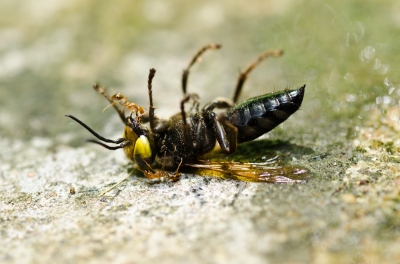
This week, I’m working on Andrew Hudgins’s sublime “Wasps in August.” You can hear Professor Hudgins read the poem here, at Slate (text too). And you should immediately go find Ecstatic in the Poison, from which this poem comes. I own two copies, and I am, sad to say, not sharing.

Professor Hudgins is one of the best living formalist poets, and a kind and funny man to boot (he teaches at The Ohio State University, alma mater of your humble blogger). I’ve never had the pleasure of taking his classes, but my friends who did treasure the experience. He was gracious enough to support the campus literary magazine and its young poets, and he was (and is) a highly-regarded mentor to new poets.

This poem describes the dying days of the wasps outside the speaker’s home, who defend and nurture their larvae in the nest. But it’s about more than that: frailty, death, rebirth, renewal, futility . . . I could go on.

The last line will floor you.