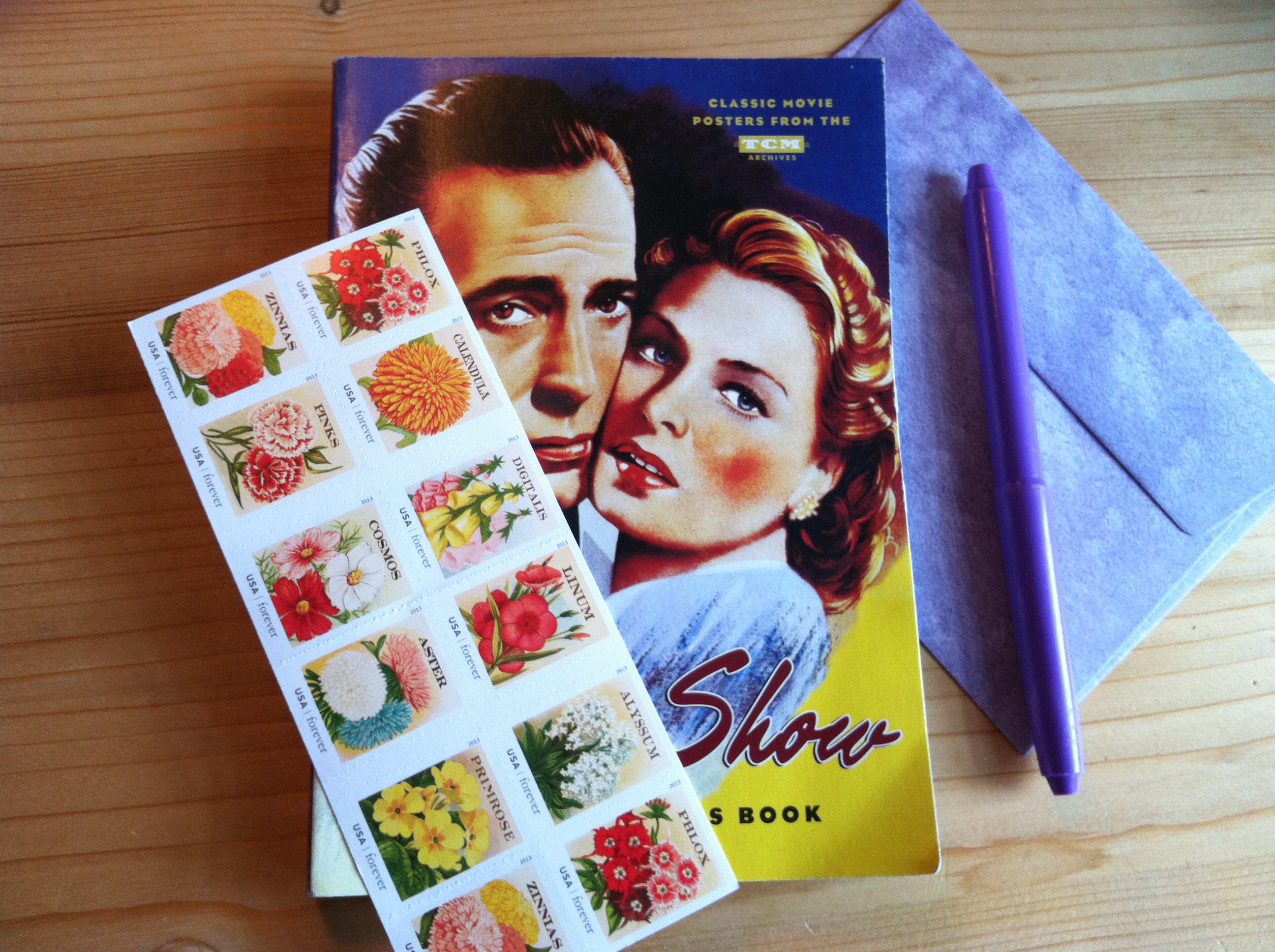
Recommended Reading: Frances and Bernard, by Carlene Bauer

Letter-writing

As I’ve mentioned before, I love a good epistolary novel, and here’s one, slender and new, that I hope you’ll love too.

It’s no secret that Carlene Bauer takes as her models for her correspondents Flannery O’Connor and Robert Lowell; in fact, several reviewers have complained that those (real) voices have not been satisfactorily mimicked, or that Ms. Bauer ought to have worked with material of her own devising.

I confess that I am unmoved by both these objections. It may be heretical to say it, as someone who attended BU and sat in the Lowell room from time to time, but confessional is not my favored poetic brand, and I have been derelict in my scholarly duty to thoroughly read O’Connor (though what I have read is sublime). And why shouldn’t writers dip into the past or borrow historical figures, in whole or in part, as they tell their own stories? [That said, I think the voices of the wholly imagined characters — Claire and Ted — come through very strongly.]

So. I loved this book for its earnest but unwearisome approach to matters of faith, writing, love, and family, which, as you might suppose, are all connected. But humor, so often lost in conversations about weighty subjects (an understatement, I know), is wry and sly and happening all the time in this novel. Here’s my favorite zinger: “The Beats are really nothing more than a troop of malevolent Boy Scouts trying to earn badges for cultural arson” (14).

[Sidebar: I will be stealing one of Frances’s lines for my Christmas/Hannukah cards this year: “Love and joy come to you, and to your wassail too” (9). I know it’s too early to be thinking about Christmas, and yet: look at me go!]

I loved the way Frances and Bernard proceed almost immediately into matters of import, which I’ve found can happen when one starts a correspondence with someone not well known and not likely to be seen again, even if that’s something one would like. As I read the novel, I thought about my own treasured friendships, and resolved to write more letters.

[I’m rather terrible at keeping up with correspondence, though; do you have any tips for becoming a reliable letter-writer?]

Recommended Reading: Gone Girl, by Gillian Flynn

I know, I know: this was the it book of 2012, and I am late to the party.

It’s a pretty rad party.

Gone Girl is part mystery, part comedy, part domestic drama, and entirely, viciously delightful. Amy disappears on the morning of her fifth wedding anniversary, and police attention begins to swirl (inevitably?) on her attractive husband with the flimsy alibi. But nothing turns out how you think it will.

Highly recommended, especially as a highbrow beach read.

Recommended Reading: The Virgin Suicides, by Jeffrey Eugenides

Jeffrey Eugenides’s Middlesex didn’t land on my radar until graduate school, when I devoured the novel in two days, reading on the T, in line at the pharmacy, in the kitchen. I stayed up late. I cried. And then I read it again.

So it was with eager fingers that I turned the first pages of The Virgin Suicides (1993), the first of Mr. Eugenides’s three published novels.

I wasn’t disappointed.

It’s very, very different from Middlesex; it doesn’t share the sweeping scope of family, history, and geography. Instead, the focus on the girls feels almost claustrophobic; the reader is hemmed in, drawn to the inevitable, macabre conclusion the book’s title suggests.

I’d never seen this style of narration before: first person plural, never broken. The middle-aged men who look back on the Lisbon sisters and their own younger selves act as archaeologists, excavating and archiving objects and memories in an attempt to come to terms with the tragedy in their hometown. Because the narrators are just as bewildered as the reader, the novel sidesteps the available easy answers, the laying of blame.

And it’s Eugenides. The writing is breathtakingly beautiful.

Recommended Reading: Life Class and Toby’s Room, by Pat Barker

One of the many gifts my father has given me is sharing his lifelong interest in World War I, that brutal period in history that often disappears into its sequel’s shadow. The war was terrifying in its intensity, its stagnation, its sheer totality. And it also produced some of the finest poetry of the twentieth century before an entire generation of young poets, novelists, painters — an entire generation of young men — was wiped out.

[Which is not to say that that women didn’t suffer didn’t the war, or that there were no incredibly talented women writers and artists of the period; see my earlier post on Anna Akhmatova.]

Some other time I’ll write a post on my recommended reading on the war, but for now, let’s talk Pat Barker.

If you haven’t read Ms. Barker’s Regeneration trilogy (Regeneration, The Eye in the Door, The Ghost Road), drop everything and make a run for your neighborhood bookstore. The trilogy is complex and marvelous, focusing especially on the war’s psychological effects on soldiers. Particularly masterful is the way Barker blends fact and fiction; her characters interact with historical figures like Owen, Sassoon, and Graves. Readers with STEM proclivities will appreciate her fine understanding of scientific and medical concepts.

As you might imagine, I was delighted to run across Ms. Barker’s lastest book, Toby’s Room (2012), in our local library a few weeks ago. It wasn’t until I read the jacket copy after I finished the novel that I realized that Toby’s Room is a sequel of sorts to Life Class (2007), which I promptly found and read next. I say ‘a sequel of sorts’ because the timelines in the two books overlap, as do the characters, though the focus shifts among them. I would describe the two novels as companion pieces.

Both are concerned with trauma—emotional and physical, resulting from war and from domestic life—and its relationship to art. Once again, Ms. Barker’s characters blend seamlessly into a landscape populated by very real figures. Of particular interest is the work of Henry Tonks, which I won’t say much more about in order not to spoil the plot of the books.

Recommended Reading: The Round House, by Louise Erdrich

The plot of Louise Erdrich’s amazing novel concerns a boy’s search for the man who attacked his mother, while his father searches for justice despite the twisted web of federal, state, and tribal laws that stands in his way.

It sounds simple, but The Round House is the work of a master-storyteller, each detail bringing daily life on the reservation into focus. Joe, the narrator, is a funny, honest companion through the often-horrifying story, and through his eyes we see all the best of late-boyhood friendships in his adventures with Cappy, Zack, and Angus, as well as the worst in men.

The raw anger and frustration that this book made me feel was balanced by admiration for Ms. Erdrich’s stunning language and deft way of shaping her characters. One of my favorite passages is Joe’s relation of the boys’ love for Star Trek: The Next Generation. The boys all want to be Worf, but admire Data immensely. (Also, the chapter names are often taken from the names of Star Trek: The Next Generation episodes.)

I finished reading The Round House last Wednesday, and I’m thrilled that I’ve finally had the chance to recommend it.

Recommended Reading: The Nine, by Jeffrey Toobin

I’ve been waiting anxiously for the Supreme Court to issue its major rulings for this session, so I asked friends to recommend the best books about the Court. Votes were cast for The Nine and for The Brethren, and the library got The Nine in first, so here we are.

It’s a startling portrait of the justices and their major cases over the last twenty or so years, and I felt I learned quite a bit about some of the justices’ personalities and the reasoning and maneuvering behind some of the major rulings. Based on this strength alone, I recommend the book.

The book is dated, of course (published before the 2008 election), but that can’t be helped. However, I felt at times that Mr. Toobin’s portrayals of the justices shaded toward unseemly. For instance, is it necessary to say that Justice Scalia “raged”? Or to comment more than once on Justice Ginsburg’s (physical) stature? Or to call Justice Kennedy vain? Far more interesting was the revelation that several of the justices enjoy travel and are interested in the views of their international colleagues.

I didn’t care for the organization of the book, which too often was chronologically vague and disjointed. And I would have preferred a narrative with fewer overt political opinions from the author, who seemed to me, at times, to be taking on the role of interpreter of the nation’s laws for himself.

Still, it’s worth reading if you’re interested in the workings of the court.

Recommended Reading: Wool, by Hugh Howey

Each year, our town library chooses an all-town summer reading book, and then hosts events related to the book in the fall. I love summer reading, and I love talking about books with other people, so I’ve been looking forward to checking out this summer’s book.  Two years ago the book was Rocket Boys, by Homer Hickam (a great memoir, which later became October Sky, one of my favorite movies), and last year the town read To Kill a Mockingbird.

This year, I’d never heard of the book, but only a few display copies were left out, so I asked a reference librarian about it. She said the seventy-five copies the library had ordered flew off the shelves so fast that they’d had to buy another thirty, of which only six were left the next day.

The book is Wool, by Hugh Howey. Here’s part of what Jill, a reference librarian at the WFPL, has to say about it:

Why have you probably never heard of it?  Because it was a self-published work by an unknown author. That means it was not in most libraries or bookstores, there were no print ads for it in magazines, and review attention was sparse at best.  Yet this novel managed to gather an army of loyal readers who passed it on, one copy at a time, to family, friends, and co-workers, slowly building it into a New York Times bestseller.  That all of this took place outside the confines of the traditional publishing model is testament to the direct relationship that now exists between the writer and the reader.

I was a little skeptical at first, but I liked the title, liked the idea of reading some sci-fi, and liked the heft of the paperback (I love paperbacks), so I started it that night.

Holy cow. This book is scary.

I had to force myself not to read ahead: that’s how suspenseful Wool can be. Howey’s pacing is spot-on, the short chapters enhancing the uneasiness of the frightening world he’s created. No spoilers, as usual, but praise is due to Howey for his tough, and admirable, female characters. Highly recommended, whether or not you’re a fan of sci-fi.

Recommended Reading: Where’d You Go, Bernadette?, by Maria Semple

If you love Arrested Development, you’ll love this book. And there’s no way it won’t be made into a movie in a hot minute.

Maria Semple wrote for (perhaps still writes for?) AD, and her hilarious send-up of Seattle upper-middle-class culture both makes me want to move there and also makes me feel better that I don’t live there already.

I’d like to tip my hat to my friend Katie, who mentioned a few weeks ago that she was reading a book she took out from the library, at which I thought: “Hey! The library! Not just for Elmo videos!”

So, the next time we went in for Elmo videos, which are next to the new (read: 2012 and forward) releases, I picked the book with the great title and decided to run with it.

Where’d You Go, Bernadette? is nearly epistolary, with occasional interpolations by the narrator, Bernadette’s daughter, Bee, and that alone makes my heart sing. I love a good epistolary novel. The Coquette, one of the earliest American novels (1797, if my first year in grad school serves me well), is a great read, and if you haven’t read Griffin and Sabine, go immediately to your nearest bookseller and take it home with you.

Anyway. I don’t want to give away the plot, as usual, because, as the title indicates, it’s also something of a detective novel. Positively delightful, fast-paced, witty, and with enough talk about Antarctica that I heartily recommend it for the beach this summer.