Recommended Reading: If You Could Be Mine, by Sara Farizan

Happy Thanksgiving, dear Readers! And Happy Thursday, non-American friends!
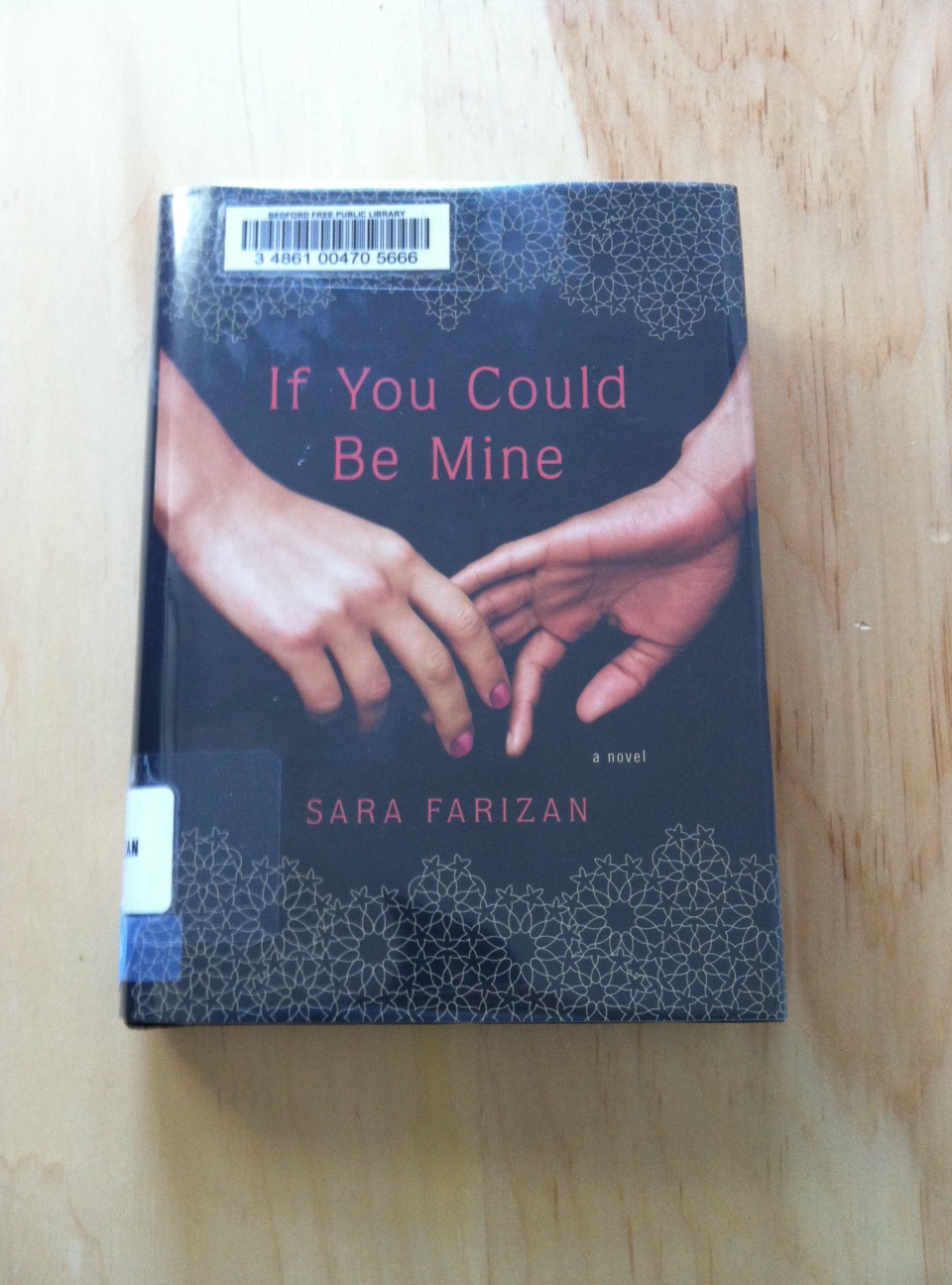
If You Could Be MineAs you may have noticed, YA fiction doesn’t make it onto my reading list very often, but in the spirit of omnivorous reading, I thought I should try out a new YA novel (a couple years ago I read The Hunger Games trilogy, which I quite liked). I chose Sara Farizan’s If You Could Be Minebecause I’m interested in reading fiction set in other countries, and because the novel focuses on LBGT* issues (near and dear to my heart).

Sahar has been in love with her best friend, Nasrin, since they were children. Nasrin loves Sahar too, but also feels the pull of a traditional life trajectory — marriage, children, a house and social position. And they live in Iran, where homosexuality is punishable by death — even for teenagers like Sahar and Nasrin.

Then Nasrin’s family arranges a marriage for her, and Sahar, desperate to save their relationship, explores drastic measures to keep them together.

Sahar’s narration makes me want to give her a big hug, and I loved the careful construction of the secondary characters, especially Sahar’s father and Nasrin’s mother.  The language is geared toward younger readers, which I was expecting, but I wasn’t expecting the frank discussions of transsexuality that’s an integral part of the novel. I appreciated Sahar’s honesty and humanity, and the unflinching portrayal of how difficult life is for the gender-nonconforming in modern Iran.

And, of course, there’s plenty about the dangers of being a woman. You know, stuff like your sleeve inching past your elbow or wearing too much makeup getting you raped or beaten. Shudder.

Nasrin is often annoying, and doesn’t seem like a worthy object for Sahar’s affection, except insofar as she listens to Sahar attentively (as Sahar points out). At first, I felt that this was a flaw in the novel, because as a reader, I wanted to be invested in both girls. About midway through, however, Nasrin grew on me. She rebels against the strictures of her society in her own way, even if it’s not the way Sahar wants (or we want, for that matter). Nasrin’s flaws make the story more real, more relatable, and all the more heartbreaking for Sahar.

If You Could Be Mine would pair well with the first volume of Marjane Satrapi’s Persepolis, especially in a teaching setting, and I think the pair together would make a great Christmas/Hannukah/Festivus/Yule/December present.

Recommended Reading: The Ocean at the End of the Lane, by Neil Gaiman

Unless you’ve been insensate for the last ten years or so, you know that Mr. Gaiman is a book world superstar with novels, short stories, and children’s books to his credit. I loved American Gods and Smoke and Mirrors, so I knew I was in for a treat when I picked up The Ocean at the End of the Lane. It’s received amazing press and Mr. Gaiman commands round-the-block lines whenever he reads at a local bookstore. photo (26)

Now, I found American Gods suspenseful, and Smoke and Mirrors occasionally chilling, but The Ocean At the End of the Lane is downright terrifying. It’s a tribute to Mr. Gaiman’s storytelling that I kept reading, because the whole novel turns around big time child endangerment, which is almost always a book-closer for me. I went into this one not knowing anything about the plot, though, so I wasn’t really prepared for how frightening the book would become.

To say much about the plot would make me feel like a thief in the night, so I’ll refrain.

But you should read this. You’re going to fall in love with the Hempstock family.


Recommended Reading: The Obituary Writer and Comfort, by Ann Hood

Ann Hood, Comfort, photo by CR OliverAbout five years ago, when I was going through a Very Bad Time, my wonderful friend Mary gave me Ann Hood’s memoir Comfort (in which Ms. Hood very graciously penned a note for me). Comfort‘s chapters deal with the experience of grief; Ms. Hood’s five-year-old daughter died from a virulent form of strep in 2002. The book is gut-wrenching, and the first chapter is the best, truest writing on grief that I’ve ever read.

That grief clearly informs The Obituary Writer, Ms. Hood’s novel that’s out this year. The novel gives us two stories in parallel. We follow Vivien in 1919 San Francisco (and environs) as she comes to grips with the disappearance of her lover in the earthquake of 1906, and Claire in 1960 Virginia, feeling trapped in a loveless marriage and catapulted suddenly into an affair. Their lives intersect, of course, but the contrast between the two women is fascinating.  How did women shape their lives when their roles were so constricted, so defined?

Ann Hood, The Obituary Writer, photo by CR OliverI found as I read that I wanted to know more about Vivien’s relationship with her lover, and how they negotiated social situations and taboos, and I was disappointed to be left in the dark about that aspect of Vivien’s life. However, that disappointment was overmatched by my interest in Claire’s fascination with Jackie Kennedy. I’m a New Englander, but I’ve never felt the affection for the Kennedy family that the rest of Boston perpetually evinces. It wasn’t until I read this book that I came up with a possible explanation for why women loved Jackie: her life, on the outside, at least, was the best, materially speaking, a housewife in 1960 could wish for. Jackie was beautiful, cultured, spoke French, married a handsome man, had two adorable children, and was never in danger of running out of money. The reality of her situation was different, of course, but I suspect that her presence in the White House gave women who felt stifled at home something to aspire to as they engaged with the parameters of their lives. But that’s just a theory.

Have you read Comfort or The Obituary Writer? What did you think?

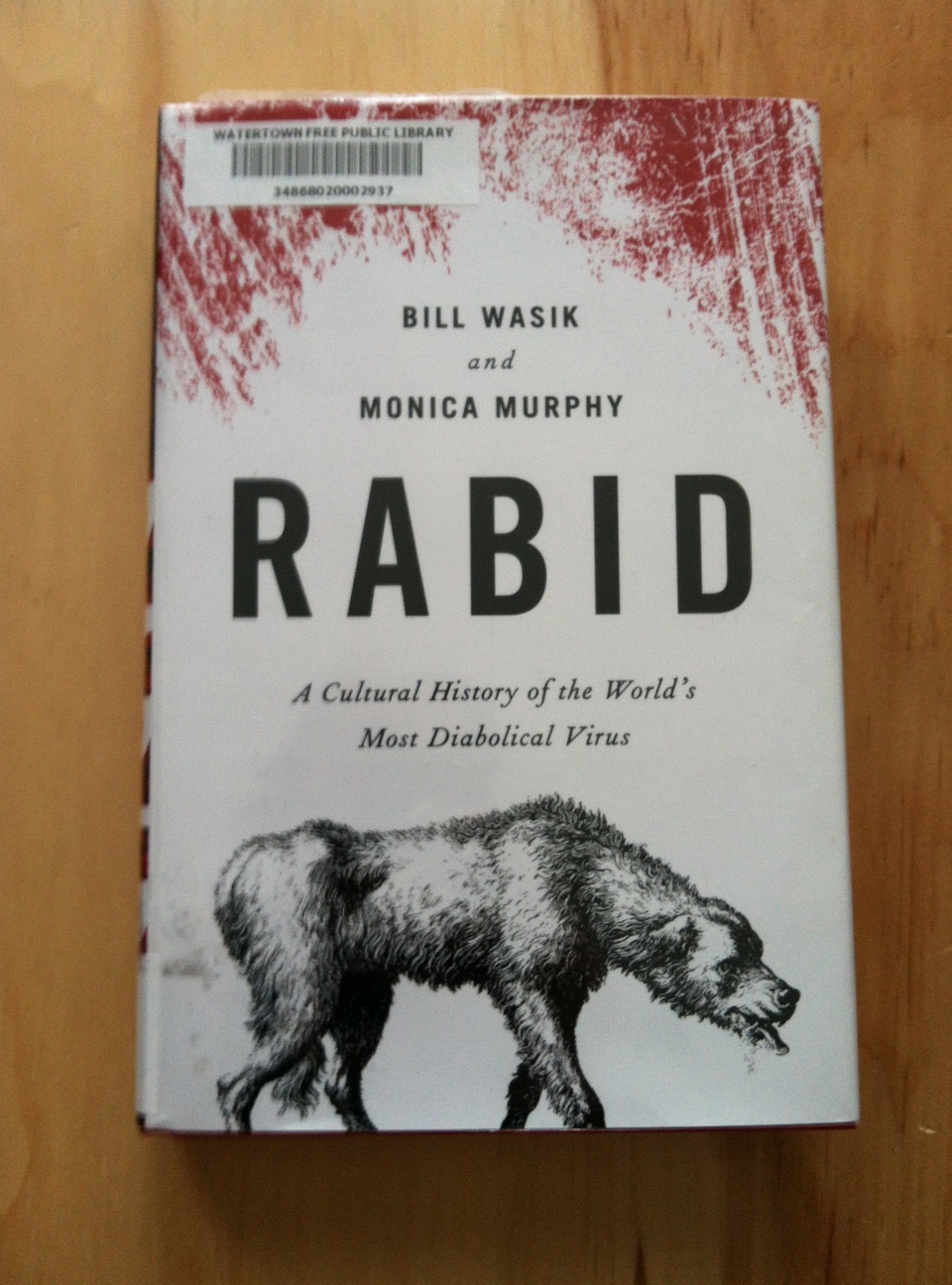
Scary Read: Rabid: A Cultural History of the World’s Most Diabolical Virus, by Bill Wasik and Monica Murphy

RabidA tip o’ the hat to my friend Kate, who pointed me to a podcast about the most fascinating story in this already-fascinating book a couple months ago.

Rabid, by veterinarian Monica Murphy and her husband, Wired editor Bill Wasik, examines rabies from a cultural standpoint — but you probably got that much from the title. I went in with the my knowledge of rabies confined to that one episode of The Office, something about twenty shots in your stomach, and a settled dislike for raccoons.

Now on the other side, I’ve got a better handle on the whole subject. The rabies vaccine is only four shots in one’s arm, for one thing. And rabies is the most deadly virus identified, with 100% human mortality (as far as we know) if the disease goes untreated. And 55,000 people die from rabies every year. I guess it’s only a joke if you live in Scranton.

The best chapters in Rabid deal with Pasteur, who invented the rabies vaccine, and with human survivors of rabies, Jeanna Giese in particular (whose case is the subject of that podcast), and how an island community like Bali deals with a sudden outbreak of the disease.

Less mesmerizing are the book’s forays into literary subjects the authors associate with rabies (the bit about the Iliad is particularly unfortunate); the authors are much better equipped to deal with the scientific and veterinary aspects of the disease’s history. Based on the last three chapters alone, Rabid is worth a look. And you’ll definitely look twice the next time you see a raccoon. Or a skunk. Or a stray dog.

Recommended Reading: The Niagara River, by Kay Ryan

Back in late July, I featured a poem called “Thin,” by Kay Ryan.  I liked it so much that I went to the library that week to find a full-length book of hers, and the library obligingly provided The Niagara River. As a child, I spent many happy summer afternoons jumping into the Niagara River from my Uncle Bill and Aunt Mary Kay’s dock, so the whole thing seemed beshert.

Image courtesy of  George Stojkovic / Freedigitalphotos.net

Image courtesy of George Stojkovic / Freedigitalphotos.net

I love these poems. They’re unlike any others in my pretty extensive poetry library. They’re short, rarely flowing from one page onto another, and the lines are short as well, often just three or four syllables in length. I found the rhythm, and the occasional rhymes, jarring, but not unpleasantly so. Many of the poems end with a subtle twist, a line that forces the whole poem into sharper focus. These poems call for slow reading and then re-reading; I wanted to savor and remember them.

Some of my favorites in this volume are “Carrying a Ladder,” “Sharks’ Teeth,” “Green Hills,” “Ideal Audience,” “Hide and Seek,” and “The Well or the Cup.” I hope you’ll have a look at them for yourself.

Recommended Reading: Fahrenheit 451, by Ray Bradbury

Yes, it’s another installment in Books Carolyn Is Utterly Embarrassed Not to Have Read by Now.

Image courtesy of Manostphoto/ Freedigitalphotos.net

Image courtesy of Manostphoto/ Freedigitalphotos.net

As a voracious reader and lover of sci-fi, it’s pretty amazing that Fahrenheit 451 has missed my to-read pile for so long. Maybe it’s because the contours of the story are so familiar; I felt going in as if I already knew the plot.

Something that startled me was the sheer number of technological advances that Bradbury saw coming in 1953 (because of his long career, I’d always assumed that Fahrenheit was a late 60s/ early 70s book — quite wrongly): wall-sized TV screens, in-ear headphones, drones. I wonder if Suzanne Collins was thinking of the Mechanical Hound when she created some of the monsters in The Hunger Games trilogy.

I’ll skip the plot summary, since you’ve probably got the gist of it, and instead highlight my favorite section: Montag’s meeting with Grayson and the other people of the book, who remind themselves, “we’re nothing more than dust jackets for books, of no significance otherwise.” Grayson goes on to tell Montag how great works of literature are preserved: “Why, there’s one town in Maryland, only twenty-seven people, no bomb’ll ever touch that town, is the complete essays of a man named Bertrand Russell” (179; the grammar’s a little off, but I can’t tell if that’s Grayson’s overexcitement or a faulty edition at work). I found the work of memory, the instinct to preserve ideas and language, deeply moving.

I wonder, though, if regarding oneself as merely a dust jacket for a book is entirely admirable. Certainly there’s a sense embedded in this idea of taking a larger, longer perspective (I’m reminded of Carl Sagan and the blue dot, or Rick’s speech at the end of Casablanca), a way of realizing our individual insignificance over the span of time. On the other hand, one person with a great deal of insight, or fortitude, or kindness, can change the world for the better. But I suppose you do need the world.

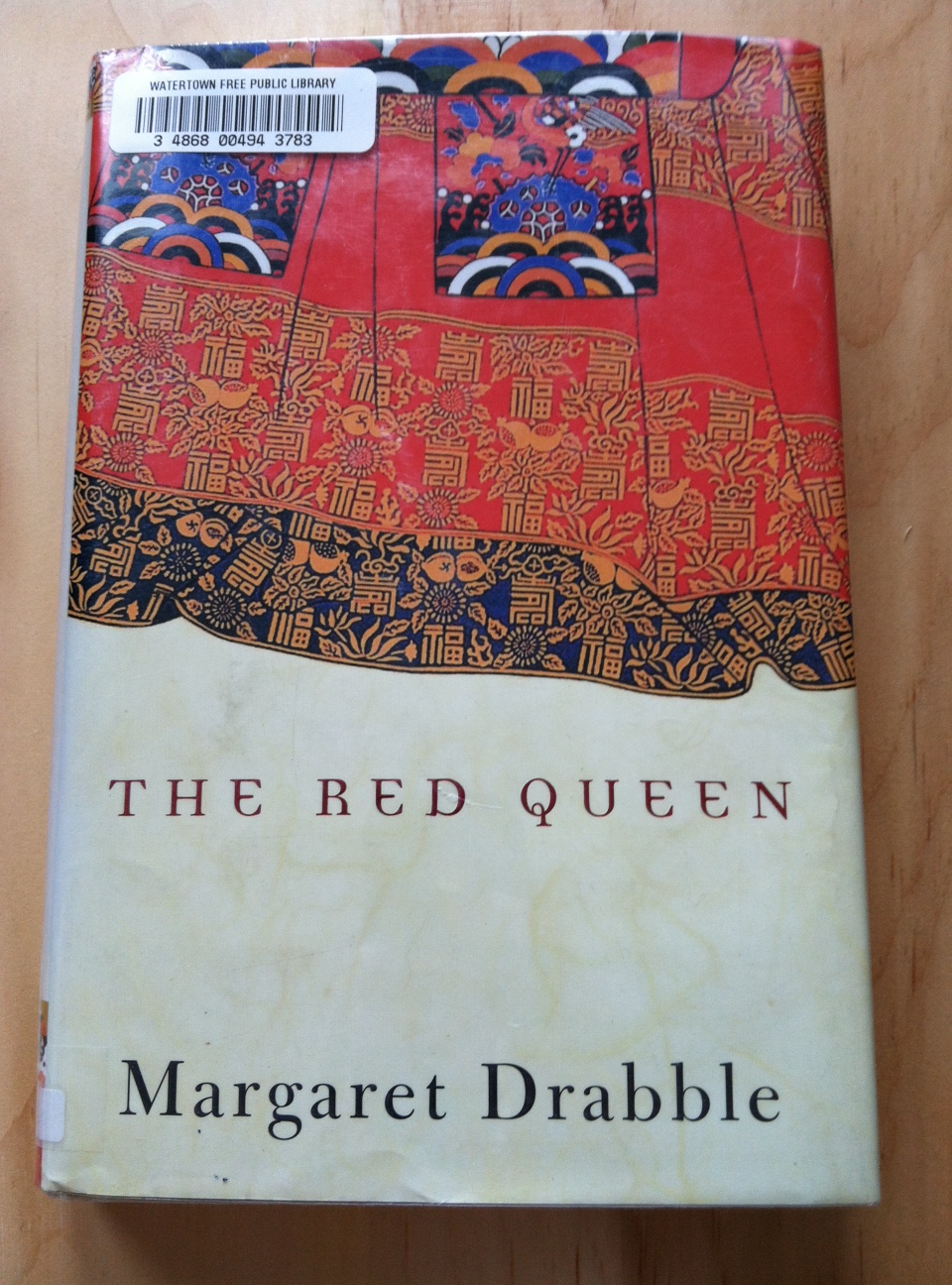
Recommended Reading: The Red Queen, by Margaret Drabble

Since I’ve read two books by A.S. Byatt so far this year, I thought it would be only fair to give one of her sister’s novels a try. Sister, you say? You haven’t heard of another novelist with the last name of Byatt?

The Red Queen

Well, that’s because A.S. Byatt’s non-pen name is Dame Antonia Duffy (she was born Antonia Susan Drabble), and her sister’s name is Margaret Drabble.

Both writers have been laureled and lauded many times over, but they do not see each other often and do not read each other’s novels, the result, apparently, of their rivalry as writers and their disagreement over the portrayal of their mother and the use of the family tea-set in a novel.  It’s a real shame, not only because their novels are so good, but because in all the interviews I’ve read, both women seem like lovely people.

Enough about that. Let’s talk about the book.

The back jacket of The Red Queen claims that it’s “a rich and playful novel about love, about personal and public history, and what it means to be remembered.” Readers may recall my feelings about unattributed jacket copy, and I do think that this is better than most, with one slight problem. “Playful” implies that the novel is funny, or piquant. It is not.

It is, however, excellent. What’s playful about the novel is its structure. In the first part, our narrator is the woman known, inaccurately, she tells us, as Lady Hong, a Korean princess of the eighteenth century. The Korean Crown Princess is known in Korea (less so in the rest of the world) for her memoirs, written for different audiences over a period of some time. The version of the princess that Ms. Drabble presents is an unreliable narrator, to be sure, sometimes blinded by her own interests or those of her family. She drifts into long digressions, circles around issues, leaves out salient details. She’s also dead, knows she’s dead, and has the advantage, with some limitations, of looking over history to fill out her own story. What she wants is to be remembered, to reach a wider audience (she won me over — I have to find those memoirs!).

In the second part of the novel, she succeeds. We switch gears entirely to follow Dr Barbara Halliwell in the present day as she attends an academic conference, makes a friend, and embarks on an affair in Seoul. Throughout her time in Korea, she’s drawn to the tale of the Crown Princess, unsure who gave her the memoirs and what she should be taking away from her visit, her affair, her very life. I’ll stop here, because you know I never offer spoilers. Let’s just say that the story keeps spiraling outward and inward, and the last few pages are a treat, so very clever. It’s a novel I’d be pleased to have on my shelf, and I hope you and A.S. Byatt will read it too.

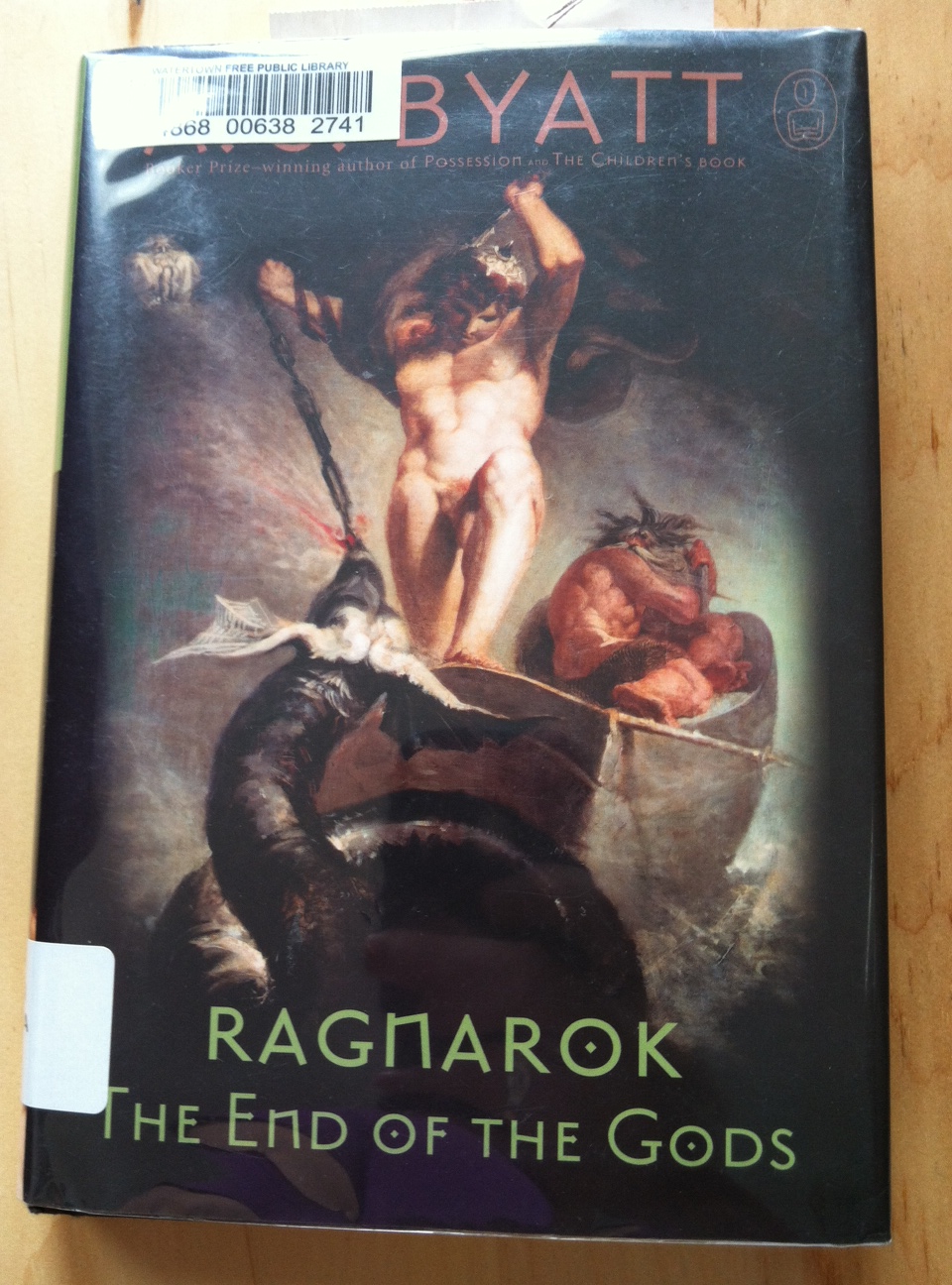
Recommended Reading: Ragnarok, by A.S. Byatt

I was raised on opera as a child; I couldn’t identify a New Kids on the Block Song (still can’t), but I could pick Wagner out of a lineup every time. So with his Ring Cycle in mind, I was excited to read A.S. Byatt’s take on Ragnarok, or The End of the Gods, especially because I found Possession to be such a wonderful book (and if you read it, you might remember that Ash wrote a poem called “Ragnarok”).

Sorry, library copy.

Sorry, library copy.

Fans of A.S. Byatt will encounter her erudition and her command of language here, with cascading descriptions and lists reminiscent of Milton’s Paradise Lost. The language is so satisfying, so meaty, that this short book (171 pages) takes quite a while to savor.

What impressed me most, in this telling, is the structure of the work. It’s not exactly a novel, but not exactly D’Aulaires’ Book of Greek Myths, either (my favorite book of mythology when I was a child). But there is a narrative flow, and the book opens with “a thin child in wartime” encountering the stories of these irascible, imperfect, impulsive gods and their creations. But these myths, as A.S. Byatt points out in an essay that closes the book, differ greatly from fairy tales; the good do not always prosper, and the bad are not always punished; indeed, Ragnarok is the end of the gods. The world with its gods dies and is not reborn.

The book is not an allegory for the woes of our world, but present in the author’s mind was, she writes, the steady bursts of destruction we inflict on the earth ourselves, without any help from the gods.

Recommended Reading: Asunder, by Chloe Aridjis

I think we l know how I feel about jacket copy and blurbs. To wit: not good. But for once, the blurbs are on to something, and it’s the gem that is Chloe Aridjis’s Asunder.

AsunderThe novel follows Marie, a guard at London’s National Gallery, through her perambulations at work, at home, and abroad. This is isn’t a novel with extravagant plot points; instead, it’s superb gathering of images and moments, a testament to a quiet life. To observation.

It’s about the entropy of decay and the possibility for violent change. It’s a weirdly beautiful excavation of life. And the images! New, lively, strange.  Here’s one example. Marie is examining a painting:

It was a mysterious painting, of a seaside landscape with a few human figures, and my eyes first came to rest on the wall of ancient wrinkled cliffs resembling a procession of tired elephants. (111)

Arresting, isn’t it?  I felt swallowed up the images as I read. I loved this novel, and if you’ll excuse me, I‘ll be off to find my own copy.

Recommended Reading: Burial Rites, by Hannah Kent

Ah, Iceland. We meet at last. Almost.

Books are modes of conveyance, right?

Books are modes of conveyance, right?

My husband has had a thing for Iceland since long before we met; he listened to Sigur Rós before it was everyone’s favorite inspiring music (Glósóli was the first song on the first mix-CD he made for me—yes, you read that right— and would have been our son’s birth song, had it not been for that pesky emergency C-section). He’s wanted to visit for ages, and when I win the lottery, I’m booking us a flight.

I can’t claim that Iceland holds the same appeal for me as it does for Mr. O, but Hannah Kent’s Burial Rites brings the stark, relentless landscape into such focus that now I’m itching to see the land, the grey sea, and the ice-blue sky. I’m not much for landscapes, as I mentioned when I wrote about Bay of Fires, but this is the second book this year to make me care deeply about its characters’ surroundings.

The jacket copy (and Goodreads summary) will tell you right off the bat that this novel is an exploration of the last months of Agnes Magnúsdóttir, the last woman publicly beheaded in Iceland, so I don’t feel too bad about telling you too. Before her execution, she’s placed as a worker-prisoner with an unwilling family for a few months while a priest tries to save her soul; instead, they hear her story. That’s what I like to call a dramatic situation.

The action of the novel moves toward the inexorable end with grace and sure footing, even if the same can’t always be said for Agnes. At first I was a little thrown by the unconventional structure (letters and documents interspersed with third-person narration and first-person narration from Agnes’s viewpoint), but by the end of the novel, I loved it. The structure regulated the pacing, and eventually the narratives meld together in perfect synchronization.

One word kept coming to me over and over as I read:

Endurance.

Not the Shackletonian type of endurance, but the kind of constant scraping by that leaves blisters that never heal. Agnes endures abandonment after abandonment until the warmest home she finds is with her keepers, her best company a nervous priest and a sharp-seeing middle-aged woman who also waits for certain death (that reliable killer of nineteenth-century female characters — tuberculosis) but no execution date.

In the world Ms. Kent recreates, even the comparatively well-off in nineteenth-century Iceland are engaged in survival tasks every day. We see Icelandic families collecting dung for fires, slaughtering sheep, knitting clothes, making blood sausage, scavenging a beached whale, gathering in the harvest, trying not to freeze. Agnes remembers feeding tallow candles to children at one farm while she ate boiled leather — because they were starving.

Furthermore, people in this story are forced to endure each other. In each household, people sleep all together — masters and servants, parents and children — in one room. Conversations are overheard, stories and gossip spread like an oil slick on the wave. There’s no way to escape, especially in the winter, when the snow closes in.

Reading this book made me think how shocking it is that we’ve managed to endure as a species, when for a long time, for many people, even the simplest pleasures were the faintest sparks in an existence spent fighting for physical survival.