Recommended Reading: My Name is Lucy Barton, by Elizabeth Strout

IMG_5831I picked up My Name is Lucy Barton*, the new novel from acclaimed author Elizabeth Strout, expecting to read a chapter or two and then come back to it the next day.

Seventy pages later, I looked up to realize that my tea had gone cold and that I’d meant to be asleep half an hour earlier. Reluctantly, I put the book aside. I finished it in one sitting the next evening.

Like Kent Haruf’s Our Souls at Night, this novel’s slimness belies its author’s complete mastery of form and character and ability to delve into complex psychological territory.

In the 1980s, Lucy Barton is a thirty-something woman confined to the hospital for weeks due to an unforeseen complication after an appendectomy. Her husband loathes hospitals and seldom visits; she misses her young daughters terribly. To Lucy’s utter surprise, her mother arrives unannounced to visit her; the two had been effectively estranged for many years.

Lucy (from a point more than two decades in the future; she is a writer) recalls their conversations, mostly about neighbors and acquaintances fallen on hard times. Elliptically, these talks cover the ground of her childhood, as Lucy gingerly remembers the desperate poverty of her rural Illinois upbringing. The family lived in a garage until she was eleven; she was locked into a truck cab when both her parents had to work and couldn’t afford a babysitter; she stayed in school as long as possible after classes because it was warm.

That poverty was tangled with abuse, as we slowly come to realize, and more difficult to understand, with love. Untethered from her family after her marriage and move to New York, Lucy desperately craves her mother’s affection—the evidence of which is her journey to a strange city and quiet refusal to leave her daughter’s side, venturing even into the bowels of the hospital when Lucy is taken away for tests—and more than that, her acknowledgment of their troubled past.

Isolation and loneliness are Lucy’s ever-present companions; one imagines her reading Forster’s prescriptive “only connect” and seeking, day after day, to do just that. Her writing is one attempt to bridge the gap between her memories and her present life—that is why, I think, she often refines her sentences, and reflects on what she’s just said to her mother, seeking precision on the one hand and internal clarity on the other. Writing about a friend, she notes, “I see now that he recognized what I did not: that in spite of my plenitude, I was lonely. Lonely was the first flavor I had tasted in my life, and it was always there, hidden inside the crevices of my mouth, reminding me.”

This is a gorgeous, thoughtful book that seeks to understand characters too often missing from contemporary novels (or reduced to cheap stereotypes), illuminating our common condition (who among us, no matter how loved and loving, does not recognize that we die alone?) with grace. It is, in a way, a plea for kindness. Highly recommended.

*I received a copy of this book from the publisher for review purposes, which did not affect the content of my review.
“recast in our image”: Lisel Mueller’s “Things”

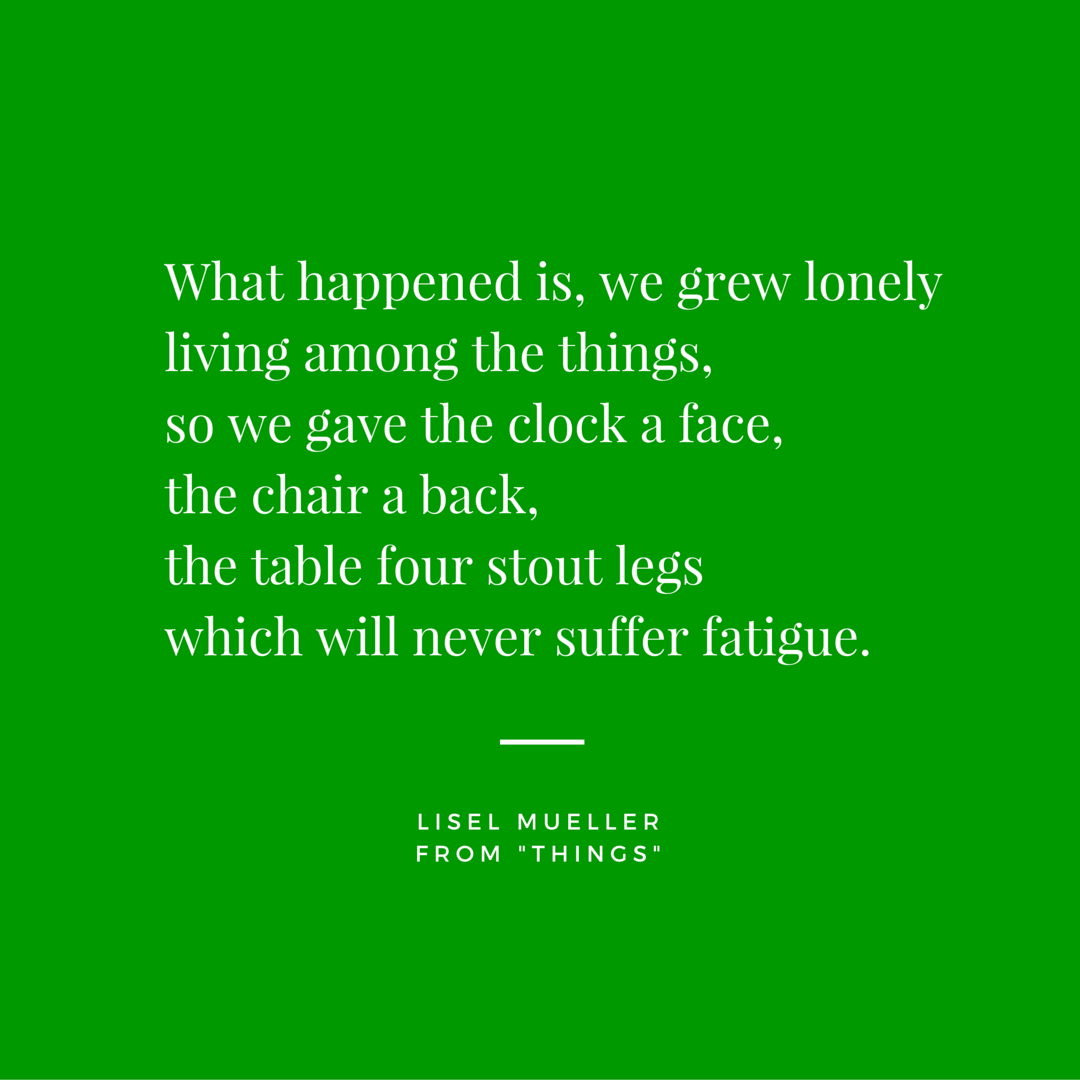
Mueller_ThingsI like naming things; maybe you do, too. I have a velvet chair named Daisy (it was my friend’s chair first; when she was young it was orange, but now it’s faded to a golden yellow), and once we had fish named Dunder, Mifflin, Don Draper, Giles, and Admiral Ackbar.

Lisel Mueller’s poem “Things” points out the ways in which, over time, we’ve named parts of objects after ourselves. It reminds me a bit of Heather McHugh’s poem “Etymological Dirge” in the way it offers us a new way to think about words we use every day.

What’s your favorite poem about an everyday object?

Review: Where My Heart Used to Beat, by Sebastian Faulks

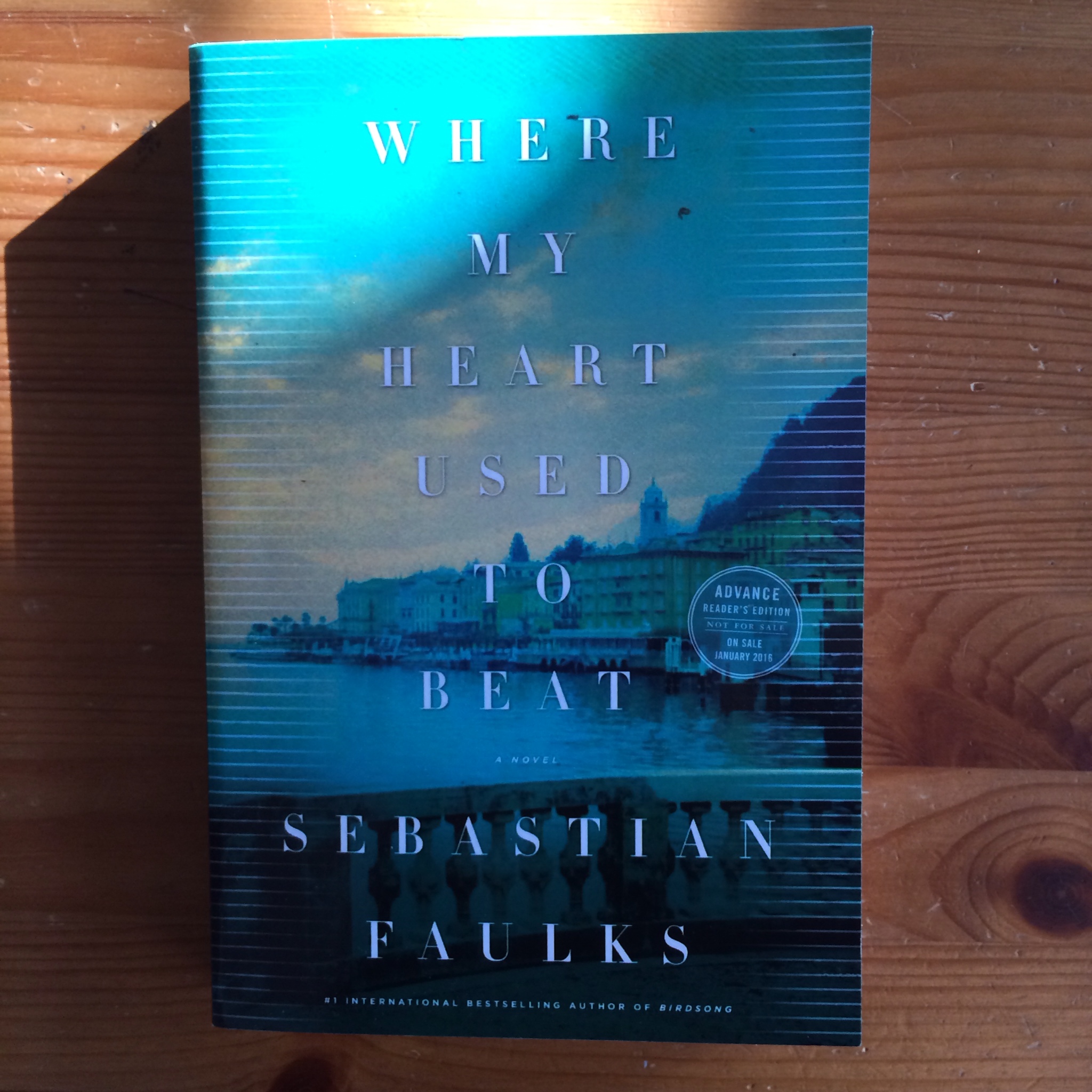
IMG_5830Where My Heart Used to Beat* is the first of Sebastian Faulks’s novels that I’ve read (his best known, Birdsong, is on my mental list of World War I novels to read); I found it both challenging and absorbing.

The novel is a deep dive into the character of Robert Hendricks, its narrator. A psychiatrist practicing in 1980 London, he receives an unexpected letter from older man, Dr. Pereira, who resides on a small island off the coast of France. Dr. Pereira, also a psychiatrist, realized after he came across Robert’s book that the younger man might be the son of a man he served with during World War I; he invites Robert to visit the island, offering both to share reminiscences of his father and an suggestion that Robert might like to be his literary executor.

Intrigued, Robert accepts the invitation, only to find that Pereira has no intention of revealing what he knows all at once; instead, he wants first to hear about Robert’s memories of his own war (World War II) and the different challenges of his life as part of an attempt to understand the depredations and despair of the twentieth century (Robert has, by this point, mostly given into despair). As the younger doctor faces the dark pieces of his life that he’s tried to shut away—sometimes narrating them to Pereira, sometimes to an imagined reader (an effect which is occasionally disconcerting)—we are drawn deeper into the recesses of his mind, with uncertain results.

While I’m glad that I stayed with the novel because its extended exploration of the protagonist was in the end rewarding, what I found challenging initially was the character himself. Much of Robert Hendrick’s background is unremarkable, given his generation; his father died during World War I; he worked hard in school and earned a scholarship to college; he went on to fight in his own war and then returned home to begin a successful career in a difficult specialty. But he has what some would term “intimacy issues”; high on my list of fictional tropes I’d be happy never to see again is the quasi-lonely middle-aged man who pays for sex and spends time remembering and judging the bodies of women he’s slept with. After one short-term affair implodes, Robert relates,

Unpleasant though it was, the sense of rupture and the vista of solitude it opened up didn’t feel traumatic; they felt more like a reversion to the norm. I had been here before: I was an habitué of loneliness, which was in any case the underlying condition of mankind from which the little alliances and dependencies we make are only a diversion.

Despite what was for me an inauspicious beginning to the novel, the quality of Mr. Faulks’s prose kept me reading. He pays special attention to Robert’s war experience; particularly well written and harrowing is the description of the British landing in Italy and subsequent trench battles at Anzio in 1944 (which I came to the book woefully untutored in). This is the setup for the great mystery and formative event of Robert’s life: the loss of his first and only love, an Italian woman he refers to as “L.”

Robert and Pereira share a humane view of mental illness, showing great respect for their patients and questioning what exactly the meaning of “madness” is. While I often found that their discussions lacked nuance, and that Robert’s further reflections, like his references to Eliot and the Aeneid, were too direct, the intricacies of this odd and yet ordinary character remained compelling.

If anything, I think Where My Heart Used to Beat is in part a modern, novelistic twist on Dante’s Inferno; Pereira is the Virgil leading Robert’s Dante into the hell (with some rather mundane circles, some indeed hellish) of his own mind, a mind obsessed with a lost Italian woman.

I’d recommend this book to readers interested in deep characterization, strong war writing, and English life in the interwar period (Mr. Faulks shows his excellent command of detail when writing about Robert’s boyhood); if you like a love story balanced with a heaping portion of non-romantic material, this is a novel for you.

Readers, what’s your favorite book about World War II?

*I received a copy of this book from the publisher for review purposes, which did not affect the content of my review.

Recommended Reading: My Brilliant Friend, by Elena Ferrante, Translated by Ann Goldstein

Yes, it’s just as good as everyone’s been saying—and I’m very glad I waited to read it.

IMG_5767

No doubt you’ve heard of the Neapolitan novels, the quartet of books by Italian writer Elena Ferrante (whose identity is not known; she’s used a pen name since her first novel was published more than twenty years ago) and translated by Ann Goldstein.

I do wish someone would give Ann Goldstein a medal, because the translation is superb, as far as this non-Italian speaker can tell—it flows exactly as it should; one never stops to think of it as a translation.

My Brilliant Friend tells of the childhood and adolescence of Elena (or Lenu), the narrator, and Lila, her enigmatic, incredibly, almost dangerously intelligent friend. Both girls are sensitive, inquisitive, brave, desirous of accomplishment; but Lila has “the characteristic of absolute determination,” while Elena sometimes flounders, unsure of herself, looking to Lila as an anchor. Their subtle competition with each other wends through the novel, as Elena reaches back into her memory to understand her friend and rival. This is best bildungsroman I’ve read since Jane Eyre, though of course completely different in scope and setting. Lila and Elena, both born in 1944, live in a rough neighborhood on the fringes of Naples; parents hitting children and husbands hitting wives are commonplace. In their neighborhood wealth stands out, as do book smarts, though neither is particularly welcome; Elena recalls, “we grew up with the duty to make it difficult for others before they made it difficult for us.”

The structure of the novel reminded me of a sidewinder; it moves forward, but often by moving sideways. Elena sets a scene—a confrontation with rock-throwing boys after school (considerably less tame than a similar scene in Anne of Green Gables, by the way)—only to skip away laterally and return to it later. Ms. Ferrante is so talented, though, that these parries and feints aren’t jarring, but fluid.

I put off reading these books for two reasons, one good and one bad. The bad reason is that I find the covers off-putting, though thematically appropriate. The good reason, or the reasonable reason, perhaps, is that each installment of the series appeared a year apart, the last in September 2015; I suspected, based on the praise I heard, that I would not want to wait before delving into each subsequent novel. That suspicion was correct; within a half hour of finishing My Brilliant Friend, I was twenty pages into The Story of a New Name. I can’t wait to see what happens, how Lila and Elena will illuminate each other’s lives.


Recommended Reading: The Bassoon King, by Rainn Wilson

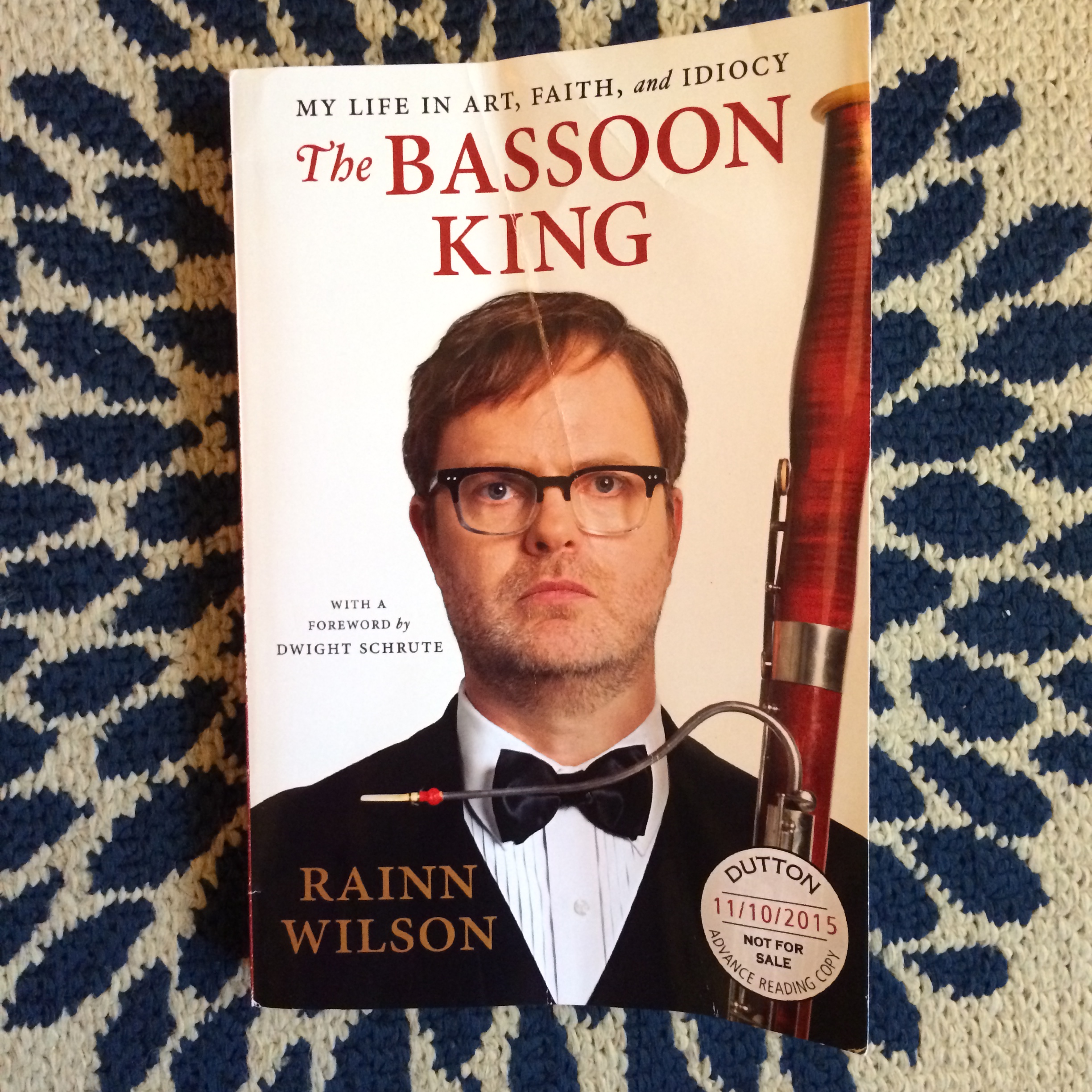
IMG_5784Celebrity memoirs—with exceptions for those written by people named Tina Fey and Amy Poehler—are not my genre of choice. But I couldn’t resist Rainn Wilson’s The Bassoon King*, partly because the title is hilarious, partly because I’ve noted with interest the actor’s advocacy for the persecuted adherents of his religion, the Bahá’í Faith (which he’s written a handy primer about, included at the end of the book), but mostly because The Office is one of my all-time favorite shows, and of course I want to better understand the man behind Dwight Schrute.

The Bassoon King is a charming catalogue of its author’s oddities and interests, which include 80s records, experimental theatre, and comic sidekicks. If you pick it up to be amused, you won’t be disappointed; Mr. Wilson is unfailingly self-deprecating, has a seemingly endless store of anecdotes from his teen years as what can only be described as a major nerd (takes one to know one, folks), and plenty of stories and harmless gossip about his work in movies and TV.

The two facets of the book I found most interesting were Mr. Wilson’s account of his unusual upbringing and the focus on the considerable amount of acting training he undertook, both in school (at Tufts and later NYU) and later in a touring company and various productions (from Shakespeare in the Park to his Broadway flop).

Rainn Wilson’s parents divorced when he was a small child (of his appearance as a baby, he writes, “Picture an ashen manatee with a tiny human face”), and he and his father ended up in Nicaragua, where they in short order found themselves living in a very odd jungle-y sort of town with a new stepmother, Kristin. Understandably, Mr. Wilson’s memories of his period are quite vivid (“like Technicolor acid-dream postcards, spliced and pasted together, flickering in a mental strobe light”); his descriptions of the various Nicaraguan beasties—including a pet sloth named Andrew—are laugh-out-loud funny, and, I can tell you from personal experience, most worth reading aloud to a 4-year-old.

Particularly affecting is his empathy for his parents (his birth-mother, Shay; Robert, his father, a writer and artist who sacrificed a great deal for the family; and Kristin). Shay and Robert both had horrific childhoods but thankfully did not continue the cycle of abuse; all three adults were supportive of the author’s adolescent adventures in geekdom (D&D, of course) and nerdom (chess club, model UN, bassoon, and drama, his niche) and his desire to become an actor. In fact, one of my critiques of the book is that we lose sight of these figures in Mr. Wilson’s later life; I particularly wanted to know how his father felt about the actor’s eventual re-acceptance of his childhood faith after a period of Bohemian rebellion.

If you weren’t a theater nerd in high school, it might be hard to imagine just how much training actors (as opposed to reality stars) go through, and how truly bizarre some of that training looks (grown people jumping around a stage as various animals or body parts? Check.). Mr. Wilson does an excellent job of showing just how much training, failure, serendipity, and experience lay behind his successful portrayal of Dwight. My favorite revelation: he took a clowning workshop with Gates McFadden. As in Beverly Crusher from Star Trek: The Next Generation. And it was awesome.

The Bassoon King is a memoir that covers more spiritual ground than most that I’ve read; Mr. Wilson is an unabashed believer and advocates strongly for his beliefs (but I do wish he would refrain from lumping all atheists together as materialists). He discusses his venture called Soul Pancake (source of Kid President videos, apparently, which I have heard of but not seen), a site devoted to asking people to “chew on life’s big questions,” and his advocacy, along with his wife Holiday Reinhorn, for the Mona Foundation, which supports grassroots education movements in developing countries. Together they founded Lidé, an initiative for “empowerment through the arts for women and girls” in Haiti. Mr. Wilson is clearly passionate about this endeavor and I would have liked to read more about it.

I recommend The Bassoon King to fans of The Office, budding actors, anyone interested in the Bahá’í Faith, and readers looking for something generally light and funny as a palate cleanser between denser reads.

Readers, what’s your favorite celebrity memoir?

*This is a review of a publisher’s advance reading copy of this book. This did not affect the content of my review.
Recommended Reading: Our Souls at Night, by Kent Haruf

IMG_5751I’m so pleased to report that the first book I read this year is Kent Haruf’s excellent (and sadly, last) novel Our Souls at Night. Set in his fictional town of Holt, Colrado (the setting of his earlier novels, which I will now be adding to my reading list), the story begins when a widow, Addie, makes her neighbor Louis (a widower) an unusual proposition: come spend the night with her, so that the both have someone to share the darkness with.

Though wary of talk in their small town, Louis agrees, and sure enough, the small community is set abuzz by what it’s presumed Louis and Addie are up to (but what is, for the bulk of the novel, holding hands and talking). But neither Addie nor Louis is willing to alter their arrangement for appearance’s sake.

The arrival of Addie’s grandson Jamie does bring change. After his parents’ arguments and separation, the boy is lonely and often frightened, but Addie and Louis minister to him with calmness, routine, and simple pleasures: softball games, camping, the observation of tiny mice. When Addie’s son returns for Jamie, however, Louis and Addie find that his disapproval means more than their neighbors’.

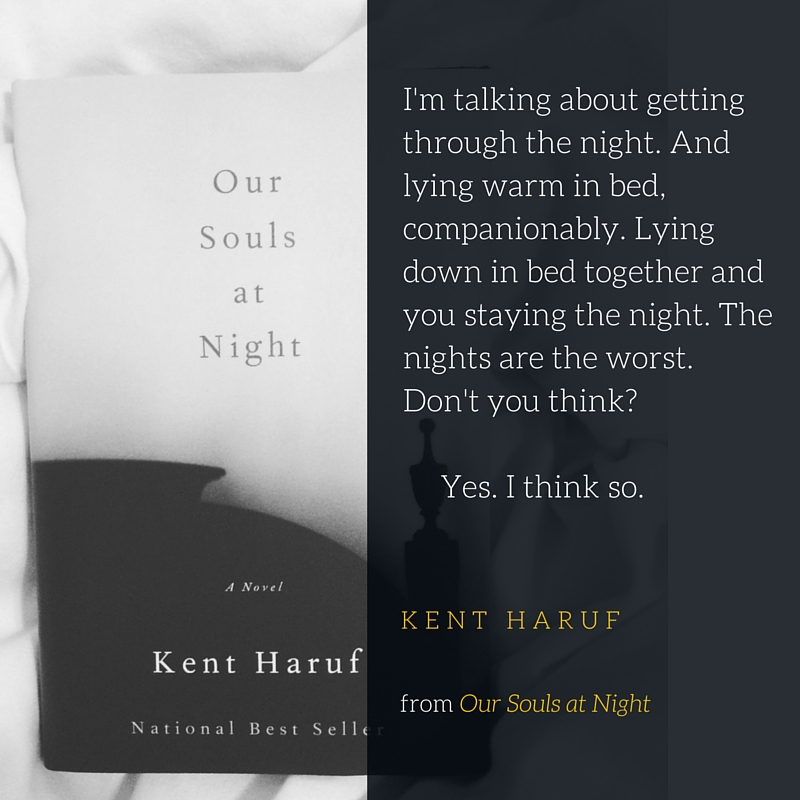
Our Souls at Night quoteThe story and style of Our Souls at Night are deceptively simple. Chapters and sentences tend to be short, and you’ll find few polysyllabic words, but so much is going on beneath the surface and in silences that it’s impossible not to recognize the incredible skill of a master writer. The novel reads quickly, gliding along smoothly until a line or an image snaps into focus, arresting momentum.

Apart from its style and simplicity, I loved this book for its focus on two main characters navigating the transition from late middle age into old age (Addie and Louis are about 70). So refreshing. While Our Souls at Night is set in the present (Jamie has a smartphone to call his mother), Addie and Louis’s world feels timeless, especially since they do things at a slower pace than that typically required by modern consumerism. As you might suspect, there’s quite a bit of nostalgic Americana in the book (fried-chicken picnics, men chewing the fat at a bakery; I love the detail of Louis carrying his pajamas to Addie’s house in a paper sack), but it’s not the treacly sort, since Addie and Louis’s old-fashioned routines are accompanied by the old-fashioned attitudes in Holt.

Our Souls at Night is highly recommended.

Have you read this book or any others by Kent Haruf? What did you think?

Some Questions and Comments Regarding Poetry

Dear Readers,

I was going to try to sum up my year in poetry reading in a rather long post with lots of quotations and best lines, but it’s been rather an eventful week around here (capped off by my husband’s grandmother’s near-miraculous recovery from severe hypothermia), and so I will be brief.

Comments and Questions:

  1. Reading poetry is a delight that I wish were more widespread.
  2. Fellow book bloggers: The vast majority of blog posts are about fiction and nonfiction, not poetry (mine included, if we’re talking about reviews and not the poem-of-the-week posts). Why is that? What would make reading poetry—say, five collections a year if you typically read about 75-125 books a year—appealing to you?
  3. Where do you, dear readers, read about poetry? Or, when you pick up a book of poems, what’s the impetus behind the choice?
  4. If you would like to read more poetry and you’re a regular around here, what can I do, or do better, to help?

And for the new year, I recommend a poem (of course): the suitably titled “New Year’s Poem” by the late Canadian poet Margaret Avison. It’s jeweled with lovely images, and the description of the party puts me in mind of a winter version of Mrs. Dalloway’s (eventually, everything comes back to Mrs. Dalloway).

Happy New Year, Dear Readers!

Recommended Reading: 5 Books for Excellent Last-Minute Gifts

Tis the season for end-of-year best-of lists, and while I’m quite happy to endorse many of the critic’s favorites this year, it may be that you don’t know your last-minute giftees quite well enough to give them A Little Life or Fates and Furies or The Wake (excellent, but . . .).

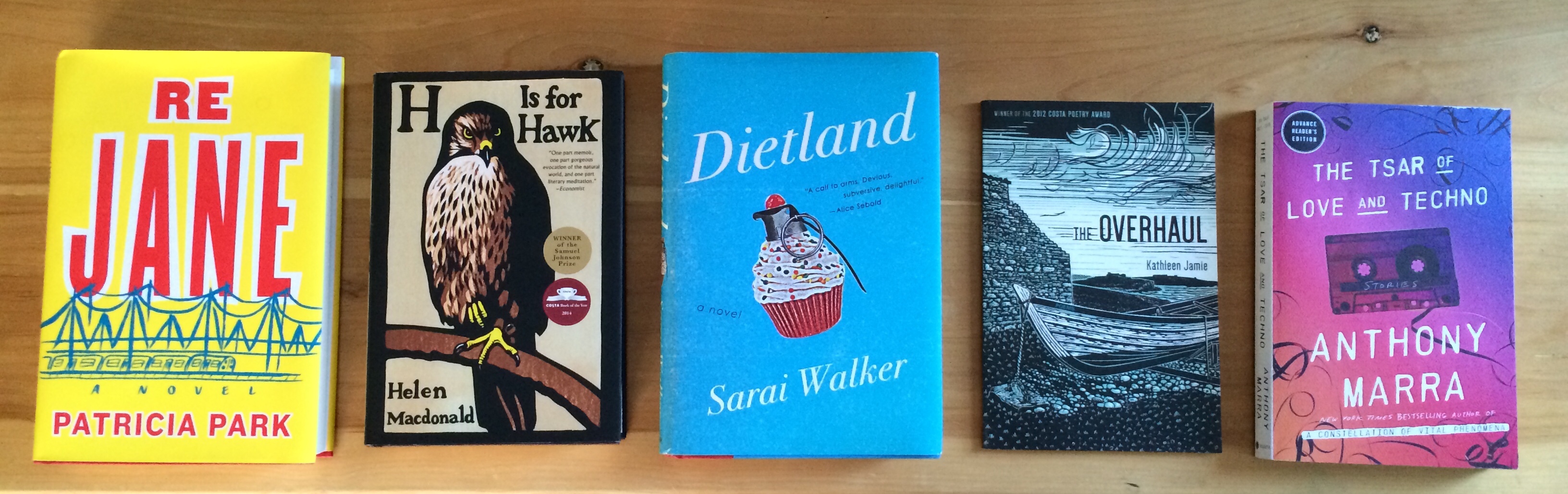
Herewith, in no particular order, five  2015 releases sure to please:

IMG_5680

Patricia Park, Re Jane: A modern take on perennial favorite Jane Eyre, this smart, funny novel is a must-read for any fans of Charlotte Brontë and modern retellings on your list.

Kathleen Jamie, The Overhaul: For the poetry fan who hasn’t read this Scottish poet and who craves a well-turned image and a gorgeous landscape. (Check out “The Whales,” part of which I have tattooed.)

Anthony Marra, The Tsar of Love and Techno: For anyone who loved A Constellation of Vital Phenomena, aficionados of the short story, or anyone who wants to be transported to a different time and place. (Bonus pick for fiction aficionados: Kitchens of the Great Midwest, by J. Ryan Stradal)

Helen Macdonald, H is for Hawk: For anyone who hasn’t read this year’s must-read memoir yet, a gripping blend of writing about grief, literature, and goshawks. (Bonus memoir recommendation: Hold Still, by Sally Mann)

Sarai Walker, Dietland: For feminists, proto-feminists, and anyone who is utterly exhausted by the fat-shaming and the dreaded “have you lost weight?” questions (twins, aren’t they?) that always seem worse around the holidays.

And you, Dear Readers? What are your last-minute book recommendations?

IMG_5678


‘Tis the Season: Donating Books

IMG_5636Perhaps, Dear Readers, you, like me, have a few books in need of new homes this holiday season. Maybe you’re clearing shelf space in anticipation of Santa leaving a few tomes under the tree, or maybe Hanukkah’s end finds you with more books than you expected.

There are many fine places to donate books; here are four where books from our house are headed this year.

Prison Book Program

This listing is for Massachusetts, but there are many similar programs that might be geographically closer to you. Book bloggers take note: ARCs are generally accepted by prison book programs.

Van Buren Family Shelter

This is a new shelter in Columbus, Ohio (home of my beloved alma mater) which I learned about from writer and professor Michelle Herman. She writes that about 250 children come through the shelter every month, and so volunteers are organizing a children’s book drive:

“The goal is to provide access to a library of books to every child, but also to send each child out of the shelter with two books of her or his own, and thus to collect at least 10,000 books now (or now-ish)–to cover the first two years or so. The organizers are contacting publishers, bookstores, libraries, and schools, as well as everyone they know, and I offered to expand the network to everyone I know. You could too, if you had a mind to. They are accepting new or gently used children’s books, which can be sent directly to the shelter.”

If you have new or gently used children’s books to send, the address is:

Van Buren Shelter
595 Van Buren Dr
Columbus OH
43223

Our Local Library

Prison book programs typically don’t accept hardcovers, so we donate ours to our local public library, where they might circulate, but more likely will be sold in the ongoing library book sale to raise funds for library improvements and outreach.

Epilepsy Foundation New England

The New England chapter of the Epilepsy Foundation collects all sorts of household goods donated by the community, including books.

I’m sure there are many other worthy places to donate books, and I’d be happy to hear about your favorites!

Comics Round Up

I know, Dear Readers: that’s a post title you probably didn’t expect from these quarters.

I’m unpredictable.

Given my nearly unassailable geek credentials, comics should be situated squarely in my wheelhouse, but two factors have stood in the way:

  1. I hate cartoons. With limited exceptions, I find them aesthetically displeasing and grating to the ear (my son’s current favorite, Paw Patrol, is the worst offender right now). Pixar movies are fine because they’re made for adults to enjoy, but I have been done with Disney movies for many years (and that’s not even taking into consideration the deplorable antifeminist and heteronormative sentiments of most of them). South Park, The Simpsons, Futurama, anything on Adult Swim: sorry, no. For years, I though of comics as cartoons in paper form.
  2. I like to have all the information. I realize that’s broad, so let me re-frame: I like to start a story from the very beginning with confidence that there will be an ending of some sort; if a story is particularly gripping, I like to know that I can read (or watch) the next installment pretty much immediately. This is why it’s been hard for me to get into Dr. Who; even if we started at the reboot, I’ll feel as though I’m missing quite a bit—and of course there’s no way I’m catching up on decades’ worth of TV any time soon. This is also why I’ve been waiting to start the Kingkiller Chronicles and to move on to Ann Leckie‘s Ancillary Sword (although the third book in that trilogy is out now, so I suppose I could). And that’s why I’ve never been interested in jumping into Marvel or D.C. comics—it would be virtually impossible to catch up after all these years. And since I associated comics with superheroes for a long time, it didn’t really occur to me that other kinds of comics might be out there.

So, for most of my reading life, I happily disregarded the existence of comics.

But then someone somewhere on the vast interwebs posted about a new comic called Saga; the first volume (collecting issues one through six) of this fantasy space opera features an interspecies couple on the cover, with the armed mother breastfeeding.

I am so totally here for that.

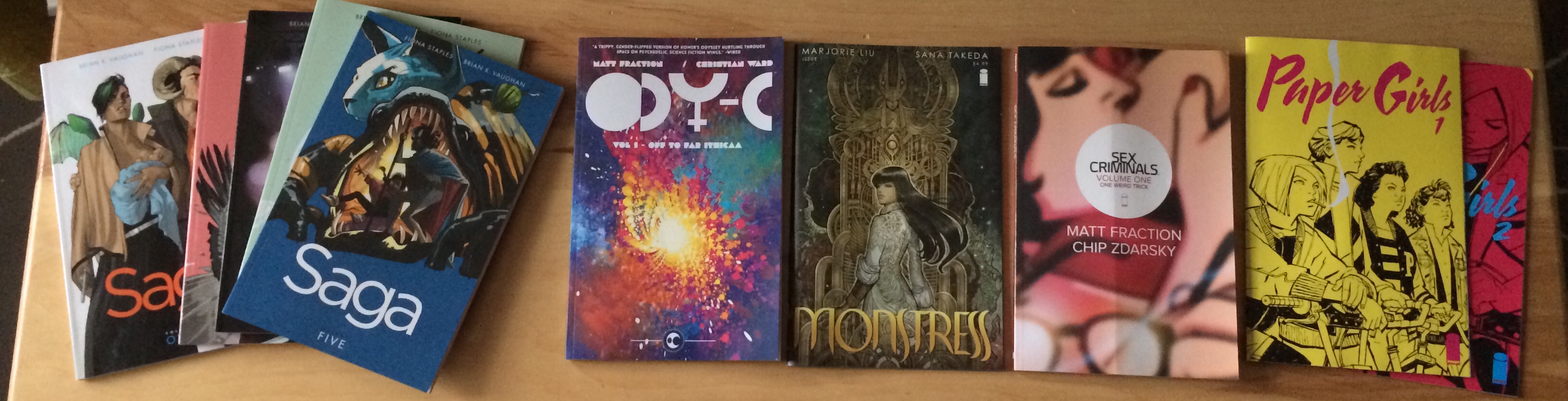
I bought it immediately, and now I’m hooked. It’s so much fun to read—think the best parts of Dune and Star Wars with pulp elements and a love story—and Fiona Staples’s art is just gorgeous, awash in color—it perfectly complements Brian Vaughan’s text. Saga was the gateway drug to a bunch of other comics (all out from Image, now that I think about it) that I read this year. Here’s my rundown of what to read and what to skip.

IMG_5638

Saga (Brian K. Vaughan & Fiona Staples): Definitely read this if you like sci-fi. There are now five volumes out and I’ve loved all of them, but I’d say the first two are perhaps the strongest. Note that Saga is intended for an adult audience: there’s some sex, a great deal of violence, and mature themes throughout.

ODY-C (Matt Fraction & Christian Ward): I wanted to love this, since it’s a gender-twisted version of the Odyssey set in space. While the artwork is really something—it seems like it wants to splatter off the page, and the colors combinations are inventive—I found two major sources of disappointment. One was the style of the writing, which was going for the archaic feel of some Odyssey translations but too often ended up as mangled syntax. The other was the gender-bending—I’m all for it in theory, but the artwork and writing combined portrayed female sexuality as monstrous (part of a long tradition)—and I don’t think the inventiveness of the project was enough to redeem it. Skip this one.

Monstress (Marjorie Liu & Sana Takeda): The art in this comic, described as “a dark fantastic adventure set in an alternate 1900s Asia,” is absolutely gorgeous, all the more remarkable for its limited palette. The story is complex; the main character, Maika, is on a mission of vengeance, infiltrating an enemy stronghold for reasons that weren’t fully clear in the first issue. It seemed that all or nearly all the characters are female, which was refreshing (you’ll notice that Ms. Liu, Ms. Takeda, and Ms. Staples are the only women among the writers and artists I’ve listed here). I’d love to see where this story goes, but given how dense it is—novelistic, almost—I think I’m going to wait for the first collection to come out before I continue reading. Recommended, though.

Sex Criminals Vol. 1: One Weird Trick (Matt Fraction & Chip Zdarsky): This came highly recommended from a few sources. I liked the hilarious title and the ridiculous premise (the main character, a librarian, discovers that time stops whenever she has an orgasm, and when she meets another person who shares her talent, hijinks ensue), but I just wasn’t into the storyline. Maybe it became more interesting in later issues, but I can’t stop time with any weird trick, alas, and life is short, so I’m afraid I won’t be finding out. Lots of other readers were really into this comic, so I’d recommend checking it out at the library.

Paper Girls (Brian K. Vaughan & Cliff Chiang, plus Matt Wilson and Jared Fletcher): I’m only a couple issues into this comic, but I like it quite a bit. Four paper delivery girls in Ohio (hey Buckeyes!) in the 80s are trying to finish their route in the wee hours of Halloween, but run across more trouble than they anticipated. This review in the Onion’s A.V. Club is spot-on. I’m not going to run out to buy every issue, but I’d definitely pick up the volume of collected issues when it comes out. I’d recommend it to any Goonies fans out there.

That’s it for this year, Dear Readers. Have you read any comics this year? What did you like? What should I be looking for next year?

P.S. If you’re a comics fan who’s stumbled across this post, let me take this opportunity to recommend a novel: Michael Chabon’s The Amazing Adventures of Kavalier & Clay. The title doesn’t lie; it’s one of my favorite books.